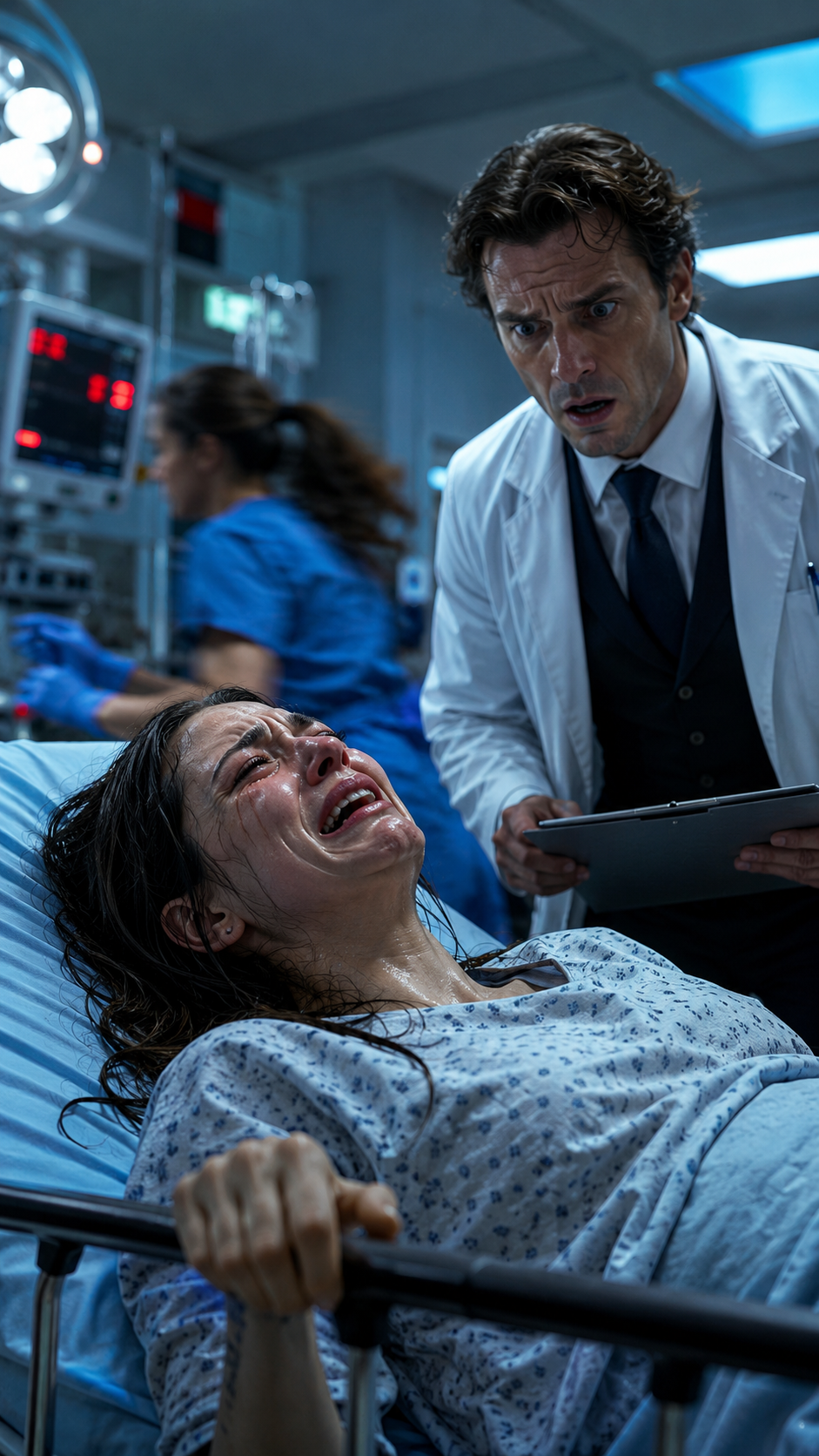
I was dying in the delivery room when the doors burst open and the man who walked in wearing a white coat looked like a ghost from another life.
For half a second, through the sweat burning my eyes and the pain tearing through my body, I thought death had chosen a cruel face.
Nicolás Herrera.
My ex-husband.
The same man who had thrown me out of his mansion nine months earlier with one suitcase, no coat, and a child inside me he refused to believe was his.
The room was too bright. Too cold. Too full of noise.
A monitor screamed beside my head. Somewhere near my knees, a nurse shouted for more suction. Another voice said my blood pressure was dropping again. The ceiling lights blurred into long white streaks, and every breath scraped through me like broken glass.
Then Nicolás stepped closer.
He was still beautiful in the way arrogant men sometimes are. Dark waves of hair pushed back from his forehead. Sharp jaw. Perfect posture. A surgeon’s hands. A king’s expression.
Only now, the king looked afraid.
His eyes moved from my face to my swollen stomach.
Then to the chart in Nurse María’s shaking hand.
Then back to me.
“Cecilia,” he said.
Just my name.
Not darling. Not wife. Not even Mrs. Herrera, the name I had buried months ago.
Just Cecilia.
As if he had a right to say it gently.
I gripped the bed rail until my fingers went numb.
“You?” My voice cracked, thin and ugly. “Anyone but you.”
Something broke across his face.
Good, I thought.
Let it break.
Let something finally hurt him.
Nine months ago, he had not looked hurt. He had looked disgusted.
It had been raining that night. Not a gentle rain. A brutal winter rain that slapped the windows of the Herrera mansion and turned the marble steps into sheets of ice. I remembered the chandelier above us, dripping gold light over his mother’s pearls, over the mahogany table, over the photographs she had thrown in front of him.
Me, standing outside a downtown hotel.
Me, embracing a man whose face was hidden by shadow.
Me, stepping into an elevator with him.
All lies.
All carefully built lies.
“Nicolás,” I had whispered, clutching a folder to my chest. “Please. Those pictures aren’t what they look like.”
His mother, Isadora Herrera, sat at the head of the table like a queen waiting for a servant to confess.
“She has been humiliating you for months,” Isadora said. “I tried to protect you, mijo. I really did.”
There had been tears in her voice.
Fake tears.
Beautiful tears.
The kind rich women learn to use as knives.
I had held out the folder with trembling hands. “Your mother is stealing from St. Raphael. I found transfers from the maternal care fund into private accounts. Shell companies. Fake vendors. Nicolás, she’s been draining millions.”
He didn’t take it.
He stared at me as if I had spat on his family name.
“My mother built that hospital,” he said.
“No,” I said, and my voice shook because that was the first part of the truth I was terrified to say. “She didn’t.”
His eyes narrowed.
The rain hammered harder against the glass.
Isadora stood slowly. “You see? She’s desperate now. First she cheats. Then she invents crimes. Next she will say the child is yours.”
My hand went instinctively to my stomach.
I had not planned to tell him like that.
I had found out that morning.
Two pink lines on a cheap pharmacy test, shaking in my hand while I sat on the bathroom floor in the guest wing, crying so hard I could not breathe. Not because I was unhappy. Because after two losses, after years of hoping, after all the silent grief Nicolás and I never learned how to share, there was life inside me again.
Our life.
Our child.
Nicolás saw my hand move.
His face changed.
For one impossible heartbeat, I thought he understood.
Then his mouth twisted.
“Do not try to trap me with a bastard child to save your meal ticket.”
The words did not hit me all at once.
They entered slowly.
One blade at a time.
“Nicolás,” I said. “Please don’t.”
But pride had already swallowed him whole.
He grabbed the folder from my hands and flung it across the room. Papers exploded over the marble floor. Bank statements. Old contracts. My father’s handwritten notes. Proof that had taken me months to collect.
Proof that should have saved us.
Instead, it scattered at his mother’s feet.
He signed the divorce papers that night.
He ordered security to take my keys.
He told the driver not to take me anywhere.
And then the man who had once kissed my forehead and promised he would never let me feel alone again watched me step into the freezing rain without a coat.
I did not beg after that.
Begging is what you do when you still believe someone can hear you.
I walked until my shoes soaked through. I walked until the mansion disappeared behind the trees. I walked with one hand on my stomach and the other around a plastic bag of documents I had managed to grab from the floor.
Behind me, St. Raphael Medical Center glittered across the city skyline like a cathedral.
His cathedral.
His kingdom.
His lie.
Now, nine months later, I was back inside that kingdom, bleeding into its sheets while my child fought for oxygen beneath my ribs.
“Her blood pressure is eighty-five over fifty,” María said, her voice tight. “Fetal heart tones are decelerating. She came in alone. No emergency contact listed.”
“I didn’t come here for him,” I rasped.
Nicolás looked at María. “Why wasn’t I paged sooner?”
“You were paged twice.”
“I was in a meeting.”
“You were at a donor luncheon,” María snapped before she could stop herself.
The room went silent for one sharp second.
Even dying, I almost smiled.
María had never feared him the way others did. She was young, small, and tired-looking, with dark circles under her eyes and a spine made of steel. Months ago, she had been the only person at St. Raphael who helped me after I disappeared. She found me a clinic outside the city. She brought prenatal vitamins. She checked my blood pressure at midnight in the back room of her aunt’s bakery.
She had also hidden copies of my documents in places Isadora would never think to search.
Nicolás looked from her to me.
Something passed between us.
A question.
A suspicion.
A door opening too late.
He took the chart from María and flipped it open.
The paper trembled.
I watched his eyes move.
Date of admission.
Gestational age.
Estimated conception.
His throat worked once.
Then again.
He turned a page as if the next one might rescue him from math.
It did not.
Nine months.
Exactly.
His face lost color.
The monitor beside me beeped faster.
I turned my head away.
I could not bear to see realization arrive in a man who had made disbelief into a weapon.
“Cecilia,” he said, but now my name sounded broken.
“Nicolás,” I whispered, barely able to pull air into my lungs, “I didn’t want you to find out like this.”
He stared at my stomach.
Then at me.
His voice came out rough, almost boyish.
“Is this baby mine?”
The pain hit before I could answer.
It tore across my abdomen, white and blinding. I arched off the bed, a sound ripping out of me that did not sound human. María grabbed my shoulder. Someone shouted for the crash cart. The main monitor screamed into one continuous tone.
“We’re losing them!” María cried.
Nicolás dropped the chart.
He moved then.
Not like a husband.
Not like a man drowning in guilt.
Like the surgeon everyone said he was.
“Prep for emergency surgery,” he ordered. “Now.”
The room exploded.
Hands moved over me. Straps. Needles. Cold antiseptic. A mask hovering above my face.
I reached blindly.
Not for him.
For María.
She caught my hand.
“The envelope,” I gasped.
Her eyes widened.
“No, Cecilia. Save your strength.”
“The envelope,” I said again. “Give it to him if I don’t wake up.”
Nicolás froze for a fraction of a second.
He had heard me.
Good.
Let him wonder.
Let him fear paper for once.
He came close as they unlocked the bed wheels. His face hovered over mine, too near, too late.
“Cecilia, listen to me. I’m going to save you.”
A laugh tried to escape me and became a cough.
“You said that once before.”
His eyes closed.
Just for a heartbeat.
Then he opened them, and there was horror there, yes, but also something worse.
Hope.
He still thought saving my body could erase what he had done to my soul.
The hallway lights flashed overhead as they rushed me toward the operating room. Wheels rattled. Nurses ran. Someone pressed a bag of fluid above me. The mask smelled like plastic and chemicals.
Nicolás walked beside the bed, one hand on the rail.
I forced my eyes open.
He leaned down.
“What envelope?” he asked.
Of course.
Even now, the question mattered to him.
The truth always had to arrive in paperwork before Nicolás Herrera respected it.
I swallowed against the dryness in my throat.
“The baby is yours,” I whispered.
His step faltered.
“But that isn’t the secret.”
His face went still.
The OR doors opened.
White light poured over us.
“What secret?” he asked.
I looked at him one last time before anesthesia pulled at the edges of the world.
“Your mother didn’t just steal from your hospital,” I breathed. “She stole my father’s hospital.”
Nicolás staggered back as if someone had struck him.
Then the mask came down.
And the world went dark.
When I woke, I thought I was dead because everything was quiet.
No screaming monitors.
No footsteps.
No pain tearing me in half.
Only a soft rhythmic sound somewhere beside me, like rain tapping gently against glass.
For a moment, I was eight years old again, lying on the floor of my father’s office at St. Raphael while he worked late.
Back then, the hospital smelled different. Less like money. More like soap, coffee, and warm bread from the cafeteria downstairs. My father, Dr. Rafael Morales, believed hospitals should never smell expensive. Expensive frightened people. Clean comforted them.
He was not famous like Nicolás.
He did not care to be.
He wore the same brown cardigan over his white coat every winter. He remembered janitors’ birthdays. He brought flowers to rooms where no visitors came. He spoke to frightened mothers as if their fear mattered just as much as their bloodwork.
“This place is not mine,” he told me once, lifting me onto his desk so I could see the city lights. “It belongs to whoever needs it most.”
I had believed him.
Children believe good men are permanent.
Then he died.
An aneurysm, they said.
Sudden.
Unpreventable.
Isadora Herrera stood at his funeral wearing black silk and an expression of perfect grief. Her husband, Alejandro, my father’s business partner, died six months later from a heart attack. After that, everything changed.
The hospital name stayed the same.
St. Raphael.
Saint of healing.
But the soul was stripped out room by room.
The charity ward shrank. The marble expanded. My father’s office became Nicolás’s office, though Nicolás never knew that. His diplomas covered the walls where my father had once taped crayon drawings from former patients’ children.
I married Nicolás before I knew the whole truth.
That is the part I still struggled to forgive myself for.
I loved him.
Not the legend. Not the surgeon everyone bowed to. The man underneath, or the man I thought was underneath.
I met him at a fundraiser when I was twenty-six. He was standing alone on a balcony, hiding from donors and rubbing at the bridge of his nose like someone with a headache he would rather die than admit. I was there to give a speech for the Morales Family Outreach Grant, the last small piece of my father’s legacy Isadora had not yet renamed.
“You hate these things too?” I asked.
He glanced at me, surprised.
“I host these things.”
“That wasn’t my question.”
For the first time that night, he smiled like a real person.
Not charming.
Not polished.
Real.
We talked for twenty minutes. Then an hour. Then all night. He told me surgery made sense because the body told the truth eventually. I told him people lied most when they were afraid of losing what they did not deserve.
He looked at me strangely when I said that.
I should have remembered.
Love makes warnings sound like poetry.
For two years, we were almost happy.
Almost.
Isadora was the shadow in every room.
She corrected my Spanish when she wanted to humiliate me, though mine was softer only because my mother was from Galicia and my father from Puerto Rico. She called me “sweet girl” when donors were watching and “that accountant’s daughter” when they were not. She sent staff to rearrange my kitchen. She changed seating charts so I would be far from Nicolás at hospital events.
Nicolás noticed some of it.
Never enough.
“She’s protective,” he would say.
“She hates me.”
“She doesn’t hate you.”
“She looks at me like I stole something.”
He would laugh and kiss my hand.
“You stole me.”
He meant it sweetly.
I did not know how close he was to the truth.
After our first miscarriage, Isadora sent white lilies to my hospital room.
White lilies.
Funeral flowers.
After the second, she stood at the foot of my bed and said, “Some women are simply not built for legacy.”
Nicolás told me she was grieving.
I told him grief did not wear perfume and pearls.
That was the first time he slept in his office.
The records came later.
I found the first discrepancy by accident while reviewing old documents for a charity audit. A vendor invoice from a neonatal equipment supplier did not match the payment amount. Then another. Then a transfer from the maternal emergency fund into a shell company registered in the Cayman Islands.
At first, I thought it was administrative fraud.
Then I found my father’s signature on a document dated three weeks after his death.
The room tilted.
For days, I did not sleep.
I searched old archives. I called retired board members. I found a nurse who remembered my father signing a trust agreement before he died. A trust meant to transfer controlling ownership of St. Raphael not to Alejandro Herrera, not to Isadora, but to me when I turned thirty.
I had turned thirty six months before Nicolás threw me out.
The trust had vanished.
My inheritance had vanished.
My father’s hospital had become the Herrera empire through forged signatures, buried contracts, and grief so fresh no one had questioned the woman who came forward to “save” the institution.
Isadora had not stolen money from Nicolás.
She had stolen Nicolás’s whole throne from my dead father and dressed the theft in marble.
I planned to tell Nicolás everything the night he divorced me.
I thought love would make him listen.
Instead, love made me underestimate what pride can do.
I woke again to a hiss of machines.
My mouth tasted like metal. My body felt heavy and far away, as if I had been stitched back into it badly.
A figure sat beside my bed.
Not Nicolás.
María.
Her hair had escaped its bun. Her scrubs were wrinkled. There was dried mascara beneath one eye.
She was holding my hand.
The moment she saw me looking at her, she started crying.
“Oh, thank God,” she whispered.
My lips barely moved.
“The baby?”
María pressed her fingers tighter around mine.
“She’s alive.”
The room blurred.
Alive.
The word entered me slowly, then everywhere.
My daughter was alive.
A sound broke from my chest. It was not a sob, not quite. More like the first breath after being underwater too long.
“She’s tiny,” María said. “Angry. Loud. Perfect.”
“Can I see her?”
“Soon. You lost a lot of blood. They have you in recovery.”
I closed my eyes.
My daughter.
My alive daughter.
For one shining second, joy rose so fiercely it hurt worse than the surgery.
Then I remembered.
“Nicolás?”
María’s expression shifted.
“He saved you.”
I turned my face toward the window.
The sky outside was gray with dawn.
Of course he did.
Of course the story would give him that.
A scalpel, a crisis, a chance to become the hero in the one language he understood.
But saving me under hospital lights did not erase the rain.
“Where is he?” I asked.
“With her.”
My eyes opened.
María lifted a hand quickly. “Not alone. The NICU team is there. He hasn’t left the glass.”
A strange ache moved through me.
I hated him.
I had loved him.
Both truths lay inside me like twins.
Before I could speak, the door opened.
Nicolás stepped in.
He looked older.
Not by years.
By collapse.
His hair was mussed. His coat was gone. Navy scrubs clung to his shoulders. There was a smear of something pale pink and white near his cuff, diluted blood and surgical fluid, the softened evidence of the war my body had fought.
He stopped at the foot of my bed.
For once, he did not command the room.
He asked permission with his silence.
María stood.
“I’ll give you two minutes,” she said, and there was warning in her voice. “Only two.”
When she left, Nicolás looked at me like he did not know what to do with his hands.
That almost broke me.
Those hands had cut me open and held my life together.
Those hands had also thrown my proof across a floor.
“Is she really alive?” I asked.
His face crumpled.
“Yes.”
The word was barely sound.
“She cried before I even cleared her airway,” he said. “The whole room heard her.”
Tears slid into my hair.
“She’s stubborn,” I whispered.
“She has your mouth.”
I almost laughed.
It hurt too much.
He came one step closer.
Then stopped again.
“I don’t know how to say what I need to say.”
“Try the truth. You avoided it long enough.”
He flinched.
Good.
Then he nodded.
“I was wrong.”
Small words.
Not enough.
But real.
“I was cruel,” he said. “Proud. Blind. I believed what made me feel betrayed because it was easier than believing my mother could be a monster.”
“She counted on that.”
“I know.”
“No,” I said, turning my head toward him. “You don’t. Not yet.”
His eyes darkened.
“María gave me the envelope.”
My heartbeat changed on the monitor.
“And?”
His jaw tightened.
“And I read enough to understand that my mother has been forging documents for years. The transfers. The shell companies. The trust.”
The trust.
My father’s ghost entered the room between us.
Nicolás lowered his eyes.
“St. Raphael should have been yours.”
I closed my eyes.
There it was.
Not victory.
Not relief.
Just a wound finally named.
“My father built that place for women like me,” I said. “Women who come in terrified and bleeding and alone. Not for donors. Not for marble floors. Not for your mother’s name on gala banners.”
His voice broke.
“I didn’t know.”
“You didn’t ask.”
Silence.
That was the blade.
Not that he had not known.
That he had not asked.
He sat slowly in the chair beside my bed, though he had once owned chairs no one could use unless invited.
“How did you find it?” he asked.
“My father kept duplicates. Old habits. He didn’t trust rich people who smiled too much.”
Something like a laugh moved through Nicolás and died.
“I wish I had known him.”
“You did,” I said.
He looked confused.
“Every time you walked into your office, you stood inside his.”
His face changed.
The marble. The diplomas. The leather chairs. The view.
My father’s room.
Nicolás covered his mouth with one hand.
For the first time, I saw him understand that theft could be architectural.
That a lie could have walls.
The door opened before he could speak.
María returned, but she was not alone.
Behind her stood Isadora Herrera.
Even after everything, she looked immaculate.
Silver hair twisted at the nape of her neck. Black coat belted perfectly. Pearls at her ears. Her lipstick the color of old wine.
She looked at me in the hospital bed and did not blink.
Then she looked at Nicolás.
“My son,” she said softly. “You need to come with me.”
Nicolás stood.
The temperature in the room seemed to drop.
“You are not allowed in here.”
Isadora smiled sadly, as if he were a child being unreasonable.
“This woman has poisoned you while you are vulnerable. You have been awake all night. You performed an emergency operation under emotional distress. Anything you think you know—”
“I read the trust.”
Her smile froze.
Only for a second.
But I saw it.
So did Nicolás.
“What trust?” she asked.
He took a step toward her.
“The one Rafael Morales signed before he died. The one giving controlling ownership of St. Raphael to Cecilia when she turned thirty.”
Isadora’s eyes moved to me.
For the first time since I had known her, I saw hatred without perfume.
Pure.
Bare.
Ugly.
“She has always been dramatic,” Isadora said. “Her father was the same. Sentimental men leave messy papers.”
María made a small sound.
Nicolás’s voice lowered.
“You forged his signature after he died.”
“Careful,” Isadora said.
One word.
A mother’s warning.
A queen’s threat.
Nicolás heard both.
For a moment, I watched the child inside the famous surgeon hesitate.
Then he said, “Security is already on its way.”
Isadora went still.
“You called security on your mother?”
“No,” he said. “I called the police.”
Her face did not collapse.
That would have been too honest.
Instead, she laughed once.
Softly.
“Do you think they will believe her? A desperate ex-wife? A woman who hid a pregnancy from you?”
“I hid because you made me unsafe,” I said.
She turned on me.
“There she is. The martyr.”
Nicolás moved between us.
That movement was small.
But it mattered.
Too late, maybe.
Still, it mattered.
Isadora looked at his back, and something in her expression twisted.
“I made you,” she whispered.
Nicolás did not turn.
“No. You decorated me.”
Her lips parted.
The police arrived three minutes later.
Not dramatic.
No handcuffs at first.
Just two detectives in dark coats, one hospital administrator white-faced behind them, and a silence that spread through the hallway as staff gathered and pretended not to watch.
Isadora did not scream.
Women like her did not scream in public.
She lifted her chin and walked out as if she were going to a board meeting.
But at the door, she stopped beside my bed.
Her eyes landed on my stomach, now softer under blankets.
“You think a baby fixes bloodlines?” she murmured.
Nicolás turned sharply. “Enough.”
Isadora smiled at him.
Then she said the sentence that would haunt him more than any confession.
“I only showed you what you were eager to believe.”
Then she was gone.
For a long time, nobody moved.
The monitor beeped.
The rain began again outside, soft against the window.
Nicolás looked like he might be sick.
I almost pitied him.
Almost.
Because she was right.
That was the cruelty of it.
Isadora had built the stage, forged the pictures, buried the records, poisoned the room.
But Nicolás had chosen his line.
He had looked at me, pregnant and shaking, and called my child a bastard.
No police report could undo that.
No surgery could remove it.
Two days later, they wheeled me to the NICU.
My stitches pulled with every breath. My legs trembled beneath the blanket. María pushed the chair slowly, scolding anyone who walked too close.
Nicolás followed several feet behind us.
He had asked if he could come.
Asked.
The word still felt strange on him.
I said yes because my daughter was not a weapon, and I refused to turn motherhood into another battlefield.
The NICU smelled like warm plastic, sanitizer, and milk. Machines hummed softly. Tiny lives slept beneath clear domes. Nurses moved with reverence.
María stopped in front of the third incubator.
“There she is,” she whispered.
At first, I saw only blankets.
Then a fist.
So small it seemed impossible that anything so tiny could have fought so hard to stay.
My daughter’s face was wrinkled and furious. A strip of dark hair lay flat against her head. Her mouth opened in a silent complaint before she settled again, as if the world had already disappointed her but she was willing to continue negotiations.
I laughed.
Then I cried so hard María had to lock the wheelchair.
Nicolás stood beside me, one hand hovering near the glass but not touching.
“She’s beautiful,” he said.
I looked at him.
His eyes were wet.
For once, he did not hide it.
“She needs a name,” he said.
“She has one.”
He nodded quickly. “Of course.”
I turned back to the incubator.
“Rafaela.”
The name landed in the space between us.
My father’s name, remade for a girl who had survived a stolen kingdom and a storm.
Nicolás bowed his head.
“Rafaela Morales,” I said.
He swallowed.
Not Herrera.
He heard it.
He accepted it.
That was the first decent thing he did without being forced.
The investigation moved faster than anyone expected because rich people betray each other beautifully when prison enters the room.
Board members claimed they had always suspected Isadora. Accountants found emails. Lawyers discovered missing pages. A retired notary remembered a woman with silver hair requesting after-hours access to sealed archives twenty-two years earlier.
Within a week, the story broke across the city.
Not the version Isadora would have written.
The real one.
St. Raphael Medical Center had been built by Dr. Rafael Morales as a nonprofit maternal care hospital. After his sudden death, documents had been forged, ownership rerouted, funds diverted, charity accounts emptied, and the widow of his business partner had slowly turned a mission into an empire.
And the woman she had thrown into the rain was the rightful heir.
People sent flowers.
Reporters camped outside.
Donors released statements full of shock they did not deserve to feel.
Nicolás resigned from the executive board before they could ask him to.
He continued operating.
That surprised me.
I thought he would retreat into shame, or fury, or expensive silence. Instead, he worked double shifts in the charity wing as federal auditors peeled his family name off the hospital like old paint.
One afternoon, a week after Rafaela was born, he came to my room carrying no flowers, no gifts, no grand apology wrapped in silk.
Just a cardboard box.
He placed it on the table.
“What is that?”
“Everything from the office.”
I stared at him.
“My father’s office?”
He nodded.
“I had the diplomas removed. The furniture too. I asked facilities to strip it back as much as possible. They found old nail holes on one wall. Tape marks. Children’s drawings, maybe.”
My throat tightened.
“I thought you should decide what happens to it.”
I looked at the box.
Then at him.
There were a hundred cruel things I could have said.
I had earned every one.
Instead, I asked, “Why are you doing this?”
He looked down at his hands.
“Because I can’t undo the rain.”
Simple.
Raw.
True.
I looked away first.
Forgiveness did not arrive like sunrise.
It came, if it came at all, like a bruise changing color.
Slow.
Tender.
Not proof that nothing happened, but proof that the body was still trying to heal.
Three weeks later, I walked into my father’s office for the first time in twenty-two years.
I carried Rafaela against my chest.
She was still too small, still wrapped in a blanket too big for her, still making soft little sounds as if arguing with angels in her sleep.
Nicolás walked behind us.
Not beside.
Behind.
The room smelled of dust and fresh paint. The marble had been removed, revealing old wood floors beneath. On the far wall, pale rectangles showed where Nicolás’s diplomas had hung. Near the window, the city opened wide and silver beneath the afternoon rain.
I remembered my father lifting me onto the desk.
I remembered him saying the hospital belonged to whoever needed it most.
I stepped to the window.
Below, ambulances moved through wet streets. People entered the doors scared, sick, hopeful, broken.
All of them trusting someone.
That was the terrible holiness of hospitals.
People handed strangers their bodies and believed they would be treated gently.
My daughter stirred against me.
Nicolás stopped a few feet away.
“Cecilia,” he said.
I did not turn.
“I know I have no right to ask for anything.”
“No,” I said softly. “You don’t.”
He accepted that.
A year ago, he would have argued.
“I want to be her father,” he said.
I closed my eyes.
There it was.
Not demanded.
Not assumed.
Asked.
“I know,” I said.
“And I know being her father doesn’t make me your husband.”
The rain traced the glass.
I looked down at Rafaela’s face.
She yawned, dramatic and offended by existence.
A tiny, perfect Morales expression.
“You can know her,” I said. “You can show up. You can earn every minute. You can be honest even when it costs you. Especially then.”
His breath caught.
“But you and me?” I turned to him. “That died on the steps of your mother’s house.”
He looked as if he had expected the wound and still felt the knife.
“I understand.”
“I hope you do someday.”
He nodded.
Then he looked at Rafaela.
“May I?”
I hesitated.
Then I crossed the room and placed our daughter carefully in his arms.
Nicolás Herrera, the famous surgeon, the golden heir, the man who had once believed love was weaker than reputation, held his child like she was made of light and judgment.
Rafaela opened her eyes.
Dark eyes.
His eyes.
My father’s stubborn frown.
For one brief, impossible moment, the room filled with something almost like peace.
Happy is a dangerous word.
People think it means the story is over.
But sometimes happy is only the softest second before truth returns with its hand raised.
The knock came just after sunset.
María stepped into the office holding a sealed evidence bag.
Her face was pale.
“Nicolás,” she said, “the detectives found one more file in Isadora’s private safe.”
He carefully handed Rafaela back to me.
“What file?”
María looked at me first.
That was how I knew.
Some truths enter the room before they are spoken.
She placed the bag on the desk.
Inside was a thin folder, old and water-stained.
Across the top was my father’s name.
Dr. Rafael Morales.
Below it, a hospital incident report dated the night he died.
My fingers went cold.
Nicolás opened the folder with shaking hands.
He read the first page.
Then the second.
His face changed in a way I had never seen before.
Not guilt.
Not grief.
Terror.
“What?” I whispered.
He did not answer.
So I took the paper from him.
The words blurred at first.
Then sharpened.
My father had not died suddenly at home, as I had been told.
He had collapsed inside St. Raphael, in the old east stairwell, after confronting Isadora about the forged trust documents. He was found alive. Breathing. Asking for help.
The emergency call had been delayed seventeen minutes.
Seventeen minutes.
At the bottom of the report was a handwritten note from the responding physician.
Patient repeatedly asked for daughter. Patient stated: “Tell Cecilia the hospital is hers.”
My knees weakened.
Nicolás reached for me, then stopped himself.
The room tilted backward through time.
The funeral.
Isadora’s black silk.
Her perfect grief.
Her hand on my shoulder while she whispered, “Your father loved this hospital too much. It consumed him.”
She had not stolen only his hospital.
She had stolen his last words.
Rafaela whimpered against my chest, and the tiny sound pulled me back from the edge.
I looked at Nicolás.
His eyes were destroyed.
He had lost a mother.
I had lost my father all over again.
Outside, rain slid down the window of the office that had always been mine.
And in my arms, my daughter opened her eyes beneath the city lights, inheriting a kingdom built by love, stolen by greed, and paid for with seventeen minutes of silence.