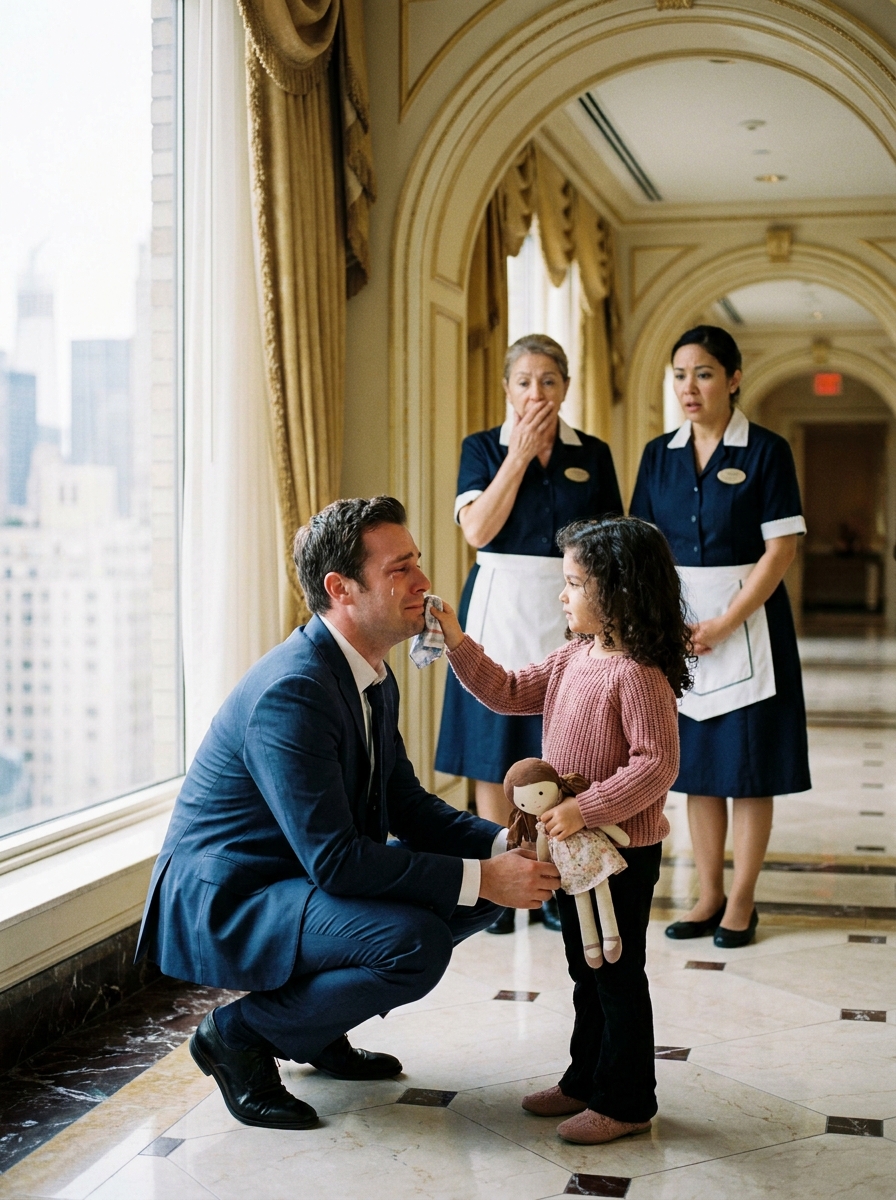
No One Dared to Approach the Millionaire… Until the Maid’s Daughter Wiped Away His Tears

No One Could Reach The Coldest Millionaire In New York—Until The Maid’s Little Girl Wiped Away His Tears
Nathaniel Cross had spent forty-two years teaching the world that he needed no one.
Then a five-year-old girl found him crying alone in the hallway of his penthouse.
She did not know he was dying, did not know he was worth billions, and did not know her tiny hand was about to save the loneliest man in New York.
No one in the building dared to speak to Nathaniel Cross unless they had to.
Not the doormen in the marble lobby.
Not the private elevator attendants.
Not the security team who wore discreet earpieces and expensive shoes.
Not even the executives who came up to his penthouse with billion-dollar proposals and left looking as if they had survived a trial instead of a meeting.
Nathaniel Cross was forty-two years old, CEO of Cross Meridian Investments, and one of the most powerful men in New York finance. His name carried the kind of weight that opened boardrooms and silenced enemies. His signature could shift markets. His refusal could destroy careers. He was not loud. He did not need to be. Men who had real power rarely wasted energy proving it.
He disliked small talk.
Distrusted affection.
Avoided familiarity.
To him, emotions were inefficient things, expensive distractions people used to justify bad decisions. He believed in strategy, discipline, numbers, and control. He believed in clean exits and precise language. He believed that people always wanted something, and the smartest person in any room was the one who understood the price before the negotiation began.
His penthouse reflected him perfectly.
It sat at the very top of a luxury building overlooking Central Park South, high enough that the city below looked less like a place where people lived and more like an elaborate system of moving lights. The apartment had been designed by a famous architect whose name appeared in magazines Nathaniel never read. Everything inside was gray, black, white, and glass. Marble floors reflected light like still water. The furniture was flawless, expensive, and uncomfortable in the way rich people sometimes mistake for elegance. Abstract paintings hung on the walls, each one worth enough to buy several decent homes, yet none of them suggested a human hand had ever trembled while creating them.
There were no family photos.
No framed memories.
No forgotten sweaters on chairs.
No magnets on the refrigerator.
No books left open beside the sofa.
Nothing personal.
Nothing soft.
The penthouse did not feel like a home.
It felt like a successful man’s denial arranged in rooms.
Nathaniel rarely noticed.
To him, the apartment was a place to sleep, shower, change suits, and prepare for the next day’s war. It existed because men like him were expected to own places like that. It impressed investors. It intimidated guests. It served a function.
Warmth did not.

The only constant human presence in the penthouse was Mrs. Whitmore, his housekeeper of nearly ten years. She was in her early sixties, careful, dignified, and observant in the silent way of people who spend their lives in other people’s homes without ever being fully invited into them. She knew Nathaniel’s habits better than his board did. She knew he woke at 5:15 without an alarm. She knew he took black coffee with no sugar, lightly toasted bread, cold juice, and silence for breakfast. She knew he never answered personal questions. She knew he accepted efficiency as a form of respect.
“Everything is ready, sir,” she said every morning at exactly seven.
Nathaniel answered with a slight nod.
Mrs. Whitmore no longer expected more.
His silence was not cruelty, she had decided long ago.
It was architecture.
A wall built so high no one could see what had once stood behind it.
Then Elena Morales arrived.
She stood outside the heavy metal door of the penthouse on a Monday morning, hands clasped so tightly her knuckles had gone pale. She had cleaned wealthy homes before. She knew polished marble, expensive rugs, silver fixtures, closets larger than apartments. She had worked for women who counted fingerprints on mirrors and men who spoke to her without learning her name.
But the Cross penthouse made her nervous in a different way.
Not because of the luxury.
Because of the man.
Everyone in her agency had heard of Nathaniel Cross.
Cold.
Demanding.
Impossible.
A man who did not fire people loudly because loudness required emotion. He simply removed them from the schedule, and they understood.
Elena had almost refused the assignment.
Then she looked at the rent notice folded in her purse, remembered the overdue electricity bill, remembered her daughter’s worn shoes, and accepted.
When Mrs. Whitmore opened the door, Elena lowered her head instinctively.
The older woman inspected her for one brief, professional moment and stepped aside.
“Come in.”
The penthouse swallowed sound.
Elena followed Mrs. Whitmore through the living room, past the massive windows, past the glass wall of Nathaniel’s office where he sat behind a desk already working. He did not look up.
Mrs. Whitmore explained the schedule.
Main living area first.
Dining room.
Kitchen.
Sitting room.
Guest bathroom.
Service corridor.
Nothing upstairs.
No unnecessary movement.
No music.
No phone calls.
No conversation near the office.
“If Mr. Cross leaves his study,” Mrs. Whitmore said, slowing near the staircase, “you stop. No greeting. No explanation. Standing still is enough.”
Elena nodded.
She understood houses like this.
The safest form of existence was knowing when to be quiet.
Still, one problem remained.
She swallowed.
“Ma’am, may I ask for one thing?”
Mrs. Whitmore turned.
Her expression was firm but not unkind.
“My daughter is five,” Elena said quickly. “Her name is Lily. I have no one to watch her today. I tried my neighbor, but she has work. I know this is not normal, and I promise she is very quiet. She will sit in a corner. She won’t touch anything. She won’t disturb anyone.”
Mrs. Whitmore’s face changed only slightly.
In the Cross penthouse, rules were not suggestions. Children did not belong there. Their laughter would sound like a dropped glass. Their questions would bounce against walls built for silence.
“I’ll ask,” Mrs. Whitmore said.
Elena waited outside Nathaniel’s office with her heart beating in her throat.
Through the glass, she saw Mrs. Whitmore speak. Nathaniel’s eyes stayed on his screen. His face did not move. After several seconds, he gave one small nod.
Mrs. Whitmore returned.
“Mr. Cross agrees,” she said. “One condition. The child must remain absolutely quiet. No running, no talking, no interruptions.”
Elena’s eyes burned with relief.
“Yes, ma’am. I promise.”
That was how Lily Morales entered Nathaniel Cross’s perfect, silent penthouse.
She came in holding her mother’s hand and an old cloth doll with yarn hair worn thin and one loose button eye. She was small, even for five. Wide dark eyes. Soft brown curls tied back with a faded yellow ribbon. Her pink sweater had been washed so many times the color had turned gentle.
She looked around the penthouse with cautious wonder.
She did not run.
Did not point.
Did not ask why the windows were so big or why the sofa looked like no one was allowed to sit on it.
Elena bent down and whispered, “Remember what I told you.”
Lily nodded solemnly.
“I’ll be quiet.”
“Very quiet.”
“Mouse quiet,” Lily promised.
Mrs. Whitmore led her to a corner near the tall bookshelf, where the light from the window fell softly across the rug.
Lily sat there with her doll in her lap.
For the first hour, she barely moved.
For the second, she whispered to the doll in a voice so soft it seemed to dissolve before it reached the air.
She told the doll about the long bus ride, about how tired Mama had been, about how the apartment upstairs had a fish wall, about how rich people must be very careful because everything in their houses looked breakable.
Nathaniel heard none of it at first.
Or rather, he told himself he heard none of it.
For two weeks, Elena worked with almost flawless precision. She arrived on time, moved quietly, cleaned thoroughly, and returned every object exactly to its place. She did not over-polish. She did not rearrange. She did not fill the rooms with perfume or chatter. She understood the apartment’s language and spoke it fluently.
Mrs. Whitmore noticed.
“You understand this house,” she said one morning.
That was all.
For Elena, it felt like a medal.
Lily remained in her corner, sometimes drawing on paper Elena brought in her bag, sometimes whispering to her doll, sometimes watching the massive aquarium that covered one wall of the living room. It was an absurdly expensive aquarium, filled with colorful tropical fish gliding through artificial coral under blue-white lights. Nathaniel had purchased it years earlier because an interior designer told him movement would soften the room.
He had not truly looked at it in years.
To him, it was maintenance, cost, and visual balance.
To Lily, it was magic.
One ordinary morning, Nathaniel stepped out of his glass office for water.
That alone was unusual. Usually, everything he needed appeared before he asked for it. But that day his report would not hold his attention. He had been reading the same line for several minutes without absorbing a word.
He crossed the living room and stopped.
Lily stood in front of the aquarium on tiptoe, both hands resting against the thick glass. A golden fish swam close to her face.
“So pretty,” she whispered.
The whisper was barely sound.
Still, it broke a rule.
Nathaniel should have spoken sharply.
He did not.
Lily smiled at the fish.
“Hello,” she said. “Do you like living here?”
Nathaniel froze.
Do you like living here?
No one had ever asked that of the fish.
No one had ever asked that of him.
He looked at the aquarium through the child’s eyes and, for one strange second, saw more than cost. He saw color. Movement. Tiny lives passing through blue light, indifferent to markets, titles, illness, power.
A memory surfaced before he could stop it.
Brooklyn.
A narrow street.
His father in a factory uniform, exhausted after a double shift, standing beside a small fish shop because little Nathaniel had pressed his nose to the window and refused to leave.
“One day,” his father had said, voice tired but warm, “you’ll work hard enough to buy anything you want.”
His father died of a heart attack while Nathaniel was in college.
Nathaniel bought the aquarium twenty years later.
He never told anyone why.
Now a child was talking to the fish as if beauty required conversation.
The wall inside him cracked.
Only a hairline fracture.
But walls do not always fall loudly.
Sometimes they begin with a whisper.
That afternoon, Nathaniel’s phone rang.
Dr. Andrew Cole.
His cardiologist.
Nathaniel frowned. The call was not scheduled.
“I’m busy,” Nathaniel said. “If this is about routine results, email me.”
There was a pause.
“Nathaniel,” Dr. Cole said carefully, “we need to talk now.”
Nathaniel’s fingers stilled over his keyboard.
“Be direct.”
Another pause.
“Your heart is failing.”
The office went silent.
New York continued moving beyond the glass. Cars. Pedestrians. Trees shifting in Central Park. A world unaware that a sentence had just split Nathaniel Cross’s life in half.
“The tests show advanced dilated heart failure,” the doctor continued. “Your heart function is dangerously low.”
Nathaniel looked at his reflection in the glass wall.
Flawless suit.
Controlled expression.
Dead eyes.
“I want solutions,” he said. “Medication. Surgery. Specialists. I don’t care about cost.”
“We can manage symptoms for a while,” Dr. Cole said. “But long-term, the only viable option is a heart transplant.”
The word entered the room like a stranger.
Transplant.
“And if that doesn’t happen?”
The doctor’s voice softened.
“Months, Nathaniel. Not years.”
No thunder.
No dramatic music.
No sudden collapse.
Just silence.
Nathaniel ended the call.
For the first time in his adult life, he looked at his hands and saw them tremble.
Not visibly enough for a boardroom.
Enough for him.
He stood.
The office felt too small. The penthouse felt too large. The city below looked suddenly obscene in its indifference.
He walked out without knowing where he was going.
The corridor blurred slightly.
He thought of all the things he had postponed. Calls he never returned. Invitations he declined. Women he did not let close. Friends who stopped trying. Mrs. Whitmore aging quietly in his home while he pretended loyalty and distance could occupy the same space without consequence.
Months.
Not years.
Nathaniel Cross, a man who controlled billions, had found the one market he could not dominate.
Time.
The first tear fell before he knew it was coming.
He stopped in the hallway.
Another followed.
Silent.
Humiliating.
Real.
He lifted a hand to wipe it away, but his fingers did not make it there.
Lily did.
She stood several feet away, doll held against her chest, eyes wide but not frightened.
She moved toward him slowly, as if approaching something fragile.
Nathaniel could not move.
The five-year-old lifted her small hand and touched his cheek.
Her palm was warm.
Her fingers clumsy and gentle as she wiped away the tear.
“Are you sad?” she asked.
The question was so simple it nearly destroyed him.
Before he could answer, Elena’s voice came from the kitchen.
“Lily, stop right there.”
Elena appeared with wet hands and fear draining the color from her face.
Her daughter stood inches from Nathaniel Cross, touching his face. The man everyone in the building avoided. The man Elena had promised never to disturb. And he was crying, exposed in a way no one was meant to witness.
“I’m sorry, Mr. Cross,” Elena said quickly. “She doesn’t understand. Lily, come here.”
Nathaniel raised one hand.
Not sharply.
Just enough.
Elena stopped.
“It’s all right,” he said.
His voice was rough.
“She did nothing wrong.”
Lily looked at her mother, very serious.
“He looks like you when you cry. I just did what I do for you.”
The sentence opened something in Nathaniel’s chest that had been locked so long he did not recognize the sound of it moving.
He lowered himself to one knee until he was level with Lily.
“Thank you,” he said quietly. “I forgot it was allowed.”
Mrs. Whitmore appeared at the far end of the hallway, silver tray trembling slightly in her hands.
“Sir?” she asked cautiously. “Are you all right?”
Nathaniel took a breath.
“No,” he said.
Everyone went still.
It may have been the first completely honest word he had spoken in years.
Lily reached out and tugged politely at the hem of his jacket.
“My mom says when you’re sad, you should talk to someone who will listen. I can listen if you want.”
Nathaniel looked at Elena, then at Lily.
“What do you usually talk about?”
Lily brightened slightly.
“The fish. My doll. The stories Mom tells when I can’t sleep. Sometimes the bus, but only if it was very rude.”
A faint sound escaped Mrs. Whitmore.
It might have been a laugh.
Elena pressed her fingers to her mouth.
Nathaniel stood slowly.
“I think,” he said, “I would like chamomile tea.”
Lily nodded approvingly.
“When Mom is sad, chamomile helps her breathe better.”
“Then chamomile,” Nathaniel said.
That afternoon, the Cross penthouse did something it had not done in years.
It held people.
Not employees moving through tasks.
Not executives performing urgency.
People.
Nathaniel sat on the sofa with a cup of tea between his hands, posture awkward, as if he knew how to sit at the head of a conference table but not among tenderness. Lily sat across from him, legs swinging, doll on her lap. Elena sat beside her daughter, still nervous, still watchful, but no longer preparing to flee. Mrs. Whitmore sat nearby, holding her own cup as if it were proof that the world had shifted.
Lily asked, “Do you live alone?”
“Yes,” Nathaniel said.
“Don’t you have family?”
The room grew heavier.
Nathaniel looked into his tea.
“No.”
“Not even a little?”
Mrs. Whitmore looked down.
Elena glanced toward the window.
Nathaniel answered honestly.
“I used to think I didn’t need one.”
Lily frowned.
“Everybody needs family.”
“Do they?”
“Yes.” She said it with total certainty. “There is the family you are born with and the family you choose.”
Nathaniel looked up.
“Who told you that?”
“My mom.”
Elena’s eyes softened.
Lily continued, “Chosen family is people who stay with you when you are sad and don’t leave.”
The words entered the penthouse and stayed.
Nathaniel did not respond for a long moment.
Then he asked, almost too softly, “How do you know who will stay?”
Lily tilted her head, as if the answer was obvious.
“If someone sees you sad and still wants to sit next to you, that person is family.”
Something in Mrs. Whitmore’s face changed.
She had worked for Nathaniel ten years. She had set his breakfast, organized his home, watched him come and go with no one waiting. She had seen him angry, indifferent, exhausted, victorious. But she had never seen him look lost.
Until now.
That evening, the doctor called again.
Nathaniel almost ignored it.
Then Lily said, “Phones are for answering unless you are eating.”
He answered.
Dr. Cole insisted he come to the hospital that night.
Nathaniel went.
But not alone.
Elena came because Lily refused to let “Mr. Nathaniel” be sad in a hospital by himself. Mrs. Whitmore came because she had spent ten years keeping the penthouse in order and suddenly realized the man inside it might not survive without someone keeping him human.
In the car, Nathaniel sat straight-backed, hands clasped too tightly.
Lily sat beside Elena, doll in her arms.
Before they got out at the hospital entrance, Lily reached for Nathaniel’s hand.
“Don’t be scared,” she whispered. “Mom and I are here.”
Nathaniel could not speak.
Inside the consultation room, Dr. Cole explained everything again.
End-stage heart failure.
Medication for symptoms.
A transplant list.
Strict evaluations.
Risks.
A chance, but not a promise.
“Roughly thirty percent,” the doctor said carefully, “if a compatible donor becomes available in time and his body responds well.”
Elena covered her mouth.
Mrs. Whitmore closed her eyes.
Nathaniel stared at the folder on the desk.
Thirty percent.
In finance, thirty percent was unacceptable if the downside was total loss.
In life, thirty percent suddenly looked like a door left open.
Lily raised her hand, as if they were in school.
“Thirty means there is still a chance, right?”
Dr. Cole smiled gently.
“Yes. It is still a real chance.”
Nathaniel looked at Lily.
A child who understood nothing about risk models had just translated mortality into hope.
“I’ll try,” Nathaniel said.
His voice was low, but steady.
“Not because I’m afraid of dying. Because I think I want to live.”
On the ride home, no one spoke much.
The diagnosis remained in the car like a fifth passenger.
But the silence was different.
It was no longer emptiness.
It was people sitting together inside fear.
That night, Elena cooked a simple meal in the penthouse kitchen because Mrs. Whitmore insisted everyone had to eat and Nathaniel, for once, did not argue. There was soup, bread, tea, and sliced apples for Lily. Nothing expensive. Nothing arranged by a private chef. The table looked almost strange with mismatched human needs on it.
Lily drew pictures on the rug while the adults spoke quietly.
Nathaniel stood near the window after dinner, looking down at the city.
For years, New York had looked like a map to conquer.
Now it looked like a million lives he had never bothered to notice.
Lily came up beside him and slipped a folded paper into his hand.
It was a drawing.
Four figures.
A tall man in a black suit.
A woman with brown hair.
A little girl with a doll.
An older woman with gray hair holding a teapot.
Above them, in crooked letters, Lily had written: PEOPLE WHO STAY.
Nathaniel stared at it.
His throat tightened.
“This is very good,” he said.
“I know,” Lily replied seriously. “I used my best yellow.”
He smiled.
A real smile.
Unpracticed.
A little painful.
“Uncle Nathaniel?” Lily asked.
The title startled him.
“Yes?”
“Will you still be here tomorrow?”
The question was not about geography.
He knew that.
“Yes,” he said. “Tomorrow and the days after that, I’ll try.”
It was the only promise he could honestly make.
Over the next weeks, Nathaniel’s life changed in ways no board could understand.
His calendar, once a weapon of efficiency, became full of medical appointments. Blood tests. Specialist consultations. Evaluations. Late-night calls. Medications arranged in careful rows.
But there were other changes too.
A small blanket appeared on the sofa because Lily fell asleep there one evening while waiting for Elena to finish cleaning.
Colored pencils occupied one corner of the coffee table.
Chamomile tea became permanent in the pantry.
Mrs. Whitmore began buying honey shaped like a bear because Lily said tea tasted “less sad” that way.
Elena remained professional at first.
Too professional.
She still called him Mr. Cross. Still stood when he entered. Still apologized for things that were not mistakes. But something had shifted between them. She had seen him cry. She had sat beside him in a hospital. She had watched him hold her daughter’s doll as if it were made of glass.
You cannot unknow someone after seeing them afraid.
One evening, Nathaniel found Elena in the kitchen washing a cup by hand.
“You don’t have to stay after hours,” he said.
“I know.”
“Then why are you still here?”
She dried the cup slowly.
“Because Lily asked if you would be alone after we left.”
His chest tightened.
“And what did you say?”
“I said I didn’t know.”
He looked away.
Elena studied him carefully.
“How are you feeling today?”
It was not a polite question.
People asked Nathaniel how he was all the time, but they did it the way they checked weather before boarding private flights. Elena asked as if the answer mattered even if it was inconvenient.
“Tired,” he said.
“Scared?”
His first instinct was to deny it.
His second was to answer.
“Yes.”
Elena nodded.
“My mother died when I was nineteen,” she said quietly. “I remember being angry that the world kept making noise afterward. Cars, radios, neighbors laughing. I wanted everything to stop because she had.”
Nathaniel turned back to her.
“Did it?”
“No.” She smiled sadly. “But I learned that sometimes people keep living before they feel ready.”
He held that sentence for a long time.
Days became weeks.
The public Nathaniel Cross continued to exist. He still made appearances by video. Still controlled major decisions. Still spoke in meetings with surgical precision. But his private life was no longer private emptiness.
It had Lily’s drawings.
Elena’s quiet presence.
Mrs. Whitmore’s watchful concern.
And Ivy Lancaster’s increasingly desperate betrayal waiting in the background.
She struck during the worst week of Nathaniel’s treatment evaluations.
Ivy requested an emergency board session, presenting documents that implied Nathaniel’s illness had compromised his judgment. She argued for temporary leadership transfer. She positioned herself as loyal, responsible, reluctantly necessary.
It was a beautiful performance.
Nathaniel watched the first part from a hospital suite, an IV in his arm and Lily asleep in the chair nearby with her doll tucked under her chin.
Sterling, his attorney, sent a message.
We have enough to stop her now.
Nathaniel looked at Lily.
Then at Elena, who was folding a blanket near the window.
Once, he would have destroyed Ivy publicly within minutes.
Not because justice required it.
Because he enjoyed precision.
Now he waited.
Not out of weakness.
Out of clarity.
“Schedule the board meeting for tomorrow,” he told Sterling. “Full evidence. Full record. No theatrics.”
The next morning, Nathaniel appeared in person.
Against medical advice.
Mrs. Whitmore nearly scolded him.
Elena did scold him.
Lily told him he was “being very boardroom dramatic,” which made Sterling choke on his coffee.
But Nathaniel went because some rooms required your face if you wanted the truth to land properly.
Ivy arrived in a white suit, elegant and sharp, the picture of controlled concern.
“Nathaniel,” she said softly in front of the board, “no one wants to make this personal.”
“Yes,” he said. “You do.”
The room went still.
He placed a folder on the table.
Then another.
Then a small recorder.
“The witness is fraudulent. The medical incapacity language was drafted before my diagnosis became known to the board. The financial projections were altered. The emergency transfer documents were prepared by counsel you paid outside firm policy.”
Ivy’s smile froze.
“You are under stress,” she said.
“No,” Nathaniel replied. “I am under treatment. Those are different conditions.”
A few board members looked down.
Sterling began distributing evidence.
The room changed temperature.
Ivy’s junior lawyer, pale and sweating, quietly asked for independent counsel before anyone questioned him. That told the board more than denial ever could.
Ivy’s mask cracked slowly.
“You would humiliate the firm like this?” she asked.
Nathaniel looked at her with an expression so calm it frightened even people who had known him for years.
“You tried to steal it while telling everyone you were saving it.”
He stood.
“I used to respect ambition, Ivy. I mistook it for strength. But ambition without loyalty is just hunger with better clothing.”
By the end of the meeting, Ivy was removed.
By the end of the day, regulators had copies of the evidence.
By the end of the week, the business press had their story.
But Nathaniel did not celebrate.
He returned to the penthouse, where Lily ran up with a picture of a fish wearing a crown and demanded he explain why “business people always look like they need naps.”
He laughed.
Then he sat down because she was right.
The transplant call came at 3:17 in the morning.
Nathaniel woke to his phone vibrating on the bedside table.
For one frozen second, he knew before answering.
A possible donor.
A narrow window.
A chance.
The penthouse came alive quietly.
Mrs. Whitmore packed a bag with shaking hands. Elena dressed Lily while trying not to cry. Nathaniel stood in his bedroom looking at the city one more time, suddenly aware that he might never see it again.
Lily came in wearing sneakers with mismatched socks.
She held out her doll.
“You take her,” she said.
Nathaniel looked at the old cloth doll.
“I can’t take your doll.”
“Yes, you can. She listens.”
He knelt.
“What if you need her?”
Lily put the doll in his hands.
“I have Mom. You need someone in there.”
No one spoke after that.
At the hospital, everything moved quickly.
Forms.
Doctors.
Questions.
Preparations.
The world narrowed to fluorescent light and quiet voices.
Before they took him back, Elena stood beside the bed.
She looked afraid, but not fragile.
Nathaniel reached for her hand.
“I need to say something.”
“You can say it after.”
“I may not get after.”
Her face tightened.
“Then say it.”
“I do not know what this is,” he said. “Between us. Between all of us. I only know that when I thought about dying, the thing that scared me most was not losing the company. It was never hearing Lily talk to the fish again. It was never seeing you in my kitchen making tea like the room belonged to someone. It was leaving before I learned how to stay.”
Elena’s eyes filled.
“Nathaniel.”
“I have been alone for so long I made it sound like discipline. It wasn’t. It was fear.”
She held his hand tighter.
“Then come back and learn something better.”
He nodded.
“I’ll try.”
Lily climbed carefully onto the side of the bed despite everyone telling her not to.
She kissed his cheek.
“Don’t be scared,” she whispered. “God and the doctors can both help. It is teamwork.”
Nathaniel closed his eyes.
When they wheeled him away, he was holding Lily’s doll.
The surgery lasted for hours.
Elena sat in the waiting room with Lily curled against her side and Mrs. Whitmore praying silently beside them. Sterling came and went, pretending to answer emails when everyone knew he was too anxious to read. Dr. Cole appeared twice, each update careful but hopeful.
Lily drew pictures.
One of Nathaniel with a giant red heart.
One of Elena making soup.
One of Mrs. Whitmore holding tea.
One of a fish with angel wings, which no one understood but everyone accepted.
At some point, Lily looked at Elena.
“Will he come back?”
Elena pulled her closer.
“I hope so.”
“That is not yes.”
“No,” Elena said, voice breaking. “It is hope.”
Lily nodded.
“Hope is okay.”
When Dr. Cole finally came out, his surgical cap in his hand, Elena stood so quickly the chair scraped backward.
The doctor looked exhausted.
But he was smiling.
“He made it through.”
Mrs. Whitmore began to cry.
Sterling turned sharply toward the window.
Elena covered her mouth with both hands.
Lily asked, very seriously, “Does that mean his new heart works?”
“It means,” Dr. Cole said gently, “his new heart has started.”
Recovery was not beautiful.
It was not a perfect montage of healing and sunlight.
It was pain.
Exhaustion.
Fear.
Machines.
Slow steps.
Setbacks.
Medication schedules.
Breathlessness.
Nathaniel hated needing help. Hated being weak. Hated the indignity of not controlling his own body.
But Elena stayed.
Not with grand speeches.
With tea.
Blankets.
Medication reminders.
A hand on his shoulder when pain made him furious.
Lily stayed too, when allowed. She sat near his bed and told stories with no proper structure. Stories about fish, buses, dolls, clouds that got lost, and a CEO dragon who learned to say please.
Nathaniel listened even when he was too tired to open his eyes.
One morning, half awake, he heard Lily whisper, “I’m here. Don’t be afraid.”
A tear slid from the corner of his eye into his hair.
This time, he did not hide it.
Three months later, sunlight poured through the penthouse windows, but it no longer struck cold marble alone.
It touched Lily’s small towel abandoned on the sofa.
Colored pencils on the glass table.
A blanket folded imperfectly.
A mug of chamomile tea cooling beside a financial report Nathaniel had not opened.
The penthouse was still expensive.
Still high above Central Park.
Still owned by a powerful man.
But it no longer felt lifeless.
Nathaniel stood by the window, one hand resting lightly over his chest. Beneath his palm, a new heart beat steadily. Fragile, miraculous, borrowed from a stranger whose family had turned grief into generosity.
He thought about that every day.
He had not been saved by money.
Money had helped.
Doctors had helped.
Science had helped.
But the deeper saving had begun before the transplant.
In a hallway.
When a five-year-old child wiped away his tears and reminded him that being loved was not weakness.
That evening, Mrs. Whitmore prepared dinner. Elena tried to help and was gently removed from the kitchen after burning the first pan of vegetables. Lily set napkins at each place with great ceremony.
“Napkins are important,” she announced. “They make dinner official.”
After the meal, Nathaniel stood.
His hands trembled slightly, but not from illness.
Elena noticed.
“What is it?”
He stepped around the table and lowered himself carefully to one knee in front of her.
Elena froze.
Lily gasped so loudly Mrs. Whitmore pressed a hand to her chest.
Nathaniel took out a ring.
Not enormous.
Not theatrical.
A simple, elegant ring with a warm stone that caught the yellow light softly.
“I used to think needing no one made me strong,” Nathaniel said, voice low. “I built a life with no doors because I thought no one could leave if I never let anyone in.”
Elena’s eyes filled.
“Then you came here with Lily. You cleaned a home that did not know it was empty. You stayed when I was afraid. You let your daughter teach me tenderness when I had forgotten the language.”
His voice broke.
“I do not want you as an employee. I do not want gratitude. I do not want obligation. I want to ask, properly and humbly, if you will choose me as family. Elena Morales, will you marry me?”
Tears slipped down Elena’s face.
Not loud.
Not dramatic.
Real.
“You are sure?” she whispered.
“No,” Nathaniel said softly. “I am terrified. But I have learned that fear is not always a warning to run. Sometimes it means something matters.”
Elena laughed through tears.
Then nodded.
“Yes.”
Lily launched herself at him before the ring was even fully on Elena’s finger.
Nathaniel caught her carefully, laughing and crying at the same time.
Lily wrapped her arms around his neck.
Then she said one word.
“Dad.”
The penthouse went silent.
Nathaniel froze.
His new heart seemed to stumble, then surge.
He held Lily tighter.
“I’m here,” he whispered into her hair. “I’ll always try to be here.”
“No,” Lily said, pulling back to look at him sternly. “Not try. Do.”
Elena laughed.
Mrs. Whitmore cried openly.
Nathaniel nodded.
“Do,” he promised.
The wedding was small.
Not because Nathaniel could not have filled a cathedral with important people, but because he no longer confused witnesses with audience.
Mrs. Whitmore walked Elena down the aisle because Elena asked her to.
Lily carried a bouquet in one hand and her old cloth doll in the other, claiming the doll had “been here from the beginning and deserved a good seat.”
Sterling attended and cried discreetly during the vows, though he denied it later with legal precision.
Dr. Cole came too, standing near the back with folded hands and the quiet satisfaction of a man who had helped keep a story alive long enough for joy to enter it.
Nathaniel’s vows were simple.
“I promise not to disappear into work when love asks me to stay. I promise to listen before I solve. I promise to remember that this family is not something I earned by surviving, but something I must honor by living well. And I promise that every day given to me by this new heart will be spent learning how to love you both better.”
Elena cried.
Lily loudly whispered, “That was good.”
Everyone laughed.
Years later, people would still talk about Nathaniel Cross.
Some would mention his return to business, though he never again worked the way he once had. He remained chairman, made major decisions, mentored younger executives, and built a foundation supporting domestic workers, healthcare access, and families facing medical emergencies.
Some would mention Ivy Lancaster, who disappeared from high finance after the investigation and became a cautionary tale about ambition without loyalty.
Some would mention the heart transplant, the rare comeback, the powerful CEO who nearly died and emerged changed.
But those people did not know the real story.
The real story was quieter.
It was Lily’s drawings taped to a refrigerator that had never held anything personal before.
It was Elena leaving a sweater over the back of Nathaniel’s chair.
It was Mrs. Whitmore drinking tea at the table instead of serving it silently from a distance.
It was Nathaniel learning to attend school recitals without checking his phone.
It was him sitting beside the aquarium while Lily explained that the golden fish was “a little dramatic but basically kind.”
It was the way he still touched his chest sometimes, feeling the heartbeat that reminded him every day that life had been given back, not purchased.
One winter night, years after the transplant, Nathaniel stood in the living room while snow fell softly over Central Park.
The penthouse glowed warm behind him.
Elena was in the kitchen, humming while she cut apples.
Mrs. Whitmore was correcting Lily’s table setting with theatrical seriousness.
Lily, now taller but still carrying the same old doll when she thought no one noticed, came to stand beside him.
“Dad?”
“Yes?”
“Do you ever miss being alone?”
Nathaniel looked at the city.
Once, he would have answered with certainty.
Now he answered with truth.
“No.”
“Not even a little?”
“Not even a little.”
Lily leaned her head against his arm.
“Good. Because we are very noisy now.”
He smiled.
“Yes. You are.”
“And you like it.”
He looked down at her.
“I love it.”
She slipped her hand into his.
That small hand had once wiped tears from his face before she even knew why he cried.
That small hand had led him from a life of controlled emptiness into the frightening, inconvenient, miraculous disorder of love.
Nathaniel squeezed it gently.
For most of his life, he had believed wealth meant having everything money could buy.
A penthouse above the park.
Cars waiting downstairs.
Paintings no one touched.
A company that responded when he breathed.
But true wealth had arrived wearing a pink sweater, carrying a worn cloth doll, and asking if he was sad.
It came through a maid who asked for permission to bring her child to work because she had no other choice.
It came through a housekeeper who stayed long enough to see a wall become a door.
It came through illness, fear, surgery, forgiveness, and a family chosen not by blood, but by presence.
No one dared approach Nathaniel Cross when he was powerful.
It took a child to reach him when he was broken.
And in the end, that was the miracle.
Not that the millionaire survived.
Not that he received a new heart.
But that, before the doctors ever opened his chest, a little girl taught him what a heart was for.