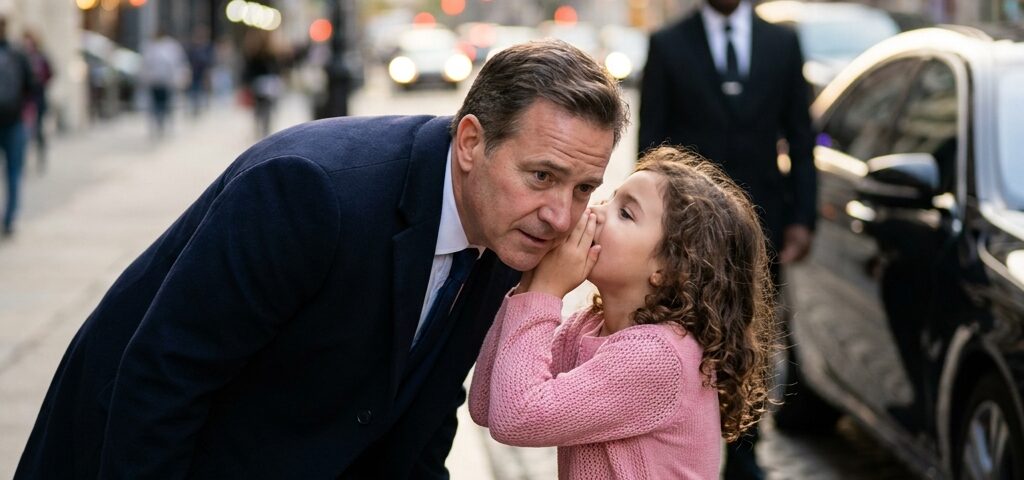
A BEGGAR GIRL OVERHEARS ARABIC FROM A DRIVER — AND WARNS A MILLIONAIRE NOT TO ENTER
The Street Girl Heard The Limousine Driver Speaking Arabic—Then Ran To The Millionaire And Begged Him Not To Get In
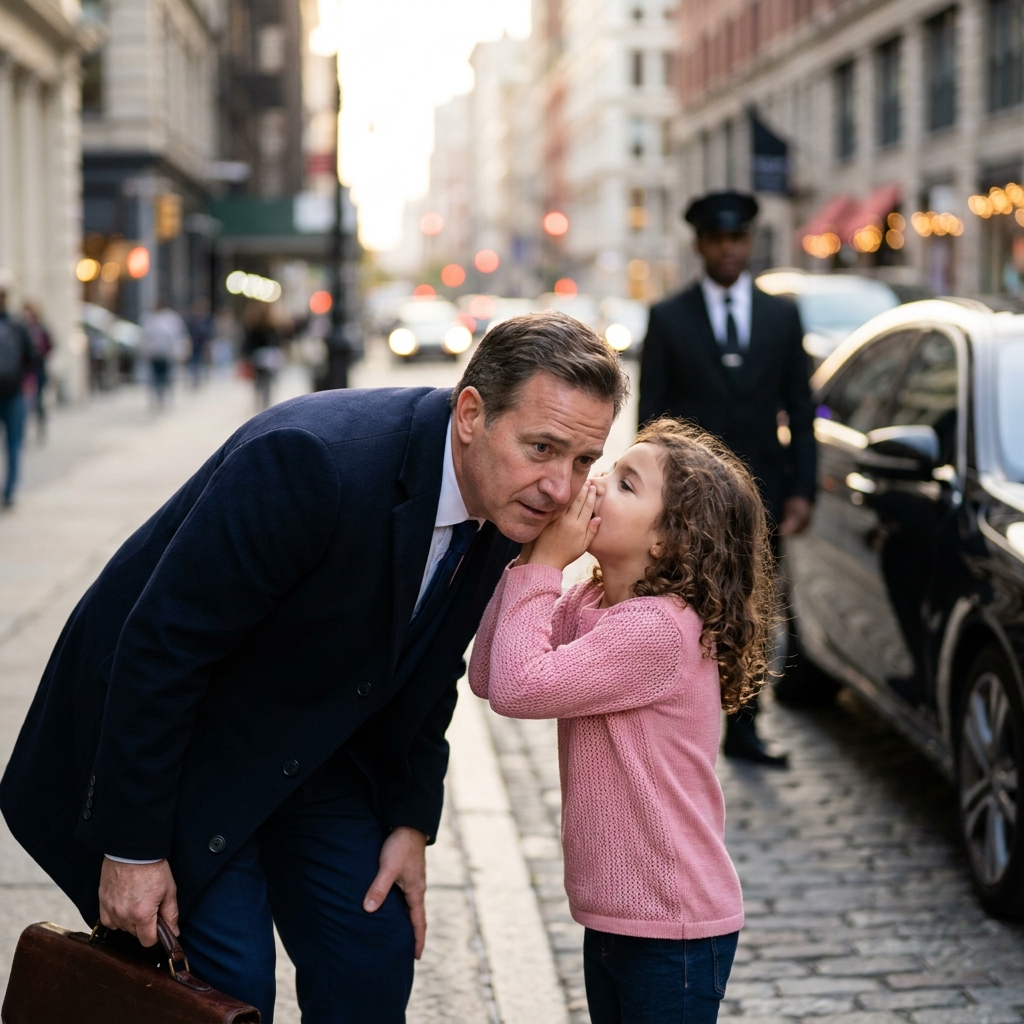
Everyone thought Kiara was just a poor girl digging for bottle caps outside a glass tower.
Then she heard two men whispering in Arabic beside a black limousine: “Hide him when he gets inside. Take him through the tunnel.”
The billionaire almost ignored her warning—until the car inspection revealed something hidden beneath his seat, and the little girl suddenly became the only person in the building he could trust.
The morning sun had already turned the cracked asphalt warm when Kiara woke up on Friday.
She opened her eyes to the familiar ceiling of the small apartment she shared with her grandmother—paint peeling in one corner, damp stain above the window, thin curtain moving gently where the frame never fully closed. Outside, motorcycles coughed awake in the narrow street. A dog barked near the trash bins. Somewhere below, a neighbor shouted for a child to hurry before school started.
It was not a beautiful home.
But it was theirs.
On the other side of the room, Helena was already preparing weak coffee in the old aluminum pot that had survived three countries, two wars, and more moves than either of them liked to count. She moved slowly now, one hand on the table for balance, but her eyes were still sharp—deep, dark, and watchful, like someone who had learned long ago that danger often arrived politely.
“Good morning, my little eagle,” Helena said.
Kiara smiled, though her stomach was already tight with worry.
“Good morning, Grandma.”
She pulled on the only clean T-shirt she owned, tied her curly hair into a messy bun, and checked the cloth bag she used for collecting bottle caps and recyclable scraps. The rent was due in three days. The electric bill was already late. Helena’s medicine had been cut in half to make it last longer, and the landlord had stopped smiling when he passed them on the stairs.
Kiara was twelve years old, but poverty had a way of making childhood feel like a shirt you outgrew too quickly.
“I’m going near Alian Tower today,” she said, forcing cheer into her voice. “Rich people throw away cans without even checking the caps. I can probably get a lot.”
Helena poured coffee into a chipped cup.
“Be careful with the eyes of others,” she said. “Not everyone who smiles is a friend. Not everyone who frowns is an enemy.”
Kiara rolled her eyes softly, but she listened.
She always listened.
Helena had sayings for everything. Some sounded like poetry. Some sounded like warnings. Some sounded like old wounds trying to become useful.
Helena had come to Brazil decades earlier as a refugee, carrying falsified documents, a baby daughter, a small canvas bag of essentials, and a language she refused to abandon. Kiara’s mother had been that baby. Years later, she vanished after a troubled relationship, leaving Kiara in Helena’s arms with no goodbye, no explanation, and no money.

So Helena raised her.
She raised her on thin soup, borrowed books, survival stories, and Arabic.
At first, Kiara learned the language as a game. Helena drew letters on old newspapers and taught her the sounds slowly, patiently, fiercely.
“So we never forget who we are,” she would say. “Knowledge is the only thing nobody can steal.”
Kiara had once asked when she would ever use Arabic in a city where most people barely listened when she spoke Portuguese.
Helena only smiled.
“The day you need it, little eagle, you will know.”
That morning, Kiara kissed her grandmother’s wrinkled cheek, promised to be careful, and stepped into the heat with her cloth bag over her shoulder.
The walk from their neighborhood to the business district felt like crossing between two different worlds without ever leaving the same city.
First came the low buildings, rusted balconies, patched roofs, narrow alleys, and street vendors setting up with tired hands. Then the streets widened. Sidewalks became smoother. Cars became quieter. Windows became reflective. Guards appeared at entrances. People walked faster, dressed cleaner, carrying coffees that cost more than Kiara’s lunch.
By midmorning, she reached Alian Tower.
Fifty floors of mirrored glass rose into the sky, reflecting clouds, money, ambition, and everything Kiara’s life was not. The building belonged to Marco Alliance, billionaire founder of one of the country’s largest technology companies. People in Kiara’s neighborhood said his company was inventing the future. Artificial intelligence. Smart systems. Financial prediction tools. Machines that could think faster than governments.
Kiara did not understand all of that.
She only understood that rich people threw away useful things near the tower.
She knew the best times. When restaurants emptied bins after breakfast. When office workers left half-finished drinks on benches. When the VIP entrance was busiest and drivers were too proud to notice a skinny girl collecting what others discarded.
She crouched near a parked Mercedes, reaching under the bumper for a bottle cap that had rolled into the shade.
That was when she heard the voices.
Low.
Male.
Not Portuguese.
Arabic.
Kiara froze so quickly her fingers stopped an inch from the cap.
The words came from near a black limousine idling by the VIP entrance.
“Hide him when he gets inside.”
Her heart kicked.
Another voice answered.
“Take him through the tunnel. The timing must be exact.”
Kiara slowly lowered herself behind the Mercedes, her breath trapped in her chest.
The men were not shouting. They were not acting like criminals in a movie. That made it worse. They spoke quietly, efficiently, as if discussing an appointment already scheduled. A tall thin man in an impeccable suit stood near the limousine driver. The driver nodded once. Their hands barely moved. Their eyes did all the talking.
Then the glass doors of Alian Tower opened.
Security guards stepped out first, forming a corridor.
In the center walked Marco Alliance.
Kiara knew him from newspapers and screens inside electronics shops. Gray hair, strong jaw, expensive suit, the kind of posture that made other adults step aside without being told. He looked older in person, heavier with authority, but unmistakable.
He was walking straight toward the limousine.
Kiara’s body moved before fear could stop it.
She dropped her cloth bag. Bottle caps spilled across the sidewalk. She ran.
“Sir!” she shouted. “Sir, please!”
A guard reached for her. She twisted away. Another blocked her path, but she slid between them like water through stone. She was small. She was quick. Poverty had taught her how to move through places that did not want her.
“Don’t get in that car!” she cried.
The head of security grabbed her arm.
“Back off,” he snapped.
Marco turned, irritated.
“What is this?”
Kiara fought to catch her breath.
“I heard them,” she said. “The driver and the man in the suit. They were speaking Arabic. They said to hide you when you got inside. They said something about a tunnel.”
The guard holding her arm scoffed.
“Mr. Alliance, we are already late. This is just a street kid looking for money.”
Marco’s gaze moved from the guard to Kiara.
At first, his eyes were cold.
Then curious.
“How do you know Arabic?”
“My grandmother taught me,” Kiara said quickly. “She came here from war. I know what I heard. Please don’t get in that car.”
The security chief, Aaron, tightened his grip slightly.
“She could have heard anything and invented the rest.”
Kiara looked directly at Marco.
“They said, ‘When he enters, don’t let him wake before the tunnel.’”
The sentence changed the air.
Marco’s expression hardened.
He raised one hand.
“Let her go.”
Aaron hesitated.
Marco’s voice lowered.
“I said let her go.”
Aaron released her arm.
“Victor,” Marco said, turning to another guard. “Full inspection of the limousine. Driver detained, quietly. No one leaves.”
Aaron stepped forward.
“Sir, with all due respect, Theo has passed every protocol. We cannot shut down the schedule because—”
“Since when do you question my orders?” Marco asked.
The silence that followed was sharp.
Aaron lowered his eyes.
“Of course, sir.”
Marco turned back to Kiara.
“You’re coming with me. I want every word you heard.”
“I need to go home,” Kiara said, suddenly aware of her dirty sneakers, sweaty shirt, and the lobby full of polished people staring at her like she was a stain on the marble. “My grandmother will worry.”
“You’ll call her,” Marco said. “But first we talk somewhere safe.”
As they entered Alian Tower, Kiara felt Aaron’s eyes burning into her back.
Not skeptical.
Angry.
Personal.
And something in her stomach turned cold.
The executive elevator moved silently upward.
Kiara stood beside Marco, clutching the strap of her empty cloth bag. She watched floor numbers rise. Forty-two. Forty-eight. Fifty.
The doors opened into a world she had only seen in movies.
Marco’s office was enormous. Glass walls. A panoramic view of the city. Leather sofas. Abstract art. Awards displayed like weapons. A desk large enough for three families to eat dinner around.
Kiara hovered near the entrance.
Marco noticed.
“You can sit.”
“I’m dirty.”
“It’s a sofa, not a holy relic.”
She sat carefully on the edge.
He brought her water himself.
That surprised her.
Powerful men usually sent other people to do small kindnesses.
“Tell me again,” he said. “Slowly. In Arabic first, then Portuguese.”
So she did.
She repeated every word she remembered. The phrase about hiding him. The tunnel. The timing. The driver. The tall man in the suit. She described their gestures, their positions near the limousine, the way the driver did not look nervous but prepared.
Marco listened without interrupting.
When she finished, his office phone rang.
He answered, listened, and went still.
“Under the rear seat?” he asked.
A pause.
“And the driver?”
Another pause.
“Bring Victor to me. Not Aaron. Victor.”
He hung up and looked at Kiara.
“They found something hidden under the seat. A kit containing substances that could render a person unconscious. Enough to remove me quietly before anyone understood what happened.”
Kiara’s mouth went dry.
“So I wasn’t wrong.”
“No,” Marco said quietly. “You were not wrong.”
For the first time that morning, Kiara felt fear fully catch her.
It was one thing to suspect danger.
It was another to know she had stepped directly into it.
A secretary brought sandwiches, fruit, and juice. Kiara hesitated. Helena always said gifts from strangers could become invisible chains. But hunger was louder than caution, and Marco did not pressure her. He simply set the tray nearby and continued making calls.
She ate quickly, then felt embarrassed by how quickly.
Marco pretended not to notice.
The door opened, and Victor entered with a woman carrying a laptop. She had brown hair tied in a severe bun and a gaze so sharp Kiara immediately stopped chewing.
“Mr. Alliance,” Victor said, “this is Olivia from digital security. She found something.”
Olivia placed the laptop on the table.
“Someone began attempting to access our main servers at the exact time you were supposed to leave the building,” she said. “The limousine operation may have been a physical diversion for a digital intrusion.”
Marco’s face darkened.
“Internal or external?”
“Both. The requests are coming from outside channels, but they’re using valid credentials from inside our system.”
“Meaning?”
“Someone inside the company is helping them.”
Kiara looked between the adults.
“What are they trying to steal?”
Marco glanced at Olivia, then back at Kiara.
For a moment, he looked like a man deciding whether a child deserved the truth.
Then he said, “Project Aurora.”
“What is that?”
“A system that can detect patterns before humans see them. Economic shifts. Market crises. Infrastructure risks. If used properly, it could help governments, businesses, and communities make better decisions before disaster hits.”
“And if used badly?”
Marco’s mouth tightened.
“It could help someone manipulate markets, create panic, crash companies, and profit from chaos before anyone knew they were being played.”
Kiara understood immediately.
“It’s like having answers to a test before everyone else.”
Marco looked at her with new respect.
“Yes. Exactly.”
Kiara suddenly stood.
“I should go home. My grandmother will be worried.”
Marco nodded.
“I’ll have someone trusted take you.”
“I can find more,” Kiara said before she could stop herself.
The room went silent.
Victor frowned.
“You’ve done enough.”
“No. The man in the suit might still be outside. If I leave now, maybe I can see where he goes.”
Marco shook his head.
“Absolutely not.”
But Kiara had already moved to the window.
Down on the street, near the opposite sidewalk, stood the thin man in the suit.
She pointed.
“That’s him.”
Everyone turned.
Olivia moved fast to the glass.
Marco’s jaw hardened.
Victor reached for his radio.
“No,” Kiara said. “If he sees security coming, he’ll run.”
Marco looked at her.
“What do you suggest?”
Before he could decide, Fiona entered.
Fiona was an administrative assistant in her early thirties with kind eyes and the worn-down smile of someone used to keeping powerful people organized while being ignored by them. She had come to escort Kiara downstairs.
When Kiara explained, Fiona looked horrified.
“No. We are not following a suspicious man. You are a child. I am an administrative assistant. We are not spies.”
Kiara pulled out her old cracked phone.
“The camera still works.”
Fiona stared at her.
“No.”
“Fifteen minutes,” Kiara pleaded. “From far away. Then we come back.”
Fiona should have refused.
Instead, she looked at the girl in the oversized sweatshirt, the same girl who had just saved Marco Alliance from the limousine.
“Fifteen minutes,” she said. “And if anything feels wrong, we run.”
They left through a side exit and pretended to wait for a ride. Kiara kept her phone angled casually.
The man in the suit paced near the curb.
Then Aaron appeared.
The same security chief who had tried to dismiss her.
Kiara stopped breathing.
Aaron spoke to the man in a low voice. Their bodies stayed angled away from the building, but their hands moved carefully. Then Aaron slipped something small into the man’s palm.
A USB drive.
Kiara recorded everything.
Fiona’s face went pale.
“We go back now.”
The man in the suit looked up.
For one terrifying second, his eyes landed directly on them.
Fiona took Kiara’s arm.
“Walk. Don’t run.”
They moved toward the building entrance, every step feeling too slow, the man’s gaze pressing against their backs.
Only when the lobby doors closed behind them did Fiona exhale.
“We need Marco.”
The video changed everything.
In the crisis room on the top floor, Marco, Olivia, Victor, and several executives watched the footage on Kiara’s cracked phone. Aaron handing over the drive. The man in the suit receiving it. The exchange was blurry but clear enough.
Victor looked betrayed.
“Aaron has worked under me for years.”
“Then someone bought years of trust,” Marco said.
Olivia’s laptop flashed a warning.
“The server intrusion is escalating. They’re trying to reach Aurora’s neural architecture.”
Marco turned to Victor.
“Find Aaron. Discreetly. Don’t alert him.”
A few minutes later, security footage showed Aaron leaving through the underground garage with two men.
“They know,” Kiara whispered.
Then her phone buzzed.
Helena.
Where are you, girl? It is getting dark. I am worried.
Kiara’s chest tightened.
If the conspirators knew Kiara had recorded Aaron, they might follow her.
They might find Helena.
Marco saw her face.
“Your grandmother needs to be moved somewhere safe.”
Kiara called Helena using a secure phone.
“Grandma, listen to me. Take the emergency bag.”
On the other end, Helena went silent.
The emergency bag was not something they joked about. It contained documents, medicine, photographs, a little cash, and the old habits of a woman who had once fled war.
“What did you do, Kiara?”
“I did what you taught me. I paid attention. I saw something wrong, and I didn’t stay quiet.”
A long breath.
“Is someone coming after you?”
“Maybe. Please go to Mrs. Viola’s. Someone trustworthy will watch the building.”
Helena did not waste time. Fear did not make her slow. It made her precise.
“Little eagle,” she said, voice low, “remember this. Powerful men protect their interests before they protect people. Trust actions, not promises.”
Kiara looked across the room at Marco giving orders, his face controlled but his eyes deeply worried.
“I’ll remember.”
That night, Kiara and Fiona were moved to a secure corporate apartment on the thirty-fifth floor. It had white sheets, a view of the city, and a bed so large Kiara sat on the edge for several minutes before daring to lie down.
She barely slept.
She dreamed of Helena’s emergency bag.
Of Aaron’s face.
Of the limousine door closing with Marco inside.
Of a tunnel without light.
The next morning, the crisis had grown.
Aaron had been found unconscious in the underground garage. Before losing consciousness again, he said only a few words.
“Solon Corporation.”
The company’s biggest competitor.
And then: “Inside. At the top.”
Someone in Marco’s inner circle was working with them.
Only five people had access capable of reaching Aurora’s core: Marco, Victor, Olivia, Pietro from research, and Luca Carmen, the finance director.
Kiara remembered Luca from the night before.
Elegant. Cold. Perfectly dressed. Condescending. He had looked at her like she was a dirty window he wished someone else would clean.
“And since when do street children speak Arabic?” he had asked.
Her answer had been calm.
“I’m not a street kid. I have a home. I just don’t have money.”
Now his credentials had been used in the breach.
So had others.
Someone was sowing confusion.
“Let me help,” Kiara said.
Marco frowned.
“No.”
“Nobody pays attention to children,” she said. “Especially poor children. They talk around us because they think we don’t understand. Let me walk around with Fiona. Say it’s a foundation mentorship day.”
Olivia looked up.
“That could work.”
Victor objected.
“She is twelve.”
“She has already noticed more than trained adults,” Olivia said.
Marco studied Kiara.
“You will never be alone. You will not approach anyone suspicious. You observe. You report. The moment it becomes unsafe, it ends.”
Kiara nodded.
She meant it at the time.
Fiona carried a clipboard, Kiara wore an Alian Foundation visitor badge, and together they toured the company.
Marketing first.
People smiled politely and returned to work.
Kiara wandered among the desks, pretending to admire posters and promotional materials. Near a corner station, a woman spoke urgently into a phone.
“I can’t talk now. Yes, I know the seriousness. No, he doesn’t suspect yet.”
The woman noticed Kiara and ended the call.
Kiara smiled innocently.
“Did you make this poster?”
The woman relaxed.
“No, dear. Graphic design.”
Kiara memorized the nameplate.
Anna Olins. Corporate Communications Manager.
Finance came next.
The whole department felt wrong.
Too many whispers. Too many conversations ending when Fiona approached. Luca was not there.
“Where is Mr. Carmen?” Kiara asked an assistant sweetly.
“In an external meeting,” the woman said too fast. “He won’t be back until tomorrow.”
At lunch, they found Pietro sitting alone in the executive restaurant, hunched over a tablet, dark circles under his eyes.
He looked nervous, brilliant, exhausted.
Kiara asked casual questions while Fiona pretended to read from the mentorship schedule.
“Finance seems tense today,” Kiara said.
Pietro gave a small, tired smile.
“Finance is always tense when something expensive breaks.”
“I heard Mr. Luca is outside the office.”
Pietro looked up.
“That’s funny. I saw him in the underground security lab an hour ago.”
Fiona and Kiara exchanged one look.
Then the thin man from the limousine appeared at the table.
Kiara recognized him instantly.
Her heart punched against her ribs.
“Pietro,” he said coldly, “we need to review the security protocols.”
Pietro stiffened.
“Alan, these are Fiona and Kiara.”
Alan’s gaze slid over Kiara.
For a second, she thought he recognized her.
Then he smiled without warmth.
“Delighted.”
When he left, Pietro leaned closer.
“Maybe you should end the tour early.”
Fiona called Marco immediately.
His answer was absolute.
“Return to the executive floor now. Do not go near the basement.”
Kiara listened.
Then she saw maintenance workers carrying equipment toward the emergency stairs.
And made the worst decision of her young life.
“I need the bathroom,” she told Fiona.
“Victor is coming.”
“Two minutes.”
Fiona hesitated, then nodded.
Kiara walked toward the restroom.
Then slipped through the stairwell door behind the maintenance team.
Her grandmother had always said sometimes the smallest person could enter where large people were seen too easily.
She followed the workers down to Level S3: restricted security laboratories. When they opened the access door, she slid through before it closed.
The basement corridor was white, cold, and sterile. Armored doors. Fluorescent lights. Cameras. A glass-walled server room at the end.
Inside stood Luca Carmen and Alan.
Kiara pressed herself near the wall.
Their voices were muffled but clear enough.
“Time is running out,” Luca said. “The transfer must finish today.”
“Aurora is incomplete,” Alan replied. “We need the rest of the code.”
“Solon has already paid.”
Kiara’s stomach dropped.
She had no phone. She had left it upstairs.
Then Pietro entered.
“We need to talk,” he said. “Alians knows there was a leak.”
Alan swore softly.
Luca turned sharply.
“How much?”
“Enough. We activate Delta Sequence. Create chaos. Crash the systems. Cover the extraction.”
Kiara nearly gasped.
Pietro was not a nervous innocent.
He was part of it.
When the three men left for another room, Kiara ran into the server room. A progress bar glowed on a screen.
Data transfer: 78%.
A storage device blinked green beside the terminal.
She did not understand the code.
She understood stealing.
She yanked the device free and shoved it into her sweatshirt pocket.
Voices returned.
She dove under a worktable just before Luca and Alan came back.
“The drive,” Luca said.
Silence.
“Where is the drive?”
They searched drawers, cabinets, equipment cases. Kiara curled smaller, barely breathing.
Then Alan said, “Someone was here.”
He left to check the hallway.
Luca stayed behind, typing furiously.
Pietro returned.
“Alan’s being detained by corporate security. The girl and the administrative assistant reported him after lunch.”
“The girl?” Luca hissed.
“The girl you ignored.”
Kiara’s throat tightened.
“And what about the witness?” Pietro asked.
“She’s secondary now,” Luca said. “Probably locked safely upstairs. Start Delta. Once the main systems collapse, nobody will care about one missing drive.”
When they left, Kiara crawled out from under the table, trembling.
The stairwell was too dangerous.
The hallway might be watched.
Then she saw the ventilation duct.
It took a chair, a stolen pen, scraped fingers, and every ounce of courage she had to unscrew the grate and pull herself into the narrow metal passage.
The duct was hot, dusty, and claustrophobic.
She crawled forward on elbows and knees, following airflow and distant voices. Twice she nearly cried. Once she whispered Helena’s name. But she kept going.
Finally, through a grate below, she saw Marco’s crisis room.
He was there with Olivia, Victor, and others, arguing over failing systems.
Kiara banged on the metal.
Everyone looked up.
Victor reached for his weapon.
“It’s me!” she shouted. “Kiara! I’m in the duct!”
They pulled her down minutes later, dusty, shaken, holding the stolen device like a sacred object.
“They’re stealing Aurora,” she said. “Luca, Alan, and Pietro. Pietro too. They’re starting something called Delta Sequence.”
Olivia plugged in the drive.
Her face went white.
“It has partial Aurora architecture. She stopped the transfer.”
Then the lights flickered.
Screens flashed red.
“It’s starting,” Olivia said. “Massive intrusion. They’re attacking multiple systems.”
Victor returned with worse news.
“Fiona is missing.”
Kiara’s face drained of color.
“I left her waiting.”
Marco placed a hand on her shoulder.
“No blame right now. Focus.”
The building began turning against them.
Elevators froze. Doors locked. Cameras failed. Fire alarms chirped, then died. Computer screens went dark one by one. Delta Sequence was not just a hack. It was an attempt to blind the tower long enough for Luca and Pietro to escape with what they had stolen and possibly take Fiona as leverage.
Marco moved to a private console.
“I built Aurora,” he said quietly. “But I also built something nobody else knows about.”
He typed a phrase.
Aurora Alpha.
Then a second password, spoken in a language Kiara did not recognize.
The lights stabilized.
A hidden backup system came alive.
On the wall screen, the tower map appeared with three moving red points.
Luca.
Pietro.
Fiona.
Basement three.
Emergency tunnel.
“Move,” Marco said.
Victor’s team moved faster.
Fifteen minutes later, the crisis room doors opened.
Security escorted Luca and Pietro in handcuffs. Alan had already been detained. Behind them walked Fiona, pale and shaking but alive.
Kiara ran to her.
“I’m sorry,” she sobbed. “I shouldn’t have left you.”
Fiona hugged her tightly.
“You reckless, brilliant child. Don’t ever do that again.”
“I won’t.”
Everyone in the room knew she probably would if the right thing demanded it.
Police arrived. Servers were secured. Aurora remained incomplete in enemy hands, which meant safe enough to survive. Solon Corporation denied involvement before anyone publicly accused them, which Marco found telling.
By evening, the tower was no longer in panic.
It was in reckoning.
Luca had betrayed fifteen years of trust for money and power.
Pietro had sold brilliance to people who promised him recognition.
Alan had compromised security from inside.
Aaron, used and discarded, survived long enough to confirm key parts of the scheme.
Anna Olins turned out to be a communications link, passing internal schedules and crisis messaging strategies.
And Kiara—the girl who had come for bottle caps—had stopped a kidnapping, exposed an insider network, saved Project Aurora, and forced Marco Alliance to confront a truth his own power had hidden from him.
The people he ignored could sometimes see the clearest.
That night, Marco took Kiara and Helena home himself.
Not to the old apartment.
To a secure building owned by the Alian Foundation, where Helena was waiting with her faded emergency bag on her lap and a rosary wound around her hand.
The moment she saw Kiara, she stood.
“My little eagle.”
Kiara ran into her arms.
Helena held her so tightly Marco looked away.
When Helena finally released her, she turned to Marco.
“You are the powerful man?”
“I suppose so.”
“Powerful men cause storms,” Helena said. “Rare ones know how to build shelter after.”
Marco accepted the judgment.
“Your granddaughter saved my life.”
Helena looked at Kiara with pride and terror in equal measure.
“She has always had more courage than sense.”
Kiara protested.
“Grandma.”
“It is true.”
Marco smiled.
“I would like to offer both of you a safer apartment, full support, and a scholarship for Kiara. No conditions. No debt. She deserves every opportunity my company can provide.”
Helena’s eyes narrowed.
“Gifts from powerful men are never free.”
“This one is,” Marco said. “Because I owe her more than money can measure.”
Helena studied him for a long time.
Then she said, “We accept help. Not ownership.”
Marco nodded.
“Agreed.”
Weeks later, the story hit the news.
Marco Alliance avoided a coordinated kidnapping and corporate espionage plot thanks to a twelve-year-old girl who understood Arabic.
That was the headline version.
It was clean.
Too clean.
Headlines did not show Kiara waking up hungry and still kissing her grandmother before leaving to collect bottle caps.
They did not show Helena keeping an emergency bag for thirty years because peace never fully erased the memory of escape.
They did not show Fiona choosing courage in a lobby where she had spent years being treated as invisible.
They did not show Olivia fighting to save a project while realizing the greatest security failure had not been code, but arrogance.
They did not show Marco sitting alone in his office after everyone left, staring at the limousine footage and understanding that if a poor child had not been taught a language the world dismissed as irrelevant, he would have vanished through a tunnel before lunch.
The Alian Foundation changed after that.
Marco did not simply give Kiara a scholarship and move on.
He created a program for children from under-resourced communities who spoke multiple languages, understood survival, noticed patterns, and had talents schools often failed to recognize because poverty arrived before paperwork. He hired Helena as a cultural adviser for refugee family outreach, though she insisted she was “too old for corporate nonsense” and then corrected every policy document with frightening precision.
Fiona was promoted to community programs director.
Olivia rebuilt internal digital security from the ground up.
Victor became a quieter man, less impressed by badges and more interested in instincts.
Marco visited Kiara’s new school once and watched her correct a teacher’s pronunciation of an Arabic phrase with such confidence that he laughed for the first time in days.
Kiara still collected bottle caps sometimes.
Not because she had to.
Because she liked remembering where she came from.
One afternoon, months after the attack, she stood outside Alian Tower again, this time wearing clean sneakers and carrying a backpack full of books instead of scrap metal.
Marco found her near the VIP entrance.
“Waiting for a limousine to mistrust?” he asked.
She smiled.
“Waiting for my grandmother. She says your elevators make her suspicious.”
“She says many things make her suspicious.”
“She’s usually right.”
Marco looked toward the curb where the black limousine had once waited.
“I almost got in,” he said.
“I know.”
“I almost ignored you.”
“I know.”
“That frightens me more than the plot.”
Kiara looked up at him.
“Why?”
“Because I built a company to predict patterns, and I still almost missed the most important warning because it came from someone I had been trained not to notice.”
Kiara considered that.
“My grandmother says truth does not always dress nicely.”
Marco smiled faintly.
“Your grandmother should run my board.”
“She would scare them.”
“They need it.”
A car pulled up, and Helena stepped out, leaning on her cane, eyes sharp as ever.
She looked at Marco, then at Kiara.
“Ready, little eagle?”
Kiara nodded.
As they walked away, Marco stood beneath the tower’s glass shadow and watched the girl who had changed his life cross the plaza with her grandmother.
A billionaire.
A refugee grandmother.
A street girl.
A limousine.
A tunnel.
A stolen project called Aurora.
And one warning no one wanted to hear.
People later said Kiara was brave because she ran toward danger.
But that was not the whole truth.
She was brave because she listened before she ran.
She heard words adults missed.
She saw anger behind politeness.
She noticed fear behind perfect suits.
She trusted the language her grandmother had given her, even when the world had told her it was useless.
And when powerful people tried to dismiss her as a poor child looking for attention, she stood her ground.
That was what saved Marco Alliance.
Not his money.
Not his tower.
Not his guards.
Not his technology.
A girl with cracked sneakers and a cloth bag full of bottle caps saved him because she understood something his company had forgotten.
The future does not belong only to those who build the tallest towers.
Sometimes it belongs to the child outside the tower, listening carefully, seeing clearly, and brave enough to shout before the door closes.