
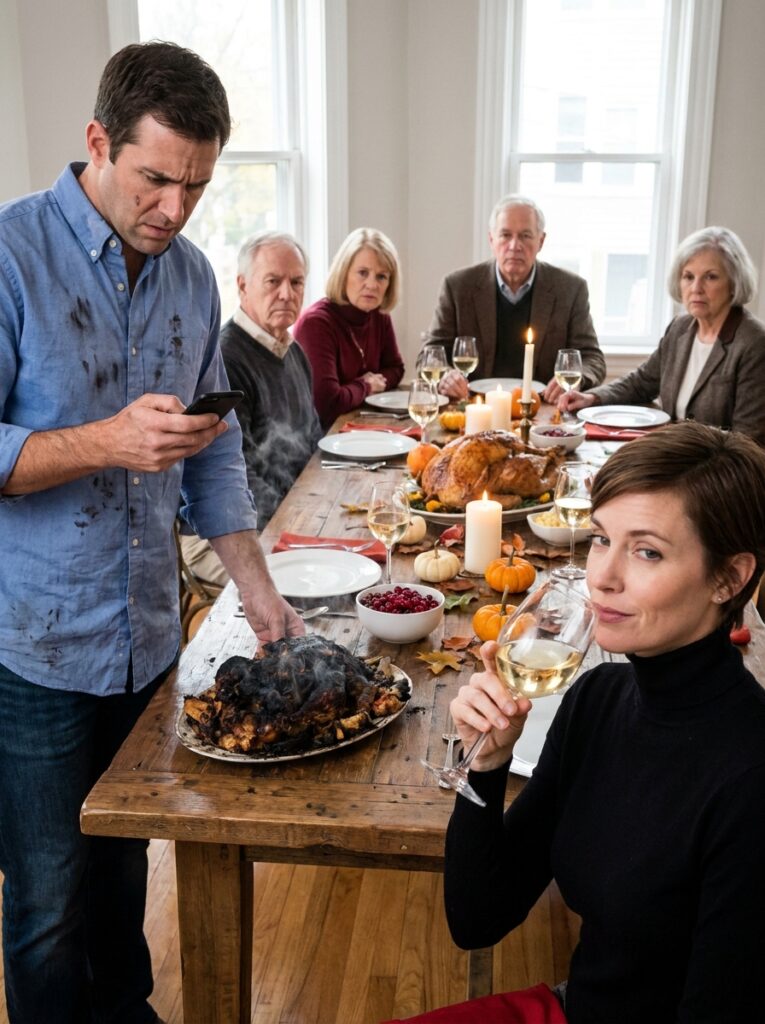
I secretly funded my brother’s startup. At Thanksgiving, he burned my gift and called me a loser. I said nothing just withdrew the $2 million. His phone buzzed. His face drained. “Who pulled the money?” I took a sip. “Me.
The first time a cop handed me a search warrant with my name on it, I laughed—an ugly reflex, like my body was trying to reject reality through humor.
It was Tuesday. Still dark. Tribeca quiet in that way it only gets before the delivery trucks and the dog walkers start their morning circuits. I’d been awake since five, not because I’m the kind of person who enjoys dawn, but because my brain had been chewing on a term sheet and refusing to swallow. I was in my entryway with a mug of coffee, watching the steam curl up like a question mark, when the buzzer rang.
Two rings. A pause. Two rings again.
Through the security feed, I saw three silhouettes. One in plain clothes, two in uniform. The woman in front held a folder thick enough to be a novel.
I opened the door wearing sweatpants, an old conference hoodie, and the expression of someone who didn’t yet understand their life had been yanked sideways.
“Ms. Elena Vance?” she asked.
“Yes.”
She raised the folder. “Detective Sarah Walsh. NYPD. This is a warrant to search your residence for evidence related to financial fraud and criminal harassment.”
Fraud. Harassment.
The coffee mug slid out of my hand. It hit the marble and exploded, brown liquid blooming across white stone in a way that would’ve been gorgeous if it weren’t my morning disintegrating in slow motion.
“I’m sorry,” I said, because apparently my mouth had decided apologies were the appropriate response to being accused of crimes. “What?”
Detective Walsh did not soften. She stepped inside like she’d been here before.
“You have the right to remain present during the search,” she said. “I suggest you call your attorney.”
My home, my clean minimalist sanctuary of quiet, suddenly filled with the sound of Velcro gloves and radios and boots. One officer moved toward my office. Another asked if there were any firearms. I blinked, too slow, like my mind had become a buffering screen.
“I run a venture fund,” I managed. “I—this has to be a mistake.”
Detective Walsh flipped open the folder and pulled out a copy of a complaint. She didn’t hand it to me right away. She held it angled toward my face like a mirror I didn’t want to look into.
Complainant: Julian Vance.
My brother’s name landed in my chest with the weight of something thrown.
Allegations. A list. Impersonation. Theft by deception. Emotional distress. Words built to sound credible. Words meant to turn me into a villain.
My laugh died.
“Julian?” I said, like maybe if I said it aloud it would become less true.
Detective Walsh studied me with the practiced patience of someone who’s seen every version of denial. “Do you know him?”
“I know him,” I whispered. “Unfortunately.”
She watched my face, waiting for more: a confession, a tantrum, a story. But the only thing I could do was stand there and feel the past unspool, pulling me back to the day I made the decision that led to this.
Three years earlier, I’d been in Singapore.
Not the postcard version of Singapore, with gardens and glowing skyline, but a windowless conference suite where the air-conditioning was turned up like a warning. I was leading a deal for Chimera Capital—my firm, my creation, my secret pride—an investment into a biotech company with the kind of research that made you believe humanity wasn’t doomed to repeat its worst habits forever.
The ink wasn’t dry yet when my phone started vibrating. Julian’s name flashed, again and again, until it felt like my pocket was trying to burn a hole through my suit.
We hadn’t spoken in months. We existed in the same family, the way two distant countries exist on the same planet: technically connected, functionally separate.
I ignored the first call. The second. The third.
Then the text came.
Please. Pick up. I’m in trouble.
I stepped into the hallway and answered.
“Julian,” I said, my voice clipped, professional. “What’s happening?”
For a beat, there was only breathing. Then a sound I almost didn’t recognize—my brother breaking.
“They pulled out,” he said. “They all pulled out.”
My stomach dropped, not because I didn’t believe he could fail, but because I knew what Julian did when the world didn’t cooperate with his fantasy. He didn’t adjust. He blamed. He burned.
“Who?” I asked.
“The investors. Series A. Gone.” His words came in fragments like broken glass. “They found out. They found out I… I rounded the numbers. I thought I could fix it before anyone noticed. I thought—”
“You lied about user growth,” I said, not as a question.
He sobbed once, harshly. “I can’t lose this, Elena. If this goes under, I’m done. I’m not like you. I can’t—”
There it was. The old script. Julian the meteor, Julian the miracle, Julian the main character. And me, the supporting cast he only remembered existed when he needed a rescue.
“How much?” I asked, even though my chest tightened as I said it.
“Two million,” he breathed. “Maybe three.”
I stared at the clean hotel wall, the elegant corporate art I hadn’t noticed until that moment. Two million was not impossible. Two million was a rounding error in my world. Two million was also the exact amount that would keep Julian alive long enough to keep hurting people.
“Elena, please,” he said. “I know we’re not close, but—Mom and Dad don’t have this. You’re… you’re the only one.”
In that hallway, with the deal behind me and the world ahead of me, I told him the first lie that started the rest.
“I don’t have that kind of money,” I said.
Silence. Then, desperate bargaining.
“Could you co-sign a loan? Could you ask someone? Could you—”
“I’ll see what I can do,” I heard myself say, and hated myself immediately.
After I hung up, I stayed pressed against the wall until my breathing settled. Not because Julian’s panic was contagious, but because something in me had responded before my brain could stop it: a reflex grown from childhood.
In our family, Julian was the sun.
My parents orbited him. Teachers praised him. Coaches built teams around him. At dinner, his stories filled the room and my achievements were treated like side notes—nice, Elena, now pass the potatoes.
When we were kids, he’d been kind sometimes. Lego castles. Cartoon marathons. Sneaking me the bigger half of a cookie. But somewhere along the line, kindness became currency. He learned he could spend it to buy attention. He learned he could withhold it to punish.
And I learned to survive by disappearing.
In therapy, they called it becoming a gray rock: giving no reaction, no fuel, no drama. You become so boring the person looking for a fight loses interest. It worked, mostly. I wore plain clothes around my family. I drove a beat-up car on holidays. I let my mother tell people I “did design work” because correcting her would’ve started a war I didn’t have the energy to fight.
I let my life be minimized to keep theirs from consuming it.
But Julian’s call cracked the old rules. He wasn’t trying to pick a fight; he was trying to keep his dream alive. And the part of me that still, inexplicably, wanted him to be the brother from the Lego days made a choice.
I called my operations director, Sarah, from my hotel room.
“I need a vehicle,” I told her. “A shell fund. Something clean. Something credible.”
There was a pause on the line—Sarah had worked with me long enough to recognize the edge in my voice.
“Elena,” she said gently. “What are you doing?”
“Family,” I answered, like it was a reason that made sense.
Sarah exhaled. “How much?”
“Two million,” I said. “Wire it to Streamline by Friday.”
She didn’t argue long—she wasn’t my therapist, and I wasn’t paying her to save me from myself. But her voice sharpened. “This isn’t investment logic. Streamline is bleeding cash. Their retention is awful. Their metrics are—”
“I know,” I cut in. “Make it look like investment logic anyway.”
“Does he know it’s you?”
“No.”
That was the most important part. Julian couldn’t know. If he knew I had money, he’d treat it like a natural resource under his feet, something he was entitled to extract until nothing was left. If he knew I was powerful, he’d either try to claim my success as proof of his influence or try to outshine it by tearing me down.
So we built Angel Ventures. Delaware registration. A real bank account. A real compliance framework. A real website with enough corporate blandness to make you trust it with your retirement.
And I became my brother’s invisible investor.
Over the next three years, I wired money in quiet chunks, each one justified as “bridge financing” or “operational support.” Each one accompanied by an email written in the language founders respected—discipline, efficiency, scale—because Julian didn’t understand love unless it wore a suit.
Sometimes he’d brag about Angel Ventures at family gatherings, glowing like a man blessed by some anonymous patron.
“Whoever they are, they get it,” he’d say, swirling whiskey like he was on a talk show. “They see my vision. They’re a shark.”
My father would beam. My mother would tear up. I would sit there in my Old Navy sweater, driving my dented Honda, and nod like my brother’s miracle had nothing to do with me.
I told myself it was fine.
I told myself it was a weird kind of kindness.
I told myself it was temporary.
And then Thanksgiving came, and Julian reminded me exactly who he was.
Part 2
I drove to my parents’ house in Connecticut the way I always did on holidays: alone, quiet, with my phone on Do Not Disturb and a steady, practiced expression that said, I’m harmless.
The Honda’s heater took ten minutes to wake up. The windshield wipers squeaked like they were complaining. I liked it that way. A normal car kept people from asking questions. Normal kept me safe.
On the passenger seat sat the gift I’d spent weeks making: a scarf knitted from vicuña yarn I’d bought from a specialty importer after three glasses of wine and a moment of optimism I should’ve distrusted. The yarn cost more than my first car. The color was charcoal—neutral, understated, impossible to accuse of being flashy.
Every stitch was a small act of hope.
When I pulled into the driveway, Julian’s Porsche was parked crooked across two spaces like the universe had designed him a metaphor. The license plate was some variation of founder swagger. I didn’t bother reading it. I parked on the grass, like always.
Inside, the house smelled like sage, butter, and expensive wine. My mother was in the kitchen commanding two caterers like a general. She didn’t turn when I walked in.
“Elena,” she said, as if my name was an item on a to-do list. “Apron’s on the hook. We’re behind.”
“Hi, Mom,” I said.
She waved a hand without looking up. “Your father’s in the living room with Julian. They’re talking business. Don’t interrupt.”
Of course they were.
I tied the apron and joined the flow of the evening, moving plates, refilling glasses, being useful in the way my family liked: quietly, without taking up attention.
Julian’s friends were already there—men in tech vests over cashmere sweaters, women with perfect hair and the laugh of people who’ve never had to sit through a performance review. They treated my parents’ house like a networking event. Someone called me “sweetheart” while handing me an empty glass.
I smiled. Gray rock.
At six fifteen, the room shifted.
Julian’s phone buzzed. He checked it and his whole body lit up like a billboard.
“Yes!” he shouted. “It cleared!”
People turned. Conversations broke. My father rose halfway out of his chair.
“What cleared?” my mother demanded, already smiling like she knew.
“The angel money!” Julian threw his arms wide. “Two million! Angel Ventures came through again. We’re good. We’re more than good. We’re unstoppable.”
Cheering erupted. My father hugged him like Julian had just come back from war. My mother’s eyes filled, the way they always did when Julian’s life performed the way she wanted.
I stood near the kitchen doorway holding a tray of appetizers and watched the celebration swirl around the money I’d quietly moved three days earlier from one account to another.
Julian spotted me.
He strode over, cheeks flushed with victory, and tipped his glass toward me like he was bestowing a favor.
“See, Elena?” he said loud enough for people to hear. “This is what it looks like when you aim big. Not… whatever it is you’re doing.”
A few of his friends laughed politely.
“I’m happy for you,” I said. I meant it in the way you mean it when you tell someone a fireworks show is pretty while you’re standing too close to the sparks.
Julian leaned closer, lowering his voice just enough to feel intimate.
“You know what’s crazy?” he said. “This investor—Angel—won’t even meet me. No ego. Just wires the money and sends these cold, intense emails like they’re my Navy SEAL coach.”
He grinned, loving the story of himself.
“I think they’re obsessed,” he added. “Like, they know I’m the next big thing.”
I swallowed. “Maybe they just believe in the product.”
He snorted. “You wouldn’t understand belief.”
Dinner was set with the kind of attention my mother reserved for public performance. The turkey was perfect. The candles were expensive. The conversation, as always, circled Julian like planets.
He talked about Streamline’s new office plans, about hiring a head of growth, about “capturing culture.” He told stories where he was always the smartest person in the room and everyone else was lucky to be near him.
My father laughed at every punchline. My mother asked questions designed to make Julian sound even more impressive.
No one asked me anything.
Halfway through, I tried, just once, to participate.
“I read something recently about burn rate,” I said, keeping my tone careful. “A lot of startups—”
Julian waved a hand. “Oh my God, Elena. Please don’t explain business to me.”
My father chuckled. “Let your brother handle his world, sweetheart.”
My mother sipped her wine like my attempt had been an unpleasant breeze. “Elena, pass the gravy.”
Something in me tightened. Not anger, exactly. More like the last thread of patience being pulled too thin.
After dinner, the living room filled with the warm roar of the fireplace. People loosened. Laughter rose. Julian held court in front of the mantel like a king.
This was the moment I’d brought the scarf for.
It was a ridiculous gift for a man like him. But that was the point. It wasn’t meant to impress. It was meant to say, I see you. I thought maybe—just maybe—if I offered something made with my own hands, something that couldn’t be bought, it might reach whatever part of Julian was still human.
I brought the gift box from my bag and walked toward him.
“I made something for you,” I said.
Julian looked at the box like it might contain a joke. “For me?”
“Yes.”
The room’s attention tilted slightly, curious. My mother watched with a tight smile that suggested she already suspected disappointment.
Julian tore the paper off. Opened the lid. Pulled out the scarf.
For one breath, his face did something complicated. A flicker. A pause. And then it hardened into disgust.
“You knitted this?” he asked, holding it between two fingers like it was damp laundry.
“It’s vicuña,” I said softly. “It’s very warm. I thought—”
Julian laughed. It wasn’t joyful. It was the laugh people use when they want an audience to join them in humiliation.
“Elena,” he said, drawing out my name like it was a lesson. “I’m a CEO. I’m building a company. I can’t show up to meetings wearing… homemade crafts.”
“It’s not—”
“It’s embarrassing,” he cut in. “This is exactly what I mean. You’re always small. You make small things. You live small. That’s why you’re—”
He scanned me, my plain sweater, my quiet posture, and smiled like he’d found the word.
“A loser.”
The room went very still, that split-second when people decide whether they’re about to witness something uncomfortable. My mother didn’t defend me. My father didn’t correct him. Someone’s glass clinked softly as a hand shook.
Julian turned toward the fireplace.
“Julian,” I said, my voice suddenly too thin. “Don’t.”
He didn’t even look back.
He tossed the scarf into the fire.
The flames caught immediately, licking the soft yarn like it was eager. The charcoal fibers curled, then brightened, then collapsed into glowing orange. Weeks of work, hours of hope, reduced to smoke in seconds.
My mother exhaled like she was relieved a bad gift had been handled. “Why can’t you be more like your brother?” she muttered, not even bothering to keep it private.
And that was the moment something in me unclenched.
Not my heart. My heart had been bruised for years. What unclenched was my fear.
The gray rock cracked.
I didn’t scream. I didn’t cry. I didn’t beg him to understand.
I pulled out my phone.
Angel Ventures had an admin portal—two-factor security, biometric authorization, a clean interface designed to make financial power feel like clicking a button.
Streamline’s next transfer was scheduled for the following morning.
Two million dollars.
I opened the authorization screen. My thumb hovered.
Across the room, Julian was basking in the laugh he’d gotten from one of his friends. He was a man convinced the world would never demand payment for his cruelty.
I tapped Revoke.
A confirmation window appeared. Are you sure? This action cannot be undone.
I looked at my family. At my father’s adoring gaze locked on Julian. At my mother’s satisfied expression. At the fire, chewing through my gift like it had always belonged there.
I tapped Yes.
Julian’s phone buzzed. Once. Twice. Three times.
He checked it with the grin of a man expecting more praise.
The grin vanished.
His face drained so fast it was almost comical. He stared at the screen like it was written in another language.
“What—” he stammered. “No. No, no, no.”
My father straightened. “Julian?”
Julian’s hands began to shake. “The money. It’s gone. The transfer—Angel pulled it.”
His friends went silent.
My mother stood. “What do you mean, pulled it?”
Julian looked up wildly. His gaze ricocheted around the room, searching for someone to blame, someone to fix it.
Then his eyes landed on my phone, still open, still glowing.
He stared at it.
He stared at me.
His mouth opened, then closed, like a fish suddenly aware of air.
“Why,” he whispered, “do you have the Angel Ventures line saved?”
I met his gaze. Felt the heat of the fire on my skin. Felt the steadiness in my spine that had been missing my whole life.
“The loser,” I said calmly, “just saved herself two million dollars.”
Part 3
For a moment, the only sound in the room was the crackle of burning yarn.
Julian stared at me like I’d performed a magic trick. His brain couldn’t reconcile the version of me he’d stored—quiet sister, low-earning, harmless—with the reality standing in front of him.
“You’re lying,” he said, voice rough. “You can’t be. You drive that garbage car.”
“I drive a Honda because it’s reliable,” I said. My voice surprised me with how steady it was. “Not because it’s all I can afford.”
My mother’s face tightened. “Elena, stop it.”
Julian took a step toward me, panic rising. “If the funds don’t clear, payroll bounces. Vendors. Rent. I—”
“You should’ve thought about that before you threw my time into the fire,” I said.
My father moved like he was trying to insert himself between us, as if his body could buffer the consequences. “Elena, your brother didn’t mean—”
“He meant it,” I said. “He always means it. He just doesn’t like being held to it.”
Julian lunged toward the coffee table and grabbed his phone. His fingers flew, dialing a number.
The sound of my own phone buzzing—his call attempting to connect to the Angel priority line—cut through the room like a siren.
He froze. Looked at the screen. Looked at me again.
“You’re Angel Ventures,” he said, the words barely forming.
I didn’t answer right away. I wanted to. I wanted to explain the years—the quiet transfers, the spreadsheets, the late-night risk assessments, the hope that he’d grow into someone worth saving.
But I realized, in that moment, that Julian didn’t deserve the story. He deserved the outcome.
“Yes,” I said finally. “I’m the one who kept your company breathing.”
The room erupted.
My mother’s voice rose first. “How could you hide that from us?”
Julian’s voice overlapped hers. “You ruined me!”
My father tried to speak, his words drowned out by their outrage, by their disbelief, by the sound of a family’s reality being rewritten in real time.
I stood still while it hit me: their first reaction wasn’t sorrow for how they’d treated me. It wasn’t shame. It wasn’t apology.
It was betrayal that I’d had something they didn’t know about.
Julian jabbed a finger toward me. “You let me struggle. You watched me—”
“I watched you spend,” I corrected. “I watched you lie. I watched you treat people like disposable tools and call it vision. Don’t rewrite this.”
He looked to my parents, desperate for allies. “Tell her! Tell her she can’t do this. She’s my sister.”
My mother stepped toward me, eyes bright with a familiar anger. “Elena, fix it. Right now.”
“No.”
The word landed heavy, clean.
My mother blinked like I’d slapped her.
Julian’s face twisted. “You’re jealous. That’s what this is. You’ve always been jealous.”
I almost laughed. “Julian, you don’t have anything I want.”
His eyes darted to the fireplace, where the scarf had collapsed into ash. Then back to me, as if he suddenly remembered what he’d done and decided it shouldn’t matter.
“It was a joke,” he snapped. “It’s a scarf. You destroyed a company over a scarf.”
“It wasn’t the scarf,” I said, and I could feel my throat tightening now—not with tears, but with something sharp and old. “It was the years. The way you talk to me. The way you let them talk to me. The way you take and take and call it earned.”
My father’s voice finally broke through, trembling with confusion. “Elena… are you saying you’ve been giving him money this whole time?”
“I’ve been funding Streamline,” I said. “Quietly. Legally. Through a fund vehicle. Because I thought if he succeeded, maybe he’d be… better.”
Julian scoffed. “I succeeded because I’m talented.”
“You succeeded because you had a safety net you didn’t even know existed,” I said. “And you set it on fire.”
Silence struck like a gavel. Julian stared at me, and something shifted in his eyes—fear, real fear, the kind narcissists only feel when the world stops agreeing with their script.
“Put it back,” he whispered. “Just… put it back. I’ll apologize. I’ll—”
“It’s done,” I said.
He reached for me, grabbing my wrist hard enough to hurt.
“You can’t,” he hissed. “You can’t take this from me.”
I pulled my arm away. “I didn’t take anything from you. I stopped giving it.”
My mother made a sound like she was physically wounded. “You’re tearing this family apart.”
“No,” I said. “I’m leaving it.”
I walked to the front hall. Behind me, Julian shouted my name like it was a command. My father pleaded. My mother screamed that I was ungrateful, that I was cruel, that I was selfish.
All words designed to hook me back into the role I’d always played.
I put on my coat slowly. Calmly. I had never felt so clear.
When I opened the door, cold air rushed in, sharp and clean. It smelled like winter and freedom.
In the driveway, my Honda waited, humble and loyal. I got in, started it, and listened to the steady engine like a promise.
As I backed out, I looked once in the rearview mirror.
The house glowed warm behind the windows. Smoke rose from the chimney. Somewhere inside, my scarf’s ashes were floating upward, dissolving into the night.
I drove away without crying.
Three months later, Julian tried to sue me.
The complaint was long, theatrical, and clearly written by someone who thought louder words meant stronger truth. It accused me of deception, emotional manipulation, “strategic sabotage,” and a dozen other phrases meant to turn my boundary into cruelty.
He wanted every dollar I’d ever transferred back, plus damages, plus punishment.
My attorney, Marcus Chen, read it with a look of delighted disbelief.
“This,” he said, tapping the document, “is an unforced error.”
We sat in his Midtown office overlooking the park. Marcus had the kind of calm confidence you pay for when you don’t want to be scared.
“He’s admitting,” Marcus continued, “that he accepted millions from an investor he never verified. He’s also admitting he falsified metrics to get money. In court. In writing.”
“So he can’t win?” I asked.
“He can make noise,” Marcus said. “He can drag your name through headlines. But legally? No. This is spite in a suit.”
I stared out at the city. “Then let him make noise.”
Marcus studied me. “That means your family learns who you are.”
“They already think they know who I am,” I said softly. “Let them finally see the real version, even if they hate her.”
The deposition was a week later.
Julian arrived looking exhausted and furious, wearing a suit that didn’t fit right, as if he’d grown smaller inside it. His lawyer was young, overeager, the kind of guy who thought aggression could replace experience.
They asked me questions meant to paint me as secretive, controlling, vindictive.
How long had I been operating the fund? Why had I concealed my identity? Wasn’t it true I’d withdrawn money because my feelings were hurt?
I answered with facts.
Angel Ventures was registered. Compliant. Audited. Documented.
Streamline’s reporting showed reckless spending. Inflated metrics. Internal emails instructing staff to “smooth” numbers before investor updates. Expense reports for parties, cars, and offices designed for appearances, not sustainability.
Julian’s lawyer’s face went pale as my team slid document after document across the table.
Julian finally snapped. “How do you have all that?”
“You sent it,” I said evenly. “You just didn’t know it was me reading it.”
The room went quiet.
Julian stared at the table, jaw clenched, as if the wood might absorb his humiliation.
When the judge dismissed the case weeks later, it was with the cold efficiency of someone offended by wasted time. Legal fees were awarded. A protective order was issued: Julian was not to contact me for two years.
I didn’t feel victorious.
I felt lighter, like I’d set down a weight I’d forgotten I was carrying.
And that’s when Julian went to the police.
Part 4
The police report was a new kind of desperation—less legal theater, more scorched earth.
According to Julian, I had impersonated an investment firm. I had stolen identities. I had harassed him with “cryptic communications.” I had, in a particularly insulting twist, manipulated our parents into thinking I was broke so they wouldn’t “benefit from my success.”
Elder abuse. Fraud. Theft.
It read like a man throwing anything he could find at a wall, hoping something would stick.
Detective Sarah Walsh didn’t look thrilled to be on my doorstep, but she looked like someone who wouldn’t ignore paperwork just because it was stupid.
They searched my office first.
That was where the absurdity finally hit: three officers stepping carefully past a sculpture I’d bought at an art auction, opening drawers full of investor reports, compliance binders, contracts. The kind of documents you only have if you’re doing things the boring, legal way.
Walsh asked for my devices. I handed them over without argument, because the truth was heavy enough to defend itself.
As they worked, I sat at my kitchen island with a blanket around my shoulders, staring at the broken coffee mug on the floor like it was a clue. I kept thinking about Julian’s face the moment the transfer vanished. The shock. The terror. The certainty that consequences were for other people.
After four hours, Walsh returned to my kitchen table and sat across from me. She placed her notebook down, uncapped her pen, and looked at me with something close to human curiosity.
“Ms. Vance,” she said, “your brother’s claims don’t align with the evidence.”
Relief hit me so hard my eyes stung.
Walsh continued, “Angel Ventures is legitimate. The transactions are documented. There’s no theft, no impersonation. The communications were standard investor correspondence. You’re in the clear.”
I exhaled shakily. “So this ends?”
Walsh hesitated. “Legally, yes. The DA won’t prosecute.”
“But,” I said.
“But,” she agreed, “your brother filed a report. That’s public record. The fact that we executed a search—someone will talk. Someone always talks.”
As if summoned by her words, my phone buzzed on the counter—returned to me now, unlocked. A notification: an email from a journalist I’d never heard of.
Subject: Request for comment.
I stared at it, heart sinking.
Walsh watched my face and softened, just a fraction. “Why didn’t you tell him it was you?” she asked, quieter now. Not accusatory. Almost… curious.
I laughed once, bitterly. “Because then he would’ve taken it differently.”
“How?”
“Like I owed it,” I said. “Like it proved he was right about me—either that I was hiding something from him, or that my success existed only to support his.”
Walsh tapped her pen. “So you hid to protect yourself.”
I nodded. “It sounds ridiculous when you say it like that.”
Walsh’s gaze drifted to the window, to the gray morning outside. “It doesn’t sound ridiculous,” she said after a moment. “It sounds familiar.”
I studied her face—tired eyes, a wedding ring, the look of someone who had learned endurance the hard way.
She closed her notebook with a quiet snap. “Off the record,” she said, standing, “your brother’s a piece of work.”
A laugh escaped me—real, surprising. “Yeah,” I said. “He really is.”
Walsh left, the uniforms with her, and my apartment returned to silence. But the silence didn’t last.
Within days, the story surfaced like blood in water.
First a business blog. Then a bigger outlet. Then a national one. A wealthy venture capitalist secretly bankrolling her brother’s vanity startup, only to cut him off after a humiliating family holiday—people ate it up. They treated it like entertainment. They debated whether I was cold or iconic, cruel or justified.
My name, which I had spent years keeping quiet in my family’s orbit, became searchable.
The worst part wasn’t the headlines.
It was my mother’s voicemail.
“Elena,” she said, voice trembling with outrage and wounded pride, “how could you let this happen to us? People are calling. Your father is embarrassed. Julian is devastated. Fix this. Fix it now.”
Not I’m sorry.
Not Are you okay?
Fix it.
A producer reached out about adaptation rights. A podcaster asked for an interview. An editor offered me a book deal. I ignored them all.
Until Forbes emailed.
Not about the family drama. About Chimera Capital. About the clean energy fund we’d built. About the portfolio companies working on medical diagnostics and sustainable infrastructure. About the work I did that actually mattered.
For the first time, someone wanted to talk about me as me, not as Julian’s sister.
I said yes.
The article came out in March.
It was fair. It was thorough. It painted me as disciplined, private, brilliant—and included, as a counterpoint, quotes from Julian and my parents.
Julian claimed I’d lied to the family. He called my secrecy “unnatural.”
My mother suggested I’d always been distant and difficult, that they’d assumed I was struggling, that they wished I’d trusted them.
My father said something about family being more important than money, as if money hadn’t been the language they valued most when it flowed toward Julian.
The internet responded with its usual cruelty.
Some praised me. Some called me heartless. Some insisted I should’ve “just communicated,” as if communication fixes people who use it like a weapon.
I stopped reading comments after the first hour.
That night, alone in my apartment, I poured wine and sat on my couch staring at the city lights outside the window.
Free felt like standing on a cliff.
My therapist, Dr. Reeves, called me the next morning.
“I saw it,” she said gently.
“Everyone saw it,” I replied.
“How do you feel?”
I thought for a long moment, because the answer wasn’t simple.
“I feel,” I said, “like I finally took off armor I didn’t realize was crushing me.”
“And?”
“And I’m cold,” I admitted. “Without it.”
Dr. Reeves hummed softly. “Then we build warmth that doesn’t come from them.”
Six months later, I was in Tokyo negotiating an acquisition that would bring solar microgrids to rural communities across Southeast Asia. Real work. Difficult, meaningful, complicated in a way that had nothing to do with family dysfunction.
My assistant handed me my tablet mid-meeting. “Personal email,” he murmured. “From your mother.”
I opened it out of habit. Out of some leftover thread.
The subject line was a single word: Please.
She wrote about Julian selling cars now. About him being humbled. About my father’s health. About stress. About missing me.
And then, like a quiet knife: We miss your help.
Not we miss you.
We miss your help.
I read it twice. Then I deleted it.
I went back into the boardroom, looked at the faces around the table, and realized something I hadn’t let myself believe before: there were worlds bigger than my family’s approval.
There were places where I was not a supporting character.
Part 5
Julian didn’t disappear after the protective order. He just found new ways to haunt the edges of my life.
He couldn’t call me directly, but he could leak. He could gossip. He could manufacture sympathy by playing the part of the fallen genius. He could show up in interviews about “startup culture” and talk about betrayal with watery eyes, carefully omitting the part where he’d set my gift on fire like a punchline.
For a while, it worked. People love a redemption arc, especially when it doesn’t require them to verify details.
I kept working.
Chimera Capital grew. Quietly. Intentionally. The way I’d always built things—patient brick by brick, not flashy billboard by billboard. We made investments in companies that improved lives instead of inflating egos. We recruited talent that valued substance. We said no to founders who confused charisma with competence.
I told myself I didn’t care what Julian did.
Then, one rainy afternoon in late October, Sarah called me with a tone I’d learned to recognize: problem.
“Elena,” she said, “Julian is pitching again.”
I leaned back in my chair, staring at the gray skyline outside my office windows. “Of course he is.”
“He’s contacting your limited partners,” Sarah continued. “Saying he has a new venture. He’s telling them you sabotaged him and he’s rebuilding. He’s asking for introductions. One of them forwarded me the email.”
A slow heat rose in my chest.
“Send it,” I said.
When the email arrived, I read it carefully.
Julian’s writing style had always been grandiose, full of dramatic verbs and sweeping claims. This one was slicker. More professional. Someone had helped him.
He didn’t ask for money directly. He asked for “a conversation.” He framed himself as “tempered by adversity.” He called the prior situation “a private family matter exploited by media.”
Then, buried in the middle, a line that made my blood run cold:
I’d appreciate discretion regarding my sister’s ongoing investigations.
Investigations. Plural. As if I was under criminal scrutiny. As if he hadn’t been the one manufacturing accusations.
He was still trying to poison me.
I called Marcus.
Marcus read the email, sighed, and said, “He’s skating close to defamation.”
“Can we stop him?”
“We can send a cease-and-desist,” Marcus said. “But you know what happens next.”
“He escalates,” I murmured.
“Yes,” Marcus said. “Because attention is his oxygen.”
I stared at Julian’s email on my screen. It felt like staring at a ghost that refused to move on.
“Send it anyway,” I said. “But I’m done being quiet.”
We didn’t just send a cease-and-desist. We sent a factual correction to every investor Julian had contacted: no investigations existed, the police report had been declined, the prior suit had been dismissed, the protective order was still active.
No drama. No insults. Just receipts.
Julian responded within days—not to me, because he couldn’t, but to the public. He posted a long, emotional statement about “powerful people silencing survivors.” He implied I was trying to ruin his future.
It might have worked five years ago.
But the internet, for all its cruelty, also loves documentation. People dug. Journalists asked for records. The truth surfaced again, stubborn and heavy.
Julian’s narrative collapsed under the weight of his own history.
And then, unexpectedly, something else happened.
Detective Walsh called me.
Not about Julian. About her.
“I’m off-duty,” she said when I answered. “This isn’t official.”
“Okay,” I said cautiously.
Walsh exhaled. “My niece is applying to colleges. She’s obsessed with finance. She saw your Forbes profile and now thinks you’re… I don’t know. A myth.”
I couldn’t help smiling. “A myth?”
“She printed your picture,” Walsh said, sounding both amused and exhausted. “Put it on her wall. It’s weird.”
I laughed. “Tell her I’m annoyingly real.”
Walsh hesitated. “Would you… talk to her? Fifteen minutes. She doesn’t have anyone in her life who’s done this.”
I thought about it. About being seventeen, brilliant, invisible, convinced my future belonged to someone else.
“Yes,” I said. “Of course.”
Two weeks later, I sat in a small café in Brooklyn across from a teenager with bright eyes and a notebook full of questions. Walsh hovered nearby, pretending not to listen.
Her niece asked me about venture capital, about math, about power, about what it felt like to build something from nothing.
No one asked me about Julian.
No one asked me to fix a family.
They asked me about my mind.
When the conversation ended, the niece hugged me unexpectedly, fierce and quick.
“You make me feel like it’s possible,” she blurted, embarrassed.
On the walk back to my car, Walsh fell into step beside me.
“You’re good with her,” Walsh said.
“I recognize her,” I replied.
Walsh glanced at me sideways. “You ever think about… doing more of that?”
“Mentoring?” I asked.
Walsh shrugged. “You’ve got a whole internet full of people arguing about whether you’re a villain. Meanwhile there are kids who just need a map.”
A map.
The word sat in my chest like something warm.
That night, I emailed Sarah.
I want to start a fellowship program, I wrote. For women and first-gen students who want to go into finance. We’ll fund internships, pay stipends, provide mentorship. Real access.
Sarah replied within minutes.
Finally, she wrote. Something worth your money.
For the first time in months, I slept deeply.
Maybe warmth didn’t have to come from the place that burned you.
Maybe you could build it elsewhere.
Part 6
By the next spring, the Chimera Fellowship existed.
It wasn’t glamorous. There were no dramatic launch parties. No champagne pyramids. We held the first cohort meeting in a simple conference room with bad coffee and good intentions. Twelve students sat around the table, nervous and sharp, clutching notebooks like armor.
I stood at the front of the room and felt something I hadn’t felt in years: responsibility that didn’t taste like obligation.
“I’m not here to inspire you,” I told them. “I’m here to equip you. Inspiration fades. Skills don’t.”
They laughed, relieved, and the sound eased something in me.
Over the months, I watched them grow into themselves. I watched them learn to read financial statements like stories, to negotiate without apologizing, to walk into rooms designed to intimidate and claim space anyway.
Sometimes they asked about my family.
Not in a gossip way. In a cautious, curious way—like they’d heard the headline but didn’t know how to talk about it.
I didn’t give them details. I gave them principles.
“If someone only loves you when you’re useful,” I said during one session, “that’s not love. That’s a transaction. And you’re allowed to stop paying.”
One of the students—a quiet girl from Ohio—raised her hand and whispered, “How do you stop feeling guilty?”
I paused, because I didn’t want to lie.
“I don’t think you stop,” I said. “I think you learn to carry guilt without letting it drive.”
After the session, I sat alone in my office and stared at my phone for a long time.
Guilt had a number.
My parents’ home phone.
I hadn’t called them since Thanksgiving. Not once. The protective order kept Julian away, but it didn’t prevent my mother from leaving voicemails dripping with accusation and sorrow that always circled back to the same demand: fix this.
When I didn’t respond, she switched tactics.
She started sending packages.
Homemade cookies. Old photos. Birthday cards with handwriting that looked tender until you read the lines between the lines: We miss you. Your father isn’t well. Family is all we have.
None of them contained the words I needed.
I’m sorry.
Then, in June, my father had a heart scare. A real one this time—not the vague “acting up” my mother used as emotional leverage, but an actual hospital stay confirmed by Sarah’s background checks and, weirdly, by a nurse who recognized my name and messaged me on LinkedIn.
The news hit me like a slow punch.
Not because my father and I were close—we weren’t—but because there are some fears your body keeps even when your mind outgrows them.
I considered visiting.
I imagined walking into that hospital room, seeing my mother’s eyes light up with relief—not at my presence, but at the return of control. I imagined my father trying to make peace without acknowledging the harm. I imagined Julian lurking somewhere nearby, waiting for an opportunity to convert a medical crisis into leverage.
And I realized: going back without boundaries wasn’t compassion. It was relapse.
So I made a different choice.
I sent a message through Marcus, formal and clean: I’m aware of Dad’s condition. I’m glad he’s stable. I’m not available for contact. Please respect the court order.
My mother responded with fury.
But my father did something unexpected.
He mailed me a letter.
Not an email. A physical letter, handwritten, shaky. No return email address, no demand for immediate response. Just paper and ink, as if he understood that digital messages were easier to weaponize.
Elena, it began.
I’m writing because your mother can’t stop talking, and Julian can’t stop blaming, and I’ve been too quiet.
I stared at the sentence for a long time.
He wrote that he hadn’t understood. That he’d been proud of Julian and lazy about what that pride cost. That he’d assumed I didn’t need attention because I didn’t ask for it.
He didn’t apologize directly—not in the way movies teach you, not with perfect lines. But there was something fragile in the letter: an attempt.
I wish I had protected you, he wrote. I wish I had asked who you were instead of accepting what was convenient.
My hands shook as I read.
At the end, he wrote: I’m not asking you to come back. I’m asking you to know I see you now.
I didn’t cry. Not then.
But later, alone in my bedroom, I sat on the floor and let a few tears fall—not for the past, but for the strange grief of being seen too late.
I didn’t respond to the letter immediately.
Instead, I folded it carefully and placed it in a drawer with my most important documents: my passport, my birth certificate, the legal paperwork ending Julian’s access to my life.
Proof of identity.
Proof of boundaries.
Proof that people can change, even if change doesn’t undo damage.
That summer, my fellowship students invited me to their internship presentations. They stood on stages and spoke with confidence that looked like magic if you didn’t know how much work it took.
After one presentation, the quiet girl from Ohio hugged me.
“I told my mom no,” she whispered. “For the first time.”
I held her and felt something in me settle.
Maybe this was the ending I actually needed: not revenge, not victory, but a life that didn’t revolve around being diminished.
Still, Julian remained a shadow at the edge.
And shadows, when they lose power, often try one last trick.
Part 7
It happened in September, right as New York was starting to cool and the city shifted into that crisp, hopeful energy people romanticize.
Sarah called me at 6:12 a.m.
“Elena,” she said, voice tight, “Julian is in trouble.”
I sat up in bed, heart pounding despite myself. “What kind of trouble?”
“He got arrested,” she said. “DUI. He hit a parked car. No one hurt, but… it’s messy.”
A cold wave washed over me—not concern for Julian, exactly, but recognition. He was spiraling, and spirals always dragged everyone nearby into the mess.
“I’m not involved,” I said automatically.
“I know,” Sarah replied. “I’m telling you because there’s a reporter calling the office. They’re asking if you’ll help him. And Julian’s attorney is… also asking.”
“Of course they are,” I muttered.
I got out of bed, made coffee, and stared at my window while the city woke up below. I told myself Julian’s life was not my responsibility.
But something kept tapping at my thoughts, like a small stone against glass: my father’s letter.
I see you now.
Had my father seen Julian, too? Had he ever truly looked at what Julian was becoming?
By noon, my father called me directly—first time in years.
I didn’t answer.
He left a voicemail. His voice sounded thinner than I remembered.
“Elena,” he said quietly, “I’m not calling to ask you to fix anything. I’m calling to tell you Julian… he’s not okay. And your mother is panicking. I’m… I’m tired of panicking.”
He paused, and I could hear hospital machines in the background, distant beeps that made my stomach twist.
“If you don’t want to speak to him,” my father continued, “I understand. But if you’re willing to speak to me… I’d like that.”
When the voicemail ended, I sat very still.
This was the new terrain: not Julian demanding, not my mother commanding, but my father asking.
I called Dr. Reeves.
“I don’t know what to do,” I admitted.
Dr. Reeves’s voice was calm. “What do you want to do?”
The question felt like a trap. My whole life, wanting had been dangerous.
“I want… to not be pulled back in,” I said. “But I also don’t want to harden into something that can’t feel.”
“You can feel without surrendering,” she said. “Boundaries aren’t cruelty. They’re clarity.”
Clarity.
So I chose clarity.
I called my father back.
He answered on the second ring. “Elena?”
“I got your message,” I said.
His exhale sounded like relief. “Thank you.”
“I’m not calling Julian,” I said immediately. “I’m not paying his bail. I’m not fixing his situation. I need you to hear that.”
“I hear it,” my father said, quiet. “I’m not asking.”
The simplicity startled me.
“What are you asking?” I asked.
He hesitated. “I’m asking you to… tell me what you would do if you were me. Not with money. With… with fatherhood.”
The words hit me harder than I expected.
I leaned back against my kitchen counter. “Dad,” I said slowly, “you can’t love him out of consequences.”
My father was silent.
“You can love him,” I continued, “and still let him face what he’s done. You can stop cushioning him. You can stop treating his pain as an emergency that everyone else must solve.”
My father’s voice cracked slightly. “Your mother won’t accept that.”
“I know,” I said. “But you don’t have to follow her.”
More silence.
Then, quietly: “I’m sorry,” my father said.
It wasn’t a perfect apology. It wasn’t a speech. It was two words with a lifetime behind them.
I closed my eyes. “Thank you,” I whispered.
After that call, something shifted.
My mother stopped sending packages. She didn’t stop being furious, but fury requires access, and she no longer had it.
Julian’s arrest became a short news cycle. The internet moved on to other drama. Streamline, long dead, was now a cautionary case study in a business school class I heard about through a friend.
And then, on a random Tuesday in November—almost exactly one year after Thanksgiving—I received a package with no return address.
The postmark was from Stanford, Connecticut.
My hands went cold as I carried it inside.
The box was small. Light. Wrapped in cheap brown paper. No note on the outside.
I set it on my kitchen island and stared at it for a long time, as if it might explode.
Finally, I opened it.
Inside was a scarf.
Not vicuña. Not hand-knit. Acrylic, machine-made, the color of rust. The kind of scarf you grab at a pharmacy because you forgot winter exists.
There was a note card tucked beneath it.
Two sentences, written in Julian’s messy handwriting:
I’m sorry. I didn’t understand what I had.
I stared at the words until they blurred.
It wasn’t enough. It didn’t erase the fire, or the lawsuits, or the police report. It didn’t undo years of cruelty.
But it was the first time Julian had offered anything that wasn’t a demand.
I held the scarf. It felt scratchy, cheap, imperfect.
It felt like Julian: awkward, inadequate, late.
I thought about calling him.
I imagined his voice, the careful tone he’d use if he thought he could get something. I imagined the vulnerability he’d show if he truly had nothing left to bargain with. I imagined my mother hovering, ready to turn any contact into an opening.
I didn’t know which version would answer.
So I chose a third option.
I folded the scarf neatly. I found a storage box in my closet—the kind I used for documents I didn’t need every day but couldn’t throw away. I placed the scarf inside, along with my father’s letter.
On the lid, I wrote one word in black marker:
Origin.
Not forgiveness.
Not closure.
Origin.
Because that was what it was: the beginning of something new, or at least the proof that beginnings were still possible.
I put the box on the highest shelf, behind winter coats.
Then I went to my window.
Outside, the city moved—lights, taxis, people living lives that didn’t revolve around my family’s gravity.
I watched the skyline and felt something gentle settle in my chest.
Not warmth yet.
But the end of freezing.
Part 8
December arrived with its usual New York theater: bright storefronts, artificial snow, people rushing as if joy could be bought on a deadline.
Thanksgiving used to mark the start of the season I dreaded most—family dinners, forced smiles, the ritual of becoming small. This year, Thanksgiving had passed without me, and December felt… strange.
Open.
I threw myself into work, as I always did when emotions threatened to demand space. Chimera had a clean-energy deal closing in Manila. The fellowship cohort was expanding. Walsh’s niece texted me updates about her college applications, including a photo of her acceptance letter to NYU that made me grin so wide my face hurt.
One evening, as I was leaving the office, Sarah caught up with me in the lobby.
“Elena,” she said, “you have a visitor upstairs.”
I frowned. “At this hour?”
Sarah nodded. “He said it’s personal. Security checked him. He’s… he’s not causing trouble.”
A familiar dread prickled.
I rode the elevator back up, every floor feeling like a countdown. When the doors opened, I stepped into the reception area and saw him standing near the windows.
Julian.
No Porsche. No entourage. No swagger.
He wore a plain coat, slightly wrinkled. His hair was too long. He looked thinner, not in a stylish way but in a worn-down way, as if his own body had stopped believing his lies.
He turned when he heard me.
“Elena,” he said, voice quiet.
My muscles tensed. “You’re not supposed to contact me.”
He swallowed. “The order ended,” he said quickly. “It expired last week. I checked.”
I hated that he’d checked. I also hated that he was right.
“What do you want?” I asked.
Julian’s eyes flicked around the office—the clean lines, the art, the calm power. Something passed across his face: shock, maybe, or the grief of realizing the world he mocked had been real all along.
“I—” He exhaled. “I wanted to say it in person. I didn’t think a note was enough.”
I folded my arms. “Okay.”
He flinched at my tone. Good. Let him feel that he didn’t control the temperature anymore.
Julian took a step closer, then stopped at a respectful distance.
“I’m sorry,” he said. “I know you’ve heard that before from people who didn’t mean it. But… I mean it.”
I said nothing.
He rubbed his palms together like he was cold. “I’ve been sober for two months,” he blurted, then looked embarrassed, as if he hadn’t planned to say it. “After the DUI, I—things got bad.”
I stayed still, letting him speak. Letting the silence do what it did best: force truth to fill it.
Julian’s voice tightened. “I keep thinking about that night. About how easy it was for me to hurt you. Like it was entertainment. Like you weren’t real.”
My chest clenched, but I didn’t soften.
He looked up at me, eyes glassy. “You were real. You are. And I built my whole life on pretending you weren’t, because if you were real, then what I did to you… meant something.”
It was the closest Julian had ever come to self-awareness.
“I didn’t come for money,” he added quickly, as if he knew what I was thinking. “I didn’t come for introductions. I came because… I don’t want to be that person anymore.”
I let out a slow breath. “That person is still in you,” I said. “People don’t just wake up different.”
“I know,” he said, voice breaking. “That’s why I’m in therapy. That’s why I’m… trying.”
Trying.
The word sounded small in his mouth, like it didn’t fit the giant personality he used to wear.
“I don’t expect you to forgive me,” Julian said. “I don’t even know if I deserve forgiveness. But I wanted you to hear me say it without a lawyer in between.”
I studied him. Looked for manipulation. For angles. For the old Julian tricks.
I saw exhaustion. I saw shame. I saw fear.
And underneath, maybe, something else: the boy who once built Lego castles.
“You burned my gift,” I said quietly.
Julian’s face crumpled. “I know.”
“You humiliated me,” I continued. “In front of everyone. And when I stopped saving you, you tried to destroy me.”
“I know,” he whispered.
“And you never once asked why I hid,” I said. “You just assumed it was about you.”
Julian’s eyes squeezed shut. “Because everything was about me,” he said, and it sounded like confession, not pride. “I didn’t know how to exist any other way.”
Silence stretched between us.
Finally, I said, “What do you want from me now?”
Julian looked up, and for the first time, his answer wasn’t dramatic.
“I don’t know,” he admitted. “Maybe… nothing. Maybe this is just… me closing a door that should’ve been closed with apology instead of fire.”
I nodded slowly. “Okay.”
He blinked, surprised.
“That’s all?” he asked, voice small.
“That’s all,” I said. “I’m not inviting you back into my life. Not yet. Maybe not ever. But I hear you.”
Julian’s shoulders sagged like he’d been holding his breath for years. “Thank you,” he whispered.
I didn’t say you’re welcome.
Instead, I said the truth that mattered most. “If you’re serious, you’ll keep doing the work even if I’m not watching.”
Julian nodded. “I will.”
He hesitated, then reached into his coat pocket and pulled out something small: a business card. Plain. No title like Founder. Just his name and a phone number.
“If you ever want to talk,” he said, “you can. And if you never want to… I understand.”
He set the card on the reception desk like an offering, then backed away.
At the elevator, he paused. “Elena?”
“Yes?”
His voice trembled. “You didn’t deserve any of it.”
My throat tightened unexpectedly.
“I know,” I said.
The elevator doors closed.
I stood alone in the quiet office, staring at the card.
For years, I’d thought closure would feel like triumph. Like a mic drop. Like walking away while flames rose behind me.
Instead, closure felt like something gentler: a door no longer rattling in the wind.
I picked up the card and slipped it into my pocket—not as a promise, but as proof that the story was no longer stuck in the moment the scarf burned.
That night, I went home, made tea, and opened the box labeled Origin.
I touched the cheap rust-colored scarf and my father’s letter.
Then I added one more thing: Julian’s card.
Not because I trusted him yet.
Because I trusted myself.
I walked to my window again and looked out at the city.
The lights shimmered. The air inside my apartment felt warm.
Not from the past.
From the life I’d built after the fire went out.
THE END!