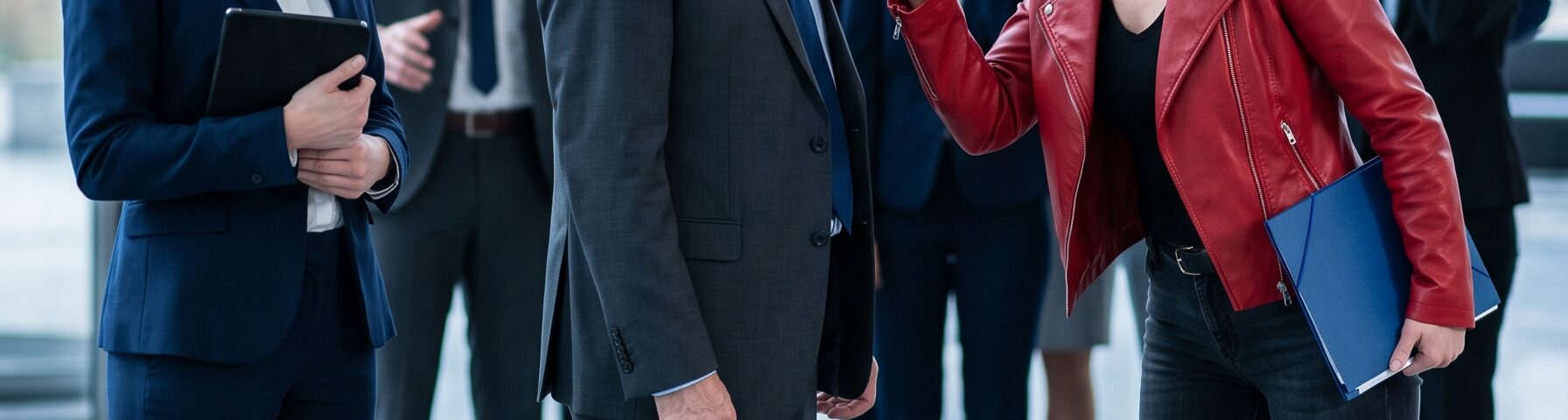
“Did You Even Read the Dress Code?” The VP’s Daughter Sneered on Her First Day Waving the Handbook. “You’re Fired!” In The Lobby, The $3B Investor Hugged Me. “READY TO SIGN THE MERGER?” He Asked. I Smiled. “SORRY SHE JUST FIRED ME. NO DEAL.” He Turned To Her With Cold Eyes.

The boardroom on the forty-second floor always smelled like lemon polish, recycled air, and the faint metallic edge of panic. It was a scent you only noticed if you’d earned the right to be in the room when the numbers on the screen had commas that could alter whole careers.
I’d earned it.
Fifteen years at Sterling Hart taught me that power didn’t usually wear a loud suit or a sharp smile. Real power sat quietly, listened longer than everyone else, and asked one question at the exact right moment. I wasn’t the loudest person on any call. I didn’t need to be. My job wasn’t to dominate the room.
My job was to close it.
Senior Liaison for Strategic Partnerships sounded dull to anyone who didn’t understand how money moved through a city like blood through veins. Internally, it meant this: if a deal was delicate, if the personalities were volatile, if the contract depended on trust more than math, it came to me.
And the Sterling deal was the most delicate of them all.
Nine months of work. Dozens of flights. Three legal teams, two governments, one family trust older than most skyscrapers in Manhattan. A three-billion-dollar acquisition that was supposed to turn Sterling Hart from a respected firm into an unstoppable one. Every clause, every comma, every “subject to” had been sculpted until the agreement was less a document and more a peace treaty.
I stood by the floor-to-ceiling window, tablet in hand, reviewing the final clauses. Below, the city looked like a circuit board, glittering and indifferent. In forty-eight hours, Marcus Sterling would sit across from our CEO and sign.
If everything went smoothly.
The door slammed open.
It wasn’t just an entrance. It was an announcement. A statement. The kind of slam that said someone believed the room belonged to them.
Cassidy Vale clacked in like she was stepping onto a runway. Twenty-four. Fresh MBA. Hair so perfectly styled it looked sprayed into place by a professional whose entire job was to make her seem important. She wore a white power suit that had never known a late-night red-eye flight or a sweaty negotiation in a cramped conference room.
She was holding a thick spiral-bound employee handbook like it was a weapon.
“Excuse me,” she said, voice sharp enough to cut glass.
She wasn’t looking at the boardroom. She wasn’t looking at the city. She was looking at me, specifically at my blazer.
I lowered the tablet and turned slowly, the same way you turn toward a barking dog that has never been trained: calm, neutral, ready.
“Can I help you?” I asked. “Cassidy, right? I’m Emily. We were supposed to—”
“I know who you are,” she interrupted, flicking her wrist like my name was an inconvenience. “And I know what you’re doing.”
I didn’t blink. “Preparing for the Sterling meeting.”
“No.” She stepped closer, her perfume hitting first—jasmine and something synthetic, the smell of confidence bought in a bottle. “You’re violating the dress code.”
For a second, my brain tried to place the sentence into reality and failed.
I glanced down at myself out of reflex, though I already knew exactly what I was wearing: a charcoal vintage Armani blazer with pearl buttons, tailored slacks, and a leather tote with softened edges from years of travel. The outfit had been to Tokyo, Zurich, and Frankfurt. It had sat across from men who owned ports and women who owned media empires. It was the uniform of someone who got invited into rooms like this.
“The dress code,” Cassidy repeated, tapping the handbook with a manicured nail. “Code four, section B. Standardized closures only.”
I stared at her.
She pointed at my blazer like it was contaminated. “Pearl buttons. Not permitted.”
I could feel the building go still around us. Through the glass walls, analysts stopped typing. Junior associates froze with coffee halfway to their mouths. People sensed something dangerous not because voices were raised, but because the wrong person had entered the wrong room and didn’t realize it.
“Cassidy,” I said, tone even, “I’m meeting Marcus Sterling in forty-eight hours to finalize a three-billion-dollar acquisition. This blazer is not the issue.”
Her cheeks flushed, the red climbing like a rising temperature. She wasn’t used to being corrected. She was used to people nodding because her last name had leverage.
“I’m enforcing standards,” she snapped. “If you can’t follow basic rules, how can we trust you with the company’s future?”
It was so absurd that it almost made me laugh. Almost.
Instead, I held her gaze and let silence do what it always did: reveal who was bluffing.
Cassidy lifted her chin. “I’m the Vice President’s chief of staff.”
That title didn’t technically exist for her. Her father, Richard Vale, had been promoted to VP last month. Cassidy had arrived today like a package delivered with his new office key.
“I’m the liaison assigned to the Sterling acquisition,” I said. “And you are interrupting preparation for the most sensitive meeting this company has held in a decade.”
She leaned in, voice dropping into a sneer. “Go home. Change. Write a formal apology to HR for the infraction.”
There it was. Not professionalism. Not standards. Control.
This wasn’t about pearl buttons. This was about marking territory. Taking down someone established on day one. Showing an entire floor that Cassidy Vale didn’t need to understand the work to own the workers.
I saw the tremor in her hand when she held the handbook. I saw the desperation behind the arrogance. She needed a win, and she had picked the biggest target in the room.
I set my tablet down on the conference table, slowly, like I was putting away something sharp.
“No,” I said.
Cassidy blinked. “Excuse me?”
“No,” I repeated, quieter. “I have work to do.”
Her face shifted from disbelief to rage so quickly it was almost impressive.
“You’re fired,” she shrieked.
The words hung in the air like smoke. Ridiculous. Impossible. Yet spoken with the conviction of someone who had never been told she couldn’t.
I watched her breathe hard, eyes wide. She had committed. She had thrown the match.
“You can’t be serious,” I said—not pleading, not panicking, just assessing. “You don’t have the authority.”
“I have authority by proxy,” she snapped. “Pack your things. Security will escort you out.”
Outside the glass, fear spread like a ripple. People weren’t just watching me. They were watching themselves—wondering if fifteen years of work could be erased by a handbook in the hands of a child.
Something cold and clear settled in my chest.
I didn’t feel anger.
I felt relief.
“Okay,” I said.
Cassidy’s expression faltered. She’d expected me to beg, to argue, to melt down. Compliance made her uneasy. Like she’d swung a sword and found no resistance, only a trapdoor beneath her own feet.
“Okay?” she repeated.
I picked up my tablet and snapped the cover shut. “Standards are important,” I said, almost pleasantly. “I’ll pack my things immediately.”
Then I walked past her, shoulder brushing hers, and headed toward my office.
She thought she’d just won.
She had no idea she’d just fired the only person in the building who knew how to keep Marcus Sterling from walking away before the coffee was poured.
Part 2
My office wasn’t sterile like the executive boardroom. It was a living map of how deals actually happened: stacks of annotated drafts, legal pads filled with shorthand that only made sense to me, a battered Rolodex that executives mocked until they needed the number that wasn’t in any database.
Cassidy’s world was digital. Clean. Shallow.
My world was human. Messy. Real.
I didn’t rush. Rushing looks like guilt. I had none.
I opened drawers with deliberate calm. First: personal items. A framed photo of my father, who’d taught me early that integrity was expensive, but desperation cost more. A crystal paperweight Marcus Sterling had given me after we closed the Tokyo logistics deal five years ago. Then: the Rolodex.
It landed in my tote with a heavy, satisfying thud.
My assistant, Sarah, hovered in the doorway. She looked pale, eyes glassy, hands twisting a tissue into confetti.
“Emily,” she whispered, like speaking too loud might summon Cassidy. “Is it true? Did she actually—”
“It’s true,” I said softly. “She did.”
Sarah swallowed hard. “But the merger. The meeting is in two days. Nobody else knows the leverage ratios. Nobody else knows the appendix clauses.”
I glanced at the files on my desk: the preliminary due diligence. The numbers were there, yes. The clauses were there, yes.
But the deal wasn’t in the files.
The deal was in the story behind the files. The Montana parcel that looked like a liability but was actually Marcus Sterling’s family legacy. The handshake promise about retaining key staff in the acquired company. The unspoken line Marcus wouldn’t allow anyone to cross without walking.
Those weren’t on a server.
Those were in my head.
“I’m sure Cassidy is very capable,” I said.
The lie tasted sweet, like poison you choose with your eyes open.
Sarah stared at me as if I’d lost my mind. “Emily, she thinks the server is everything.”
“I know,” I said. “That’s why she reads handbooks.”
I logged out of every encrypted system. I cleared my local cache. I didn’t destroy anything. I simply removed my fingerprints from shortcuts they didn’t deserve.
When I stepped out into the hallway, the entire floor pretended to work. Heads down. Eyes darting. Silence louder than any shouting match.
Cassidy waited by the elevators with two security guards who looked deeply uncomfortable.
“Make sure she didn’t take proprietary data,” Cassidy snapped.
Bob, head of floor security, didn’t even check my bag. He’d watched me work late nights for years. He’d watched me buy his team pizzas during holidays. He met my eyes with apology.
“She’s clean,” Bob mumbled.
Cassidy scoffed. “Fine. Get her out. I want this toxicity off my floor.”
I pressed the elevator button and waited for the ding.
When the doors slid open, I turned to Cassidy. She was braced for a fight, a curse, a dramatic promise that she’d regret it.
Instead, I smiled.
“Thank you, Cassidy,” I said.
Her brow furrowed. “For what?”
“For clarifying the priorities of this organization,” I said lightly. “It’s been illuminating. Good luck with the merger. The appendices are tricky.”
Her mouth opened. “What appendices?”
I stepped into the elevator. “The file is complete,” I said. “Digital drives are so impersonal, though.”
The doors slid shut, cutting off her face just as the first flicker of panic appeared in her eyes.
As the elevator descended, my stomach dipped with gravity. My mind rose with something close to freedom.
Outside, sunlight hit the glass tower like it was mocking the chaos inside. I didn’t hail a cab. I walked two blocks to a quiet café, ordered a double espresso, and sat by the window.
Then I turned my phone off.
Let them sit in the silence a while.
That afternoon, I wandered an art gallery, staring at abstract canvases where chaos had been trapped inside frames. It felt familiar. For the first time in years, I noticed details I’d trained myself to ignore: the texture of paint, the hush of a room with no demands, the way my shoulders dropped when no one expected me to carry a billion-dollar future.
At six p.m., back in my apartment with a glass of wine, I turned my phone on.
It buzzed like an angry hornet for two full minutes.
Fourteen missed calls from Sarah. Three from HR. Five from the general counsel. Unknown numbers. Twenty-seven emails.
I took a sip of wine and scrolled.
Sarah: Legal is asking who authorized your termination. Cassidy is locked in her office.
Sarah: Tokyo partners called. Cassidy told them you were no longer a cultural fit. There was yelling. In Japanese.
Sarah: Where are the appendix files? Cassidy is screaming that you deleted them. She says they never existed on the server.
I smiled. Not because I wanted the company to burn—though I didn’t mind the warmth.
Because they were finally experiencing what it felt like to lose the invisible thing they’d taken for granted: competence.
An email from the general counsel, David, popped up.
Emily, significant breakdown in communication. Call me immediately. We need to reinstate your contract before the Sterling meeting. Cassidy is new and overzealous. Let’s not let emotions derail the merger.
Emotions.
They always called it emotions when a woman reacted, and strategy when a man did.
I set the phone down.
Then I opened the locked drawer in my antique writing desk. Inside was a leather-bound folder embossed in faded gold: NDA Legacy Protocol. Sterling Family Trust.
Most people assumed I was hired because of my résumé.
The truth was older.
My father had been the Sterling family’s attorney. I’d played hide-and-seek in the Sterling estate library while men discussed trust funds and smoked cigars. When Marcus Sterling finally agreed to let outside capital touch his empire, he had one condition: he wanted a bridge. Someone who understood old money, quiet loyalty, and what couldn’t be said on paper.
That bridge was me.
I traced the private number inside the folder. Calling it was the nuclear option. Breached confidentiality. Ended my corporate career if anyone found out.
I dialed anyway.
It rang twice.
“This is Marcus,” came the voice—deep, gravelly, controlled.
“It’s Emily,” I said.
A pause. A shift in the air.
“I thought we were quiet until Friday,” Marcus said.
“We were,” I replied. “But the parameters have changed.”
Part 3
“Changed how?” Marcus asked, and the warmth vanished from his voice, replaced by the steel of a man who owned shipping fleets and never lost sleep.
“I’ve been terminated,” I said.
Silence. So long I checked my screen to make sure the call hadn’t dropped.
“Terminated,” he repeated, like the word didn’t belong in his world. “By whom?”
“By the Vice President’s daughter,” I said. “A dress code violation. Culture misalignment.”
“A dress code violation,” Marcus said flatly.
“Yes.”
“And who is handling the Montana transition clauses?”
“Nobody,” I said. “They think the server file is sufficient.”
A sound came through the line—half laugh, half growl. “Files on a server list Montana as dead acreage.”
“Correct,” I said. “Without my addendum, the algorithm flags it for liquidation within six months.”
Marcus exhaled slowly. “So they fired the only person who knows what matters, forty-eight hours before closing.”
“That appears to be the situation.”
Another pause, shorter this time. “Are you free for breakfast tomorrow?”
“Unemployed, Marcus. I’m free all day.”
“Good. Meet me at the Pierre. Eight a.m.” His voice sharpened. “And Emily—don’t sign anything with them. No severance. No NDA extension. Nothing.”
“I wouldn’t dream of it.”
When I hung up, my apartment no longer felt like a refuge. It felt like a war room.
The next morning, the Pierre served breakfast with hushed efficiency that made every conversation feel like a coup. Marcus Sterling looked exactly as he always did: navy suit, silver hair, eyes that had seen everything and were impressed by nothing.
We didn’t discuss weather. We didn’t discuss menus.
“They called my team,” Marcus said, buttering toast with surgical calm.
“Cassidy?” I asked.
Marcus’s mouth twitched. “She told my counsel you were hospitalized. Severe exhaustion. Fully briefed her.”
The audacity nearly made me choke on my tea. “That’s not just a lie,” I said. “That’s a dangerous one.”
“If you’re sick, delay clauses trigger,” Marcus replied. “If you’re fired, key-person disclosure triggers. She’s trying to buy time.”
“She thinks she can charm you,” I said.
“She thinks I’m a checkbook with legs,” Marcus corrected, eyes cold.
He slid a document across the table. Not a merger agreement. A consultancy contract.
“My holding company needs a Director of Strategic Acquisitions,” he said. “Salary double. Equity. First assignment: find a new buyer for my company.”
I stared at the paper. It wasn’t just a job.
It was freedom.
“There’s one thing,” Marcus added, a shark-sleek grin appearing. “I’m still scheduled to visit your tower tomorrow at nine.”
“Why?” I asked, though I already suspected.
“Because I want to see her face when she tries to explain why the ‘hospitalized liaison’ is standing on the other side of the room.”
He leaned in. “You’ll be in the lobby. Visible. I’ll handle the meeting. You handle the exit.”
My access credentials were revoked that afternoon. Rumors hit the financial blogs by evening. Sterling Hart’s stock wobbled. By dawn, it was bleeding.
The morning of the meeting, the sky was bruised purple with rain. I sat in a coffee shop across from Sterling Hart Tower with Marcus’s assistant, James, a man who looked like he’d been carved out of marble and dressed by the kind of tailor who didn’t accept normal money.
Across the street, behind the lobby glass, Cassidy paced like a trapped animal. She was yelling at a receptionist, gesturing at elevators, trying to look like the gatekeeper. Then she looked out the window.
She saw us.
More importantly, she saw James.
Everyone knew James. He was the harbinger of Marcus Sterling.
Cassidy froze. Her mouth opened. She grabbed her phone and started dialing.
My phone stayed silent.
I’d blocked her number an hour earlier.
“Let her sweat,” James said calmly. “Panic makes people sloppy. Marcus hates sloppy.”
At nine sharp, a black town car glided to the curb. Marcus stepped out, buttoned his jacket, and looked up at the tower with the expression of a demolition expert assessing a condemned building.
He walked in.
Twenty minutes later, I crossed the street and entered the lobby.
The marble floors amplified my footsteps. The waterfall roared softly in the background. The air-conditioning was cold enough to make the scene feel like a museum exhibit.
Marcus stood near the turnstiles, still, waiting. Cassidy was there too, slightly disheveled—white suit wrinkled, hair no longer perfect. The CFO and general counsel hovered like men who wanted to disappear.
Cassidy was saying, voice shrill, “As I said, Emily is indisposed. Hospitalized. She briefed me fully. I’m ready to proceed with signing.”
Marcus stared at her without blinking. “In the hospital,” he repeated.
“Yes,” Cassidy said too fast.
Marcus pulled out his phone and tapped once. “That’s strange,” he said. “Because I just received a text from her.”
Cassidy’s face emptied of color.
Marcus turned slightly, eyes scanning the lobby, and landed on me.
He didn’t smile. He simply opened his arms.
I walked forward.
Marcus hugged me, brief and firm, like a man confirming reality. Then he stepped back and spoke loudly enough for the whole lobby to hear.
“Ready to sign the merger?” he asked.
I smiled.
“Sorry,” I said clearly. “She just fired me.”
I let the silence hit, then added, “No deal.”
Marcus turned to Cassidy.
His eyes were cold enough to frost glass.
Part 4
Cassidy stumbled over her own breath. “She’s lying,” she blurted, pointing at me. “She must be— I fired her.” The truth spilled out like panic vomit. “She violated the dress code!”
The CFO’s head snapped toward her. “You did what?”
Marcus didn’t raise his voice. He didn’t have to. His calm was its own kind of violence. “You told my legal team she was hospitalized,” he said. “You lied to me, to your own counsel, and you terminated the project lead forty-eight hours before closing.”
Cassidy’s lips trembled. “Her buttons,” she insisted. “Her bag. It’s in the handbook.”
Marcus’s laugh was dry and sharp. “You fired the architect of a three-billion-dollar deal over buttons.”
He looked at the CFO. “Is this the leadership I’m buying? Is this the judgment I’m investing in?”
The CFO stepped forward, hands raised, desperation dripping from every gesture. “Mr. Sterling, this is a misunderstanding. Cassidy is new. We can reinstate Emily immediately. With a bonus. Whatever you want.”
Marcus raised one hand, a simple stop. Then he turned to me. “Emily, are you employed by this company?”
“No, Mr. Sterling,” I said. “My employment was terminated for cause effective Tuesday morning.”
Marcus nodded once. “Then you have no authority to negotiate. None whatsoever.”
He turned back to the cluster of executives. “There is no one here I trust to sign this paper.”
Cassidy’s voice cracked. “You can’t! We have a term sheet!”
“Term sheets are contingent on good faith,” Marcus said, ice in every syllable. “You’ve demonstrated none.”
He pivoted toward the revolving doors. “Meeting’s off. Good day.”
As Marcus walked out, the lobby didn’t just fall silent. It detonated.
The CFO, Henderson, erupted like a man watching his house burn while someone argued about curtain colors. “You fired her!” he roared at Cassidy, the acoustics turning his rage into thunder. “Without legal. Without board approval!”
Cassidy shrank back against the security desk, suddenly not a predator but a terrified child in an expensive suit. “She was insubordinate! Disrespectful!”
“You’re a liability,” Henderson shouted. “That was three billion walking out the door. That was our stock price. That was my pension!”
Cassidy’s eyes snapped to me, wild. “This is your fault!” she screamed. “You set me up!”
“I planned to wear a blazer,” I said calmly. “You planned the rest.”
Henderson spun toward me, forcing a smile that looked painful. “Emily. Emily, please. Ignore her. She’s suspended. Effective immediately. We can fix this. We can call Marcus back. You’ll be Senior VP. Twenty percent raise. Options. Just pick up the phone.”
I looked at him—the man I’d saved more times than he’d ever admitted. He wasn’t asking because he respected me. He was asking because he needed me.
“My answer is no,” I said.
His face tightened. “Name your number.”
“It’s not about a number,” I replied.
I reached into my tote and pulled out a cream-colored envelope.
“What’s that?” Henderson asked.
“My acknowledgment of termination,” I said, letting him believe it was resignation. “You can’t rehire someone you publicly terminated for cause without triggering a cascade of liability.”
Henderson’s eyes went glassy. “Where will you go?”
“The client,” I said simply.
Realization hit him like a punch. “You’re working for Sterling.”
“As of this morning,” I said. “Director of Strategic Acquisitions.”
Henderson took a step back, looking suddenly older. “You’ll negotiate against us.”
“If you want to salvage anything,” I said. “Yes.”
I checked my watch. “But not today.”
Then I walked out of the lobby, leaving behind a corporate carcass still twitching.
Three days later, Sterling Hart stock dropped eighteen percent. Blogs called it a leadership crisis. Analysts used phrases like internal chaos and governance failure. The board begged Marcus Sterling for another meeting.
Marcus agreed on one condition: the entire executive team, including the VP and his daughter, would be present to apologize.
The boardroom was packed. The air-conditioning blasted, but everyone still sweated. Cassidy sat at the far end, no white suit, no perfume cloud, just a dull gray dress and a face that looked like it had been scrubbed raw.
Her father, Vice President Richard Vale, wouldn’t look at her.
The doors opened. Marcus walked in, followed by James.
Then me.
I entered last, wearing a new black suit with gold buttons.
The room inhaled as one.
The CEO started to speak, voice shaking. “We believe this meeting is to discuss reinstatement of the merger—”
“I’m not here to merge,” Marcus said, sitting at the head of the table like it belonged to him. “I’m here to make an offer for your assets at thirty cents on the dollar.”
Henderson choked. “Thirty cents? That’s robbery.”
“That was the price when you had competent leadership,” Marcus said calmly. “That was the price when you had Emily.”
Every head turned toward me, betrayal and panic in their eyes.
Cassidy whispered, barely audible. “Emily… how could you?”
I looked at her, and for the first time, I didn’t feel anger.
I felt pity.
“I worked here fifteen years,” I said. “I followed the code. I played the game. And you decided it wasn’t enough.”
The VP finally spoke, voice strained. “Emily, come back. We’ll fire Cassidy. We’ll give you her job. Just tell him to sign the original deal.”
Marcus leaned back, watching me. “Ready to sign?” he asked, almost conversational.
I smiled.
“Sorry,” I said softly. “She just fired me. No deal.”
Marcus stood. “You heard the lady. Thirty cents on the dollar. You have until five p.m., or we wait for bankruptcy and buy it for ten.”
He walked out.
I followed.
And for the first time in fifteen years, I didn’t check my reflection to see if my buttons were straight.
I already knew they were.
Part 5
The first week at Sterling Holdings felt like stepping from a glass maze into open air. Marcus didn’t run his company like a social club for executives. He ran it like a ship in deep water: clear roles, clear expectations, no tolerance for performative leadership.
James handed me a keycard and a thin laptop that looked unremarkable but could probably access satellites. “Welcome,” he said, as if it were a verdict.
My new office had windows, but no vanity. A large table. Two chairs. A wall-sized whiteboard. A safe built into the floor.
Marcus came by on day one and said, “I don’t hire people I have to babysit.”
“Good,” I replied. “I’m tired of babysitting.”
He nodded like that was the correct answer.
The Sterling Hart board panicked publicly and fought privately. At first they tried to posture—press releases, reassurances, talk of “continued strategic vision.” Meanwhile their stock slid and their lenders started calling.
I knew how the next phase would go because I’d lived inside it for years: when a company loses its story, it becomes a carcass. Everyone starts carving.
Marcus’s thirty-cent offer wasn’t just aggressive. It was accurate.
Sterling Hart’s valuation had been propped up by trust in leadership and by the Sterling deal itself. Without it, their environmental liabilities, especially the Montana parcel, turned from a sentimental footnote into a legal nightmare.
I called Tokyo.
Not the official line. The private one.
The Tokyo partners didn’t want to hear from Sterling Hart. They wanted to hear from me. They were furious at being told I was “no longer a cultural fit,” and in their world, that phrase translated to insult.
“We will not tolerate disrespect,” their lead counsel said through clipped English.
“I understand,” I replied. “And I’m sorry you were dragged into incompetence.”
Silence, then a quiet, approving chuckle.
I offered them something better: stability. A path forward through Sterling Holdings that preserved their interests and insulated them from Sterling Hart’s collapse.
Within forty-eight hours, Tokyo agreed to move their partnership discussions away from Sterling Hart and toward Marcus.
That single shift knocked another support beam out of Sterling Hart’s structure.
Next, Montana.
On paper, it was non-revenue acreage. In reality, it was a web: environmental protection clauses, legacy trust provisions, and a hidden condition Marcus had required when he first entertained any deal at all.
He would not allow his family’s land to be liquidated to satisfy a quarterly report.
And Sterling Hart had no idea what they’d agreed to, because the only person who could translate it had been fired over buttons.
I drafted a new proposal for Marcus: not a merger, but a staged acquisition. Buy their profitable divisions cheap, leave their liabilities where they belonged, offer a transition package to retain key employees, and, most importantly, place the Montana parcel into a conservation-backed trust that could not be sold off by desperate executives.
When Marcus read it, he smiled faintly. It was the closest he came to praise.
“You’re protecting the legacy,” he said.
“I’m protecting leverage,” I replied. “Legacy just happens to be what makes this deal move.”
On day nine, Sterling Hart’s board requested another meeting. This time, they didn’t posture. They begged.
I attended as Marcus’s advisor, sitting quietly, taking notes, watching faces. Henderson looked hollow. The CEO looked sleep-deprived. The VP looked furious, like his pride had been stripped away layer by layer.
Cassidy wasn’t there. Rumor had it she was “on leave,” which meant hidden in her father’s office while lawyers tried to build a narrative where she was an anomaly, not a symptom.
The board accepted Marcus’s thirty-cent offer by 4:47 p.m. on the deadline day.
Not because they liked it.
Because the alternative was bankruptcy, and everyone knew Marcus would buy the whole company for ten cents during the auction and still sleep like a baby.
When the agreement was signed, Marcus didn’t toast. He simply said, “Good. Now we do the hard part.”
The hard part was people.
I insisted on retention packages for the teams that had actually built Sterling Hart’s value: analysts, project managers, legal staff, operations. People who’d watched Cassidy waltz in and torch their future without understanding what she held.
Marcus agreed, not out of softness, but because he understood something most predators missed: talent didn’t stay loyal to money. Talent stayed loyal to respect.
I called Sarah—my old assistant—on a Friday evening.
She answered on the first ring, voice raw. “Emily?”
“You want a job?” I asked.
She laughed, half-sob. “Is that a real question?”
“It’s a real offer,” I said. “Come build something where handbooks aren’t used like knives.”
Sarah didn’t hesitate. “Yes.”
That night, I stood in my apartment, the same place where I’d turned off my phone and watched the tower burn from a distance. I looked at my new suit hanging on the chair. Gold buttons, smooth fabric, no pearl.
I smiled.
Not because I’d won.
Because I’d stopped playing their game.
Part 6
Sterling Hart tried to make Cassidy disappear quietly, but the market doesn’t respect quiet. Neither do regulators.
The press caught wind of the internal termination chaos: unauthorized firing of key personnel, misrepresentation to a counterparty, failure to disclose key-person changes as required by contract terms. Investors started asking questions about governance. Lenders started asking if the board had any control at all.
When someone starts asking if the adults are in charge, it’s already too late.
A whistleblower package landed on a journalist’s desk: emails, messages, internal meeting notes. The story wasn’t just “VP’s daughter ruins deal.” It was systemic nepotism exposed under fluorescent light.
Richard Vale’s name got dragged into it, and he panicked. He tried to salvage his reputation by throwing Cassidy fully under the bus, publicly calling her “overzealous,” privately insisting she’d acted alone.
That might have worked if Cassidy had been smarter.
But panic makes people sloppy.
Cassidy hired a lawyer and threatened a wrongful termination suit against Sterling Hart, claiming she’d been scapegoated. In the process, she leaked things her father didn’t want leaked: that she’d been promised influence, that her title had been invented, that she’d been encouraged to “assert authority immediately.”
It wasn’t just messy.
It was radioactive.
The board forced Richard Vale to resign within three weeks of the asset sale. They framed it as “stepping down to focus on family.” The market translated it correctly: sacrifice the VP to prove you can.
Cassidy’s social circle evaporated. People who’d laughed at her jokes stopped answering her calls. Companies stopped inviting her to networking events. The city’s finance world is small and ruthless, and nothing travels faster than a story that ends with a three-billion-dollar investor walking out because you fired the wrong woman over pearl buttons.
One afternoon, months later, I ran into Cassidy by accident.
Not in a boardroom.
In a quiet café near my new office.
She stood near the pickup counter, wearing plain slacks and a cardigan. No power suit. No handbook. Her hair pulled back, face bare. If I hadn’t known her, I might have mistaken her for any other young professional trying to look invisible.
Her eyes met mine, and for a second, I saw something human: exhaustion, fear, the shock of consequences.
She swallowed. “Emily.”
I didn’t smile. I didn’t glare. I simply acknowledged her presence the way you acknowledge weather.
“Cassidy,” I said.
Her hands tightened around her coffee cup. “I didn’t know,” she blurted. “About any of it. About Montana. About the trust. About you.”
“I know,” I said calmly. “That was the problem.”
Her mouth opened, then shut. Her cheeks reddened. “My dad—”
I lifted a hand slightly. Not aggressive. Just a boundary. “This isn’t about your dad.”
Cassidy’s eyes flickered, like she was looking for a script that didn’t exist.
“I ruined everything,” she whispered.
“You ruined your first day,” I corrected. “Sterling Hart ruined itself by building a culture where competence could be overwritten by entitlement.”
She flinched. “I was trying to enforce standards.”
“You were trying to enforce control,” I said. “Standards are about excellence. Control is about fear.”
Cassidy’s gaze dropped to my tote bag—distressed leather, softened edges, the one she’d called toxic. She looked like she wanted to apologize and didn’t know how without making it about herself.
“I’m sorry,” she said finally, voice thin.
I believed her in the way you believe someone who’s sorry they touched a hot stove. The pain had educated her.
“Good,” I said. “Now learn something.”
She blinked up at me, startled.
“Read a different handbook,” I added, then turned and walked out.
Not because I was cruel.
Because forgiveness is not a job requirement.
And because my life was no longer organized around people like Cassidy learning lessons at my expense.
Part 7
At Sterling Holdings, I built a team the way my father had taught me to build anything: with integrity first, then talent, then loyalty earned through action.
Sarah became my chief coordinator within two months. She thrived in a place where her intelligence wasn’t treated like background noise. I recruited two legal analysts from Sterling Hart who’d been quietly brilliant for years but never promoted because they weren’t flashy. I brought in a compliance specialist who’d survived three corporate scandals and wore cynicism like armor.
Marcus let me work.
He didn’t micromanage. He didn’t flatter. He simply expected results and offered resources. That was his version of respect.
Our first major move was stabilizing the acquired assets: reassuring clients, locking down key contracts, and managing layoffs with as much dignity as the market allowed. Marcus could have gutted Sterling Hart’s divisions for profit, but he understood that scorched earth leaves nothing worth owning.
We created retention paths for high performers. We set up a legacy program for long-term employees that rewarded institutional knowledge instead of punishing it. We moved the Montana parcel into a conservation trust with clear legal walls. Marcus signed it personally.
The press tried to spin it as a PR stunt.
Marcus didn’t care.
“It’s not charity,” he told me. “It’s strategy. People fight harder for something they can respect.”
One Friday evening, I drafted a new internal policy document. Not an employee handbook in the old sense. Something leaner, sharper, less obsessed with appearances and more obsessed with behavior.
Dress code: professional, client-appropriate, culturally aware. No mention of standardized closures. No hysteria about bags. Instead, the emphasis was on what actually mattered: transparency, accountability, competence, and a strict prohibition against using policy as a weapon.
Sarah read it and smiled. “If Sterling Hart had this, Cassidy would’ve had nothing to hide behind.”
“Exactly,” I said.
A year after the lobby incident, we hosted a small internal event. Not a party. A debrief disguised as celebration. The kind of thing companies do when they want to acknowledge a win without admitting how close they came to disaster.
Marcus stood at the front of the room with a glass of water. He didn’t do champagne speeches.
He looked at the team and said, “We acquired assets. We stabilized clients. We retained the people who make value. That’s success.”
Then he looked at me.
“And we did it because someone in this room understands that the paper is not the deal. The people are.”
That was the closest thing to praise I’d ever get from Marcus Sterling.
Afterward, Sarah nudged me. “He likes you,” she whispered.
“He respects results,” I said.
“That’s his love language,” Sarah replied.
I laughed, and the sound surprised me. It had been a long time since work made me laugh.
Late that night, Marcus stopped by my office door. He didn’t knock. He never knocked. He simply appeared with that quiet, predatory grace.
“You did well,” he said.
“Thank you,” I replied.
He glanced at my blazer. Gold buttons. “Nice closures,” he deadpanned.
I arched an eyebrow. “Did you even read the dress code?”
Marcus’s mouth twitched. “I wrote the new one.”
We stood there for a beat, the air lighter than it used to be in corporate towers. Then Marcus turned and walked away, leaving behind a simple truth:
I wasn’t surviving corporate life anymore.
I was shaping it.
Part 8
Two years after Cassidy fired me, Sterling Hart barely existed as a name. The brand lived on as a line item inside Sterling Holdings’ portfolio, stripped of its illusion and rebuilt into something useful. The people worth keeping had moved over. The clients worth serving had stabilized. The liabilities were contained behind legal walls thick enough to withstand storms.
Every once in a while, I’d pass the old tower and feel nothing.
No anger.
No nostalgia.
Just the faint amusement of remembering pearl buttons and a handbook held like a blade.
On a clear Monday morning, Marcus called me into his office. He slid a file across his desk. “New acquisition,” he said. “Your call.”
I opened it. A mid-sized logistics firm with a strong workforce, decent margins, and one major issue: a founder with old-money pride and a board full of impatient venture capital.
I looked up. “They need a translator,” I said.
Marcus nodded once. “Exactly.”
I didn’t realize, then, how much my life had narrowed around the idea of translating power—old to new, quiet to loud, legacy to quarterly earnings. It was what I’d always done. The difference now was that I did it with authority, not permission.
That afternoon, Sarah walked into my office holding a small box.
“What’s that?” I asked.
She grinned. “A gift from the team.”
Inside was a set of pearl buttons mounted on a tiny plaque like museum artifacts. Underneath, engraved in neat lettering:
Standardized closures only.
I laughed so hard I had to sit down.
Sarah smiled. “We thought you’d appreciate the irony.”
I ran my thumb over the smooth pearl and felt something settle in me. Not vengeance. Not bitterness.
Closure.
Later, as I headed to the elevator, I caught my reflection in the polished metal. New suit. Gold buttons. Distressed tote. Calm eyes.
For years, I’d checked myself in mirrors before big meetings, making sure I looked like I belonged.
That day, I didn’t adjust anything.
I didn’t need to.
I stepped into the elevator and pressed the button without hesitation.
As the doors slid shut, I thought of Cassidy standing in that lobby, shrieking about dress codes while a three-billion-dollar investor watched her unravel. I thought of Henderson begging me to fix what they broke. I thought of Marcus’s cold eyes when I said, No deal.
And I understood the real lesson.
It was never about a blazer.
It was about believing you can replace competence with entitlement.
It was about confusing authority with wisdom.
It was about thinking a handbook can save you when you refuse to read the room.
The elevator descended smoothly, carrying me toward a day filled with real work, real leverage, and real decisions.
And for the first time in my career, the air didn’t smell like fear anymore.
It smelled like possibility.
Part 9
The new acquisition file Marcus slid across his desk looked harmless at first glance: a mid-sized logistics firm with a clean balance sheet, a recognizable client list, and a founder named Henry Wexler who’d built the company from one warehouse and a beat-up box truck.
Then I read the board minutes.
Impatient venture capital. A push for a quick flip. A founder who treated the company like a family heirloom. Two incompatible definitions of success trapped under the same roof.
“They’ll tear each other apart,” Sarah said when I handed her the summary.
“They already are,” I replied.
Marcus didn’t buy companies for fun. He bought them when the market handed him an opening and everyone else was too arrogant to see it. But this deal wasn’t just about timing. It was about translation—taking a proud founder who spoke legacy and a board that spoke exit multiples, and getting them to sign the same paper without destroying the thing they were selling.
We set the first meeting in Chicago, in Wexler’s headquarters: brick walls, exposed beams, framed photos of trucks from the eighties. Henry Wexler met us in the lobby himself, tall and solid, hands rough, eyes sharp.
He looked Marcus over like he was measuring whether a suit could understand labor.
“You’re Sterling,” Henry said.
“I am,” Marcus replied.
Henry’s gaze slid to me. “And you’re the one who’s actually dangerous.”
It wasn’t a compliment. It was recognition.
“I’m Emily,” I said. “I’m here to make sure nobody walks out of this room angry enough to burn the building down.”
Henry’s mouth twitched. “Good. Because that’s where I’m at.”
We sat in a conference room that smelled like coffee and dust and hard work. The VC reps arrived late, dressed like they were doing Henry a favor by showing up at all. Their lead, a woman named Trish, smiled too brightly and said, “We’re excited to explore strategic options.”
Henry didn’t bother with corporate language. “You mean you’re excited to sell my company out from under me.”
Trish’s smile stayed fixed. “We’re excited to maximize value for all stakeholders.”
Henry slammed his hand on the table. “My drivers are stakeholders. My dispatchers are stakeholders. Their mortgages are stakeholders.”
This was the moment most deals died—two sides convinced the other was the enemy, pride and greed turning the air into gasoline.
I leaned forward and spoke quietly. “Everybody wants control,” I said. “The question is what kind.”
Trish’s eyes narrowed. “Excuse me?”
“Henry wants control because he built something,” I continued. “You want control because you funded it. Marcus wants control because he can stabilize it. I want control because chaos is expensive.”
Silence. Then Henry exhaled sharply, like he’d been holding his breath for months.
Trish tilted her head. “And what’s your solution, Emily?”
“My solution is simple,” I said. “We buy the company, we keep the workforce intact, we set performance targets for expansion, and Henry stays involved as an operating advisor with real authority over the parts he built.”
Trish’s smile became a little tighter. “That’s not a clean exit.”
“It’s not a clean exit if your only goal is cash,” I replied. “But it is a clean exit if your goal is value. You don’t maximize value by gutting the thing that creates it.”
Henry stared at me. “You’d keep my people?”
“We don’t buy hollow shells,” Marcus said. “We buy engines.”
Trish leaned back, eyes calculating. “What’s the number?”
Marcus named it. It was fair, not generous. Enough to satisfy the VCs, enough to keep Henry from feeling like he’d been robbed.
Trish didn’t say yes immediately. She wanted leverage. She wanted to make us beg. So she tried a move I’d seen a hundred times: she turned to Henry and said, “If you’re emotional about this, Henry, maybe you should step out.”
Henry went rigid, like someone had hit an old bruise.
I didn’t let him explode. I didn’t let her win the room.
I turned to Trish. “Careful,” I said. “You’re about to do something you can’t undo.”
Her brows rose. “Is that a threat?”
“It’s a warning,” I replied. “I’ve watched people lose billion-dollar deals because they couldn’t resist humiliating the wrong person.”
Trish stared at me for a long beat, then shifted her gaze away first.
The meeting ended without a signature, which was fine. In negotiations, sometimes the win is simply not losing.
Outside, Henry walked with me to the lobby.
“I don’t like Sterling’s reputation,” he said bluntly. “People say he eats companies.”
Marcus was already heading toward the car. I stayed with Henry a moment longer.
“Marcus eats chaos,” I said. “Not companies.”
Henry grunted. “And you?”
I thought of the old tower, Cassidy’s handbook, the waterfall lobby, and the moment Marcus hugged me like a verdict in front of everyone.
“I eat arrogance,” I said.
Henry laughed once, surprised by it. “Good. Because my board is full of it.”
Back at Sterling Holdings, Sarah handed me a sealed envelope. “It came by courier,” she said. “No return address.”
Inside was a subpoena.
Sterling Hart’s downfall had finally attracted the kind of attention that didn’t care about spin: regulators, auditors, investigators. The governance failures, the misrepresentations, the contract breach risk—someone was building a case that would be painful for everyone who’d been in that tower.
My name was on the list.
Sarah looked alarmed. “Are you in trouble?”
“No,” I said. “I’m a witness.”
But being a witness in corporate war is still dangerous. It means you’re in the story, whether you want to be or not.
Marcus walked into my office later and looked at the subpoena without blinking.
“They’re going to try to make you the villain,” he said.
“Let them,” I replied. “I didn’t lie. I didn’t forge authority. I didn’t weaponize policy.”
Marcus nodded once. “Good. Then we tell the truth.”
I sat at my desk that night, reading through old emails and timelines, building my own file the way I always did: facts first, emotion last. I didn’t feel fear. I felt something steadier.
If Sterling Hart wanted to burn down the remnants of its reputation to protect itself, fine.
I’d already left the building.
Part 10
The deposition room was smaller than I expected. No waterfall. No marble. Just beige walls, a long table, a recorder, and a court reporter whose typing sounded like rain on glass.
Across from me sat Sterling Hart’s outside counsel, flanked by an investigator and a corporate compliance officer with tired eyes. They offered me water like they were being polite. But politeness in this context was just packaging.
Their questions started simple: my job title, my responsibilities, timeline of the Sterling negotiations. Then they sharpened.
“Did you ever receive formal written authority to negotiate on behalf of Sterling Hart regarding the Montana parcel?”
“Yes,” I said, sliding a document across the table. “Signed by the CEO and general counsel, dated nine months before close.”
The attorney’s jaw tightened. “And the addendum you referenced—was that stored on company servers?”
“It was partially,” I answered. “The legal language was in the draft. The operational and relational requirements were held in secured notes and direct communications with the Sterling family counsel.”
“So it wasn’t documented,” he tried.
“It was documented,” I corrected. “It just wasn’t reducible to a PDF without destroying the reason the clause existed.”
He frowned, annoyed. “Are you suggesting Sterling Hart’s system is inadequate?”
“I’m suggesting Sterling Hart relied on people more than it admitted,” I said. “Which is common. And dangerous when you treat people as replaceable.”
Then came the question they were really circling.
“Describe the circumstances of your termination.”
I took a breath. “Cassidy Vale entered the boardroom on her first hour of employment,” I said. “She cited the employee handbook regarding standardized closures and ‘distressed’ accessories. She demanded I go home and write a formal apology. I refused. She declared me terminated. Security escorted me out.”
The investigator blinked. “Over buttons.”
“Yes,” I said.
The compliance officer rubbed his forehead like he’d been living inside this nightmare for months.
“Did Cassidy have authority to terminate you?” the attorney asked quickly.
“No,” I replied. “Not under any written policy I’ve ever seen. But authority wasn’t the tool she used. She used fear.”
The attorney leaned forward. “Did anyone instruct her to do this?”
“I can’t speak to her private conversations,” I said. “But I can speak to the culture that made her believe she could.”
After three hours, the deposition ended. I stepped outside into crisp air and felt something I didn’t expect: lightness.
The truth had weight, but it also had clarity. In corporate environments, clarity is rare. And when you have it, it’s a kind of armor.
Back at Sterling Holdings, Marcus’s assistant James met me in the hallway.
“Marcus wants to see you,” he said, like it was weather.
Marcus was standing by the window in his office, hands behind his back, looking out at the city the way generals look at maps.
“They tried to trap you,” he said without turning.
“They tried,” I replied. “They failed.”
Marcus nodded once. “Good.”
He turned and held up a thin folder. “Wexler’s board agreed to our terms,” he said. “Conditional on Henry staying.”
“Smart,” I said.
“Not smart,” Marcus corrected. “Necessary. Henry is the company.”
I took the folder and scanned the highlights. The numbers were solid. The structure was fair. The retention clauses were tight.
One line caught my eye: a request for a public statement from Sterling Holdings about ethical governance and leadership culture.
I looked up. “They want a press release.”
Marcus’s mouth twitched. “They want reassurance.”
“I can write it,” I said.
Marcus nodded. “You will.”
That night, I drafted the statement carefully. Not marketing fluff. Not corporate nonsense. A clean message: competence matters. Governance matters. Policies exist to protect, not to punish. Leadership is responsibility, not a surname.
Sarah read it and said quietly, “If Sterling Hart had ever said this out loud, half the building would’ve stayed loyal.”
“They didn’t want loyalty,” I said. “They wanted obedience.”
The next morning, Marcus signed the Wexler deal in Chicago. Henry Wexler shook his hand, then shook mine, grip firm.
“Don’t let them turn you into a myth,” Henry said under his breath. “My people need to know what you actually did.”
“I didn’t save them,” I said. “I just stopped the wrong people from hurting them more.”
Henry nodded slowly. “That’s saving.”
On the flight home, Sarah sat beside me reading news alerts. “Sterling Hart’s board is under investigation,” she murmured. “They’re naming names.”
“Let them,” I said.
Sarah looked at me. “Does it ever bother you? That one twenty-four-year-old with a handbook nearly derailed everything?”
I stared out the plane window at clouds like folded fabric. “It wasn’t one person,” I said. “Cassidy was just the cleanest symptom.”
“What’s the cure?” Sarah asked.
I thought of the new policy I’d drafted. The plaque with pearl buttons. The teams we’d retained. The way Marcus had hugged me in the lobby like a declaration of allegiance.
“The cure is building a place where competence can’t be overruled by entitlement,” I said. “And then enforcing it.”
Sarah smiled faintly. “You sound like you’re building your own empire.”
I didn’t deny it.
Because for the first time, I understood something clearly: I didn’t just want to win deals.
I wanted to change what winning looked like.
Part 11
Two years later, Sterling Holdings held its annual leadership summit in a room that didn’t smell like fear. That was the first thing I noticed.
It smelled like coffee, faint wood polish, and the quiet confidence of people who weren’t bracing for humiliation.
Marcus stood at the front, as always, not wasting words. Around him sat executives, managers, analysts, operations leads—people from Wexler Logistics, people from the old Sterling Hart divisions we’d absorbed, people we’d hired fresh because we didn’t want to inherit bad habits.
I sat in the second row with Sarah, a tablet on my lap, notes prepared. The agenda wasn’t about profit projections. It was about systems. Culture. Risk. The kind of conversation that prevents disasters instead of cleaning them up afterward.
Marcus spoke for ten minutes, then stopped and looked at me.
“Emily,” he said. “Stand up.”
I did, confused.
He faced the room. “I built Sterling Holdings by buying undervalued assets,” he said. “But I’ve learned something. The most undervalued asset in any company is competence that isn’t protected.”
He paused, eyes scanning faces.
“This woman protected competence when it was inconvenient,” he continued. “She turned a public firing into a structural advantage. She built teams that don’t flinch. She translated legacy into strategy. She made us better.”
I felt my throat tighten, which annoyed me.
Marcus didn’t do sentiment. If he was speaking like this, it meant something.
“I’m appointing Emily as President of Sterling Holdings effective immediately,” he said.
The room went still, then erupted into applause.
Sarah grabbed my hand under the table, squeezing hard. I stood there, heat rising into my face, and thought of the old tower’s waterfall lobby, the handbook, the pearl buttons, Cassidy’s shriek.
I thought of my father’s photo on my desk, his quiet lessons about integrity and cost.
Marcus stepped closer and said low enough only I could hear, “Don’t thank me.”
“I wasn’t going to,” I whispered back.
His mouth twitched. “Good.”
After the summit, people approached me—congratulations, questions, offers of support. I answered with the same calm I’d used in boardrooms for years. Inside, something steady clicked into place.
This wasn’t revenge anymore.
This was direction.
That afternoon, I walked into my new office and found a small box on the desk. No note.
Inside was a single pearl button.
I smiled.
I opened a drawer and placed it beside the plaque Sarah had given me years ago, the one with standardized closures only engraved underneath. I didn’t keep it out of bitterness. I kept it as a reminder: rules can be used to build or to destroy. The difference is always intent.
As I turned back to my desk, Sarah appeared in the doorway.
“There’s someone downstairs asking for you,” she said carefully.
“Who?” I asked.
Sarah hesitated. “Cassidy Vale.”
For a moment, time folded. I saw her white suit in the lobby, her trembling finger, her shriek. I felt the old irritation rise, then pass through me like a wave that no longer had anything to crash into.
“Send her up,” I said.
Cassidy entered my office looking older than her age. Not in years. In consequence. Her hair was simpler now. Her posture less performative. She held no handbook. Just a thin folder.
“Emily,” she said quietly.
“President,” I corrected without cruelty. “That’s the role now.”
Cassidy swallowed. “President,” she repeated.
She held out the folder. “I’m working in compliance now,” she said. “Not here. Another firm. I… I wanted to give you something.”
I didn’t take it yet. “Why?”
Cassidy’s eyes flickered. “Because I finally understand what I did. Not just to you. To everyone.”
She opened the folder and slid a document forward: a draft policy framework for preventing nepotism abuse and weaponized enforcement. Clear reporting lines. Termination authority rules. Whistleblower protections. Mandatory training on power misuse.
It was good.
I looked up at her. “Did you write this?”
“Yes,” she said. “With a team. But I pushed for it. Hard.”
“Why bring it to me?” I asked.
Cassidy’s voice shook. “Because you were right. Control isn’t standards. It’s fear. And I used fear like it was a tool I deserved.”
Silence stretched. Cassidy held it, for once not trying to fill it with excuses.
I finally took the folder. “This is solid,” I said.
Cassidy exhaled like she’d been holding her breath for years. “I’m not asking for a job,” she said quickly. “I’m not asking for forgiveness. I just… I want to put something good into the world that balances what I did.”
I considered her for a long moment. Then I nodded once.
“Send this to my chief legal counsel,” I said. “If it holds up, we’ll adopt parts of it. And we’ll credit the framework’s origin anonymously.”
Cassidy blinked, surprised. “Why anonymously?”
“Because this isn’t about your redemption story,” I said. “It’s about building guardrails so no one else can do what you did.”
Cassidy nodded slowly, eyes wet. “Understood.”
She turned to leave, then paused at the door. “Emily… I’m sorry.”
I didn’t answer with forgiveness. I didn’t need to. I gave her something more useful.
“Go be competent,” I said.
Cassidy left quietly.
When the door shut, I sat down and looked at the city through the window. The skyline hadn’t changed. The games hadn’t disappeared. But my position in them had.
I wasn’t the person trying to survive corporate air anymore.
I was the person deciding what the air would smell like.
I opened my laptop and began drafting Sterling Holdings’ new leadership code.
No mention of pearl buttons.
Just one opening line, plain and unbreakable:
Competence is protected here.
THE END!