PART 1
He had buried the possibility of fatherhood years ago, carved it out of himself like dead tissue a surgeon removes because it will kill you if it stays. He’d made the decision with the same cold precision he applied to every other liability in his life — cleanly, completely, without looking back.
He was Alessio Ferro. He did not grieve things he had chosen to release. He did not revisit closed doors. He did not allow sentiment to grow in the spaces where strategy was supposed to live. The empire he controlled demanded everything and forgave nothing, and he had accepted those terms long before he understood what they would cost him.
But the universe doesn’t negotiate with men like him. It doesn’t send warnings. It doesn’t file paperwork or request a meeting or offer the courtesy of preparation. It simply delivers. And what it delivered on a frozen Tuesday morning in February would not merely surprise him.
It would detonate every carefully constructed wall he had ever built, dismantle every protocol he had written in blood and survival, and reach directly into the sealed vault behind his sternum where he had locked away the one version of himself the world was never allowed to see again — the version that wanted something real.
The blizzard that hit Chicago that morning wasn’t a storm. It was a verdict. By seven a.m., Michigan Avenue was a ghost town buried under three feet of fresh powder, visibility near zero, O’Hare shut down since the previous evening, the mayor’s emergency declaration already twelve hours old. The city that prided itself on surviving every winter the lake threw at it had gone completely still.
Alessio was not still. He sat in the rear of his armored Rolls-Royce, a glass of water untouched in his hand, his mind still moving through the morning’s business — a four-hour meeting concerning the Delgado family’s increasingly aggressive attempt to insert shipping representatives into his northern port contracts along the Great Lakes corridor. He’d watched the encroachment develop for six weeks with the patient stillness of a man who understood the most effective response to aggression was never the first one.
It was the last one — the one that left nothing standing. Three Delgado-aligned port commissioners had resigned by end of business. A fourth had discovered, with the help of Alessio’s intelligence team, that his offshore accounts contained transactions he’d find very difficult to explain to federal authorities receiving an anonymous tip by noon.
A clean, surgical morning’s work. The kind Alessio was built for.
Theo, his driver of eleven years, navigated the deserted white canyon of Michigan Avenue at a careful fifteen miles an hour. No pedestrians, no cabs, no movement anywhere. Which was why, when Theo hit the brakes, the jolt registered like a gunshot. Alessio’s hand found the grip of his sidearm by pure reflex before his conscious mind had processed the stop.
He swept the street through the windshield with the rapid threat assessment of a man who’d survived seventeen assassination attempts through the absolute refusal to be caught unprepared. Left. Right. Forward.
Then he saw them.
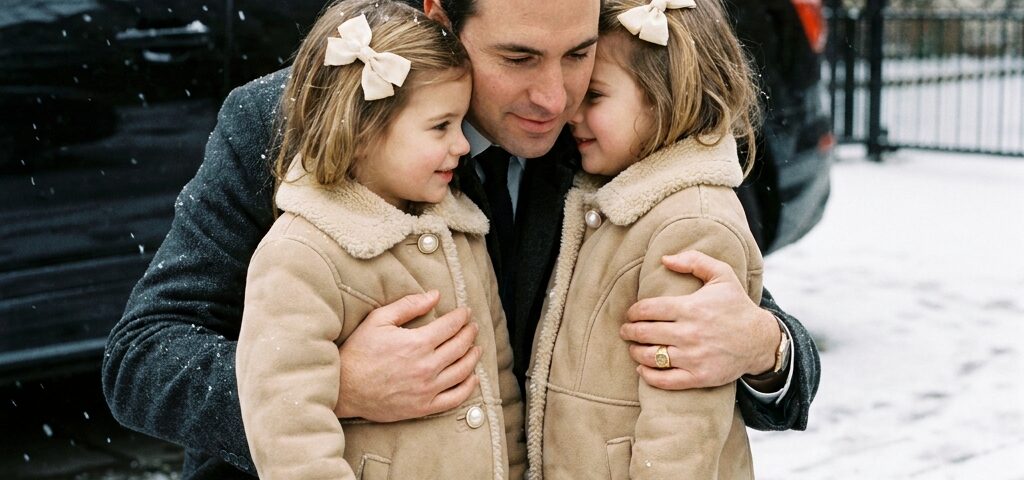
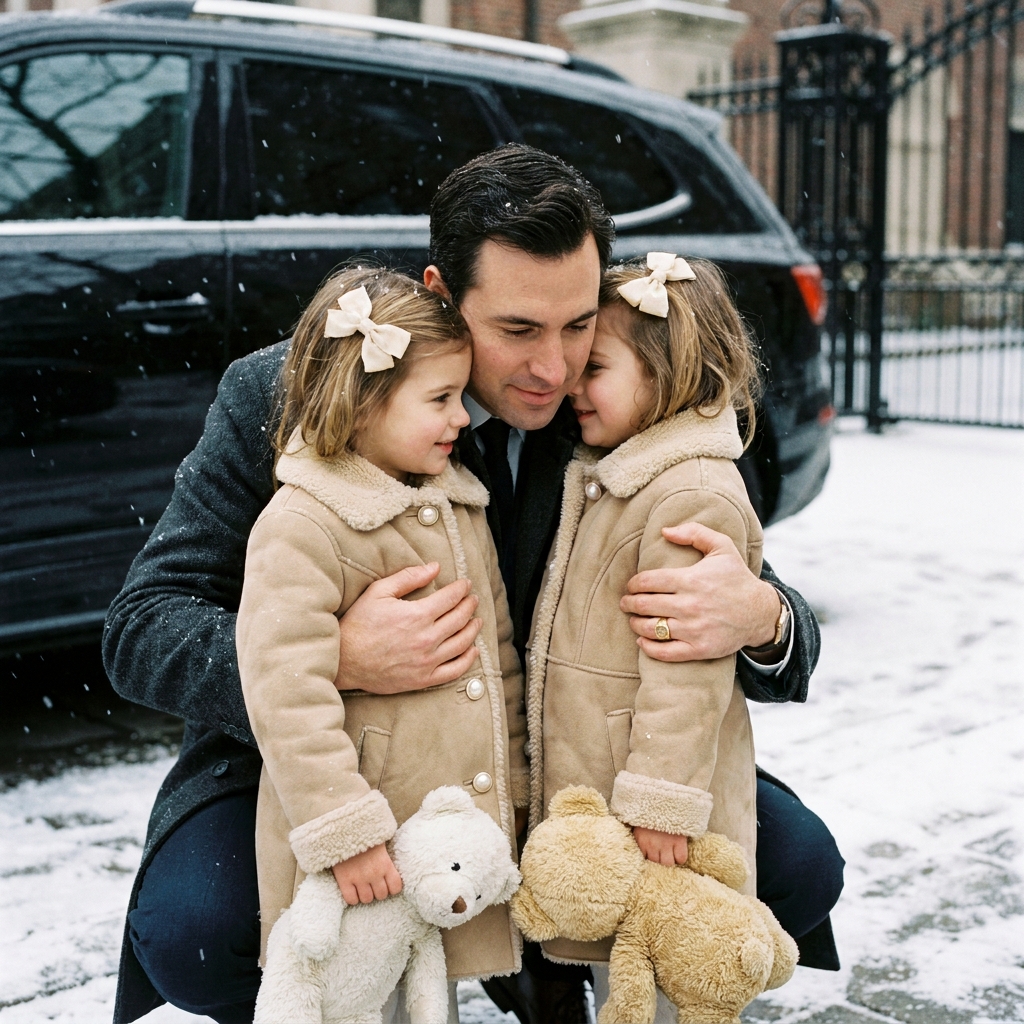
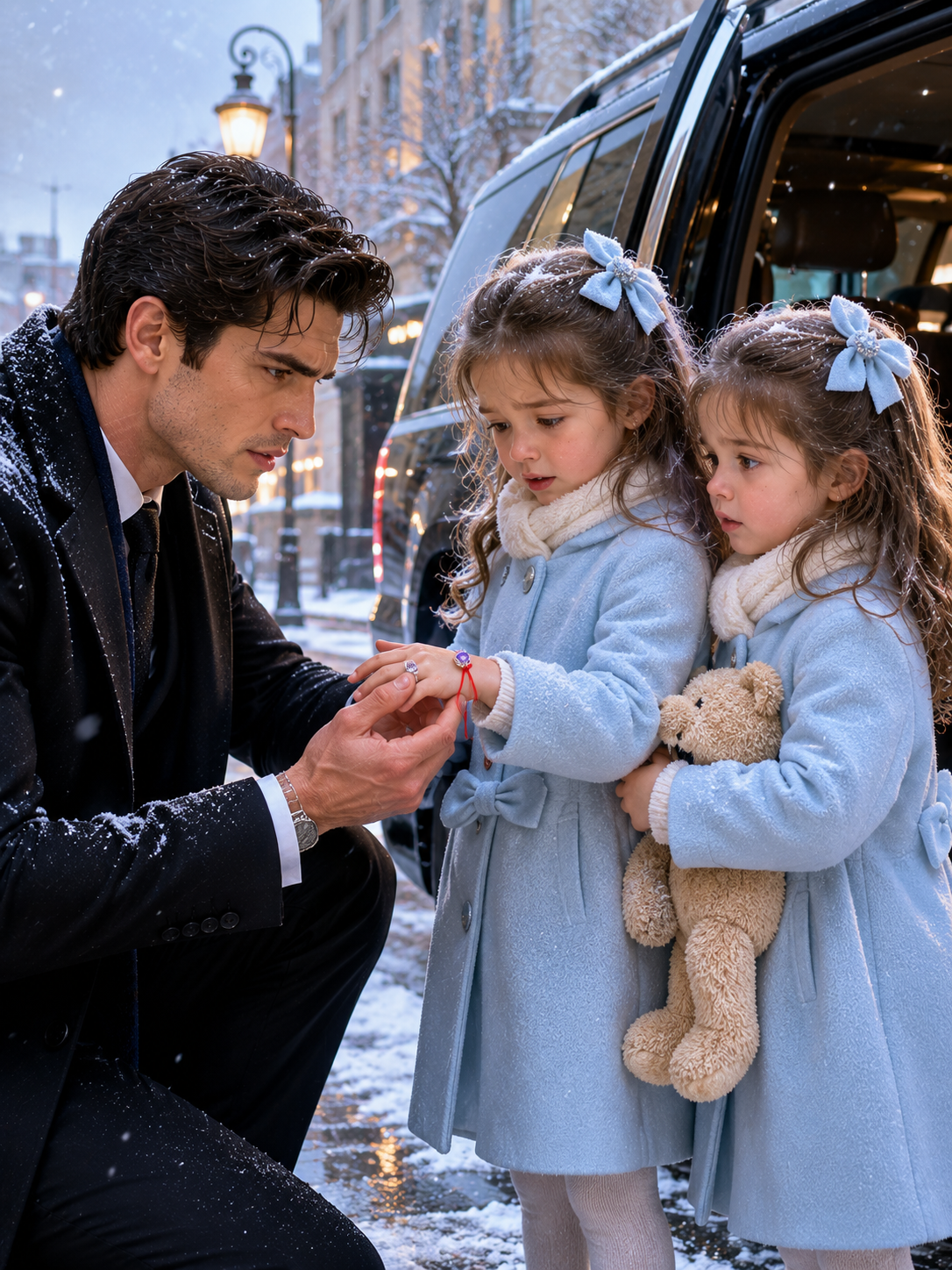
Two little girls, identical, standing in the exact center of the intersection, directly in the Rolls-Royce’s headlights, completely and impossibly motionless. Roughly four years old. Matching pale blue wool coats — well-made, the kind that suggested a careful parent, entirely inadequate for a blizzard of this magnitude. No adult, no bags, no visible point of origin. Just there, holding each other’s hands with a white-knuckled grip that told him everything about how long they’d been out there, though neither made a sound.
“Boss, I’ll get them,” Theo said, reaching for the door handle.
“Wait.” The single word came out with quiet, absolute authority.
Alessio looked at the girls through the armored glass, running the calculation his mind always ran. Deserted streets were ideal staging grounds. The storm would mask a flanking vehicle. The girls could be deliberate bait. He had been moved by compassion exactly once in his adult life, and it had nearly cost him everything. His protocol was ironclad — he did not exit an unsecured vehicle for any stimulus, however it was packaged.
He watched them for ten full seconds. Then the smaller one turned her head and looked directly at the section of tinted glass behind which he sat. Not at the headlights. At him. From thirty feet, through a howling blizzard and armored glass, in the dark, she found his eyes.
Her eyes were mercury gray — the exact, unmistakable shade he’d looked at in the mirror every morning of his thirty-eight years.
He opened the door and stepped into the blizzard. The cold hit him like a wall. He walked to the front of the car, crouched to their level, and up close the resemblance wasn’t a trick of the storm light. It was anatomical — the brow, the jaw, the way both girls held their chins slightly elevated, as though lowering them was a concession they’d decided not to make. His mother had told him he held his chin that way, that it made him look like he was daring the world to try harder.
He asked, low and measured in the voice he reserved for situations requiring zero escalation, if they were hurt. Where their mother was.
They looked at him with the same unblinking, assessing stillness. No crying, no flinching. Just looking, with the deeply unsettling quality of being evaluated by something far more perceptive than it had any right to be.
Then his eyes dropped. The elder twin’s right hand was raised slightly, as though she’d been holding something up for a long time, waiting to be noticed. On her tiny finger, kept from sliding off by a knot of red string looped through the band, was a ring. Small, feminine, an oval alexandrite stone shifting between violet and forest green in the storm light, set in antique platinum filigree so delicate it looked like it had been made by someone who understood that the most beautiful things were the ones that looked breakable but never were.
His lungs stopped.
He had seen that ring in exactly one place, on exactly one hand, at exactly one moment in his life. Four years earlier, at Hinsdale Memorial, he’d sat beside a hospital bed for six hours while the woman who raised him said goodbye to the world. He’d slid that ring onto her finger himself in the funeral home, pressed his lips to her forehead, watched two men lower the casket lid. He had stood at the graveside in the October rain and watched them lower it into the ground.
That ring was in the earth. It was categorically impossible for it to be on this child’s finger, on this street, in this storm.
Alessio picked up both girls without a word, one in each arm, carried them to the car, and closed the door against the wind.
“Drive,” he told Theo. His voice betrayed nothing. It never did.
As the car moved through the empty white streets, the smaller girl sat in his lap, studying him with the same focused intensity he brought to classified documents. Then she reached up, her small warm hand finding the scar on his jaw — the one from a warehouse knife fight when he was nineteen, a story only three living people knew.
Her touch wasn’t exploratory. It was deliberate. The touch of a child confirming something she’d been told.
“Mama said you had a sad face,” she whispered.
His jaw tightened beneath her fingers. “What’s your mama’s name?”
She blinked, her gray eyes — his eyes — holding his without wavering. “If we ever got lost, we should find the man with the wolf ring.” She looked down at the heavy platinum signet on his right hand, the crowned wolf of the Ferro syndicate, teeth bared, crown intact. She nodded once, with the grave satisfaction of a small child completing an important mission.
“We found you.”
PART 2
The Lincoln Park estate had been designed with a single governing philosophy: nothing that mattered could be reached without Alessio’s explicit permission. Twelve-foot limestone walls, concealed sensors that could detect a footstep in snow from forty meters, ballistic glass, reinforced doors, panic rooms on every floor, exit tunnels emerging three properties away. He had walked every square foot of it the way a general walks a battlefield before the fighting starts, identifying vulnerabilities, closing gaps, engineering a space that was less a home than a declaration that the world was only allowed inside on his terms.
He had never once imagined carrying two four-year-old girls through its front door.
Vittorio Anselmi was waiting in the foyer — sixty-one, broad-shouldered, thirty years as right hand to two consecutive heads of the Ferro syndicate, first Alessio’s father, then Alessio himself. He had weathered wars, betrayals, indictments, and the deaths of men he’d known since they were boys, all with the same anchored stillness. He looked at Alessio walking through the door carrying two sleeping girls in matching pale blue coats, and for the first time in thirty years, had no response prepared.
“Get Dr. Petrov,” Alessio said quietly. “Now. Clear the east wing.” He paused. “Nobody asks questions tonight, Vittorio. Not yet.”
Dr. Nadia Petrov appeared in the medical suite within four minutes, shifting instantly into clinical mode — cold, exhausted, physically unharmed. The elder twin woke during the exam and watched her work with a solemn cooperative attention that made the doctor pause and glance at Alessio with an expression she quickly smoothed over.
He stood at the glass partition long after they’d been changed and fed and had fallen into the deep, trusting sleep of children who’d finally found somewhere their bodies believed was safe. Vittorio joined him quietly and had never seen his boss’s face do what it was doing. Not grief. Not shock. The expression of a man confronting proof that a chapter of his life he’d believed permanently closed had been open the entire time, unfolding without him.
“Bring me everything on Sofia Reyes,” Alessio said. “The full file. Including the sealed parts.”
Vittorio didn’t ask a single question. Thirty years had taught him exactly which moments required them.
The file was forty-seven pages of clinical intelligence documenting a decision Alessio had made five years earlier and never revisited, because revisiting served no operational purpose. Sofia Reyes, twenty-seven at the time they met. A forensic accountant, summa cum laude, ninety-eighth percentile on her CPA exam, working for a legitimate Chicago firm called Ashford Consulting. No criminal record, no flags in any database. She’d been assigned to audit Harborline Capital, one of Alessio’s outermost financial buffers, as routine third-party compliance — the kind of engagement that happened every two years specifically to maintain the buffer’s credibility. She was never supposed to get close to anything real.
PART 3
On her third day she found an anomaly — small, technically compliant, structurally unusual. Ninety-nine accountants out of a hundred would have noted it and moved past. Sofia pulled the thread, quietly, methodically, unable to leave it unexplained. His security team flagged her within forty-eight hours. Recommendation: manage her. Alessio had decided to manage her personally, told himself it was tactical, and believed that for about three weeks before the self-deception became too unstable to hold.
Across three months of carefully managed proximity, Sofia Reyes had done something no rival family, no federal investigation, no accumulated violence of a life on the edge of catastrophe had ever managed. She’d made him feel like the version of himself that existed before the empire — curious instead of controlling, laughing without calculating the strategic cost of the warmth it projected. She treated him like a person. He hadn’t understood, until her, how starved he’d been for exactly that.
Then the Delgado family found out. A specific, credible threat, timed for the following Friday — not to kill her, but to take her and use her as leverage to restructure his entire northern operation in their favor. His verification had been conclusive. Forty-eight hours to act.
He couldn’t fight the Delgados on this front without the engagement itself signaling to every rival within a thousand miles that Sofia Reyes was the lever that moved Alessio Ferro. That signal, once sent, could never be unsent. The only way to protect her permanently was to make her disappear so completely she ceased to exist as a variable in anyone’s calculation, including his own.
He’d called Iris, his most trusted ghost operative — twelve bulletproof identities in eleven years, never lost a principal — and given the order. New identity, new city, two million untraceable dollars, an absolute wall of silence. No goodbye. No explanation. He’d told himself the absence of explanation was itself protection, that the less she understood, the safer she’d be. He’d told himself that so many times he’d stopped examining whether it was true.
He had not known she was pregnant.
That sentence sat at the center of everything now, the load-bearing fact around which every other fact reorganized itself with brutal logic. He had not known. But the two girls sleeping down the hall, with his eyes and his mother’s ring and the particular way they held their chins, were living, undeniable proof that not knowing had never made it untrue.
He pressed the intercom. “Vittorio. Get me Dr. Petrov. I need blood types cross-referenced against my medical file tonight.”
Twenty minutes later, a single printed sheet arrived on his desk, no preamble. Both girls carried his rare AB-negative blood type. Neither matched an unknown maternal profile on file. The probability of coincidental match, annotated in Dr. Petrov’s precise handwriting, was statistically negligible.
He picked up his satellite phone and called the contact listed only as I in a directory of twelve names representing the most trusted and capable people he had ever worked with in his life. “Iris. Find Sofia Reyes. Whatever name she’s using, wherever she went. Six hours.” A pause. “Alive and safe.”
“Understood.”
He set the phone down beside the report, walked back to the glass partition, and looked at his daughters sleeping with their hands intertwined, maintaining even in unconsciousness the fierce connection they’d shown in the middle of a frozen intersection. He understood, for the first time, that there were certain things no security protocol had ever been written to protect against — things that found you regardless of the walls, that the universe simply delivered to your door in matching pale blue coats and waited to see what kind of man you’d be about it.
Somewhere in the country, under a name he didn’t know yet, Sofia Reyes was already moving.
She did not run from danger. She ran toward the center of it, because five years of building a quiet life in Milwaukee had never once let her forget that quiet wasn’t the same as safe. It was the waiting room between storms.
She had known this day was coming — not the vague dread of ordinary people sensing bad news approach, but the precise, documented certainty of a forensic accountant who had spent five years passively mapping the financial architecture of the organization that erased her. She knew the Ferro syndicate’s outer shell corporations the way a surgeon knows anatomy — every layer, every connection, every pressure point, built quietly from open sources and public filings and the kind of patient pattern recognition most people lacked the discipline to sustain. Not for revenge. Because knowledge was the only armor available to a woman raising two children alone at the edge of a world that wanted them as leverage.
When the black sedan appeared in her mirror on the interstate outside Milwaukee, she identified the surveillance pattern in under forty seconds. Two cars back, consistent interval. She didn’t accelerate. She didn’t panic. She made three calls in four minutes, strapped her daughters into their seats with hands that didn’t shake, and drove south toward Chicago with the calm, purposeful momentum of a woman executing a plan rehearsed so many times it had become instinct.
She crashed the car deliberately on West Chicago Avenue, sent the girls toward Michigan Avenue with one instruction and the red-stringed ring she’d carried in the inner pocket of every coat she’d owned for five years, and turned to walk back into the fire.
The Lincoln Park estate was entirely silent by the time Sofia walked through its gates — not the silence of emptiness, but the pressurized silence of armed men told to stand down, finding it professionally uncomfortable. Iris’s team had intercepted her at Northwestern Memorial’s parking structure, exactly as she’d calculated, and the drive to Lincoln Park took eleven minutes through streets still buried in blizzard remnants.
Sofia spent those minutes sitting straight-backed in the armored SUV, coat torn at the shoulder, a thin cut dried above her eyebrow, asking exactly two questions: whether her daughters were unharmed, and whether the blood cross-reference had been run. Iris, who had built her entire professional reputation on remaining expressionless under pressure, answered both in a flat, careful voice and then spent the remainder of the drive looking out the window with the expression of a woman quietly recalibrating a significant number of prior assumptions.
The medical suite was the first place they took her. Ava and Lia were awake by then, sitting on the wide examination bed in clothes two sizes too large, sharing a bowl of cut fruit with the focused territorial energy of children who’d decided normalcy was the correct response to an abnormal situation.
When the door opened, both girls launched off the bed simultaneously and hit Sofia at knee level with a combined impact that drove her back a full step. She dropped to the floor without hesitation, both knees hitting the cold tile, arms wrapping around them so tightly that Dr. Petrov, standing near the instrument cabinet, turned quietly to study the wall with great professional attention for the next thirty seconds.
Sofia pressed her face into the space between their dark heads and held on with the specific, whole-body grip of a woman who had driven into an ambush and crashed a car and walked back through the wreckage of her own careful life by force of will alone, and now had no further use for composure. She held them a long time. Then she pulled back, checked both faces with the rapid clinical sweep of a mother assessing damage, kissed each forehead in turn, and stood. She smoothed her torn coat and turned around.
Alessio Ferro was standing in the doorway — not leaning, not deploying the studied stillness he used when power needed communicating. Just standing, jacket gone, collar open, hands at his sides, looking at her with an expression containing, in equal contradiction, the composure of a man who’d run an empire for fifteen years and the completely unmanageable reality of a man watching the woman he’d erased walk back through his door carrying five years of consequences.
The expression was so uncharacteristic that Sofia — who’d rehearsed this moment in her Milwaukee kitchen over cold coffee at two in the morning — felt something shift unexpectedly in her own carefully maintained composure. She’d prepared for cold. For calculated. She had not prepared for this.
She filed it away and turned to Dr. Petrov. “Can you take them to the kitchen? I’ll be there in twenty minutes.”
Ava paused at the doorway, looking back at Alessio. “Are you coming?” she asked, with the complete absence of subtext that is either the gift or the devastation of being four.
“In a few minutes,” he said, gentleness he clearly hadn’t used in a long time, arriving with visible effort. Ava studied him, decided it was acceptable, and followed her sister down the corridor.
The study door closed. Sofia sat down across from his desk without invitation, crossed her legs, hands flat on her knees. Alessio sat on the edge of the desk rather than behind it — a deliberate choice she noted without giving him credit for it.
She told him everything in the level, structured cadence of a professional presenting findings to a board, because it was the only register she trusted herself to use with the fire this warm and his face doing what it was doing. The Delgado threat. The staged disappearance.
The two million dollars she’d accepted because her daughters needed to eat and refusing on principle was a luxury she couldn’t afford. That she’d been eight weeks pregnant when Iris put her in a car without her knowledge. That she’d named the girls Ferro because a child wasn’t responsible for her parents’ choices, and whatever he’d done, his daughters deserved the full weight of what they were.
That she’d carried his mother’s ring since the day Isabella Ferro pressed it into her hand during a hospital visit and told her, low and urgent, that it belonged to the future, that Alessio would need someone to give it back to him when he was ready to understand what it meant. She hadn’t understood until the morning she tied it to Ava’s finger with red string and sent her daughters into a blizzard toward a man she both despised and trusted with the only people she couldn’t afford to lose.
When she finished, the room held nothing but the fire. Alessio hadn’t moved, hadn’t interrupted, hadn’t offered the preemptive justifications she’d prepared counterarguments for. He’d listened with total absorption, and when she stopped, he looked at his hands and said the only true thing available to him.
“I thought I was saving your life.”
“You were,” she said. “But you didn’t ask if I wanted to be saved that way. You didn’t trust me with the truth. You made the decision for me and erased me without my consent. Then you spent five years not knowing you had daughters because you decided, unilaterally, that I was safer not knowing why.” She paused. “And I came back anyway. Not for you. For them. Because the Serrano cartel isn’t going to stop, and you have the only infrastructure on this continent capable of ending this before it reaches my girls again.”
He looked at her a long moment, then stood, opened his desk drawer, and set a slim encrypted hard drive between them, extracted from her coat during intake. “You accessed it?” she asked.
“We tried. Two hundred fifty-six bit key, biometric lock. Couldn’t break it in forty minutes.”
Something crossed her face that wasn’t quite a smile. She pressed her thumb to the sensor. It clicked open. “Five years of passive intelligence on the Delgado-Serrano financial alliance. Shell overlaps, transaction patterns, communication mapping.” She looked up. “And the identity of the man inside your organization who sold my location to the Delgados in the first place. It wasn’t a breach from outside, Alessio. Someone in your inner circle flagged me as a vulnerability and sold that intelligence before your security team even filed their report. You’ve had a leak at the captain level for at least six years.”
The silence that followed was of an entirely different quality. He picked up the drive, looked at it like something about to detonate a significant portion of his world before making any of it safer.
“How did you build this?” he asked, the question entirely genuine, his composure briefly and completely replaced by undisguised astonishment.
“I’m a forensic accountant. I followed the money. I always have. You just never asked me to do it for you.”
Vittorio appeared with an urgent report that couldn’t wait. Alessio read it in fifteen seconds — the Serrano cartel had made a direct demand through a Delgado intermediary: withdraw from the northern port operations within seventy-two hours, or forfeit any guarantee of safety for his newly discovered family. Using his daughters as leverage before they’d even confirmed possession.
He handed the report back. His face had finished its transformation — the fractured, reckoning man of the last twenty minutes replaced by something ancient and without mercy.
“Full mobilization,” he told Vittorio. “Every captain activated within the hour. I want the Serrano cartel’s North American financial infrastructure mapped and ready for simultaneous disruption within twenty-four.”
At the door he looked back at Sofia. “Do not leave this building.”
“I’ll be in your intelligence room,” she said, already pulling the drive toward her. “I have seventeen more files.” He stopped. She looked up, her eyes holding his with the same steady directness Ava had shown him through a blizzard. He understood now exactly where his daughters had learned it. “Find out who the inside man is before you mobilize,” she said. “Because if they knew about me five years ago, they know about tonight. They’ll tell the cartel where to find us before your captains finish their first cup of coffee.”
“I’m going to need everything on that drive.”
“I know,” Sofia said. “That’s why I brought it.”
The Serrano cartel made the irreversible mistake of believing Alessio Ferro’s primary weapon was violence. Every rival organization that had ever moved against him had learned otherwise firsthand, and the survivors carried those lessons in the particular permanent way men carry things learned too late, but violence was never his first instrument. It was his last. His first instrument was information — and for the first time in the syndicate’s history, that information was Sofia’s.
She worked nineteen straight hours in the estate’s intelligence room, fingers moving across three keyboards while his technology team executed her instructions with the focused urgency of people told, in terms leaving no room for interpretation, that the woman at the center terminal had authority equal to their boss for as long as this operation lasted.
By Tuesday morning, seventeen Serrano-linked shell accounts across four jurisdictions had been flagged through anonymous submissions to separate federal financial crimes task forces. By noon, frozen. By Wednesday evening, the cartel’s North American funding had collapsed so completely their Chicago enforcement team received no payment confirmation on any channel.
Sofia sat back from the terminal, pressed her palms flat on the desk. “That,” she said quietly, “is how you end an organization without starting a war your daughters will read about someday.”
The inside man was Alderman Felix Doyle — a man who’d attended Isabella Ferro’s funeral, shaken Alessio’s hand at the graveside, spent twelve years cultivated as the syndicate’s most reliable political buffer while selling calibrated intelligence to whoever paid for at least six of those years. Alessio handled it personally and quietly; the details of that conversation were never recorded anywhere, by design. By Thursday morning, Doyle had resigned from public office citing health reasons, his entire political infrastructure transferred seamlessly to a Ferro-aligned successor before the resignation letter finished printing.
The cartel’s remaining Chicago team, stripped of funding and running on desperate orders from panicking leadership, made their final move Friday night. The breach attempt on the Lincoln Park estate lasted eleven minutes and failed with a totality that was less a defensive victory than a demonstration of what happens when an organization built on secrecy moves against a fortress that has been told exactly where they’re coming from, at what time, through which entry point, by a woman who extracted that information from their own communication patterns forty-eight hours before they gave the order. Nobody reached the panic room. Nobody reached the corridor. Nobody reached anything that mattered at all.
Three months later, the private ballroom of a downtown hotel held a gathering the Chicago underworld would discuss for a generation. Every Ferro captain, every allied family head, every political figure operating within the syndicate’s sphere sat in absolute silence as Alessio walked through the doors with Ava on his left arm and Lia on his right, both in deep navy with pearl earrings that had required forty-five minutes of patient negotiation, and Sofia beside him — not behind him, not on his arm, beside him, stride for stride, in a gown the color of midnight.
He spoke for less than two minutes. He acknowledged his daughters by name in front of every man in the room, stated without elaboration that any threat against them was a declaration of war against the full authority of the Ferro syndicate, then looked at Sofia and told the room that the woman beside him had built a superior intelligence operation from a kitchen table in Milwaukee with fewer resources than most of them had with unlimited ones, and that she was not a guest in this organization. She was its future.
Vittorio started clapping. The room followed, the sound rolling through the ballroom in a wave that told Alessio, more clearly than any report ever could, exactly how thoroughly the ground beneath his organization had already shifted.
Later, with the guests gone and the girls asleep upstairs, the great room finally quiet, Alessio found Sofia at the window, watching the city lights scatter across the dark glass. He opened his hand. The alexandrite ring sat in his palm, catching the light. He told her what his mother had told him about it, that he’d been carrying it for three months waiting for the right moment, and slid it gently onto her finger, asking her to stay, telling her the rest they’d build together, one decision at a time, the way anything worth keeping was built.
Sofia looked at the ring, then at the skyline. “You know,” she said, “for a man who controls an empire, you were completely unprepared for a four-year-old.”
Alessio Ferro, the most feared man in the Midwest, laughed — fully, freely, with his whole chest, the sound filling the quiet room like something locked away for a very long time finally, irrevocably let out.
Upstairs, Ava and Lia Ferro slept with their hands intertwined, entirely unaware they had rewritten the future of an empire simply by existing, and simply by finding, on the worst morning of their short lives, exactly the right man to walk toward through a blizzard nobody else could have survived crossing.
THE END