Part One: The Glass Door.
Alexander Moore was in the middle of a board meeting when the child appeared at the glass door.
At first, he thought she belonged to someone from accounting.
That was the only explanation that made sense.
Children did not wander onto the forty-ninth floor of Moore Global Holdings.
They did not pass lobby security, private elevators, biometric turnstiles, executive reception, and three layers of assistants.
They did not stand outside the boardroom in a red coat too thin for winter, holding a dented metal lunchbox against their chest as if it contained the last safe thing in the world.
Yet there she was.
Small.
Serious.
Breathing white against the glass because the lobby below had not warmed her yet.
Alexander saw her through the reflection of quarterly numbers on the conference screen.
For half a second, he kept listening to the chief financial officer.
Then the girl lifted one mittened hand and tapped the glass.
Once.
Twice.
The chief financial officer stopped speaking.
The twelve board members turned.
Alexander’s assistant, Claire Benton, hurried toward the child from the outer office.
Her heels clicked fast on marble.
Her face wore the smooth panic of someone who understood that disorder near Alexander Moore was rarely forgiven.
“You cannot be here,” Claire said, opening the glass door only wide enough to block the child’s entry.
The girl looked past her.
Straight at Alexander.
“Are you Mister Moore?”
Her voice was small but clear.
“My grandma said you might know my daddy.”
A murmur moved around the boardroom.
Alexander’s hand tightened around his pen.
He had been asked many things in that room.
To approve acquisitions.
To close divisions.
To fire men who had worked for his father.
To sell old factories.
To keep secrets under the softer name of strategy.
No one had ever asked him if he knew their father.
Claire bent slightly.
“This is a private floor.”
The girl hugged the lunchbox harder.
“I know.”
“Grandma said rich people have private floors because they are afraid of questions.”
One board member coughed.
Another looked down.
Alexander should have dismissed her.
He should have told Claire to call security.
He should have protected the meeting, the schedule, the stock movement, the merger vote waiting on the next agenda slide.
Instead, he stood.
Every head in the room turned toward him.
The girl watched him with wide gray eyes.
Moore eyes.
The thought came so quickly that Alexander almost rejected it.
His family had those eyes.
His father had them.
Alexander had them.
His younger brother James had them most of all.
James, who had died years earlier in a military accident overseas.
James, who had been disowned before that.
James, whose name had not been spoken in a Moore boardroom since their father signed him out of the family like a bad investment.
Alexander walked to the door.
Claire whispered, “Sir, security is on the way.”
“Cancel it.”
Claire froze.
“Sir?”
“Cancel it.”
She stepped back.
The girl looked up at Alexander.
He was tall enough to make adults look up, but the child did not shrink.
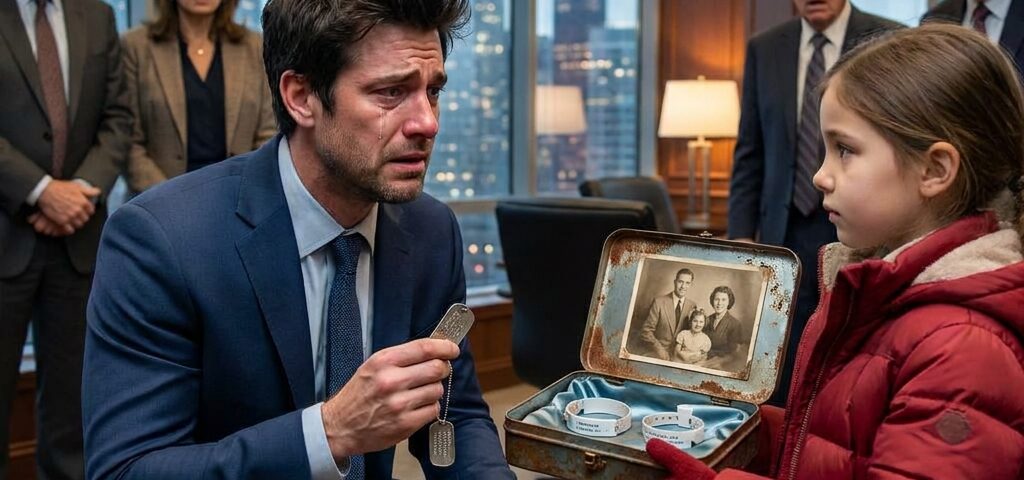
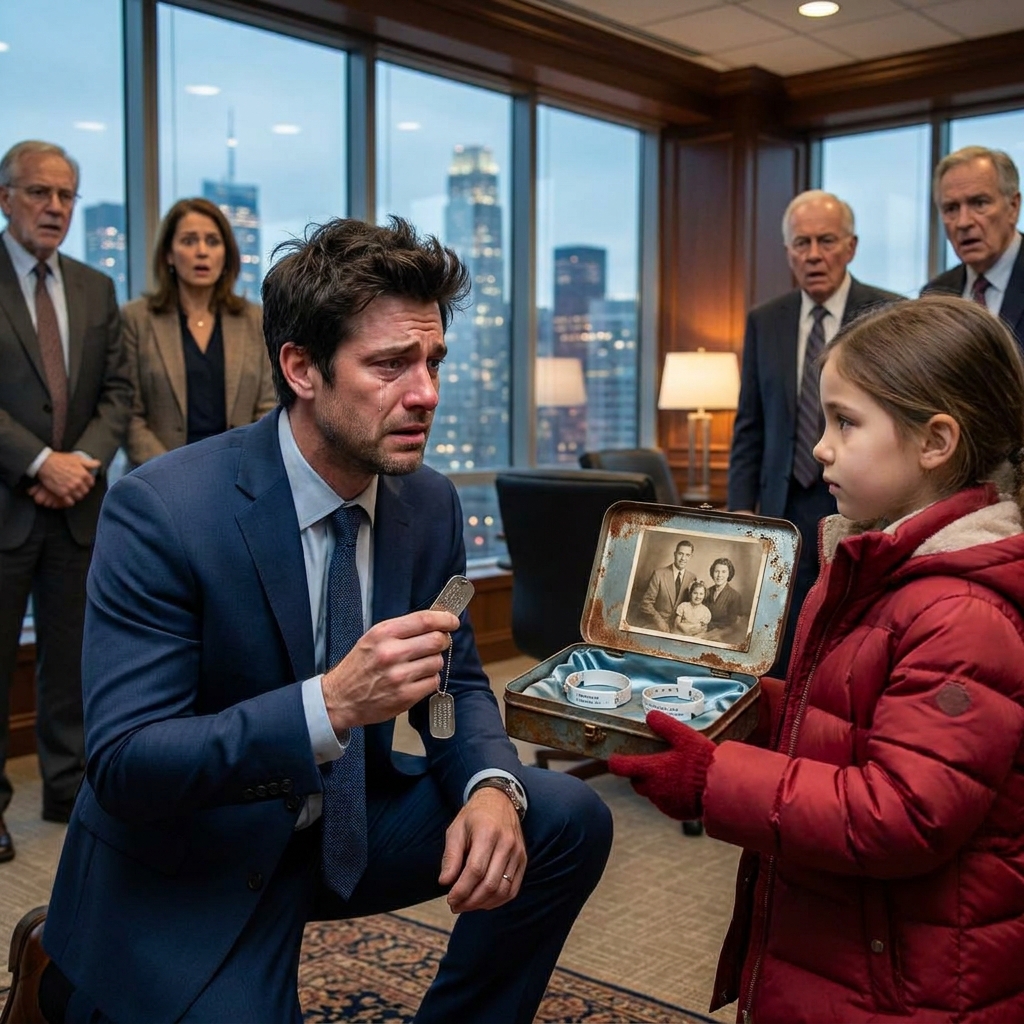
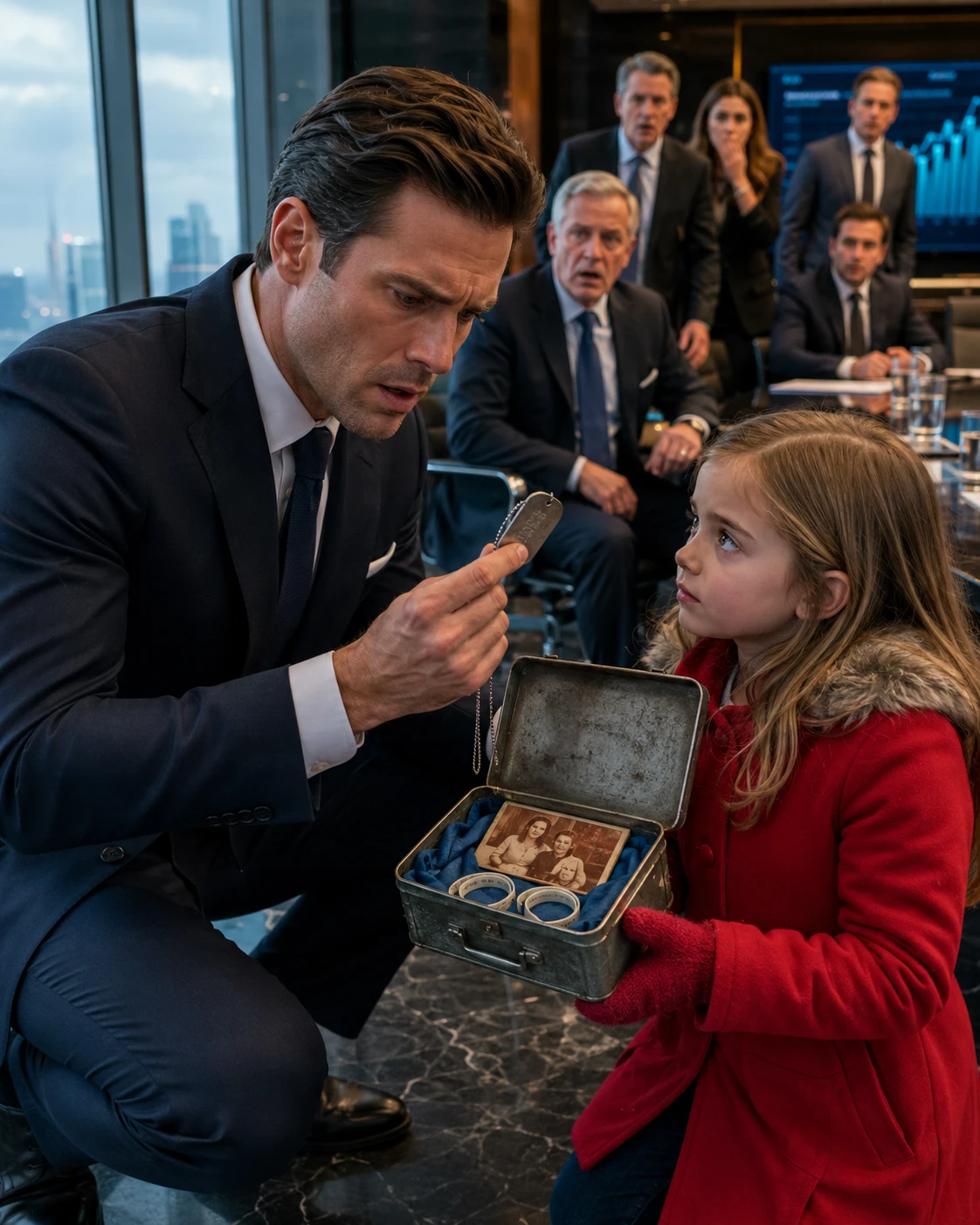
She opened the lunchbox.
The metal hinge squeaked.
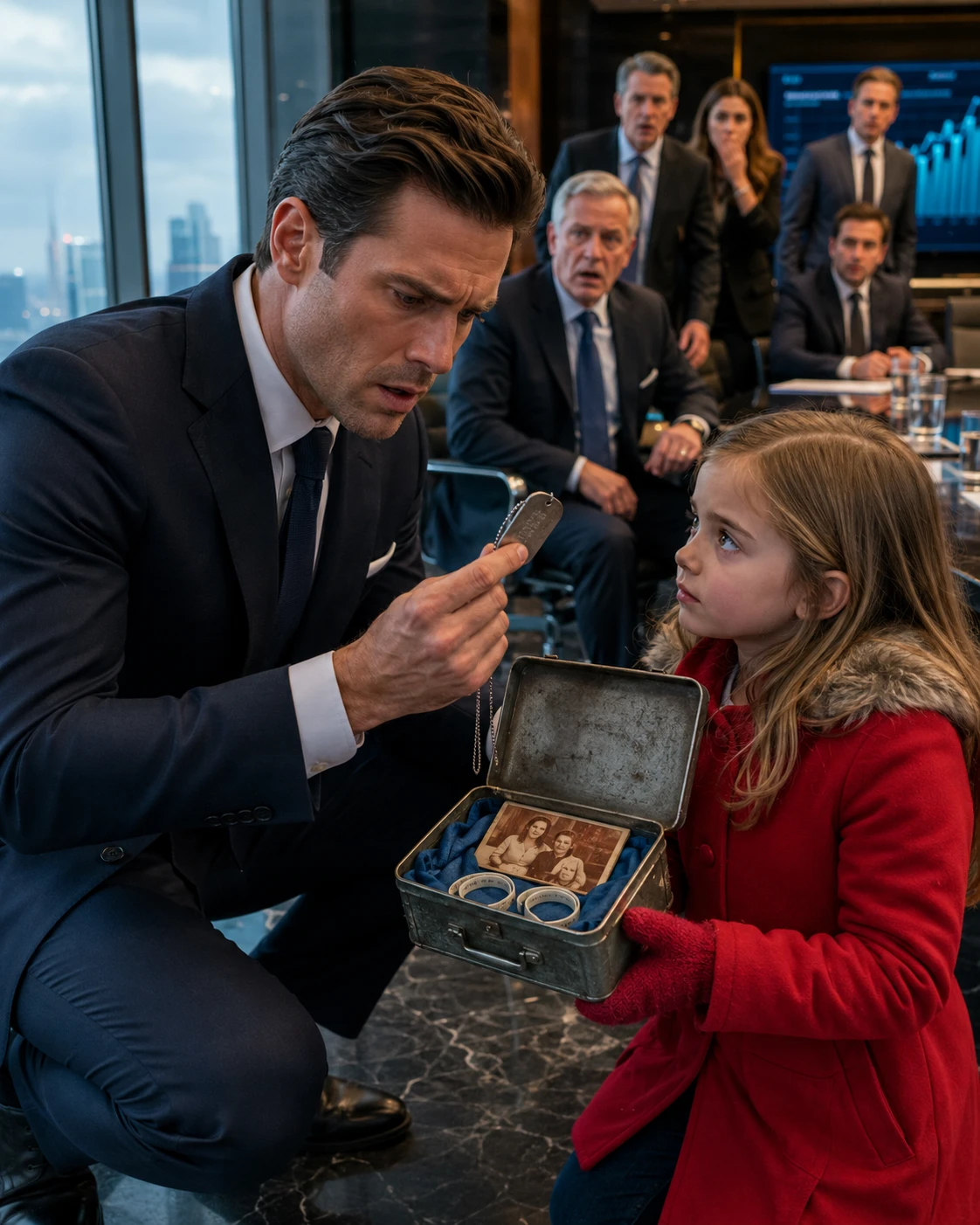
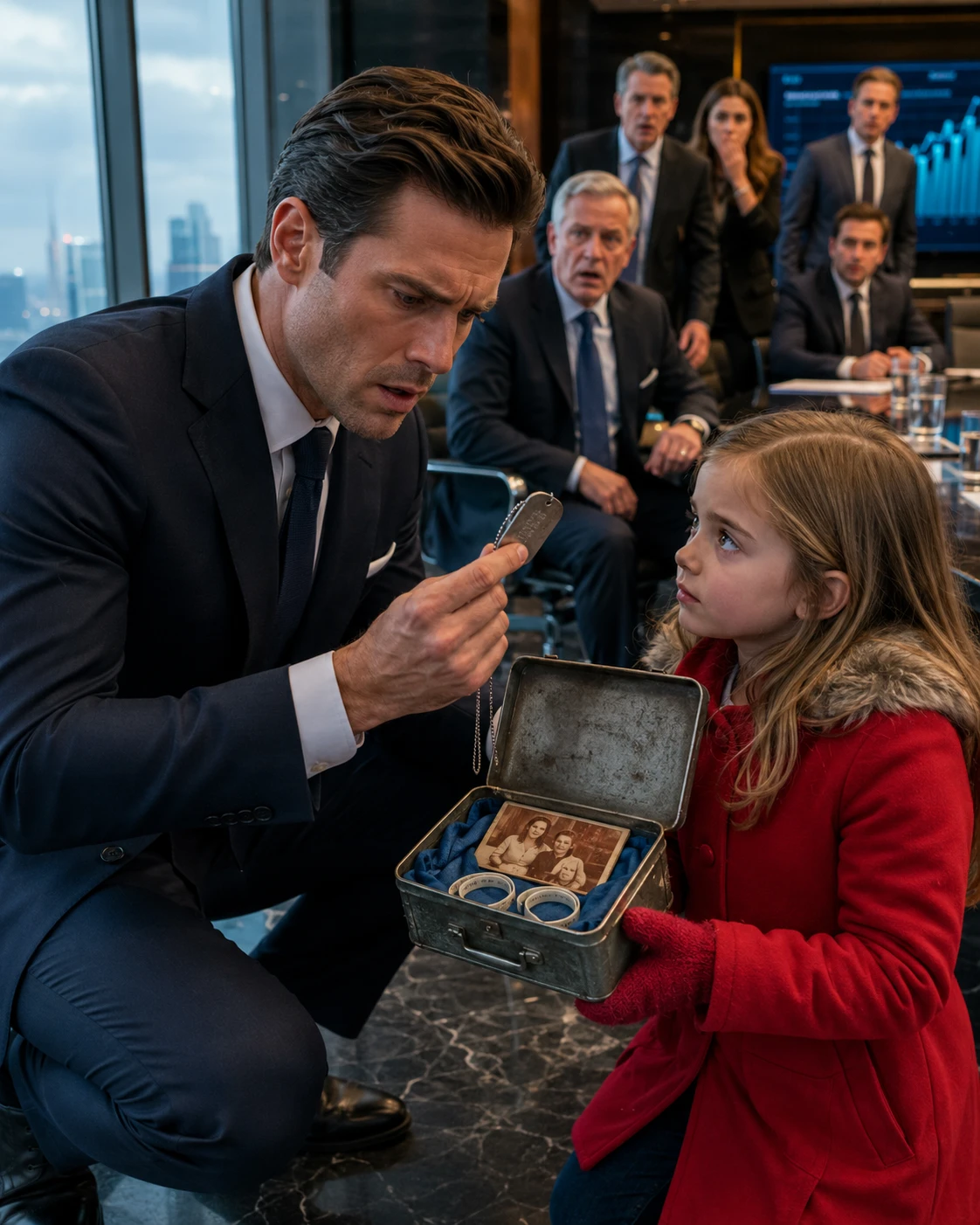
Inside was a folded handkerchief, two hospital bracelets, a faded photograph, and a scratched military dog tag resting on blue cloth.
Alexander’s breath stopped.
The tag was dull silver, worn along the edges, but the stamped name remained clear.
Captain James Moore.
United States Army.
Alexander reached for it, then stopped.
“May I?”
The child nodded.
He lifted the dog tag from the lunchbox.
The metal was colder than the room.
For one second, Alexander was not a billionaire in a glass tower.
He was twenty-two years old again, standing at the end of a gravel driveway while his brother loaded one duffel bag into a taxi.
Their father had refused to come outside.
James had looked at Alexander and smiled like leaving did not hurt.
“Take care of yourself, Alex.”
Alexander had said, “Call me when he calms down.”
James had laughed.
“He will die before he calms down.”
He had been right.
Their father died without calming.
And James died before Alexander found the courage to call first.
Now a child stood in his boardroom with James’s dog tag inside a lunchbox.
Alexander looked at her.
“Where did you get this?”
“My mommy kept it until she got sick.”
The girl swallowed.
“Grandma said rich people do not like surprises.”
The boardroom seemed to tighten.
Alexander crouched in front of her.
“What is your name?”
“Lily.”
“Lily what?”
She hesitated.
“Lily James Moore.”
The pen fell from someone’s hand behind him.
It hit the conference table and rolled until it stopped against a water glass.
Alexander could not move.
James.
His brother’s name.
Living inside a child’s name.
“Where is your mother?” he asked.
Lily looked down at the lunchbox.
“In the hospital.”
“Where is your grandmother?”
“Downstairs.”
Claire said softly, “Mister Moore, there may be a safety concern.”
Alexander did not look at her.
“There is.”
He closed his hand around the dog tag.
“And it is not the child.”
Part Two: The Woman in the Lobby.
Alexander took Lily downstairs himself.
Not through the public elevator.
Not with security around her.
Not with Claire’s anxious apologies trailing too close.
He used the private executive elevator, the one his father had installed so Moore family members never had to share air with the people who made the building function.
Lily stood beside him, lunchbox clutched to her chest.
She did not touch anything.
Not the brass rail.
Not the mirrored wall.
Not the small dish of mints near the control panel.
Children who believe they belong somewhere touch things.
Children who have been warned about rich people stand very still.
Alexander looked down at her red coat.
The sleeves were short.
Her wrists showed.
“Are you cold?”
“I am fine.”
That was the answer poor children learn before they understand pride.
“You can be cold and still be brave,” Alexander said.
Lily looked up at him.
“Grandma says that too.”
The elevator opened into the private lobby.
The woman waiting near the security desk wore a faded Army coat with the sleeves repaired at both cuffs.
She stood straight despite her age, one hand on a cane, the other resting near a canvas folder tucked under her arm.
Her hair was white and braided low.
Her face was lined.
Her eyes were sharp enough to make the security guards pretend they had never considered removing her.
She saw Lily first.
Then the dog tag in Alexander’s hand.
Then Alexander.
“So,” she said.
“You came down.”
Her voice had command in it.
Not volume.
Command.
Alexander knew military authority when he heard it.
His brother had carried the same tone after basic training, though James had used it mostly to tease him.
“Are you Lily’s grandmother?”
“In every way that matters.”
Lily ran to her.
The old woman placed one arm around the child but kept her eyes on Alexander.
“My name is Major Ruth Callahan, retired.”
“I commanded Captain James Moore’s unit during his last deployment.”
Alexander felt the title strike him.
Captain James Moore.
Not black sheep.
Not disowned son.
Not family embarrassment.
Captain.
“Where is Lily’s mother?” he asked.
“Saint Catherine’s Medical Center.”
“Is she safe?”
Ruth’s mouth tightened.
“She is alive.”
“That is not what I asked.”
“No.”
“It is not.”
Alexander deserved that.
Ruth looked toward the lobby guards.
“Is there somewhere private, Mister Moore?”
Claire hurried forward.
“We can arrange a conference room.”
Ruth looked at her.
“You tried to throw a child out of one.”
Claire went pale.
“I did not know—”
“No.”
Ruth’s voice stayed calm.
“You did not ask.”
Alexander turned to Claire.
“Bring tea, soup, and a doctor on call.”
Ruth’s eyes narrowed.
“We did not come for charity.”
“I know.”
“Then do not start there.”
Alexander nodded.
“Then tea only.”
Lily tugged Ruth’s coat.
“Grandma, he said I can be cold and brave.”
Ruth looked at Alexander for a long moment.
“That sounds like something James would have said badly.”
The words broke something in him.
Alexander looked down at the dog tag.
“How did James have a daughter?”
Ruth’s expression darkened.
“Because your father returned every letter.”
Part Three: The Letters.
They went to a private lounge off the lobby.
Not the executive dining room.
Ruth refused anything with chandeliers.
“Rooms that expensive make people lie slower,” she said.
Alexander did not argue.
Lily sat on the sofa with the lunchbox on her lap.
Ruth sat beside her.
Alexander sat opposite them, still holding the dog tag like a confession.
Claire stood near the door, shaken and silent.
Ruth opened the canvas folder.
The first thing she placed on the coffee table was a photograph.
James stood in uniform outside a field hospital.
Beside him was a young woman in blue scrubs, her dark hair pulled back, her smile tired and bright.
His arm was around her waist.
Her hand rested over a small swell beneath her shirt.
“My daughter,” Ruth said.
“Emily Callahan.”
“She was an Army nurse attached to the surgical unit.”
“James married her overseas.”
Alexander looked at the photo.
James looked older than he had in Alexander’s memory.
Thinner.
Happier.
More alive than he had ever looked inside the Moore mansion.
“My father said James married recklessly,” Alexander said.
Ruth’s eyes hardened.
“Your father used recklessly to mean without permission.”
Alexander accepted the hit.
“What happened?”
“They wrote.”
Ruth placed three envelopes on the table.
Returned.
Unopened.
Stamped by Moore estate mail control.
Addressed to Charles Moore.
Then to Alexander Moore.
Then to Moore Family Office.
“My daughter wrote first,” Ruth said.
“She told your family James was married.”
“She told them she was pregnant.”
“She included photographs.”
“All returned.”
Alexander picked up the envelope addressed to him.
His name.
His office.
His old address.
He had never seen it.
“I did not receive this.”
Ruth watched him carefully.
“That may be true.”
“It is also convenient.”
He lowered his eyes.
She was right.
Ignorance had been the Moore family’s most expensive luxury.
The next document was a birth certificate.
Lily James Moore.
Father: James Alexander Moore.
Mother: Emily Ruth Callahan Moore.
Alexander stared at the middle name.
James had given his daughter Alexander’s name too.
Ruth seemed to read his face.
“He wanted her to know she had two sides of family.”
“My daughter told him not to be foolish.”
“What did he say?”
Ruth looked toward Lily.
“He said hope and foolishness had always looked similar in the Moore family.”
A faint ache passed through Alexander.
That was James.
Tenderness disguised as a joke.
Ruth placed another document on the table.
Military casualty notification.
Captain James Alexander Moore.
Killed in a convoy attack.
Survived by spouse, Emily Ruth Moore, and minor child, Lily James Moore.
Alexander whispered, “The Army knew.”
“Yes.”
“My father knew?”
“Yes.”
“How?”
Ruth opened another envelope.
A copy of a certified notice addressed to Charles Moore after James’s death.
Surviving spouse and minor child identified.
Request for family medical history and estate contact.
Returned by Moore Family Office.
Marked:
No recognized heir.
Alexander read the phrase twice.
No recognized heir.
It was written in blue ink by someone paid to make a child vanish without using the word child.
Lily leaned against Ruth.
“Is that bad?”
Ruth kissed her hair.
“Yes, sweetheart.”
“It is bad.”
Alexander’s voice went cold.
“Who marked this?”
Ruth looked at him.
“Your father’s attorney.”
“Martin Vale?”
“No.”
“Richard Crane.”
Alexander closed his eyes.
Richard Crane had been his father’s chief counsel for thirty-two years.
A man who knew where every body was buried because he had drafted the cemetery plot.
Crane still served as emeritus adviser to the Moore trust.
Alexander had kept him out of sentiment.
No.
Out of cowardice.
Old men who knew old secrets were easier to honor than confront.
Ruth placed one final document on the table.
A will.
James’s will.
Alexander did not touch it immediately.
“What is in it?”
Ruth’s eyes did not soften.
“Everything your father stole.”
Part Four: James’s Will.
The will was not dramatic.
That made it worse.
It was simple, direct, and written with the practical clarity of a soldier who knew death could arrive before paperwork was ready.
I, Captain James Alexander Moore, leave all property, inheritance rights, future claims, and Moore family shares or interests lawfully mine to my daughter, Lily James Moore.
If my wife, Emily Ruth Callahan Moore, survives me, she shall serve as guardian and trustee.
If my wife is unable to serve, Major Ruth Callahan shall serve.
I ask my brother, Alexander Moore, if he ever reads this, to remember that silence is a choice even when it is inherited.
Alexander stopped reading.
Silence is a choice even when it is inherited.
His brother’s handwriting appeared at the bottom.
James Alexander Moore.
Witnessed by two officers.
Notarized through a military legal office.
Filed in an Army records system.
Ignored by the Moore family.
Ruth watched him read.
“My daughter sent that to your father.”
“Then to you.”
“Then to the Moore family office.”
“Each letter came back.”
Alexander’s hands shook.
He set the will down because he did not trust himself not to tear the paper by accident.
“My father disowned James.”
Ruth’s eyes sharpened.
“Your father disapproved of James.”
“He did not legally erase a child by disliking her mother.”
Alexander looked toward the glass walls of the lounge.
Beyond them, employees moved through the lobby.
No one knew that inside this quiet room, an empire had begun to rot aloud.
“What shares?” he asked.
Ruth opened another section of the folder.
“When James was twenty-one, he inherited a minority block from his grandmother.”
“I remember.”
“Your father absorbed those shares after James was disowned.”
“He said James signed them back.”
Ruth placed a copy of a transfer document on the table.
“Did he?”
Alexander stared.
The signature was James’s name.
But it was wrong.
Too smooth.
James wrote like he was fighting the page.
This signature was neat.
Polished.
Dead.
“No,” Alexander said.
Ruth nodded once.
“My daughter challenged it.”
“She was told she had no standing.”
“She sent the will.”
“She sent the birth certificate.”
“She sent the military record.”
“She sent Lily’s medical bills when Emily got sick.”
“She sent everything.”
“What illness?”
Lily looked down at the lunchbox.
“Mommy’s blood is tired.”
Ruth’s hand tightened around hers.
“Leukemia,” Ruth said.
Alexander stood.
The room tilted slightly.
“How long?”
“Diagnosed eighteen months ago.”
“Treatment?”
“Interrupted twice.”
“Why?”
“Money.”
The word landed with obscene simplicity inside a building worth hundreds of millions.
Alexander looked toward Claire.
Her face was pale.
“Find Saint Catherine’s,” he said.
“Now.”
Ruth lifted a hand.
“No.”
Alexander turned back.
“No?”
“You do not storm into a hospital with money and call it repair.”
“My daughter is not a photo opportunity.”
“My granddaughter is not a scandal settlement.”
Alexander drew a slow breath.
“You are right.”
Ruth’s gaze remained hard.
“I usually am.”
“Tell me what she needs.”
Ruth leaned back.
“What she needed was for one Moore to answer a letter before she became too sick to climb your tower.”
Lily looked up.
“I climbed it.”
Ruth’s face softened.
“Yes.”
“You did.”
Alexander crouched in front of Lily.
“Did your mother send you?”
“No.”
“Grandma did.”
Ruth said, “I brought her to the lobby.”
“I did not send her past security.”
Lily said, “The guard was arguing with Grandma, so I went to find the top person.”
Alexander almost smiled.
“Did you know where to go?”
“No.”
“I followed the mirrors.”
“The mirrors?”
“They made the hallway look important.”
Ruth muttered, “James’s child.”
Part Five: The Boardroom Learns.
Alexander returned to the boardroom with Lily’s lunchbox in his hands.
Ruth and Lily waited in the lounge because Ruth refused to let her granddaughter become theater.
Alexander respected that.
But the lunchbox came with him.
The board members were still seated when he entered.
No one had resumed the meeting.
The quarterly numbers remained frozen on the screen.
Profit growth.
Asset consolidation.
Shareholder strength.
Everything suddenly looked like a joke told over a grave.
Claire followed him in with shaking hands.
Alexander placed the lunchbox on the conference table.
The metal thud echoed.
“This meeting is adjourned.”
The board chair, Helena Price, frowned.
“Alexander, we still need to approve the Meridian acquisition.”
“No.”
The chief financial officer shifted.
“Is this related to the child?”
“Yes.”
Helena leaned forward.
“Then perhaps we should move personal matters—”
Alexander opened the lunchbox.
The dog tag lay inside.
Captain James Moore.
His brother’s name looked harsher beneath boardroom lights.
“This is not personal.”
He placed the birth certificate beside it.
“This is a governance issue.”
Then the will.
“This is an estate issue.”
Then the forged share transfer.
“This is a fraud issue.”
Silence moved around the table.
Richard Crane was not on the board, but his name lived in every old document inside Moore Global.
Helena looked at the transfer.
“What exactly are we looking at?”
“The shares my father claimed James returned.”
“They appear to have been transferred.”
“They were forged.”
The general counsel, Paul Merrick, sat upright.
“That is a serious allegation.”
Alexander looked at him.
“I am in a serious mood.”
Paul glanced at the signature.
“Have you confirmed—”
“My brother wrote like he was trying to stab the paper.”
“That is not his signature.”
A board member named Elliot Graves cleared his throat.
“Even if irregular, this would be decades old.”
Alexander turned to him.
“You are suggesting the age of theft improves it?”
Elliot looked away.
Helena said carefully, “What does the will say?”
Alexander placed it in front of her.
“James left everything to his daughter.”
Another silence.
This one had numbers inside it.
Everyone in that room understood what a missing heir meant.
What absorbed shares meant.
What voting history meant.
What dividends meant.
What illegal consolidation meant.
What public disclosure could do.
Paul Merrick said, “We need outside counsel immediately.”
“Yes.”
“And preservation of all estate and share transfer records.”
“Yes.”
“And no one contacts Richard Crane before counsel reviews exposure.”
Alexander stared at him.
“Richard Crane is not being protected.”
“I mean to preserve—”
“No.”
Alexander’s voice sharpened.
“You mean to manage.”
“I know the difference because I have paid men like you too well to do it.”
Paul closed his mouth.
Alexander looked at the room.
“My brother had a daughter.”
“My father returned her mother’s letters.”
“The family office denied her existence.”
“Shares belonging to James appear to have been absorbed through forged documents.”
“His widow is sick.”
“His child walked into this building with a lunchbox because every formal door failed her.”
No one spoke.
Alexander lifted the dog tag.
“A child’s lunchbox carried more power than this entire boardroom.”
Then he looked at Claire.
“Bring Ruth Callahan and Lily Moore upstairs.”
Claire swallowed.
“Yes, sir.”
“And Claire.”
She stopped.
“You will apologize to Lily.”
“I tried, sir.”
“You will try again without defending yourself.”
Her eyes filled.
“Yes, sir.”
Part Six: Emily.
Alexander went to Saint Catherine’s that evening.
Not alone.
Ruth came.
Lily came.
Alexander’s personal physician did not.
His public relations team did not know.
His driver parked in the visitors’ garage because Ruth said, “No private entrance.”
Emily Callahan Moore was in room 614.
She was thirty-seven years old.
Too thin.
Her dark hair was hidden beneath a scarf.
Her lips were pale.
Her eyes, when she opened them, were tired and fierce.
James had married well.
That was Alexander’s first thought.
His second was shame.
Emily looked at him for a long moment.
“You look like him.”
Alexander stepped inside slowly.
“My father?”
“No.”
Her voice was weak.
“James when he was pretending not to feel guilty.”
That pierced him more cleanly than anger would have.
Lily climbed carefully onto the side of the bed.
“Mommy, I found him.”
Emily’s hand trembled as she touched her daughter’s cheek.
“I see that.”
“He came down.”
Emily looked at Ruth.
Ruth said, “Eventually.”
Alexander deserved that too.
He stood near the foot of the bed.
“I did not know.”
Emily closed her eyes.
“For years, I hated you for that sentence.”
Alexander nodded.
“You should have.”
Her eyes opened.
“It may even be true.”
“It is.”
“That does not make it innocent.”
“No.”
Something changed in her face.
Not forgiveness.
Recognition that he understood the charge.
That mattered.
She turned to Lily.
“Did you show him the dog tag?”
“Yes.”
“And Daddy’s will.”
“Yes.”
“And the picture?”
“Yes.”
Emily smiled faintly.
“My organized girl.”
Lily looked proud.
Alexander said, “I am reopening the trust and share records.”
Emily looked at him.
“Are you doing that because she found you or because cameras might?”
“There were no cameras.”
“There are always cameras near men like you.”
He accepted that.
“I am doing it because James asked me to remember that silence was a choice.”
Emily’s eyes closed.
A tear slipped down the side of her face.
“He wrote that?”
“Yes.”
“He never told me.”
Ruth stood near the window, stiff and silent.
Emily whispered, “He always believed you would come.”
Alexander could not answer.
Emily looked at him.
“I stopped.”
That was worse.
She continued.
“I told him Moores do not come for people who embarrass them.”
“What did he say?”
“That you were different before the house trained you.”
Alexander looked down.
“The house trained me well.”
Lily frowned.
“Houses cannot train people.”
Ruth said, “Rich ones try.”
Emily coughed.
Ruth moved immediately.
Alexander stepped back.
He had entered too late to belong to the rhythm of care.
That was right.
Belonging had to be earned.
When Emily settled, Alexander said, “What do you need?”
Emily looked at Lily.
“Her future safe.”
“It will be.”
“No.”
“Not a promise.”
“A structure.”
Ruth smiled faintly from the window.
“My daughter likes enforceable nouns.”
Alexander nodded.
“A structure.”
“And no headlines.”
“No headlines.”
“And no Moore family member taking her because my blood work scares them.”
His jaw tightened.
“No one will take Lily from you.”
Emily studied him.
“Say it legally.”
Alexander looked at Ruth.
Ruth nodded once.
So he said it.
“I will fund independent counsel for you and Ruth.”
“I will not control that counsel.”
“I will support a guardianship structure naming Ruth if needed.”
“I will not petition for custody.”
“I will not allow the Moore family office to interfere.”
Emily breathed out.
“Better.”
Lily looked at him.
“Does this mean I can know my family now?”
The room stilled.
Alexander crouched beside the bed.
The answer was not simple.
Family had hurt her before she knew the word.
Blood had failed her.
A name had locked doors instead of opening them.
But she had asked.
He said, “It means you can know the ones who earn it.”
Lily considered that.
“Can you earn fast?”
Emily almost laughed.
Ruth did.
Alexander nodded.
“I will try.”
Part Seven: Richard Crane.
Richard Crane arrived at Moore Tower the next morning at eight.
He had not been summoned.
That meant someone had warned him.
Alexander made a note.
Crane was eighty-one, elegant, thin, and powdered with the kind of old authority that expected younger men to confuse age with wisdom.
He had served Alexander’s father for decades.
He carried a cane he did not need and a leather briefcase he almost certainly did.
Alexander met him in the archive room.
Not his office.
Not the boardroom.
The archive room.
Gray shelves.
Security cameras.
Documents stacked in numbered boxes.
Outside counsel present.
Forensic auditors present.
Paul Merrick present and sweating.
Crane looked at the gathered records.
Then at Alexander.
“This seems dramatic.”
Alexander held up the dog tag.
“My niece found me yesterday.”
Crane’s expression did not change.
“Ah.”
That one syllable convicted him more than denial would have.
“You knew.”
Crane removed his gloves.
“I knew James had complications.”
“Her name is Lily.”
“Yes.”
“That would be the child.”
Alexander stepped closer.
“The child?”
Crane sighed.
“Alexander, your father handled the matter.”
“He returned letters.”
“He did not wish to engage with a family that had rejected him.”
“James rejected control.”
“Do not become sentimental.”
The old man’s voice sharpened.
“Sentiment is what ruined your brother.”
Alexander felt his father’s house rise around him.
The portraits.
The dining room.
The long table where James once said he loved Emily and Charles Moore said love was not a strategy.
Crane continued.
“James’s shares were resolved.”
“Forged.”
“That is an ugly word.”
“Accurate words often are.”
Crane’s eyes narrowed.
“You cannot prove intent.”
Alexander nodded to the forensic document examiner.
She placed enlarged signatures on the table.
James’s known signature.
The transfer signature.
A secretary’s handwriting from Crane’s office.
Ink dating analysis request.
Courier logs.
Returned letters.
Internal memo from Crane to Charles Moore.
Recommend immediate absorption of J.A.M. shares before foreign spouse creates standing.
Another memo.
Minor child alleged.
Do not acknowledge.
Acknowledgment creates fiduciary exposure.
Crane’s jaw tightened.
Paul Merrick looked like he wanted to disappear.
Alexander said, “You helped erase my niece.”
Crane straightened.
“I protected the Moore estate.”
“No.”
“You protected my father from consequences.”
“Same thing, in his time.”
Alexander stared at him.
That was the family disease in one sentence.
Same thing.
Estate and man.
Money and morality.
Control and love.
All merged until a child could be turned away by mail.
Crane leaned on his cane.
“You have no idea what your father built.”
“I know what he buried.”
“And you are prepared to damage the company over a child who arrived with a lunchbox?”
Alexander picked up the lunchbox from the table.
He had brought it intentionally.
“Yes.”
Crane laughed quietly.
“You always were James’s weaker echo.”
Alexander smiled.
It surprised him.
For years, that sentence would have wounded him.
That morning, it felt like the first compliment Crane had ever given.
“Remove Mister Crane’s access,” Alexander said.
The security director stepped forward.
Crane’s face changed.
“You cannot treat me like a dismissed clerk.”
Alexander looked at him.
“I am treating you like evidence with legs.”
Part Eight: The Lunchbox Fund.
The legal process took months.
Truth is rarely fast once wealthy people hire attorneys to slow it down.
The forged transfer was challenged.
The absorbed shares were traced.
Dividends were calculated.
Voting impacts were reconstructed.
Old board actions were reviewed.
Moore Global Holdings had to disclose potential irregularities connected to legacy ownership.
The stock dipped.
The press smelled blood.
Alexander refused to use Lily’s name.
When reporters asked about “the hidden heir,” he said, “A minor child is not a headline.”
Ruth approved.
Emily approved more quietly.
Her treatment restarted under a plan chosen by her doctors, funded through an independent medical trust Alexander created but did not control.
Ruth reviewed every document.
She marked them with sticky notes.
She sent back entire drafts with comments like:
Too much Moore discretion.
Define emergency.
No private guardianship language.
Remove phrase legacy integration.
Alexander came to fear Ruth’s red pen more than hostile shareholders.
Lily visited Moore Tower once a week after school once Emily stabilized.
Not for display.
Because she asked to see where her father’s name had been hidden.
Alexander showed her the archive.
The real one.
Not the boardroom.
He showed her the boxes.
The letters.
The old transfer document.
The place where her father’s will had been stored after the investigation began.
She stood very still.
“Did the papers feel lonely?”
Alexander did not know how to answer.
Ruth, standing behind them, said, “Probably.”
Lily placed her lunchbox on the archive table.
“Then now they have friends.”
Alexander looked at the little metal box.
Red paint chipped.
Handle bent.
Inside, she still kept James’s dog tag, though now it rested in a proper case when she was at home.
That lunchbox had become famous inside Moore Tower despite no official announcement.
Employees whispered about it.
Executives feared it.
Board members referred to it carefully as the Callahan file until Lily overheard and corrected them.
“It is a lunchbox,” she said.
“Do not make it boring.”
Alexander eventually created a family access fund for military spouses, estranged heirs, and dependents blocked from benefits by estate structures.
He wanted to name it after James.
Emily said no.
“My husband did not need a building named for him.”
Ruth said, “Name it after the thing that got past your security.”
So it became The Lunchbox Fund.
Its plaque read:
For children carrying proof adults refused to open.
Part Nine: The Family Dinner.
Six months after Lily walked into the boardroom, Alexander invited Emily, Ruth, and Lily to dinner.
Not at the Moore mansion.
Emily refused.
“Too haunted,” she said.
Not at a private club.
Ruth refused.
“Too many forks for people who lost basic manners.”
They chose Alexander’s apartment.
Lily inspected it like a small general.
“Where are the family pictures?”
Alexander looked around.
There were none.
There was art.
Books.
Glass.
Stone.
Expensive emptiness arranged by a designer who had mistaken loneliness for minimalism.
“I do not have many.”
Lily frowned.
“Were you not in the family?”
Ruth muttered, “Good question.”
Emily sat on the sofa, thinner but stronger, with color returning to her face.
She looked at Alexander.
“Do you have pictures of James?”
Alexander went to his study.
He returned with a small wooden box.
Inside were photographs he had not opened in years.
James on a bicycle.
James with a black eye after defending Alexander at boarding school.
James in uniform, grinning badly.
James at twenty, arm slung around Alexander’s shoulders.
Lily climbed beside Emily.
“That is Daddy?”
“Yes,” Emily whispered.
“He had messy hair.”
“He did.”
“He looks happy.”
Alexander said, “He usually was when he was about to get in trouble.”
Lily smiled.
“Grandma says I have that face.”
“You do.”
She liked that.
After dinner, Lily fell asleep on the couch with the lunchbox tucked beside her.
Emily watched her.
“I used to hate that box.”
Alexander sat across from her.
“Why?”
“It had everything left.”
“Dog tag.”
“Will copy.”
“Photographs.”
“Returned letters.”
“Hospital bracelets.”
“I used to think a child should not have to carry a father in metal.”
Alexander looked at Lily.
“What do you think now?”
Emily’s voice softened.
“I think she carried him where we could not.”
Ruth, near the window, said, “Children should not have to do adult transport.”
Emily smiled.
“No.”
“But mine did.”
Part Ten: The Vote.
The board vote to restore Lily’s shares took place nine months after the lunchbox appeared.
It was not simple.
Nothing involving old money, forged signatures, and public companies ever is.
But the independent review confirmed enough.
James’s transfer had been fraudulent.
His shares had been unlawfully absorbed into the Moore family control block.
Dividends owed to his estate were substantial.
Voting adjustments were required.
Settlement was cheaper than litigation.
Moral repair was not the stated reason.
It rarely is on board resolutions.
But Alexander knew.
Helena Price read the final recommendation.
“Restoration to the James Moore Descendant Trust.”
“Retroactive distributions with interest.”
“Independent trustee selected by Emily Moore and Ruth Callahan.”
“Non-interference provision barring Moore family control.”
“Public disclosure limited to corporate governance correction.”
“Protection of minor beneficiary identity.”
The room voted.
Unanimous.
Not because every person had become good.
Because the lunchbox had made them afraid of becoming evidence.
Alexander accepted that.
Fear is not virtue.
But it can move furniture out of the doorway.
After the vote, he went downstairs to the lobby.
Lily waited with Ruth near the fountain.
She had grown into a thicker red coat now.
Still red.
Her choice.
Alexander crouched.
“It passed.”
She blinked.
“What passed?”
“The board restored what belonged to your father.”
She looked at Ruth.
“Is that good?”
Ruth nodded.
“It is overdue.”
Lily looked back at Alexander.
“Does Daddy know?”
The question stopped him.
Emily had entered behind Ruth and heard it too.
Alexander answered carefully.
“I think if he could know, he would be glad you were brave.”
Lily frowned.
“I was scared.”
“Yes.”
“That counts?”
“More.”
She thought about that.
Then opened the lunchbox and removed the dog tag.
She held it out to Alexander.
He did not take it.
“No,” he said.
“That is yours.”
“I know.”
She pushed it closer.
“You can hold it today.”
His throat tightened.
He took it.
The metal was warmer now.
Part Eleven: The Name.
A year after Lily first arrived, Alexander took her to the memorial wall at Moore Global.
It had been there since his father’s time.
Bronze names of Moore men who had served in wars, endowed hospitals, founded divisions, chaired boards, donated wings, and improved the family story.
James’s name had never been included.
Charles Moore had said disowned sons did not belong on family walls.
Alexander had once accepted that sentence because accepting was easier than fighting a dead man who still owned the room.
Now a new bronze plate had been installed.
Captain James Alexander Moore.
Beloved husband of Emily.
Father of Lily.
Brother of Alexander.
Served with honor.
Returned by truth.
Lily read it slowly.
“Brother of Alexander,” she said.
“That is you.”
“Yes.”
She touched the letters.
“Returned by truth.”
“Your grandmother wrote that.”
Ruth stood behind them.
“Your first draft was terrible.”
“It was dignified.”
“It was marble soup.”
Emily laughed softly.
Alexander looked at James’s name.
For years, his brother had existed in him as guilt without action.
Now the name had weight.
Place.
Witness.
Lily opened her lunchbox.
Inside was a new item.
A photograph of her at the boardroom door from security footage.
Alexander had not given it to her.
Claire had.
After apologizing properly.
Lily placed the photo beneath the memorial for one moment.
Then picked it up again.
“This is not Daddy,” she said.
“No.”
“But this is where I found his brother.”
Alexander looked down at her.
“Yes.”
She slipped the photo back into the lunchbox.
“Good.”
Part Twelve: Present Tense.
Emily survived.
Not easily.
Not with magical simplicity.
Cancer did not bow because a billionaire discovered guilt.
But treatment held.
Her blood counts improved.
Her hair returned in soft curls Lily called “tiny storms.”
Ruth moved into an apartment near them, though she insisted it was temporary and everyone knew she lied.
Alexander learned how to be an uncle badly at first.
He bought too much.
Spoke too formally.
Asked permission too late.
Once, he sent Lily a birthday gift so large it required two delivery men.
Ruth made him return it.
“What was it?” Lily asked.
“A mistake,” Ruth said.
Alexander replaced it with a book about constellations and a small telescope Emily approved.
Lily loved both.
Slowly, he learned.
He learned to ask before acting.
To sit in hospital waiting rooms without taking over.
To let Emily make decisions.
To let Ruth correct him.
To let Lily call him Uncle Alex only when she felt like it.
Sometimes she called him Mister Moore when he sounded too corporate.
That cured him quickly.
The lunchbox stayed with Lily.
Not every day.
But on important days.
Doctor milestones.
Court days.
The day the first trust statement arrived.
The day she visited James’s grave with Alexander, Emily, and Ruth.
At the cemetery, Lily placed the lunchbox beside the stone.
“Hi, Daddy,” she said.
“I found them.”
Emily cried quietly.
Ruth stood at attention.
Alexander placed one hand on his brother’s headstone.
“I am sorry I came late.”
The wind moved through the grass.
No answer came.
No absolution.
Only a child’s hand slipping into his.
That was enough for the day.
Part Thirteen: The Boardroom Again.
Two years after Lily’s first appearance, Alexander held another board meeting in the same glass room.
The company had survived the scandal.
Richard Crane had been indicted on fraud-related charges and died before trial, which Ruth called “an inconvenient exit.”
Several old family office officers were removed.
A new independent governance structure took over legacy trust matters.
The Lunchbox Fund had already helped twenty-seven families locate records, benefits, wills, and names that institutions had misplaced or buried.
At the end of the meeting, Alexander looked at the glass door.
For a moment, he saw her again.
A little girl in a thin red coat.
A lunchbox held tight.
A question no adult in the building deserved to hear.
Are you Mister Moore?
My grandma said you might know my daddy.
He had not known James well enough at the end.
That was the truth.
He had known the boy who stole his cufflinks.
The teenager who fought at boarding school.
The young soldier who came home once and looked too large for their father’s dining room.
He had not known the husband.
The father.
The man who wrote a will for a daughter he hoped would one day know both sides of herself.
But Lily had brought him back.
Not as a ghost.
As an obligation.
As a name that required repair.
The final twist was not that a child reached the forty-ninth floor.
It was not that a lunchbox held a military dog tag with Alexander’s last name.
It was not that James Moore had left a will.
It was not that Charles Moore had returned every letter, forged a transfer, and absorbed shares meant for his granddaughter.
It was not that an old commanding officer in a faded Army coat knew more about honor than the whole boardroom.
The final twist was simpler.
Alexander Moore believed his family history was finished because rich families print their lies on heavy paper.
Then a little girl arrived carrying the lighter version of truth.
A lunchbox.
A dog tag.
A will.
A photograph.
A name.
She came looking for a father’s name, and a billionaire found the niece his family had hidden for years.
She asked whether she could know her family now.
Alexander spent the rest of his life understanding that family was not something Lily had been begging to enter.
It was something the Moores had failed to deserve.
A child’s lunchbox carried more power than the entire boardroom because the boardroom had forgotten what power was supposed to protect.
The lunchbox remembered.
It carried James’s name through security.
Through glass doors.
Through assistants.
Through shareholders.
Through old lies.
Through a family office that mistook silence for law.
And when Alexander held the dog tag in his hand, he finally understood that some inheritances do not arrive through wills.
Some arrive through children brave enough to ask the question everyone else returned unopened.