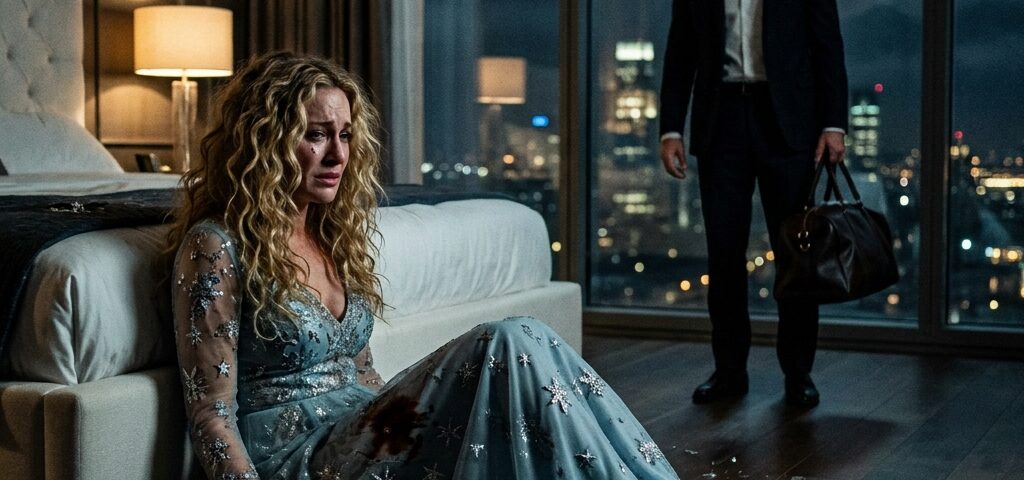
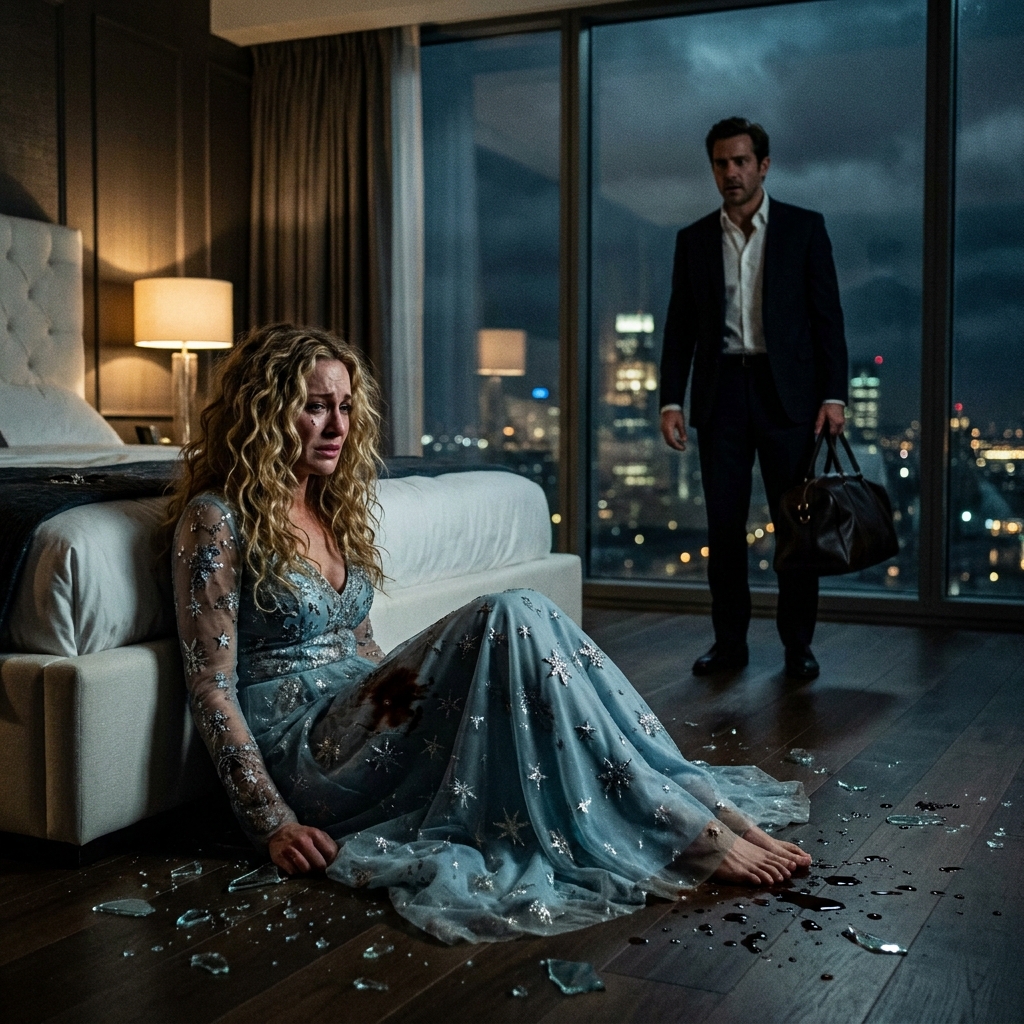
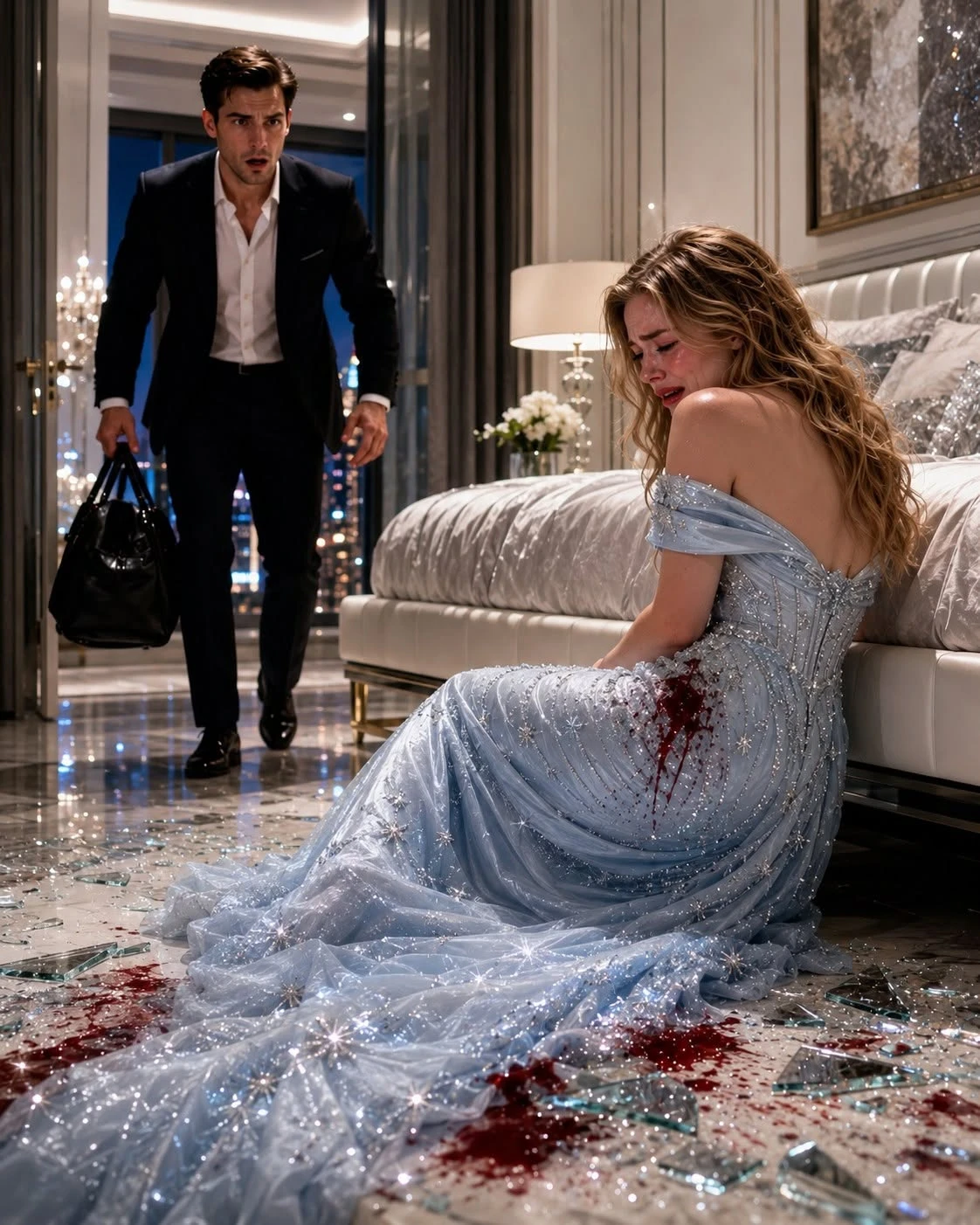
The night I came home early from a business trip, I expected to surprise my pregnant wife. Instead, I found her lying in darkness with her silk nightgown on backward, shattered glass across the floor, and blood on our wedding photo.
My name is Adam Carter, and before that night, I would have sworn I knew the woman sleeping beside me.
I had been in New York for three days, pretending to care about quarterly projections while every quiet second of my mind drifted back to Chicago, back to our apartment above the river, back to Lily standing barefoot in the kitchen with one hand on her belly and the other stirring soup she could no longer stand the smell of. She was seven months pregnant, round and luminous and tired in a way that made me ache. Sometimes she fell asleep mid-sentence. Sometimes she cried because the baby kicked when I spoke near her stomach. Sometimes she looked at me like she was carrying not just our son, but every fragile dream I had ever been too proud to say out loud.
So when my last meeting ended early, I changed flights without telling her.
I bought a tiny blue knit hat from an airport shop because it looked ridiculous and soft. I imagined her laughing at it. I imagined sliding into bed behind her, pressing my palm against the curve of her stomach, whispering, “Guess who came home early?” I imagined her turning toward me with that sleepy smile that made the whole world quiet.
But when I opened the door to our apartment, the world was already quiet.
Too quiet.
The living room was dark, not the soft evening dark Lily liked, with one lamp glowing and jazz humming from the speaker, but a thick, dead darkness that seemed to have weight. The air smelled wrong. Metallic. Sour. Beneath it was the faint perfume she wore only when my mother visited, as if sweetness could protect her from judgment.
“Lily?” I whispered.
No answer.
My suitcase wheels bumped softly against the floor. I left it by the door and stepped forward. A thin strip of light came from the bedroom, yellow and trembling, as if the lamp had been knocked sideways.
I walked toward it smiling, still clinging to the stupid little fantasy for one last second.
Then I reached the doorway.
And froze.
Lily was curled on the edge of the bed with her back to me. Her hair spilled across her face. One arm hung over the side, fingers grazing the rug. She wore her champagne silk nightgown, the one she said made her feel beautiful when pregnancy made her feel like a stranger inside her own body.
But it was backward.
The seams showed at the collar. The delicate lace that should have rested against her chest was twisted against her shoulder blades.
For one second, my mind tried to make it normal.
Maybe she was exhausted.
Maybe she had changed in the dark.
Maybe pregnancy had made her too tired to care.
Then I saw the floor.
Our silver-framed wedding photo lay shattered beside her feet. Glass glittered across the rug like ice. The frame was bent nearly in half, my smiling face split by a jagged crack, Lily’s white veil stained by something dark.
Across the white carpet was a fresh red smear.
Blood.
A cold feeling moved through my chest, slow and intimate.
I did not call her name.
I did not run to her.
I stood there.
And then my mother’s voice returned like poison.
Women have secrets, Adam. Make sure you aren’t being played for a fool.
She had said it three weeks earlier over dinner at her house, smiling gently while pouring tea, her pearls shining at her throat, her hand resting over mine as if she were saving me from a fire I couldn’t see. She had always spoken softly when she wanted to control me. The softer her voice, the sharper the blade underneath.
Now I looked at Lily’s backward nightgown.
The broken photo.
The blood.
And I let my mind become cruel.
Had someone been here?
Had they fought?
Had she dressed quickly after someone left?
Had she broken our wedding picture in guilt, panic, rage?
Then came the thought I hated most.
What if the baby wasn’t mine?
For sixty seconds, I let jealousy hold me still.
A full minute.
While my wife lay bleeding.
While our child moved somewhere inside her.
While I put the woman I loved on trial in my head because my mother had taught me suspicion before she ever taught me tenderness.
Then Lily moved.
Not peacefully.
Not like someone waking from sleep.
Like someone being dragged back into her body by pain.
Her hand clutched her belly. A small, broken gasp escaped her lips.
“Lily,” I whispered.
She turned toward me.
Her face was gray. Her lips were almost blue. Damp hair clung to her temples. Her eyes opened slowly, unfocused at first, then widening when she saw me.
Not guilty.
Not afraid of being caught.
Afraid of being alive.
“Adam,” she whispered, trembling, “don’t call your mother.”
My blood went cold.
“What?”
Tears slid sideways down her temples into her hair.
“She was here.”
The room tilted.
“She said the baby would ruin everything.”
I stumbled to the bed. Only then did I see the bruises blooming around her wrist, four dark fingerprints pressed into pale skin. I saw the cut across her palm, where she must have fallen into the broken glass. I saw the nightgown had been turned around not by laziness, but by hands that had dressed her after she was too weak to stop them.
My jealousy shattered into horror.
“Lily.” My voice cracked. “Who did this?”
Her hand tightened over our baby.
Then she whispered the sentence that destroyed every lie my family had ever told me.
“Your mother brought the doctor.”
For a moment, I heard nothing. Not the traffic below. Not the faint ticking of the wall clock. Not even my own breathing.
Only those words.
Your mother.
Brought the doctor.
I reached for my phone with fingers that barely worked and called 911. My voice sounded far away as I gave our address, told them my wife was pregnant, bleeding, injured, possibly drugged. The dispatcher asked questions. I answered what I could. Lily drifted in and out, gripping my sleeve each time her eyes opened, as if afraid I might vanish.
“I’m here,” I kept saying. “I’m here. I’m sorry. Lily, God, I’m sorry.”
She tried to speak, but pain folded her in half.
Blood spread beneath her thigh.
That sight finally broke something animal inside me.
I scooped broken glass away with my bare hand, not caring when it cut me. I wrapped a towel around her palm. I kept one hand under her head and the other against her belly, whispering to our son like he could hear me through skin and fear.
“Stay with us, little man. Stay with your mom. Please.”
The ambulance arrived in seven minutes.
It felt like years.
Paramedics flooded the room with light and voices. They asked what happened. Lily looked at me, terrified, and said nothing. I answered for her because I thought I was protecting her.
“My mother was here,” I said. “A doctor too. I don’t know who. She said—she said they hurt her.”
One paramedic looked up sharply. The other started cutting Lily’s nightgown away.
“No,” Lily whimpered. “Don’t let her near him.”
“Near who?” I asked.
Her eyes rolled toward me.
“Our baby,” she breathed. “She wanted him.”
The ride to the hospital became a blur of sirens, wet streets, and Lily’s hand crushing mine. Every time the ambulance hit a bump, she made a sound I will hear until the day I die. Not a scream. Something smaller. Something worse. A mother trying not to frighten the child inside her while her body betrayed them both.
At Northwestern, they rushed her through double doors and stopped me with a hand against my chest.
“Sir, you need to wait here.”
“She’s my wife.”
“We know. The doctors will update you.”
“She’s seven months pregnant.”
“We know.”
The doors swung shut.
And I was alone beneath white hospital lights with my wife’s blood drying under my fingernails.
That was when my phone rang.
Mom.
Her name glowed on the screen with a photo from last Christmas: Evelyn Carter smiling beside our tree, elegant and untouchable, one hand resting on Lily’s shoulder like a blessing.
I stared at it until the ringing stopped.
Then a text appeared.
Adam, are you home?
Another.
Call me immediately.
Another.
Do not believe anything Lily says tonight. She is unstable.
My hands began to shake.
For thirty-two years, my mother had known exactly when to arrive inside my head. She had raised me after my father died, or so she said, with sacrifice, discipline, and a love that always came with receipts. She paid for school. She introduced me to clients. She reminded me which doors bore our family name and which people were allowed through them.
When I married Lily, my mother cried at the wedding.
Everyone thought it was joy.
Now I remembered how tightly she had held my wife at the reception. How Lily had smiled stiffly afterward. How, in the elevator, she had rubbed her ribs and joked, “Your mom hugs like she’s checking for weapons.”
I had laughed.
God help me, I had laughed.
A doctor came out twenty minutes later. Dr. Alana Reese. Calm eyes. Blue scrubs. Blood on one sleeve.
“Mr. Carter?”
I stood too fast.
“Your wife is alive. The baby still has a heartbeat.”
Still.
That one word nearly put me on the floor.
“But?” I asked.
Dr. Reese’s face softened with professional sorrow. “She has signs of trauma, blood loss, and uterine irritability. We’re trying to stop preterm labor. She also appears to have been given a sedative.”
“A sedative?”
“We’ll know more after labs.”
“Can I see her?”
“Soon. She’s asking for you.”
I followed her down a hallway that smelled of antiseptic and rain-soaked wool. Lily lay in a curtained room, smaller somehow beneath monitors and wires. Her belly rose under a blue blanket. A fetal heartbeat filled the room in fast, galloping rhythm.
Our son was still there.
Alive.
I stepped beside her bed.
Her eyes opened.
“I didn’t let them,” she whispered.
I bent close. “Let them what?”
She swallowed, tears shining. “Take him.”
My knees weakened.
“Lily, who was the doctor?”
She looked toward the curtain, afraid even of fabric.
“I don’t know his name. Your mother called him Martin. He had a black bag. She said he owed her.”
“Owed her what?”
Lily’s mouth trembled.
“She said blood pays blood.”
Before I could ask what that meant, she gripped my wrist with sudden strength.
“Adam. Listen to me. There’s a folder.”
“What folder?”
“In the nursery. Behind the moon painting. I hid it after she came the first time.”
“The first time?”
Her eyes filled with shame that should never have belonged to her.
“I tried to tell you,” she whispered. “You said I was overwhelmed.”
The memory struck me hard.
Two weeks earlier, Lily had called me at work crying. She said my mother had come by unannounced and touched her belly without asking. She said Evelyn had whispered something strange: This child should have been mine to decide.
I had been between meetings. Irritated. Embarrassed. Trained.
I told Lily my mother was intense, but harmless.
I told her pregnancy made everything feel bigger.
I told her to rest.
I had handed my wife back to the wolf and called it family.
“I’m sorry,” I said, but the words were too small to live in that room.
Lily closed her eyes.
“You have to see the folder before she gets it.”
Then her monitor spiked.
Nurses rushed in.
Dr. Reese pushed me back.
Lily cried out, one hand reaching for me.
“Adam!”
“I’m here!”
But the curtain closed between us.
This time, I did not stand still.
I ran.
The apartment was taped off when I got back, two police officers moving through the bedroom, photographing glass, blood, fingerprints. I told them about the folder. One of them, Detective Mara Voss, followed me to the nursery.
The room was soft blue and unfinished. A crib still waited in pieces against the wall because I had promised to assemble it after New York. There were tiny folded onesies in a drawer. A stuffed elephant sat on a shelf with its ears too big for its body. Above the changing table hung a painting Lily had made herself: a crescent moon over a sleeping fox.
My hands shook as I lifted it down.
Behind it was a slit in the wall backing, carefully taped.
Inside sat a manila folder.
Detective Voss put on gloves and opened it.
Photographs slid out first.
My mother outside our building.
My mother speaking to a man in a gray coat.
My mother entering the apartment with him at 2:14 p.m. two weeks ago, according to the printed timestamp.
Then medical documents.
Prenatal records.
Insurance forms.
A copy of Lily’s bloodwork.
And beneath them, a legal document that made no sense until it made too much.
Petition for Emergency Conservatorship.
Subject: Lily Carter.
Reason: mental instability, prenatal delusions, danger to unborn child.
Requested authority: Evelyn Carter.
I stared at it.
“She was trying to have Lily declared unfit?”
Detective Voss said nothing, but her jaw tightened.
There was one more page.
A private adoption placement agreement.
Prospective guardian: Evelyn Carter.
Child: unborn male infant Carter.
My stomach turned.
“She wanted our baby.”
Detective Voss slid the papers back carefully. “Mr. Carter, do you know why?”
“No.”
But even as I said it, a memory rose.
My mother’s hand on Lily’s belly during Sunday dinner, lingering too long.
Her voice, sweet as rot.
A Carter boy finally. Your father would have loved that.
I had corrected her gently.
“Our boy, Mom.”
She had smiled at me.
Of course, darling.
But her eyes had stayed on Lily’s stomach.
My phone rang again.
Mom.
Detective Voss looked at the screen. “Answer it. Put it on speaker.”
I did.
“Adam.” My mother’s voice was breathless, but not frightened. Angry. “Where are you?”
“At the apartment.”
A pause.
“Why?”
“Lily’s at the hospital.”
Another pause, thinner.
“I know.”
Detective Voss’s eyes sharpened.
“How do you know?”
“Because she called me before inventing whatever story she is telling now. She has been unstable for weeks. I warned you.”
“You warned me not to trust her.”
“I warned you because I love you.”
“Did you bring a doctor here tonight?”
Silence.
Then she sighed.
Not like a guilty woman.
Like a tired queen.
“You are emotional.”
“Answer me.”
“I brought someone to evaluate her. For her safety. For the baby’s safety.”
“She was bleeding.”
“Because she became hysterical.”
“She said you tried to take him.”
My mother laughed softly.
That laugh did something to me. It was so familiar. So polished. It had floated over birthday cakes, hospital rooms, board meetings, funerals.
“Adam,” she said, “that child is the only clean thing left in this family.”
Detective Voss lifted her head.
“What does that mean?” I asked.
My mother’s voice dropped.
“Come home to me. Alone. We need to talk about your father.”
The line went dead.
My father.
The word opened a locked room inside me.
I had been six when he died. A boating accident on Lake Geneva, according to my mother. A storm. A body recovered two days later. She never let me ask much. Whenever I tried, her grief became a wall I felt cruel for touching.
Detective Voss took the phone from my hand long enough to check the call record.
“Do you have somewhere your mother might go?”
“Her house in Lincoln Park.”
“Then we go there,” she said.
“I’m coming.”
“No. You’re going back to the hospital.”
“My wife—”
“Needs you alive. Let us do our job.”
But I had spent my whole life letting other people stand between me and the truth.
I drove behind the police anyway.
Rain blurred the city into streaks of red and white. My mother’s house rose from the darkness like something preserved in ice, all limestone steps and black shutters and windows glowing gold. I had grown up there. Learned to tie my shoes in that entryway. Learned not to cry in that dining room. Learned that love could be withdrawn without warning.
Police lights painted the walls blue.
No one answered the door.
They forced it open.
Inside, the house smelled of lilies. My mother always kept fresh white lilies in the foyer because she said they made death look expensive.
“Evelyn Carter!” Detective Voss called.
Silence.
We moved through rooms arranged like museum exhibits of wealth: polished piano, crystal bowls, portraits of men who never looked kind. On the mantel stood a photograph of my father holding me as a baby. His smile was crooked. Mine was toothless.
I had never noticed before that my mother was not in the picture.
A sound came from upstairs.
Not a footstep.
Music.
A lullaby.
My skin crawled.
We climbed.
At the end of the hall, the door to my childhood bedroom was open.
The room had been transformed.
The navy walls were repainted pale blue. A crib stood where my bed once had. Tiny clothes hung in the closet, tags still attached. Shelves were filled with diapers, bottles, blankets, silver rattles.
On the rocking chair sat my mother.
She held the ridiculous blue knit hat I had bought at the airport.
I looked down at my coat pocket.
Empty.
Somehow, in the ambulance chaos, it must have fallen at the apartment.
She had gone back for it.
Or someone had brought it to her.
“My sweet boy,” she said.
Detective Voss raised her hand. “Evelyn Carter, stand up slowly.”
My mother ignored her. Her eyes stayed on me.
“You were always too soft,” she said. “Your father did that to you.”
“What did you do to Lily?”
“I protected what belongs to this family.”
“My son does not belong to you.”
Her face changed.
For the first time in my life, the mask slipped completely, and what looked out from behind it was not madness exactly. It was grief fermented into ownership.
“You don’t even understand what he is.”
“He’s a baby.”
“He is your father’s grandson.”
I laughed once, broken and empty. “Yes. That’s usually how families work.”
“No,” she said.
And then she smiled.
“Not that father.”
The room seemed to breathe around me.
“What?”
She stood slowly, still holding the hat.
“The man you call your father was not your father.”
Detective Voss stepped closer, but my mother lifted a hand.
“Oh, let him hear it. He deserves at least one truth tonight.”
My pulse hammered in my ears.
“My father was David Carter.”
“David Carter raised you for six years because I allowed it,” she said. “Because it suited me. Because he loved you enough to pretend.”
“Pretend what?”
“That you were his.”
I shook my head.
“No.”
“Yes.”
“No.”
She moved to the dresser and opened the top drawer. Inside were envelopes tied with black ribbon. She took one out and held it toward me.
I did not move.
Detective Voss took it instead.
Inside was a photograph, old and creased.
My mother, younger, standing beside a man I had never seen.
But I had seen him.
In mirrors.
In the shape of my mouth. The angle of my brow. The dimple in my chin that David Carter never had.
On the back, in blue ink, was a name.
Julian Vale.
My mother watched me read it.
“He was brilliant,” she whispered. “Dangerous. Everything David was not. I loved him, and he left me with you.”
The hallway tilted.
“What does this have to do with Lily?”
Her smile returned, terrible and tender.
“Julian had a daughter.”
I stopped breathing.
“No.”
“She changed her name after her mother remarried. I didn’t know when you first brought Lily home. Not immediately.”
The photograph slipped from my hand.
“No.”
“But then I saw her mother’s maiden name on the wedding paperwork.” My mother’s eyes shone. “I tried to stop it gently. You wouldn’t listen. Then she became pregnant.”
The silence after that was not empty. It was full of every moment I had misunderstood.
My mother’s coldness toward Lily.
Her obsession with the baby.
Her warnings.
Her urgency.
My voice came out barely human.
“You’re saying Lily is—”
“Your half sister,” my mother said.
The words struck the room like a gunshot.
Detective Voss went still.
I staggered backward into the crib.
Wood cracked against my hip.
“No. No, that’s not true.”
“It is.”
“You’re lying.”
“I have lied about many things,” my mother said softly. “Not that.”
I thought of Lily laughing in our kitchen. Lily kissing me under rain on our second date. Lily wearing my shirt while painting the nursery moon. Lily’s hand guiding mine over our son’s kick.
The mind protects itself from certain cliffs.
Mine did not.
I fell.
My mother stepped toward me.
“I was going to fix it.”
“Fix it?” I whispered.
“The marriage could be annulled quietly. Lily could be handled. The child could be raised properly, away from scandal. Away from her weakness. Away from yours.”
“You drugged her.”
“She fought.”
“You hurt her.”
“She refused to sign.”
“You tried to steal our baby.”
“I tried to save him from being born into a lie!”
The last word cracked out of her, raw and ugly.
Then, from downstairs, an officer called out, “Detective! We found someone in the basement!”
My mother’s face drained.
Detective Voss grabbed her arm. “Who?”
Evelyn said nothing.
They found Dr. Martin Heller tied to a chair in my mother’s wine cellar, alive, bruised, and terrified.
Not by us.
By her.
He confessed before sunrise.
He had been my mother’s private physician years ago. He had falsified documents before, covered up her breakdowns, prescribed sedatives in other names. She had called him that afternoon and told him Lily needed to be “calmed” long enough to sign conservatorship papers. He claimed he thought it was a family intervention.
But when Lily refused, when she screamed for help, Evelyn panicked.
Martin tried to leave.
Evelyn struck him with a wine bottle and locked him downstairs.
Then she returned upstairs alone.
“What happened after that?” Detective Voss asked him.
Martin’s voice shook.
“She said if Lily wouldn’t sign, grief would make Adam easier to control.”
My stomach turned to stone.
“What does that mean?”
The doctor looked at me with eyes emptied by fear.
“She was going to make it look like Lily lost the baby after an affair. She said Adam would hate her, divorce her, and hand over anything left.”
Anything left.
My son.
At 4:42 a.m., my mother was arrested in the nursery she had built inside my childhood bedroom.
She did not cry.
She looked only at me as they led her past, rainlight flickering across her face.
“I did it because I love you,” she said.
And for the first time, I understood that some people use love the way arsonists use matches.
At the hospital, Lily was still fighting labor.
I entered her room with a truth in my mouth that could destroy her more completely than my mother ever had.
She looked at me and knew.
That was Lily’s gift and her curse. She could read the weather of a heart before the storm arrived.
“What did you find?” she whispered.
I sat beside her. Took her hand carefully around the bandage.
“Lily…”
Her eyes filled.
“Tell me.”
I couldn’t.
Not there. Not while monitors traced her pain. Not while our son’s heartbeat galloped between us like a tiny horse running from a fire.
So I told her only part.
“My mother planned it. She’s been arrested. The doctor’s alive. He confessed.”
Lily closed her eyes. Relief crossed her face, then collapsed into exhaustion.
“She won’t get him?”
“No.”
“Promise?”
I kissed her knuckles.
“I promise.”
For three days, I kept the deeper truth inside me while Lily fought to keep our son inside her body. I slept in a chair. I counted contractions. I learned the language of nurses’ faces. I prayed without knowing who I was speaking to.
On the fourth morning, Lily woke before sunrise.
The room was blue with early light.
“Adam,” she said, “you’re looking at me like I’m already gone.”
I turned from the window.
She touched the empty space beside her on the bed.
“Sit.”
I sat.
She watched me for a long moment.
“You found something else.”
My throat closed.
“Yes.”
“About your father?”
I stared at her.
She gave a sad, fragile smile.
“Your mother said things. While she was here. At first I thought she was trying to scare me.”
“What did she say?”
“That blood knows blood. That I had no right to carry a Carter child because I was already too close to the name.”
Tears burned my eyes.
“Lily, I don’t know how to say this.”
Her hand went still in mine.
“Say it clean.”
So I did.
I told her about Julian Vale. About the photograph. About my mother’s affair. About the possibility that Julian was my biological father. About his daughter.
About her.
Lily did not scream.
That would have been easier.
She turned her face toward the window and became so quiet I thought something inside her had left.
The fetal monitor kept beating.
Fast. Fast. Fast.
Finally, she whispered, “No.”
“I know.”
“No, Adam.”
“I know.”
“No.” She looked at me then, and her eyes were not denial. They were recognition. “My father’s name wasn’t Julian Vale.”
I froze.
“What?”
“My mother told me my biological father died before I was born. But his name was Daniel. Daniel Meyer. I have his letters.”
I stared at her.
“What letters?”
“At my aunt’s house. In a box. My mother gave them to me before she died.”
“Lily…”
“Your mother lied.”
Hope is cruel when it arrives too quickly.
It makes the heart stand before the verdict.
Detective Voss ordered DNA testing. Not the cheap kind from curiosity websites. Legal. Verified. Urgent.
They tested me against stored samples connected to Julian Vale’s medical records. They tested Lily against her father’s letters, sealed with old hair tucked in an envelope by a grieving woman who never imagined it would one day become evidence.
We waited forty-eight hours.
In that time, Lily and I did not touch except when fear made us forget. We spoke softly, like strangers trapped in the ruins of a house they had built together. Every memory between us became dangerous. Every tenderness had a shadow.
On the second night, she cried while I pretended to sleep.
“I still love you,” she whispered into the dark, like a confession to a God who might punish her for it.
I did not open my eyes because I was afraid if I did, I would crawl into the bed and hold her, and I no longer knew whether holding her was comfort or sin.
“I still love you too,” I said.
She broke then.
Not loudly. Just folded her hand over her mouth while tears slipped through her fingers.
The results came at dawn.
Detective Voss brought them herself.
Dr. Reese stood nearby.
Lily held my hand so tightly our bones hurt.
Detective Voss opened the folder.
“Adam,” she said, “Julian Vale is not your biological father.”
I stopped breathing.
“David Carter was your father.”
The room blurred.
Lily made a sound like air returning to the world.
“And Lily?” I asked.
“Daniel Meyer was her biological father. There is no sibling relationship between you.”
For one impossible second, joy filled the room.
Pure joy.
Lily sobbed. I leaned over her and pressed my forehead to hers, both of us shaking, both of us laughing through tears, both of us alive inside the miracle that the worst thing had not been true.
Our son kicked between us.
Strong.
Angry.
There.
We were not ruined.
That was the happy moment.
The one I return to when I want to torture myself.
Because it lasted less than a minute.
Then Dr. Reese’s face changed.
The monitor alarmed.
Lily’s smile vanished.
Pain seized her body so violently she arched off the bed.
“Something’s wrong,” she gasped.
Nurses rushed in. Dr. Reese shouted orders. The fetal heartbeat stuttered, vanished, returned faintly, then scattered beneath static.
“Emergency C-section,” someone said.
I stood frozen.
Not from suspicion this time.
From terror.
Lily reached for me as they unlocked the bed.
“Adam!”
I ran beside her until the operating room doors stopped me.
Her fingers slipped from mine.
“Save him,” she cried.
Then, softer, as the doors swung shut:
“Save us.”
They saved our son.
He was born at 9:17 a.m., two pounds eleven ounces, silent for the first six seconds of his life.
Six seconds is not long unless it contains your whole soul.
Then he cried.
Tiny. Furious. Alive.
They let me see him through plastic in the NICU, his body threaded with tubes, his hand no bigger than the end of my thumb. He looked impossible. A person made of breath and defiance.
“His mother?” I asked.
No one answered fast enough.
Lily had lost too much blood.
The trauma, the sedative, the labor, the surgery—her body had endured what no body should. They worked on her for ninety-three minutes.
I know because I counted every one.
When Dr. Reese came out, she had removed her cap. Her hair was damp at the temples. Her eyes told me before her mouth did.
“I’m so sorry.”
There are sentences that do not enter you right away.
They stand outside, patient and monstrous, waiting for your body to understand.
“No,” I said.
Dr. Reese stepped closer.
“She fought very hard.”
“No.”
“Adam—”
“No. We got the results. She knows. She knows we’re okay.”
My voice rose.
“She knows.”
Dr. Reese’s eyes filled.
“She asked me to tell you something before we took her under.”
I could not move.
“She said, ‘Tell him I believed him at the end.’”
At the end.
Not in the beginning, when I stood in the doorway and judged her.
Not when she called me weeks before and I dismissed her fear.
At the end.
When it counted too late.
They let me sit with her afterward.
Someone had cleaned the blood from her skin. Her hair lay smooth against the pillow. She looked younger. Almost like the girl I met in a bookstore during a storm, when she asked if I was going to buy the last copy of a novel she wanted and I said only if she had coffee with me first.
Her hands were cold.
I held the bandaged one.
“I’m sorry,” I told her.
The room did not forgive me.
“I’m sorry I froze.”
The machines were gone now. The silence was complete.
“I’m sorry I let her voice be louder than yours.”
Outside, somewhere down the hall, our son cried.
Our son.
Lily’s son.
The boy she had protected with her body while I stood in darkness measuring her against my mother’s lies.
I named him Noah because Lily once said the name sounded like a door opening after rain.
My mother’s trial lasted six weeks.
The newspapers called her elegant. Troubled. Protective. A grieving widow with complicated motives.
They never called her what she was.
A woman who mistook possession for love and left a child without a mother.
She was convicted of kidnapping conspiracy, assault, unlawful restraint, falsifying medical documents, and manslaughter. When the sentence was read, she looked back at me.
Even then, she expected me to soften.
I did not.
Noah stayed in the NICU for sixty-one days.
I read to him every night from Lily’s favorite book. I placed my finger against his palm and let him grip me with impossible strength. I told him about his mother’s laugh. About how she burned toast because she got distracted by songs. About how she painted moons because she believed even darkness deserved something gentle.
When I finally brought him home, the apartment had been cleaned.
But I could still see everything.
The place where the photo shattered.
The stain that never fully left the carpet.
The doorway where I had stood for sixty seconds and failed.
I rebuilt the nursery alone.
On the wall above the crib, I hung Lily’s crescent moon painting.
Behind it, I placed a new folder.
Not secrets.
Truth.
DNA results. Court records. A letter from me, written for the day Noah is old enough to ask why his grandmother is a ghost and his mother is a story everyone tells carefully.
But there is one thing I have never written down.
One thing only I know.
The night before Lily died, when we were still waiting for the DNA results, she woke from a dream and asked me to bring her the blue knit hat.
“The ugly one?” I asked.
“The perfect one,” she said.
I had to tell her it was gone.
My mother had taken it.
Lily smiled faintly.
“Then buy another.”
“I will.”
“No,” she said. “Not the same. Another. Promise me he won’t spend his life trying to replace what was stolen.”
So I did.
I bought Noah a green hat instead.
Soft as moss.
Bright as spring.
And every year, on his birthday, I take him to the river at sunrise. He is five now. He has Lily’s eyes and my stubborn chin. He asks hard questions. I answer as cleanly as I can.
This year, he held my hand and looked up at the pink sky.
“Daddy?”
“Yeah, buddy?”
“Was Mommy scared when I was born?”
My chest tightened.
I watched the river carry the morning in broken pieces of gold.
“Yes,” I said. “But she was braver than scared.”
He thought about that.
Then he pressed his small hand over his heart the way Lily used to press hers over him.
“Did she love me?”
I knelt in front of him.
The wind moved through his hair.
“She loved you before you had a name.”
His eyes shone, solemn and ancient.
Then he smiled.
And for one second, Lily was there.
Not as a memory.
As light.
As breath.
As the impossible mercy of a child who survived a room full of darkness.
I held my son beside the river while the city woke around us, and the green hat on his head glowed softly in the sun like something stolen had finally learned how to live.