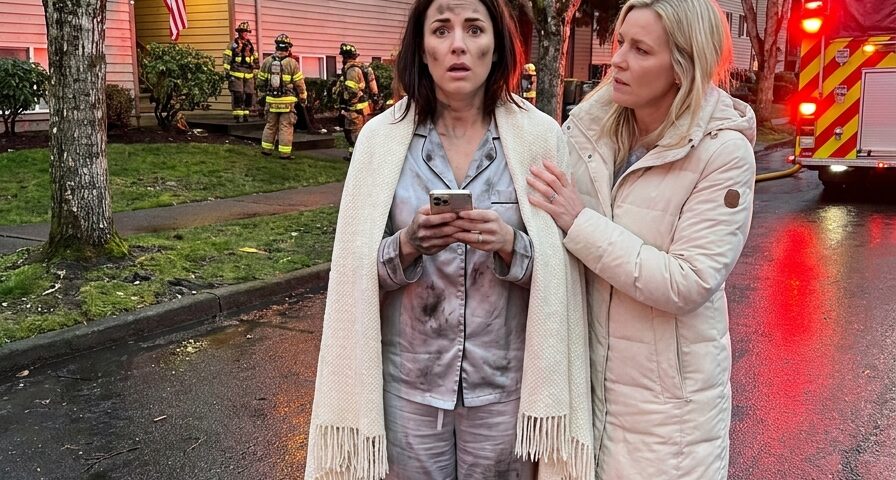
When My Apartment Went Up in Flames, I Called My Parents—My Mother Coldly Said, “That’s Not Our Problem.”
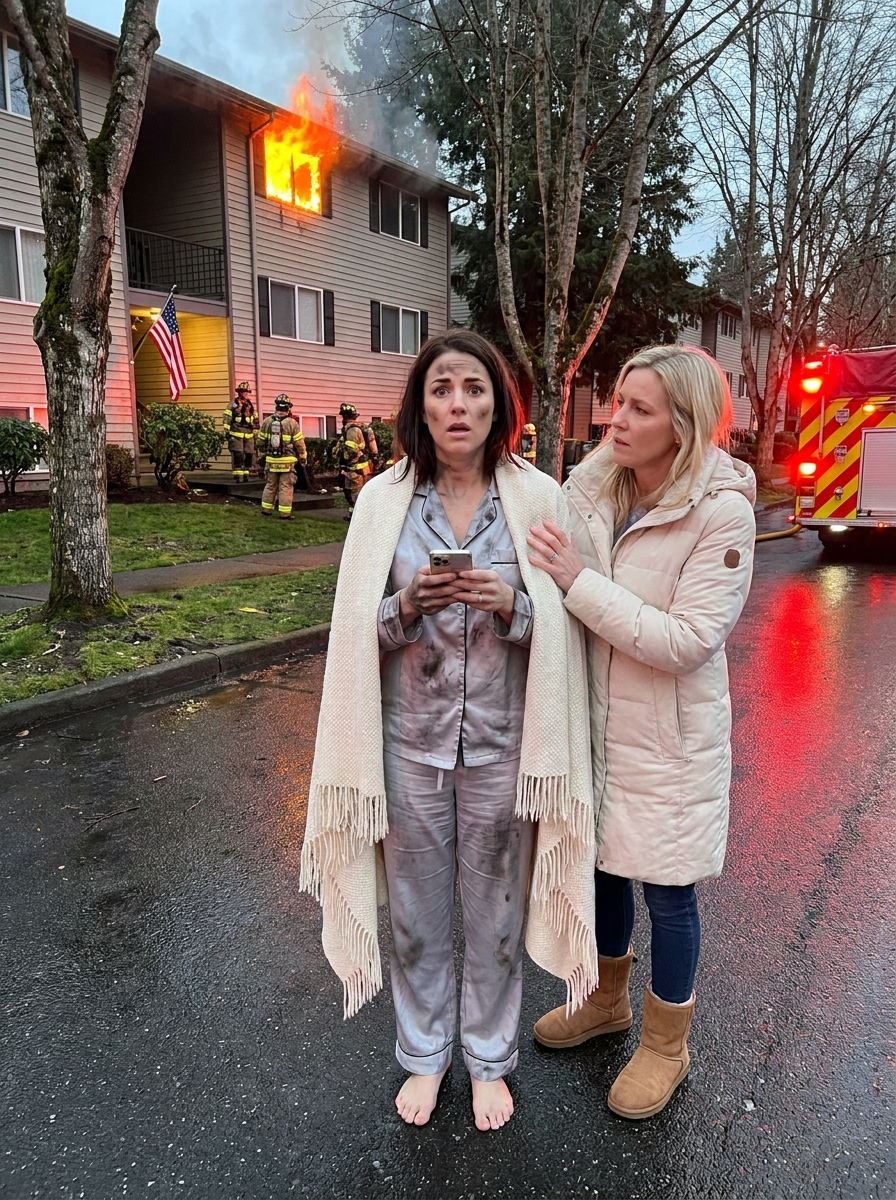
The motel room the Red Cross voucher paid for was three blocks away from the apartment complex, tucked between a gas station and a closed laundromat. The man behind the desk gave me a key card without meeting my eyes. I suppose people who arrive at four in the morning wrapped in borrowed blankets do not invite questions. The room smelled faintly of bleach and old smoke, which felt like a joke too cruel for anyone to say out loud. I locked the door, sat on the edge of the stiff bed, and stared at the wall until daylight pushed through the curtains.
I did not sleep. Every time I closed my eyes, I saw the hallway again. The smoke. The orange pulse behind the windows. I heard my mother’s voice repeating itself with the calm precision of a verdict. Not our problem. You should have been more careful.
By noon, my entire life fit inside a plastic shopping bag a volunteer had given me. A toothbrush. A comb. Travel-size deodorant. A sweatshirt from a donation box that smelled like someone else’s detergent. The woman at the front desk told me I could stay two nights under the voucher, maybe three if the paperwork cleared. After that, she gave me a look that said she had seen people fall through cracks before and knew better than to promise the ground would appear beneath them.
I called my landlord. I called my insurance company. I called my boss and explained, in a voice so calm it frightened me, that I would not be in for a few days because my apartment had burned down. I did not call my mother again. Pride would have been a noble reason, but the truth was simpler. I was afraid she would answer. I was afraid she would not.
On the second day, after I had spent hours filling out forms and trying to remember every object I owned for an insurance claim that reduced my life to categories and estimated values, my phone rang with an unfamiliar county number.
“This is Ivy Myers,” I said.
A man’s voice answered. “Ms. Myers, my name is Grant Holloway. I’m a fire investigator with the county. I’m sorry to bother you, but I’d like to meet with you at the property, if you’re able. There are a few things we need to discuss.”
I looked down at my borrowed sweatshirt and the motel carpet patterned with brown leaves. “Is this about the report?”
“In part,” he said. His voice was measured, careful. “I think it would be better if we spoke in person.”
Something in his tone made the room feel smaller.
An hour later, I stood across from what remained of my building. In daylight, the damage looked both less dramatic and more devastating. The flames were gone, the fire trucks gone, the crowd gone. What remained was a wounded structure with black stains climbing the brick, broken windows boarded over, and the sour wet smell of burned insulation and soaked ash hanging in the air. Yellow tape snapped lightly in the wind. A dumpster had already been rolled near the entrance, and inside it were pieces of strangers’ lives mixed with mine.
Grant Holloway was waiting near the stairwell. He was in his mid-forties, with gray at the temples and a county badge clipped to his jacket. He held a clipboard under one arm. His face was calm, but not indifferent. I had spent enough years reading expressions across conference tables at work to know the difference between a person who had bad news and a person who had chosen not to reveal all of it yet.
“Ms. Myers,” he said, offering his hand. “I’m sorry for what happened.”
I shook his hand because politeness is a reflex even when your life is rubble. “Do you know what started it?”
He did not answer right away. Instead, he glanced toward the building. “Do you feel able to walk with me? We won’t go far inside. The structure’s been cleared for limited access, but I don’t want you near the worst areas.”
I nodded, though my legs already felt unsteady.
The interior hallway looked like a place after war. The walls were streaked with soot. Water pooled in shallow patches on the floor. The smell was almost unbearable. Every breath coated the inside of my mouth with chemicals and char. When we reached the fourth floor, I stopped involuntarily at the sight of my door.
It was no longer a door. It was a blackened frame around darkness.
Grant stood beside me, giving me a moment without pretending not to notice I needed one.
“This may be difficult,” he said. “But I need to ask you a few questions. Who had access to your apartment in the week before the fire?”
I turned toward him. “Access?”
“A key. A way in. Anyone who might have entered while you weren’t home.”
“No one,” I said. “I lived alone. My landlord had a key. Maintenance, I guess, if there was an emergency, but there wasn’t one. Nobody else.”
“No family?”
The question tightened something in my chest. “No.”
“No ex-boyfriend? Friend? Neighbor?”
“My ex hasn’t been here in years. I don’t give out keys.”
He watched me for a second, his expression unreadable. “You’re sure?”
“I’m sure.” Then, because the silence pressed on me, I added, “Why are you asking?”
Grant shifted the clipboard under his arm and looked toward the back of what used to be my apartment. “The fire didn’t start where we’d expect an accidental residential fire to start. Not in the kitchen. Not near an outlet. Not near a heater, appliance, charging cable, or anything with an electrical source.”
I swallowed. “Then where?”
“Near the back bedroom window.”
The words were simple. They should not have frightened me as much as they did.
“There’s no wiring there,” I said.
“I know.”
“There’s nothing there but the window and a dresser.”
“I know,” he repeated, softer this time.
For the first time since the fire, fear shifted shape inside me. Until then, I had been afraid of what had happened. Now I began to fear why.
Grant opened the folder tucked beneath his clipboard. “We found evidence of an accelerant in that area. The burn pattern suggests something was poured along the base of the wall near the window. We’re waiting on lab confirmation, but preliminary indicators are consistent with gasoline or a similar flammable liquid.”
I stared at him. “Poured?”
“Yes.”
“Deliberately?”
He did not look away. “That’s what it appears to be.”
The hallway seemed to tilt slightly beneath me. I reached for the wall, then remembered too late that it was covered in soot. My fingers came away black.
“But I was inside,” I said. It came out so quietly I barely heard myself. “I was asleep.”
“I understand.”
“No, you don’t.” My voice cracked. “If the alarm hadn’t gone off, if I’d slept a little harder, if I’d taken cold medicine or worn earplugs, I could have died.”
Grant’s jaw tightened. “That’s one of the reasons I’m treating this very seriously.”
I wanted to ask who would do this to me, but the question died before it formed. Because even before Grant reached into the folder, even before he said there was something else, some deep and buried instinct inside me had already begun walking toward a name I did not want to say.
“We recovered an item near the suspected point of origin,” he said. “It doesn’t belong in a normal fire pattern, and I need to know whether you recognize it.”
He pulled out a clear evidence bag.
Inside was a half-melted keychain. The metal charm was warped and blackened, but the shape remained visible. A small silver fox, curled as if mid-leap.
The hallway disappeared. The smell, the soot, the ruined walls, all of it receded behind the sudden roar of memory.
I had bought that keychain three years earlier at a little shop in Asheville during a weekend trip I had taken alone after my engagement ended. I had given it to my younger stepbrother, Weston, for his twenty-fourth birthday because he had always joked that foxes were smarter than people gave them credit for. Back then, we had still spoken. Back then, I had still believed he was reckless but harmless. Back then, I had not yet learned how quickly desperation could rot a person from the inside.
“Ms. Myers?” Grant asked.
I could barely breathe. “That belongs to Weston.”
“Who is Weston?”
“My stepbrother,” I said. “Weston Cole. I haven’t seen him in over a year.”
Grant’s pen moved across the clipboard. “Why not?”
Because he had come to my apartment with red eyes and shaking hands, asking for twelve thousand dollars. Because he had said he owed people money, dangerous people, and that if I loved him, I would help. Because I had believed the truth was kinder than enabling him and told him no. Because he had called me selfish, cold, just like my real father, even though my real father had been dead for ten years and had never been anything but gentle with me. Because my mother had taken his side before I finished explaining.
I said only, “He asked me for money. I refused. We haven’t spoken since.”
Grant looked at the evidence bag, then back at me. “Do you know whether he knew where you kept cash, valuables, documents?”
I let out a bitter, startled laugh. “I didn’t keep cash. I barely had savings. My most valuable things were sentimental.”
The moment I said it, grief struck so hard I bent forward slightly, one hand over my mouth. My grandmother’s quilt. My father’s records. The photographs. The wedding album I had pretended not to care about but had carried through three apartments because some younger, softer version of me still lived inside those pages. Sentimental things do not survive fire better because they are priceless only to you.
Grant waited. When I straightened, his voice was gentle but firm.
“I need you to tell me everything you can about Weston Cole.”
Part 3
I told Grant what I knew, and the more I spoke, the more ashamed I felt. Not because Weston’s choices were my fault, but because I had spent so long minimizing them that hearing the truth out loud made me feel like an accomplice to my own blindness. Weston had always needed rescuing. That was the family sentence passed down long before I understood its language. He was my stepfather’s son from a previous marriage, though my stepfather, Ray, had been more shadow than parent, a man who drifted in and out of work, in and out of sobriety, in and out of the house until a heart attack took him when Weston was eighteen. My mother responded to Ray’s death by turning Weston into a permanent emergency.
He was grieving. He was sensitive. He was misunderstood. He was trying. He had bad luck. He had bad friends. He had anxiety. He had no direction because no one believed in him enough. Every excuse arrived before the consequence could touch him. If Weston missed rent, Mom paid it. If he crashed a car, Mom blamed the road conditions. If he borrowed money and forgot to repay it, Mom called it a misunderstanding. I used to think she loved him more because he needed more. It took me years to understand that sometimes being the dependable child is its own punishment. Nobody worries about the roof that never leaks until the day it collapses.
When Weston came to me for money the year before the fire, I had known he was in trouble the moment I opened the door. He smelled like cigarettes and rain. His hair was damp, his eyes bloodshot, his jaw working like he had been chewing on fear. He sat at my kitchen table without removing his jacket and told me he needed help. Not a little help. Twelve thousand dollars.
“For what?” I had asked.
He rubbed both hands over his face. “I made a mistake.”
“What kind of mistake?”
“The kind where if I don’t fix it, things get ugly.”
I knew then it was gambling, though he did not say the word until ten minutes later. Sports betting. Online poker. A few private games with men who did not send polite reminders when money came due. He spoke quickly, trying to outrun the sound of his own choices. He said he had a plan. He said he would pay me back. He said Mom could not know because it would kill her. Then, when I said I did not have twelve thousand dollars to hand him, his desperation hardened into cruelty.
“You always act like you’re better than us,” he said.
“No, I act like I can’t solve this for you.”
“Dad would’ve helped me.”
The word Dad from his mouth did not mean my father, and yet he knew exactly where to aim it.
I stood beside the sink, arms folded, feeling every old family wound reopen. “My father taught me not to throw good money into a fire.”
Weston’s face changed. “Careful, Ivy.”
“Get help. Real help. I’ll help you find a counselor, a support group, a financial attorney, anything like that. But I’m not giving you cash.”
He stared at me with such hatred that for the first time in my life, I felt afraid of him.
“You’ll regret this,” he said.
People say ugly things when they are desperate. That is what I told myself after he slammed my door hard enough to rattle the frame. That is what I told myself when my mother called twenty minutes later to accuse me of humiliating him. That is what I told myself for the entire year that followed, through holidays I was not invited to and family group messages that went silent whenever I replied. I told myself Weston was angry, not dangerous.
Standing in the blackened hallway of my apartment with his melted fox keychain in an evidence bag between me and Grant Holloway, I understood the difference had almost killed me.
After I gave Grant Weston’s full name, last known address, phone number, and every detail I could remember, he told me not to contact him. “Let us handle that,” he said. “I know it’s tempting to confront someone when you think you have answers, but right now the best thing you can do is give us room to investigate.”
I nodded as though I agreed, but my mind had already moved somewhere else. It had moved to my mother.
There was one thing Grant did not know yet. One thing I had not admitted because it made me feel childish and pathetic. My mother’s response on the night of the fire had not been ordinary cruelty. It had been too fast, too flat, too clean. Not our problem. You should have been more careful. She had not asked if I was hurt. She had not asked where I was. She had not even sounded surprised for more than a breath. At the time, I had thought the shock of her rejection was making me imagine things. Now that I knew Weston’s keychain had been found inside my burned apartment, her silence sounded like knowledge.
That night, back at the motel, I sat on the bed with my phone in my lap for nearly an hour before I called her. The room was dim except for the lamp beside the bed. Outside, traffic hissed over wet pavement. I had showered three times and still smelled smoke in my hair.
She answered on the second ring.
“Ivy,” she said, guarded.
Not honey. Not thank God you called. Not are you safe?
“Did Weston come to my apartment?” I asked.
Silence.
I closed my eyes. My stomach turned cold. “Mom.”
“What are you talking about?”
“The investigator found his keychain in my apartment. The fox one I gave him. They said the fire was started deliberately near my bedroom window.”
Her breathing changed. That was all. A small catch, barely there, but I heard it.
“I don’t know anything about that,” she said.
“Don’t lie to me.”
“Ivy, you’re upset.”
“My home is gone. Someone poured gasoline in my bedroom while I was asleep. So yes, I’m upset.”
Another silence. Longer this time. I imagined her standing in the kitchen of the house where I had grown up, one hand braced on the counter, looking toward the hallway as if Weston might appear there and rescue her from the truth.
“He didn’t mean for it to happen,” she said finally.
I stopped breathing.
Those six words entered me slowly, like a blade too sharp to feel at first.
“What did you say?”
“He was scared,” she whispered. “He was desperate, Ivy. He needed money, and he thought maybe you had some cash hidden away, or jewelry, or something he could pawn. He only went there to look.”
“He broke into my apartment?”
“He said the window latch was loose.”
“The window latch was loose because maintenance was scheduled to fix it.” My voice rose. “He climbed through my bedroom window?”
“He wasn’t thinking clearly.”
“When did he tell you?”
“Ivy—”
“When did he tell you?”
“The morning after,” she said, and then the truth began spilling out in pieces, each one worse than the last. Weston had shown up at her house shaking, smelling of smoke, with a burn on his wrist and soot on his jacket. He had confessed that he went to my building late because he thought I was at work. He did not know I had switched shifts. When he found no cash, he started searching drawers. Then a neighbor’s dog began barking, and he panicked. He knocked over a container of paint thinner from beneath the sink, or maybe it was already out, or maybe he said gasoline because he had brought it to scare me later. My mother contradicted herself so many times I could hardly follow the lies from the half-truths.
But the center of it was clear.
Weston had been inside my apartment.
Weston had started the fire.
And my mother had known.
“He said it was supposed to be small,” she said, crying now. “Just enough to cover that he’d been there. He didn’t know you were home. He swore he didn’t know.”
I stood up because sitting suddenly felt impossible. “He set fire to my apartment to hide a burglary.”
“He made a mistake.”
“A mistake is forgetting to lock a door. A mistake is backing into a mailbox. He could have killed me.”
“But he didn’t.”
The words came out before she could stop them. I heard the instant she realized what she had said.
The room went utterly still around me.
I had spent my whole life trying to earn a softness from my mother that she had no intention of giving me. I had made myself easier, quieter, more responsible. I remembered birthdays where Weston’s emergencies overshadowed my milestones, holidays where I washed dishes while he slept on the couch, phone calls where my good news was met with distracted approval because Weston was always somewhere burning down his own life. But nothing, not one memory, had prepared me for my mother weighing my survival against his guilt and deciding the important thing was that I had lived.
“You knew,” I said. My voice sounded strange, almost calm. “When I called you from the parking lot with no shoes and nowhere to go, you already knew.”
“I was protecting my son.”
Something inside me cracked so cleanly that for a moment I felt relief.
“I was your daughter.”
She sobbed once, harshly. “Ivy, please. You don’t understand what prison would do to him.”
“No,” I said. “You don’t understand what he did to me.”
Then I hung up.
I did not cry. Not then. I called Grant Holloway instead.
Part 4
Grant arrived at the motel forty minutes later with another investigator and a digital recorder. It was nearly midnight, but he looked fully awake, as if he had expected the case to turn in this direction and had only been waiting for the moment it did. I sat at the small table near the window, wrapped both hands around a paper cup of coffee, and told him everything my mother had said. My voice shook at first, then steadied as I repeated the details. Weston climbing through the bedroom window. Weston searching for money. Weston panicking. Weston setting the fire to erase evidence. My mother knowing since the morning after. My mother telling him to stay quiet.
Grant listened without interrupting except to clarify names and times. The recorder’s red light blinked between us like a tiny warning.
“Did she explicitly say he started the fire?” he asked.
“Yes.”
“Did she say he knew you were inside?”
“She said he swore he didn’t. But I don’t know if that’s true. I was supposed to be working late. My schedule changed two days before.”
“Did Weston know your schedule?”
“He used to. I don’t know anymore.”
The other investigator, a woman named Detective Marisol Keene, wrote notes in a small black notebook. “Has Weston contacted you since the fire?”
“No.”
“Has your mother attempted to call back?”
I looked at my phone on the table. It had remained silent since I hung up. “No.”
Detective Keene’s mouth tightened slightly. “All right.”
The next days passed in a blur of interviews, statements, and practical humiliations. There is something uniquely exhausting about proving you had a life after that life has been reduced to ash. The insurance company wanted inventories. The police wanted timelines. The landlord wanted forms signed before he would release what little remained from the apartment. People asked me to remember the purchase dates of furniture that no longer existed, the serial number of a laptop melted beyond recognition, the approximate value of a quilt my grandmother had sewn by hand from old dresses and flour sacks. How do you price the last object that still smelled faintly of someone who loved you?
Friends from work brought clothes. My boss paid for a week at an extended-stay hotel and told me not to argue about it. A woman named Tasha from the second floor found me through the apartment complex email list and dropped off a box of toiletries, snacks, and a pair of fuzzy socks with little cats on them. Kindness arrived from places I had not expected. It made my mother’s absence louder.
On the fourth day after I spoke to Grant, Weston was arrested.
I found out not from my mother, but from Detective Keene, who called while I was sitting in the lobby of the extended-stay hotel eating instant oatmeal with a plastic spoon. She told me Weston had been taken into custody that morning and charged with burglary and arson, with additional charges possible depending on the prosecutor’s review. She spoke carefully, professionally, but I heard something human underneath.
“We recovered clothing from his residence,” she said. “There are items being processed now. We also obtained surveillance footage from a gas station near your building showing him purchasing a small fuel container that night.”
I closed my eyes. Until that moment, some foolish piece of me had still hoped the story would unravel differently. That my mother had misunderstood. That Weston had lied to sound more important than he was. That the keychain had been planted by some impossible coincidence. But there it was, hard and plain. A fuel container. The word accidental no longer had anywhere to hide.
“What happens now?” I asked.
“He’ll be arraigned. The prosecutor will decide how to proceed. You may be contacted by victim services.”
Victim. The word landed heavily. I had used it for other people, people on the news, people in case files, people whose tragedies had shape and official language. I did not know how to wear it myself.
“Will my mother be charged?” I asked.
There was a pause. “At this stage, we don’t have evidence that she participated before or during the crime. Knowing after the fact and failing to report can be complicated legally. The prosecutor will review her statement if we obtain one, but I can’t promise anything.”
Of course she would remain just outside the reach of consequence. My mother had always been gifted at standing close to damage without appearing to hold the match.
After the call, I sat there until the oatmeal went cold. People moved around me in the lobby, dragging suitcases, checking out, checking in, living lives with doors and closets and private bathrooms full of ordinary belongings. I wondered whether Weston had been frightened when the police came. I wondered whether my mother cried. I wondered whether either of them had thought of me standing barefoot on concrete while my apartment burned.
My answer came that evening.
My phone rang just after seven. Mom.
I watched her name pulse on the screen until the call ended. A minute later, she called again. Then again. On the fourth call, I answered and said nothing.
“How could you?” she cried.
I almost laughed. The question was so enormous, so perfectly backward, that for a moment I could not believe she had spoken it.
“How could I?” I repeated.
“They arrested him in front of the neighbors. They put him in handcuffs like some kind of criminal.”
“He is a criminal.”
“He’s your brother.”
“He burned down my home.”
“He was scared, Ivy. He needs help, not prison.”
“He needed help years ago. You gave him excuses instead.”
She made a wounded sound, but I had no room left inside me for her pain. I had spent decades making room.
“You don’t know what I’ve been through with him,” she said. “You’ve always been independent. You don’t understand what it’s like to have a child who can’t stand on his own.”
“I understand exactly what it’s like to be punished for standing on my own.”
Silence.
The words surprised both of us. They had risen from somewhere old, somewhere deeper than the fire. I saw myself at sixteen, getting a part-time job to buy my own school clothes because Mom’s money had gone to cover Weston’s traffic fines. I saw myself at twenty-two, cleaning out my father’s apartment alone because Mom said funerals made her uncomfortable and Weston said he could not handle grief. I saw myself at twenty-nine, trying on wedding dresses without her because Weston had been dumped by a girlfriend and needed her that weekend. I saw the pattern in its entirety, bright and merciless.
“You made me the child who didn’t need anything,” I said. “Then you acted like that meant I wasn’t allowed to need anything.”
“Ivy, that’s not fair.”
“No. What isn’t fair is calling my mother while I watched my apartment burn and hearing her tell me it wasn’t her problem because she already knew who did it.”
Her breathing turned ragged. “I panicked.”
“You chose.”
“He’s my son.”
“And I was your daughter,” I said again, but this time it did not break me. This time it sounded like a door closing.
She began to cry harder. “Please don’t do this to the family.”
“The family?” I looked around the hotel lobby, at the beige walls, the vending machine, the suitcase containing everything I currently owned. “There is no family here. There is you protecting Weston, and there is me surviving what he did.”
“Ivy—”
“Do not call me again unless it’s to tell the truth to the police.”
I ended the call and blocked her number before my hand could tremble.
That night, for the first time since the fire, I slept for nearly six hours. My dreams were not peaceful. Smoke still found me. But when I woke, my phone was silent, and silence, I discovered, could be a kind of shelter.
Part 5
Rebuilding did not feel heroic. No music swelled in the background. No montage carried me gently from ruin to renewal. Rebuilding was sitting in a government office under fluorescent lights, waiting for a replacement driver’s license. Rebuilding was crying in the aisle of a department store because I could not decide which towels to buy and suddenly missed the frayed green ones I had owned for ten years. Rebuilding was learning that grief is not only for people. You can grieve a mug, a chair, a sweater, a handwritten recipe tucked into a cookbook, a dented saucepan your father once used to make soup when you had the flu.
For weeks, smoke followed me everywhere. It clung to memory rather than fabric. I smelled it in clean hotel sheets, in the steam from my coffee, in the cold air outside the grocery store. Some nights, I woke convinced the alarm was screaming again, my body already halfway out of bed before the room came into focus. The victim services counselor told me this was normal. I hated that word. Normal made terror sound orderly.
Grant Holloway kept me updated when he could. Weston pleaded not guilty at first, then changed his plea after the evidence became too heavy to pretend around. The gas station footage. The accelerant report. The keychain. The partial confession he had given my mother, which she eventually admitted to investigators after Detective Keene made clear that lying would not save him. I was told she cried through the entire statement. I wondered whether she cried for what he had done or for the fact that she had failed to bury it.
The prosecutor asked if I wanted to give a victim impact statement. I said yes before I could talk myself out of it.
The courthouse smelled of polished wood and old paper. I wore a navy dress borrowed from a coworker and shoes that pinched my heels. Weston looked smaller than I remembered when they brought him in, his face pale, his hair cut short, his eyes fixed on the table in front of him. My mother sat two rows behind him. She looked older, but not softer. When I walked past, she reached slightly toward me, then stopped when I did not look at her.
I had written my statement the night before in a notebook because typing felt too clean. My hands shook when I unfolded the paper, but my voice did not.
I told the court about waking to smoke. I told them about running barefoot down four flights of stairs, about the stranger’s blanket, about watching flames move through the only home I had. I told them about the objects no insurance check could replace. My grandmother’s quilt. My father’s records. The photographs. The birthday cards. The proof that I had belonged to people who were gone.
Then I looked at Weston.
“You didn’t just break into my apartment,” I said. “You broke into the last safe place I had left. You made a choice to protect yourself by creating a fire you could not control. Whether you knew I was inside or not, you decided my home was disposable. You decided my life was an acceptable risk.”
His face crumpled then. For a second, I saw the boy he had been, the one who used to build forts out of couch cushions and steal fries off my plate. I felt sadness, but it did not change the truth. Love, history, blood, proximity, none of it could unburn a room.
I turned slightly, not enough to face my mother fully, but enough that she would hear every word.
“And after it happened, the person I called for help chose silence. She chose him. She told me it was not her problem. I have spent most of my life believing that if I became easy enough to love, one day my family would notice I was worth protecting. I know now that I was always worth protecting. They simply chose not to.”
The courtroom was very quiet when I finished.
Weston was sentenced to prison time, restitution, and mandatory treatment for gambling addiction and substance abuse. No sentence could restore what I lost. No number of years could give me back the moment before the alarm woke me, when my apartment still existed and I still believed my mother’s cruelty had limits. But consequence mattered. Truth mattered. Standing there and speaking without apology mattered.
My mother waited for me outside the courtroom. I knew she would. She stood near a marble column, clutching her purse with both hands, her eyes red.
“Ivy,” she said.
I stopped because some part of me, even then, needed to know what she would say when there was nothing left to hide behind.
“I’m sorry,” she whispered.
It should have been everything. Once, I would have handed over years of pain for those two words. I would have reshaped myself around them, softened the edges, made excuses, accepted the smallest crumb of remorse as a feast. But the woman standing in front of me had not become sorry when I was homeless. She had not become sorry when I begged for answers. She had become sorry when the truth became public and consequences arrived at her door.
“I believe you’re sorry,” I said carefully. “But I don’t think you’re sorry for the same things I am.”
Her mouth trembled. “I lost my son today.”
“No,” I said. “You lost me long before today. You just finally noticed.”
I walked away before she could answer. Outside, the air was cold and bright. For the first time in months, I breathed without tasting smoke.
The new apartment I found was two towns over, on the second floor of a brick building with wide windows and a grocery store close enough to walk to. It was smaller than Unit 4B, and the floors creaked near the kitchen, and the bathroom sink dripped unless I turned the handle just right. But it was mine. I bought new locks the day I moved in. I installed a security camera facing the hallway. I bought a fireproof safe for the few photographs friends had managed to reprint and the handful of documents I had gathered piece by piece from offices, banks, and online portals. No one had a spare key except me.
At first, the emptiness of the place hurt. The walls were too bare. The shelves held nothing with history. Every object was new, chosen quickly, paid for with insurance money, donations, or careful budgeting. But slowly, the apartment began to gather evidence of living. A blue mug from a thrift store. A soft gray blanket from Tasha. A framed photograph of my father that my cousin found on an old hard drive and emailed to me with a message that simply said, Thought you might need this. A record player I bought secondhand, though I owned no records yet. Sometimes hope is not a grand feeling. Sometimes it is buying the thing before you have anything to play on it.
Months passed. The nightmares became less frequent. I stopped checking the stove three times before bed and checked it only once. I learned which neighbors held the door open and which ones talked too loudly on the phone. I learned the morning light in the kitchen was best around eight. I learned that safety was not the same as certainty, but it was something you could build in small, stubborn ways.
I did not speak to my mother. She sent letters at first. I returned them unopened. Then she sent messages through relatives, who used words like forgiveness and family as if they were keys that could unlock any door. I told them the same thing each time: I was not angry because she failed to be perfect. I was done because she had chosen to protect the person who harmed me while I stood in ashes asking for help. There is a difference between a mistake and a revelation. My mother had revealed herself. I believed her.
Sometimes people ask if losing everything changed me. The answer is yes, but not in the way they expect. The fire did not make me harder. I had already been hard in all the wrong places, braced against disappointment, trained to need little, proud of surviving on scraps. What the fire gave me, strangely, was tenderness toward myself. It forced me to see the woman on the curb that night not as foolish for calling her mother, not as weak for needing shelter, not as dramatic for grieving objects, but as someone who deserved to be saved.
I deserved to be saved.
I deserved the thermos of coffee, the spare clothes, the frantic drive across town, the trembling hug, the mother who said, Stay where you are, I’m coming. I did not receive those things, but their absence no longer proves anything about my worth. It proves something about hers.
On the first anniversary of the fire, I took the day off work. I expected to spend it in bed, but when morning came, the apartment was filled with clean winter sunlight, and I did not want to hide from it. I made coffee in the blue mug. I placed my father’s photograph on the kitchen table. Then I drove to a record shop downtown and spent an hour flipping through crates until I found an old album he used to play on Sunday mornings. The cover was worn at the corners. The record inside had a scratch on side B. I bought it anyway.
Back home, I set it on the secondhand player and lowered the needle. For a moment there was only crackle. Then music filled the room, thin and imperfect and alive.
I stood in the middle of my new apartment and cried. Not because everything had been restored. It had not. Not because justice had healed me. It had not. I cried because the sound reached some untouched place inside me, some room the fire had not found, and opened a window.
My life had burned. My family had failed me. My mother had chosen someone else’s escape over my survival. But I was still there. Breathing. Listening. Beginning again.
And this time, every key belonged to me.
THE END