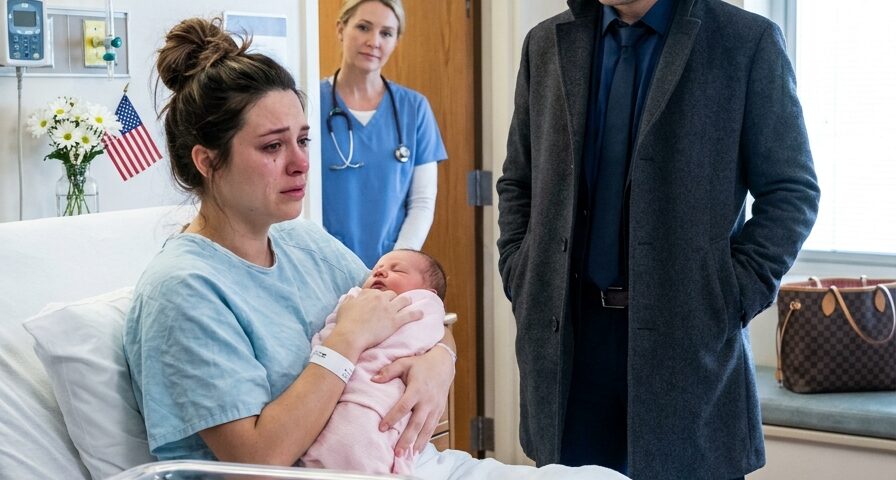
Two hours after giving birth, Sable Reed asked her husband to hold their daughter. He didn’t move. He stood by the hospital window in his tailored gray coat, looked at that tiny newborn like she was someone else’s problem, then leaned close and whispered, “I already have a son with another woman. I won’t acknowledge your child.”
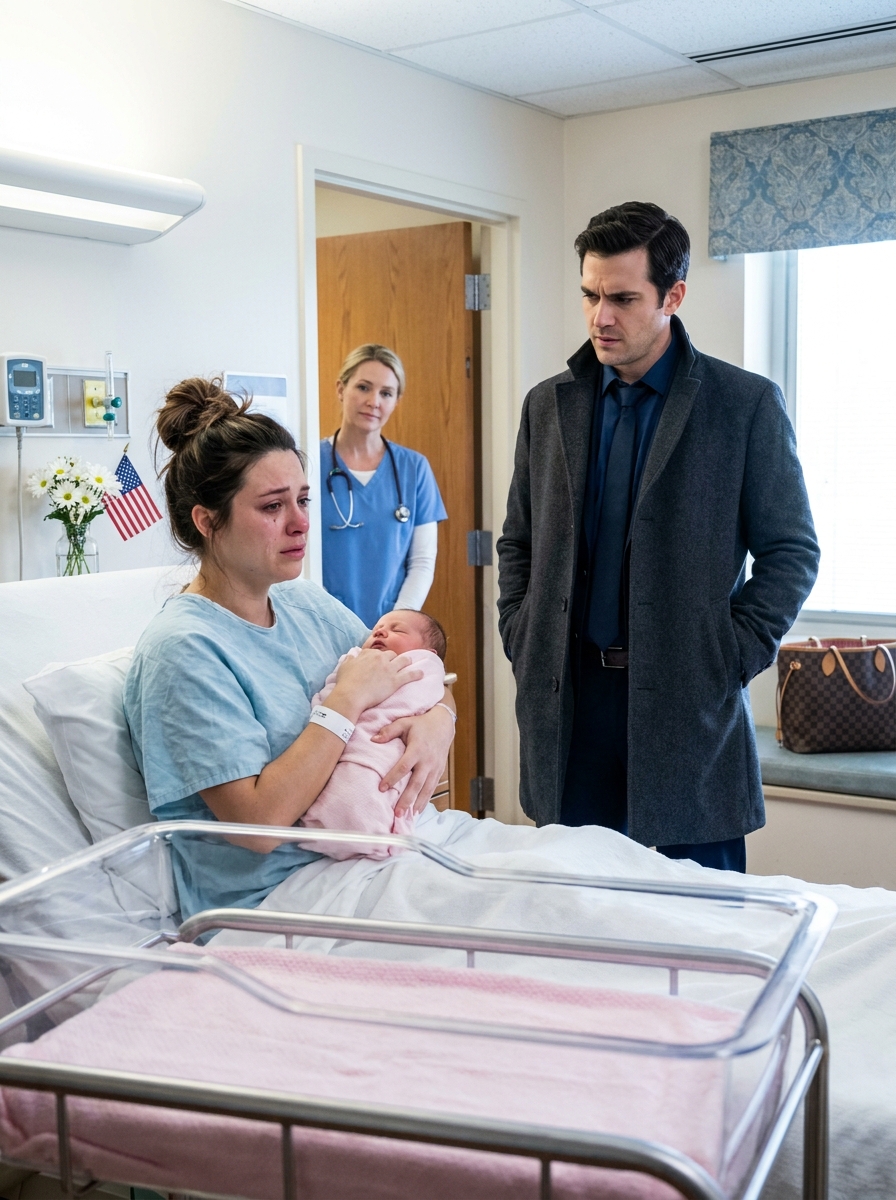
Two hours after I gave birth, I asked my husband to hold our daughter.
He did not even reach for her.
Weston Callaway stood near the hospital window in his gray tailored coat, one hand tucked in his pocket, his phone still warm in the other. Outside, a cold Charlotte rain tapped against the glass. Inside, our baby girl slept against my chest, wrapped in a striped hospital blanket, her face still pink and swollen from the work of being born.
I was shaking from exhaustion. My hair was damp. My throat was raw. The room smelled like antiseptic, warmed cotton, and the weak coffee someone had abandoned on the side table.
But all I cared about was the little bundle in my arms.
Our daughter.
The child we had prayed for, planned for, painted a nursery for.
“Weston,” I whispered. “Do you want to hold her?”
He turned from the window slowly.
For a second, I thought he was overwhelmed. Some new fathers freeze. Nurses had told me that. They get scared. They do not know where to put their hands. They need a minute to understand that the baby is real.
Then he looked at our daughter like she was a problem that had arrived too early.
He stepped closer, bent down, and spoke low enough that no nurse in the hallway could hear him.
“I already have a son with another woman,” he said. “I’m not putting my name on this baby.”
The room went quiet in a way I still remember in my bones.
Not silent, exactly. The machines kept beeping. A cart rolled somewhere down the hall. A nurse laughed softly at the station. The world outside my bed kept going as if my life had not just cracked open.
I looked at Weston.
I waited for his face to change.
I waited for shame. Panic. Regret. Anything human.
Nothing came.
He stood there calm and careful, as if he had just told me a legal fact instead of broken a family beside his newborn child.
I looked down at my daughter.
She was sleeping through the first rejection of her life.
Her tiny fist rested under her chin. Her mouth moved once, as if she were dreaming of milk, warmth, nothing more complicated than being held.
I should have screamed.
Maybe another woman would have. Maybe she would have thrown the water cup at him or called for the nurse or demanded that he say it again where everyone could hear. Maybe she would have sobbed until the whole maternity ward knew what kind of man had just walked into room 412 wearing a wedding ring and no heart.
I did none of that.
Something inside me went still.
Not numb. Not weak.
Still.
I pulled my daughter closer, felt the little weight of her against me, and smiled.
Weston noticed. His jaw tightened just enough.
“Then remember this moment,” I whispered, “because it is the last one you will ever get from us.”
He laughed.
It was a small laugh. A little breath through his nose. The kind of laugh men use when they believe a woman has no leverage and has mistaken pain for courage.
He thought I was exhausted.
He thought hormones were talking.
He thought by morning I would be frightened enough to beg.
He had no idea that before the sun came up, the first thread of his life would start coming loose.
My name is Sable Reed.
For four years, I was Sable Callaway.
This is the story of the night my husband threw away his marriage, his daughter, his reputation, and the future he had been raised to believe no one could take from him.
All within two hours of becoming a father.
I met Weston Callaway four years before that hospital room, back when I still believed good manners meant good character.
I was working as a contracts auditor for a midsize firm in Charlotte, North Carolina. It was the kind of job people called boring until their signatures cost them six figures. I read fine print for a living. Lease agreements. vendor contracts. development schedules. addendums full of language nobody respected until it trapped them.
My office was on the sixth floor of a building near Tryon Street. I kept a cardigan over my chair because the air conditioning was always too cold, and I drank coffee from a chipped mug that said Read Before Signing. Most days, I ate lunch at my desk and highlighted clauses while traffic crawled below the windows.
Weston came in during a compliance review involving Callaway Holdings.
Everyone in Charlotte knew the Callaway name, even if they could not explain why. His grandfather had started with a roadside motel near Asheville and built it into a real estate and hospitality empire. Hotels. office towers. parking decks. mixed-use developments with rooftop bars and polished stone lobbies. If a new building went up downtown and people in suits started whispering before the permits were public, there was a decent chance Callaway money was somewhere behind it.
Weston did not look like money the way some men do.
He was not loud. He did not tap his watch. He did not make jokes at the receptionist’s expense or expect coffee to appear because he entered a room. He spoke softly. He listened. He remembered little things.
That was what made him dangerous.
A rude man warns you. A charming one invites you to ignore the warning.
Our first real conversation happened over a conference table scattered with documents. I pointed out a clause that could expose his company to a penalty if a vendor missed an inspection deadline. Weston looked at the page, then at me, and said, “You caught that on the first read?”
“I catch a lot of things on the first read,” I said.
He smiled.
It was not a big smile. Just enough.
Two weeks later, he asked me to dinner.
I said no the first time because I did not date clients. He waited until the review closed and asked again. That time, I said yes.
He took me to a quiet restaurant in Dilworth, not the flashiest place, not the kind of restaurant where people take pictures of the wine list, but warm and low-lit, with servers who knew when to disappear. He asked about my parents. My work. My sister. What I liked to read when I was not reading contracts.
He did not check his phone once.
That felt rare enough to be romantic.
For the first year, I thought I had found something almost impossible: a wealthy man who knew how to be kind without making a performance of it.
His family was harder to understand.
His mother, Adele Callaway, was polite in the way expensive silver is cold even when polished. She had soft blond hair, pearls for every occasion, and a voice that could make an insult sound like a prayer request.
The first time she met me, she looked at my navy dress and said, “That color is brave on you, dear.”
I was still young enough in that world to thank her.
His father, Preston Callaway, barely spoke to me. He was not openly cruel. That almost made it worse. He simply looked through me with the quiet efficiency of a man deciding whether something belonged on a balance sheet.
At family dinners, he would ask Weston about refinancing, zoning boards, board votes, acquisition timelines. Then he would turn to me and say, “Still working with contracts, Sable?”
Still.
One word can carry a whole room’s opinion when placed correctly.
I told myself they were old money, though they were not truly old money. Not in the generational New England sense. Their money was Southern, practical, and only a few decades old, which meant they guarded it with the anxiety of people who still remembered life without it.
Weston made their chill bearable.
He would squeeze my hand under the table when Adele said something sharp. He would roll his eyes once we got into the car. He would loosen his tie in our kitchen after Sunday dinners and say, “You survived another Callaway performance.”
I believed that meant he saw through them.
I did not understand yet that seeing through something and refusing to become it are two very different things.
We married eighteen months after our first dinner.
Weston insisted on a small courthouse ceremony.
“No ballroom,” he said. “No company circus. Just us.”
That sounded romantic to me.
We stood in a county courthouse hallway that smelled like floor wax and old paper. A young couple in jeans waited on one bench. A man in a work uniform sat across from us holding a bouquet from the grocery store. Weston’s hands shook while I straightened his tie.
“You nervous?” I asked.
“Terrified,” he said, and laughed.
I thought a man that nervous about marrying me could not possibly be cruel.
I was wrong.
Marriage to Weston looked beautiful from the outside.
We lived in a white brick house in Myers Park beneath old trees that dropped leaves into the gutters every fall. The neighbors waved from porches. Adele sent seasonal wreaths I never asked for. At Christmas, the whole street glowed in soft white lights, and Weston would complain about the ladder before climbing it anyway.
Inside, our life had a rhythm.
He made coffee before I came downstairs. I kept track of dry cleaning, insurance notices, dinner reservations, family birthdays. We ate takeout on the kitchen island more often than Adele would have approved. On Saturdays, I went to the farmers market; Weston pretended not to care about the cinnamon bread but always ate half of it before lunch.
For a while, I was happy.
That is the part people do not like to hear after betrayal. They want the villain to have always looked like one. They want the victim to have ignored obvious signs.
But real heartbreak does not usually arrive wearing a warning label.
It arrives in small edits.
A phone facedown on the counter.
A business trip extended by a night.
A shower taken immediately after coming home.
A new password on an old device.
A receipt folded twice and left in a coat pocket.
The receipt came from a restaurant two towns over. I found it on a Tuesday morning while checking Weston’s suit before sending it to the cleaners. The time stamp said 9:18 p.m. He had told me he left a client dinner at 11.
I brought it up over breakfast, half joking because I still wanted innocence to win.
He looked at the receipt, then constructed an explanation so smoothly I almost admired it.
A colleague’s retirement dinner. He had joined late. Someone else paid first. The receipt was for drinks. Nothing important.
Three sentences for one dinner.
A man telling the truth rarely needs that much scaffolding.
I let it go.
At the time, I called that trust.
Later, I understood it was fear dressed nicely.
In our second year of marriage, I met Camille Russo.
She was Weston’s executive assistant at Callaway Holdings. She wore sharp blazers, kept her dark hair pinned low, and spoke in a voice that never seemed to rise above calm. The first time I met her, she handed Weston a folder before he asked for it. He thanked her with a familiarity I noticed and then politely dismissed in the same breath.
The second time was at a holiday dinner held in a private room at a hotel downtown.
There were white tablecloths, poinsettias by the windows, and a pianist playing Christmas songs soft enough not to interrupt conversations about tax strategy. I remember Adele air-kissing the wives of board members. I remember Preston standing near the bar with two men from the bank. I remember Weston across the room, laughing at something Camille had said.
Then I remember Camille looking at him.
Not like a woman in love, exactly.
Like a woman waiting for a promise to become less expensive.
I told myself I had imagined it.
That same night, I ended up beside Camille near the drink table. She asked how nursery planning was going, because I had mentioned months earlier that Weston and I hoped to start a family.
It was an ordinary question.
What I remember is how carefully she asked it.
As if my answer might hurt her.
“We’re still hoping,” I said.
Her face shifted. Barely.
Then she excused herself before I finished the sentence.
I did not think about it again for almost two years.
Or maybe I did, but only in the way a person touches a bruise through fabric and pretends it does not hurt.
Weston and I had been trying for a baby since our first anniversary.
At first, trying felt hopeful. Apps, calendars, vitamins, jokes about timing. Then it became appointments. Bloodwork before sunrise. Ultrasounds in dim rooms. Waiting rooms full of women pretending not to count one another’s expressions.
Weston came to the early appointments.
He held my hand through two procedures that did not take. He sat beside me in the clinic parking lot while I cried after another negative test. He told me we had time.
“It will happen when it’s supposed to,” he said.
I held on to that sentence like a handle in deep water.
Now I wonder if patience was simply easier for him than honesty.
Because while I was praying over our future, he was building another one behind my back.
When I finally got pregnant, Weston cried at the ultrasound.
That memory stayed with me too long. It became evidence I kept presenting to myself after everything fell apart.
He cried. He must have loved her.
He cried. He must have meant it.
He cried.
As if tears cannot lie.
He painted the nursery himself.
Soft green walls, because I did not want everything pink. A white crib. A rocking chair from a small furniture store outside town. Shelves for books she would not understand for years.
Adele came over once, stood in the doorway, and said, “It’s very simple.”
“Thank you,” I said, because by then I had learned how to accept her insults without feeding them.
Weston laughed after she left and kissed the top of my head.
“She hates anything she didn’t choose,” he said.
I thought he was on my side.
That was one of the crueler tricks.
We chose the name Marlo the week before she was born.
I was folding tiny sleepers warm from the dryer, and Weston was standing barefoot in the nursery doorway with a mug of tea in his hand.
“What about Marlo?” I said.
He repeated it once.
“Marlo Callaway.”
I remember smiling at the sound of it.
He smiled too.
By then, Camille’s son was already four months old.
I did not know.
I did not know Weston had been driving to a townhouse outside Charlotte while telling me he had investor meetings. I did not know Adele had already held that baby. I did not know Preston had already looked at a child born outside his son’s marriage and seen not a scandal, not a wound, not a woman betrayed, but a male heir.
What I learned later was that Preston had given Weston an ultimatum.
Callaway Holdings had a year-end board review coming. The company was also in the middle of a major refinancing period, the kind of money movement that makes bankers nervous and board members alert. Weston was being positioned as the next public face of the development arm. His personal stability had been presented, in writing, as part of the company’s confidence package.
An affair with an employee was a risk.
A child from that affair was a larger risk.
A wife giving birth to another child the same week the board was scheduled to meet turned that risk into a clock.
Preston told him to resolve it before the review.
Resolve it.
That was the word people like the Callaways used when they wanted something human to become administrative.
The morning I went into labor, Weston arrived at the hospital before I finished checking in.
He looked nervous, rain in his hair, office shirt wrinkled under his coat. He paced the triage room, asked the nurse too many questions, and told anyone who came near us that we had waited a long time for this baby.
I believed him.
That is the part that still embarrasses me, though I know it should not. I believed the man holding my hand while another woman somewhere in the same city was probably waiting for him to choose.
Labor lasted eleven hours.
Weston counted my breathing. He gave me ice chips. He pressed a cold cloth to my forehead. He said, “You’re doing so well,” in a voice that sounded almost broken.
Maybe some part of him meant it.
I have stopped needing every moment to be fake in order for the betrayal to be real.
Marlo was born at 6:47 on a Tuesday morning.
She came out furious.
One sharp cry, then another, filling the room with proof. Proof she was here. Proof she had fought her way into the world. Proof no family board, no old man’s will, no polished lie could make her less real.
They placed her on my chest, and my whole body seemed to become a shelter.
Weston stood beside the bed.
His eyes were wet.
When the nurse asked if he wanted to cut the cord, he did. His hand shook.
For one hour, I let myself believe we had made it.
Then his phone buzzed.
He looked down.
Something in his face changed.
He stepped into the hallway.
The door did not close all the way.
I heard only pieces.
A woman’s voice, strained and angry.
Weston saying, “Not like this.”
Then, “I said not over the phone.”
Then nothing.
When he came back, he did not look at the baby.
He said he needed to make a few calls.
He returned nearly an hour later wearing a fresh suit.
I should have understood then.
No man changes into a fresh suit to meet his newborn daughter.
He changes because he is about to defend himself.
I was propped up in bed, Marlo tucked against me, when he closed the door.
“I need to tell you something,” he said.
I stared at him, too tired to be afraid.
He told me about Camille.
He told me she had given birth to a son four months earlier.
He told me his parents knew.
He said the baby had been named Preston, after his father.
I remember that detail landing harder than the rest.
They had given that child the family name before my daughter had even taken her first breath.
Then Weston said, “My family needs a male heir.”
I looked down at Marlo.
“She is your child,” I said.
He exhaled like I was missing the practical point.
“Camille gave them what they needed.”
What they needed.
Not what he loved.
Not what was right.
What they needed.
“I will support you privately,” he said. “But I’m not acknowledging her as a Callaway.”
Her.
He would not even say her name.
That was when the stillness came over me.
Some women become fire in moments like that. I became glass. Clear. Cold. Hard enough to cut.
“You’re choosing them,” I said.
“I’m choosing my family’s future.”
I smiled because suddenly I understood something he did not.
He thought the future was a thing men like him inherited.
He did not know it could also be taken back.
“Then remember this moment,” I whispered. “Because it is the last one you will ever get from us.”
He laughed.
Then he left.
I stayed in the hospital two more nights.
Not because I hoped he would return. Hope had left the room with him. I stayed because my doctor wanted me monitored, because my body hurt, because Marlo needed feeding every two hours, and because a woman should not have to rebuild her life while still wearing a hospital bracelet.
Weston did not come back.
My sister, Odette, drove from Savannah the moment I called her.
She arrived before sunrise with tangled hair, no makeup, and a tote bag full of snacks because Odette believed every crisis required protein. She walked into that hospital room, washed her hands, took one look at me, and did not ask whether I was okay.
She knew better.
“What do you need?” she asked.
That was Odette.
No panic. No performance. Just action.
She held Marlo so I could sleep. She argued politely with a nurse about my medication schedule. She found a diner nearby that served real eggs and brought me breakfast in a Styrofoam box because, as she said, “No woman should be expected to process betrayal on hospital oatmeal.”
She had warned me about Weston once.
At my wedding, while everyone else was talking about the flowers, she leaned close over a slice of cake and said, “That man is polite in a way that only works when people are watching.”
I had laughed.
I did not laugh in the hospital when I finally understood what she meant.
On the second night, after Marlo had fallen asleep and the hallway had gone quiet, I returned a call from a woman named Josephine Nadair.
She was the attorney handling my late uncle Elliot’s estate.
Uncle Elliot had died eight months earlier. He was my mother’s older brother, a retired structural engineer who had lived in Raleigh, driven the same Buick for fifteen years, and kept his grocery receipts in envelopes labeled by month. He was quiet, precise, and allergic to nonsense. When I was a child, he fixed our porch steps without being asked and taught me how to read a ruler properly.
He had no children of his own.
I assumed Josephine’s calls were about routine paperwork. Some final signature. Some small account that needed closing. I had ignored three weeks of voicemails because pregnancy had swallowed my whole life.
When I called from the hospital, Josephine answered on the second ring.
“Sable,” she said, “I’m glad you called.”
Her voice made me sit a little straighter.
I apologized for the delay. I told her I had just had a baby.
Then, because I was too tired to polish the truth, I told her what Weston had done.
Josephine was silent for a long moment.
When she spoke again, her voice had changed.
“Then we need to discuss your uncle’s documents sooner rather than later.”
That was not comforting.
It was useful.
At that point, useful was enough.
Josephine explained that one year before he died, Uncle Elliot had brought her an old partnership agreement. Decades earlier, he had done structural engineering work for a development deal connected to Weston’s grandfather. Part of his compensation had come in the form of equity in a development arm that later became part of Callaway Holdings.
The stake was small but not meaningless.
Eleven percent.
More important, it came with a voting agreement that had never been dissolved.
The agreement gave the holder the right to request a formal executive conduct review if leadership behavior could expose the company to reputational or financial risk during an active financing period.
I was lying in a hospital bed, still sore, still bleeding, with my newborn sleeping inches from my heart, trying to understand corporate governance through a fog of pain medication and betrayal.
“What does that mean?” I asked.
“It means,” Josephine said, “you may have more say in that company than Weston thinks.”
I looked at Marlo.
Her mouth moved in her sleep.
Josephine did not promise me victory. Good lawyers do not sell fairy tales. She told me not to sign anything. Not to agree to anything verbally. Not to let Weston or his family frame the next conversation.
“Call me when you leave the hospital,” she said. “Before you go home.”
So I did.
I wish I could say I walked out of that hospital powerful.
I did not.
I walked out carefully, one slow step at a time, with Odette carrying the diaper bag and a nurse checking the car seat straps twice. My body hurt. My milk had come in. I cried in the parking garage because Marlo’s hat slipped over one eye and somehow that was the detail that undid me.
I went back to the house in Myers Park because Marlo’s things were there.
The soft green nursery. The diapers. The bassinet. The tiny clothes folded in drawers Weston had assembled.
For one week, I lived in the house we had made for a family that no longer existed.
Weston did not come home.
He sent one text.
Have you had time to think things over?
I stared at it for so long the screen went dark.
Think things over.
As if he had asked me to reconsider a vacation rental.
As if he had not stood beside our newborn daughter and erased her from his future.
On the fourth night, he called.
I answered because part of me wanted to know what kind of man he would become now that I could see him clearly.
He did not ask about Marlo.
He asked whether I had spoken to anyone at Callaway Holdings.
That was how I knew he was afraid.
“I haven’t decided anything yet,” I said.
That was true.
Not complete, but true.
He sighed gently.
“I hope we can keep this civil for everyone’s sake.”
I almost smiled at that.
Men like Weston often discover civility right around the time accountability enters the room.
I hung up without answering.
That night, I sat in the nursery while Marlo slept in the bassinet and looked at the walls he had painted. There were still little strips of painter’s tape in one corner near the window where he had missed them. I remembered him standing on a step stool, laughing when paint got on his sleeve.
I wanted to hate every memory.
I could not.
That was another grief.
On the fifth night, I opened the closet and started packing.
Not with music blasting. Not with a dramatic suitcase thrown on the bed. Quietly. One drawer at a time.
My documents.
Marlo’s hospital papers.
Insurance cards.
Tax returns.
A folder Josephine told me to keep close.
Odette came that Saturday with her husband’s pickup. She brought packing tape, black coffee, and the expression of a woman willing to fight an entire subdivision if anyone looked at me sideways.
We moved into a small rental two streets from her house.
The kitchen cabinets stuck. The guest bathroom faucet squeaked. The backyard fence leaned after every storm. The neighbor across the street had wind chimes that seemed committed to emotional terrorism.
But that first night, I slept with Marlo beside me and did not wake up wondering what lie was happening downstairs.
That felt like peace.
A week later, I sat in Josephine Nadair’s office downtown.
Her building had marble stairs, brass elevator doors, and the heavy quiet of a place where people came to learn what signatures had cost them. Josephine herself was in her sixties, silver-haired, dry-eyed, and far too practical to waste language.
She opened Uncle Elliot’s file on her desk.
“He was a quiet man,” she said, “but quiet is not the same as passive.”
Inside the folder were agreements, amendments, letters, copies of old board notices, and one document with my uncle’s handwriting in the margin.
Josephine walked me through it slowly.
Callaway Holdings was in an active refinancing period. Weston had signed executive statements representing stability and continuity. A hidden relationship with an employee, a child born from that relationship, and another child born within his marriage days before board review created risk.
Not moral risk.
Companies are not built to panic over morality.
Reputational risk. Financial risk. Governance risk.
Those words, cold as they were, finally gave the truth a door it could walk through.
“What happens if we request the review?” I asked.
“Weston will have to answer questions from people he cannot charm with a hospital-room whisper.”
I filed the request the next morning.
It was not revenge.
I need that understood.
Revenge would mean Weston was still the center of the story. This was about refusing to let him decide which child counted, which woman mattered, which truth got documented.
Two weeks later, Camille Russo called me.
Her name appeared on my phone while I was sitting at the rental kitchen table, trying to eat toast with one hand and hold Marlo with the other.
I almost let it ring.
Then I answered.
For a few seconds, neither of us spoke.
Finally, Camille said, “I know I have no right to call you.”
She sounded tired.
Not the dramatic kind of tired people use to invite sympathy. The real kind. Worn down. Sleep-starved. Done pretending the story made sense.
“I heard about the review,” she said. “I wanted to tell you something before everyone else turns it into whatever helps them.”
I said nothing.
She told me she had moved to Charlotte from a small town outside Baton Rouge. She had taken the job at Callaway Holdings because it was the best opportunity she had ever been offered. She had no family nearby. No deep friendships. Just work, a quiet apartment, and a boss who noticed when she stayed late.
“He was kind at first,” she said.
Of course he was.
That was always where Weston began.
He told her his marriage was complicated. He told her I was distant. He told her we were more arrangement than love. He told her he would leave eventually, but the timing had to be handled carefully because of the company.
Eventually.
A word men use when they want a woman to live in the waiting room of their decisions.
By the time Camille understood she was not waiting for a future but being stored out of sight, she was pregnant.
“I am not asking you to forgive me,” she said.
“Good,” I replied.
She accepted that without protest.
Then she said, “He does this. He tells people exactly enough to keep them moving toward him.”
That sentence stayed with me.
Because it was true.
He had done it to both of us.
Different promises. Same performance.
“Why are you telling me?” I asked.
Camille’s breath trembled.
“Because someone should know the truth before they have to hear it in a room full of lawyers.”
I did not forgive her that day.
I still do not know if forgiveness is the right word for what I eventually felt.
But I stopped seeing her as the woman who had stolen my husband.
Weston had not been stolen.
He had walked willingly from room to room, telling each woman whatever she needed to hear so he could keep getting what he wanted.
The board meeting happened on a Thursday morning.
I was not required to attend.
Josephine told me I could stay home, and legally, she was right.
But I went.
Marlo was seven weeks old, asleep in a carrier against my chest.
I did not bring her as a prop. I brought her because she needed me. Also because I wanted Weston to see exactly who he had dismissed when he had said the word her.
The Callaway Holdings conference room sat on the fourteenth floor, with a long glass wall overlooking downtown Charlotte. The table was dark wood. The coffee was fresh. The air was too cold. Everything looked expensive enough to pretend nothing ugly had ever happened there.
Six board members were present, along with two outside attorneys.
Preston sat at the head of the table.
Weston sat three chairs down from him, navy suit, clean shave, perfect posture.
Then he saw Marlo.
For half a second, his face shifted.
Not with love.
With inconvenience.
That hurt more than I expected.
Josephine began with the documents. She explained the voting agreement, the active financing period, the executive conduct provision. She spoke calmly, which made every word heavier.
Loud anger gives powerful men something to dismiss.
Paperwork gives them something to fear.
Preston asked the first direct question.
“Is it true you fathered a child with an employee while your wife was pregnant?”
Weston’s mouth tightened.
“The situation is being handled privately.”
Preston did not blink.
“That was not my question.”
The room went still.
“Yes,” Weston said.
Preston looked down at the folder in front of him, then back at his son.
“Is it also true you refused to acknowledge your daughter within hours of her birth?”
Weston looked at me.
There it was.
That old reflex.
He wanted me to soften the truth. To make it less sharp. To help him become the kind of man he had failed to be.
I said nothing.
Weston turned back to his father.
“That conversation has been mischaracterized.”
Josephine opened another folder.
“We have a written statement confirming Mr. Callaway left the maternity room shortly after declining to hold the child and did not return during the hospital stay.”
Weston’s hand flexed against the table.
Before he could answer, Josephine’s phone buzzed.
She looked at it once.
Then again.
Her expression barely moved, but I knew. Something new had arrived.
“Excuse me,” she said. “I have just received relevant correspondence from a former Callaway Holdings employee.”
Weston’s face changed before she read a word.
The messages came from a former colleague who had left the company two months earlier after a bonus dispute. People who treat others as disposable often forget resentment has a filing system.
The thread showed Weston months earlier joking about the “heir situation.”
Once the optics were stable, he wrote, he could “transition Camille out” and “manage support privately.”
Optics.
Transition.
Manage.
There it was in his own words.
Not love. Not family. Not even loyalty to the son he had used as his excuse.
Just strategy.
Camille was in the room with her attorney. She had sat quietly most of the morning, hands folded flat on the table. When Josephine finished reading, Camille stood.
Her face was pale, but her voice was steady.
She looked at Weston and said, “You should have told the truth to somebody. Anybody. Even once. Before it cost this much.”
Then she walked out.
No one stopped her.
Weston did not follow.
That told me the rest of what I needed to know.
After the meeting, I carried Marlo toward the elevators while Josephine stayed behind with the attorneys.
Weston caught up just as the doors opened.
We stepped inside together.
The elevator mirrors showed us from every angle: Weston in his perfect suit, me in a simple black dress with a burp cloth tucked into my bag, our daughter sleeping between us.
“You planned this,” he said.
It was not a question.
He needed it to be my fault.
I looked at him through the mirror.
“I did not have to plan anything,” I said. “I just stopped covering for you.”
The doors opened to the parking garage.
I walked out.
He did not laugh that time.
What followed was not a clean victory.
Real life rarely gives women clean victories. It gives them invoices, court dates, mediation rooms, and email threads with subject lines that make your stomach hurt before breakfast.
There were depositions.
Financial disclosures.
Custody proposals.
Succession arguments.
The trust language from Uncle Elliot’s era was old and formal. It gave priority to children born within an intact marriage, but the circumstances were unusual enough that Callaway’s attorneys fought hard.
Josephine warned me more than once that the outcome could go sideways.
“This is leverage,” she said. “Not magic.”
I appreciated that.
By then, I had lost my appetite for fairy tales.
Callaway Holdings wanted the dispute kept quiet. Not because they had suddenly developed a conscience, but because public records have a long afterlife. Lenders read. Reporters read. Competitors read with champagne.
That gave us room.
It took four months to settle.
Marlo would hold formal inheritance standing as Weston’s only child born within his legal marriage. Camille’s son would receive private support from Weston personally, but he would not enter the company’s succession structure.
The male heir Weston had chosen did not become the future of Callaway Holdings.
The daughter he refused to hold did.
When Josephine told me, I was in her office bouncing Marlo against my shoulder, trying to keep spit-up off my blouse.
I did not cheer.
I felt relief first.
Then grief.
Because no child should need a legal agreement to prove she belongs.
The divorce settled around the same time.
I did not ask for everything. Odette thought that was a mistake.
“If it were me,” she said, “I would ask for the house, the cars, the art, the retirement accounts, his cuff links, and his ability to enjoy golf.”
I laughed for the first time in weeks.
But I did not want Weston’s life.
I wanted mine back.
I asked for fair support, legal fees, secured trust protections for Marlo, and enough to begin again without begging.
Because of Uncle Elliot’s stake, the board’s distrust, and Weston’s sudden lack of polish in rooms where it mattered, fair turned out to be more than he expected.
I bought a small house two hours away.
It had a maple tree out front, a kitchen with morning light, and a back porch just wide enough for two chairs and a child’s plastic slide.
It was not a Callaway house.
Thank God.
No marble foyer. No silent dining room. No neighbors measuring the worth of your life by the landscaper’s schedule.
Just a house.
Mine.
The custody arrangement was the only part that hurt differently.
Weston asked for structured visitation.
I agreed to reasonable terms because one day Marlo might ask whether I had stopped him from knowing her.
I wanted the answer to be no.
He used four of the first six visits.
He arrived late to two.
He cut one short for a work call.
By her first birthday, he had stopped scheduling them.
No mediator can make a father show up.
No trust can create tenderness.
No court order can teach a man to choose what he already decided was inconvenient.
Preston reached out almost a year later.
Through Josephine, of course. Callaways preferred buffers. Buffers made hard things feel less personal.
He asked if we could speak without lawyers.
I almost refused.
Then I looked at Marlo, who was sitting on the floor trying to put a wooden block into one of my shoes, and I thought about all the questions she would have someday.
So I agreed.
We met at a coffee shop near my new house. Neutral ground. Small tables. Local art on the walls. A bulletin board by the door covered in church suppers, piano lessons, and a flyer for a lost orange cat named Biscuit.
Preston arrived early.
He stood when I came in.
That old training never left him.
“Sable,” he said.
“Preston.”
He looked older. Not fragile. Just less armored.
For a while, we talked about Marlo. Safe things. Her first steps. Her stubbornness. Her habit of feeding half her breakfast to Odette’s dog and then acting betrayed when the dog ate it.
Then Preston wrapped both hands around his coffee cup and said, “My father taught me that sentiment was a luxury the business could not afford.”
I waited.
“I hated him when I was young,” he said. “Then I became him slowly enough not to notice.”
Outside, an older couple crossed the parking lot under one umbrella. A woman in scrubs came in for coffee, her hospital badge swinging from her pocket. Life kept moving around his confession.
“When Weston left that hospital room,” Preston said, “I recognized something I had helped build.”
It was not an apology.
Not exactly.
Men like Preston often reach remorse late and call it honesty.
But it was the closest thing to truth he had ever given me.
“I cannot undo it,” he said.
“No,” I replied. “You cannot.”
He nodded.
He did not ask me to make him feel better.
That was something.
Adele sent a letter a month later on cream stationery, her handwriting as perfect as ever.
She wrote that she hoped I understood “these things are complicated.”
I read it twice.
Then I put it in a drawer and never answered.
Some people ask for understanding only after they have run out of ways to demand silence.
I did not owe Adele the comfort of pretending complication was the same as innocence.
Preston now sends a card on Marlo’s birthday.
He signs it Grandfather.
Eventually, he asked through Josephine whether he could visit occasionally, with no expectations.
I said yes.
Not for him.
For Marlo.
She deserves to know people for herself when it is safe to do so. She deserves more than the version of family built out of my anger or their shame.
The visits are careful.
Preston sits on my living room floor in expensive slacks while Marlo hands him blocks and orders him to build towers “better.” He obeys. When the tower falls, she claps, and he claps too, like an old man learning late that being useful is not the same as being loved.
Sometimes, watching them, I feel something loosen in me.
Not forgiveness.
Maybe the beginning of peace.
Weston called once.
It was late, almost a year after everything was final. Marlo was asleep. I was folding laundry on the sofa, matching tiny socks that seemed to multiply only when they were missing their partners.
The number was blocked.
I knew before I answered.
“Sable,” he said.
His voice was smaller than I remembered.
No boardroom smoothness. No careful charm. Just a man alone with the echo of himself.
“I wanted to ask if there might still be a way to be part of Marlo’s life.”
I stood and walked to the hallway outside her room.
Her night-light glowed through the cracked door. I could hear her little breaths.
Weston kept talking.
“I know I handled things badly.”
Badly.
A word too small to hold what he had done.
“I should have been there from the beginning,” he said.
I closed my eyes.
There are moments when the old version of you tries to rise. The woman who would have softened. Explained. Made room. Helped him find a way to feel less guilty.
I did not let her answer.
“You had your two hours,” I said.
He went quiet.
“I gave you the rest of her life after that to change your mind,” I continued. “You spent every bit of it proving you did not want to.”
“Sable—”
“No. Not because you’re lonely. Not because your father is disappointed. Not because the company stopped treating you like the future. If you want to be her father, you can start by showing up through the legal channels already available to you. But you do not get to call me at night and ask me to hand you peace.”
He did not respond.
Maybe he cried.
Maybe he was only silent.
I hung up before I could find out.
He has not called since.
No card. No message. No request through Josephine.
Nothing.
That is its own answer.
Marlo is two now.
She runs everywhere, usually toward whatever is breakable, wet, or recently cleaned. She has my mouth, Weston’s chin, and an opinion about everything from bananas to socks. She believes the moon follows our car because it likes her. She has named the maple tree in our front yard Mr. Leaf and says hello to it every morning.
She loves Odette more than pancakes, which is saying something.
She calls Josephine “JoJo Paper” because Josephine always arrives with folders.
Preston is “Grandpa Blocks.”
Weston is not a name she knows yet.
Sometimes she asks in the broken way toddlers ask hard things.
“Daddy far?”
“Daddy come?”
“Daddy home?”
There is no answer small enough for her yet.
So I say, “He lives far away.”
Then I hold her while she moves on to crackers or her stuffed rabbit or the picture book about the dog who refuses to take a bath.
One day, the truth will have to grow with her.
I will not make Weston into a monster. Children should not have to carry adult bitterness before they are strong enough to set it down.
But I will not make him into a hero either.
I will tell her he had choices.
I will tell her he made the wrong ones.
I will tell her none of those choices changed her worth.
Not for one second.
I think about that hospital room more than I expected to after all this time.
Not every day.
But sometimes.
Usually in quiet moments. Folding Marlo’s pajamas. Waiting in the pharmacy line. Sitting in the car after preschool pickup while she sleeps in the back seat with one shoe off.
I think about the half second before I smiled.
That tiny space where I could have begged him. Asked why. Asked what I had done wrong. Asked what our daughter lacked before she had even opened her eyes properly.
I could have broken in front of him.
Maybe he expected that.
Maybe he needed it.
Instead, something steadier than anger rose in me.
I still do not know where it came from.
Maybe from Uncle Elliot, who left behind papers nobody respected until they mattered.
Maybe from Odette, sleeping crooked in a hospital chair with one hand on Marlo’s bassinet like she was guarding a treasure.
Maybe from my mother, who spent thirty years working in a public school office and taught me that records matter because people lie.
Maybe from my daughter herself, small and warm against me, needing me to become someone I had not yet met.
Or maybe it happens to every woman eventually.
Maybe there comes a moment when you finally run out of reasons to shrink for someone who was never going to notice the sacrifice.
People ask if I got revenge.
I do not think so.
Revenge would mean Weston still owns the center of the story.
He does not.
Marlo does.
Our life does.
The kitchen with morning light. The maple tree. The back porch. The Sunday dinners with Odette. The birthday cards signed by a man learning late how not to repeat his father. The trust documents locked in Josephine’s office. The quiet relief of a home where no child has to be useful to be loved.
Sometimes winning is not watching someone lose everything.
Sometimes winning is hearing your daughter laugh from the next room and realizing no one has the power to make that sound unwanted.
Every night, after Marlo has picked the wrong pajamas, demanded the same book twice, and negotiated for water as if she is closing a real estate deal, I tuck her into bed.
I brush her hair back from her forehead.
I tell her the same thing.
“Some people who are supposed to choose you don’t,” I whisper. “But that is not the end of the story. That is just where you find out who does.”
Most nights, she is asleep before I finish.
I say it anyway.
For her.
For me.
For the woman in that hospital bed who smiled because falling apart would have given him too much.
The people who fail you may stand beside your bed in your weakest hour. They may call cruelty practicality. They may use family, money, reputation, or tradition to explain why your heart should accept less than it deserves.
Let them talk.
Let them laugh.
Let them believe they have chosen the future.
Then build one without them.
That is what I did.
And every time my daughter reaches for my hand, every time she runs across our little front yard yelling hello to Mr. Leaf, every time she sleeps peacefully in a house where her name is never spoken like a burden, I remember the man who refused to hold her.
He thought he was giving her nothing.
He was wrong.
He gave me the last push I needed to stop begging for a place in a family that had never made room for love unless love came with the right last name, the right gender, the right advantage.
He gave me the moment I finally chose us.
And that, as it turned out, was worth more than anything he lost.