PART 2 – I Found My Daughter Trembling in Her Room
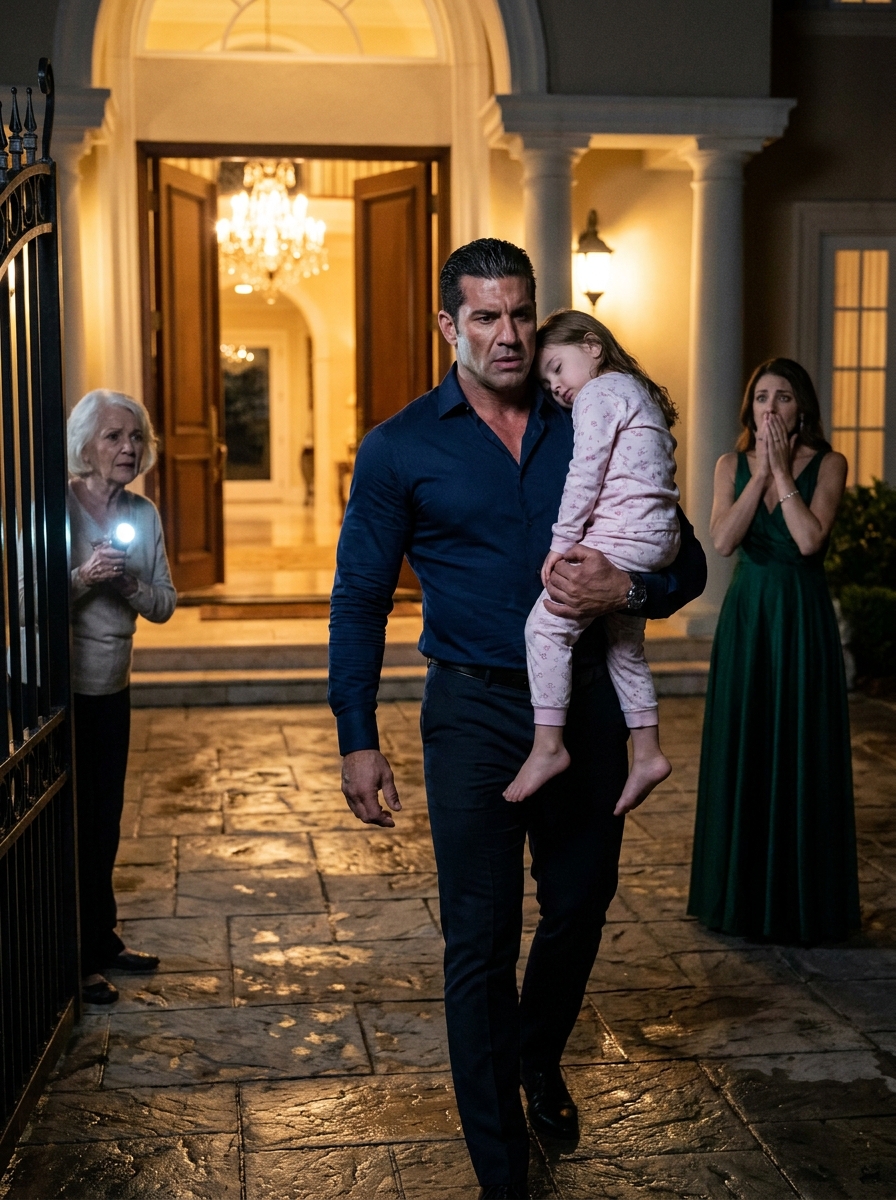
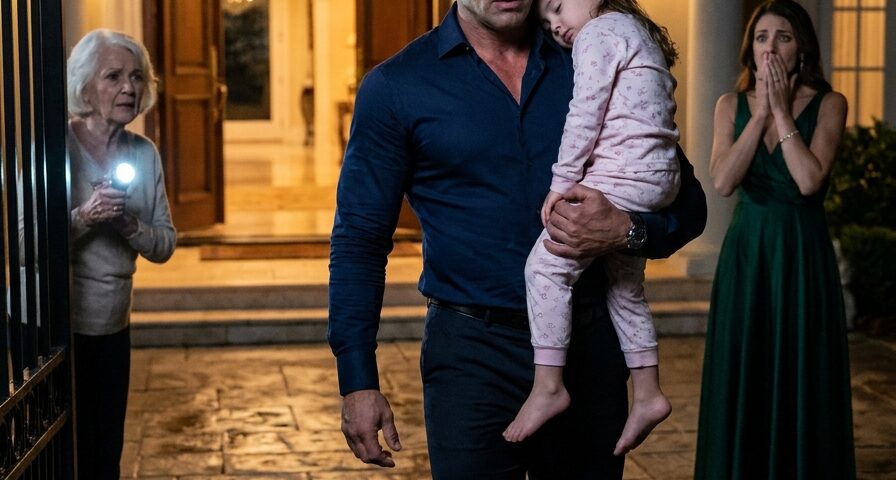
Mrs. Kennedy stood behind the fence with both hands pressed around her phone.
For a moment, I did not understand why she was crying. Rain clouds had gathered low over the rooftops, turning the late afternoon gray and heavy, and the whole street seemed to be holding its breath. Gracie’s arms were locked around my neck, her face hidden against my shoulder, her little stuffed rabbit crushed between us.
“Sawyer,” Mrs. Kennedy said.
Her voice shook so badly I almost did not recognize it.
Caroline stood in the doorway behind me. “Go inside, Ruth.”
Mrs. Kennedy flinched at the sound of her name, but she did not move.
I tightened my hold on Gracie. “Mrs. Kennedy, is everything okay?”
She looked at my daughter, then at me. “No,” she whispered. “No, it isn’t.”
Caroline stepped onto the porch. “This is a family matter.”
The sentence made something cold settle inside me.
A family matter.
As if pain became private when it happened behind a locked door.
I kept my voice low because Gracie was trembling. “Caroline, move away from the door.”
“I told you not to leave.”
“I heard you.”
“And you’re choosing this?” she said, her eyes flashing. “You come home after five days and decide you know everything?”
Gracie made a small sound against my shirt.
That was enough.
“I know she’s hurt,” I said. “That’s what I know.”
Caroline opened her mouth, but Mrs. Kennedy spoke first.
“I have a video.”
The street went silent.
Even Caroline seemed to freeze.
My eyes shifted to Mrs. Kennedy’s phone. “A video of what?”
She swallowed. “Yesterday afternoon. I was trimming my roses. Your kitchen blinds were open. I didn’t mean to see anything, Sawyer, but I heard shouting, and then I saw Gracie fall.”
Caroline’s face changed in an instant. Not to guilt. Not exactly. It was something quicker and sharper, like panic looking for a place to hide.
“You recorded inside my house?” she snapped.
“I recorded because I was afraid for the child,” Mrs. Kennedy said, tears slipping down her cheeks. “And because it wasn’t the first time I heard her crying when Sawyer was away.”
Those words struck harder than anything Caroline had said.
Not the first time.
I looked down at Gracie. Her eyes were closed tight, as if every adult sentence in the yard was another door shutting.
I kissed her hair. “We’re going now.”
Caroline moved toward me. “Sawyer—”
“Don’t.”
One word. Quiet. Final.
For once, she stopped.
Mrs. Kennedy hurried to her gate. “I’ll come with you. I can show the doctors if they need to know what happened.”
Caroline laughed once, brittle and stunned. “This is absurd. You people are acting like I’m some monster.”
No one answered.
I carried Gracie to the car and buckled her gently into the back seat. Her rabbit sat in her lap like a small gray guard. When I closed the door, I looked through the window and saw her watching the house, not her mother.
That told me more than any argument could.
Mrs. Kennedy climbed into the passenger seat, gripping her phone so tightly her knuckles were pale. I started the car. Caroline stood in the driveway with her arms crossed, rain beginning to dot her blouse.
As I pulled away, Gracie whispered from the back seat, “Dad?”
“Yes, sweetheart?”
“Are we in trouble?”
The question opened something inside me I did not have words for.
“No,” I said, forcing my voice to stay steady. “You are safe. That’s the only thing that matters right now.”
She looked down at her rabbit. “Mom said people would be mad at me.”
“People are going to help you.”
Her mouth trembled. “Even if I spilled the water?”
“Especially then.”
At the hospital, everything became bright lights and careful voices. A nurse named Lila knelt to speak to Gracie at eye level. She did not rush her. She did not talk over her. She asked if the rabbit had a name.
“Benny,” Gracie whispered.
“Well, Benny can come with us,” Lila said. “He looks very responsible.”
For the first time since I had walked through our front door, Gracie almost smiled.
Almost.
They examined her gently. I stayed where she could see me, holding her hand whenever she reached for mine. A doctor explained that they needed imaging to make sure nothing deeper had been injured. He spoke calmly, but I saw his eyes when he looked at the bruise.
Mrs. Kennedy waited outside the curtain until the doctor asked to speak with me privately.
“I need to be clear,” he said. “This injury needs to be documented. Because of what your daughter disclosed, we are required to notify child protective services.”
“I understand.”
He studied my face, perhaps expecting anger or denial.
There was none.
“Do whatever you need to do,” I said. “Just help her.”
He nodded. “We will.”
When the social worker arrived, she introduced herself as Marisol Grant. She had a gentle manner and a notebook she did not open until Gracie gave permission. She asked questions in small, careful pieces, never pushing too hard. I watched my daughter answer in whispers, each one brave enough to break my heart.
“Did something like this happen before?” Marisol asked softly.
Gracie looked at me.
I wanted to say she did not have to answer. I wanted to gather her up and carry her somewhere no question could reach. But truth had brought us to safety, and I could not teach her to fear it.
“You can tell her,” I said. “I’m right here.”
Gracie rubbed Benny’s ear between her fingers. “Mom gets mad when Dad leaves. She says I make too much noise. Sometimes she squeezes my arm. Sometimes she makes me stay in my room until I can be sweet again.”
Marisol’s pen paused for only a second.
My hand curled around the edge of the chair.
Sweet again.
I thought of all the business trips I had taken, all the nights I had called home and heard Caroline say Gracie was already asleep. I had believed her. I had even felt grateful that she was keeping bedtime easy while I was away.
Now memory rearranged itself.
The missed calls. The short answers. The way Gracie had started asking, “How many sleeps until you come home?” with a seriousness that felt too heavy for an eight-year-old.
Mrs. Kennedy gave the video to the hospital staff and later to an officer who arrived quietly, without flashing lights or drama. No one treated it like a spectacle. There were forms, statements, careful questions, and a seriousness that made the entire night feel both unreal and painfully ordinary.
Caroline called seventeen times.
I did not answer.
Then she called my mother.
My phone buzzed with Mom’s name just after Gracie fell asleep in a hospital bed, Benny tucked under her chin.
I stepped into the hall.
“Sawyer,” Mom said, breathless. “Caroline called me crying. She said you took Gracie and won’t answer. What is going on?”
I leaned against the wall and closed my eyes. “Gracie is in the hospital.”
The line went quiet.
“What?”
“She’s safe. They’re checking her back.”
“Oh my God. What happened?”
I looked through the glass at my daughter sleeping beneath a thin blanket. “Caroline hurt her.”
My mother made a sound like the air had left her. “No. Sawyer, are you sure?”
The question should have angered me. Instead, I heard what was underneath it: fear that a truth this ugly could exist inside a family we thought we knew.
“Yes,” I said. “Gracie told me. The doctor saw the injury. Mrs. Kennedy has video.”
My mother began to cry.
“I’m coming,” she said.
“You don’t have to drive tonight.”
“I’m coming.”
She arrived forty minutes later in sneakers, her gray hair pulled back crookedly, her coat buttoned wrong. She hugged me once, hard, then went to Gracie’s bedside and touched her forehead with such tenderness that I had to look away.
“Hi, my little star,” she whispered, though Gracie was asleep. “Grandma’s here.”
Around midnight, Marisol returned.
“The immediate safety plan is that Gracie does not return home tonight,” she said. “Given your cooperation and the circumstances, she can be discharged into your care, but Caroline cannot have unsupervised contact until further review.”
“Can we go to my mother’s?” I asked.
“That would be best, if your mother agrees.”
Mom stood from the chair. “Of course.”
Marisol looked at me. “This will take time. There may be interviews, temporary orders, and court involvement. I know that sounds overwhelming.”
I nodded.
It did sound overwhelming.
But not as overwhelming as taking Gracie back to a house where she had learned to whisper pain.
When Gracie woke, I told her we were going to Grandma’s.
She blinked slowly. “Is Mom coming?”
“No.”
Her face tensed.
I sat beside her. “You don’t have to decide how you feel about that tonight.”
“Is she mad?”
“I don’t know.”
“Are you mad?”
I inhaled. The easy answer was yes. A louder answer lived in my chest. But Gracie did not need my anger. She needed my steadiness.
“I’m sad,” I said. “And I’m going to make sure you’re safe.”
She studied me, then nodded as if that was an answer she could carry.
At my mother’s house, she gave Gracie my old bedroom, the one with blue walls and glow-in-the-dark stars still stuck to the ceiling from when I was twelve. Mom found soft pajamas in a drawer, made toast cut into triangles, and placed a night-light by the door.
Gracie stood in the middle of the room, uncertain.
“You can put Benny anywhere you want,” Mom said.
Gracie looked at the bed. “Can I sleep with Dad?”
Mom glanced at me.
“Of course,” I said.
So I slept on the edge of my old bed, barely moving, while my daughter curled against my side with one hand gripping my sleeve. Every time she shifted, I woke. Every time she sighed, I listened.
Near dawn, she whispered, “Dad?”
“I’m here.”
“Did I destroy the family?”
The words were so small, and so wrong, that I had to breathe before answering.
“No, Gracie. You told the truth. Truth doesn’t destroy a family. It shows what needs to be fixed.”
She was quiet for a long time.
Then she said, “Can families be fixed?”
I stared at the plastic stars on the ceiling, faded but still faintly glowing.
“Sometimes,” I said. “But first, people have to be honest.”
The next morning brought paperwork, phone calls, and the strange challenge of making breakfast while the world shifted beneath our feet. Mom made pancakes shaped like uneven moons. Gracie ate half of one, then asked if she had to go to school.
“Not today,” I said. “Today we rest.”
She seemed relieved, then guilty for being relieved.
I began to notice how often she watched adults before deciding what to do. If Mom reached for a plate too quickly, Gracie flinched. If my phone rang, her shoulders lifted. The injury on her back was not the only thing healing would have to reach.
Around noon, my attorney, Daniel Price, called back. He had handled our home purchase years ago, and I had never imagined saying the words temporary custody to him.
“Document everything,” Daniel said. “Medical records, communications, witness statements. Do not engage in arguments with Caroline. Keep every message.”
“She’s been texting nonstop.”
“What is she saying?”
I looked at the phone on the kitchen table. There were apologies mixed with accusations, grief mixed with blame. I love her. You’re turning her against me. It was an accident. You ruined my life. Please come home. Your mother never liked me.
“Everything,” I said.
“Then don’t respond except through necessary channels. Your daughter’s safety is the priority.”
After the call, I found Gracie in the living room with Mom, drawing at the coffee table. She had drawn a house with three windows. In one window was me. In another was Grandma. In the third was a rabbit with very long ears.
“Where are you?” I asked gently.
She pointed to a tiny figure standing outside the house.
My mother looked at me, her eyes shining.
“Why outside?” I asked.
Gracie shrugged. “I didn’t know if there was room.”
I crouched beside her. “There is always room for you.”
She looked at the picture, then picked up a purple crayon and drew herself inside the doorway.
That was the first small victory.
In the afternoon, Mrs. Kennedy came by with a casserole and swollen eyes. She stood on Mom’s porch twisting her wedding ring.
“I should have called sooner,” she said the moment I opened the door. “I kept telling myself maybe I misunderstood. Maybe I was hearing normal parenting frustration. I didn’t want to interfere.”
I stepped onto the porch and closed the door behind me.
“You helped her,” I said.
“Not soon enough.”
I looked at the woman who had lived beside us for six years, who had waved at Gracie on her scooter and brought over tomatoes every summer. She seemed smaller now, burdened by what she had seen through a window.
“Mrs. Kennedy, I missed it too.”
She shook her head. “You were away.”
“I was her father. I should have asked better questions.”
“We all should have.”
That truth settled between us without blame.
Then she opened her purse. “There’s something else.”
I braced myself.
She handed me a small pink envelope.
“Gracie gave this to me three weeks ago. She said it was a pretend letter for my cat. I thought it was sweet. I put it on my refrigerator. Last night, after everything, I read it again.”
My fingers tightened around the envelope.
Inside was a folded sheet of notebook paper covered in Gracie’s uneven handwriting.
Dear Mr. Pickles,
If you hear me crying, please don’t tell. Mommy says crying makes people leave. I try to be quiet. Daddy comes home Friday. I can be good until Friday.
Love,
Gracie
The porch blurred.
Mrs. Kennedy covered her mouth.
I folded the letter carefully and slid it back into the envelope. I wanted to run into the house and promise Gracie nothing bad would ever happen again, but promises made in fear can become another kind of burden.
So I stood still until I could speak.
“Thank you for keeping this.”
“I didn’t know.”
“I know.”
That evening, Gracie asked to call her mother.
My mother was washing dishes. I was at the table reviewing paperwork. We both stopped.
“Are you sure?” I asked.
Gracie nodded, though her fingers twisted Benny’s ear. “I want to hear if she’s still mad.”
I did not like the reason, but I understood the need.
Marisol had said any contact should be supervised and limited. I called her first, then followed her guidance. The phone would be on speaker. I would end the call if Caroline blamed, pressured, or frightened Gracie.
When Caroline answered, her voice was soft in a way I had not heard in years.
“Gracie?”
My daughter leaned toward the phone. “Hi, Mom.”
“Oh, baby.” Caroline began to cry. “I miss you so much.”
Gracie looked at me, uncertain.
I nodded gently.
“I’m at Grandma’s,” she said.
“I know. I wish you were home.”
Gracie’s shoulders rose.
Caroline continued, “I didn’t mean for any of this to happen. You know Mommy loves you, right?”
Gracie whispered, “Yes.”
“And you know sometimes accidents happen when little girls don’t listen.”
I reached for the phone.
“Caroline,” I said evenly. “We’re ending the call.”
“No, wait—”
I disconnected.
Gracie stared at the silent screen.
“She still thinks it’s my fault,” she said.
I moved beside her. “That doesn’t make it true.”
“But she’s my mom.”
“I know.”
“Can moms be wrong?”
The question was careful, almost dangerous.
“Yes,” I said. “Moms can be wrong. Dads can be wrong too. Grown-ups are responsible for what they do when they are wrong.”
She absorbed that slowly.
Then she leaned into me, and I held her while the kitchen lights hummed overhead.
The following days moved in uneven steps. There was a temporary order. There were interviews. There was a counselor named Tessa who had a basket of smooth stones and never asked Gracie to talk before she was ready. There were nights when Gracie slept deeply and mornings when a dropped spoon made her cry.
I stayed.
I canceled meetings. I forwarded work to colleagues. I learned the names of everyone involved in protecting my daughter and wrote everything down in a blue notebook Mom found in a drawer.
Caroline sent fewer messages as the week went on. Then, unexpectedly, one arrived without anger.
Sawyer, I started counseling today. I don’t expect you to believe me. I don’t know what is wrong with me, but I know something is. Please tell Gracie I love her.
I did not show Gracie right away.
I sent the message to Daniel and Marisol. Then I sat with it for a long time.
Healing, I was learning, did not arrive like justice in a movie. It arrived like paperwork. Like pancakes. Like a child drawing herself inside a house. Like deciding not to answer a cruel message with another cruel message. Like choosing safety over winning.
On Friday afternoon, one week after I had come home from my trip, I took Gracie to the park near my mother’s house. The air smelled of cut grass and wet leaves. She climbed the small play structure slowly at first, testing every step, then slid down with Benny tucked under one arm.
At the bottom, she laughed.
It was not her old laugh yet. It was smaller, cautious, as if asking permission to exist.
But it was laughter.
I sat on the bench and let the sound reach places in me that had been clenched for days.
My phone buzzed.
It was a number I did not recognize.
“This is Sawyer Owens,” I answered.
A woman’s voice replied, calm and professional. “Mr. Owens, my name is Elise Morton. I’m calling from Lakeview Family Services. I understand your wife, Caroline, has recently been involved in an investigation regarding your daughter.”
My eyes moved to Gracie, who was now making Benny “drive” the steering wheel on the play structure.
“Yes,” I said carefully.
“I’m sorry to contact you without warning,” Elise said. “But your name appeared in an old file that was flagged this morning.”
“My name?”
“Not yours specifically at first. Your household.”
A chill moved through me despite the warm air.
“I don’t understand.”
There was a pause, the kind professionals use when choosing words that will not break something too quickly.
“Before Caroline married you,” Elise said, “she gave birth to another child.”
The park noise faded.
I stood slowly.
“What?”
“A baby boy,” Elise continued. “Placed through a private arrangement nine years ago. The records were incomplete, which is why it has taken time to connect them. But there is a note in the file that concerns your daughter.”
My hand tightened around the phone.
“What note?”
Elise’s voice softened.
“It says Caroline requested that no future children in her household ever be contacted by the boy’s adoptive family unless a medical emergency occurred.”
I looked at Gracie.
She was waving from the top of the slide, the gray rabbit lifted high against the bright sky.
“Mr. Owens,” Elise said, “that emergency happened yesterday. A family has been trying to reach you. And they say Gracie may have a brother who needs her help.”