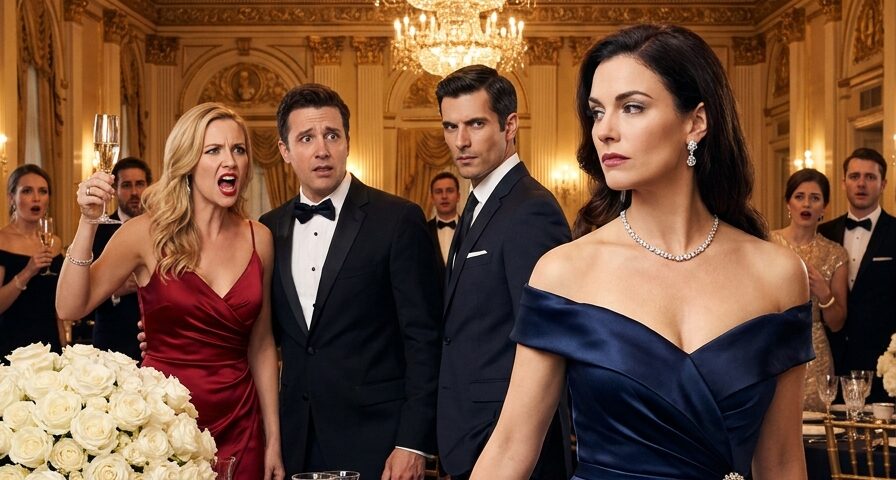
PART 2 – My Husband’s Mistress Humiliated Me at a Gala
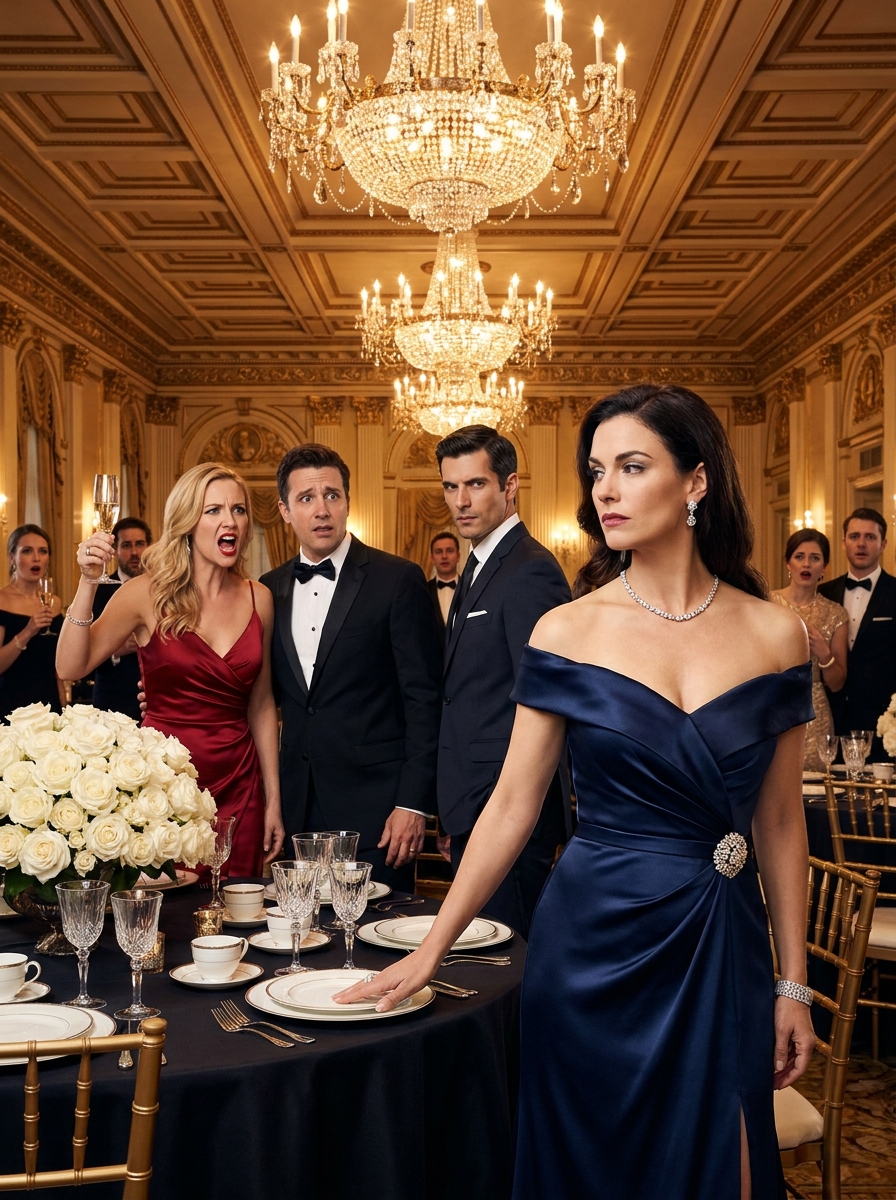
The ballroom doors opened with a hush that felt louder than applause.
Mason Hartwell walked in first.
He was not a dramatic man. He did not storm rooms, slam folders onto tables, or raise his voice to prove authority. My brother had built his reputation by doing the opposite. He entered quietly, observed everything, and let other people discover too late that silence was not weakness.
Behind him came my father’s longtime attorney, Eleanor Voss, dressed in black silk with a pearl pin at her throat. Two men from Summit Ridge Bank followed, their expressions carefully neutral.
Sloane Avery still stood on the stage with her champagne glass raised.
Her smile lasted three seconds.
Then she recognized Mason.
Not personally, perhaps. But she recognized what he represented: the Hartwell family, the money behind Preston’s rise, the old agreements he had pretended no longer mattered.
Preston rose from his chair so abruptly that the legs scraped against the marble floor.
“Mason,” he said, forcing a laugh. “This is hardly the time.”
Mason did not look at him.
He looked at me.
“Victoria,” he said gently. “Are you ready?”
Every person in the Mayfair Grand Ballroom turned toward me again.
This time, they were not waiting for me to cry.
They were waiting to see whether I truly understood the fire I had just invited inside.
I placed my napkin beside my untouched dinner and stood. My navy gown settled around me like water. My hands were steady, though my heart was not. I had imagined this moment for one hundred and twelve days, but imagination never captured the scent of orchids, the shine of candlelight, or the strange sadness of watching your marriage collapse in front of six hundred witnesses.
“I am,” I said.
Preston stepped toward me. “Victoria, don’t do this here.”
I turned to him.
For twelve years, I had known every line of his face. I knew how his eyes softened when he wanted forgiveness before he asked for it. I knew how his mouth tightened when someone challenged him. I knew the elegant, practiced charm that had persuaded boardrooms, donors, reporters, and me.
Tonight, all of it looked smaller.
“You brought her here,” I said quietly. “You allowed her to take that stage. You made this public before I did.”
His jaw flexed.
Sloane lowered her glass at last. “This is unnecessary. Preston and I love each other. Everyone knows marriages end.”
A murmur passed through the room.
I looked at her, not with anger, but with something colder and more honest.
“Marriages do end,” I said. “But companies funded by family trusts do not get to be quietly emptied while their founders’ daughter is distracted by betrayal.”
The color left Preston’s face entirely.
There it was.
Not merely fear.
Recognition.
Sloane blinked. “What is she talking about?”
Mason finally turned toward Preston. “Would you like to explain, or should Eleanor?”
Preston’s lips parted. No words came.
Eleanor Voss stepped forward with a slim leather folder. “Earlier this evening, Summit Ridge Bank received formal notice from Hartwell Holdings to suspend discretionary access to the Hale Development primary credit line pending review. The loan covenants permit such action if material misrepresentation, undisclosed transfer, or suspected misuse of collateral is identified.”
Several people at nearby tables shifted as if the marble beneath them had grown unstable.
Preston looked around, suddenly aware that among the guests were lenders, investors, board members, city officials, and at least three journalists who had spent the evening pretending not to eavesdrop.
“You can’t just freeze my company,” he said.
“My father can freeze his money,” Mason replied. “And he did.”
Sloane descended one step from the stage. “Preston?”
He did not look at her.
That told me more than any confession could have.
For months, she had believed she was stepping into a life already prepared for her. A penthouse, a husband with old money beside his name, access to rooms where women smiled politely and men stood when she approached.
She had not understood that Preston’s empire was not built on his name alone.
It had been built on mine.
The auction host still stood near the podium, his face frozen in professional horror. “Perhaps we should take a brief intermission—”
“No,” I said.
The word surprised even me.
I had spent most of my life making discomfort easier for everyone else. Hosting dinners after arguments. Smiling through rumors. Translating Preston’s arrogance into ambition and my family’s expectations into support. But there comes a moment when a woman realizes peacekeeping has become self-erasure.
“No intermission,” I repeated. “The foundation deserves its evening. The guests deserve clarity. And I deserve not to be whispered about while men in suits decide what parts of my life are too unpleasant to mention.”
My father had always said I possessed my mother’s calm. He had never understood that calm was not absence of emotion.
It was discipline.
I faced the room.
“I apologize to the Whitcomb Children’s Foundation and to every donor here tonight,” I said. “This event was meant to raise money for families who need support, not to become the theater for private betrayal. My family will match tonight’s fundraising total, whatever it is, so the work continues untouched by what happens next.”
A soft wave moved through the ballroom, surprise shifting into something warmer.
Then I turned back to Preston.
“But I will not protect a lie anymore.”
Preston stepped closer and lowered his voice. “Victoria, please. Come with me for five minutes.”
“For what? So you can tell me she forced your hand? So you can swear there’s an explanation? So you can remind me how much is at stake?”
His expression cracked.
“Everything is at stake,” he whispered.
“I know.”
For a second, I saw the man I had married standing underneath the man he had become. Not innocent. Not absolved. But frightened.
And that was what hurt most.
Sloane approached us, her red gown brushing the floor. “Preston, tell them this is ridiculous. Tell them you’re leaving her.”
He flinched.
Not enough for the room to miss.
Her confidence faltered. “Preston?”
Mason opened the leather folder Eleanor had handed him. “Perhaps we should all avoid further improvisation.”
He removed a document and placed it on the nearest table.
Preston stared at it as though it had risen from a grave.
“What is that?” Sloane demanded.
“A preliminary review,” Mason said. “Three weeks ago, Victoria requested an independent audit of Hale Development’s recent transfers.”
Sloane’s eyes moved to me. “You hired auditors?”
“Yes.”
“You were spying on him.”
“No,” I said. “I was verifying what my name was still being used to guarantee.”
A man at the front table muttered something under his breath. His wife elbowed him sharply.
Mason continued, “Several payments were routed through a consulting entity called Avery Strategic Partners.”
All eyes turned to Sloane.
Her face flushed. “That’s my firm. Preston hired me legitimately.”
“Did he?” Mason asked.
Preston said nothing.
Eleanor’s voice cut in, smooth and devastating. “Avery Strategic Partners was incorporated eleven months ago. It has no employees listed beyond Ms. Avery. No client history before Hale Development. Yet it received seven payments totaling four point six million dollars for advisory services connected to the Westbridge expansion.”
Sloane’s lips parted.
That was the first moment I believed she might not know the whole truth.
Preston finally spoke. “Those were advance consulting fees.”
Mason looked almost bored. “For reports nobody can locate?”
“They’re confidential.”
“Then you’ll have no difficulty producing them.”
Silence.
The kind that changes careers.
Sloane turned fully toward Preston now. “You told me the payments were equity positioning.”
I watched him close his eyes.
There it was: the small hidden door opening inside the larger room.
“You told me,” Sloane continued, quieter, “that Victoria had signed off.”
A strange stillness settled in me.
Preston had not merely betrayed me with her.
He had used me to deceive her too.
For a moment, Sloane and I looked at each other across the wreckage of the same man’s promises. I did not like her. I would never pretend I did. But I recognized the shock in her face. It was the expression of a woman discovering she had been cast in a story different from the one she believed she was living.
Mason leaned close to me. “You don’t have to stay.”
“I do,” I said.
Preston reached for my hand.
I stepped back before he touched me.
That tiny movement seemed to wound him more than any public accusation.
“Victoria,” he said, his voice lower now. “I made mistakes.”
“Do not make them sound accidental.”
His eyes reddened. “I was drowning.”
The room seemed to fade at the edges.
“Drowning in what?” I asked.
He glanced at Mason, then at Eleanor, then at the bankers who stood like patient shadows near the doors.
“In expectations,” he said. “In your father’s shadow. In the way every room reminded me I was Mr. Victoria Hartwell before I was Preston Hale.”
I heard a few uncomfortable shifts around us, but my focus stayed on him.
“You could have told me that.”
“I did.”
“No,” I said. “You resented me quietly and called it pride. You spent my family’s trust and called it independence. You found someone who admired the version of you I had spent years helping you maintain.”
He looked down.
The sadness that moved through me then was not sharp. It was deep and old and strangely gentle. Because once, I had loved this man. I had loved his ambition before it hardened. I had loved his laugh before it became performance. I had loved the way he held my hand at my mother’s funeral and did not let go for hours.
But love, I had learned, could become history while still feeling present.
Sloane set her champagne glass on a table so carefully it did not make a sound.
“Preston,” she said. “Did you use my company to move money?”
He did not answer.
Her face tightened. “Did you?”
“I was going to fix it,” he said.
That answer was enough.
Sloane staggered back half a step. For the first time that night, the woman in red looked young. Not innocent, but young. Young enough to have mistaken proximity to power for safety.
Mason signaled to the bankers. One of them stepped forward and handed Preston a sealed notice.
“Mr. Hale,” he said, “this confirms temporary suspension of further draws on the credit facility pending documentation review.”
Preston took it as though it weighed pounds.
A phone began buzzing at one of the investor tables. Then another. Then another.
News moved faster than dignity in rooms like this.
Within minutes, partners would know. By morning, half of Manhattan would have a version of the story, polished, distorted, and passed between coffee meetings. I could not control that. I no longer wanted to.
I had controlled enough.
Eleanor touched my elbow. “Victoria, your father is waiting in the east salon.”
I nodded.
Preston looked up sharply. “Your father is here?”
“He’s been here since before dessert,” Mason said.
For the first time that evening, Preston looked truly afraid.
My father, Edmund Hartwell, had not attended public galas in years. Arthritis had slowed his walk, grief had quieted his appetite for society, and age had softened neither his mind nor his standards. He had trusted Preston with capital, influence, and—more personally—with me.
That was the debt Preston feared most.
I walked away from the table without looking back.
The ballroom parted for me. Not dramatically, not like a queen moving through subjects, but like people making space for a woman they had misjudged. Some lowered their eyes. Some looked at me with pity, which I disliked. Others with admiration, which I trusted even less.
At the edge of the room, I paused beside the foundation director, a small woman named Dr. Lena Ortiz whose hands were clasped tightly around her program.
“I am sorry,” I said.
Her eyes softened. “Mrs. Hale, the children will still be helped. That is what matters.”
“Yes,” I said. “It is.”
Then I left the ballroom.
The east salon smelled of leather, lilies, and rain-soaked wool. My father sat near the fireplace in his wheelchair, a charcoal suit draped over his narrow frame, one hand resting on his cane. Age had made him physically smaller, but his presence still filled the room.
When he saw me, his stern face changed.
Not much.
Just enough.
“My girl,” he said.
That nearly undid me.
Mason closed the door behind us. Eleanor stayed near the window, giving us privacy without leaving.
I crossed the room and knelt beside my father’s chair, ignoring the gown, the marble, the fact that I was forty-six years old and had not knelt at his side since my mother died.
He placed his hand on my hair.
For one quiet moment, I let myself be someone’s daughter.
“You were magnificent,” he said.
“I was humiliated.”
“No,” he said. “You were betrayed. There is a difference.”
My throat tightened.
“I thought I would feel powerful.”
He brushed his thumb gently over my temple. “And?”
“I feel tired.”
“That is honest.”
I laughed once, weakly. “I’m not sure honesty is enough tonight.”
“It is a beginning.”
Mason poured water into a crystal glass and handed it to me. “The first calls are already coming in. Preston’s board will request an emergency meeting by morning.”
“Let them.”
“He may try to blame Sloane.”
“He will,” Eleanor said.
I looked up. “Can he?”
Eleanor’s expression remained calm. “He can try. But the authorization trails are his. If Ms. Avery was misled, she may become cooperative very quickly.”
I thought of Sloane’s face when she realized the payments were not what Preston had claimed. The thought did not bring satisfaction.
It brought complication.
My father studied me. “You’re feeling sorry for her.”
“No.”
He lifted an eyebrow.
I sighed. “Perhaps a little.”
“She tried to humiliate you.”
“Yes.”
“And still?”
“And still, I know what it is to believe Preston when he speaks softly.”
Mason looked away first.
My father’s hand fell to mine. “That is why you are stronger than he understood.”
A knock came at the door.
Eleanor opened it slightly. A hotel security manager stood outside, uncomfortable but composed.
“Mrs. Hale,” he said. “Ms. Avery is asking to speak with you privately.”
Mason immediately said, “No.”
My father said nothing.
I rose slowly. “Where is Preston?”
“In a conference room with Mr. Bradshaw and two members of his board,” the manager replied. “Ms. Avery is in the library. She appears upset.”
Mason shook his head. “Victoria, absolutely not.”
I looked at my brother. “She may know things.”
“Then Eleanor can speak with her.”
“She asked for me.”
“That doesn’t mean you owe her anything.”
He was right.
But not all meetings are about what is owed.
Some are about what is unfinished.
“I’ll go,” I said. “Eleanor can stay within hearing distance.”
My father watched me carefully. “Are you certain?”
“No,” I said. “But I’m going.”
The library was down a narrow hall lined with old portraits and heavy sconces. Music from the ballroom reached us only faintly now, a softened echo of strings and polite applause. Life continuing, because life always has the indecency to continue during personal catastrophes.
Sloane stood near a tall window, her red gown stark against the dark glass. Without the stage lights, she looked less like a conqueror and more like a woman who had dressed for a future that had evaporated.
She turned when I entered.
For several seconds, neither of us spoke.
Then she said, “I didn’t know.”
I closed the door halfway, leaving Eleanor visible in the hall. “Which part?”
Sloane swallowed. “The money. The credit line. Your signature. I knew he was married. I’m not going to insult you by pretending otherwise.”
“Good.”
Her eyes flashed briefly, then dimmed. “He told me you had an arrangement.”
I almost smiled. “Of course he did.”
“He said your marriage had become a business partnership. That you both understood appearances mattered until the Westbridge deal closed.”
“And you believed him?”
“I wanted to.”
The admission landed softly.
She looked at her hands. “He said you were cold.”
I thought of Preston whispering that I looked beautiful. Preston calling me brilliant when investors praised a strategy I had quietly shaped. Preston telling me, years ago, that my steadiness made him brave.
“I’m sure he did,” I said.
Sloane’s voice broke. “He said I made him feel alive.”
“That may also be true.”
She looked startled.
“People often use truth as packaging for lies,” I said. “It makes the lies easier to carry.”
Sloane wiped quickly beneath one eye, angry at the tear. “I thought I was winning.”
“I know.”
“I wanted everyone to see that he chose me.”
“And now?”
She looked toward the door, beyond which Preston’s future was being dismantled by men who had once toasted him.
“Now I don’t know what he chose.”
I studied her carefully. “Why did you take the microphone?”
Her face colored. “Because he kept delaying. He said after the gala. After the investors. After the foundation announcement. There was always another after. I thought if I forced the truth into the room, he would finally stand beside me.”
“And he didn’t.”
“No.”
The words seemed to cost her.
For the first time all evening, I felt no desire to wound her. She had wounded herself on the same blade I had simply learned to stop holding.
Sloane reached for a clutch on the windowsill and removed a small flash drive.
“He asked me to keep backup files,” she said. “Invoices, projections, correspondence. He said it was safer if certain things were not on Hale servers during the expansion review.”
My heartbeat changed.
“What things?”
“I didn’t understand all of it. I told myself that was normal. Big deals are complicated.” She laughed without humor. “That was convenient, wasn’t it?”
She held out the drive.
I did not take it immediately.
“Why give this to me?”
“Because Preston told me tonight that if I loved him, I would say the consulting fees were my idea.”
The room seemed to grow colder.
“He asked you to take responsibility?”
She nodded.
“And would you have?”
Her eyes met mine. “Before tonight, maybe.”
I believed her.
That unsettled me more than if she had lied.
I took the flash drive. “Eleanor will review it.”
Sloane held my gaze. “There’s something else.”
Of course there was.
In stories, betrayal arrives like lightning. In life, it arrives in layers, each one revealing the shape of the one beneath.
“What?” I asked.
“There were emails about a property in Connecticut. Not Westbridge. A private estate.” She frowned, trying to remember. “Grayhaven, I think. He said it was being purchased through a holding company.”
I went still.
Grayhaven.
My mother’s childhood home.
The house my father had refused to sell after she died. The house he had placed in a protected family trust before Preston and I married.
No one outside the family discussed Grayhaven.
Not ever.
Sloane saw my face. “What is it?”
I did not answer.
I opened the library door.
“Eleanor,” I said. “Find Mason.”
Within ten minutes, we were back in the east salon. Mason plugged the flash drive into Eleanor’s secured laptop while my father watched from beside the fire, his expression carved from stone.
Files appeared across the screen.
Invoices. Draft agreements. Private messages. Scanned letters. Spreadsheets labeled with harmless names that did not feel harmless at all.
Mason opened one folder marked GH.
My father’s hand tightened around his cane.
Inside was a draft purchase proposal for Grayhaven.
Buyer: Northstar Heritage LLC.
Seller authorization: pending trustee consent.
Mason swore under his breath.
I leaned closer. “Who owns Northstar Heritage?”
Eleanor searched quickly, her fingers moving with elegant precision.
A corporate filing appeared.
For a long moment, no one spoke.
Then Mason said, “That can’t be right.”
My father’s face had gone gray.
I read the name twice.
Northstar Heritage LLC was not controlled by Preston.
It was controlled by my father’s former chief financial officer, Alistair Crane, a man who had retired two years earlier after serving our family for nearly three decades.
My father whispered, “Alistair?”
The name carried disbelief, old friendship, and a grief that had not yet found its shape.
Mason opened another file.
It was an email from Preston to Alistair.