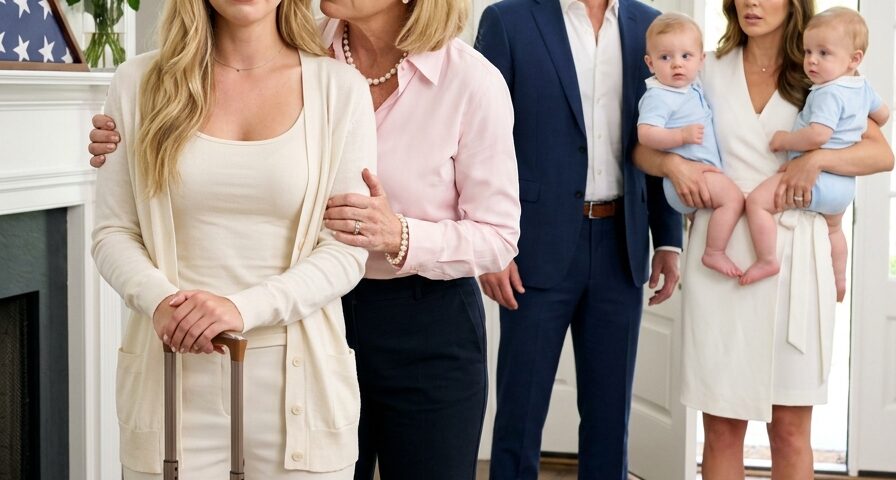
My Husband Had Twins With My Sister—But When I Divorced Him, His Mother Went Pale and Whispered, “She Didn’t Tell You?”…

PART 2
Ava met Eleanor two mornings later at a quiet coffee shop near Lake Forest, halfway between Ava’s Chicago townhome and the Whitmore family house. It was the kind of place Eleanor would have chosen: polished wood tables, white cups, soft jazz playing low enough that no one had to raise their voice.
Eleanor was already seated when Ava arrived. Her silver-blonde hair was pinned neatly, but her hands betrayed her. They trembled around a cup of tea she had not touched.
Ava sat across from her.
For a moment, neither woman spoke.
Eleanor looked at Ava the way people look at a door they know they must walk through, even though everything behind it is burning.
“I should have told you years ago,” Eleanor said.
Ava’s throat tightened. “Told me what?”
Eleanor closed her eyes.
“When you and Grant were trying to have a baby, there was a medical report.”
Ava felt every sound in the café fade. The espresso machine. The scrape of chairs. The quiet murmur of other people’s lives continuing as if hers were not being dismantled sentence by sentence.
“What report?”
“It came to the house by mistake,” Eleanor said. “Addressed to Grant. I opened it because I thought it was insurance paperwork. It wasn’t.”
Ava did not move.
Eleanor’s eyes filled again. “It was from Dr. Miriam Harlow. Your fertility specialist.”
Ava remembered Dr. Harlow immediately. Kind voice. Careful hands. Soft gray office walls covered in watercolor prints. A woman trained to deliver pain gently, as though gentleness could alter the facts.
“I don’t understand,” Ava said.
Eleanor’s lips parted, but nothing came out.
Ava leaned forward. “Eleanor. What did it say?”
Eleanor lowered her gaze to the table. “It said the problem wasn’t you.”
The words did not hit Ava all at once.
They entered slowly.
The problem wasn’t you.
For eight years, Ava had carried blame inside her body like a second skeleton. Every injection bruise on her stomach. Every negative test. Every silent apology to Grant. Every family dinner where someone said, “These things happen when women wait too long,” and Ava swallowed the shame because she believed she deserved it.
“The report was about Grant?” Ava asked.
Eleanor nodded.
“A severe male factor issue. Dr. Harlow recommended you both discuss alternative options. Donor sperm. Adoption. Other paths.” Eleanor pressed a shaking hand to her mouth. “I thought if Grant knew, it would destroy him.”
Ava stared at her.
“So you let it destroy me instead.”
Eleanor flinched as if struck.
“I told myself I would tell him when the time was right,” she whispered. “Then one month became six months. Six months became a year. Then you lost the first pregnancy, and I thought—God forgive me—I thought maybe the report had been wrong. Then the treatments continued, and I was trapped inside my own silence.”
Ava’s voice went flat. “You weren’t trapped. You chose.”
“Yes,” Eleanor said. “I did.”
There was something brutal about that honesty. Ava almost hated her less for not hiding from it.
“Does Grant know?” Ava asked.
“No.”
“Does Lauren?”
“No. At least, I don’t think so.”
Ava looked out the window toward the gray street. A woman pushed a stroller past the glass. The sight should have hurt. Instead, Ava felt something colder than grief begin to form.
If Grant’s diagnosis was real, then the twins Lauren had just delivered were almost certainly not his biological children.
Which meant one of two things.
Either Lauren had betrayed Grant too.
Or Lauren knew exactly what she had done.
“Why call me now?” Ava asked.
Eleanor wiped her eyes with a napkin. “Because Grant called me yesterday. He said he was bringing Lauren and the babies to meet me. He sounded so proud, Ava. So happy. He said, ‘Mom, you’re finally a grandmother.’”
Her voice broke.
“I couldn’t breathe. I kept hearing your voice from years ago, apologizing because you thought your body had failed him. And I realized I had let my son build a lie on top of the lie I buried.”
Ava said nothing.
Eleanor reached into her purse and pulled out a small envelope, worn at the edges. She placed it on the table but kept two fingers pressed to it, as though afraid it might vanish.
“This is not the original report,” she said. “It’s a note I wrote the day I read it. I copied the key findings because I thought one day I would need to remember exactly what I had hidden.”
Ava stared at the envelope.
“Where is the original?”
“In a fireproof safe at my house.”
“Get it.”
Eleanor nodded. “I will.”
“No,” Ava said quietly. “Not someday. Today.”
Eleanor looked up.
Ava’s voice remained calm, but something in it had hardened beyond repair.
“I am done living inside other people’s secrets.”
That afternoon, Ava called Dr. Miriam Harlow’s clinic. The receptionist put her on hold for less than two minutes before Dr. Harlow herself came on the line.
“Ava,” the doctor said carefully. “It’s been a long time.”
“I need my full fertility file,” Ava said. “And Grant’s related records from our treatment years, where I am legally permitted to receive them.”
A pause.
Then Dr. Harlow exhaled.
“Eleanor told you.”
“She told me enough.”
“Come tomorrow morning,” Dr. Harlow said. “I’ll pull everything myself.”
Ava did not sleep that night.
Grant was still away, claiming he was in California. Lauren sent no more messages. Ava’s mother called once, probably because Lauren had panicked and needed someone to absorb the mess. Ava let it go to voicemail.
At 8:30 the next morning, Ava sat in Dr. Harlow’s office and watched the doctor slide a thick folder across the desk.
“I failed you,” Dr. Harlow said.
Ava looked at her.
“I let a frightened mother interfere with information that belonged inside your marriage,” Dr. Harlow continued. “I cannot undo that. I can only give you what should have been given years ago.”
Ava opened the folder.
Page after page, the truth waited in clean black ink.
Grant’s test results. Recommendations. A written summary addressed directly to him.
Ava read every line.
By the time she finished, her hands were steady.
Her marriage had not collapsed because she could not give Grant a child.
It had collapsed because everyone around her had found it easier to let her carry a lie than to tell the truth.
And now that truth was about to walk into Eleanor Whitmore’s living room in two baby carriers.
PART 3
Eleanor called Ava at 6:12 p.m. on Thursday.
“They’re coming tonight,” she said.
Ava was standing in her home office, sorting printed evidence into labeled folders. She placed the page she was holding on the desk.
“Grant and Lauren?”
“Yes. He just texted. He said they’ll be here by seven. He wants to introduce me to the twins.”
Ava looked at the divorce petition lying beside her keyboard.
“Do you have the report?”
Eleanor’s breath shook. “Yes.”
“Then decide what kind of mother you want to be tonight.”
There was a silence long enough to reveal the weight of that sentence.
“I know,” Eleanor whispered.
Ava almost felt sorry for her.
Almost.
She did not drive to Lake Forest. She did not hide outside the house. She did not need to witness the explosion to know what fire sounded like. She stayed home, poured herself a glass of ice water, and waited.
Eleanor told her everything later.
Grant arrived first, letting himself into the Whitmore house with the easy confidence of a son who had never been denied entry anywhere in his life. He wore a navy coat and expensive shoes, his face bright with the exhausted pride of new fatherhood.
Lauren followed behind him.
Eleanor said Lauren looked beautiful in that fragile, performative way she had always mastered. Pale hair loose around her shoulders. Soft beige sweater. A tiny diamond necklace at her throat. She carried one baby carrier while Grant carried the other.
For years, Lauren had entered rooms as Ava’s younger sister.
That night, she entered as the woman who had stolen Ava’s husband and believed the babies in those carriers made her victory permanent.
“Mom,” Grant said, smiling.
Eleanor stood near the fireplace, one hand resting on the mantel because her knees had weakened the second she saw the infants.
Grant set one carrier down and lifted a sleeping baby into his arms.
“You’re finally a grandmother.”
Eleanor looked at the child’s small face. Then at Grant. Then at Lauren.
All the blood drained from her face.
Grant’s smile faltered.
“Mom?”
Lauren adjusted the blanket around the second baby. “Eleanor, are you okay?”
Eleanor said nothing.
Grant frowned. “You look like you’ve seen a ghost.”
In a way, she had.
Eight years of buried guilt stood in front of her wearing her son’s face.
Eleanor told Ava she had rehearsed a hundred versions of the truth. Calm ones. Gentle ones. Motherly ones. But when the moment came, only five words escaped.
“She didn’t tell you?”
The room went silent.
Grant’s expression changed first. Confusion, then irritation, then something sharper.
“Who didn’t tell me what?”
Lauren went still.
Eleanor noticed that immediately.
It was not the stillness of a guilty woman caught in a known lie. It was the stillness of someone realizing there was another secret in the room, one she had not been invited to understand.
“Mom,” Grant said slowly. “What are you talking about?”
Eleanor turned and walked down the hallway toward the study.
Grant followed.
Lauren remained in the living room with the twins, but Eleanor said she could hear Lauren’s breathing, quick and uneven, from the hallway.
The safe was in the back of the study closet. Eleanor knelt on the rug, her hands shaking so badly she entered the combination wrong twice.
Grant stood in the doorway.
“Mom, you’re scaring me.”
“I should have scared you years ago,” Eleanor said.
He did not answer.
The safe opened with a soft metallic click.
Inside was a sealed envelope.
Eleanor carried it back to the living room and placed it on the coffee table. Grant stood over it like a man staring at a loaded weapon.
“What is that?”
“The truth,” Eleanor said. “The one I stole from you and Ava.”
At Ava’s name, Lauren lowered her eyes.
Grant sat.
Eleanor opened the envelope.
The original report had yellowed slightly along the edges, but the words remained perfectly legible. Dr. Harlow’s letter. Lab findings. Clinical recommendations. Grant’s name at the top of every page.
Grant picked up the first sheet.
At first, he read quickly.
Then slower.
Then again.
His face changed in increments, each one more painful than the last.
“This is mine,” he said.
Eleanor nodded.
“This isn’t Ava’s.”
“No.”
His voice lost all strength. “You knew?”
Eleanor’s tears fell freely now. “Yes.”
“For eight years?”
“Yes.”
Grant stood so suddenly the paper bent in his fist.
“You let me think it was her.”
“I was trying to protect—”
“Do not say you were protecting me.”
The baby in Lauren’s arms began to fuss. Lauren bounced him automatically, though her eyes stayed locked on Grant.
Grant looked down at the report again.
Ava imagined him seeing it all: the waiting rooms, the injections, Ava’s bruises, her quiet apologies, the way she had curled into herself after every failed cycle while he accepted comfort he had no right to receive.
Grant pressed a hand over his mouth.
“She apologized to me,” he said, voice breaking. “Ava apologized to me.”
Eleanor sobbed.
Lauren finally spoke.
“Grant.”
He turned toward her.
She swallowed. “What does this mean?”
The question opened a second door.
Grant stared at the infants.
Eleanor said the room became so quiet she could hear the old clock ticking in the hallway.
Lauren looked from Grant to the report, then back again.
“If that’s true,” she whispered, “then the twins…”
She could not finish.
Grant’s eyes hardened.
“Who else was there?”
Lauren’s mouth opened. No sound came out.
“Lauren,” Grant said. “Who else was there?”
Her face crumpled—not into grief, but into the panic of a person who had counted on one lie hiding another.
“I didn’t know,” she whispered.
“That isn’t an answer.”
“I thought—”
“You thought what?”
Lauren began crying.
Eleanor said Grant looked at the babies one more time, and something inside him seemed to collapse inward. He had walked into the house believing he had finally won the family life that Ava’s body had supposedly denied him.
Instead, he learned he had destroyed his marriage for children who might not be his, with a woman who might have betrayed him exactly as he had betrayed Ava.
He grabbed his keys.
Eleanor reached for him. “Grant, don’t drive like this.”
“I need to see Ava.”
“No,” Eleanor said. “You need to sit with what you’ve done.”
But Grant was already at the door.
Lauren called his name once.
He did not turn around.
PART 4
Ava saw Grant’s headlights sweep across her living room wall at 9:03 p.m.
She had known he would come. Men like Grant always came when the truth stopped serving them. They came with red eyes, shaking hands, and explanations shaped like apologies. They came not because they suddenly understood the damage, but because the damage had finally reached them.
Ava did not rush.
She finished taping a label onto a folder, placed it into a banker’s box, and walked to the door.
Grant stood on the porch in the cold Chicago night, his coat open, his hair messy from running his hands through it. He looked nothing like the polished businessman who charmed investors over dinner and made waiters feel like personal friends.
He looked like a man who had just discovered the floor beneath him was painted on.
“Ava,” he said.
She opened the door halfway.
He held up the medical report.
“You knew?”
“I found out recently.”
His eyes filled. “I didn’t.”
“I know.”
That answer seemed to hurt him more than accusation would have.
“Can I come in?”
Ava considered saying no.
Then she stepped aside.
Not because she owed him comfort. Because she wanted him inside the room where she would end the marriage, fully and finally, with no witnesses for him to perform for.
Grant walked into the living room slowly. His gaze moved across familiar objects: the gray sofa they had picked out together, the framed photo from their honeymoon in Maine, the bookshelf he had built badly and Ava had pretended not to notice leaned slightly to the right.
He sat.
Ava remained standing.
“I don’t know where to start,” he said.
“The truth is usually efficient.”
Grant flinched.
He looked down at the report. “My mother hid it. She hid it for eight years.”
“Yes.”
“If I had known—”
Ava raised a hand. “Be careful with that sentence.”
He looked up.
“If you had known, maybe some things would have been different,” she said. “But knowing or not knowing did not make you sleep with my sister.”
Grant closed his eyes.
“I was broken,” he whispered. “I felt like I was failing you. Failing myself. I didn’t know how to talk about it.”
“So you made me carry the failure.”
“I didn’t know it was mine.”
“You knew the affair was yours.”
Silence.
Ava sat across from him then, not because she was softening, but because her knees were tired and she had no interest in making pain theatrical.
Grant leaned forward, elbows on his knees.
“Lauren says she didn’t know about the report.”
“I believe that.”
He looked at her quickly.
Ava gave a humorless smile. “Don’t confuse belief with sympathy.”
Grant swallowed.
“She says there was no one else.”
Ava did not answer.
“But after tonight, I don’t know what to believe. I don’t know if those babies are mine. I don’t know if anything in my life is what I thought it was.”
Ava looked at him for a long moment.
“Welcome,” she said quietly.
His face crumpled.
It was not cruelty. It was accuracy.
For eight years, Ava had lived inside uncertainty and blamed herself for the fog. Grant had helped build that fog, even unknowingly in one place and knowingly in many others. Now, finally, he was choking on it too.
“I’m sorry,” he said.
Ava had imagined those words before. During the first night after the photo. During the lawyer meeting. During the drive back from Dr. Harlow’s clinic. She had imagined them breaking her open.
They did not.
“I know,” she said.
“I mean it.”
“I know.”
“Then why does it sound like it doesn’t matter?”
Ava folded her hands in her lap.
“Because apology is not a time machine.”
Grant stared at her.
“You’re sorry now because the story changed,” she continued. “Because you are no longer the man who found fatherhood outside his wounded marriage. Now you’re the man who betrayed his wife, discovered she was never the problem, and may have been deceived by the woman he chose over her.”
He looked away.
“That is not repentance, Grant. That is consequences.”
His jaw worked, but no words came.
For the first time in their marriage, Ava realized she did not need him to agree.
She did not need him to understand.
She did not need him to validate the pain in order for it to be real.
“My attorney has already filed,” she said.
Grant’s head snapped up.
“You filed?”
“Yes.”
“When?”
“Before I knew about the report.”
He looked stunned. “So even before this…”
“Yes.”
“You were already done.”
Ava thought about the moment the photo arrived. The caption. Lauren’s call. The way Grant had come home and lied about San Diego with hospital air still probably clinging to his clothes.
“I was done the second I saw you holding those babies.”
Grant pressed his palms together in front of his mouth.
“I don’t want to lose you.”
“You already lost me.”
The sentence landed between them with no drama at all. That was the strangest part. Some truths did not need volume.
Grant cried then.
Quietly at first, then with the helplessness of someone who had spent years controlling narratives and had finally reached one that would not obey him.
Ava watched him and felt sadness, yes. But the sadness was not an invitation.
It was weather.
It passed through her without changing where she stood.
“What happens now?” he asked.
“The divorce proceeds. You establish paternity if you need to. You deal with Lauren. You deal with your mother. You deal with yourself.”
“And us?”
“There is no us.”
He nodded slowly, as if some part of him had known before arriving that this was the answer.
Grant left close to midnight. Ava watched from the window as his car pulled away.
For the first time since the photo, her chest did not feel tight.
She locked the door.
Then she walked upstairs, removed the honeymoon photo from its frame, and placed the empty frame face down in a drawer.
PART 5
Divorce had a sound.
Before Ava lived through it, she might have imagined shouting, slammed doors, breaking glass, lawyers barking across polished tables.
In reality, divorce sounded like printers, email notifications, calendar reminders, and the soft click of a pen signing documents that once seemed impossible.
Rachel Voss moved with surgical patience. She filed motions, sent preservation letters, requested financial disclosures, and advised Ava not to answer any message that was emotional rather than legal.
Grant sent many.
Some were apologetic.
Some were confused.
A few were angry.
Ava read none after the first week. She forwarded everything to Rachel.
Lauren called twenty-three times in four days.
Ava blocked her.
Their mother, Barbara, left one voicemail.
“Honey, I know you’re hurt, but your sister just gave birth. This family needs compassion right now.”
Ava deleted it before it ended.
Compassion, she had learned, was a word people often used when they wanted the injured person to make the room more comfortable.
Meanwhile, the truth continued unfolding without Ava’s help.
Grant requested a paternity test.
Lauren resisted.
That fact reached Ava through Eleanor, who called one evening with a voice hollowed by exhaustion.
“She says he’s attacking her during postpartum recovery,” Eleanor said. “She says if he loved the babies, biology wouldn’t matter.”
Ava stood at her kitchen window watching snow begin to fall over Chicago.
“What does Grant say?”
“He says love built on fraud is not love.”
Ava almost laughed, but did not.
People learned best when the lesson came wearing their own words.
Two weeks later, Eleanor called again.
This time, she did not need to explain. Ava heard it in her silence.
“They’re not his,” Ava said.
Eleanor began crying.
The twins’ biological father was a man named Owen Mercer, a married real estate developer from San Diego who had met Lauren at a conference and apparently believed discretion was included with hotel room service. Lauren had not planned for twins. She had not planned for a misdirected photo. She had not planned for Eleanor’s old medical file.
But lies did not care about plans.
They cared about pressure.
Under enough of it, they split.
Grant unraveled quietly at first, then publicly. He took a leave from Whitmore Logistics, the company he had spent twelve years building with a college friend. He stopped attending investor dinners. He sold his share six months later.
Lauren left Illinois before spring.
Barbara drove her to Arizona, according to a cousin who still thought Ava wanted updates. Ava did not respond to the message.
There was a time when Ava would have needed to know everything. Every consequence. Every regret. Every tear Lauren cried.
But freedom, she discovered, had its own appetite. It preferred empty space.
The mediation took place in a conference room on the twenty-third floor of a downtown office building. The windows looked out over Lake Michigan, steel-gray under a cloudy sky.
Grant arrived in a dark suit that hung slightly loose on him. He looked thinner. Older. Not destroyed, exactly, but reduced to a truer size.
Ava wore navy.
Rachel sat to her right.
Grant’s attorney, a tired-looking man named Paul Denton, arranged papers he clearly knew would not be contested much. Grant had agreed to most terms. The house would be sold unless Ava chose to buy out his share. Retirement accounts would be divided according to law. No spousal support. No hidden assets. No performance.
Before the mediator entered, Grant looked at Ava.
“Can I say something?”
Rachel’s eyes shifted toward Ava.
Ava nodded once.
Grant folded his hands on the table. “I know I’ve said sorry. I know it doesn’t fix anything. But I need you to know I understand more now than I did that night at your house.”
Ava waited.
“I kept thinking the worst thing I did was betray you with Lauren,” he said. “But that wasn’t all of it. The worst thing was letting your pain be convenient for me. Even before Lauren. Even before I knew the report existed. I let you manage everything. The appointments. The grief. The questions from family. The hope. I let you be the strong one because it made me feel less weak.”
His voice shook.
“You deserved a partner. I gave you an audience.”
Ava looked at him, and for the first time in months, she felt something loosen that was not forgiveness exactly, but the beginning of not needing anger to protect her.
“Thank you for saying that,” she said.
Hope flashed in his face. Small. Dangerous.
Ava ended it before it could grow.
“It changes nothing.”
He looked down.
“I know.”
The divorce was finalized forty-seven days later.
Ava did not celebrate with champagne. She did not post a quote about new beginnings. She did not burn her wedding dress.
She went home, changed into sweatpants, ordered Thai food, and slept for eleven hours.
In the morning, sunlight filled her bedroom.
For the first time in years, Ava woke without mentally checking the temperature of another person’s mood.
There was grief, yes.
But beneath it was silence.
Clean, spacious silence.
PART 6
Spring came late to Chicago that year.
By April, the snow had melted into gray piles along curbs, and the trees along Ava’s street began showing the smallest green buds. The city looked bruised but alive.
Ava decided to keep the townhome.
Not because it held happy memories. Not because she wanted to preserve the life she and Grant had built. She kept it because she could afford it, because she liked the kitchen light in the mornings, and because leaving would have felt like letting betrayal evict her from her own life.
She repainted the bedroom.
Soft white.
No drama. No symbolism. Just a color that made the room feel larger.
Eleanor came over in May.
Ava almost said no when she called. Then she heard the careful humility in Eleanor’s voice and remembered that accountability, real accountability, was rare enough to deserve acknowledgment when it appeared.
Eleanor arrived carrying tulips and no expectation of being welcomed warmly.
“I won’t stay long,” she said.
Ava placed the flowers in water.
They sat in the kitchen where the photo had first arrived months earlier.
Eleanor looked around as if the house itself might accuse her.
“I’m not asking you to forgive me,” she said.
“Good.”
Eleanor nodded. “I deserve that.”
Ava poured tea.
For several minutes, they sat without speaking.
Finally, Eleanor said, “Grant moved to Denver.”
Ava absorbed that with mild surprise. “For work?”
“For distance, I think.”
Ava nodded.
“Lauren is in Scottsdale with Barbara. The twins are healthy.”
Ava’s hand paused on her cup.
“I’m glad they’re healthy,” she said honestly.
That was the strangest part. The babies had become symbols in everyone else’s war, but they were innocent. They had not chosen their mother’s lies, Grant’s betrayal, Eleanor’s silence, or Ava’s pain.
Eleanor looked relieved.
“I don’t know if I’ll ever meet them again,” she said. “Grant can’t bear the sight of them. Then he feels monstrous for feeling that way. It’s all very…”
“Human,” Ava said.
Eleanor’s eyes filled.
“Yes.”
Ava studied the woman across from her. Eleanor’s silence had wounded her deeply. Nothing would change that. But Eleanor had also opened the safe. She had stopped protecting the lie when it mattered most. Late was not the same as never.
“I don’t know what we are now,” Ava said.
Eleanor nodded. “Neither do I.”
“But I don’t hate you.”
Eleanor covered her mouth with one hand.
Ava looked toward the window, where sunlight moved across the counter.
“I did hate you for a while,” she admitted. “I hated everyone. You. Grant. Lauren. My mother. Dr. Harlow. Myself, for not seeing it sooner.”
“You couldn’t have known.”
“I know that now.”
Eleanor left after an hour.
At the door, she did not ask to hug Ava.
That restraint meant more than an apology.
By summer, Ava had reduced her old life into boxes. Marriage records went to storage. Evidence files went to Rachel. Fertility paperwork went into a locked drawer, not because Ava wanted to hide it, but because she wanted to decide when it had access to her.
Then, in August, Dr. Harlow called.
“I know I may be the last person you want to hear from,” she said.
Ava was at work, reviewing a fraud risk report for a nonprofit foundation in Washington, D.C.
“What is it?”
“I’m starting a patient transparency initiative,” Dr. Harlow said. “Full access protocols. Mandatory dual disclosure in couple-based fertility treatment. Independent patient advocates. I want to fund the first year personally, but I need someone who understands records, systems, and what happens when information is controlled by the wrong person.”
Ava leaned back in her chair.
“You want my help.”
“Yes. But only if it does not harm you.”
Ava almost said no.
Then she thought of another woman sitting in another clinic, blaming herself because someone else had decided truth was too dangerous.
“What would you call it?” Ava asked.
“I was hoping you might help decide.”
Three months later, the first office of ClearPath Family Advocacy opened in Chicago.
Ava did not put her name in the brochure.
She did not turn her marriage into a public tragedy or herself into a symbol. She simply built systems that made silence harder.
Every patient received direct access to personal results. Every couple received separate counseling before shared treatment decisions. Every file had audit trails. Every disclosure required confirmation.
The work did not heal her.
Healing was not that simple.
But it gave shape to what she had survived.
And some days, shape was enough.
PART 7
A year after the divorce, Ava flew to San Diego for a conference on financial ethics in medical systems.
She almost declined the invitation because the city still carried Grant’s lies in her memory. His fake work trips. His hotel charges. His easy voice on the phone saying, “I wish I were home,” while he was likely with Lauren somewhere Ava had once wanted to visit.
But Ava was tired of letting other people contaminate entire places.
So she went.
The conference was held at a hotel overlooking the marina. The ocean moved beyond the windows, silver under morning light. Ava gave a talk on hidden incentives, patient access, and institutional accountability. She did not mention Grant by name. She did not mention Lauren. She did not need to.
Afterward, a woman approached her in the lobby.
She was about forty, with red eyes and a conference badge turned backward.
“My husband and I are starting IVF next month,” the woman said. “I requested our full files after your talk. I never would have thought to ask.”
Ava felt the old ache, but it no longer swallowed her.
“I’m glad,” she said. “Ask for everything. Read everything. Make sure every result belongs to the person being blamed for it.”
The woman nodded, tears slipping down her face.
That evening, Ava walked alone along the waterfront. Families passed her. Couples. Children sticky with ice cream. A little boy chased a seagull while his father laughed.
For years, sights like that had felt like knives.
Now they felt like weather again.
Beautiful for someone else. Not always meant to wound her.
Her phone buzzed just after sunset.
A message from an unknown number.
Ava. It’s Lauren. Please don’t delete this. I know I don’t deserve a response. I just wanted to say I’m sorry. Not because my life fell apart. Because I understand now that I wanted yours, and I didn’t care what it cost you.
Ava stood near the railing, ocean wind pulling at her hair.
Another message appeared.
The boys are almost one. They’re innocent in all this. I’m trying to become someone they won’t be ashamed of someday.
Ava read the message twice.
Then she locked the phone and placed it back in her purse.
She did not reply.
Some apologies were real and still not owed an audience.
When she returned to Chicago, a letter from Grant waited in her mailbox. No return address except a Denver postmark.
Ava made tea before opening it.
The letter was four pages.
Grant wrote that he had started therapy. That he had left logistics and was teaching small business operations at a community college. That he had not spoken to Lauren in months. That he had begun volunteering with a men’s infertility support group because he had finally understood how shame became dangerous when men refused to name it.
Near the end, he wrote:
I used to think losing you was my punishment. Now I think losing you was the consequence. The punishment is having become the kind of man who needed losing you to become honest.
Ava sat with that sentence for a long time.
Then she folded the letter and placed it in the locked drawer with the medical file.
Not because Grant deserved a place there.
Because the story was complete.
That winter, ClearPath expanded to Washington, D.C., then Denver, then San Diego. Ava traveled often. She learned to enjoy hotel rooms again. She learned that silence could be peaceful instead of lonely. She learned that being alone was not the same as being abandoned.
On the second anniversary of the divorce, Rachel Voss invited Ava to dinner.
Not as her lawyer.
As a friend.
They ate at a small Italian restaurant in River North. Rachel raised a glass of sparkling water.
“To surviving the truth,” she said.
Ava smiled. “To finding it.”
Later that night, Ava walked home under streetlights, Chicago glittering around her. Her life was not the one she had planned at thirty. There were no children asleep upstairs. No husband waiting in the kitchen. No framed family photo on the mantel.
But there was a foundation helping people.
There were mornings full of light.
There were friends who did not require her to shrink.
There was a version of herself who no longer apologized for pain someone else caused.
At home, Ava stood in the kitchen where the photo had arrived two years earlier.
For a moment, she could almost see that woman again: barefoot, stunned, holding a phone that had turned her marriage into wreckage.
Ava wished she could reach back and touch her shoulder.
She would tell her: You are not being destroyed.
You are being returned to yourself.
Her phone buzzed.
This time, it was Eleanor.
Thinking of you today. Proud of the life you built. No need to answer.
Ava smiled softly.
Then, after a long moment, she typed back:
Thank you. I hope you’re well.
It was not forgiveness wrapped in a bow.
It was not reunion.
It was simply a door left unlocked, not for the past to come back, but for peace to enter if it ever arrived quietly enough.
PART 8
Three years after the photo, Ava stood on a stage in Washington, D.C., accepting an award she had never expected and had not wanted until she saw who was sitting in the audience.
Women.
Men.
Couples.
Doctors.
Advocates.
People whose private pain had too often been managed by systems designed for convenience instead of truth.
ClearPath had helped more than twelve thousand patients access records, understand treatment options, and separate medical reality from family shame. Ava still resisted being called inspirational. She preferred useful.
Useful saved people.
Inspirational was what strangers called you when they wanted the pain to look prettier.
She stepped up to the microphone under warm lights. A large American flag stood at one side of the room, its fabric still and formal. Cameras pointed at her. The audience quieted.
Ava looked down at her notes, then set them aside.
“I spent eight years believing my body was the reason my family did not exist,” she began.
No one moved.
“I was wrong. But the deeper wound was not the diagnosis. It was the silence around it. It was the way people who claimed to love me decided I was strong enough to carry what they were afraid to say.”
She paused.
“The truth does not stop pain. But it gives pain an honest name. And once you can name what hurt you, you can decide what no longer gets to own you.”
In the third row, Dr. Harlow wiped her eyes. Eleanor sat beside her, older now, thinner, but present. Ava had invited her after months of thought. Eleanor had accepted with a note that said, I will come only if my presence supports you, not if it burdens you.
That was why Ava had said yes.
After the ceremony, Eleanor approached carefully.
“You were wonderful,” she said.
“Thank you.”
Eleanor’s eyes moved across Ava’s face. “I saw Grant last month.”
Ava felt no sharpness at the name. Only recognition.
“How is he?”
“Trying,” Eleanor said. “Honestly, I think.”
Ava nodded. “Good.”
“He asked me not to tell you anything. He said your peace matters more than his need to be remembered kindly.”
Ava looked away for a moment.
“That sounds like growth.”
“It does.”
They stood together in the busy reception hall, two women connected by damage neither could erase and accountability one of them had finally chosen.
Eleanor touched the strap of her purse.
“There’s something else. Lauren wrote me. She asked me to forward you a picture of the boys for their third birthday. I told her I would ask first.”
Ava thought about it.
Three years ago, the image of those babies had shattered her marriage. Now two little boys existed somewhere in Arizona, probably with Lauren’s eyes and someone else’s smile, innocent of every adult lie that had surrounded their birth.
“No,” Ava said gently. “Not now.”
Eleanor nodded. “I understand.”
“And Eleanor?”
“Yes?”
“I hope they’re happy.”
Eleanor’s face softened. “I do too.”
That night, Ava returned to her hotel room overlooking the lights of Washington, D.C. She removed her earrings, kicked off her heels, and sat by the window with a cup of peppermint tea.
For the first time in years, she allowed herself to imagine the future without defending it.
Maybe she would marry again someday.
Maybe not.
Maybe she would foster.
Maybe she would mentor.
Maybe motherhood would find her in a form she had not been taught to expect.
Or maybe her life was already full, not because it resembled anyone else’s, but because it finally belonged entirely to her.
Her phone lit up with a message from Rachel.
Proud of you. Also, your speech made three attorneys cry. A rare public service.
Ava laughed out loud.
The sound surprised her.
It filled the room easily.
She opened her laptop and began drafting the next ClearPath initiative: a national patient rights toolkit for fertility clinics, written in language ordinary people could understand before they were too tired, scared, or ashamed to ask the right questions.
Outside, the Capitol dome glowed against the night.
Ava thought of the old title people might have given her life: betrayed wife, barren woman, abandoned sister, divorced at thirty-seven.
None of those titles fit anymore.
She had chosen a new one.
Witness.
Builder.
Woman who stopped carrying lies.
Before sleeping, Ava walked to the bathroom mirror and looked at herself. There were fine lines beside her eyes now. A small scar on her hand from a kitchen knife accident. A silver thread beginning near her temple.
She looked older than the woman in the honeymoon photo.
She looked freer too.
Ava turned off the light.
In the darkness, there was no husband lying beside her, no secret breathing in another room, no medical report hidden in a safe, no sister waiting to be forgiven.
There was only Ava.
And for the first time in her life, only Ava was enough.
THE END