At My Father-in-Law’s 80th Birthday, I “Retired” From Being This Family’s Slave by Destroying Their Luxury Dinner—Then My Cruel Mother-in-Law Screamed About Her Fortune, Not Knowing I Had Already Bought Every Dollar of It
Part 2
Eleven years earlier, Nora Bennett had arrived at Eleanor Whitmore’s Gold Coast townhouse before sunrise with two grocery bags cutting into her fingers.
It was Eleanor’s seventieth birthday, and Nora had promised to cook for thirty people.
The lake wind came sharp through the narrow street, pressing her thrift-store coat against her legs. In one bag, she carried short ribs, fresh rosemary, mushrooms, and pearl onions. In the other, she carried greens, potatoes, apples, and the ingredients for the caramel cake Arthur loved.
She rang the bell at 5:12 a.m.
Eleanor opened the door in a silk robe, already irritated.
“You’re late.”
Nora glanced at her phone. “I’m sorry, Eleanor. The butcher opened at five, and—”
“Excuses already?” Eleanor stepped aside. “Kitchen.”
Nora did not answer. She had learned early that defending herself in this house only gave Eleanor more words to sharpen. She went straight to the kitchen, took off her coat, and tied on the gray apron she kept folded in her bag.
By noon, the townhouse had filled with perfume, laughter, expensive shoes, and voices that rose whenever Nora entered the room carrying food.
Preston arrived with Meredith in a black luxury SUV. He was tall, handsome, and accustomed to being admired. Meredith entered behind him wearing a camel cashmere coat and the expression of a woman who believed every room was improved by her presence.
“Mother,” Meredith said, handing Eleanor a designer box, “we found this in New York. I thought of you immediately.”
Eleanor nearly melted.
“My brilliant girl,” she said, kissing Meredith’s cheek. “You shouldn’t carry heavy things with those hands. Those hands belong in courtrooms, not kitchens.”
From the kitchen doorway, Nora looked down at her own hands. Her knuckles were red from cold water. A burn mark crossed her wrist. Flour clung under one nail.
Meredith noticed and smiled.
“Nora, are you still selling food at that market?”
“Yes,” Nora said quietly. “Fulton Market. The prepared-food stall.”
“How brave,” Meredith replied. “I’m always terrified of market food. You never know about hygiene.”
The guests laughed politely.
Nora returned to the stove.
That was how it always went. Eleanor praised Meredith as the lawyer daughter-in-law, Preston as the surgeon son, and treated Daniel as a disappointment because he worked as a purchasing manager for a mid-sized office supply company instead of becoming rich. Nora, by extension, became proof of Daniel’s failure.
“Daniel married down,” Eleanor once said at Thanksgiving, not realizing Nora was standing behind her with a tray of coffee.
Or perhaps she did realize.
Arthur Whitmore was the only person in that house who never mocked Nora.
He was quiet, soft-spoken, and dressed plainly despite his family’s polished image. Eleanor often dismissed him as forgetful. Preston called him old-fashioned. Meredith suggested medical evaluations whenever Arthur disagreed with her.
But Arthur watched.
He saw Nora serve everyone before eating cold leftovers in the kitchen. He saw her clean while guests praised caterers for dishes she had made. He saw her bandage her own burned fingers without complaint.
That birthday afternoon, Nora cut herself washing a heavy pot.
Blood spread across a dish towel.
Meredith saw from the dining room and wrinkled her nose.
“Nora, please wear gloves. Guests are still here.”
Nora bowed her head. “Of course.”
She turned away quickly so no one would see the tears in her eyes.
A minute later, Arthur entered the kitchen.
He moved slowly, checking over his shoulder as though he were smuggling state secrets. From his cardigan pocket, he removed a small bandage. It was old, the paper wrapper yellowed at the edges.
“Here,” he whispered. “A cut like that needs covering.”
Nora stared at him, stunned by the gentleness of it.
“I’m fine, Dad.”
“No,” Arthur said. “You are not. But you keep saying it because nobody here asks honestly.”
He took her hand and wrapped the bandage around her finger with trembling care.
Nora broke then. Just a little. One tear slipped down her cheek.
Arthur squeezed her hand.
“Listen to me,” he whispered. “I have something put away. More than they know. More than anyone knows. When the time comes, don’t be afraid.”
Before Nora could ask what he meant, Eleanor called from the living room.
“Arthur! Stop bothering her and come sit down. You’re acting confused again.”
Arthur’s shoulders folded inward. The powerful look in his eyes disappeared, replaced by the harmless old-man mask everyone expected.
He left without another word.
But from that day forward, Nora understood two things.
Arthur Whitmore was not weak.
And something enormous was hidden beneath the surface of this family.
Part 3
Nora’s life had always been divided between two worlds.
In one world, she was Daniel’s quiet wife, the woman Eleanor ordered around, the daughter-in-law Meredith pitied with cruel politeness, the market cook with cracked hands and an old apron.
In the other world, she was the majority owner of Rosewater Holdings.
The name came from her parents, Rose and Walter Bennett.
After their deaths, Nora had discovered that her parents’ little diner had not been their only legacy. Walter had quietly invested in abandoned lots on the South Side decades earlier, back when no one wanted them. Rose had kept every document in labeled envelopes, hidden in a metal recipe box behind bags of flour.
Nora was twenty-eight when she learned that the “worthless land” her parents had held was now sitting in the path of massive redevelopment.
At first, she had been terrified.
She knew food. She knew customers. She knew how to stretch rent money and make soup from bones. She did not know lawyers, developers, zoning boards, or private equity.
Then Arthur found out.
Not because Nora told him.
Because he had secrets too.
Arthur had inherited land outside San Diego years earlier from an uncle everyone in the Whitmore family dismissed as eccentric. That land later became valuable beyond imagination. Instead of telling Eleanor, Preston, and Meredith, Arthur hid the fortune inside trusts and companies after realizing his family loved status more than people.
He had tested them in small ways.
He wore old sweaters. They mocked him.
He asked Preston for help reading medical bills. Preston sighed and told Daniel to handle it.
He gave Meredith a chance to protect a tenant from eviction. She advised raising rent.
He watched Eleanor praise wealth in public while humiliating kindness in private.
Only Nora treated him with dignity when she believed he had nothing.
So Arthur made an offer.
“I’ll teach you what I know,” he told Nora in the back of her market stall one rainy Thursday. “You teach me how you read people so well.”
Together, they became dangerous.
Nora had instinct. Arthur had capital. She understood neighborhoods before developers did. She knew which blocks had loyal foot traffic, which old bakeries would survive gentrification, which immigrant grocers had customers no spreadsheet could measure. She could taste a sauce and know whether a hotel chef had cut corners. She could speak to janitors, bankers, truck drivers, chefs, and investors with the same clear respect.
Within six years, Rosewater Holdings owned five commercial buildings in Chicago, two in San Diego, and partial stakes in hospitality projects in California and Washington, D.C.
Nora still worked at her market stall.
People called it humility.
It was not.
It was memory.
That stall kept her close to the world that made her. It kept her grounded. It kept her from becoming Eleanor.
Daniel knew some of it, but not all. Nora had tried to tell him once, but he had been so ashamed of his family’s treatment of her that he mistook her secrecy for distance. Their marriage became loving but bruised, full of unfinished conversations.
Arthur knew everything.
He visited the stall secretly, wearing a baseball cap and carrying an old canvas bag. Nora packed him meals: seafood stew, roast chicken, sweet cornbread, peach cobbler, potato soup. He ate them on a bench by the river sometimes, smiling like a child hiding candy.
“You saved my life,” he told her once.
Nora shook her head. “You gave me a chance.”
“No,” Arthur said. “I gave you numbers. You brought the soul.”
The trouble began when Meredith decided Nora’s market building was an opportunity.
Fulton Market had changed. Restaurants, condos, boutique hotels, and investors had moved in. Nora’s stall sat at the heart of a building Meredith wanted for a client. She assumed Nora was too poor and too ignorant to understand its value.
One Saturday, Meredith arrived wearing sunglasses, a cream coat, and contempt.
She pushed through the lunch line and handed Nora an envelope.
“It’s generous,” Meredith said. “Take the buyout, close this little operation, and start fresh somewhere appropriate.”
Nora wiped her hands and opened the envelope.
The offer was insulting. Less than a quarter of the property’s value, written in language meant to frighten someone without legal help.
Nora slid it back.
“I can’t sign this.”
Meredith blinked. “Why not?”
“I don’t own the building.”
“Then who does?”
Nora smiled faintly. “Someone who knows its worth.”
Meredith’s jaw tightened.
A week later, Eleanor called Daniel, furious.
“A neighbor saw Nora stepping out of a black car downtown. With a driver. I told you something was wrong with that woman. Market cooks don’t have drivers.”
Daniel hung up without answering.
But doubt had already entered the family.
Preston began asking questions. Meredith followed Nora one afternoon to a glass tower near the Chicago River. When Nora entered through a private lobby, Meredith laughed to herself.
“She’s cleaning offices,” she told Eleanor later. “That must be it.”
The family laughed.
At that exact moment, Nora was on the forty-second floor signing a supply agreement with a national hotel group for a seafood broth recipe based on her father’s old diner stock.
The contract was worth more than Preston’s house.
Nora did not tell them.
Not yet.
Arthur’s eightieth birthday was coming.
And he had decided the performance was over.
Part 4
Eleanor wanted Arthur’s eightieth birthday to look like old money.
That was how she put it.
Not warm. Not meaningful. Not full of people Arthur loved.
Old money.
Meredith found the private dining room at Montclair House, a Michelin-starred restaurant near the river. Preston arranged a photographer. Eleanor ordered white orchids, gold place cards, imported wine, and a cake decorated with Arthur’s initials.
Nobody asked Arthur what he wanted.
When Nora asked him privately, his answer was simple.
“Your seafood soup,” he said. “The one with saffron and crab. Tastes like being forgiven.”
So Nora woke at four in the morning.
She bought blue crab, shrimp shells, halibut bones, leeks, fennel, cream, and fresh herbs. She roasted the shells until the kitchen smelled like the ocean after rain. She simmered the broth for hours, skimming it patiently, tasting it until it carried sweetness, salt, smoke, and memory.
Daniel watched her from the doorway.
“You don’t have to do this,” he said.
“Yes, I do.”
“For him?”
“For me too.”
Daniel came closer. “Nora, about my family—”
She stopped stirring.
“Not today,” she said gently. “Today is his birthday.”
Daniel nodded, but pain crossed his face.
At the restaurant that evening, Nora arrived carrying the soup in polished thermal containers. She wore a navy dress under a simple coat, but Eleanor immediately looked at the containers and sighed.
“Oh good,” Eleanor said. “You brought something to keep yourself busy. Ask the kitchen where you can stand.”
“I’m a guest,” Daniel said quietly.
Eleanor turned.
“What?”
“My wife is a guest.”
The sentence surprised everyone, including Nora.
Preston laughed under his breath. “Daniel, don’t start.”
Eleanor waved her hand. “Nora likes helping. It’s what she does.”
And just like that, Nora was sent through the side door.
In the kitchen, the restaurant staff treated her politely. One young chef recognized her and whispered, “Are you Nora Bennett from Rosewater?”
Nora placed a finger to her lips.
“Not tonight.”
The dinner unfolded exactly as Eleanor wanted. Preston gave Arthur and Eleanor a luxury cruise package. Meredith presented two gold bars in a velvet case and announced them loudly enough for the guests to admire.
Everyone applauded.
Arthur smiled politely.
Then Nora entered with a bowl of seafood soup.
She set it before Arthur with both hands.
“Happy birthday, Dad.”
Arthur’s eyes filled.
He lifted the spoon, but Eleanor snatched the bowl before he could taste it.
“What is this smell?” she demanded.
“Seafood soup,” Nora said. “Arthur asked for it.”
“Arthur doesn’t know what he asks for half the time.”
The table went silent.
Arthur’s hand tightened around his napkin.
Eleanor tasted half a spoonful, then made a face exaggerated enough for every guest to see.
“It tastes like the market,” she said. “Cheap. Heavy. Common.”
Nora stood perfectly still.
“Eleanor,” Daniel warned.
But Eleanor had an audience, and audiences always made her crueler.
“Honestly, Nora, tonight is not the place for food from your little stall. This is your father-in-law’s eightieth birthday. We are not feeding construction workers.”
Meredith smiled into her wine.
Nora took one breath.
Then Eleanor did the unforgivable.
She dumped the entire bowl onto the restaurant’s pale rug.
Creamy broth spread across the floor.
Crab, herbs, and saffron scattered at her feet.
Arthur whispered, “Eleanor, no.”
But Eleanor was not finished.
“And don’t look so wounded,” she snapped at Nora. “What did you expect? Your parents spent their lives in a greasy little diner. You can dress it up, but you can’t turn low-class food into legacy.”
That was the moment something inside Nora went silent.
Not loud.
Not explosive.
Silent.
A deep internal door closed.
The room blurred around the edges. She saw her father’s hands rolling biscuit dough at dawn. Her mother laughing while counting quarters for payroll. The funeral after the crash. The recipe box. The land deeds. The nights Nora spent crying over contracts she barely understood. Arthur’s old bandage on her cut finger. Eleven years of being told her worth depended on people too small to recognize it.
Meredith stood.
“Nora, don’t be dramatic. Eleanor is right. You should apologize.”
Nora looked at her.
Then she looked at Preston.
Then Eleanor.
Then the table, shining under candles paid for with money none of them realized had already slipped beyond their reach.
Nora placed both hands on the edge of the tablecloth.
Arthur lowered his eyes.
Daniel rose slowly.
“Nora,” he whispered.
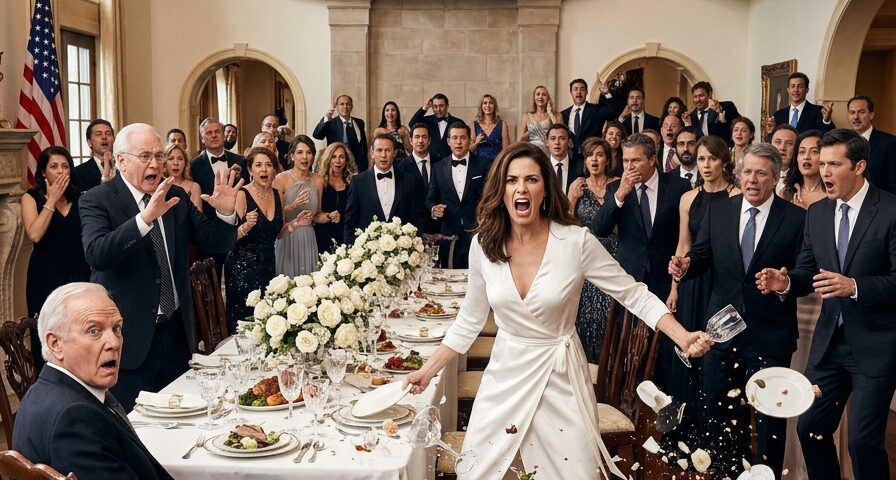
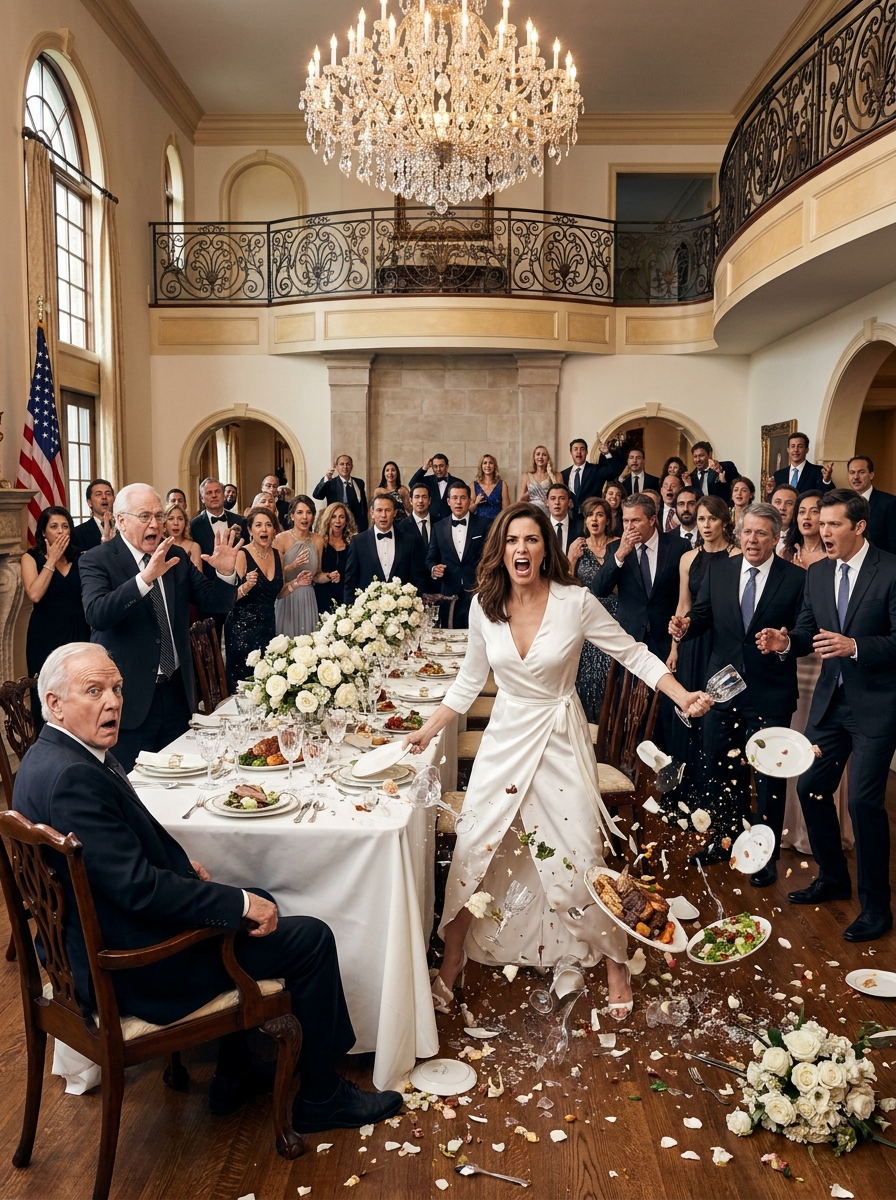
She pulled.
The banquet collapsed.
Crystal shattered. Plates exploded. Wine sprayed across Meredith’s ivory suit. The birthday cake hit the floor upside down. Guests screamed and jumped back. A waiter dropped a tray near the door.
Nora untied her apron and dropped it like a flag at Eleanor’s feet.
“Today,” she said, “I retire from being this family’s servant.”
And for the first time in eleven years, the Whitmores saw her standing at her full height.
Part 5
After Nora and Daniel left Montclair House, the Whitmore family did not recover.
Not emotionally.
Not socially.
Not financially.
The guests fled first, pretending to have urgent calls, sick children, early flights, anything that allowed them to escape the wreckage. The restaurant manager presented Preston with a bill that made his mouth fall open.
“This is outrageous,” Preston said.
The manager looked at the destroyed room. “Sir, the rug alone is custom Italian wool.”
Meredith wiped wine from her sleeve with a napkin, shaking with fury. “We will sue.”
The manager’s expression did not change. “You may speak with ownership.”
“Good,” Meredith snapped. “Who owns this restaurant group?”
The manager hesitated.
Then said, “Rosewater Hospitality.”
Meredith went still.
“What did you say?”
Before he could answer, Preston’s phone rang.
It was the bank.
His loan for a luxury private cardiac clinic in River North had been denied. No explanation beyond “revised risk exposure.” Preston shouted into the phone until the banker ended the call.
Minutes later, Meredith received an email from her firm. Her largest real estate client had requested immediate reassignment. She had been removed from the case.
That client controlled a development project connected to the same building she had tried to pressure Nora into leaving.
Meredith read the email three times.
Her hands began to tremble.
At Eleanor’s townhouse, panic replaced pride.
Eleanor lay on the sofa with a cold cloth across her forehead, moaning that Nora had cursed them. Preston paced like a trapped animal. Meredith sat at the dining table with her laptop open, searching public records.
Daniel arrived near midnight.
Alone.
Eleanor sat up. “Where is your wife?”
“My wife,” Daniel said, “is finally resting.”
Preston rounded on him. “Do you understand what she did? She humiliated this family.”
Daniel looked at the brother who had humiliated him for most of his adult life.
“No,” he said. “She revealed it.”
Eleanor gasped.
Daniel turned to Arthur, who sat silently near the window.
“Dad, are you coming with us?”
Eleanor laughed bitterly. “Arthur can’t even remember where he puts his glasses.”
Arthur stood.
The room changed.
He was still old. Still thin. Still wearing a plain cardigan. But the foggy, harmless expression slipped away.
“I know exactly where my glasses are,” Arthur said. “I also know where the deeds are, where the trusts are, which accounts Preston borrowed against without reading the terms, and which documents Meredith filed with misleading valuations.”
Meredith’s face drained.
Eleanor stared. “Arthur?”
He looked at his wife with a sadness older than anger.
“I gave this family too many chances.”
The next morning, Meredith went to the Cook County Recorder’s Office and pulled records for Nora’s market building. It belonged to Rosewater Holdings LLC.
She smirked in relief.
“Nora lied,” she told Eleanor. “It isn’t in her name.”
But she did not check the corporate filings deeply enough.
If she had, she would have seen that Rosewater Holdings was controlled by Nora Bennett.
By noon, every problem got worse.
Preston’s clinic lease was suddenly under review. The property owner had discovered conflicts in his financing documents. The medical board received an anonymous but well-documented complaint about patient-billing irregularities at his hospital group.
Meredith’s firm called her into a closed-door meeting. Her attempted pressure campaign against a small food vendor had been reported, complete with documents and recordings.
“This is professional misconduct territory,” her managing partner said.
Meredith tried to speak.
No sound came out.
Eleanor received a notice from a trustee regarding old debts tied to the Gold Coast townhouse. Arthur’s name was protected. Hers was not.
By evening, Eleanor, Preston, and Meredith received the same message.
Come to the penthouse of the Harrington Tower at 7 p.m. if you want answers.
No signature.
Only one name at the bottom.
Nora.
The Harrington Tower stood above the Chicago River, all black glass and sharp light. Eleanor had admired it for years, calling it the kind of building where “important people breathe different air.”
Now she entered shaking.
A security officer in a black suit greeted them.
“Mrs. Whitmore. Dr. Whitmore. Ms. Whitmore. The chairwoman is expecting you.”
“The what?” Preston snapped.
The officer did not answer.
They were escorted to a private elevator that rose without stopping. Forty floors. Fifty. Sixty.
When the doors opened, the penthouse office spread before them like another country.
Glass walls. Lake views. Walnut floors. Original art. A conference table long enough to seat a board of directors.
And behind the desk stood Nora.
Not in an apron.
Not in old market clothes.
She wore a tailored charcoal suit, her hair swept back, pearl earrings at her ears, her face calm and unreadable.
Eleanor made a small choking sound.
Meredith whispered, “No.”
Preston barked a laugh. “What is this? Some rented office? A costume?”
A side door opened.
Arthur walked out in a navy suit with a leather briefcase in his hand.
His back was straight.
His eyes were clear.
And for the first time in years, he looked like the man he had been before his family mistook kindness for weakness.
“Sit down,” Arthur said.
No one moved.
Nora pressed a button.
Two assistants entered and placed thick folders on the table.
Property deeds. Trust summaries. Corporate structures. Donation agreements. Medical evaluations. Loan documents. Lease agreements. Ethics complaints. Hotel contracts.
Meredith stared at the folders as if they were loaded weapons.
Arthur opened his briefcase.
“You wanted inheritance,” he said. “So let’s discuss inheritance.”
Part 6
Arthur’s voice did not rise.
That made it worse.
“I inherited land in California thirty years ago,” he began. “Your mother called it worthless dirt. Preston told me to sell it for whatever I could get. Meredith, when you joined this family, you advised Eleanor not to let me make financial decisions without supervision.”
Meredith swallowed.
Arthur placed a document on the table.
“That land became part of a major coastal development outside San Diego. I sold portions, leased portions, and placed the rest into trusts. The total value exceeded one hundred and twenty million dollars before Nora ever touched it.”
Eleanor gripped the chair in front of her.
“One hundred and twenty million?” she whispered.
Arthur ignored her.
“I hid it because I wanted to know who loved me when they thought I was ordinary.”
His eyes moved from Preston to Meredith to Eleanor.
“You all failed.”
Preston’s jaw clenched. “Dad, that’s unfair.”
Arthur looked at him. “You raised your hand to strike Nora in public.”
Preston looked away.
Arthur turned to Nora, and his expression softened.
“Nora did not ask for my money. She asked whether I had eaten lunch.”
Nora remained standing beside the desk.
Arthur continued. “She helped me reorganize the holdings. She saw value where my advisors saw risk. She protected small tenants while increasing revenue. She turned my fortune into something stronger. In return, I transferred control to her in stages, legally, while I was medically certified competent.”
Meredith found her voice.
“That can be challenged,” she said. “Children have inheritance rights. Depending on structure, undue influence—”
Nora opened a folder and slid it across the table.
“Five attorneys. Three medical evaluations. Two independent trustees. Full video records of every signing. You can challenge it, Meredith. You will lose loudly.”
Meredith read the first page.
Her confidence collapsed line by line.
Nora opened another file.
“This is the contract you brought to my market stall. Below-market offer. Coercive language. Misrepresentation of redevelopment risk. I also have audio of you implying city action if I refused.”
Meredith’s lips parted.
“If I send this to the Illinois Attorney Registration and Disciplinary Commission,” Nora said, “what happens to your career?”
Meredith sat down hard.
Preston stepped forward, sweat shining at his temples.
“Nora, please. Whatever happened at dinner, we’re family. My clinic loan—”
“Denied,” Nora said.
“Can you fix it?”
“I caused it.”
He stared.
“The building you wanted to lease is mine. The bank’s risk committee reconsidered after receiving accurate information about your pending complaints and unstable lease position.”
Preston’s face twisted. “You’re destroying me.”
“No,” Nora said. “I stopped protecting you from the consequences of being exactly who you are.”
Eleanor began to cry.
“Nora, I am your mother-in-law.”
Nora looked at her for a long moment.
“No. You are Daniel’s mother. You never treated me as a daughter.”
Eleanor pressed a hand to her chest. “I was strict. That is all. Families say things.”
“You insulted my dead parents.”
The words landed like a blade.
“They worked until their bodies broke,” Nora said. “They fed people who could not pay. They left me everything I needed to become what I am. You called them low-class because they wore aprons instead of pearls.”
Eleanor covered her mouth.
For once, she had no weapon ready.
Arthur removed one final envelope from his briefcase and placed it before Eleanor.
“What is that?” she asked.
“A divorce agreement.”
The room froze.
“Arthur,” Eleanor whispered, “at our age?”
“At our age,” Arthur said, “peace matters more than appearances.”
Eleanor turned to Preston. “Say something.”
Preston was staring at the documents about his clinic.
She turned to Meredith.
Meredith was staring at the possible end of her law career.
Arthur’s face hardened.
“You adored successful children and ignored decent ones. You turned my home into a courtroom where Nora was always guilty. I should have stopped you sooner. That failure is mine. But it ends tonight.”
Eleanor sank into a chair.
Nora pressed the intercom.
“Please escort our guests downstairs.”
Two security officers entered.
Preston exploded. “You can’t throw us out like criminals!”
Nora’s eyes did not move.
“You came here for answers. You have them.”
As they were led toward the elevator, Meredith stopped at the door and looked back.
“Nora,” she whispered, “what do you want?”
For the first time all night, Nora looked tired.
“I wanted you to see a person before you saw a title,” she said. “You couldn’t.”
The elevator doors closed on them.
Inside the penthouse, silence settled.
Daniel, who had stood near the window the entire time, turned to Nora with tears in his eyes.
“I failed you,” he said.
Nora walked to him.
“Yes,” she said softly. “Sometimes.”
He flinched, but she took his hand.
“But you came with me when it mattered. Now we decide whether we can rebuild from truth.”
Daniel bowed his head. “I will spend the rest of my life earning that chance.”
Arthur sat down heavily, suddenly looking eighty again.
Nora went to him.
He reached for her hand.
“My daughter,” he said. “Not by blood. By choice.”
Nora squeezed his fingers.
For the first time since the banquet table crashed, she cried.
Not because she had lost a family.
Because she had finally found the courage to leave the wrong one.
Part 7
Six months later, the old market building reopened as the Rosewater Culinary Institute.
Nora refused to let developers turn it into luxury condos.
Instead, she restored the brick walls, widened the aisles, upgraded the kitchens, and gave long-term vendors leases they could actually survive. The butcher who had once extended her credit got a new storefront. The baker next door received equipment grants. Retired cooks from across Chicago were hired to teach classes in soup, bread, preserving, butchery, and food budgeting.
Reporters called Nora “the apron chairwoman.”
She hated the nickname at first.
Then Arthur told her, “Let them say apron. They think it means service. You and I know it means strength.”
So Nora wore one at the opening ceremony.
Not the old gray apron.
A new one, deep blue, embroidered with two names inside the pocket.
Rose and Walter.
Daniel stood beside her, no longer hiding behind shame. He had left his old job and now managed operations for the institute, not because Nora handed him power, but because he earned trust day by day. He attended counseling. He apologized without excuses. He learned to say no to his mother without shaking.
Their marriage did not magically heal.
Real wounds never do.
But each morning, Daniel made coffee before Nora woke. Each evening, he asked what she needed and listened to the answer. Some nights they laughed again. Some nights they talked about the years they had lost to silence. Slowly, carefully, they built a home where love no longer had to whisper.
Arthur moved into the penthouse’s guest suite.
Nora refused every suggestion that he live in a private retirement facility.
“He spent years pretending to be alone,” she told Daniel. “He won’t actually be alone now.”
Arthur became the institute’s unofficial grandfather. He sat near the demonstration kitchen, tasting soups, telling young cooks that patience was an ingredient, and reminding business students that profit without dignity was just theft in a better suit.
Eleanor’s fall was quieter.
At first, she moved in with Preston.
That lasted three weeks.
His clinic deal collapsed, and investigations into billing misconduct suspended his hospital privileges. Without the admiration that had fed him, Preston became bitter. He blamed Meredith. Meredith blamed Eleanor. Eleanor blamed Nora until even she grew tired of hearing herself say the name.
Meredith resigned from her firm before disciplinary proceedings could become public. She found administrative work at a small legal office in Indiana, far from the Chicago rooms where she had once floated like royalty.
Preston sold his house.
He took consulting shifts where no one cared about the Whitmore name.
Eleanor eventually ended up in a modest assisted-living facility outside Joliet. It was clean, safe, and ordinary, which to her felt like punishment. Sometimes she watched television interviews with Nora and wept into tissues, muttering that she had thrown away the luck of her own house.
One cold afternoon, Eleanor appeared outside the Rosewater Culinary Institute.
She looked smaller than Nora remembered.
Her coat was buttoned wrong. Her hair, once perfectly styled, had gone thin and gray beneath a wool hat. She stood across the street for nearly twenty minutes before Daniel saw her.
He went outside alone.
Nora watched through the glass.
Eleanor reached for him, but Daniel gently stepped back.
“Mother,” he said.
“I need to speak to Nora.”
Daniel’s face was calm. Sad, but calm.
“No.”
“She turned you against me.”
“No,” Daniel said. “She helped me see what I allowed.”
Eleanor began to cry. “I have nowhere else.”
Daniel closed his eyes for a second.
Then he handed her an envelope.
Inside was information for safe housing support, meal assistance, and a prepaid account for basic needs. Not luxury. Not surrender. Mercy with boundaries.
“This is the last financial help I will give you,” Daniel said. “Use it wisely.”
“I’m your mother.”
“Yes,” Daniel replied. “And I am finally becoming the kind of man who does not confuse duty with obedience.”
Eleanor looked past him through the window.
Nora stood inside, wearing her apron, surrounded by students, vendors, steam, laughter, and warm light.
For a moment, Eleanor seemed to understand exactly what she had lost.
Then she turned and walked away.
A year later, Nora published a memoir titled The Apron Was My Medal. It became a national bestseller, not because it was a revenge story, though many readers loved that part, but because it spoke to every person who had ever been underestimated while doing the work no one respected.
On the final page, Nora wrote:
The lowest place did not make me low. It made me strong. Every dish I washed, every insult I survived, every morning I rose before dawn taught me the weight of my own hands. When I finally stood up, I was not becoming someone new. I was remembering who I had been all along.
On Arthur’s eighty-first birthday, there was no Michelin restaurant.
No gold place cards.
No imported wine selected to impress strangers.
There was a long wooden table inside the institute after closing time. Vendors, students, Daniel, Arthur, and Nora sat together under soft lights while snow tapped gently against the windows.
Nora served seafood soup.
Arthur took the first spoonful.
His eyes closed.
“Perfect,” he whispered.
Daniel lifted his glass.
“To Dad,” he said. “And to the woman who taught this family what worth really means.”
Nora looked around the table.
There were no people there who required her humiliation as proof of their importance. No one mocked the market. No one sneered at cracked hands. No one called service shameful while depending on it.
Arthur reached over and touched the embroidered names on Nora’s apron.
“Rose and Walter would be proud,” he said.
Nora smiled.
For years, she had imagined victory as a loud thing. A slammed door. A ruined dinner. A room full of enemies finally afraid.
But victory, she learned, was quieter.
It was soup served hot.
A husband learning courage.
An old man safe at the table.
A market alive with work and dignity.
A dead mother and father honored not with statues, but with recipes, jobs, and second chances for people the world ignored.
That evening, after everyone left, Nora stood by the window overlooking the glowing city of Chicago. Daniel came to her left. Arthur came to her right.
For a while, nobody spoke.
Below them, the market lights shone warmly through the snow.
Nora thought of the gray apron lying at Eleanor’s feet in that ruined dining room. She thought of the woman she had been when she dropped it.
Then she touched the new apron at her waist.
This one was not armor.
It was not a chain.
It was a medal.
Nora Bennett had not escaped the kitchen.
She had turned it into an empire.
THE END