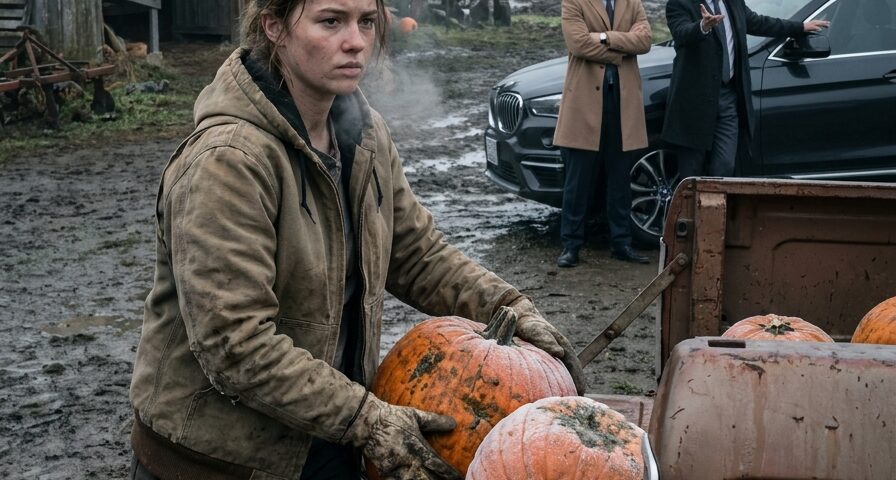
They Laughed When I Bought 600 Moldy Pumpkins for My Father’s Pigs—Then the Winter Ledger Exposed the Farm They Tried to Steal
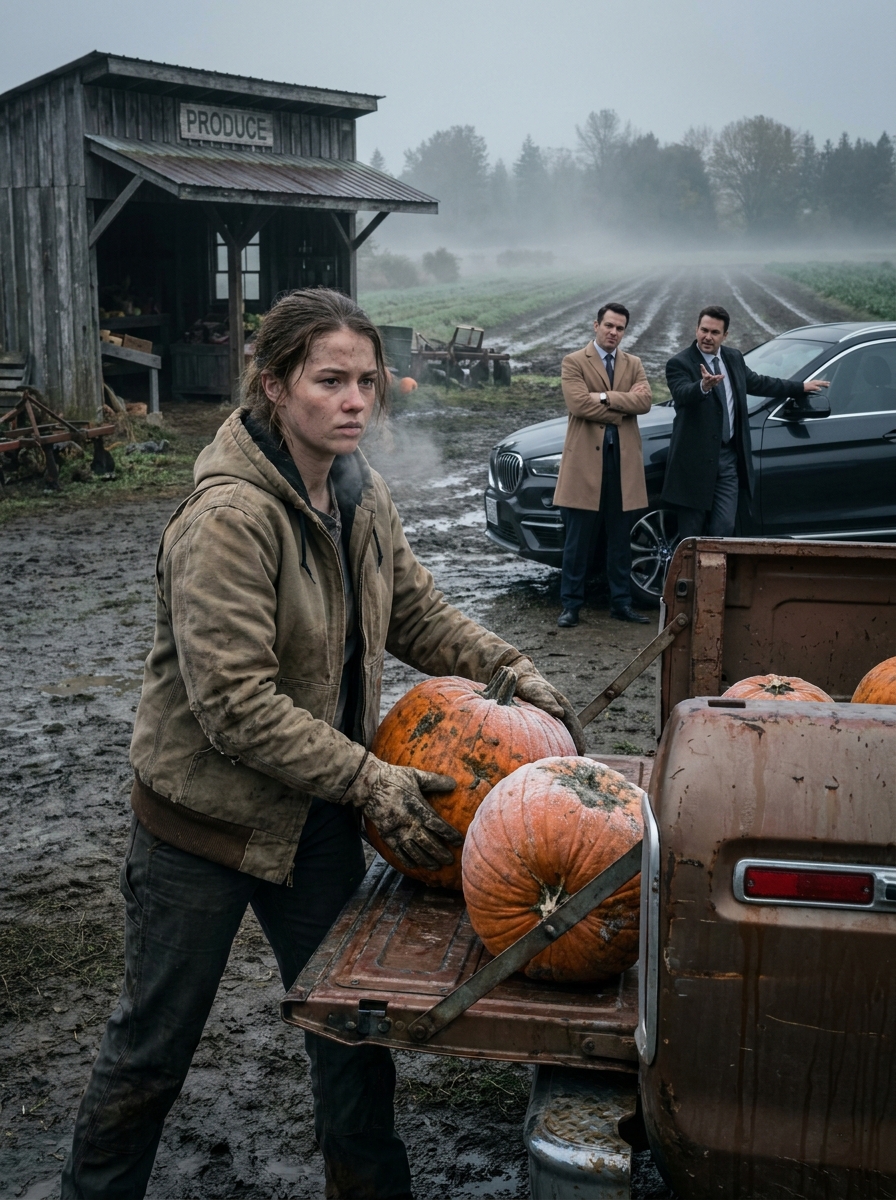
Part 1
The first pumpkin split open against the tailgate with a wet sound that made two men at the farm market laugh like boys behind a schoolhouse.
I remember that sound better than the laugh.
It was the last Friday of October, cold enough that the mud in the Route 12 market lot had stiffened overnight, but not cold enough to keep the smell down. Six hundred pumpkins sat behind Walt Becker’s produce shed in sagging orange rows, some cracked by frost, some caved in around the stems, some wearing gray-green patches of mold like bruises that had learned to bloom.
A loader tractor idled near the dumpster. Walt had one hand tucked in his coat pocket and the other holding a clipboard he no longer needed. Halloween was over for him. The families had already taken their photographs, the church had already hosted its trunk-or-treat, and every pumpkin left in that back lot was now a hauling bill.
I stood beside my father’s old flatbed, staring at the pile.
Walt looked at me the way men in Hartwell County had looked at me since I came home, like I was a girl playing at a job that had already beaten better men.
“You need one for your porch, Nora?” he asked.
“I need the lot.”
He blinked. “The lot?”
“All of them.”
Behind me, one of the men laughed again. I didn’t have to turn around to know it was Reed Voss. His family owned the grain elevator, half the rental ground west of town, and a white farmhouse so big people used it for directions. His father had sat on the county board for twenty-two years. Reed had inherited the kind of confidence that never had to earn its boots dirty.
My brother Carter stood beside him in a clean canvas jacket, arms folded, watching me like I was embarrassing him personally.
“Nora,” Carter called, “tell me you’re not about to buy rotten pumpkins with the bank breathing down your neck.”
I kept my eyes on Walt. “What were you paying to haul them off?”
Walt shifted his weight. “Seventy-five dollars.”
“I’ll give you seventy-five. You don’t call the hauler.”
He stared past me at the pumpkins, then at my truck. “They’re heavy. Some are bad through.”
“I’ll sort them.”
Reed gave a low whistle. “Sort garbage. There’s a college education at work.”
That one was meant to land.
I had gone to college for exactly three semesters before Mama got sick and Dad needed help with the hogs. Folks in Hartwell had a way of remembering your leaving and your failing better than the years you stayed to do what had to be done.
Carter stepped closer. “You don’t have time for this. The bank meeting is Monday. You need to be cleaning up the place, not dragging home a disease pile.”
“It’s not your farm,” I said.
His mouth tightened. “It was Dad’s farm.”
“And he left it to me.”
“He left you a mess.”
That got quiet.
Even Reed stopped smiling for half a second, though not out of kindness. Everybody in town knew Mason Bell had died in August with one field full of Johnson grass, a hog barn needing roof tin, and a feed account that made the banker sigh before he spoke. Everybody knew he had left Bellweather Farm to his only daughter instead of his son. What they did not know, or pretended not to know, was that Carter had not shoveled manure in that barn since he was seventeen and decided the land was beneath him until a developer wanted it.
Walt cleared his throat. “If you want them, Nora, they’re yours. But I want them gone today.”
“I’ll make two trips.”
“You’ll need three.”
“I’ll make three.”
I started loading.
The first pumpkin was firm on one side and soft on the other. The second left orange pulp across my glove. The third was good but cracked clean down the ribs. I set them into separate places on the truck bed without thinking too hard about it: usable feed near the cab, seed candidates by the left rail, compost against the tailgate. Dad had sorted everything. Nails, twine, boards, medicine bottles, debts, weather, people. Especially people.
He used to say waste was just work nobody had assigned yet.
At twenty-six, I had rolled my eyes at him. At thirty-four, with his farm in my name and half the town waiting for me to fail, I understood him better.
Carter stood there for ten minutes, then lost patience.
“You can’t save a hog operation with Halloween trash,” he said.
“No,” I said, lifting another pumpkin. “But I can save some grain.”
Reed chuckled. “You hear that, Carter? She’s going to beat a six-year feed high with pumpkin pie.”
I did not answer.
My right shoulder was burning by the time the first load sat high enough to make the springs groan. Walt took my seventy-five dollars like he felt half guilty and half relieved. Carter had already left. Reed remained, leaning against his pickup with his phone in his hand.
“Smile, Nora,” he said. “This might be useful at the auction.”
That made me turn.
“What auction?”
His face changed so quickly most people might have missed it.
“The one Carter says is coming if you don’t make arrangements.”
“Carter talks too much.”
Reed slipped the phone into his pocket. “Bankers don’t like sentiment. Neither do buyers. You might think on that before you waste winter feeding pigs things that should be buried.”
I climbed into the truck. “I’ll bury what needs burying.”
On the drive home, the flatbed pulled hard on the hills. The pumpkins shifted and thumped behind me. The road to Bellweather Farm ran between harvested soybean fields and leafless fence rows, then dipped toward our place where the hog barn sat low against the wind and the old white farmhouse leaned into a stand of black walnut trees.
I had been back three months.
Three months since Dad’s funeral.
Three months since Carter stood in the kitchen after the funeral sandwiches were cleared and said, “The sensible thing is to sell before the place eats you alive.”
Three months since I found the bank notices in Dad’s rolltop desk, tied in twine beside his ledgers, all of them marked in his blocky handwriting.
Three months since I opened the last ledger and found a page that made no sense.
NORTH LINE. CHECK OLD DEED. REED KNOWS.
Under it, written smaller:
DON’T SIGN ANYTHING UNTIL JUNE HASKELL SEES IT.
June Haskell was the retired county clerk. She had worked in the courthouse for forty-one years and knew more family secrets than the cemetery. But she had broken her hip the week after Dad died and was staying with her daughter two counties over. I had called once. Her daughter said June was sleeping. I had not called again because the roof leaked, the pigs needed worming, the bank wanted numbers, and grief was a hand around my throat every morning before coffee.
By the time I backed the first load up to the barn, the sun was already low.
The pigs were restless, forty-three of them nosing the gates and grumbling over the late feed. Dad had kept a small breeding line and bought feeder pigs each spring. Nothing fancy. Nothing that impressed men like Reed Voss. But he knew hogs. He knew which sow would turn mean before farrowing and which runt deserved another week before judgment. He had built that herd one careful choice at a time.
I turned on the barn lights and started unloading.
Not into a pile. Piles make lies. Piles let good rot with bad.
I marked three sections with baling twine. Feed. Seed. Compost.
The best pumpkins, meaning the ones with firm walls and mostly clean stems, went near the workbench. Those would be cut for seed before they softened. The cracked ones with solid flesh went closest to the hog pens. The collapsed ones and the deep-molded ones went by the compost bay door.
I worked until my shirt stuck to my back and the cold bit through it. Then I drove back to Walt’s for the second load.
When I pulled in, Carter was there again.
This time, he had brought my sister-in-law, Melissa, who stayed inside their SUV with the heat running and looked at the pumpkins like poverty was contagious.
Carter stepped in front of my truck before I could back up.
“Reed told me you gave Walt money for this mess.”
“I did.”
“Are you trying to make us look stupid?”
“You don’t need me for that.”
His eyes hardened. My brother had Dad’s blue eyes and none of his patience. “The bank has a lien. If you damage the livestock, they can force liquidation.”
“I’m not damaging anything.”
“You don’t know what you’re doing.”
“I know moldy feed doesn’t go to animals. I know solid pumpkin flesh can supplement grain. I know you haven’t read a hog ration chart in your life.”
His cheeks colored. “I know there’s an offer on the table.”
That was the first time he had said it plainly.
Reed had been circling Bellweather since before Dad died. He called it concern. He said eighty acres was too much for a single woman with bad credit and old equipment. He said his family could fold the land into their operation and keep Dad’s name “respected.” He said it softly, always with witnesses.
“What offer?” I asked.
Carter glanced toward Melissa. “A fair one.”
“From Reed?”
“From Voss Agricultural Holdings.”
I laughed once, not because it was funny. “He named his greed so it would fit on a check?”
“He can clear the debt.”
“And take the farm.”
“The farm is already taking itself.”
The loader tractor sat silent behind us. Walt pretended to study his clipboard.
Carter lowered his voice. “Dad was sick. He made emotional choices. You know he did. Leaving the farm to you was one of them.”
Something in me went very still.
“Dad knew exactly what he was doing.”
“Then why didn’t he tell you about the second note?”
I stared at him.
Carter’s mouth twitched, and I knew he regretted saying it.
“What second note?”
He stepped back. “Ask the bank.”
“Carter.”
But he was already walking away.
That night, after three trips and six hundred pumpkins, I stood in the barn with my gloves ruined and my arms shaking. The pumpkins lay sorted in their sections under yellow light. The pigs had settled. Rain ticked against the tin roof in a soft, nervous rhythm.
I went into the house, washed my hands, and opened Dad’s ledgers on the kitchen table.
Feed purchases. Pig weights. Breeding dates. Vet visits. Repair costs. Seed invoices from years before he stopped planting much besides hay. Notes about the east clay strip by the north fence, the place that had never grown right.
And then, in the back of the 2019 ledger, I found a receipt folded so small it had nearly become part of the binding.
HASKELL COUNTY RECORDS OFFICE
COPY REQUEST: ORIGINAL BELL DEED, 1964
PAID: MASON BELL
CLERK: J.H.
On the back, Dad had written:
The fence is wrong.
I sat in that kitchen with pumpkin pulp under my fingernails and my dead father’s warning in my hand.
Outside, in the barn, forty-three pigs slept through the rain.
By Monday morning, half the town had heard I bought six hundred rotten pumpkins.
By Monday afternoon, the banker had heard too.
Mr. Ellison sat across from me in his office under a framed print of a red barn that had never housed an animal in its life. He was not a cruel man, but he was a banker, which meant his sympathy had margins.
“Nora,” he said, folding his hands, “I need to know you have a realistic winter plan.”
“I do.”
He glanced at the papers I had brought. “This shows a projected grain reduction.”
“Thirty-five to forty percent, with supplements maintained. Pumpkins introduced gradually. Nothing spoiled fed. Anything questionable composted.”
His eyebrows moved. “You’ve researched this?”
“My father did. I’m continuing it.”
He leaned back. “Your brother expressed concern.”
“I’m sure he did.”
“He also mentioned a private offer that would satisfy the debt and leave you with some equity.”
“From Reed Voss.”
Mr. Ellison did not answer quickly enough.
I felt heat crawl up my neck. “Is there a second note?”
He removed his glasses and cleaned them with a cloth. “There is an equipment note your father co-signed against the property last spring.”
“For what equipment?”
“A used grinder mixer.”
“We don’t have a new grinder mixer.”
His silence told me more than words would have.
“Who has it?” I asked.
“The invoice lists Bellweather Farm as purchaser.”
“That’s not what I asked.”
Mr. Ellison looked tired. “The bank has documents. That is all I can speak to without making allegations.”
“Carter.”
He did not confirm it.
He did not have to.
I drove home with a copy of the equipment note on the passenger seat and a sick feeling deeper than anger. Carter had borrowed against Dad’s land while Dad was sick. Whether Dad understood or not, I did not know. Whether Carter planned to repay it before anybody noticed, I did not know. But I knew why he wanted a quick sale.
The farm was not just drowning.
Someone had been holding its head under.
That evening, I split the first pumpkin for the pigs. The flesh inside was bright and clean, sweet-smelling in the cold air. I cut it into wedges and set them in the trough with a reduced grain ration. The pigs hesitated only long enough to sniff. Then they crowded in, chewing with loud, pleased determination.
I watched them for half an hour.
No miracle happened.
No trumpet sounded.
Just animals eating what the town had called trash.
That was enough.
Part 2
By the second week of November, the laughter had reached the feed store.
I heard it when I walked into Kline’s Feed & Supply for mineral mix and salt blocks. Three men stood near the coffee pot, and one of them said, “Ask Nora. She’s got hogs eating jack-o’-lanterns now.”
The others chuckled.
Dennis Kline, who owned the place, did not laugh. He had known Dad since they were boys and had the permanently stooped posture of a man who had carried feed sacks before forklifts did the lifting.
He rang up my supplements without comment, then nodded toward my notebook. “Keeping records?”
“Every pound.”
“Good.”
One of the men at the coffee pot turned. It was Gerald Price, a cattleman with a weathered face and no patience for foolishness. “They holding weight?”
“So far.”
“How much grain you cutting?”
“Started at twenty percent. Moving toward forty if they keep condition.”
He stopped smiling. Farmers respect numbers before they respect people. “Forty?”
“With pumpkins, minerals, hay bedding access, and protein balanced. It’s not slop. It’s a ration.”
Gerald looked at Dennis. Dennis shrugged. “Pumpkin’s feed if you know what you’re doing.”
That sentence traveled farther than the laughter had.
At home, the work became a rhythm.
Mornings, I split feed pumpkins on Dad’s old chopping block. The hatchet handle fit my palm where his hand had worn it smooth. I checked each pumpkin before it went near the hogs. Clean flesh, no sour smell, no deep mold. The bad ones were carried to compost.
The seed pumpkins I processed in the mudroom. I scooped pulp into a basin, washed seeds in the old enamel sink, and spread them across wire racks Dad had used for drying onions. I labeled paper envelopes with dates and notes: thick rind, deep orange flesh, held firm after frost. I did not know varieties. I knew survival.
The compost pile steamed by Thanksgiving.
I built it in layers: pumpkin waste, straw bedding, manure, leaves from the walnut grove, more pumpkin, more straw. I turned it every four days until my shoulders ached. I kept a thermometer stuck deep in the middle and wrote down the heat like it was a heartbeat.
One hundred thirty-two degrees.
One hundred forty-one.
One hundred thirty-eight after turning.
The east clay strip waited beyond the north fence, ugly and stubborn. Dad had cursed that ground for twenty years. In spring it swallowed boots. In summer it cracked open like old pottery. Nothing grew there but dockweed and spite. Yet it lay along the line where Dad had written: The fence is wrong.
I called June Haskell again the first Sunday of December.
This time, she answered.
“Nora Bell,” she said, her voice thin but sharp. “Took you long enough.”
I closed my eyes. “You knew I’d call?”
“Your father said you would when you stopped trying to do everything alone.”
That almost broke me.
I sat at the kitchen table, one hand over my mouth, while rain scratched at the windows.
June gave me instructions. Not comfort. Instructions were better.
“Go to the courthouse records room. Ask for Book 42, page 318. Then ask for the 1987 survey filed under Clifton Voss, not Mason Bell.”
“Clifton Voss?”
“Reed’s grandfather.”
“What am I looking for?”
“A creek line that disappeared.”
“June.”
She sighed. “Your father found it two months before he died. He was going to file a boundary correction, but he got worse. He asked me to pull copies. I did. Then somebody came asking questions.”
“Who?”
“I’m old, not stupid. You know who.”
Reed.
The next morning, I drove to the courthouse in a hard frost. The records room smelled like dust, toner, and the stale perfume of old paper. The young clerk at the desk looked uncertain until I said June Haskell had sent me. Then she gave me a look people reserve for church ladies and loaded guns.
Book 42, page 318 held the original Bell deed from 1964, when my grandfather bought the farm. The northern boundary did not stop at the current fence. It ran to a seasonal creek beyond the clay strip, then west along a stone line that no one had mentioned in my lifetime.
The 1987 Voss survey showed the creek as theirs.
Not because the deed said so.
Because a fence did.
A fence can lie if enough people benefit from believing it.
I paid for copies and carried them to my truck with hands that would not stop shaking.
The land in question was not huge. Eleven acres, maybe twelve depending on how the creek wandered. But it included the old farm lane Reed needed for his planned expansion, the low water access he had been pretending was his, and the strip Dad had wanted to heal.
I understood then why Reed kept calling Bellweather worthless while trying so hard to buy it.
I also understood something uglier.
Carter had known there was value. Maybe not all of it, but enough.
When I confronted him, he did not deny the grinder mixer.
He came to the farm in dress shoes that sank in the barnyard mud, holding his phone like it was proof he had somewhere better to be.
“I was going to pay it back,” he said.
“With what?”
“The sale.”
“There is no sale.”
“There has to be.” His voice cracked around the edge. “Melissa and I put money into a house based on that land paying out. Dad promised me he’d make it right.”
“Dad promised you Bellweather?”
“He said I’d get my share.”
“You got your share when he paid your failed dealership debt in 2018.”
Carter’s face went pale.
I knew because I had found that ledger too.
Dad had never told me. He had just written it down in the same careful hand he used for pig weights and fence staples. Carter loan. No interest. Family. Do not mention.
“I was his son,” Carter said.
“And I was what?”
He looked toward the barn. The pigs were grunting inside, warm and alive. “You were the one who stayed. That doesn’t make you better.”
“No. It made me present.”
He flinched.
I held up the equipment note. “Did Dad know he signed this?”
Carter looked away.
That was the answer.
“He was on pain medicine,” I said. “He was dying.”
“I needed help.”
“You used him.”
“I was going to fix it.”
“No,” I said. “You were going to sell the farm and bury it.”
His mouth twisted. “And what are you going to do? March into court with old paper and pumpkin seeds? Reed has lawyers. The bank has deadlines. You have pigs eating decorations.”
The insult should have hurt.
Instead, it steadied me.
“I have records.”
He laughed bitterly. “Records don’t pay notes.”
“Sometimes they prove who made them.”
Carter left angry. I let him. There was work to do.
Winter came down hard after Christmas.
The first real cold hit on January 6, when the thermometer outside the kitchen window read nine degrees at dawn and the water line to the far pen threatened to freeze. I had wrapped the exposed pipe in November, cursing Dad for leaving so much undone and then crying because he was not there to argue with me. The insulation held.
The pigs held too.
I checked them twice a day, running my hand over their backs the way Dad taught me. Spine covered. Ribs felt but not sharp. Eyes clear. Manure normal. Appetite strong. I wrote it all down.
Pumpkin stock: 58 percent remaining.
Grain reduction: average 37 percent.
Deaths: zero.
Illness: zero.
Weight trend: steady gain.
The compost pile kept heat even when snow crusted the barnyard. It was not pretty. It was not dramatic. But it was alive in the center, breaking down what no one wanted and turning it into something the clay strip needed.
Then Reed filed a complaint.
The county livestock officer arrived with a young deputy and a clipboard. His name was Tom Alvarez, and I knew him from school though we had not spoken in years. He stepped out of his truck looking apologetic.
“Nora,” he said, “I have to inspect.”
“I figured.”
The complaint alleged neglect, spoiled feed, unsanitary conditions, and possible disease risk to neighboring livestock. It was written in careful language by someone who had either paid a lawyer or sat beside one at dinner.
I walked Tom through every section.
Feed pumpkins split and checked.
Spoiled pumpkins separated for compost.
Compost contained and managed.
Feed ration chart.
Mineral supplements.
Water access.
Bedding.
Pig condition.
He spent two hours in the barn. The deputy took photographs. I showed them the notebook. Tom read more of it than I expected, his brow slowly rising.
“You’ve been tracking compost temperature?”
“Yes.”
“Pumpkin percentage?”
“Yes.”
“Condition scores?”
“Yes.”
He looked at the pigs, who were nosing around his boots with cheerful disrespect. “They look good.”
“They are good.”
The deputy scratched one behind the ear and got mud on his sleeve.
Tom closed his clipboard. “I’ll file it unfounded.”
“Can I get a copy?”
“You’ll have it by Friday.”
He paused at the barn door and looked toward the north fence. Snow lay thin over the east strip, making the bad ground look almost clean.
“My uncle used to lease from Reed’s grandfather,” he said. “He always said that fence was moved after the ’86 flood.”
My heart kicked. “Did he say from where?”
Tom shrugged. “No. But he said your grandfather raised hell about it until he got sick. Then folks stopped talking.”
Small towns do not forget.
They store truth like tools in a shed nobody opens until the handle is needed.
By February, the first batch of compost finished. Dark, crumbly, smelling like earth instead of rot. I spread it across the frozen east strip in wheelbarrow loads until my legs shook. When the ground thawed, I moved the hogs through in short rotations, letting them root and mix without destroying. The clay changed by inches, not by magic. But inches matter when a farm is being measured for a grave.
The bank deadline was March 15.
On March 2, Mr. Ellison called me in.
Reed Voss was sitting in the office when I arrived.
So was Carter.
Reed wore a charcoal coat and polished boots. Carter would not meet my eyes.
Mr. Ellison looked worse than he had in November. “Nora, Mr. Voss has presented a purchase offer that would satisfy both notes.”
“I didn’t ask for one.”
“No, but given the farm’s financial position—”
“The farm’s position has changed.”
Reed smiled gently. “Has it?”
I placed my folder on the desk.
Feed reduction reports. Vet inspection. Livestock officer findings. Compost records. Weight records. Grain invoices showing savings. Seed inventory. A spring planting plan for the east strip. Copies of the original deed and the Voss survey.
Reed’s eyes went to the deed.
There it was.
Not fear. Recognition.
Mr. Ellison noticed too.
I said, “Before we discuss any sale, we need to discuss why Mr. Voss is offering money for land he has publicly called worthless.”
Reed leaned back. “Old boundary disputes are common.”
“So are wrong fences.”
His smile thinned. “You should be careful. Accusing people of stealing land is serious.”
“I agree.”
I slid Tom Alvarez’s inspection report across the desk first. “The complaint was unfounded.”
“I’m glad your animals are healthy,” Reed said.
“No, you’re not.”
Mr. Ellison cleared his throat. “Nora.”
I turned to Carter. “Did you know about the deed?”
Carter’s jaw worked. “Reed said there might be a boundary issue.”
“When?”
He said nothing.
“When, Carter?”
“Last summer.”
Dad had still been alive last summer.
Still in pain. Still trusting his son to come by and mow once in a while. Still writing notes in ledgers with hands that shook.
I felt something in me go cold and clean.
Reed stood. “This has become emotional. My offer expires today.”
“Good.”
He looked at me as if I had slapped him.
I turned to Mr. Ellison. “I’m making the March payment.”
“With what?” Carter snapped.
I pulled a cashier’s check from the folder.
The amount did not cover everything. Not even close. But it covered enough to stop acceleration. It came from reduced feed costs, two feeder pigs sold early at a decent price, a small emergency account Dad had kept hidden in a coffee can above the pantry, and every unnecessary thing I owned.
Mr. Ellison took the check.
Reed’s face went still.
“I’ll also be filing a formal boundary review,” I said. “And disputing the equipment note based on capacity and use. The grinder mixer is not on my property. It never was.”
Carter whispered, “Nora.”
“No,” I said. “You don’t get to use my name now.”
For a second, I saw my brother at eight years old, running barefoot across the yard with a jar of lightning bugs. Then I saw him at thirty-seven, willing to sell our father’s land to cover a debt he had placed on a dying man’s signature.
Both were true.
That was the worst part.
Part 3
The county land meeting took place on a Thursday evening in April, after a day of rain that left the courthouse steps slick and the farmers irritable.
I arrived in jeans, boots, and Dad’s old brown jacket. Carter came in a suit. Reed came with his lawyer. Mr. Ellison sat near the back. So did Dennis Kline, Gerald Price, Tom Alvarez, and Walt Becker from the farm market, who had no reason to be there except curiosity and maybe conscience.
June Haskell came in last, leaning on a walker.
The room changed when she entered.
Some people have authority because of office. June had authority because she remembered where bodies were buried and who had borrowed the shovel.
The board chairman, a tired man named Everett Sloan, called the meeting to order. Reed’s lawyer spoke first. He used phrases like historical use, accepted boundary, good-faith reliance, and agricultural continuity. He said the Voss family had maintained the disputed acreage for decades.
June made a sound from the front row that might have been a cough and might have been disgust.
Then it was my turn.
I did not give a speech. I had planned one in my head while splitting pumpkins, while turning compost, while checking pigs in January cold. But standing there with Dad’s copies in my hands, I understood that the truth did not need decorating.
I placed the original deed copy on the table.
“This is my grandfather’s deed from 1964. It describes the northern boundary as running to the seasonal creek and along the stone line.”
I placed the 1987 Voss survey beside it.
“This survey treats the fence as the boundary but does not explain the deed conflict.”
I placed an old aerial photograph June had brought me, dated 1985, showing the fence line before the flood.
“This image shows the fence in its earlier position.”
Reed’s lawyer objected to the word earlier.
June stood with effort. “I stamped that photo into the drainage file myself.”
Nobody interrupted her.
She looked at the board. “After the ’86 flood, Clifton Voss rebuilt a section of fence. Walter Bell complained it had been moved south. He filed a handwritten note. It was never processed because the county surveyor at the time was Clifton’s nephew.”
The room murmured.
Reed leaned toward his lawyer, face tight.
June continued. “Mason Bell requested those records last June. He said Reed Voss had approached him about buying Bellweather and he wanted to know why a man called the farm worthless but kept asking about the north line.”
Reed said, “That is hearsay.”
June looked at him over her glasses. “Then call me a liar plain.”
He did not.
I placed Dad’s ledger page on the table last.
NORTH LINE. CHECK OLD DEED. REED KNOWS.
My hand trembled only after I let go.
Everett Sloan read the page slowly. “This is Mason’s writing.”
“Yes.”
“What are you requesting?”
“A boundary review, a temporary injunction on any sale or transfer involving Bellweather tied to this disputed land, and a county survey using the deed description, not the current fence.”
Reed stood. “This is a desperate attempt to delay foreclosure.”
I turned to him. “No. This is me asking why you tried to buy my farm before I found the creek.”
For once, he had no smooth answer ready.
So Carter provided one.
“She can’t run it,” he said, standing abruptly. “That’s what this is about. Everybody knows it. Dad knew it too. He was scared she’d bury herself out there trying to prove she was him.”
The room went quiet in the way rooms do when family shame spills into public air.
I looked at my brother, and for the first time since Dad died, I did not want to beat him. I wanted him to hear me.
“I’m not trying to be Dad.”
His mouth opened, then closed.
“I’m trying to keep what he left because he knew I would work it. Not sell it. Not borrow against it. Not hand it to Reed because Reed smiled and promised you a clean ending.”
Carter’s face crumpled around anger. “You think you’re so righteous.”
“No,” I said. “I think I stayed.”
That was all.
June sat down. Dennis Kline stared at the floor. Walt Becker rubbed a hand over his jaw.
Everett Sloan called for order and scheduled the county survey.
Reed left before the meeting ended.
Carter stayed in his seat like a man who had missed the last bus home.
The survey took three weeks.
During those three weeks, spring came to Bellweather in small, stubborn ways. The east strip softened. The compost darkened the topsoil. The pigs, fat and content, worked their assigned patches with snouts down and tails flicking. I planted the dried pumpkin seeds in rows along the improved ground and underseeded clover between them.
I did not know if they would come up.
That was farming. You could do everything right and still wait like a fool with hope in your hands.
On the seventeenth day, green broke through.
Not everywhere. Not evenly. But enough.
I knelt in the field and touched one seedling with one finger.
Dad had always said a farm forgives slowly. He never said it refuses.
The county survey confirmed the deed.
The legal fight did not end that day, but Reed’s certainty did. His family had been using eleven acres that did not belong to them, including the creek access and the old lane. The board ordered the fence line reviewed and temporarily barred any development or sale tied to the disputed boundary.
Mr. Ellison called me after the ruling.
“The bank is willing to restructure,” he said.
I leaned against the kitchen counter because my knees had gone weak. “Because of the land?”
“Because of the land, the livestock report, your payment, and your operating records. You demonstrated viability.”
Viability.
It was an ugly banker word.
It sounded beautiful anyway.
The equipment note took longer. Carter eventually admitted the grinder mixer had gone to a custom-feed side business he tried to start with Reed’s cousin. Dad’s signature had been obtained when he was sick enough that a decent son would have brought him soup, not loan papers. The bank did not erase the problem overnight, but they removed Bellweather from immediate liability while the matter went into legal review.
Carter came to see me in June.
He parked by the walnut trees and walked to the barn without Melissa. He looked thinner. Older. For the first time in years, he wore work boots.
I was repairing a gate latch.
“I didn’t think it would go that far,” he said.
I kept working. “Which part?”
He swallowed. “Any of it.”
“That’s not an apology.”
“I know.”
The latch screw was stripped. I replaced it from the coffee can of odd hardware Dad kept near the door.
Carter watched. “Dad always said you had his hands.”
That almost made me throw the screwdriver.
Instead, I said, “Don’t use him to soften me.”
He nodded once, ashamed enough to be quiet.
“I was mad,” he said after a while. “When he left it to you. I told myself I deserved half because I was his son. But I didn’t want half the work. Just half the rescue.”
That was the truest thing he had said.
I looked at him then. “Why did you help Reed?”
“He said the boundary thing might make the place worth more. Said if we sold quick, nobody had to dig through old records. I thought…” He rubbed his face. “I thought if you found out, you’d fight, and if you fought, everything would get exposed.”
“The equipment note.”
“And the money Dad gave me before.”
I nodded.
He looked toward the hog barn. The pigs were sleeping in the shade, bellies round, ears twitching at flies.
“They really made it through on those pumpkins.”
“They made it through because I sorted them, balanced the ration, kept records, and got lucky with weather.”
He almost smiled. “You sound like Dad.”
This time, it did not hurt as much.
“I am not dropping the dispute,” I said.
“I know.”
“I’m not selling.”
“I know that too.”
“What do you want, Carter?”
He looked past me to the east strip, where pumpkin vines had begun to run between clover blooms. “To say I’m sorry without asking you to fix what it costs me.”
I let that stand.
Forgiveness, like soil, is not repaired by one application of the right material. It takes seasons. Some ground never comes all the way back. Some comes back different.
By July, the east strip was green enough that people slowed on the road.
The pumpkins spread their leaves over clay that had once baked bare by midsummer. Clover held the spaces between vines. Bees worked the blossoms. The soil was still heavy, still imperfect, still Bellweather stubborn, but when I pushed the probe in, it went deeper than it had in October.
Gerald Price stopped one morning and leaned on the fence.
“Those from Walt’s rotten pumpkins?”
“Seeds from the best of them.”
He spat into the grass, considering. “I got a low patch by the south pasture. Never could get it right.”
“Needs organic matter?”
“Needs divine intervention.”
“Start with compost. It’s more reliable.”
He laughed, but he listened.
Then Walt came by in August.
He stood at the edge of the east strip, hat in his hands, staring at the vines as if they were a magic trick he had accidentally sold for seventy-five dollars.
“I threw those away for years,” he said.
“You didn’t need them.”
He looked at me. “You did.”
“I needed something cheap enough to fail with.”
That made him smile sadly. “You want first call this fall?”
“Yes.”
“What all can you use?”
“Pumpkins. Winter squash. Soft apples if they’re clean enough. Corn stalk bundles. Anything that can become feed, seed, bedding, or compost.”
He shook his head. “Feed, seed, bedding, or compost.”
“Everything gets a job.”
“Your dad used to say things like that.”
“I know.”
In September, I harvested twenty-six pumpkins from the east strip.
Twenty-six was not a fortune. It would not pay off the bank or frighten the grain elevator or make a magazine send a photographer. But twenty-six pumpkins grew where nothing useful had grown in years. They were proof you could change a place without conquering it.
I saved seed from the strongest five. The scarred ones went to the pigs. The weak ones went to compost. The vines were chopped and layered with straw. The cycle began again, larger than before.
Reed’s fence came down in October.
Not all of it. Just the section the survey marked wrong. Two county men, a hired fencing crew, and one silent Voss employee pulled posts that had stood longer than I had been alive. Reed did not attend. His lawyer sent papers. His family paid for the correction after the board threatened penalties.
I watched from my side of the field with Dad’s jacket zipped against the wind.
When the last wrong post came out, the land looked strange.
Not bigger exactly.
Truer.
Carter was there too, standing beside his truck. We did not speak for a long time.
Finally he said, “Dad would’ve liked seeing that.”
“Yes.”
“He would’ve liked seeing you see it.”
I did not answer because my throat had closed.
The new fence went in along the deed line. For the first time in my life, the seasonal creek ran inside Bellweather Farm where it had always belonged. It was narrow and ordinary, nothing more than water slipping over stones under sycamore roots. But I stood beside it that evening until the light went thin, listening like it had something to tell me.
The bank restructuring came through before Thanksgiving.
The terms were still hard. Farms do not become easy because one secret comes into daylight. The roof still needed tin. The tractor still smoked on cold starts. Feed prices still rose when they felt like it. But I had time, and time is sometimes the difference between losing and lasting.
At Kline’s Feed, Dennis taped a note beside the register.
Ask Nora Bell about waste-feed sorting and compost cycles.
I saw it when I went in for mineral mix.
“You making me famous?” I asked.
He shrugged. “I’m giving people an answer before they sell cows they don’t want to sell.”
“Tell them not all waste is feed.”
“I do.”
“Tell them to sort.”
“I do.”
“Tell them to keep records.”
He gave me a look. “Nora, I’m scared not to.”
That made me laugh for the first time in what felt like a year.
By the first anniversary of the pumpkin day, Walt’s market had another clearance pile waiting. This time, nobody laughed when I backed up the flatbed.
Gerald Price was there with his stock trailer. A woman from the goat dairy came for squash. Mike Danner, who farmed corn east of town, took three bins of soft apples for compost. Walt had a clipboard with names on it, turning what used to be a hauling bill into a list.
Reed drove past once, slow enough that I saw his face.
He did not stop.
Carter came late in the afternoon. He wore jeans and work gloves. Melissa was gone by then; I had heard enough gossip to know their marriage had cracked under the weight of debts and blame. He did not ask for pity.
He picked up a pumpkin, checked the stem, and set it in the right pile.
I watched him sort three more before speaking.
“That one’s compost,” I said.
He looked at the soft spot, nodded, and moved it.
We worked until the lot was clean.
At dusk, Walt handed me a receipt marked zero hauling waste. He looked proud of it.
I folded it and put it in my pocket.
Back at Bellweather, the barn smelled of straw, animals, and cold earth. The pigs crowded the gate, expecting dinner. The new pumpkin stock sat sorted under the lights. Feed. Seed. Compost. Not perfect, not pretty, not saved by luck alone.
Assigned.
I opened Dad’s ledger and wrote the date.
One year since first pumpkin purchase. Forty-three hogs wintered last year without loss. Feed costs reduced enough to maintain bank payment. Boundary corrected. North creek restored to Bellweather. East strip producing. System established.
I paused, pen hovering.
Then I added:
The work answered.
Outside, the wind moved across the new fence line and through the walnut trees. In the distance, the creek ran over stones that had waited decades for someone to remember where the truth belonged.
I went to the barn and split a pumpkin clean in two.
The flesh inside was bright, solid, and sweet.
The pigs came running.