They Laughed at My Abandoned Stone Cabin—Then a 5-Day Blizzard Made Them Beg at My Door
Part 1
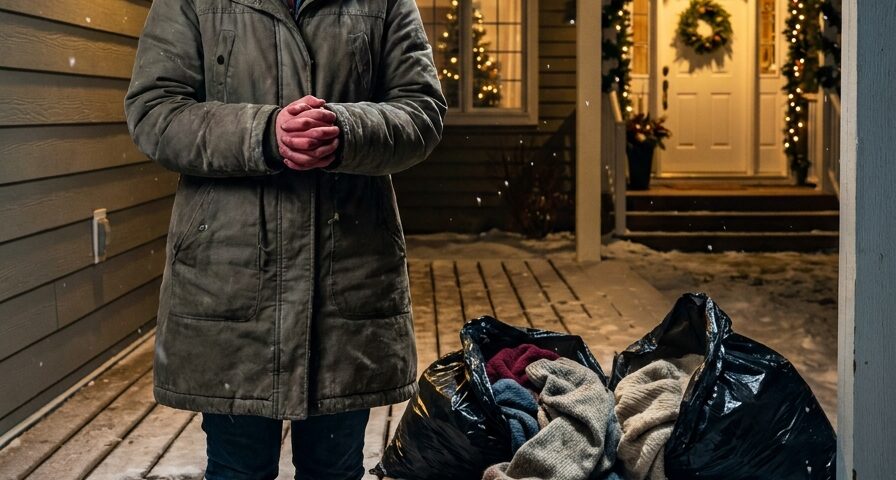
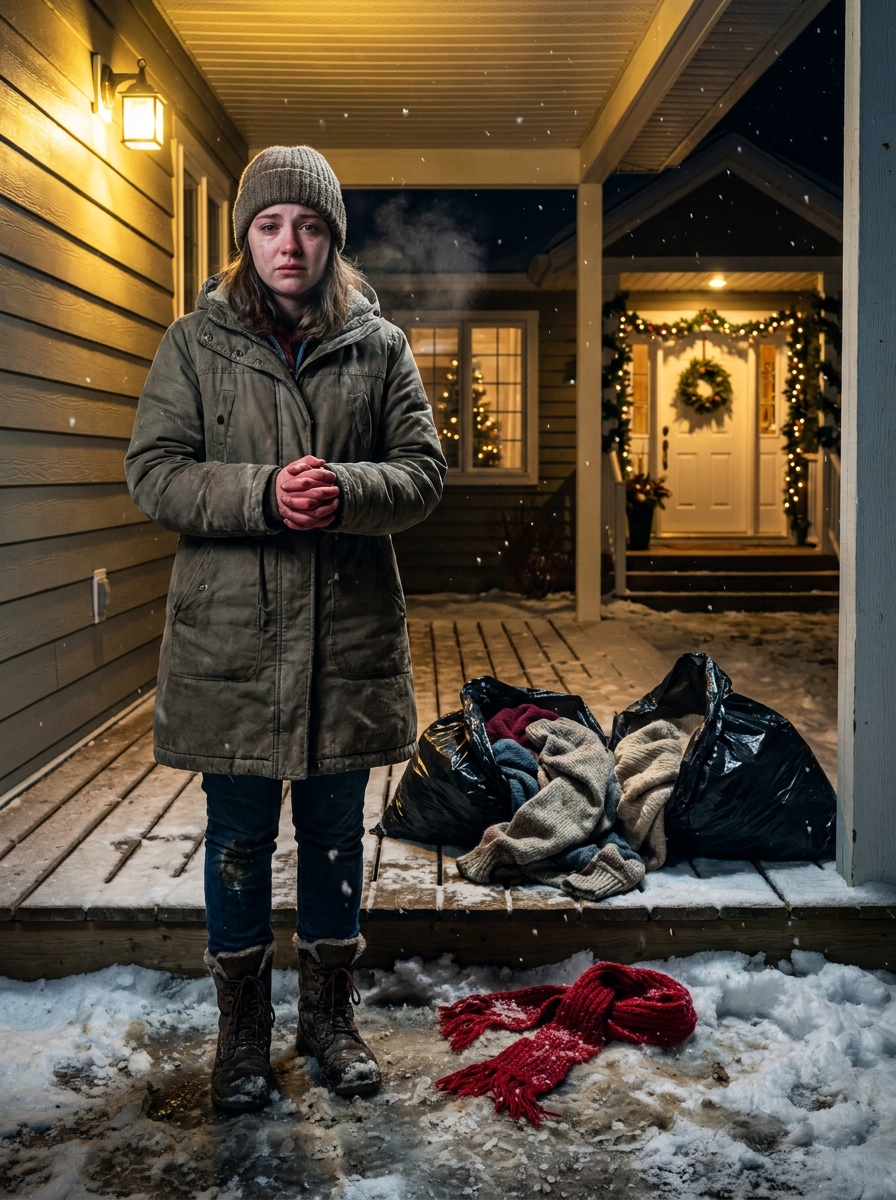
My father threw my clothes onto the porch in two black trash bags the night I turned nineteen.
Not suitcases. Not boxes. Trash bags.
One split when it hit the frozen boards, and my sweaters spilled out into the porch light like something dead. A pair of socks slid down the steps. My mother’s old red scarf, the only thing of hers I still wore, landed in a crust of dirty snow beside the driveway.
Behind my father, my stepmother stood in the open doorway with her arms folded across her cream-colored sweater. Denise never raised her voice when she wanted to hurt me. She didn’t need to. She had spent six years teaching everyone in Briar Glen that quiet cruelty sounded like concern.
“You made your choice, Mara,” she said.
My name in her mouth always sounded like a stain.
I looked past her into the house. Warm light. Pine garland still wrapped around the banister from Christmas. The smell of coffee and cinnamon from the kitchen. My little half sister’s drawings taped to the refrigerator. The brass key I had carried since middle school was still in my coat pocket, heavy and useless.
“Dad,” I said, trying to keep my voice steady. “Where am I supposed to go?”
My father wouldn’t look at me.
That was the part I remember most. Not the cold. Not the trash bags. Not Denise’s faint smile. My father’s eyes stayed on the porch railing as if the peeling white paint deserved more mercy than his daughter.
“You should have thought about that before you stole from this family.”
“I didn’t steal anything.”
Behind Denise, my stepbrother Caleb made a little sound, almost a laugh. He was twenty-two, home from college again after losing another scholarship he claimed had been “political.” He leaned against the hallway wall with my father’s old varsity jacket over his shoulders, his blond hair damp from a shower, his face clean and smug.
“You got caught,” he said. “At least leave with some dignity.”
Dignity.
I had been wearing my diner uniform when I came home. Black pants, white shirt, apron stuffed in my backpack. My hair smelled like fryer oil. My feet ached from a double shift. I had worked thirteen hours serving eggs, coffee, and meatloaf to people who called me sweetheart while leaving quarters under wet napkins.
I had been saving every dollar for community college.
The money had disappeared from the little gray lockbox beneath my bed three days earlier. Two thousand eight hundred and forty dollars. Every tip. Every birthday check. Every secret bill tucked away from Denise because she had a way of turning my money into “household contribution.”
When I reported it missing, Denise cried.
By morning, she claimed she had found deposit slips in my backpack for an account she didn’t recognize. By afternoon, Caleb told Dad he had seen me sneaking into his room. By dinner, I was accused of stealing from the emergency heating fund my father kept for the house and for my little sister’s medical bills.
The truth didn’t matter. Denise had already set the table for my guilt, and everyone sat down to eat.
“I swear on Mom,” I whispered.
That finally made my father look at me.
“Do not bring your mother into this.”
My mother had died when I was twelve. Her name was Lillian. She used to tell me storms came in two kinds: the ones in the sky and the ones people carried into your life. She said the trick was learning which shelter would hold.
I had believed my father was shelter.
That night, I learned he was weather.
Denise stepped onto the porch and handed me an envelope. “There’s eighty dollars in there. More than generous, considering.”
I didn’t take it.
She pressed it against my chest until I had to grab it or let it fall.
“You are not welcome in this house anymore,” she said. “Not until you admit what you did and agree to the conditions your father and I discussed.”
“What conditions?”
My father’s jaw tightened.
Denise answered for him. “You sign over any claim to your mother’s remaining property interests. You apologize to Caleb. You agree to counseling. And you stop telling people in town that we mistreat you.”
I stared at her.
“My mother’s property?”
Denise’s eyes flickered. Just once.
I noticed because I had spent years surviving in that house by noticing small things. The way her voice changed when she lied. The way Caleb scratched his neck when he was nervous. The way Dad grew silent whenever my mother’s name came close to money, land, or anything Denise didn’t control.
“I don’t know what you’re talking about,” I said.
“Of course you don’t,” Caleb muttered.
My father opened the screen door wider. “Enough. Leave before I call Sheriff Vance.”
The sheriff had gone to high school with my father. He bought pies from Denise’s church fundraisers. He once told me I was lucky to have such a stable family after losing my mom.
I bent and gathered my clothes with hands that had gone clumsy from cold. My socks were wet. My scarf was wet. One trash bag was ripped beyond saving, so I stuffed what I could into the other and tied the torn plastic around the rest. My backpack dug into my shoulder.
When I stood, my father was still in the doorway.
“Dad,” I said one last time.
For one second, something moved across his face. Shame maybe. Or memory. Or the man he used to be before grief made him weak and Denise made weakness useful.
Then Caleb said, “Don’t let her manipulate you.”
And my father shut the door.
The lock clicked.
I stood on the porch of the only home I had ever known, holding my life in garbage bags, listening to my little sister upstairs crying because no one had let her say goodbye.
The brass key was still in my pocket.
I don’t know why I tried it. Maybe because the body needs proof the heart can understand. I set down one bag, pulled the key out, and slid it into the deadbolt.
It didn’t turn.
They had already changed the locks.
That was when childhood ended for me. Not on my birthday cake. Not with candles. Not with a speech about responsibility. It ended with a key that no longer knew me.
I walked down the driveway with eighty dollars, a broken phone at twelve percent battery, and snow soaking through the soles of my work shoes.
Briar Glen was small enough that everybody knew your business before you did. The Bennett house sat on Maple Crest, where porches were wide and wreaths were expensive. At the bottom of the hill, the town narrowed into three blocks of old brick storefronts, a pharmacy, a church, a laundromat, and Loretta’s Diner, where I worked weekends and evenings.
I called my aunt first.
No answer.
I called my father’s sister in Boise.
Straight to voicemail.
I called my best friend from high school, Jessa, who had stopped coming around after Denise told her mother I had “behavioral issues.”
She answered, listened to me cry for ten seconds, then whispered, “My mom says I can’t get involved.”
By then my fingers were numb.
The bus station was really just a heated room attached to a gas station on Route 12. Two vending machines. A cracked plastic bench. A restroom key attached to a wooden paddle. I bought a coffee I didn’t want so the clerk wouldn’t kick me out.
At midnight, my phone died.
At one, the clerk told me I couldn’t sleep there.
At two, I was sitting behind the laundromat under a metal awning, hugging my trash bag to my chest, trying not to shake so hard my teeth cracked.
That first night has never left my bones.
People talk about homelessness like it starts when you sleep outside. It starts before that. It starts when you realize no door in the world is waiting for you. It starts when your mind counts every dollar and every outlet and every bathroom. It starts when you stop being a daughter and become a problem other people step around.
Near dawn, I walked to the diner because I didn’t know where else to go.
Loretta Alvarez was unlocking the front door when she saw me through the glass. She was sixty-three, with silver hair pinned in a knot and a face that could scare a drunk cowboy sober. She had hired me when I was sixteen because my mother used to bake pies for her church events.
Her eyes dropped to the trash bag in my hand.
She didn’t ask questions in the doorway. She opened the door, took the bag from me, and said, “Kitchen. Now.”
I sat at the prep table while she made me eggs, toast, and coffee with too much sugar. When I finally told her what happened, her mouth flattened into a line so hard it looked carved.
“Did you steal that money?”
“No.”
“Did you sign anything?”
“No.”
“Good.”
That was the first good word I had heard all night.
She let me wash my face in the employee restroom and sleep for ninety minutes on the old vinyl booth in the back corner before the breakfast rush. Then she put me on shift. Not because she was cruel, but because she knew I needed cash more than pity.
By noon, the story had already reached town.
Customers glanced at me, then away. Two women from Denise’s church whispered over pancakes. A man who used to give me extra tips left nothing. Sheriff Vance came in for coffee and watched me like I might steal the sugar packets.
At three, Caleb walked in with two friends.
He sat in my section.
“Rough night?” he asked when I came to the table.
I held my order pad. “What can I get you?”
He smiled. “You still work here? I figured criminals got fired.”
His friends laughed.
Heat crawled up my neck. I looked toward the counter. Loretta was watching, one hand on the coffee pot.
“What can I get you?” I repeated.
Caleb leaned back. “Dad says if you come home and do the right thing, maybe this doesn’t have to get uglier.”
“What right thing?”
“You know.”
“No,” I said quietly. “I really don’t.”
His smile thinned. “Sign the papers Denise gave you.”
There it was again.
Papers.
Property.
My mother.
Caleb looked past me toward the window where snow had begun falling again. “You always thought being sad made you special. But you’re not special, Mara. You’re just homeless now.”
I wrote nothing on the pad.
He ordered three burgers and tipped me a penny.
Loretta banned him from the diner before he reached the door.
That night, she offered me the storage room behind the kitchen. It had a cot, a mop sink, and shelves of paper towels. I cried harder over that cot than I had on the porch because kindness is dangerous when you are trying not to fall apart.
For two weeks, I lived in the back of Loretta’s Diner.
I washed dishes. I served tables. I cleaned grease traps. I learned which gas station bathroom was safest after dark, which church pantry gave out canned soup on Thursdays, which laundromat dryers could warm your hands if you stood close without looking desperate.
Denise posted online about “tough love.”
My father didn’t call.
My little sister, Emma, sent one message from her tablet: I’m sorry. I miss you. Mom says I can’t talk to you.
Then the message disappeared.
At the end of January, Loretta told me the fire marshal had warned her she couldn’t keep letting me sleep in the diner.
“I’ll figure something out,” I said.
She slid a folded paper across the counter. “Maybe you already have.”
It was an old county parcel notice. A maintenance structure on North Ridge Road. Stone foundation. Collapsed roof. No utilities. Former pump house for a spring-fed water line abandoned decades ago.
“I own the tax lien,” Loretta said. “Bought it years ago because my late husband thought he’d restore it. He didn’t. It’s ugly, cold, and halfway up a hill.”
I looked at the paper.
“Why are you showing me this?”
“Because ugly, cold, and halfway up a hill is still better than behind my mop buckets.”
The pump house sat above town in a fold of granite and pine, tucked into a natural hollow where the ridge curved like a protective shoulder. From the road, it looked like a ruin. One wall had collapsed. The roof sagged. The door hung crooked. Everyone in Briar Glen called it the old stone shed.
I saw something else.
I saw thick walls that blocked wind. A southeast opening that caught morning sun. A dry back corner where snow hadn’t drifted even after three storms. I saw the kind of shelter my mother would have studied with narrowed eyes and a pencil behind her ear.
My mother had not been an architect, but she had loved old buildings. She used to take me on walks after storms and show me how snow told the truth about wind.
“See that porch?” she would say. “Pretty, but useless. Wind hits it straight on.”
Then she would point to a barn tucked behind cottonwoods. “That one listens.”
At nineteen, with no home and no family willing to claim me, I stood in that ruined stone hollow and heard my mother’s voice.
This one listens.
By February, everyone in town knew I was trying to live there.
The jokes started immediately.
“Cave girl.”
“Trash-bag queen.”
“Denise Bennett’s runaway problem.”
One afternoon, my father drove up in his truck while I was hauling scrap lumber from Loretta’s cousin’s barn. He got out wearing his wool coat and that tired, embarrassed expression he used whenever my existence inconvenienced him.
“This has gone far enough,” he said.
I kept my hands on the lumber. “What has?”
“This.” He gestured at the stone walls, the patched tarp, the little fire ring I had built outside. “You’re making yourself look unstable.”
I almost laughed. “I’m trying not to freeze.”
“You could come home.”
My chest tightened before I could stop it.
“Really?”
He looked away. “Under the conditions Denise explained.”
There it was. Love with a contract attached.
“What property does she want me to sign away?”
His face changed. Not much. Just enough.
“You don’t understand adult matters.”
“I’m nineteen.”
“You are a child acting out.”
“No,” I said. “I’m your daughter standing outside because you changed the locks.”
He flinched.
For a moment, I thought he might say he was sorry.
Instead, he said, “Your mother would be ashamed of what you’ve become.”
The words hit so hard I couldn’t breathe.
Then a voice behind him said, “Funny. I was thinking the opposite.”
Loretta stood beside her pickup, holding a box of donated wool blankets and a crowbar.
My father’s face darkened. “This is family business.”
“Then act like family,” Loretta said.
He left without helping me carry a single board.
That evening, snow began to fall again. I sat inside the roofless stone shell beneath my tarp, wrapped in my mother’s red scarf and two donated blankets, listening to wind slide over the ridge instead of smashing into it.
The town below glowed with warm windows.
I had no electricity. No running water. No father. No answer.
But I had stone around me, a roof plan sketched on cardboard, and a key in my pocket that no longer opened the past.
For the first time since being thrown out, I stopped asking where I was supposed to go.
I looked at the walls around me and whispered, “Here.”
Part 2
Survival did not arrive like courage. It arrived like a list.
Find dry socks. Find cheap nails. Find where the roof leaks. Find out which grocery store throws away bread on Tuesday. Find the library hours. Find a safe place to charge your phone. Find a way not to cry when someone from church sees you washing your hair in a restroom sink.
Every morning, I woke before dawn in the pump house with my breath white above my face and my fingers tucked under my arms. I heated water on a camp stove Loretta gave me, drank instant coffee from a chipped mug, and wrote down what needed doing.
Patch east wall.
Raise sleeping platform.
Seal window gap.
Ask Mr. Nolan about venting.
Mr. Nolan was the town librarian, though everyone still called him Professor because he had taught earth science at the high school for thirty-four years. He found me asleep once at a back table with county building manuals open around me and frostbite warnings on the computer screen.
Instead of kicking me out, he set down a stack of books.
“Passive solar design,” he said. “Basic carpentry. Weather patterns in mountain valleys. And this one has pictures, which is helpful when your brain is tired.”
I stared at him. “Why?”
He adjusted his glasses. “Because your mother used to return books with notes in the margins on separate paper so she wouldn’t damage the pages. I respected that.”
I looked down before he could see my eyes fill.
Mr. Nolan became my second ally, though he never announced himself that way. He let me use the library computer to apply for a replacement Social Security card because mine had vanished from my room. He showed me how to search county records. He taught me the word “microclimate,” which sounded fancy but meant what my mother had always known: a place could behave differently from the land around it if you paid attention.
The pump house behaved differently.
Snow collected heavily along the road but not in the hollow. Wind screamed across the exposed ridge above me, then softened near the stone entrance. Morning sunlight reached the back wall for almost two hours when the sky was clear. The spring line still trickled underground, not enough for plumbing, but enough to keep the soil near the old channel slightly warmer than the surrounding ground.
I started keeping a notebook.
Outside temperature. Inside temperature. Wind direction. Snow drift depth. Fuel used.
At first, it was just practical. Then it became something else. Proof, maybe. Proof that I wasn’t crazy. Proof that the place everyone mocked had reasons for surviving.
The work was slow because poverty makes every task take three times longer.
I couldn’t buy insulation, so Loretta asked around and found a farmer with old sheep’s wool he considered useless. I washed it in buckets until my hands cracked, dried it near the diner’s back vent, and packed it between salvaged boards. I couldn’t afford proper flooring, so I built a raised platform from pallets and scrap joists, leaving space underneath for air to move. I dug a narrow drainage channel with a borrowed shovel and lined it with stones. I fixed the roof with mismatched metal sheets that pinged and popped in the cold.
People came to watch.
That was the humiliating part. They drove up like I was entertainment.
A few offered advice. Most offered judgment.
Sheriff Vance stopped one morning while I was hauling stones.
“You can’t live out here forever,” he said.
“I’m not planning to live in ruins forever.”
He glanced at the walls. “Could’ve fooled me.”
Another day, Denise arrived in her spotless SUV with Caleb in the passenger seat. She stayed behind the wheel with the heater running while he stepped out and filmed me on his phone.
“Smile, Mara,” he called. “People should see what happens when you betray your family.”
I was holding a hammer. For one dangerous second, I imagined throwing it through his windshield.
Instead, I set it down.
That was one thing homelessness taught me fast: anger is expensive. If I lost control, even once, they would use it to explain everything they had done to me.
So I lifted another board and carried it inside.
Caleb laughed. “You really think this dump is a house?”
I turned then.
“No,” I said. “I think it’s mine.”
He stopped laughing.
Denise’s window rolled down. Her voice floated out, soft and poisonous. “Nothing is yours, Mara. You’ll learn that soon enough.”
Then they drove away.
That night, I searched county records until the library closed.
Bennett. Lillian Bennett. Mara Bennett. North Ridge. Probate. Trust.
Most files were boring. Tax records. Property transfers. Old easements. Then I found a scanned document from thirteen years earlier involving my mother’s parents. A partial land interest. North Ridge water access. Something transferred into a trust.
My mother’s name was there.
So was mine.
My hands went cold.
The file was incomplete, but it was enough to make Denise’s sudden obsession with signatures feel less mysterious. There was land connected to my mother. Maybe not much. Maybe worthless. But Denise wanted it badly enough to throw me into winter.
Mr. Nolan printed the page without charging me.
“You need a lawyer,” he said.
“I have forty-six dollars.”
“Then you need the legal aid clinic in Missoula.”
The bus ticket cost twenty-two dollars. I went on a Monday, wearing my cleanest diner shirt and carrying every document I had in a folder Loretta gave me. The legal aid office smelled like old carpet and burnt coffee. A young attorney named Priya Shah listened carefully while I explained the lockbox, the accusation, the papers, the property record, and the fact that my identity documents had disappeared.
She didn’t promise miracles.
That made me trust her more.
“What I can do,” she said, “is request the probate file and advise you not to sign anything. I can also help you report the missing documents and the stolen savings.”
“My family says I stole from them.”
“Families say many things when money is involved.”
I almost cried from the plainness of it.
While Priya worked on the records, I kept building.
By March, the pump house had a real door.
By April, I had a small woodstove installed with help from Loretta’s cousin, who used to work construction and charged me only in pie. By May, I had shelves, a narrow bed, a table made from a sanded door, and curtains sewn from old flour sacks.
It still wasn’t easy.
Rain came through two roof seams. Mice invaded my oats. A late frost killed the herbs I planted in coffee cans. Once, a man I didn’t know pounded on the door after midnight because he had heard “a girl lived alone up there.” I sat with my back against the wall holding a tire iron until he left.
The next day, Loretta gave me a can of bear spray and Mr. Nolan helped me install a second bolt.
Survival made me practical in ways sadness never could.
I learned to split kindling. I learned to stretch soup for four meals. I learned that shame fades when you are too busy staying alive to feed it. I learned that accepting help does not make you weak, but letting someone own you because they helped is another kind of cage.
Summer came.
The town moved on to other gossip, but not entirely. I was still the Bennett girl who lived in the stone shed. I was still the cautionary tale Denise polished whenever she needed sympathy.
At church fundraisers, she told people, “We pray Mara gets the help she needs.”
At the hardware store, Caleb told the cashier I had “mental issues.”
My father said nothing.
That silence became its own language.
Then, in July, Priya called.
“I have the probate file,” she said. “You should come in.”
I took the bus with my folder on my lap and a knot in my stomach.
Priya laid out the documents one by one. My maternal grandfather had owned several odd parcels around North Ridge, including the old pump house land and water easement. When he died, the interest passed to my mother. When my mother died, it was supposed to pass to me when I turned nineteen.
Not eighteen.
Nineteen.
My birthday.
The same night I was thrown out.
“There’s more,” Priya said.
There had been a trust account, too. Not huge, but enough for tuition, housing, and repairs to the property. My father had been temporary custodian. He was supposed to transfer control to me on my nineteenth birthday.
Instead, three weeks before my birthday, someone had filed paperwork claiming I was financially irresponsible, unstable, and under family review for theft.
My signature appeared on one form.
It was not my signature.
I stared at the page until the letters blurred.
“That’s forged.”
“I thought you might say that,” Priya said. “We’ll need a handwriting expert eventually. But first, I want to know if you recognize the witness.”
She turned the page.
Caleb Bennett.
My stepbrother had witnessed a forged signature on a document declaring me too unstable to receive my mother’s inheritance.
For several seconds, I heard nothing but blood rushing in my ears.
Not because of the money. Not even because of the land.
Because suddenly the shape of my banishment became clear.
They had not thrown me out because they believed I stole.
They had thrown me out because I was about to receive something they wanted, and homelessness made me easier to discredit.
If I looked unstable enough, desperate enough, criminal enough, Denise could point to my life and say, See? We were right not to give her anything.
I walked out of the legal aid office shaking.
At the bus station, I locked myself in a bathroom stall and cried with my hand over my mouth so no one would hear. Then I washed my face, bought a coffee, and opened my notebook.
For months, I had been recording temperatures, wind, fuel, repairs, expenses, and every visit from people who came to mock me.
Now I turned to a clean page and wrote a new title.
Things They Took.
Under it, I wrote:
My home.
My documents.
My savings.
My mother’s trust.
My reputation.
Then I paused.
Under that, I wrote:
Things I Still Have.
My name.
My proof.
My hands.
The shelter.
The truth.
By September, the pump house was no longer a ruin.
It was small, strange, and beautiful in a way I couldn’t explain to people who measured homes by square footage and countertops. The stone walls held the day’s warmth after sunset. The raised floor stayed dry. The stove heated the whole space with half the wood I expected. I built a covered entry from salvaged beams so snow wouldn’t block the door. Mr. Nolan helped me place markers along the path from town: painted stakes, reflective tins, a rope line near the steepest turn.
“For you?” Loretta asked when she saw them.
“For storms,” I said.
She studied me. “You expecting one?”
“I’m expecting people to underestimate one.”
She smiled a little. “That sounds like your mother.”
In October, the first offer came.
My father drove up alone.
I was stacking firewood under the lean-to. He looked older than he had in January. There were hollows under his eyes, gray in his beard. For one weak second, I wanted to run to him. Grief is stubborn that way. It will beg at doors your pride has already walked away from.
“Mara,” he said.
I kept stacking. “Dad.”
He looked at the pump house, at the patched roof, the clean windows, the smoke curling from the pipe. Something like surprise moved across his face.
“You did all this?”
“With help.”
He nodded slowly. “Denise says the legal aid clinic contacted us.”
“I know.”
“You’re making serious accusations.”
“No. I’m answering serious accusations.”
His jaw tightened. “This could damage the family.”
I laughed once, not because it was funny, but because the sentence was too heavy to hold any other way.
“The family survived me sleeping behind a laundromat,” I said. “I think it can survive paperwork.”
He looked down.
For the first time, I wondered how much he knew and how much he had chosen not to know because not knowing was easier.
“You can still come home,” he said quietly.
The old hunger rose in me. The one that wanted my room back. Emma’s laughter through the wall. My mother’s mug in the kitchen cabinet. My father saying he had made a terrible mistake.
“What are the conditions?” I asked.
He closed his eyes.
That answered before he did.
“Drop the legal complaint,” he said. “Sign a family settlement. Denise thinks it would be best if the trust remained managed for a while. You’d have an allowance. We’d tell people you had a breakdown but you’re recovering.”
The hunger inside me curled up and went cold.
“You want me to trade the truth for a bedroom.”
“I want to protect you.”
“No,” I said. “You want me quiet.”
His face reddened. “You have no idea what Denise has done to keep this family together.”
“I know exactly what she did to keep my mother’s money.”
He stepped back as if I had slapped him.
I picked up another log. “Tell Emma I love her.”
“Mara—”
“You should go before the road freezes.”
He left.
Part of me broke again that day, but it broke clean. Like ice separating from a roof in sunlight.
November brought hard cold.
December brought early storms.
By New Year’s, the town began talking about weather the way people do when they are nervous but don’t want to sound afraid. The grocery store sold out of salt twice. Ranchers moved cattle lower than usual. The old-timers at the diner stared west through the windows and argued about pressure systems.
Mr. Nolan showed me barometer readings from the library’s little weather station.
“Ugly pattern,” he said.
“How ugly?”
He tapped the paper. “If this moisture hits that cold front and stalls against the range, very.”
I stocked more wood.
I filled water jugs.
I bought beans, rice, oats, candles, batteries, and canned peaches because my mother used to say sweetness mattered in emergencies. I checked the rope line. I reinforced the entry. I sealed one last draft along the north wall.
People laughed again, but less loudly this time.
On January 17, Caleb posted a picture of my cabin online with the caption: Mara Bennett preparing for the apocalypse in her luxury cave.
I didn’t respond.
On January 19, the sky turned the color of wet ash.
That afternoon, I walked down to the diner to pick up my paycheck and warn Loretta that the road up to my place might close if the snow came hard.
Caleb was at the counter.
He looked thinner. Nervous. There were rumors he owed money again. He watched Loretta hand me my envelope and smirked.
“Still playing pioneer?”
I tucked the money into my coat. “Still playing witness?”
His face changed.
Just for a second.
Enough.
Then the diner door opened and Denise came in, wrapped in a camel coat, smiling like a woman entering a room she owned.
“Mara,” she said. “Your father is worried.”
“No, he isn’t.”
Her smile held. “You always were dramatic.”
Loretta muttered, “Lord, give me patience,” from behind the counter.
Denise stepped closer. “The legal nonsense ends now. You have no idea how much worse this can get for you.”
I looked at her perfect hair, her pearl earrings, her soft leather gloves. I thought of my first night behind the laundromat. I thought of my mother’s red scarf frozen in the driveway. I thought of my father asking me to call a lie recovery.
“You already made me homeless,” I said. “You’ll have to be more specific.”
Her eyes hardened.
Outside, wind struck the diner windows so sharply everyone turned.
Snow began falling before sunset.
By midnight, the world disappeared.
Part 3
The storm did not feel like weather at first. It felt like a door slamming shut across the whole valley.
Wind hit Briar Glen from the northwest at a speed that made old houses tremble. Snow came sideways, then upward, then in wild spinning sheets so thick my lantern light barely reached the woodpile. By dawn, the road below my cabin had vanished. The rope line hummed under ice. The painted stakes were half-buried.
Inside, the stone walls held.
I wrote in my notebook at six in the morning.
January 20. Outside: minus 18. Inside: 61. Wind severe. Stove steady. North wall dry.
Then I made oatmeal and fed the little gray cat who had adopted my woodpile in November.
I had named her Penny because that was what Caleb had once tipped me.
By the second day, the storm became frightening even from shelter. Gusts screamed over the ridge like metal tearing. Snow piled so high against the outer windbreak that I had to dig the vent clear every few hours. The world beyond the hollow was white movement and sound.
Still, inside stayed warm.
Not luxurious. Not easy. But steady.
The place everyone called a cave was doing what I had built it to do. The stone softened the temperature swings. The entry blocked the worst of the wind. The raised floor stayed dry. The stove used less wood than any house I had lived in.
On the second evening, my radio picked up fragments from the county emergency channel.
Road closures. Power outages. Medical calls delayed. Roof collapse on Mill Street. Heating failure near Maple Crest.
Maple Crest.
My hand froze over the dial.
That was where my father lived.
Where Emma lived.
I turned the volume up, but static swallowed the rest.
I spent that night awake.
I hated myself for worrying. Then I hated myself for hating it. Love does not disappear just because people mishandle it. It lingers like a bruise you keep pressing to see if it still hurts.
On the third day, someone knocked on my door.
Not a polite knock. A desperate pounding.
Penny shot under the bed. I grabbed the tire iron out of old habit and opened the inner door. Snow burst into the entry as a man stumbled forward and collapsed against the wall.
Sheriff Vance.
His mustache was crusted white. His face was gray with cold.
Behind him, Mr. Nolan clung to the rope line with one arm around a teenage boy I recognized from the hardware store.
“Get inside!” I shouted.
They fell more than walked into the shelter.
The boy’s lips were blue. Mr. Nolan’s glasses were iced over. Sheriff Vance tried to speak, but his jaw shook too hard.
I got blankets around them. Hot water on the stove. Boots off. Gloves off. Wet outer layers hung near the fire. My hands moved without asking my fear for permission.
After twenty minutes, Mr. Nolan could talk.
“Library roof section gave way,” he said. “We moved people to the church, but the church furnace failed. Roads are blocked. Vance remembered your markers.”
Sheriff Vance stared at the stove like he couldn’t understand it.
“This place is warm,” he said.
I handed him tea. “That was the idea.”
He looked ashamed.
I didn’t need his apology right then. I needed him thawed enough to help if more people came.
They did.
By late afternoon, six more had reached the cabin: Mrs. Keene from the pharmacy, a young mother with a toddler wrapped inside her coat, two brothers from a ranch outside town, and an elderly man who kept saying he was sorry for tracking snow on my floor.
On the fourth day, the storm grew worse.
That was when my family came.
I heard Emma crying before I saw them.
I opened the door and found my father half-carrying her through the entry, his face raw from windburn, his coat torn at the sleeve. Denise stumbled behind him in boots completely wrong for deep snow. Caleb came last, dragging one foot, panic naked on his face.
For a second, nobody moved.
My father looked at me across the threshold of the home he had mocked, the home he had asked me to abandon, the home I had built because he gave me nowhere else to survive.
“Mara,” he said, and his voice broke.
Emma reached for me.
That decided everything.
I pulled her inside.
She was thirteen, too thin, shaking so hard I felt it through both our coats. “I’m sorry,” she sobbed into my shoulder. “I wanted to call you. Mom took my tablet. I’m sorry.”
“None of this is your fault,” I said, holding her tight. “You’re safe now.”
Denise stood just inside the door, staring at the room.
At the shelves of food.
At the stacked firewood.
At the people wrapped in blankets.
At Sheriff Vance drinking coffee from my chipped mug.
Humiliation passed across her face, and even then, even frozen and dependent on my fire, she managed to make it look like anger.
“We need space,” she said. “Emma should be near the stove.”
Loretta, who had arrived an hour earlier with two frostbitten fingers and a backpack of diner biscuits, looked up from the bench.
“Children and elderly are already near the stove,” she said. “Mara’s been organizing just fine.”
Denise’s mouth tightened. She was not used to rooms where her voice didn’t become law.
Caleb sank onto the floor. His left ankle was swollen. I wrapped it because I was not cruel, but I did not comfort him.
My father watched me moving through the room—handing out blankets, rationing soup, checking vents, adding wood, writing names in my notebook so we knew who had made it and who might still be missing.
At some point, he whispered, “You learned all this?”
I didn’t look at him. “I had to.”
By evening, twenty-seven people were inside the stone shelter.
The cabin was small, but the covered hollow and storage alcove gave us more room than anyone expected. People sat shoulder to shoulder on blankets. Children slept under coats. The young mother fed her toddler mashed beans with a plastic spoon. Sheriff Vance and the ranch brothers took turns keeping the entry clear. Loretta managed food like a general. Mr. Nolan monitored the radio from the table.
My father kept trying to speak to me.
I kept finding work to do.
On the fifth morning, the wind stopped.
No one trusted it at first. Silence after days of screaming felt unnatural, almost dangerous. Then Sheriff Vance opened the outer door, and pale sunlight spilled over snow so deep the town below looked erased.
Briar Glen was buried.
Roofs poked out like broken teeth. Cars were smooth white mounds. Power lines sagged. Smoke rose from only a few chimneys. The road to Maple Crest had disappeared entirely.
Search parties formed from whoever could walk.
My cabin became the command point because it was warm, stocked, and high enough to see across the valley. The same people who had called it a cave now asked where to stack supplies. Where to bring the injured. Where to send children while adults dug out homes.
No one laughed.
For two days, we worked through the aftermath. Neighbors were found alive in upstairs bedrooms, basements, and one truck buried near the feed store. Not everyone’s animals survived. Two roofs collapsed completely. The church hall flooded when pipes burst. The Bennett house on Maple Crest had lost heat on the second day and part of the kitchen ceiling had come down under snow load.
If my father had waited another hour to leave, Emma might not have survived the cold.
That knowledge sat between us like a second storm.
On the third day after the blizzard, Sheriff Vance asked to see my notebook.
I handed it over.
He turned pages slowly. Months of temperatures, repairs, expenses, weather observations, names of visitors, dates of harassment, and notes about the legal documents Denise and Caleb had pressured me to sign.
When he reached the page titled Things They Took, he stopped.
Denise was sitting across the room with a blanket around her shoulders.
For the first time since I had known her, she looked afraid.
Sheriff Vance closed the notebook. “Mara, after roads clear, I think we need to talk formally about those stolen documents.”
Caleb made a sound. “Are you serious? Now?”
The sheriff looked at him. “Especially now.”
The truth did not explode all at once. It unfolded.
Priya arrived three days later with a county officer and certified copies of the trust documents. The forged signature was obvious beside my real one. My missing Social Security card and birth certificate were found in Denise’s locked desk after Sheriff Vance obtained permission from my father, who had finally stopped protecting ignorance.
Caleb broke first.
He admitted Denise had told him the trust was “family money” my mother never meant me to control. He admitted signing as witness. He admitted taking my savings from the lockbox, though he claimed Denise said it was to prove I was irresponsible.
Denise denied everything until Priya produced bank records showing transfers from the trust account into a renovation fund for the Bennett house.
The same house that had nearly frozen them.
There is no perfect justice in real life. No lightning bolt. No courtroom gasp that heals the child in you. But there are consequences.
Denise was charged with forgery and financial exploitation. Caleb took a plea for his cooperation and left town to live with an uncle who reportedly made him get an actual job. My father was not charged, but the court removed him as trustee and ordered a full accounting of every dollar. The house had to be refinanced to repay what Denise had taken.
People in Briar Glen apologized in awkward waves.
Some brought casseroles. Some cried. Some tried to rewrite history so they had “always wondered” if I was telling the truth.
I accepted apologies when they were honest. I ignored performances.
The hardest apology came from my father.
He walked up to the cabin in March, when snow still lined the shaded parts of the ridge but sunlight had begun softening the road. He looked smaller without Denise beside him.
I was repairing a section of fence near the path markers.
He stopped a few feet away. “Can we talk?”
I nodded once.
He held my brass house key in his palm.
The old one.
“I found it in your coat pocket that night after you tried the door,” he said. “It must have fallen on the porch. I kept it.”
My throat tightened despite everything.
“I changed the locks before you came home,” he said, voice shaking. “Denise told me it was for safety. I let her. I let her convince me my own daughter was dangerous because believing that was easier than admitting I had married someone cruel.”
I said nothing.
He wiped his face. “Your mother would not be ashamed of you. She would be ashamed of me.”
The words entered me carefully. Not as healing. Not yet. But as truth.
He held out the key.
I looked at it for a long moment.
Then I shook my head.
“That door isn’t mine anymore.”
His hand fell.
“I know,” he whispered.
“I love you,” I said, and his face crumpled. “But I’m not coming back to be the daughter you believe only after everyone else does.”
He cried then.
I let him.
Forgiveness, I learned, is not the same as returning to the scene of the injury and calling it home.
By summer, the trust was legally mine.
It was not a fortune, but it was enough to secure the North Ridge parcel, finish the cabin properly, enroll in community college part-time, and start a small emergency shelter fund with Loretta and Mr. Nolan. We called it The Ridge Project. Nothing fancy. Just practical help: motel vouchers, bus passes, replacement ID fees, winter coats, and a list of safe places for people who suddenly had no door waiting for them.
The town council asked me to speak about winter preparedness.
I almost said no.
Then Emma squeezed my hand and said, “Please.”
So I stood in the same community hall where Denise had once called me unstable and explained wind shadows, raised floors, emergency supplies, and why shame should never be part of disaster planning.
Sheriff Vance sat in the front row.
So did my father.
When I finished, no one clapped at first. The room was too quiet. Then Loretta stood, and everyone followed.
I did not feel victorious exactly.
I felt steady.
That was better.
In September, I painted the cabin door blue because my mother once said every safe place deserved a color the sky would recognize. I hung her red scarf inside a frame near the stove, not because I needed it for warmth anymore, but because it had survived the night everything else was taken.
Emma visited on weekends. She helped plant herbs in coffee cans and taught Penny to tolerate being brushed. My father came sometimes, always calling first, always leaving before dark unless invited. We were building something cautious and imperfect, which was the only honest way to rebuild.
One evening, near the first frost, Mr. Nolan brought me a small bronze plaque the town had commissioned for the entrance to the stone hollow.
I expected something embarrassing. Heroic words. Disaster words. Maybe my name too large.
Instead, it read:
She listened when others laughed.
The ridge answered.
I touched the letters and thought of my mother walking after storms, teaching me to read snow. I thought of the trash bags on the porch, the key that would not turn, the diner cot, the laundromat awning, the first morning sunlight reaching the back wall of a ruin everyone else dismissed.
I had wanted my old home to open its door and take me back.
Instead, I had built a different door.
One that opened from the inside.
That winter, the first snow came quietly. I stood beneath the granite curve of the ridge with Penny winding around my boots and smoke rising from the blue-doored cabin behind me. Down in Briar Glen, new windbreaks lined several houses. Emergency markers stood along the roads. The church basement had a backup generator. The library kept a shelf of forms for replacement documents and shelter services.
The town had changed.
So had I.
I was still the girl they threw away at nineteen. That would always be part of my story.
But I was also the woman who survived the cold, found the lie, kept the proof, built the shelter, opened the door, and learned that belonging is not always given by the people who share your blood.
Sometimes belonging is made.
Stone by stone.
Meal by meal.
Name by name in a notebook.
Fire by fire through the long dark.
And sometimes, after everyone says nothing can survive where you are standing, the storm comes, the world breaks open, and the place they mocked becomes the only warm light left on the ridge.