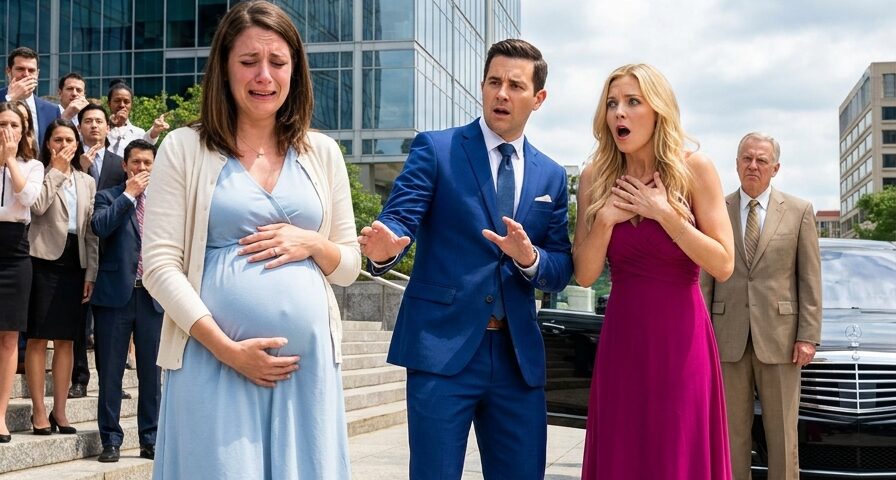
CEO Left His Pregnant Wife For A Supermodel On Live TV, But Her Hidden Tech Empire Was Already Buying His Company
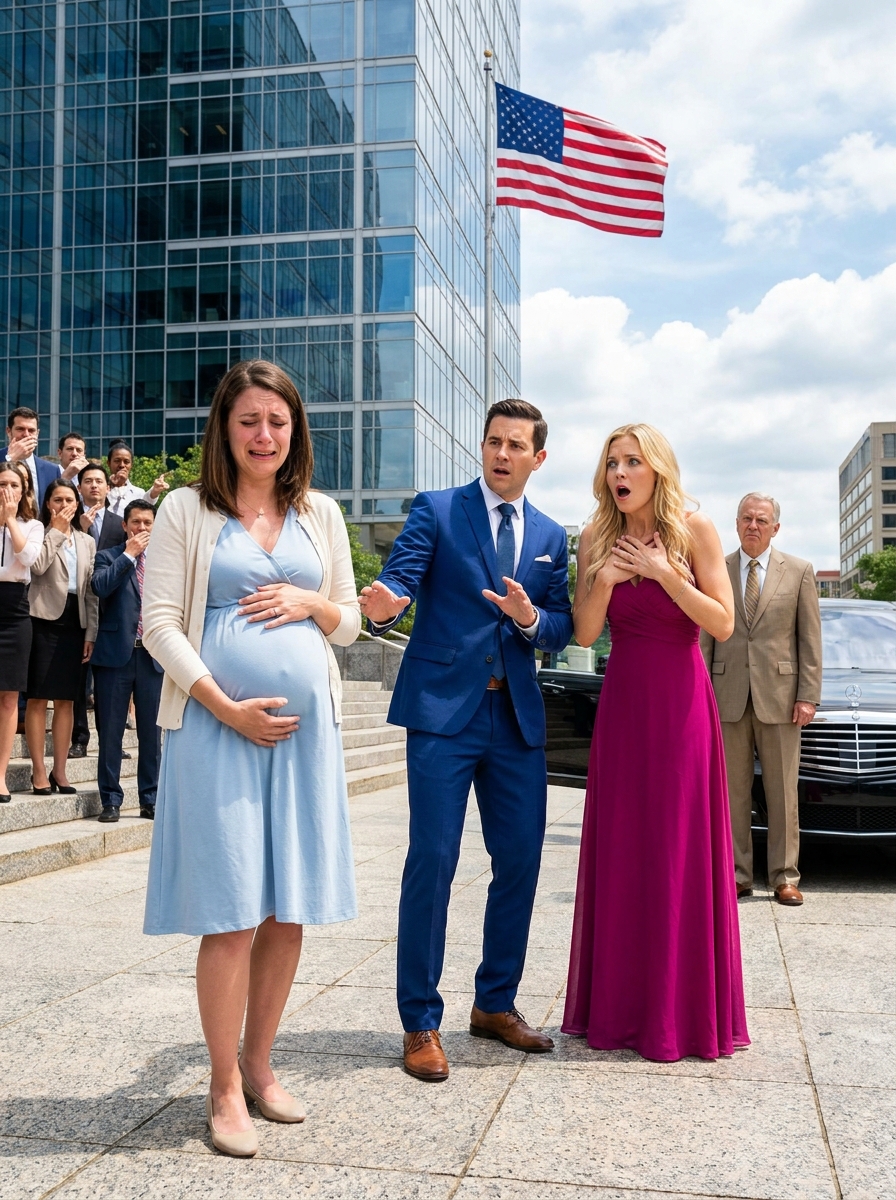
CEO Left His Pregnant Wife For A Supermodel On Live TV, But Her Hidden Tech Empire Was Already Buying His Company
Madison Vale found out her husband had replaced her when the camera zoomed in on his hand resting on another woman’s waist.
Not in private.
Not through a whispered confession.
On live television, in front of twelve million viewers, while Madison sat seven months pregnant in the back row of a Manhattan charity gala wearing the navy dress he had told her looked “too plain for the cameras.”
The host laughed and said, “Preston Cross and his stunning girlfriend, supermodel Sienna Hart, are the power couple of the year.”
Girlfriend.
Madison felt the word land like a slap.
Preston didn’t correct it.
He smiled.
He lifted Sienna’s hand and kissed her knuckles beneath the chandelier lights.
The ballroom applauded because rich people were trained to clap before they understood what they were clapping for.
Madison did not move.
Her fingers stayed folded over the curve of her stomach.
Her baby kicked once.
Slow.
Hard.
As if even her unborn daughter had heard the insult.
Across the room, Preston’s mother, Eleanor Cross, turned just enough to see Madison’s face.
Then she looked away.
That hurt more than the cameras.
A waiter leaned down with a silver tray. “Sparkling water, ma’am?”
Madison looked up at him.
He was young. Nervous. Maybe twenty-two. His eyes had already flickered toward the big screen where her husband was still smiling beside another woman.
“No, thank you,” Madison said.
Her voice did not shake.
That surprised her.
Her whole body felt hollowed out, but her voice came out clean.
She placed one hand on the armrest and stood.
Three women at the next table pretended not to stare.
One of them whispered, “Isn’t that his wife?”
Another whispered, “I thought she was on bed rest.”
Madison heard every word.
She walked past their table.
Past the ice sculpture.
Past the donors in tuxedos and diamond collars.
Past the giant floral arch Preston’s company had sponsored with a glowing sign that read CROSSCORE TECHNOLOGIES: BUILDING THE FUTURE.
She almost laughed at that.
Building the future.
Preston couldn’t even protect his own family.
At the edge of the ballroom, a security guard moved to block her.
“Mrs. Cross,” he said softly, “Mr. Cross asked that you remain seated until after the broadcast.”
Madison stopped.
There it was.
Not concern.
Not regret.
Control.
She looked at the guard’s earpiece. Then at the small black camera angled above the exit.
“What’s your name?” she asked.
He blinked. “Aaron.”
“Aaron,” she said, “I am pregnant, sober, calm, and leaving a public event. If you put a hand on me, it will become the worst career decision you’ve ever made.”
Aaron stepped aside.
Madison walked out.
No screaming.
No scene.
No shattered glass.
Just the quiet click of her low heels against marble as the entire life Preston had built around her began to crack behind her.
Because Madison had not married Preston Cross for money.
Because Madison had not signed his contracts blindly.
Because Madison had not spent five years smiling beside him without learning exactly where the bodies were buried.
Because Madison had not told him her real last name.
Because Madison had not come to that gala as his abandoned wife.
Because Madison had come as the woman whose private family trust had just acquired enough silent shares to decide whether CrossCore Technologies would still exist by sunrise.
Outside, Manhattan was cold and glittering.
Cameras flashed behind barricades.
Reporters shouted names that were not hers.
“Preston! Sienna! Look this way!”
Madison paused beneath the awning.
Her black SUV waited at the curb, but before she could reach it, a tall woman in a cream pantsuit stepped from the shadows.
Rachel Kline.
Her attorney.
Her only real friend in New York.
Rachel’s eyes moved over Madison’s face, then down to her stomach. “You saw it?”
“Everyone saw it.”
“I’m sorry.”
Madison looked back at the hotel doors.
The applause inside rose again, muffled by glass.
“Don’t be,” she said. “He just made our timeline easier.”
Rachel’s mouth tightened. “The board vote is at eight tomorrow morning.”
“I know.”
“You can still delay. You don’t have to walk into that room pregnant, humiliated, and exhausted.”
Madison looked at her.
Rachel stopped talking.
Madison had that effect when she was quiet.
Preston used to call it coldness.
Her grandfather had called it discipline.
“No delay,” Madison said. “File the injunction at midnight. Release the share disclosure at six. I want the board packet on every director’s tablet before they finish their first coffee.”
Rachel nodded once.
“And Preston?” Rachel asked.
Madison watched a black town car glide past, its tinted windows reflecting the hotel lights.
“Let him enjoy the gala,” she said. “It’s the last room he’ll ever enter thinking he owns it.”
Inside the ballroom, Preston Cross was still smiling.
He had always been handsome in the way men with expensive haircuts and no real hunger often were. Tall, broad-shouldered, with blue eyes that looked honest in photographs and calculating in mirrors.
He had learned early that people trusted a clean jawline and a good suit.
Investors trusted him.
Journalists trusted him.
Women trusted him.
Madison once had.
Five years earlier, she met him at a founder dinner in Palo Alto where she was using a fake consulting badge and sitting two seats away from a venture capitalist who chewed with his mouth open.
Preston had been thirty-one then.
Ambitious.
Brilliant enough to impress a room, not brilliant enough to know when he was being measured.
He had talked about artificial intelligence with the confidence of a man who thought confidence was a credential.
Madison had listened.
She wore a black dress from Nordstrom Rack, pearl studs from her grandmother, and a name tag that said Maddie Lane.
Not Madison Vale.
Not Madison Ellery Vale, granddaughter of Joseph Vale, founder of Vale Systems, one of the most secretive private tech empires in the country.
Her grandfather had raised her after her parents died in a winter plane crash outside Aspen.
He taught her chess before she could ride a bike.
He taught her code before she could drive.
He taught her the one rule that had saved him from bankruptcy, betrayal, and billion-dollar lawsuits.
Never tell hungry people where the pantry is.
So Madison lived quietly.
No social media.
No interviews.
No public trust documents under her full name.
Her inheritance was wrapped in layers of foundations, family offices, and holding companies with names so boring they put journalists to sleep.
Preston knew none of that.
He knew Maddie Lane, the quiet consultant who asked sharper questions than anyone else at the table.
He pursued her for three months.
Coffee.
Dinner.
A weekend in Carmel.
A handwritten note left at her apartment door that said, You see the world like someone who could build it better.
Madison kept that note for years.
Not because it was romantic.
Because it was the first lie she wanted to believe.
Preston proposed after eighteen months.
He said he loved her calm.
He said he loved that she didn’t need attention.
He said he loved that she made him feel peaceful.
What he meant, Madison later understood, was that she made him look stable.
A quiet wife softened a ruthless man.
A pregnant wife made him look human.
A loyal wife standing two steps behind him made investors believe he had something to lose.
For a while, Madison played the part willingly.
She helped polish his speeches.
She flagged weaknesses in acquisition targets.
She warned him when his CFO started moving numbers too creatively.
He ignored the warnings until they made him money, then repeated them later as if they had been his own insights.
Madison noticed.
She always noticed.
The first time she heard Sienna Hart’s name, it came from Preston’s phone at 1:13 a.m.
A message lit up the screen while he slept beside her.
Can’t stop thinking about your hands.
Madison stared at it in the dark.
Her daughter was only ten weeks inside her then, no bigger than a strawberry.
Preston snored softly.
Madison did not wake him.
She photographed the message with her own phone, emailed it to an encrypted folder, and slept on the far edge of the bed.
The next morning, Preston kissed her forehead and told her he had an early investor call.
She smelled Sienna’s perfume on his shirt collar when he leaned over her.
Jasmine.
Vanilla.
Something sharp underneath.
Madison smiled and said, “Good luck.”
By noon, she had hired a private investigator.
By Friday, she had hotel receipts.
By the next Monday, she had photos of Preston leaving a Tribeca penthouse with Sienna at dawn, wearing the same tuxedo he had worn to Madison’s birthday dinner.
Rachel had asked then, “Do you want to confront him?”
Madison said no.
“Do you want divorce papers ready?”
“Yes.”
“Do you want to tell him you know?”
Madison looked at the photos spread across Rachel’s desk.
Preston’s hand on Sienna’s lower back.
Sienna laughing into his shoulder.
The city waking behind them.
“Not yet,” Madison said.
Rachel studied her. “What are you waiting for?”
Madison placed one finger on a separate folder.
CrossCore’s debt structure.
Its acquisition loans.
Its hidden liabilities.
Its dependency on three patents Preston did not actually own.
“I’m waiting,” Madison said, “for him to confuse my silence with weakness.”
He did.
Men like Preston always did.
At first, his disrespect came wrapped in concern.
“You’re tired, Maddie. Stay home tonight.”
“The board dinner will be boring.”
“Sienna is just useful publicity. Don’t be insecure.”
Then it came sharpened.
“You don’t understand optics.”
“You’re emotional because of the pregnancy.”
“You’re not built for the spotlight.”
Then, two weeks before the gala, he stopped pretending.
Madison found a garment bag hanging in his dressing room.
Inside was a silver couture gown, size two, not hers.
The receipt was charged to Preston’s personal card.
The note attached said, For S. Wear this when the world meets us.
Madison stood in the closet for a long time.
The housekeeper, Ana, found her there.
Ana was sixty, Puerto Rican, and had worked in Preston’s family homes since he was in boarding school.
She glanced at the gown.
Then at Madison.
“I can make tea,” Ana said quietly.
Madison closed the garment bag.
“No,” she said. “But thank you.”
Ana hesitated. “Mrs. Cross…”
Madison turned.
Ana lowered her voice. “His mother was here yesterday when you were at the doctor. She told Mr. Cross the baby would make things complicated if he waited too long.”
Madison felt something colder than anger move through her.
“What did he say?”
Ana swallowed.
“He said he had lawyers for complicated things.”
That night, Madison sat alone in the nursery.
The walls were pale green.
Preston had complained the color was too old-fashioned.
Madison had painted it anyway.
A wooden crib stood against one wall, still empty. On the dresser sat three tiny onesies folded with ridiculous care. White. Yellow. Soft gray with little embroidered stars.
Madison rested both hands on her stomach.
“I’m sorry,” she whispered.
The baby moved beneath her palms.
Madison’s eyes burned, but she did not cry.
Not because she wasn’t hurt.
Because she had learned long ago that tears were expensive when people were waiting to profit from them.
The next morning, she called her grandfather’s old office in San Francisco.
Vale House still answered on the first ring.
“Mr. Alden’s office,” said a woman with a voice like warm steel.
“This is Madison.”
Silence.
Then, “One moment, Miss Vale.”
Nobody had called her that in years.
When Graham Alden came on the line, he didn’t waste time.
He had been her grandfather’s general counsel for thirty-eight years. He was seventy now, narrow-faced, dry-eyed, and terrifying in rooms full of men who underestimated old lawyers.
“Are you safe?” he asked.
“Yes.”
“Is the child safe?”
“Yes.”
“Do we need criminal counsel?”
“Not yet.”
“Good,” Graham said. “Then tell me who we’re destroying.”
Madison almost smiled.
“Not destroying,” she said. “Acquiring.”
CrossCore’s rise had been fast enough to blind people.
Preston built the company around a supply-chain automation platform called NEXUS, software that promised to predict global bottlenecks before they happened.
Hospitals used it.
Retail giants used it.
Defense contractors had started testing it quietly.
The press called Preston a visionary.
Madison knew better.
NEXUS worked because of an old predictive architecture developed years earlier by a now-dead engineer named Oliver Chen, whose patents had been absorbed into a research incubator owned by one of the Vale foundations.
Preston had licensed part of the architecture through a third-party shell company.
He thought the owner was a sleepy Nevada IP fund.
He never bothered to ask who owned the fund.
Madison did.
Because she already knew.
Vale Systems controlled the license.
And the license had morality clauses, use restrictions, and termination triggers sharp enough to cut bone.
Preston also had debt.
A lot of it.
He had expanded too fast, bought too aggressively, and promised investors growth he could not sustain without another funding round.
That made CrossCore vulnerable.
So Madison did what Preston always assumed she was too soft to do.
She moved money.
Quietly.
Legally.
Patiently.
Through three holding companies, one pension fund partnership, two distressed-debt vehicles, and a family foundation nobody connected to her married name.
She bought notes.
She bought options.
She bought influence.
By the week of the gala, Madison did not simply have divorce papers ready.
She had leverage over the company Preston loved more than any living person.
Including himself.
At the gala, after Madison left, Preston did not notice for eight minutes.
That was what hurt when Rachel showed her the footage later.
Not the kiss.
Not Sienna’s hand sliding over his chest.
Not the host calling Sienna his girlfriend.
The eight minutes.
Preston had publicly erased his pregnant wife, and for eight full minutes, he did not even look for her.
When he finally did, he leaned toward his assistant, Logan, and muttered something.
Logan scanned the ballroom.
Then Eleanor Cross walked up behind Preston and whispered in his ear.
Preston’s smile tightened.
Sienna noticed.
She lifted her chin and pressed closer to him, as if claiming territory.
The broadcast camera loved it.
America loved it.
By midnight, clips were everywhere.
CEO Preston Cross debuts supermodel girlfriend at HopeBridge Gala.
Sienna Hart and tech mogul stun Manhattan.
Pregnant wife nowhere in sight.
That last headline made Madison tilt her head.
She was sitting barefoot at her kitchen island, wearing one of Preston’s old Harvard sweatshirts because it still fit over her stomach.
Rachel sat beside her with a laptop.
Ana had left soup warming on the stove and gone home after squeezing Madison’s hand without a word.
“Nowhere in sight,” Madison read aloud.
Rachel winced. “We can push back.”
“No. Let them write it.”
“You don’t want a statement?”
“Not yet.”
Rachel rubbed her temple. “Madison, by morning his PR team will paint you as unstable. They’ll say you’ve been separated for months. They may imply the pregnancy is why he delayed announcing Sienna.”
Madison scrolled through the headlines.
Sienna was trending.
Preston was trending.
Madison Cross was trending too, but mostly as a question.
Who is Preston Cross’s wife?
There were only a few public photos of her.
A wedding shot.
Two charity events.
One blurry image of her leaving an OB appointment with sunglasses on.
The internet had already decided she was plain.
Boring.
A background wife.
A rich man’s mistake before his real match arrived.
Madison placed her phone face down.
“File it.”
Rachel’s fingers moved across the keyboard.
At 12:01 a.m., an emergency petition landed in New York Supreme Court.
At 12:04 a.m., notice went to Preston’s legal team.
At 12:07 a.m., a sealed packet was delivered to the independent directors of CrossCore.
At 12:11 a.m., Graham Alden sent one sentence from San Francisco to Madison.
The pantry is locked.
Madison slept for three hours.
At 3:26 a.m., she woke to Preston pounding on the penthouse door.
Not knocking.
Pounding.
The baby kicked hard enough to make her breathe through her teeth.
Madison sat up slowly.
Her phone buzzed on the nightstand.
Preston: Open the door.
Preston: Now.
Preston: Do not make me look insane in front of my own building staff.
Madison looked toward the hallway.
She had changed the access codes two weeks earlier.
Not to keep Preston out forever.
Just to make sure he understood doors could close both ways.
She pulled on a robe, walked barefoot to the entry monitor, and looked at the screen.
Preston stood outside in his tuxedo, bow tie undone, hair less perfect now.
Sienna stood behind him in the silver gown.
Madison stared.
That was almost impressive.
He had brought the mistress to the marital home.
Preston leaned toward the camera. “Madison, open the door.”
She pressed the intercom.
“Why is she here?”
Sienna stepped forward before Preston could answer.
Up close, she was even more beautiful than the billboards. High cheekbones. Glossy brown hair. A face built for perfume campaigns and cruel lighting.
“I think we should talk like adults,” Sienna said.
Madison looked at her bare left hand.
No ring.
No shame either.
“Adults don’t come to pregnant women’s homes at three in the morning wearing borrowed gowns,” Madison said.
Sienna’s smile flickered.
Preston slapped one hand against the door. “Enough. Open it.”
“No.”
His eyes widened.
It was small, but Madison saw it.
Preston was not used to no.
Not from staff.
Not from investors.
Not from women.
Especially not from her.
“Madison,” he said, lowering his voice into the tone he used during negotiations, “you embarrassed me tonight.”
She almost laughed.
“I embarrassed you?”
“You walked out during a live broadcast.”
“You introduced your mistress as your girlfriend while your pregnant wife sat thirty feet away.”
His jaw tightened. “The situation was mishandled.”
“By whom?”
“Don’t do this through a door.”
“I like the door.”
Sienna folded her arms. “Preston, this is ridiculous.”
Madison’s eyes shifted to her.
“I agree.”
For one second, Sienna looked pleased.
Then Madison said, “You should ask him why he needed you on camera before the divorce was filed.”
Sienna blinked.
Preston snapped, “Madison.”
Good.
There it was.
Fear.
Sienna looked at him. “What does that mean?”
“Nothing,” Preston said.
Madison leaned closer to the intercom.
“It means you’re not the prize, Sienna. You’re the distraction.”
Sienna’s face changed.
Not shattered.
Not innocent.
Just calculating.
A woman realizing the man beside her might have used her as much as she used him.
Preston pointed at the camera. “Open this door or I’ll have building security—”
“You’ll have building security what?” Madison asked. “Override an owner’s lawful access restriction on a residence owned by my separate trust?”
Preston went still.
There.
Another mini-payoff.
A tiny door opening in his mind.
Separate trust.
He had forgotten.
Or never cared enough to read.
The penthouse had not been purchased by him.
Madison bought it three months before the wedding through a trust her prenup clearly protected.
Preston lived there because she allowed it.
“Madison,” he said slowly, “you need to be careful.”
“No,” she said. “I needed to be careful two years ago. Now I need to be accurate.”
Rachel appeared in the hallway behind Madison, fully dressed, carrying a folder.
Preston saw her on the monitor.
His expression hardened. “You called a lawyer?”
Rachel leaned toward the intercom. “Actually, she called several.”
Sienna took a step back.
Preston didn’t.
Pride kept men in burning rooms.
“Fine,” he said. “You want lawyers? You’ll hear from mine by morning. You’ll get what the prenup allows and not a penny more.”
Madison felt her daughter shift again.
This time, softer.
As if listening.
“Preston,” Madison said, “the prenup is the least interesting document you signed.”
For the first time that night, he had no answer.
Madison ended the intercom.
The screen went black.
Behind her, Rachel exhaled.
“That was satisfying.”
Madison turned away from the door.
“No,” she said. “That was necessary. Satisfying comes later.”
Morning arrived gray over Manhattan.
At 6:00 a.m., CrossCore’s directors received the disclosure.
At 6:03 a.m., Preston’s CFO called him eleven times.
At 6:08 a.m., CrossCore’s stock froze in pre-market chatter as journalists caught scent of a governance crisis.
At 6:15 a.m., Sienna Hart left the Four Seasons through a side entrance wearing sunglasses and the same silver gown under a trench coat.
At 6:22 a.m., Preston called Madison.
She let it ring.
At 6:23, he called again.
At 6:24, again.
At 6:25, Rachel looked at Madison across the breakfast table.
“You want me to answer?”
Madison was eating toast slowly because her doctor had told her stress on an empty stomach was stupid.
“No.”
At 6:27, Preston texted.
What did you do?
Madison did not reply.
At 7:40 a.m., she arrived at CrossCore headquarters in a black maternity dress, a camel coat, and flat shoes.
Not the dramatic outfit the internet would have preferred.
No red lipstick.
No revenge dress.
No diamonds big enough to announce war.
Just a pregnant woman with clean hair, steady eyes, and a leather folder tucked beneath one arm.
The lobby went quiet when she entered.
CrossCore occupied forty-six floors of a glass tower near Bryant Park.
Madison had chosen the lobby marble herself after Preston complained the first option looked “too safe.”
Now employees looked up from security gates and coffee cups.
Some stared at her stomach.
Some looked away.
Some whispered.
She knew what they had seen online.
She knew what they assumed.
Poor wife.
Humiliated wife.
Discarded wife.
Madison walked to the reception desk.
The receptionist, Lily, stood so fast her chair rolled backward.
“Mrs. Cross.”
“Good morning, Lily.”
“I—good morning. Mr. Cross is upstairs.”
“I know.”
Lily swallowed. “Do you need me to call—”
“No. Thank you.”
Madison placed a hand on the scanner.
The gate flashed red.
Access denied.
Another mini-payoff.
Preston had already tried to erase her.
Lily’s face went pale. “I’m so sorry. It must be a system mistake.”
Madison looked at the small red screen.
Then at the security camera.
Then she smiled faintly.
“Actually, it’s evidence.”
Rachel stepped up behind her and handed Lily a printed letter.
“This is notice of unlawful exclusion of a beneficial shareholder representative from a scheduled board meeting,” Rachel said. “Please timestamp receipt.”
Lily stared.
The head of security hurried over, a thick man named Collins who had once refused Madison entry to Preston’s executive floor because “spouses wait downstairs.”
Madison remembered.
He probably did too.
“Mrs. Cross,” Collins said, “Mr. Cross requested—”
“I’m not here as Mrs. Cross.”
The lobby seemed to hold its breath.
Madison opened her folder and removed a cream card embossed with a small silver V.
Vale Strategic Holdings.
Collins frowned.
He recognized the name.
Everyone in tech recognized it vaguely, the way sailors recognized dark clouds.
Powerful.
Private.
Rarely seen.
Never ignored.
“I’m here,” Madison said, “as the appointed representative of CrossCore’s largest secured debt holder and a disclosed minority voting bloc.”
Collins looked at Rachel.
Rachel smiled without warmth. “You can let her through, or you can explain to the board why security created another exhibit.”
The gate opened ninety seconds later.
Madison stepped into the elevator.
By the time the doors closed, the lobby had already started texting.
Preston was waiting on the forty-sixth floor.
His tie was perfect again.
Men like him believed grooming could cover panic.
Behind him stood Eleanor Cross in winter-white wool, lips pressed thin.
The Cross family always dressed like old money, though their money was barely thirty years old and mostly built from real estate deals that left lawsuits behind like oil slicks.
Eleanor looked Madison up and down.
“Pregnancy has made you dramatic,” she said.
Madison removed her gloves finger by finger.
“Good morning to you too, Eleanor.”
Preston stepped closer. “You shouldn’t be here.”
“I have a board seat proxy.”
“You have a vendetta.”
“I have both.”
His nostrils flared.
Eleanor’s eyes sharpened. She understood danger faster than her son did.
“Madison,” Eleanor said, softening her voice, “last night was unfortunate. Preston should have handled the announcement privately.”
Madison looked at her.
“Announcement?”
Eleanor’s face remained smooth.
“Yes. These things happen. Marriages fail. Public figures move on. The healthiest choice now is dignity.”
“Dignity,” Madison repeated.
“Think of the baby.”
Madison felt the words slide across her skin like something dirty.
There it was.
The favorite weapon of people who had none.
Think of the baby.
As if Madison had forgotten the child pressing beneath her ribs.
As if Preston had not stood beneath a chandelier and kissed another woman’s hand while that child heard applause for her mother’s erasure.
Madison took one step closer to Eleanor.
“I am thinking of my daughter,” she said. “That is why I’m not letting your son leave her with a bankrupt name, a poisoned company, and a father who uses women as press strategy.”
Preston’s face darkened. “Be careful.”
Madison looked at him.
“You keep saying that.”
Rachel appeared at her shoulder. “The board is assembled.”
Preston turned on Rachel. “You’re enjoying this.”
Rachel’s smile was small. “Professionally.”
Inside the boardroom, nine people sat around a long black table.
Madison knew every face.
Gerald Pike, the chair, former banking executive, famous for pretending neutrality until power picked a side.
Anika Rao, independent director, sharp enough to slice glass.
Martin Hensley, old investor, loyal to Preston because Preston made him rich.
Denise Calder, audit committee chair, whose emails suggested she had been asking the right questions for six months and getting buried.
Two venture partners.
One former senator.
One retired general.
And Logan Reed, Preston’s chief of staff, sitting against the wall with a tablet and the expression of a man who had not slept.
Preston entered like he still owned the air.
Madison entered after him and chose a seat opposite his.
Not beside him.
Opposite.
People noticed.
Good.
Gerald cleared his throat. “This emergency session was called due to recent disclosures regarding shareholder position, debt exposure, and potential licensing instability.”
Preston laughed once.
It sounded fake even to strangers.
“Let’s say what this is,” he said. “My wife is upset about a personal matter and has weaponized inherited money to interfere with company operations.”
Madison opened her folder.
“Correction,” she said. “Your wife is a beneficial owner’s representative acting under valid proxy authority. The personal matter is separate, though relevant to judgment.”
Martin Hensley leaned back. “Mrs. Cross, with respect, you don’t have operational experience at this scale.”
Madison looked at him.
“Mr. Hensley, in 2019 you voted to acquire DataSpire for $440 million despite unresolved litigation in Delaware. I warned Preston the indemnity language was weak. He ignored me, then settled for $86 million eighteen months later. In 2021, you approved the Zurich expansion based on revenue projections that assumed a hospital contract CrossCore had not yet won. I flagged that too. In 2023, I identified the procurement vulnerability that saved your federal pilot after your own compliance team missed it.”
The room went very still.
Madison turned one page.
“So when you say I lack operational experience, what you mean is that I lacked a nameplate.”
Anika Rao’s mouth twitched.
Mini-payoff.
Small.
Sharp.
Preston’s hand curled around the back of his chair.
Gerald shifted. “Let’s focus on today’s material concerns.”
“Yes,” Madison said. “Let’s.”
Rachel distributed packets.
Preston didn’t touch his.
Eleanor, seated along the wall as a family observer, watched every page like it might bite.
Madison stood.
Not fast.
Not dramatic.
Just enough to make the room adjust around her.
“CrossCore is carrying more risk than disclosed in its last investor update. Some of that risk comes from debt. Some comes from pending employee claims. But the central exposure is the NEXUS core architecture license.”
Preston cut in. “That license is secure.”
“No,” Madison said. “It is renewable.”
“Automatically.”
“If compliance certifications remain accurate.”
“They are.”
Madison looked at Denise.
Denise looked down.
There.
The room felt it.
Preston did too.
His voice lowered. “What are you implying?”
“I’m not implying anything. I’m stating that three restricted-use provisions may have been violated when CrossCore adapted NEXUS modules for defense logistics simulations without proper approval.”
The retired general sat forward.
Preston’s face drained one shade.
“Those simulations were exploratory,” he said.
“Then why were they billed under implementation revenue?”
Denise closed her eyes.
Mini-payoff.
The first real crack.
Gerald looked at Preston. “Is that true?”
Preston opened his mouth.
No sound came out fast enough.
Logan Reed shifted against the wall.
Madison saw his thumb move across his tablet.
Nervous.
Interesting.
She continued.
“Vale Strategic Holdings is prepared to discuss a restructuring plan that protects CrossCore’s employees, stabilizes debt, and preserves client contracts. But not under current leadership.”
Martin barked a laugh. “You want Preston removed?”
Madison looked at her husband.
Preston looked back with murder in his eyes and fear behind it.
“I want an interim governance review,” Madison said. “Effective immediately.”
Preston slammed his palm on the table.
“There it is.”
The sound made someone flinch.
Not Madison.
“You want revenge,” he snapped. “Because I don’t love you anymore.”
The room froze.
Not because it was shocking.
Because it was stupid.
Preston realized it half a second too late.
Madison looked at him for a long moment.
When she spoke, her voice was quiet.
“Preston, you stopped loving me long before last night. That is not why we’re here.”
His jaw worked.
“We’re here,” she said, “because you thought the woman you humiliated had no power unless it came from you.”
Nobody moved.
Even Eleanor looked down.
Madison sat.
Gerald removed his glasses and rubbed the bridge of his nose.
The emergency vote took forty-one minutes.
Preston fought.
He argued valuation.
He attacked process.
He accused Madison of emotional instability until Anika Rao asked whether he was comfortable putting that phrase in writing about a pregnant shareholder representative after a public adultery scandal.
He stopped using that phrase.
Denise requested an independent audit.
The former senator asked about regulatory exposure.
The retired general asked why he had not been briefed on defense simulation billing.
Martin Hensley tried to delay.
Madison produced the debt acceleration clause.
At 9:12 a.m., the board voted to place Preston Cross on temporary administrative leave pending governance review.
Five in favor.
Three opposed.
One abstention.
Preston stared at Gerald as if betrayal were something only other people committed.
“You can’t do this,” he said.
Gerald’s voice was tired. “We just did.”
Preston turned to Madison.
For the first time since she had known him, he looked at her without performance.
No charm.
No polish.
No mask.
Just hatred.
“You planned this,” he said.
Madison gathered her papers.
“No. You planned this. I prepared for it.”
By noon, the story had changed.
Not fully.
Not cleanly.
Public stories never moved in straight lines.
But the first wave cracked.
Tech CEO placed on leave after wife’s shareholder bloc raises governance concerns.
Pregnant wife of Preston Cross linked to mysterious Vale Strategic Holdings.
Who is Madison Cross?
Sienna Hart deletes gala photo with Preston Cross.
That one made Rachel laugh.
Madison did not.
She was in a private medical office on Park Avenue with a fetal monitor strapped around her belly.
The doctor, Dr. Elise Morgan, watched the screen.
“Stress can trigger contractions,” Dr. Morgan said.
“I know.”
“Your blood pressure is high.”
“I know.”
Dr. Morgan gave her the look doctors reserve for patients too intelligent to be careless and too stubborn to be obedient.
“Madison.”
Madison sighed.
“I’ll rest.”
“No interviews. No boardrooms. No dramatic confrontations.”
“I can promise no interviews.”
Dr. Morgan did not smile.
The baby’s heartbeat filled the room.
Fast.
Steady.
Alive.
Madison closed her eyes.
For the first time all day, her control wavered.
Not outwardly.
Not enough for Rachel to see.
But inside, where no one could photograph it, she felt the delayed bruise of the night before.
The hand on Sienna’s waist.
The kiss.
The applause.
The empty eight minutes.
She breathed through it.
In.
Out.
Her daughter kicked beneath the monitor.
Dr. Morgan’s voice softened. “She’s strong.”
Madison opened her eyes.
“Yes,” she whispered. “She is.”
When she returned to the penthouse, Ana was waiting with soup again.
And a stack of Preston’s clothes folded into black garment bags by the elevator.
Madison paused.
Ana lifted her chin.
“He called the service entrance,” Ana said. “Told me to pack his things.”
“And you did?”
“I packed the ugly things.”
Madison looked at her.
Ana shrugged. “The good suits are still in the closet. You bought them.”
Madison laughed.
It came out unexpectedly.
Small and cracked, but real.
Ana’s eyes softened.
“There she is,” Ana said.
Madison touched the nearest garment bag.
Inside, she saw gym clothes, old loafers, a fleece vest she had always hated, and three monogrammed shirts with collars too stiff for any decent human being.
A perfect exile wardrobe.
“Thank you,” Madison said.
Ana nodded.
Then her expression shifted.
“There is something else.”
Madison went still.
Ana reached into her apron pocket and removed a small envelope.
No stamp.
No return address.
“This was pushed under the service door this morning.”
Rachel stepped forward. “Did you touch it?”
Ana gave her a look. “I am not new.”
She held it by the corner.
Rachel took it with a tissue, opened it carefully, and slid out one photograph.
Madison saw the image and felt the air leave the room.
It was a picture of the nursery.
Taken from inside the penthouse.
The pale green walls.
The empty crib.
The folded onesies.
On the back, written in black marker, were six words.
He isn’t the only one lying.
Madison reached for the kitchen island.
Rachel said her name.
Ana crossed herself.
For three seconds, Madison could not hear anything but the memory of her baby’s heartbeat.
Fast.
Steady.
Alive.
Then her phone buzzed.
Unknown number.
A message appeared.
Check who owns Sienna Hart’s agency before midnight.
Below it was a file attachment.
A video.
Madison stared at the screen.
Outside the windows, Manhattan glittered like nothing terrible had happened.
Inside the apartment, the nursery door stood half-open.
And from somewhere deep inside the home, a floorboard creaked.
Not near the elevator.
Not near the service entrance.
From the hallway leading to the baby’s room.