PART 2
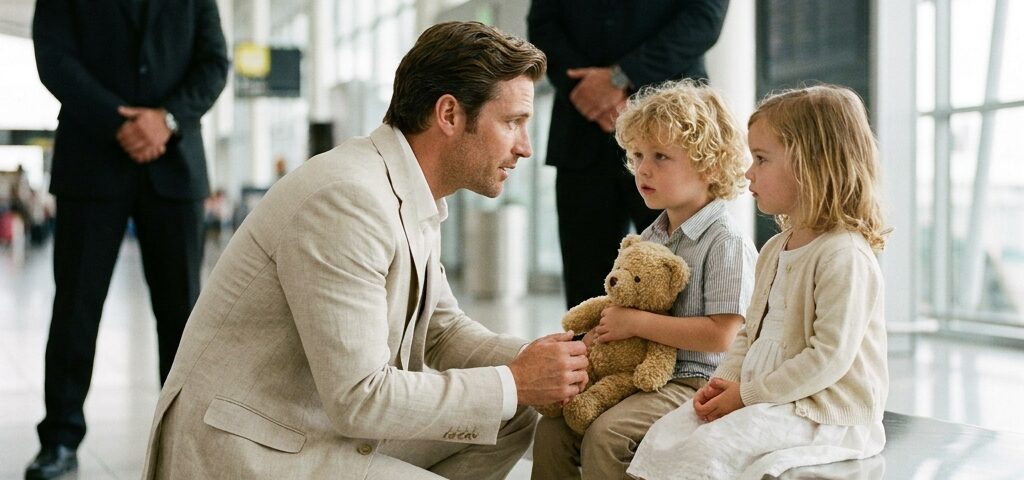
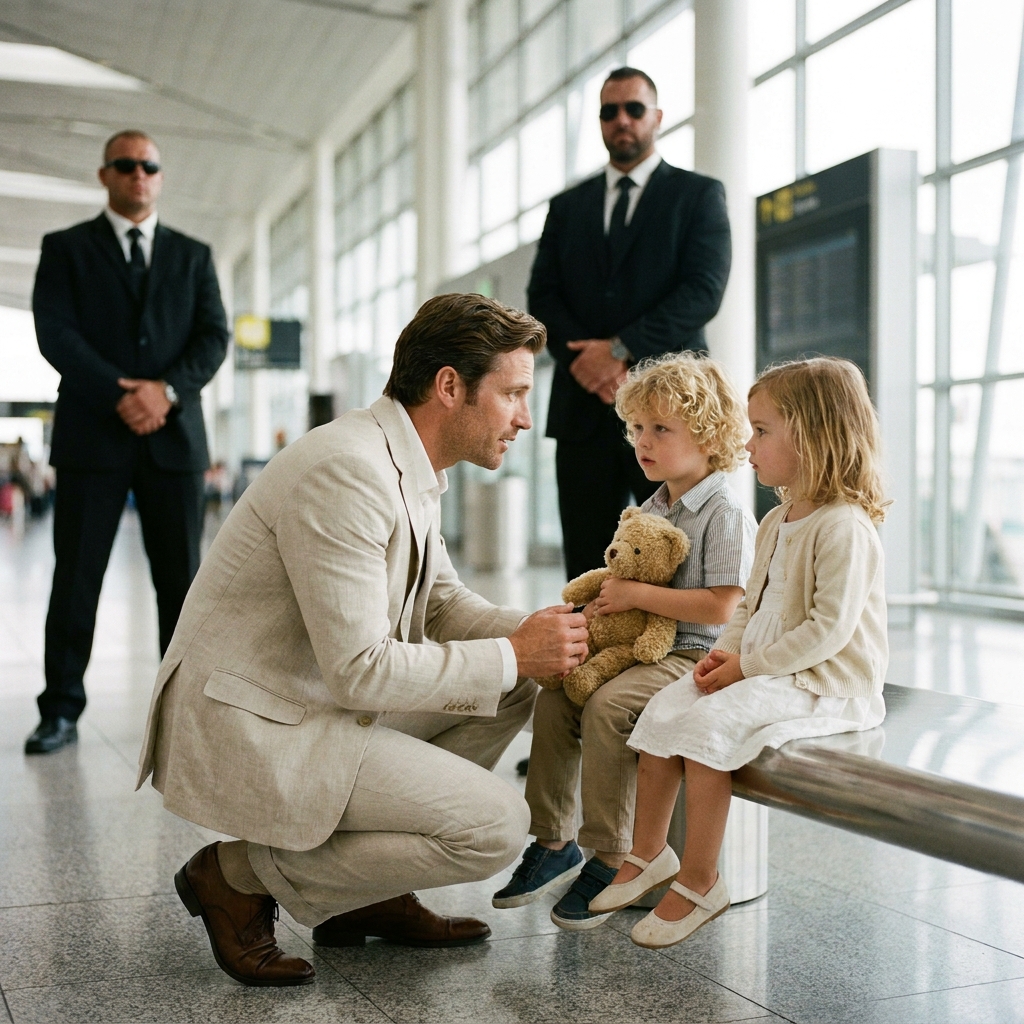
Lily’s hand was small in mine, cold despite the warm pulse of the terminal lights overhead. Owen sat pressed against her shoulder, the teddy bear wedged under his chin like a shield. Around us, O’Hare Airport kept breathing its enormous, restless breath—announcements echoing, wheels rattling over polished floors, strangers rushing toward places where someone might be waiting.
But for those two children, time had stopped at Gate 17.
I kept my voice calm when I spoke into the phone again.
“No one boards or exits until airport security reaches that aircraft. Do it through the proper channels. Quietly.”
Marco was already moving. He had worked with me long enough to understand that calm did not mean relaxed. Calm meant a decision had been made.
The gate agent, a woman with silver-framed glasses and a name tag that read Denise, stared at me with wary confusion. “Sir, you can’t just stop a plane.”
I looked up at her. “I’m not stopping a plane. I’m reporting two abandoned minors.”
Her expression changed at once.
She stepped around the counter, lowering herself so she was closer to the twins’ eye level. “Sweetheart,” she said gently to Lily, “did the woman who brought you here tell you to wait?”
Lily nodded.
“Did she say when she was coming back?”
Owen answered before his sister could. “She said we had to be good and not bother anyone.”
The words were simple. That made them worse.
Denise pressed her lips together, then spoke into her radio, her voice firm but careful. Within minutes, two airport police officers arrived. One was a tall Black woman named Officer Grant, whose calm eyes softened when she saw the twins. The other, Officer Ruiz, began asking Denise for details near the gate desk.
I stayed seated beside Lily and Owen.
“Are we in trouble?” Owen whispered.
“No,” I said. “You didn’t do anything wrong.”
Lily looked down at our joined hands. “She gets mad when people make trouble.”
“Who?”
“Marissa,” she said.
The name landed like the first clue in a locked room.
“Marissa is your stepmother?”
Lily nodded. “She married Dad.”
Owen’s fingers tightened around the bear. “Before he got sick.”
Officer Grant crouched nearby. “I’m Officer Grant. I help kids who get separated from grown-ups. Can I ask you a few questions?”
Lily leaned slightly closer to me but nodded.
Officer Grant’s voice stayed kind. “Do you know your last name?”
“Vale,” Owen said. “Owen Vale. Lily Vale.”
The name struck a faint chord in my memory, not because I knew children by that name, but because I had spent half my life remembering families whose companies crossed mine. Vale. Pharmaceutical packaging. Midwest distribution. A quiet fortune wrapped in old money and private grief.
“Your father’s name?” I asked before I could stop myself.
Lily swallowed. “Daniel.”
Daniel Vale.
I stood slowly.
Marco, who had returned from the corridor, noticed my expression at once. “You know that name?”
“I knew of him,” I said.
But that was not entirely true.
Years ago, Daniel Vale had sat across from me in a hospital fundraising meeting, pale but smiling, speaking not about profit or legacy, but about a pediatric research wing he wanted built before his illness took his strength. He had shown me a photo then—two babies with blond curls asleep in one crib, their tiny fists touching.
“My twins,” he had said with quiet pride. “They’re the best part of me.”
I had not thought about that meeting in years.
Now his children sat abandoned in an airport, carrying a worn bear and a silence too heavy for their age.
Officer Ruiz approached. “The aircraft is still at the gate. Door has not been reopened yet. Chicago PD and airline supervisors are coordinating. The passenger has been identified as Marissa Vale.”
“Where was she going?” I asked.
He studied me. “And you are?”
“Ryker Steel.”
That name changed the air, as it often did, but not in the way people assumed. Officer Ruiz did not look impressed. He looked cautious.
“I understand you’re involved because you found the children, Mr. Steel. But this is now a police matter.”
“As it should be,” I said.
The answer seemed to surprise him.
I gave him my card anyway. “My legal team is available if documentation is needed. My priority is that the children are safe.”
Lily tugged my sleeve. “Are they going to make us go with her?”
I knelt again. “Not tonight.”
I did not know if I had the authority to promise that. I only knew I would move every mountain necessary to make it true.
A child services representative arrived nearly twenty minutes later, a woman named Hannah Brooks with tired eyes and a gentle manner that suggested she had learned how to carry other people’s emergencies without letting them crush her. She carried two small bottles of water, a pack of crackers, and two stuffed airport mascot toys someone had found in a gift shop.
Owen accepted the crackers but not the toy. Lily accepted neither.
Hannah sat across from them. “I know this is scary. My job is to make sure you have somewhere safe to sleep tonight while grown-ups figure things out.”
Lily’s face tightened.
“Not a group home,” Owen whispered.
Hannah paused.
I looked from one twin to the other. “Have you been in one before?”
Neither answered.
That answer was enough.
Hannah’s expression revealed nothing, but I saw her make a note. “We’ll look at all options. Do you have grandparents? Aunts? Uncles?”
Lily stared at the floor.
Owen mumbled, “Aunt Clara.”
Hannah brightened slightly. “Do you know her last name?”
“Vale,” Lily said. “Dad’s sister. Marissa said she moved away because she didn’t want us.”
For the first time, anger rose sharp enough that I had to look away. Not wild anger. Not theatrical. The cold, focused kind that arrives when an adult realizes how carefully a child has been taught to feel unwanted.
Hannah noticed. “We’ll verify that.”
Marco came close and lowered his voice. “The woman is being escorted off the plane.”
Lily heard him. Her whole body stiffened.
I turned to Officer Grant. “Can the children be taken somewhere private before that happens?”
Officer Grant nodded immediately. “Yes.”
Denise opened a small staff room behind the gate area. It smelled faintly of coffee and printer paper. There was a round table, four chairs, and a window facing the runway, where planes moved like distant lanterns through the afternoon haze.
The twins sat side by side. Hannah remained with them. I stood near the door, uncertain whether I was helping or intruding.
Then Lily said, “Please don’t go.”
So I stayed.
For the next hour, the world narrowed to small tasks. Water. Crackers. A clean napkin for Owen when crumbs stuck to his sleeve. A quiet explanation that no, they would not have to answer every question all at once. Hannah asked about school, favorite foods, bedtime routines. Lily answered more often than Owen, though she always looked at him first, as if permission passed silently between them.
They liked pancakes. Owen liked dinosaurs. Lily liked drawing houses with yellow windows. They had not been to kindergarten regularly because Marissa said transportation was difficult. They slept in the same room because Owen had nightmares. Their father used to sing off-key. He used to call them his “two brave stars.”
When Lily said that, her voice broke.
She turned her face away quickly, embarrassed by the sound.
I handed her a tissue without speaking.
At some point, Marco entered with a paper cup of coffee I never drank. “Marissa Vale is claiming this was a misunderstanding,” he said quietly.
Hannah looked up. “What kind of misunderstanding?”
“She says she believed a nanny was meeting them at the gate.”
Officer Grant, who had joined us near the door, shook her head. “No nanny has come forward. No call was made to airport services. No arrangement was recorded with the airline.”
I looked at the twins. “Was a nanny supposed to come?”
Owen hugged the bear tighter. “We don’t have a nanny anymore.”
Lily whispered, “Marissa said nannies tell too many stories.”
A silence followed.
Hannah closed her notebook slowly.
Outside the staff room, the airport lights began to shift toward evening. The gray-blue sky beyond the window deepened. I should have been on a flight to New York. There was a merger meeting waiting, contracts, rooms full of people paid to panic if I was absent.
For once, none of it mattered.
My phone vibrated again and again. I ignored it until Marco finally said, “It’s Evelyn.”
My older sister rarely called twice.
I stepped into the hallway. “Not now.”
“That’s how you answer your only sister?” Evelyn said. “Your assistant said you stopped a plane.”
“Not personally.”
“Ryker.”
I closed my eyes. “Two children were abandoned at O’Hare.”
Her voice changed. “Are they safe?”
“For now.”
“Do they need anything?”
I looked through the small window in the door. Lily was drawing with a pen Hannah had given her. Owen watched the pen move as though the picture might explain what came next.
“They need someone who won’t leave,” I said.
Evelyn went quiet.
After our parents died, Evelyn had been eighteen and I had been twelve. She had raised me with grocery coupons, late-night homework checks, and a stubborn belief that grief did not excuse giving up. Years later, when money came, she never let me pretend wealth had created character. It had only revealed what was already there.
“Then be that until the right person is found,” she said.
“I don’t know if I can.”
“You don’t have to know. You just have to stay.”
When I returned to the room, Lily had drawn a house. Yellow windows. Two small figures in the doorway. A third figure stood farther back under a tree. Tall. Square shoulders. No face.
“Who’s that?” I asked.
She covered the page with her hand. “No one.”
Hannah gave me a look that meant not yet.
By early evening, the decision was temporary but clear. The children would not be released to Marissa. Child services would seek emergency placement while contacting relatives. Because of my involvement and because Lily refused to let go of my sleeve whenever anyone mentioned leaving, Hannah asked whether I would be willing to remain present until a placement was confirmed.
“Yes,” I said.
Marco blinked. “Ryker, your apartment—”
“Has rooms.”
Hannah looked cautious. “Emergency kinship or foster placement is not that simple, Mr. Steel.”
“I know. I’m not asking you to break rules.”
“Good,” she said. “Because I won’t.”
“I’m asking what can be done within them.”
That answer seemed to satisfy her more than any display of influence would have.
It took hours. Background checks. Calls. Forms. A judge reached after dinner. My sister, summoned by Hannah as a character reference, gave answers so thorough that Hannah later told me she knew my childhood dentist, my least favorite vegetable, and the fact that I once brought home a stray dog and hid it in the laundry room for three days.
Near midnight, temporary emergency placement was approved under strict supervision until a relative could be located.
When Hannah explained it to the twins, Owen asked, “Is he a stranger?”
“Yes,” Hannah said honestly. “But he is a stranger who stayed. And I will be checking on you.”
Lily looked at me. “Do you have cereal?”
“I have no idea,” I said.
For the first time, Owen almost smiled.
Marco arranged the car. Denise brought two small airline blankets and pressed them into my hands. “For the kids,” she said, then turned away quickly.
As we walked through the terminal, Lily held my left hand and Owen held my right. Cameras watched from ceilings. Travelers glanced at us without knowing what they were seeing. Two children leaving behind one life and entering another, not rescued in any grand, shining way, but simply not left alone.
The city outside was cold. The car smelled of leather and rain.
Owen fell asleep before we reached the highway. Lily fought sleep longer, her head bobbing, eyes fixed on the window where Chicago lights smeared gold across the glass.
“Mr. Steel?” she murmured.
“Ryker is fine.”
“Does your house have locks?”
“Yes.”
“On the inside?”
The question moved through me like a blade slipped quietly between ribs.
“Bedroom doors don’t need to be locked where you’re safe,” I said carefully. “But if a closed door helps you feel better, we can talk about it with Hannah tomorrow.”
She considered that, then nodded once.
My apartment occupied the top floors of a building overlooking the river. I had bought it for privacy, for silence, for the illusion that height could create distance from everything below. That night, it looked absurdly unprepared for children. Glass tables. White furniture. Art chosen by consultants. A refrigerator containing mineral water, olives, and something my housekeeper had labeled soup.
Marco stood in the foyer with two sleepy children and one stuffed bear. “This place looks like a museum.”
“I’m aware.”
“We need pajamas.”
“I’m aware.”
“And toothbrushes.”
“Marco.”
“And cereal.”
Owen, half-asleep, whispered, “Pancakes.”
Marco looked at him solemnly. “We can solve pancakes.”
Evelyn arrived twenty minutes later with two overnight bags, a sack of groceries, and the expression of a woman prepared to reorganize an entire household by force of will. She wore jeans, a wool coat, and no makeup. Her dark hair was twisted into a clip. To me, she looked like home walking through the door.
Lily hid behind my leg.
Evelyn stopped several feet away and smiled gently. “Hi, Lily. Hi, Owen. I’m Evelyn. Ryker is my little brother, which means I know all his secrets.”
Owen opened one eye. “All of them?”
“Most of them.”
“Did he ever eat bugs?”
I stared at my sister.
Evelyn’s smile widened. “Only once, and it was a raisin.”
Owen’s almost-smile returned.
That was how my apartment began changing.
Not dramatically. Not all at once. But through small invasions of life. Two toothbrushes in blue cups. Pancake mix on the counter. A night-light from the building concierge’s emergency supply of things his grandchildren had outgrown. Evelyn found clean T-shirts for them to sleep in, oversized and soft.
When bedtime came, Lily stood in the doorway of the guest room and looked at the large bed as if it might swallow her.
“Can Owen sleep there too?” she asked.
“Of course.”
I brought extra pillows. Evelyn tucked the blankets around them with practiced hands. Owen placed the bear between himself and Lily. Lily kept her eyes open.
“Will you be here in the morning?” she asked.
“Yes.”
“Promise?”
I had made promises in boardrooms that moved markets. I had signed documents worth more money than most people could imagine. None of them felt as serious as this.
“I promise.”
She studied me, searching for the lie.
Then she nodded.
I did not sleep much.
At three in the morning, I found Owen standing silently in the hallway, barefoot, clutching the bear. His eyes were open but unfocused.
“Hey,” I said softly.
He blinked.
“Bad dream?”
He nodded.
I crouched. “Do you want to tell me about it?”
“Dad was at the airport,” he whispered. “But he couldn’t find us.”
I sat on the floor because it seemed easier than asking him to stand in his sadness. After a moment, he sat too.
“My parents died when I was young,” I said. “For a long time, I dreamed they were trying to get home but couldn’t.”
Owen looked at me. “Did they?”
“No.”
He absorbed that with the seriousness only children can bring to truth.
“But my sister stayed,” I said. “That helped.”
He leaned against the wall. “Lily stays.”
“Yes,” I said. “She does.”
After a while, he let me carry him back to bed.
Morning arrived pale and quiet over the river. Evelyn made pancakes badly, which somehow delighted the twins. Marco appeared with clothes, school supplies, and three kinds of cereal because he had panicked in the grocery aisle. Hannah arrived at nine and inspected everything with professional care.
“No locked rooms,” she said.
“None.”
“No media.”
“Absolutely not.”
“No contact with Marissa except through authorities.”
“Understood.”
She watched Lily show Evelyn her drawing. “They seem calmer.”
“They’re good at pretending.”
Hannah looked at me then, and for the first time her guarded expression softened. “Yes. They are.”
By noon, she had news.
“We found Clara Vale.”
The twins froze.
Hannah sat at the dining table, phone in hand. “She lives in Michigan. She says she has been trying to locate the children for months.”
Lily’s face went pale. “Marissa said Aunt Clara didn’t want us.”
“I know,” Hannah said. “But Clara says that isn’t true.”
Owen’s voice shook. “Is she coming?”
“She’s driving here now.”
Lily slipped off her chair and came to stand beside me. “Do we have to go?”
The question should have relieved me. A blood relative had been found. A person who might have loved them all along was coming. The system was working, imperfectly but steadily.
Instead, my chest tightened.
“No one is deciding everything this minute,” Hannah said. “You’ll meet her with me here.”
Clara Vale arrived at four in the afternoon, carrying grief like a coat she had forgotten how to remove. She was in her late thirties, with the same blue eyes as the twins and Daniel’s gentle mouth. Snow clung to the hem of her dark coat. Her hands trembled when she saw them.
“Lily,” she whispered. “Owen.”
The twins stared.
Clara did not rush forward. That mattered. She knelt where she was, tears filling her eyes. “You probably don’t remember me. You were three when I last saw you. I’m Aunt Clara. Your dad’s sister.”
Lily looked at Hannah, then at me.
Clara opened her bag slowly and took out a photograph. Daniel stood in a backyard, thinner than in my memory but smiling. Beside him was Clara. In front of them, two toddlers sat in the grass, each holding one end of the same stuffed bear.
Owen gasped.
“That’s Bruno,” he said.
Clara laughed through tears. “Yes. You named him after a dog in a book Daniel read every night.”
Owen looked down at the bear in his arms, as if it had suddenly become a bridge to a vanished world.
“Why didn’t you come?” Lily asked.
The room went still.
Clara pressed the photograph against her chest. “I tried. After your dad died, Marissa told me you needed space. Then she changed numbers. Then the house was sold. My letters came back. I hired someone to find you, but every address led nowhere.”
“Marissa said you were angry because Dad left us money,” Lily said.
Clara flinched. “Your father did leave money. For you. Not for me.”
Hannah leaned forward. “What kind of money?”
“A trust,” Clara said. “Daniel set it up before he died. Education, medical care, living expenses. Enough that the children would never be a burden on anyone.”
I felt the final pieces of the day begin to rearrange themselves into something darker, quieter, and more deliberate than simple abandonment.
“What happened to the trust?” I asked.
Clara’s eyes moved to mine. “Marissa controlled access as surviving guardian. But only until the court finalized Clara’s petition for shared oversight.”
Hannah’s pen stopped. “You filed a petition?”
“Eight months ago,” Clara said. “The hearing is next week.”
The room seemed to lose air.
Marco, standing near the windows, muttered, “So she wasn’t running from the children.”
I finished the thought. “She was running before someone looked closely.”
Lily did not understand all of it, but she understood enough. Her hand found mine again.
Hannah excused herself to make calls. Officer Grant returned within the hour. Clara gave statements. Documents appeared by email: court filings, returned letters, copies of Daniel’s will. My legal team, finally useful for something that mattered, began reviewing everything.
Through it all, the twins sat at the kitchen island, coloring with Evelyn. Normalcy, even borrowed normalcy, held them together.
At dusk, Clara stood by the window, looking down at the river.
“I thought I had failed them,” she said.
“Maybe you were lied to by someone very determined,” I replied.
She wiped her cheek. “Daniel trusted Marissa near the end because he was scared. He didn’t want to die believing his children would be alone.”
I thought of the man in the hospital meeting, holding a photo of sleeping babies.
“He didn’t,” I said. “Not entirely.”
Clara looked at me. “Why did you stop?”
The answer should have been easy. Anyone decent would have stopped. But hundreds had walked past. Maybe they had not seen. Maybe seeing required a kind of willingness.
“I recognized the quiet,” I said.
She understood enough not to ask more.
That evening, Hannah decided Clara would remain in Chicago while emergency custody was reviewed. The twins were not ready to leave with her yet, and Clara, to her credit, did not push.
“I can wait,” she told Lily. “As long as you need.”
Lily studied her. “Grown-ups say that.”
Clara nodded. “They do.”
“Then they leave.”
Clara’s face crumpled, but she steadied it. “Then I’ll say something else. I’ll be at breakfast tomorrow.”
Lily looked at me. “Here?”
I glanced at Hannah.
Hannah sighed. “Here is acceptable for one supervised breakfast.”
Marco whispered, “We need more pancake mix.”
For the second night, the apartment filled with small sounds. Running water. Evelyn humming in the kitchen. Owen asking Clara cautious questions about his father. Lily pretending not to listen while coloring another house with yellow windows.
This time, the tall figure under the tree had a face.
Not mine.
Daniel’s.
Later, after the twins had fallen asleep, I stood alone in my study with Daniel Vale’s will open on my desk. Legal language marched across the page in orderly lines. Assets. Guardianship. Trust conditions. Contingencies.
Then I saw a clause highlighted by my attorney.
In the event of evidence suggesting misconduct by the surviving guardian, temporary advisory authority was to transfer to the secondary trustee named herein.
I read the sentence twice.
Then the name below it.
Ryker Elias Steel.
For a long moment, I heard nothing but the river wind against the glass.
Daniel had named me years ago.
Not Clara. Not a bank. Not a family lawyer.
Me.
Marco stood in the doorway, his face pale. “Ryker, there’s something else.”
I looked up.
He held out an old sealed envelope, delivered that evening by Clara from Daniel’s files. Across the front, in handwriting I recognized from a forgotten thank-you note years before, were five words:
For Ryker, when they are found.
PART 3
The envelope felt heavier than paper should have.
For several seconds, I did nothing but stare at Daniel Vale’s handwriting. Five words sat across the cream-colored surface in dark blue ink, neat and steady, as if he had written them at a desk in daylight, not from inside the shadow of a life ending too soon.
For Ryker, when they are found.
Not if.
When.
That single word pressed against my ribs.
Marco remained in the doorway, waiting. He had seen me negotiate hostile acquisitions, government investigations, boardroom betrayals, and the kind of private threats wealthy men made when they forgot money did not make them invisible. He had seen me calm.
He had rarely seen me unsure.
“Where did Clara get this?” I asked.
“Daniel’s storage boxes,” Marco said. “She brought a few things in case they helped the custody review. She said she found it taped inside the lid of a file box marked medical receipts.”
“Does she know what’s inside?”
“She said no. It was sealed.”
I ran my thumb along the edge.
Across the apartment, beyond the study door, I could hear soft movement. Evelyn in the kitchen rinsing mugs. Clara speaking quietly to Hannah Brooks near the dining table. Somewhere farther down the hall, Lily and Owen slept in the guest room, two small bodies under too-large blankets, Bruno the bear resting like a loyal guard between them.
Everything in my apartment had changed in less than two days.
The silence had changed most of all.
It no longer felt expensive.
It felt like it was listening.
I opened the envelope carefully.
Inside were three folded pages and a small photograph.
The photograph fell out first, landing faceup on my desk.
Daniel stood beside me in a hospital courtyard years earlier. I remembered the day, though I had not remembered the picture. He wore a gray scarf despite the spring sun. I wore a suit and the expression of a man who had come for a donor meeting and expected nothing more meaningful than polite conversation.
Between us stood a young doctor holding a ceremonial shovel for the new pediatric wing.
On the back, Daniel had written:
You stopped long before O’Hare.
My throat tightened before I understood why.
I unfolded the letter.
Ryker,
If this letter reaches you, then the worst possibility has become real, but so has the best one: Lily and Owen have been found.
I know this is unfair. I know we were not close friends in the ordinary sense. We had a handful of meetings, two long conversations, and one argument about whether money can ever truly repair what neglect destroys. You said no. I said it had to try.
I trusted you from that argument forward.
I lowered myself into the chair.
The words blurred for a moment, not because I did not understand them, but because I did.
Daniel had seen something in me during that hospital project I had not seen in myself. Back then, I had thought of charity as obligation, reputation, perhaps atonement. Daniel had thought of it as a promise made to strangers who might never know your name.
I kept reading.
My illness is advancing. I am writing letters I hope no one needs. Marissa is kind to me when people are watching and impatient when she thinks I am too weak to notice. I do not want to believe she would harm the children, but I have learned that refusing to see a danger does not make it less dangerous.
Clara has tried to warn me. I have been proud, frightened, and ashamed.
If Marissa separates Lily and Owen from Clara, if my children vanish into paperwork, if someone finds them and wonders why a dying man named a near-stranger as trustee, tell them this: I chose you because you knew what it meant to be a child left in a room waiting for someone who did not come.
My hand closed around the page.
I was twelve again.
A hospital hallway. Evelyn’s fingers wrapped around mine. A doctor speaking softly. My father’s watch in a plastic bag. My mother’s purse sitting on a chair as if she might return any moment and pick it up.
I had forgotten the waiting.
No. That was a lie.
I had buried it under towers, contracts, acquisitions, and the carefully polished armor of a man people called untouchable.
Daniel had seen through it in one conversation.
Marco’s voice came softly. “Ryker?”
I swallowed.
“I’m fine.”
He did not insult me by believing that.
The letter continued.
I have placed a secondary trust authority in your name. The court may ignore it. Marissa may contest it. Clara may be angry that I did not trust her fully, though the truth is I did. I trusted her heart. I needed someone with enough power to withstand the people Marissa might use.
But there is another reason.
If you are reading this, please look for the blue ledger.
Marissa believes I destroyed it. I did not.
The ledger proves the children’s trust was never the real target.
I stopped.
The apartment seemed to still around me.
Marco stepped closer. “What ledger?”
I looked up slowly. “I don’t know.”
The final paragraph was shorter.
Please protect Clara from blaming herself. Please protect my children from believing they were unwanted. And please, if there is anything decent in the world, make sure Lily keeps drawing houses with yellow windows. She says those are the ones where people come home.
Daniel Vale
For a long moment, I could not move.
Then I folded the letter and placed it carefully on the desk, as if it belonged to someone sleeping.
Marco’s face was unusually grave. “Do we tell Clara now?”
I looked toward the hall.
Through the glass panel beside the study door, I could see Clara sitting at the dining table with her hands clasped tightly around a mug. Hannah was speaking gently, likely explaining procedures, timelines, next steps. Evelyn stood nearby, not interfering, just present.
Clara had spent months searching for the children while being told, in a hundred quiet ways, that she had failed them. Now Daniel’s own words said he had trusted her heart but hidden the one piece of information that might have helped her.
“Yes,” I said. “But not like a briefing. Like family.”
Marco arched an eyebrow. “You doing family meetings now?”
“I’m improvising.”
“Terrifying.”
I almost smiled.
We gathered at the dining table five minutes later. Evelyn sat beside Clara. Hannah remained because she needed to document anything relevant to the children’s safety. Marco stood near the kitchen island, trying to look invisible and failing because he was built like a locked door.
I placed the letter in front of Clara.
She stared at Daniel’s handwriting, and all the color drained from her face.
“I know that writing.”
“It was sealed,” I said. “It was addressed to me.”
“Why you?” she whispered.
“I’m still trying to understand that.”
Her fingers trembled as she touched the envelope but did not open it. “Daniel named you in the trust documents too. I thought it was a mistake when I saw it. Or something Marissa altered.”
“I thought the same.”
Clara looked at me then, and in her eyes I saw a grief that had learned to stand upright.
“What did he say?”
I did not summarize. Some truths are too delicate to paraphrase.
I handed her the letter.
She read it silently.
At first, her face barely changed. Then her shoulders began to shake. Evelyn reached for her hand, and Clara clutched it as if they had known each other for years instead of hours.
“He knew,” Clara whispered. “He knew something was wrong.”
“Yes.”
“I begged him to listen. I brought him bank statements, messages, things Lily said on video calls before Marissa stopped them.” Clara pressed the letter against her chest. “He told me I was grieving too hard and seeing monsters.”
“Maybe he wanted you to be wrong.”
She closed her eyes. “So did I.”
Hannah leaned forward carefully. “The letter mentions a blue ledger.”
Clara opened her eyes.
For the first time since arriving, fear crossed her face.
“What?” I asked.
She shook her head slowly. “I haven’t heard that phrase since Daniel was first diagnosed.”
“What is it?”
“I’m not sure. He kept notebooks. Old-fashioned habit from our father. Business notes, personal reminders, medication schedules. Marissa hated them. She said they made him look paranoid.” Clara frowned, reaching into memory. “There was one blue book he kept locked in his desk. I asked about it once. He said it was insurance.”
“Against Marissa?”
“I don’t know.”
Evelyn glanced toward the hallway where the twins slept. “Does Marissa know it exists?”
“Daniel’s letter says she thinks it was destroyed,” I said.
Hannah made another note. “Then someone else may be looking for it.”
As if summoned by the words, my phone lit up on the table.
Unknown number.
Marco straightened.
I answered on speaker without speaking first.
For three seconds, there was only static.
Then a woman’s voice, smooth and breathless, filled the room.
“Mr. Steel, you’ve involved yourself in something you don’t understand.”
Clara went rigid.
Marissa Vale.
I kept my tone even. “You abandoned two children in an airport.”
“I made a mistake under emotional stress.”
“No. You made a decision.”
A soft laugh. “Men like you always think you can rename things and own them.”
Evelyn’s eyes narrowed.
I said nothing.
Marissa continued. “The children are confused. Clara is unstable. Hannah Brooks is underqualified. And you, Mr. Steel, are a stranger with a hero complex and too much money.”
Hannah’s expression did not change, though I saw her pen pause.
“You should speak through your attorney,” I said.
“You should ask Clara what she did the night Daniel changed his will.”
Clara stood so fast her chair scraped against the floor. “You liar.”
There was silence on the line.
Then Marissa said softly, “Hello, Clara. Still performing innocence beautifully, I see.”
Evelyn rose, placing a steadying hand on Clara’s arm.
I kept my gaze on the phone. “This call is being documented.”
“Good,” Marissa said. “Then document this. Daniel was not the gentle saint Clara has sold you. He hid things from everyone. Especially from his children.”
The line clicked dead.
For a moment, no one moved.
Then Clara covered her mouth with both hands. “She wants to make me look dangerous.”
Hannah’s voice remained calm. “Did anything happen the night Daniel changed his will?”
Clara lowered her hands. “Yes.”
We waited.
She looked toward the dark window, where the city reflected back at us in pieces.
“I argued with him. Badly. I had found out Marissa had withdrawn money from one of the children’s medical accounts. Daniel defended her. I said if he wouldn’t protect Lily and Owen, I would go to court before he died.” Her voice cracked. “He told me to leave his house.”
“What happened after that?” Hannah asked.
“I left. Two days later, he changed the will.” Clara looked at me. “He removed Marissa’s sole control and added oversight. Mine first. Yours if I couldn’t serve.”
“Why would Marissa mention that night?” Evelyn asked.
“Because the next morning Daniel collapsed,” Clara whispered. “Marissa told everyone the argument weakened him.”
The room held its breath.
Hannah spoke gently. “Did it?”
“No.” Clara’s answer came sharper now. “His doctors said the collapse was expected. His condition was worsening. But Marissa made sure every nurse, cousin, and neighbor heard that I upset him.”
I thought of Marissa’s voice on the phone. Smooth. Practiced. Skilled at turning uncertainty into accusation.
“She’s laying groundwork,” Marco said. “Same as before.”
I nodded. “Then we don’t answer emotion with emotion. We answer with records.”
Clara looked exhausted. “Records are exactly how she took them.”
“Then records are how we bring them back.”
The next morning, the apartment smelled of pancakes again.
This time Evelyn let me make them, which proved to be a mistake. The first batch stuck to the pan. The second looked like torn maps. The third was edible only because Owen declared that “weird pancakes taste more brave.”
Lily remained quieter than her brother. She sat beside Clara but kept one foot hooked around the leg of my chair, a small compromise between old fear and new possibility.
Clara did not push. She asked simple questions.
“Do you still like strawberries?”
Lily shrugged. “Sometimes.”
“Your dad used to cut them into stars.”
Owen looked up. “How?”
“With a tiny knife and too much confidence.”
That made him laugh.
The sound startled everyone, including Owen himself.
Clara froze as if afraid movement might break it. Then she smiled through tears and looked down at her plate.
After breakfast, Hannah suggested a supervised visit in the living room while adults sorted through Daniel’s files. The twins sat with Clara on the rug. Evelyn brought out colored pencils. Owen asked about Daniel’s old stories. Lily listened without admitting she was listening.
Clara told them about their father trying to build a treehouse that leaned dramatically to one side. About how he once burned soup. About how he sang “You Are My Sunshine” so badly that baby Lily screamed until he switched to humming.
“He called us brave stars,” Lily said quietly.
Clara’s face softened. “Because you were born early. Tiny, furious, and determined. He said you fought your way into the world.”
Owen hugged Bruno. “Did he know we were too much trouble?”
Clara flinched, but she answered with extraordinary steadiness.
“No. He thought you were the greatest gift he ever received.”
Owen stared at her.
“You’re not saying that because grown-ups have to?”
“No,” Clara said. “I’m saying it because I was there.”
Lily’s pencil stopped moving.
Something in the room shifted then. Not healed. Healing is not a door that opens once. It is a window cracked slowly after years of stale air.
But for the first time, Lily leaned the smallest bit toward Clara.
In my study, Daniel’s files formed uneven towers across the desk. My attorneys worked remotely. Marco coordinated with security. Hannah checked every document before anything left the apartment. It was careful, tedious, and necessary.
By afternoon, we had a timeline.
Daniel’s first will named Marissa as guardian and Clara as emergency backup.
Six months before his death, after Clara’s warning, Daniel revised it. Clara gained oversight of the trust. I appeared as secondary trustee in the event of obstruction, misconduct, or disappearance.
Three months after Daniel’s death, Marissa sold the Vale family home.
Four months after that, Clara’s letters began returning undelivered.
Eight months later, Clara filed for shared oversight.
One week before the hearing, Marissa took the twins to O’Hare.
Every fact pointed in the same direction, yet the blue ledger remained invisible.
That evening, Clara remembered something.
“The lake house.”
We all looked up.
“What lake house?” I asked.
“Daniel kept a small place in Wisconsin. Not fancy. More like a cabin. It belonged to our parents. Marissa hated it because it wasn’t modern enough.” Clara stood, pacing as memories caught up. “He went there after treatments sometimes. He said he could think there.”
“Was it sold?”
“I assumed so.”
Marco checked property records. “Still owned by the Vale trust.”
Clara turned sharply. “What?”
“No sale recorded.”
Her eyes widened. “Then Marissa lied. She told me it was sold to cover medical debt.”
“Can Daniel’s desk be there?” Evelyn asked.
Clara’s answer came slowly. “Yes. The old rolltop from his office. Marissa didn’t want it in the new house. Daniel sent it to the cabin.”
The blue ledger.
Nobody said it, but everybody thought it.
Hannah lifted a hand. “Before anyone runs to Wisconsin, remember there is an active custody review. These children need stability, not another dramatic disruption.”
“She’s right,” Evelyn said.
I looked toward the living room.
Lily and Owen were building a blanket fort with Clara. Or rather, Owen was building, Clara was holding up one corner, and Lily was pretending not to care while correcting the roof structure every thirty seconds.
“I’ll go,” Marco said.
“No,” Clara replied. “I should. Daniel was my brother.”
“Then I’m going with you,” Evelyn said.
Clara blinked. “You don’t have to do that.”
“I know.”
Evelyn’s tone ended the discussion.
I stayed with the children because leaving them after promising to remain would have broken something too fragile to repair. Hannah approved the plan only after attorneys arranged proper documentation and local authorities were notified that Clara had lawful access to the property.
The next day stretched strangely.
The twins asked questions with their bodies before their mouths. Lily hovered near the windows. Owen checked the hallway whenever the elevator chimed. They had learned that adults leaving often meant adults gone.
So we made the day visible.
Evelyn and Clara called from the road before breakfast, from a gas station near the state line, and when they reached the cabin. Clara showed the twins the lake by video. Frozen at the edges, silver under a pale sky.
“Dad took us there?” Owen asked.
“When you were babies,” Clara said through the phone. “You both hated hats.”
“I still hate hats,” Owen said.
“I remember.”
Lily said nothing, but she watched the screen as if trying to step through it.
Hours passed.
No ledger.
They found old fishing rods, Daniel’s college books, children’s life jackets too small for anyone now, a box of tax records, winter boots, a cracked mug that said World’s Okayest Dad. They found the rolltop desk locked.
Marco talked Evelyn through opening it without damaging the wood.
Inside were receipts, photographs, medication logs, letters Daniel had started and not finished.
No blue ledger.
At four in the afternoon, Clara called again. Her face was flushed from cold and frustration.
“I don’t understand. He said insurance. He wouldn’t have hidden it somewhere obvious, but he wouldn’t have made it impossible.”
Behind her, Evelyn’s voice said, “Ask Lily.”
Clara hesitated. “What?”
Evelyn appeared beside her on the screen. “Ask Lily where her father hid important things.”
Lily, sitting beside me on the sofa, stiffened.
I looked at her. “Do you remember something?”
She shook her head too quickly.
Owen looked at his sister. “The blue moon box.”
Lily glared at him.
“What is the blue moon box?” I asked gently.
Owen pointed at the phone. “At the cabin. Dad had a box with a moon. Lily put rocks in it.”
Clara’s hand flew to her mouth. “The toy chest.”
The video blurred as they moved through the cabin. Floorboards creaked. A door opened. Evelyn breathed hard, laughing once with disbelief.
Then the camera steadied on a small wooden toy chest painted dark blue, with a crescent moon on the lid.
Clara knelt and opened it.
Inside were faded blankets, wooden blocks, a stuffed rabbit, and a layer of old picture books.
Under the books was a false bottom.
Under the false bottom was a blue leather ledger.
Nobody spoke.
Lily slid closer to me until her shoulder touched my arm.
Clara opened the ledger with shaking hands.
Her eyes moved across the first page.
Then the second.
Then all the warmth left her face.
“What is it?” I asked.
Clara looked into the camera.
“It’s not just financial records.”
Evelyn read over her shoulder, and her expression changed too.
“It’s a list,” Clara whispered. “Names. Dates. Payments.”
“Trust payments?” Hannah asked from the chair nearby.
Clara shook her head.
“Children,” she said. “Families from the foundation Daniel supported. Foster placements. Guardianships. Adoption petitions.”
My pulse slowed.
Daniel’s letter returned to me.
The children’s trust was never the real target.
Clara turned another page and went still.
“Ryker.”
“What?”
She lifted the ledger closer to the camera.
At the bottom of one page, beneath a series of names and dates from more than twenty years earlier, was my own name.
Ryker Elias Steel.
Beside it were my parents’ names.
And below them, in Daniel’s handwriting, one sentence had been underlined twice.
Steel accident file transferred through Bellweather intermediary.
I could not breathe.
The room around me faded to the sound of Lily’s small voice.
“Ryker?”
I looked down.
She had taken my hand the way she had at Gate 17, trusting me to know what came next.
But for the first time since O’Hare, I had no answer.
On the screen, Clara turned the final page they had found marked with a red ribbon.
Her face crumpled.
“There’s a photograph.”
Evelyn took it and held it toward the camera.
It showed my parents standing beside Daniel Vale more than two decades ago.
Between them was a woman I had seen only once.
In a security photo from O’Hare.
Marissa Vale.
Only then, her name written on the back of the photograph was not Marissa.
It was Isabelle Bellweather.
And beneath it, in Daniel’s handwriting, were four words that changed everything:
She started with Ryker.
👉 Follow the page and turn on notifications so you won’t miss the next chapter. The story continues in the next post.