During a family dinner at my son’s house…

During a Family Dinner at My Son’s House, I Saw Something That Made Me Call 911
I barely managed to keep myself from losing my temper during what was supposed to be a reconciliation dinner.
I had gone into the kitchen only to get a glass of water.
What I saw there turned everything upside down.
My name is Charles Davis. I was fifty-eight years old, retired from the NYPD after twenty-eight years in the Financial Crimes Unit. By the time you spend nearly three decades following stolen money through fake invoices, shell companies, and people’s carefully polished lies, you learn something most folks never do.
Money has a smell.
Not literally. Not like smoke or gasoline.
But when it is moving wrong, when it is being hidden, bent, shaved, or dressed up as something noble, you can feel it before you can prove it.
That Tuesday morning, when my son Tim’s name flashed across my phone after six months of silence, I almost did not answer.
For a few seconds, I just stared at the screen while my coffee cooled in front of me.
The mug in my hand said NYPD Financial Crimes Unit, 28 Years of Service. It had been a retirement gift from a life that felt more honest than the one I was living now.
Finally, I picked up.
“Dad,” Tim said.
His voice had that careful tone he used when he was walking on eggshells.
“I know we haven’t talked in a while, but Patty was thinking maybe you could come over for dinner next week. The kids miss their grandpa.”
I looked down at the mug.
“The kids miss me.”
“Of course they do.”
A pause.
“I miss you too, Dad.”
That one landed harder than I wanted it to.
The last time Tim and I had spoken, I had questioned his and Patty’s lifestyle. A new BMW in the driveway. Designer furniture. Expensive vacations. Restaurant bills that made no sense for a nonprofit director and a software engineer.
When I mentioned it, Patty called me controlling.
Tim called me worse.
“What’s the occasion?” I asked.
“Does there need to be one? It’s almost Christmas. Family time.”
Family.
The word felt hollow.
I thought about the forty-five thousand dollars I had lent them two years earlier for the down payment on their house. I was still waiting on repayment. I thought about the wedding, twenty-eight thousand dollars I had scraped together because Patty said every girl deserved her dream day. I thought about every time I had put family first, only to be pushed away once the check cleared.
Still, Tim was my son.
“Sure,” I said. “I’ll be there.”
The week crawled by.
I kept my routine. Morning walks through Queens. Coffee at Murphy’s Diner. Chess with Leonard Murphy at the community center.
Leo had been my partner for fifteen years before he moved over to FBI financial crimes. Sharp mind. Sharper instincts. The kind of man who could glance at a bank statement and tell you which line had been written by a liar.
“You look worried,” he said, moving his bishop across the board.
“Tim invited me to dinner.”
Leo whistled low.
“After six months? What does she want?”
“That’s the question, isn’t it?”
He captured my knight.
“Charlie, I’ve known you since you busted the Riverside embezzlement case. You taught me to trust my gut. What’s yours saying?”
“That this isn’t about the kids missing their grandpa.”
“Then why go?”
I moved my rook.
“Because he’s still my son.”
The night of the dinner arrived cold and clear. I drove my eight-year-old Honda through streets lined with holiday lights toward the house I had helped them buy.
482 Maple Avenue sat in one of Westchester’s most expensive neighborhoods. Manicured lawns. Three-car garages. Houses pushing seven hundred thousand dollars and climbing.
Their mortgage had to be at least thirty-eight hundred a month.
On Tim’s salary alone, impossible.
The front door opened before I could knock.
Patty stood there in a designer dress I did not recognize. Her smile was bright and brittle.
“Charlie, you made it.”
She hugged me quickly. Her perfume was expensive and unfamiliar.
The house behind her gleamed. New furniture. Fresh paint. Pendant lights. Everything screamed money they should not have had.
Tim appeared in the hallway, six foot one and dressed in practiced charm. Custom shirt. Perfect hair. The kind of smile that had once gotten him out of trouble with every teacher he ever had.
“Dad,” he said. “Good to see you.”
His handshake was firm enough to prove something.
“Come in. We’ve got quite the spread tonight.”
The dining room table could have fed twelve.
Prime rib. Lobster tails. Wine that probably cost more than my weekly groceries. The kids, Emma and Jake, seven and five, sat quietly in clothes that still had store creases in them.
“This is incredible,” I said, because what else could I say?
“Tim got a promotion,” Patty said quickly.
Too quickly.
“And the foundation’s doing amazing work. Heroes Hope Foundation raised over three hundred eighty thousand dollars this year for veterans. Prosthetics, counseling, housing assistance. Life-changing stuff.”
I watched her talk.
This woman had married my son eight years earlier. Back then, she had been sweet, hardworking, grateful for every opportunity. I kept wondering when gratitude had turned into entitlement. When warmth had become calculation.
“That’s generous,” I said. “Veterans deserve every bit of help they can get.”
My father had served in Korea. He came back with pieces missing that had nothing to do with his body. He taught me about service, sacrifice, and honor in the quiet way men like him taught anything.
They did not lecture.
They lived it.
“Exactly,” Patty said, leaning forward. “Which is why I wanted to talk to you tonight.”
There it was.
The real reason for the dinner.
Not the grandkids. Not Christmas. Not reconciliation.
The ask.
“We’re starting a new initiative,” she continued. “Six months from now, we could triple our impact. But funding timelines are tight, and I thought, well, you’ve always been generous with family.”
I looked at Tim.
He would not meet my eyes.
“How much?” I asked.
“Twenty-two thousand,” Patty said, as if that made it reasonable. “It’s tax deductible. And honestly, what else are you doing with your pension? Sitting on it while people who served our country go without?”
The presumption stole my breath.
I set my fork down carefully.
“I appreciate the opportunity,” I said, keeping my voice level. “But that’s not something I can do right now.”
Patty’s smile tightened.
“Can’t or won’t?”
“Does it matter?”
Tim’s voice carried an edge. “Patty is trying to explain the program, Dad.”
“These are veterans who need help,” Patty said.
“I know what veterans need,” I replied quietly. “I also know what family means. Or what it used to mean.”
The temperature in the room seemed to drop twenty degrees.
Tim’s jaw clenched.
“What’s that supposed to mean?”
“It means I’m still waiting on the forty-five thousand dollars I lent you two years ago. That was for your house. Your future. You told me you were going to pay it back.”
“We’ve had expenses,” Patty snapped.
“Expenses,” I said.
The word came out harder than I meant it to.
“Like a life,” she said. “Like responsibilities you wouldn’t understand.”
“Like an eighty-five-thousand-dollar BMW?” I asked. “Like this house that’s twice what you need?”
Tim stood abruptly, his chair scraping against the floor.
“I think you should leave.”
I looked at him for a long moment.
My son.
The boy who once fell asleep on my chest during Yankee games. The teenager who called me from college because he did not know how to make pasta. The man now standing between me and his wife’s performance of outrage, choosing it over the truth.
“I think I should too.”
I stood. My napkin slid off my lap and fell to the floor like a white flag.
As I walked toward the front door, I understood exactly what I had become to the people I loved most.
A wallet.
Not a father.
Not a grandfather.
A wallet.
“Dad, wait,” Tim called.
But I was already outside.
I sat in my car for a long moment, hands shaking. Not from hurt, exactly. From something else. A feeling I recognized from my detective days.
The feeling that came when a case finally clicked into place.
Then my chest tightened.
Pressure spread across my ribs.
I had felt it before. Stress-induced hypertension. My doctor had warned me about confrontation. I needed water. I needed to sit for a minute.
Maybe, foolishly, I needed to try one more time.
I got out of the car and walked back to the house.
I did not knock.
The door was not locked. They had left it open in their certainty that I would not return.
The argument echoed through the foyer before I had taken three steps inside.
Tim’s voice was sharp and bitter.
“Your father always has to make everything about him. Always the righteous cop, looking down on everyone.”
“He just doesn’t understand our situation,” Patty said.
Softer.
More controlled.
“No,” Tim said. “He understands perfectly. He likes keeping me dependent. Control through money. Classic manipulation.”
I stood there with one hand on my chest, feeling the pressure ease slightly.
Funny how anger can override physical pain.
But I still needed water. My mouth tasted like copper.
The kitchen sat adjacent to the dining room through an archway. I moved quietly, my detective instincts still sharp after three years of retirement. In investigations, I had learned to observe, to notice what other people missed, to let the room speak before anyone inside it had a chance to lie.
That skill does not retire.
The kitchen was another showpiece. Granite countertops. Commercial-grade appliances. Pendant lights that probably cost more than my first car.
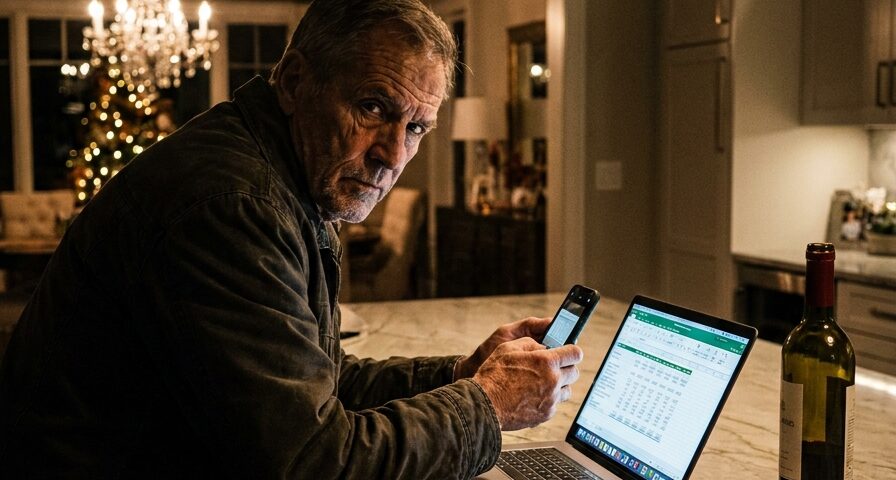
And there, on the island, sat an open laptop.
I was not snooping.
I was reaching for a glass when my eyes caught the header.
Heroes Hope Foundation Financial Overview Q3 2024.
Twenty-eight years in financial crimes teaches you to recognize certain patterns.
Invoice discrepancies.
Irregular payment schedules.
Ghost vendors.
The spreadsheet practically screamed at me.
Patriot Medical Supply — $52,000.
I had never heard of them.
A quick scan showed three more like it.
Freedom Prosthetics — $67,000.
Veterans First Equipment — $61,000.
My hands moved on autopilot. I pulled out my phone.
Old habits die hard when evidence is sitting in plain sight.
I photographed the first page, then scrolled.
Bank statements showed wire transfers to accounts in Delaware, the kind of corporate havens people use when they do not want anyone asking too many questions.
The foundation had raised $387,000.
The disbursements to actual veterans appeared to be maybe $45,000.
The rest had disappeared into a web of shell companies and what looked like offshore gambling accounts.
My father’s face flashed in my mind.
How he had struggled after Korea. How he waited months for the VA to approve his disability claim. How he died still believing his country valued his service, even though the paperwork never seemed to move fast enough to prove it.
Patty was stealing from people like my father.
“What are you doing?”
I turned.
Patty stood in the archway. Her face shifted from confusion to alarm as she saw the phone in my hand, the laptop, the financial confession glowing on the screen.
“These are private documents.”
She moved forward, reaching.
“These are evidence,” I said.
My voice came out flat.
The old detective voice.
“You’ve been embezzling from a veterans’ charity, Patty. Wire fraud. Falsifying tax documents. These Delaware accounts—let me guess. You’re the beneficial owner hiding behind an LLC.”
Her face drained of color, then flushed red.
“You went through my things?”
“They were sitting open on your kitchen counter because you never thought someone might actually look. That’s arrogance.”
I pulled out my phone and started dialing.
“What are you doing?”
Panic crept into her voice.
“Calling 911.”
She lunged.
Five foot six. Twenty years younger. Desperate.
But I had spent a career dealing with desperate people.
I stepped aside and let her momentum carry her past me. She caught herself on the counter, breathing hard.
“911. What’s your emergency?”
“This is Charles Davis, retired NYPD. I’m at 482 Maple Avenue in Westchester. I need to report financial crimes. Embezzlement from a federally funded charity. I have documentary evidence.”
Patty’s expression cycled through denial, rage, fear, and calculation.
Tim appeared in the doorway.
“Dad?”
His eyes were red from arguing.
“What’s happening?”
“Your wife has been stealing from wounded veterans,” I said quietly. “Three hundred eighty-seven thousand dollars, give or take.”
“That’s insane,” Tim said, his voice pitching high.
“Patty?”
“He’s lost his mind,” she said quickly. “He broke into our house and went through private papers.”
“I walked through an unlocked door because I felt ill. Your papers were open on the counter. Unless I’m mistaken, Heroes Hope Foundation received federal grants last year. That makes this federal wire fraud, Tim. Five to twenty years, depending on how they charge it.”
The dispatcher asked me to stay on the line.
I could already hear sirens.
Westchester had its advantages. Response times averaged under four minutes.
Tim looked between us, his world fracturing in real time.
“Patty, is this true?”
“Of course not, baby.”
She grabbed his arm.
“He’s lying. He’s angry because we wouldn’t let him control our lives anymore.”
“The bank statements show wire transfers totaling three hundred forty-two thousand dollars to Delaware shell corporations,” I said, still holding my phone up. “The invoices are fraudulent. Patriot Medical Supply lists an address that is actually a UPS store in Newark. I investigated cases like this for three decades, Tim. I know what I’m seeing.”
He stepped back from Patty as if she had become radioactive.
“You promised those funds were going to veterans,” he said. “You stood in front of the Rotary Club and talked about the Marine who lost both legs.”
“I helped people,” Patty said, her voice cracking. “We did help people. Maybe I took some operational costs, but—”
“Operational costs don’t hide in Delaware LLCs,” I said.
Red and blue lights washed across the kitchen windows.
Patty looked at the door.
Then at me.
Then at Tim.
I watched the calculation happen.
Run.
Fight.
Deflect.
She chose deflect.
“This is persecution,” she said, her voice suddenly calm. Controlled. “You’ve wanted me gone since day one, Charlie. You can’t stand that Tim chose me. You can’t stand that we built something you couldn’t control. Now you’re weaponizing your old cop friends to destroy us.”
Smart.
Establish the narrative before the police arrived.
I had seen that trick dozens of times.
The doorbell rang.
Tim did not move, so I walked past him, past Patty’s silent rage, and opened it.
Leonard Murphy stood there in a suit, his FBI shield clipped to his belt. Behind him stood two uniformed officers from Westchester PD.
“Charlie,” Leo said.
He took in the scene with experienced eyes.
“You sounded serious on the dispatch.”
“Financial fraud,” I said. “Embezzlement from a federally funded veterans’ charity. I have photos of the evidence. It was in plain sight when I entered the kitchen.”
Leo’s expression did not change, but I saw the shift in his posture.
All business now.
“And the subject?”
“Patricia Davis. Director of Heroes Hope Foundation.”
Leo nodded to the uniformed officers, who moved past me.
Patty had her phone out, probably texting a lawyer. Tim stood frozen, his designer shirt suddenly looking like a costume.
“Mrs. Davis,” Leo said, his voice carrying authority earned over decades. “I’m Special Agent Murphy, FBI Financial Crimes Unit. I need to ask you some questions about Heroes Hope Foundation.”
“I want my lawyer,” Patty said immediately.
“That’s your right.”
Leo turned to me.
“Charlie, I’ll need those photos. And we’ll need your statement.”
I handed him my phone and watched his eyes move across the screen.
Seeing what I had seen.
We had worked together for too many years to need many words.
“We’ll need to secure these materials as evidence,” Leo said.
He looked back at Patty.
“Mrs. Davis, are you the owner of the LLCs listed in these Delaware filings?”
“Lawyer,” Patty repeated.
“Okay.”
Leo gestured to the officers.
“We are seizing these materials as evidence of potential federal crimes. Mrs. Davis, you are not under arrest at this time, but I strongly suggest you remain available for questioning.”
Tim finally found his voice.
“This is a mistake. There’s an explanation.”
“There usually is,” one of the officers said, not unkindly.
He began photographing the laptop screen, then carefully collecting documents into evidence bags.
Tim realized the truth slower than I did, but I saw the moment it reached him.
The grandfather clock in their foyer, probably worth eight thousand dollars, chimed nine times.
Nine o’clock.
A night that had begun with prime rib and lobster tails ended with police evidence bags on a granite countertop.
Patty’s eyes found mine.
Pure hatred.
Unfiltered.
“You’ll regret this.”
“Maybe,” I said. “But those veterans won’t.”
Leo touched my arm.
“Let’s get your statement outside.”
I followed him into the December cold, leaving Tim standing in his magazine-perfect kitchen, finally beginning to understand what his wife really was and what his father had always been.
The next week passed in a blur of statements, interviews, and phone calls I did not want to answer.
Leo kept me updated.
The FBI had taken over the case. Federal prosecutors were building their file. Forensic accountants were tracing every dollar Patty had touched.
The machine I had once been part of was grinding forward, methodical and relentless.
But this time, I was not running it.
I was just a witness, waiting to see if justice would work the way it was supposed to.
Tim did not call.
I told myself I expected that.
I was lying.
My neighbor, Dorothy Brown, knocked on my door that Saturday morning with a casserole I did not need and concern I probably did.
Dot had been a nurse for forty years before retiring, which meant she could read vital signs even when people thought they were hiding them.
“You look terrible,” she said, pushing past me into my kitchen.
“Good morning to you too, Dot.”
“Don’t sass me, Charlie Davis.”
She set the casserole on my counter.
“The whole neighborhood is talking. Margaret saw the FBI at your son’s house. Said there were evidence boxes.”
“Small towns and wealthy suburbs,” I said. “Same gossip. Different property values.”
“It’s complicated,” she said.
“I said that.”
“No, you tried to say it like it was an ending. It’s usually the beginning.”
She poured herself coffee without asking and settled into my breakfast nook like she owned it.
“You want to talk about it?”
“Not particularly.”
“Then I’ll talk, and you’ll listen.”
She took a sip of my coffee, then grimaced.
“You still buy the cheap stuff.”
“I live on a pension.”
“You live like a man punishing himself for outliving his wife.”
That shut me up.
Dot softened slightly.
“I’ve known Tim since he was eight years old, playing in your backyard after your wife passed. Sweet boy. Smart. Then he married Patty, and I watched him change. Little things at first. Less time for friends. Expensive car he couldn’t afford. That smile that never quite reached his eyes anymore.”
I sat down across from her.
Outside, December snow had started falling soft and quiet.
“Sometimes people become who they marry,” Dorothy said.
“Sometimes they were always that person,” I replied, “just waiting for permission.”
“Which is he?”
I looked at the table.
“I don’t know anymore.”
“Yes, you do. You’re just afraid of the answer.”
The coffee tasted bitter.
Or maybe that was just my mood.
My phone buzzed.
A text from Leo.
Call me when you can. Developments.
I excused myself and stepped into my study before dialing.
“We arrested her this morning,” Leo said without preamble. “Federal charges. Wire fraud. Embezzlement. Falsifying tax documents. Bail set at two hundred fifty thousand.”
I absorbed that.
A quarter million.
Patty did not have that kind of cash.
Not legitimate cash, anyway.
“How did she take it?”
“Like a woman who thought money could buy her out of anything.”
Leo’s tone was dry.
“Her lawyers are already calling it a witch hunt. Claims you have a personal vendetta. Says the evidence was obtained illegally.”
“I didn’t break into their house.”
“I know. The prosecutor knows. But expect them to fight dirty. Patty hired Timothy Carter.”
I closed my eyes.
Carter charged five hundred dollars an hour minimum and had a reputation for turning juries against prosecutors instead of defendants.
“That will cost her forty thousand just for pretrial work.”
“Desperate people make expensive decisions,” Leo said.
A pause followed.
“Charlie, there’s something else.”
I already hated the sound of it.
“What?”
“Tim posted bail.”
The words hit harder than they should have.
“How?”
“Sold her jewelry. Took a loan against his 401(k). He’s standing by her publicly. Calling it a witch hunt. Says you’ve always been controlling and couldn’t handle their success.”
I looked out my window at the snow, watched it cover everything in white, making the world look clean when it was not.
“He really believes her.”
“Or he has invested too much to admit he was wrong,” Leo said. “Eight years of marriage. Two kids. A house he helped pay for with money he thought was legitimate. Tough to walk away from that.”
After we hung up, I sat in my study for a long time.
The room held my career in pieces. Plaques from the NYPD. A letter from the mayor thanking me for my service. Photographs from cases won and criminals convicted.
Twenty-eight years of believing in justice.
But justice for my own son felt like failure.
The trial came eight months later.
Federal courthouse. Judge Morrison presiding.
I sat with Leo and watched justice unfold from the witness side of the room.
The prosecutor’s opening was devastating in its simplicity.
“Patricia Davis stole three hundred eighty-seven thousand dollars from wounded veterans through systematic fraud.”
The trial lasted six days.
FBI accountants traced every dollar through offshore accounts.
A hundred eighty-four thousand dollars had gone to online gambling sites.
A whistleblower accountant testified about processing fraudulent invoices.
“I chose comfort over conscience until I couldn’t sleep at night,” she said. “When I confronted Patricia, she fired me and threatened to destroy my career.”
Then came the veterans.
Thomas Martinez rolled into court in his wheelchair.
“I applied for a specialized chair,” he said. “Three thousand two hundred dollars. Denied twice while Patricia Davis bought luxury cars with foundation money.”
Sandra Brooks arrived with her service dog.
“My application for mobility equipment was denied three times. Twenty-eight hundred dollars. I wore an ill-fitting prosthetic for two years. Infections. Nerve damage.”
Roberto Santos held up a photograph.
“That’s me at twenty-two in Afghanistan,” he said. “Patricia denied my housing assistance. Forty-six hundred dollars. I lived in my car for three months.”
Ruth Hensley, a woman in her seventies, clutched a folder in both hands. Her son Daniel had been denied medical equipment worth eight thousand dollars.
“He died waiting,” she said quietly. “She took my future. My grandchildren who will never exist.”
No cross-examination could undo that.
Tim took the stand on day five.
He looked pale and smaller than I remembered.
“I knew nothing about the foundation finances,” he said. “I trusted my wife completely.”
His voice cracked when the prosecutor asked about the divorce.
“My marriage collapsed when I realized who I had really married. She chose stealing over honesty. There’s nothing convenient about realizing you lived with someone capable of that.”
When asked why he posted bail, Tim looked across the courtroom and met my eyes.
“I thought I owed her that much,” he said. “I was wrong about a lot of things.”
Patty did not testify.
Her lawyer tried to paint me as a vindictive father-in-law, a retired cop who could not stand being told no by his son’s wife.
But evidence has a way of outliving character attacks.
Three hundred eighty-seven thousand dollars stolen.
Lives damaged.
Veterans denied help while she lived in luxury.
The jury deliberated nine hours.
Guilty on twelve counts.
As marshals led Patty away, she looked at Tim with pure accusation.
He did not flinch.
Outside, Tim found me near my car.
“Dad, I…”
“You don’t need to say anything.”
“Yes, I do.”
His eyes were red.
“You were right about everything. The money. The lifestyle. Her. I chose her lies over your truth because facing the truth meant admitting I’d been played for years.”
I thought about my father. About what he would have wanted.
Justice, yes.
But also family.
“You’re still my son,” I said.
He broke down then.
Really broke down.
“Can I come home for a while?” he asked. “Just until I figure things out? The kids and I don’t have anywhere else to go.”
I looked at him.
My son.
Broken. Ashamed. Finally honest.
“You don’t have to ask,” I said. “You’re always welcome.”
Patty was sentenced to twelve years in federal prison, three years of supervised release, and full restitution of three hundred eighty-seven thousand dollars.
Timothy Carter argued for leniency. He claimed family hardship. He said Patty had made mistakes but was not beyond redemption.
Judge Morrison did not look moved.
“You stole from people who sacrificed everything for this country,” he said. “The court finds no mitigating circumstances that justify what you did.”
Six months later, we had Sunday dinner at my place.
Nothing fancy.
Roast chicken. Mashed potatoes. Green beans. Emma and Jake arguing over who got the corner brownie. Tim helping clear plates without being asked.
Simple food.
Honest conversation.
Tim was rebuilding. Working through the divorce. Learning to trust his instincts again. The kids came every weekend, filling my house with noise and life I had not realized how badly I missed.
Tim lost the Westchester house. Too many memories. Too much debt. He found a modest apartment ten minutes away and started over with a clear conscience and a smaller bank account.
The restructured Heroes Hope Foundation survived under new leadership, with me advising on oversight and financial controls.
We approved applications Patty had denied.
Thomas Martinez got his specialized wheelchair.
Sandra Brooks received proper prosthetics.
Roberto Santos found stable housing.
Ruth Hensley attended the foundation’s anniversary dinner. She held my hand with both of hers.
“You gave my son justice,” she told me. “That’s all a mother can ask for.”
Donations kept coming from people inspired by the story, people who wanted to help veterans who had been denied assistance.
One evening, I was working in my small garden behind the house while Tim helped me plant bulbs for spring. Emma and Jake chased each other around the yard, their laughter echoing off neighboring houses.
I realized something had changed.
I had started this journey angry. Betrayed. Dismissed by my own family.
Now I felt something different.
Not just peace.
Purpose.
Justice had been served.
My relationship with Tim was stronger than before because it was finally built on truth instead of comfortable lies. The grandchildren I had feared losing were part of my daily life. Veterans were being helped by a foundation that actually cared about them.
Patty would spend the next twelve years in federal prison, learning that stealing from people who had already given so much carries consequences. Her lawyer filed appeals, but Leo said they would not stick.
The evidence was too solid.
The crime too clear.
Tim looked up at me, dirt on his hands from planting daffodil bulbs.
“Dad,” he said, “will these really grow?”
“Yes,” I said. “They need time and care. But they’ll bloom in spring.”
He looked toward the kids laughing in the yard.
I looked at the dark soil, at the bulbs beneath it, at the son I nearly lost and the family slowly growing back around me.
Some things do not bloom right away.
Families.
Justice.
Redemption.
Sometimes doing the right thing costs you everything you thought you wanted. But if you are patient, if you hold on to your principles, you may get back something better than what you lost.
Not the same.
Never the same.
But real.
Honest.
Built on truth instead of comfortable lies.
And that is worth more than any amount of money anyone could steal.