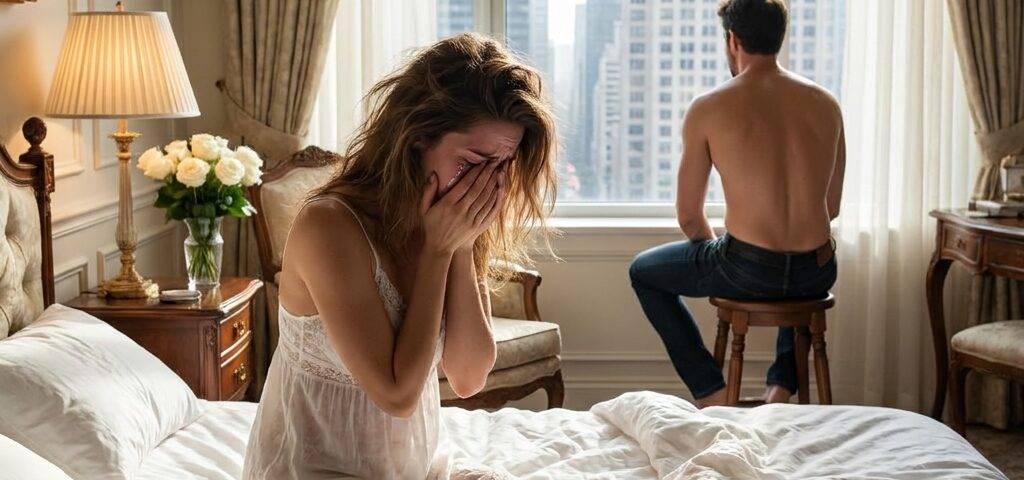

The room fell silent.
For a second, maybe two, no one moved. The glass walls of the conference room reflected a frozen version of us back at ourselves: twelve executives in tailored suits, a polished mahogany table, the skyline of Manhattan glittering beyond us, and me standing with one hand on the back of my chair as if that flimsy piece of furniture could keep the floor from vanishing beneath my feet.
He had changed.
Or maybe he had not changed at all, and it was only my memory that had blurred around the edges to protect me.
The man across the room was older than most of the people seated around the table, perhaps in his early sixties now, with silver hair combed neatly back and a face that looked carved by experience rather than age. He wore a charcoal suit without a wrinkle, a watch that probably cost more than the house I grew up in, and the calm expression of someone accustomed to entering rooms and owning them before he said a word.
But his eyes were exactly the same.
Steady. Watchful. Impossible to read.
“So,” he said quietly, without breaking eye contact, “it seems fate ignored my only request.”
A faint ripple moved through the room. My boss, Elaine Foster, turned toward me with a smile that was more confusion than warmth.
“You two know each other?”
I opened my mouth.
Nothing came out.
The man saved me from answering.
“Only in passing,” he said, his tone smooth enough to erase suspicion. “A long time ago.”
Only in passing.
Seven years of nightmares. Seven years of questions. Seven years of carrying a secret so heavy it had shaped every decision I made.
Only in passing.
I forced my fingers to loosen around the chair. “Mr. Vale,” I said, reading his name from the presentation folder in front of me even though I had already known it from the moment he stepped in.
Adrian Vale.
Founder and CEO of Vale Consolidated. Billionaire investor. Philanthropist. Media ghost. A man whose face appeared occasionally in business magazines but never lingered long enough in the public imagination to become familiar.
I had seen his photograph before.
Many times.
But always from a distance, always under headlines about mergers, global logistics, medical research donations, or mysterious private acquisitions. I had told myself the resemblance was coincidence. I had told myself memory was unreliable. I had told myself that a frightened twenty-one-year-old girl waking up in a strange hotel room would not remember a face clearly.
I had been lying to myself.
Adrian Vale inclined his head. “Ms. Whitaker.”
Hearing my name in his voice made something cold unfurl in my chest.
Elaine clapped her hands once, too brightly. “Well, now that we’re all acquainted, shall we begin?”
People sat. Papers shifted. Laptops opened. The meeting resumed as if my life had not just split down the middle.
I took my seat because there was no graceful alternative. My legs felt hollow. Across from me, Adrian Vale listened as our team introduced the proposal: a strategic partnership between our firm and his company’s new technology investment branch. Numbers appeared on the screen. Charts. Projections. Risk models.
I had built half of those models myself.
Normally, I would have been precise and confident. I would have answered questions before they were finished. I would have spotted flaws in the assumptions and quietly guided the room toward the strongest position.
Instead, I heard only fragments.
“Five-year growth…”
“Market volatility…”
“Projected capital deployment…”
Every few minutes, Adrian asked a question. Each time, it was intelligent and exact, the kind of question that made everyone sit a little straighter. He had not become powerful by accident. That much was obvious.
Yet whenever his gaze shifted toward me, I felt twenty-one again. Small. Poor. Exhausted. Alone in a hotel suite with a million dollars and a note that had haunted me more than the money ever could.
Don’t look for me.
When the presentation reached my section, Elaine glanced at me. “Clara, would you walk us through the sensitivity analysis?”
My name sounded distant.
I rose anyway.
The first slide appeared behind me, clean and sharp. My hands trembled, so I held the remote with both of them.
“As you can see,” I began, “we modeled three potential economic environments over a sixty-month horizon…”
My voice was steadier than I felt. Numbers helped. Numbers had always helped. They had rules. They did not wake up years later and smile at you across a conference table.
I explained the downside risk, the liquidity safeguards, the possible regulatory complications. I answered questions from Vale’s CFO, a narrow-faced woman named Marissa Chen, who seemed impressed despite herself. I even managed to meet Adrian’s eyes when he asked whether our assumptions accounted for delayed deployment across emerging markets.
“They do,” I said. “But I would recommend revisiting the model quarterly rather than annually. The opportunity is strong, but only if oversight remains active.”
A faint smile touched his mouth.
“Cautious,” he said.
“Prepared,” I replied.
For the first time, something like amusement warmed his eyes.
The meeting lasted ninety-four minutes. I counted every one.
When it ended, people stood and exchanged polished phrases. Elaine looked pleased. Vale’s team looked interested. The deal was alive, maybe more alive than before.
I gathered my papers too quickly, knocking a pen onto the carpet.
Adrian bent and picked it up before I could.
For one strange second, we were both reaching for the same object, our hands inches apart.
He held it out.
“Ms. Whitaker,” he said softly.
“Mr. Vale.”
“You’ve done well.”
The words struck deeper than they should have. Not because they sounded kind, but because I had imagined hearing them from him so many times. In those imagined conversations, I had screamed. I had demanded answers. I had thrown the money back in his face. I had asked whether he understood what it meant to turn a person’s life into a question mark.
In reality, I took the pen.
“I did well before I knew your name,” I said.
His expression shifted almost imperceptibly.
“I know.”
Elaine appeared at my side before I could answer. “Adrian, we’re hosting a small dinner tonight for both teams. I hope you’ll join us.”
His gaze remained on me. “I wouldn’t miss it.”
I decided then that I would not attend.
I lasted exactly thirty-five minutes before Elaine cornered me in my office.
“Absolutely not,” she said.
“I’m not feeling well.”
“You were pale in the meeting, I’ll give you that. But you were also brilliant, and Vale specifically asked whether you would be joining us tonight.”
My stomach tightened. “He did?”
“Yes. Which means you need to be there.”
“Elaine…”
She softened. Elaine Foster was not an unkind woman. She was demanding, sharp, and allergic to excuses, but she had promoted me twice because she believed in my work before I fully believed in it myself.
“Clara, is something wrong? Did Vale say something to upset you?”
There it was. The door. The chance to tell someone.
I looked at my mentor, at the concern tucked behind her professional mask, and the old instinct rose in me.
Protect the life you built. Protect your parents. Protect your brother. Protect the truth from becoming gossip.
“No,” I said. “It’s nothing like that.”
She studied me for a moment. “Then come to dinner. Sit near me. Talk numbers. Leave early if you must.”
By seven-thirty that evening, I was seated at a private table in a quiet restaurant overlooking the river, wearing the same navy dress I had worn to work and wishing I had invented a better excuse.
The dinner was elegant but restrained. No crystal chandeliers this time. No loud music. No careless laughter. The lighting was low, the tables spaced far apart, and the waiters moved like shadows.
Adrian sat across from me.
Of course he did.
For most of the first hour, conversation stayed safely professional. Elaine discussed market timing. Marissa Chen spoke about regulatory patience. Someone from our legal team made a dry joke that received polite laughter.
I ate almost nothing.
Adrian ate even less.
At one point, his phone lit up beside his plate. He glanced at the screen, and for the first time that day, his composure cracked. It was brief, gone almost before I registered it, but I saw it: concern, sharp and personal.
He turned the phone face down.
A few minutes later, he excused himself.
I watched him leave the room through a side corridor.
I told myself not to follow.
Then I followed.
The corridor led past the restrooms toward a quiet alcove near a service entrance. Adrian stood with his back to me, one hand in his pocket, the other holding his phone to his ear.
“I said no interviews,” he said, voice low. “Not now.”
A pause.
“I don’t care what they claim to have found. Keep it contained until I know who gave it to them.”
Another pause.
His shoulders stiffened.
“Then find out whether she knows.”
My breath caught.
Adrian turned.
For a moment, neither of us spoke.
Then he ended the call.
I should have pretended I was looking for the restroom. I should have retreated. Instead, seven years of silence rose up and made me brave.
“Whether who knows?” I asked.
His eyes narrowed slightly. Not anger. Calculation.
“You shouldn’t listen to private conversations.”
“You shouldn’t leave people with life-changing sums of money and cryptic notes.”
The words came out before I could soften them.
The hallway seemed to grow quieter.
Adrian slipped his phone into his jacket pocket. “You’re right.”
That stunned me more than denial would have.
“I’m right?”
“Yes.”
I laughed once, but there was no humor in it. “That’s it? Seven years, and that’s your explanation?”
“No,” he said. “That’s my admission.”
I stared at him. Up close, he looked more tired than he had in the boardroom. The lines near his eyes were deeper, his skin paler under the warm hallway light. Power had not protected him from age or sorrow. Somehow, that made him more difficult to hate.
“I looked for you,” I said.
“I know.”
The floor seemed to tilt.
“You know?”
“I knew within six months.”
My hands curled at my sides. “You knew I was searching and said nothing?”
“I made sure you never found anything useful.”
The honesty of it landed like a slap.
“Why?”
“Because I thought distance was safer.”
“For whom?”
His silence answered before he did.
“For you,” he said.
I shook my head slowly. “No. You don’t get to say that like it explains anything. You don’t get to decide what’s safe for me after leaving me with a fortune and disappearing.”
His jaw tightened.
The door to the dining room opened behind us, spilling laughter into the corridor. Adrian glanced past me, then back.
“Not here.”
“Then where?”
He reached into the inner pocket of his jacket and withdrew a small cream-colored card. No logo. No title. Only an address printed in black ink and a time written beneath it.
Tomorrow. 8:00 p.m.
“My private office,” he said. “Come alone.”
I looked at the card but did not take it. “That sounds exactly like something a woman should refuse.”
A flicker of something almost like regret crossed his face.
“Fair.”
He took a pen from his pocket, turned the card over, and wrote a second line.
Bring anyone you trust.
Only then did I accept it.
“Why tomorrow?” I asked.
“Because after tonight, the story may no longer be mine to tell.”
Before I could ask what that meant, he walked past me and returned to dinner.
I stood in the hallway with the card in my hand, feeling as though I had been handed not an address, but a key to a locked room inside my own life.
I did not sleep that night.
At three in the morning, I sat cross-legged on my living room floor surrounded by seven years of obsession.
Old notebooks. Printed articles. Hotel records I had obtained through favors I was not proud of asking. Photographs of Adrian Vale from magazines. A copy of the note, preserved in a plastic sleeve because I had feared the original would fall apart from being unfolded too many times.
Consider it fate. Don’t look for me.
The handwriting was elegant and slanted slightly to the right.
I had traced those words with my eyes until they no longer looked like language.
On my laptop, I searched Adrian Vale again, though I knew the results by heart. Born in Boston. Built a logistics empire from a small freight company. Married once, widowed young. One daughter, deceased. No public romantic life. Known for privacy. Known for ruthless acquisitions. Known for unusual donations to rural hospitals, scholarship programs, and addiction recovery centers.
One daughter, deceased.
Her name had been Lillian Vale.
She died eight years ago.
I had read that fact before. Many times. It had seemed tragic but unrelated.
Now I clicked deeper.
There were few photos of Lillian. Adrian had guarded his family fiercely. The clearest image showed her at nineteen, standing beside him at a charity event. She had dark hair, delicate features, and a smile that seemed uncertain, as if she had not yet decided whether the world was safe.
I stared at her face for a long time.
Something about her felt familiar.
Not because she looked like me. She didn’t, not exactly. But there was something in the tilt of her head, the cautious set of her shoulders.
The article beneath the photo said she had died after a long illness. No details.
I closed the laptop.
By morning, I had decided to bring the only person who knew almost everything.
Almost.
My brother answered on the second ring.
“Clara?” Noah sounded half-asleep. “Is everything okay?”
The concern in his voice undid me for a second. In my mind, he was still fifteen, lanky and sunburned, pretending not to cry when I left West Virginia for New York. Now he was twenty-four, finishing his graduate program in agricultural engineering, taller than our father, with our mother’s stubborn chin.
“I need you to come to the city,” I said.
A pause.
“When?”
“Today.”
He was fully awake then. “What happened?”
I looked toward the window, where morning light pressed softly against the glass.
“I found him.”
Noah arrived at Penn Station just after five, wearing jeans, a wool coat, and the same old backpack he had used since college. The moment he saw me, his face changed.
He hugged me hard.
For years, Noah had known there had been money. He knew someone had given it to me under strange circumstances. He knew I hated talking about it. He did not know about the hotel room, the note, or the man.
Not the full truth.
We sat in a corner booth at a diner near my apartment while rain blurred the windows and taxis hissed by outside.
I told him everything.
Not graphically. Not dramatically. Just the truth as I remembered it: the party, the tequila, the hotel suite, the man asleep beside me, the envelope, the money, the note, the years of searching, and the meeting in the boardroom.
Noah listened without interrupting. His face went pale in stages.
When I finished, he stared at his untouched coffee.
“I should’ve known,” he said.
“You were a kid.”
“I knew something was wrong after freshman year. You came home that summer and wouldn’t sleep unless the hallway light was on.”
My throat tightened. “I thought I hid it.”
“You hide things from Mom and Dad. Not from me.”
A sad smile pulled at my mouth.
He reached across the table and covered my hand with his. His palm was rough, like Dad’s. “I’m going with you tonight.”
“I was hoping you would.”
“Good. Because I wasn’t asking.”
At eight that evening, we stood outside a limestone building on a quiet street that looked more residential than corporate. There was no sign for Vale Consolidated, only a discreet brass panel beside the door.
A security guard escorted us to a private elevator. No one asked our names. No one seemed surprised that Noah was with me.
That bothered me.
The elevator opened directly into an office that felt less like a workplace and more like a museum curated by a lonely man. Tall windows overlooked the city. Shelves lined the walls, holding leather-bound books, framed maps, and small objects from places I could not identify. On one wall hung a large black-and-white photograph of a young woman laughing beneath an apple tree.
Lillian.
Adrian stood near the window.
He turned when we entered, and his gaze moved from me to Noah. For a split second, something strange passed over his face.
Recognition.
Impossible.
“You brought your brother,” he said.
Noah stepped slightly in front of me. “I brought myself.”
Adrian nodded once. “Fair enough.”
A woman emerged from a side room carrying a folder. She was in her seventies, elegant in a dark green suit, with silver hair twisted at the nape of her neck and eyes that missed nothing.
“This is Margaret Ellison,” Adrian said. “My attorney and oldest friend.”
Margaret looked at me with an expression I could not name. “Ms. Whitaker.”
“You know who I am,” I said.
“Yes.”
“Apparently everyone does except me.”
Adrian flinched. It was slight, but I saw it.
He gestured toward a seating area. “Please.”
Noah remained standing until I sat. Then he took the chair beside mine, angled protectively.
Adrian sat across from us. Margaret stayed near the shelves, folder held against her chest.
For several seconds, the only sound was the rain tapping softly against the windows.
Then Adrian said, “I owe you the truth. Not because I planned to give it tonight, but because there are people trying to expose parts of it for reasons that have nothing to do with you.”
“Who?” I asked.
“A journalist. Perhaps more than one. Someone leaked old records connected to a private foundation I funded years ago.”
“The million dollars,” I said.
He nodded.
Noah leaned forward. “Start at the beginning.”
Adrian looked at him for a long moment, then back at me.
“My daughter, Lillian, died eight years ago,” he said. “The official statement called it a long illness. That was incomplete.”
His voice remained controlled, but his hands betrayed him. One thumb moved slowly over the knuckle of the other, again and again.
“Lillian had a rare blood disorder. Treatable, in some cases. Complicated in hers. For years, we searched for a compatible donor. Family, registries, international databases. Nothing worked.”
The room seemed to draw inward.
“When she was twenty, her doctors found a partial match in a medical research database. Not enough for a transplant, but enough to suggest there might be relatives of the donor who could be closer matches. The donor had participated anonymously as part of a university health study.”
I stopped breathing.
Columbia had offered a paid medical study my sophomore year. Fifty dollars for blood samples and a questionnaire. I had done it because fifty dollars meant groceries.
Adrian saw understanding flicker across my face.
“Yes,” he said softly. “You.”
Noah’s chair creaked as he shifted.
“But I wasn’t contacted,” I said. “No one ever told me.”
“Because you weren’t a match strong enough to help her directly. But your genetic profile raised questions.”
“What questions?”
Margaret finally stepped forward. “Questions about family lineage.”
I looked from her to Adrian.
He reached for a framed photograph on the table beside him. It showed Lillian as a child, standing between Adrian and a woman with kind eyes.
“My wife, Evelyn, died when Lillian was twelve,” he said. “After Lillian became ill, certain test results suggested something Evelyn had taken to her grave.”
The words entered the room slowly.
Adrian looked at Noah.
Then at me.
“Lillian was not my biological daughter.”
Noah went still.
A cold thread wound through my chest.
Adrian continued, each word measured. “I loved her as my daughter. That never changed. But the discovery led us to search for her biological family. Quietly. Desperately. We found evidence that Evelyn, before our marriage, had given birth to a child and placed that child through a private adoption arrangement. The records were sealed. Some had been altered. Some had vanished.”
My mind flashed to my parents in West Virginia. My mother’s flour-dusted hands. My father teaching me to mend a fence. Their faces at my graduation, proud and tearful.
“No,” I whispered.
Adrian’s eyes filled with something that looked painfully close to pity. “Clara, your adoption was never disclosed to you?”
The room disappeared around me.
Noah stood so quickly his chair almost tipped. “She’s not adopted.”
Margaret’s gaze softened. “Mr. Whitaker—”
“No.” Noah’s voice shook. “Our parents would have told us.”
I wanted to say the same thing. I wanted to defend them. But memory, cruel and precise, began rearranging itself.
The locked metal box beneath my parents’ bed.
The way relatives sometimes fell quiet when I entered a room.
My mother crying on my eighteenth birthday after everyone else had gone to sleep.
My father once saying, “Blood isn’t the only way people belong,” then changing the subject when I asked what he meant.
Adrian did not push. That made it worse.
“What does this have to do with that night?” I asked, my voice barely audible.
He closed his eyes briefly.
“Lillian was dying. Her doctors believed a closer relative might be her only chance. By the time we traced the adoption trail to your family, your records had been buried under layers of legal protection and old mistakes. I knew of you before I knew you. Your name. Your school. Your background. I also knew you were struggling financially.”
My skin prickled.
“You investigated me.”
“Yes.”
“At twenty-one.”
“Yes.”
Noah looked ready to speak, but I lifted a hand. I needed to hear it all before I shattered.
“The night of the party,” Adrian said, “I was at that restaurant for a private event. I recognized you. I had not intended to approach you there. You were upset, unsteady, surrounded by people who did not seem to be looking after you. I intervened.”
“Intervened how?”
“You were being pressured to leave with someone. A young man. I stepped in, claimed you were with my party, and had my driver bring you to the hotel suite attached to the event reservation. You were sick. Frightened. Barely conscious. I called a private physician.”
The memory shifted again.
A cool cloth on my forehead.
A woman’s voice saying, “She needs rest.”
The faint smell of antiseptic.
I had buried those fragments because they did not fit the story fear had built.
“You slept in the other room,” Adrian said. “The suite had two bedrooms. In the morning, the connecting door was open. I had fallen asleep in the sitting area and later moved to the bed in the outer room. When you woke, I realized how it must have looked.”
I stared at him, unable to speak.
“Nothing happened between us,” he said, voice low. “I should have stayed and explained. I should have called someone for you. I should have done almost anything other than what I did.”
“The money,” I whispered.
“A coward’s solution,” he said. “And a desperate father’s. I thought if I left enough to change your circumstances, then perhaps one day, when I asked for help, it would not feel like I had only taken from you.”
“But you never asked.”
His face folded in on itself.
“Lillian died three weeks later.”
The rain tapped against the glass like tiny fingers.
Noah sat down slowly.
I pressed my hands together in my lap because they had begun to tremble.
Three weeks.
All these years, I had imagined motives: guilt, arrogance, manipulation, cruelty, pity. I had never imagined grief moving in the dark, making terrible choices while racing against time.
“Why the note?” I asked.
Adrian looked toward the photograph of Lillian beneath the apple tree.
“Because after she died, I could not bear to pull you into the wreckage. Because I had no right. Because I was ashamed. Because if I told you the truth, I would have to tell you that I had watched your life from a distance and considered asking you for something no stranger should ask.”
“A transplant?”
“Testing first. Possibly marrow donation. Nothing guaranteed.” He swallowed. “But yes.”
My thoughts turned to my parents again. My real parents. My only parents. Had they known? Had someone contacted them? Had they refused to tell me?
Or had they protected me from a billionaire who arrived with doctors, lawyers, and impossible grief?
I did not know which possibility hurt more.
Margaret opened the folder.
“There is more,” she said.
Adrian looked at her sharply. “Margaret.”
“She deserves to know before someone else decides how to tell it.”
He said nothing.
Margaret removed a document and placed it on the low table between us. It was a copy of a birth certificate.
My eyes found the name first.
Baby Girl Ellison.
Mother: Evelyn Rose Ellison.
Father: Unknown.
I looked up.
“Ellison,” I said.
Margaret’s face was very pale.
“My younger sister,” she said. “Evelyn.”
The room held its breath.
Adrian rose and walked to the window, as if the city below might offer him mercy. Margaret remained still, but her eyes shone.
“Evelyn was seventeen,” she said. “Our parents were strict, terrified of scandal. I was twenty-four, newly married, and living overseas. By the time I came home, the baby was gone. Evelyn was told the adoption was legal and final. She never recovered from it, not fully.”
I stared at the birth certificate, but the words blurred.
Baby Girl Ellison.
Not Clara.
Not Whitaker.
A beginning I had never known.
“Are you saying,” Noah began carefully, “that Clara and Lillian were sisters?”
“Half-sisters,” Margaret said. “We believe so.”
Adrian turned from the window. “Lillian never knew. Evelyn never told her.”
I leaned back, feeling air enter my lungs in small, painful increments.
All my life, I had thought I was the eldest child of Thomas and Rebecca Whitaker, born into a family that measured wealth in harvests, weather, and how long a truck could run after the check-engine light came on.
Now a piece of paper said I had begun somewhere else, as someone else, connected to a dead woman I had never met and a man who had mistaken secrecy for protection.
Noah reached for me. I gripped his hand.
“You said a journalist has records,” I said after a while. My voice sounded strange to me. “What exactly do they have?”
Margaret hesitated.
Adrian answered. “Enough to suggest I paid you a million dollars shortly before Lillian died. Enough to imply I bought silence, or access, or something worse.”
I understood then why he had looked afraid at dinner.
Not for himself.
For me.
The old anger did not vanish. It changed shape. It became heavier, more complicated, tangled with reluctant understanding.
“And did you?” I asked.
His eyes met mine.
“I paid because I was afraid of what I might become if I let desperation make one more decision.”
No one spoke.
It was Noah who finally broke the silence.
“Our parents,” he said. “Do they know?”
Margaret looked down.
“We don’t know what they were told. The adoption file is incomplete.”
I stood. The room tilted slightly, but I stayed upright.
“I need to go home.”
Adrian took one step forward, then stopped himself. “Clara—”
“No.” My voice was not loud, but it ended the conversation. “You have had seven years with this truth. I’ve had seven minutes.”
He accepted that with a nod.
Margaret handed me a sealed envelope. “Copies of everything we have. There may be errors. There may be gaps. But it is yours.”
I took it.
At the elevator, Adrian said my name.
I turned despite myself.
He looked older than he had when we arrived.
“I am sorry,” he said.
There were too many things he could have meant.
I did not forgive him.
I did not refuse him either.
I simply stepped into the elevator with Noah and watched the doors close.
We took the late train to West Virginia the next morning.
Neither of us suggested flying. Some truths require slow travel. The train gave me hours to watch cities soften into towns, towns into fields, fields into dark ridges of mountains that looked unchanged by human secrets.
Noah sat beside me, reading the documents again and again.
I could not look at them anymore.
At one point, he said, “You’re still my sister.”
I turned toward him.
He looked embarrassed by the obviousness of it, but his eyes were wet.
“I know,” I said.
“No, I mean—nothing in that envelope gets to rewrite us.”
I leaned my head on his shoulder the way I had when we were children during thunderstorms.
For the first time since Adrian Vale walked into the boardroom, I cried.
Not loudly. Not dramatically. Just tears slipping quietly down my face while the mountains rose in the distance and my brother pretended not to notice until I handed him a napkin and he laughed through his own.
Our parents’ farm looked smaller than I remembered.
The white paint on the porch had peeled in new places. The barn roof sagged slightly at one corner. Smoke curled from the chimney, and my mother’s wind chimes trembled in the cold breeze.
Mom opened the door before we knocked.
“Clara?” Her smile appeared first, then confusion. “Noah? What are you two doing here?”
Behind her, Dad rose from his chair, one hand braced on the table.
I had planned a careful opening. Something gentle. Something mature.
But the moment I saw their faces, all my carefulness dissolved.
“Am I adopted?”
The question landed in the kitchen like a dropped plate.
Mom went white.
Dad closed his eyes.
That was answer enough.
Noah made a sound beside me, sharp with hurt.
Mom reached for the counter. “Clara…”
“How could you not tell me?”
She pressed a hand to her mouth, and for the first time in my life, my mother looked old.
Dad came forward slowly. “Sit down, sweetheart.”
“Don’t.” My voice broke. “Please don’t call me that right now if you’re about to explain why everyone knew my life except me.”
He stopped.
Mom began to cry silently.
That hurt most of all.
We sat around the kitchen table where I had done homework, kneaded biscuit dough, filled out college applications, and counted scholarship letters like miracles. The same table where my parents had told us hard truths about droughts, debts, illness, and death.
But never this.
Dad folded his hands.
“You came to us when you were six days old,” he said. “A woman from an agency in Charleston brought you. She said your birth mother was young and wanted a closed adoption. She said there were no medical concerns, no family contact, no names we were allowed to know.”
Mom looked at me through tears. “We tried to tell you when you were little. I bought books. I practiced the words. But you were so happy, Clara. You were ours in every way that mattered, and every year it got harder.”
“That’s not an excuse,” Noah said.
“No,” Dad said quietly. “It isn’t.”
I looked at him then. Really looked. The shame in his face was not defensive. It was worn, familiar, carried for years.
“Did someone contact you?” I asked. “About Lillian Vale?”
Mom and Dad exchanged a glance.
My stomach tightened.
Dad stood and walked to the old cabinet beside the stove. From the top shelf, behind recipe tins and spare candles, he took down a metal box.
The locked box.
He opened it with a key from his pocket.
Inside were papers, photographs, and a stack of letters tied with faded blue ribbon.
Dad placed one letter in front of me.
The envelope was postmarked eight years ago.
The return address was a law office in New York.
My hands shook as I unfolded it.
The letter requested contact regarding a confidential medical matter possibly involving a biological relative.
“You never told me,” I whispered.
Mom reached for me, then pulled her hand back. “You were twenty. Finals were coming. You were exhausted. We called the number. A lawyer explained that a wealthy family was searching for biological relatives for a sick young woman. They wanted you tested. They said there might be urgency.”
“So why didn’t you tell me?”
Dad’s voice was rough. “Because we asked what they knew about your birth family, and they wouldn’t tell us. We asked what they wanted from you beyond testing, and they wouldn’t promise it would stop there. Then they offered money.”
I looked up.
Mom cried harder.
“They offered us money?” I asked.
Dad nodded. “Not directly. Not like a bribe. They called it compensation for travel, inconvenience, future medical care. It was more money than we’d ever seen.”
“How much?”
He looked away.
“How much, Dad?”
“One million dollars.”
The kitchen became very quiet.
Noah stared at him. “You refused?”
“Of course we refused,” Mom said, wounded. “We thought someone was trying to buy our daughter.”
My daughter.
The words split me open.
Dad pushed the letter toward me. “We told them if they wanted to speak to you, they needed to provide full legal proof of who they were and how they found you. We never heard back.”
Because Lillian died.
Because Adrian retreated.
Because grief and fear had collided on both sides, and I had been left standing in the middle of a bridge no one finished building.
I covered my face with my hands.
“I could have helped her,” I said.
Dad’s chair scraped back. “Clara, no.”
“What if I could have?”
Mom stood and came around the table, kneeling beside me the way she had when I was small. “Listen to me. You were not responsible for a secret no one gave you. Not then. Not now.”
I wanted to believe her.
Maybe someday I would.
That night, I slept in my childhood room beneath a quilt my grandmother had made before I was born. Or before I arrived. I no longer knew which words fit.
The room was mostly unchanged: old books, a faded Columbia pennant, a photograph of Noah and me covered in mud after a summer storm. I lay awake listening to the house settle, the soft murmur of my parents’ voices below, the wind brushing the windows.
Near midnight, there was a knock at my door.
“Come in,” I said.
Mom entered carrying the metal box.
“I should have given you this years ago.”
She sat on the edge of the bed and opened the box again. From beneath the legal papers, she removed a small envelope yellowed with age.
“This came with you,” she said. “The agency told us it was the only thing your birth mother left.”
Inside was a photograph.
A teenage girl stood beneath an apple tree, holding a newborn wrapped in a white blanket. Her face was turned slightly away, but I could see enough.
Evelyn.
My birth mother.
On the back, in faded ink, someone had written:
For my first daughter. May she be loved enough for both of us.
I pressed the photograph to my chest.
Mom’s voice trembled. “I was afraid if you knew, you’d wonder whether we were enough.”
I looked at the woman who had packed my lunches, stayed up during fevers, mailed me twenty-dollar bills she pretended were spare cash, and cried every time I boarded a bus back to New York.
“You were enough,” I said.
Her face crumpled.
“But enough doesn’t mean I didn’t deserve the truth.”
“I know.”
She lay beside me like she had when I was little, and for a long time we held hands in the dark.
The next morning, I walked alone to the edge of the orchard.
The apple trees were bare, their branches black against the pale winter sky. I thought of Lillian’s photograph in Adrian’s office, the way she laughed beneath a tree like this. I wondered whether she had known she had a sister somewhere. Whether some part of her had felt an absence she could not name.
My phone buzzed.
A message from Elaine.
Call me immediately.
My stomach tightened.
I called.
Elaine answered on the first ring. “Clara, where are you?”
“West Virginia. Family emergency.”
“You need to see this.”
“What happened?”
A pause.
“The story broke this morning.”
I closed my eyes.
Elaine continued, careful and tense. “A financial blog published allegations that Adrian Vale made a secret million-dollar payment to a young woman connected to his daughter’s medical records. They don’t name you, but there are enough details that people are digging.”
The orchard seemed to sway.
“There’s more,” Elaine said.
My grip tightened around the phone.
“What?”
“The article claims the payment wasn’t made after the hotel incident. It says the transfer was authorized two days before.”
I opened my eyes.
Across the field, Noah was walking toward me from the house, waving one arm. He held something in his hand.
Another envelope.
“Clara?” Elaine said. “Are you there?”
But I was watching my brother’s face as he reached me, pale and stunned.
He handed me the envelope without a word.
It had been hidden inside the lining of the metal box.
No stamp. No postmark. Only my name written across the front in handwriting I recognized immediately.
The same handwriting from the hotel note.
Consider it fate.
Don’t look for me.
I opened it with numb fingers.
Inside was a single sheet of paper.
Only one sentence had been written on it.
Adrian Vale was not the man who left you the money.