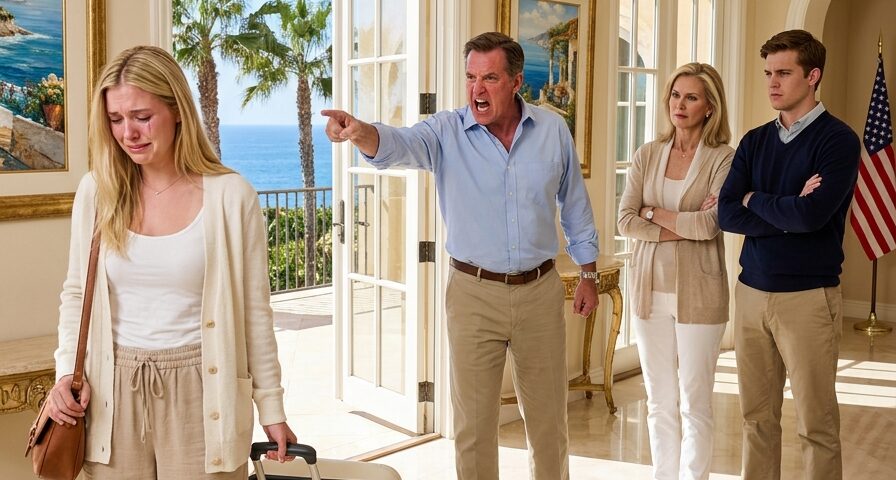
My Father Threw Me Out and Left Me Sleeping in My Car—But the Next Morning, Two Attorneys Took Me to My $30 Million Oceanfront Mansion…
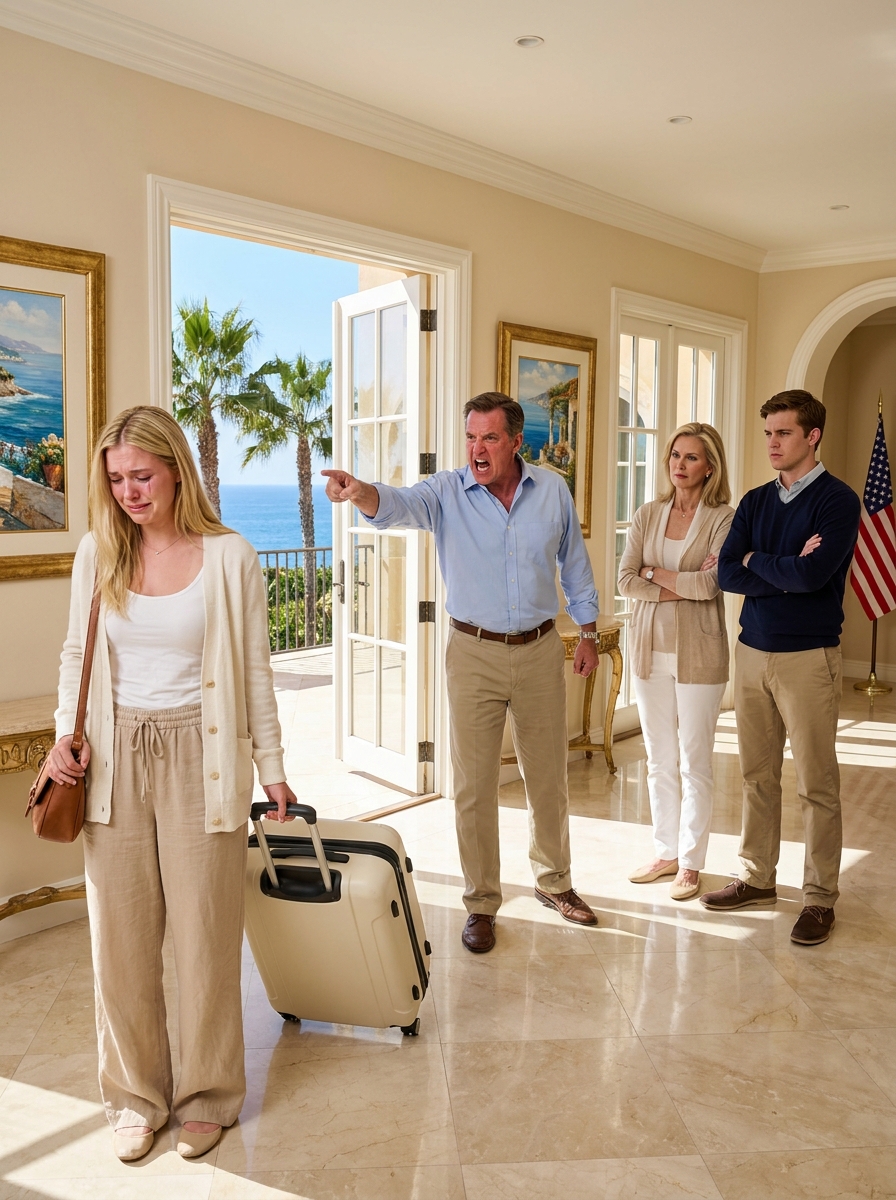
PART 2 — THE HOUSE ABOVE THE PACIFIC
The drive from Riverside to La Jolla felt like a journey between two different lives.
Emma followed the attorneys’ SUV west along the highway as sunrise spread across Southern California. The gray industrial edges of the Inland Empire gradually gave way to green hills, expensive neighborhoods, and glimpses of the Pacific Ocean.
She had not slept for more than twenty minutes.
Each time she looked in the rearview mirror, she saw the broken suitcase, the cracked photograph, and the blanket she had used in the supermarket parking lot.
They were proof that the previous night had been real.
Yet the silver key on the passenger seat suggested something even more unbelievable.
At 8:17 a.m., Nathan’s SUV turned onto a private road overlooking the ocean. Emma passed homes hidden behind stone walls, sculpted hedges, and towering gates.
The attorneys stopped before a black iron entrance.
Nathan entered a code.
The gates opened.
Emma drove slowly through them.
A long driveway curved between palm trees and white rose gardens. Beyond the landscaped grounds stood a sprawling Mediterranean-style mansion with cream-colored walls, arched windows, and terracotta roofing.
Behind it, the Pacific stretched endlessly beneath the morning sun.
Emma parked but did not get out.
Rebecca approached her window.
“You’re safe here.”
Emma looked at the mansion.
“Whose house is this really?”
“Yours.”
“I have eighty-seven dollars.”
“You also have the property, a substantial trust, several investment accounts, and controlling interest in two commercial developments.”
Emma gave a small, stunned laugh.
“I slept in a parking lot last night.”
“I know.”
“My father threw me out because I lost a job that paid fifty-six thousand dollars a year.”
Rebecca’s expression became serious.
“Your father knew more about your financial position than you did.”
Emma stepped out of the Civic.
The ocean breeze lifted her hair. The air smelled of salt, jasmine, and freshly cut grass.
Nathan stood near the front entrance, holding the cream envelope.
“Your grandfather purchased this estate through a private holding company eleven years ago,” he explained. “The property was maintained by a management firm. Daniel stayed here occasionally, but he never registered it under his personal name.”
“Why?”
“To protect it from Richard.”
The answer came too quickly to be speculation.
Emma stared at Nathan.
“What did my father do?”
“That is explained in the documents your grandfather left.”
Nathan handed her the envelope.
“Read this before entering.”
Emma broke the blue wax seal.
My dearest Emma,
If you are reading this, Richard has finally done what I feared he would do.
You are frightened, tired, and probably blaming yourself. Before anything else, understand this: losing your job did not make you a failure. Being rejected did not make you unworthy. The people who convinced you otherwise needed you to doubt yourself because the truth would have made you impossible to control.
This house belongs to you.
It was purchased with money that should always have been part of your future. But the house itself is not the inheritance that matters most.
Inside, you will find seven sealed letters. Open them in order. Do not skip ahead, no matter how painful the waiting becomes.
Some truths must be carried one piece at a time.
Trust Nathan and Rebecca.
And when your family arrives—and they will arrive—remember that you are not standing in their house anymore.
You are standing in yours.
With all the love I was not always permitted to show,
Grandpa Daniel
Emma reread the last sentence.
Not always permitted?
She looked at Nathan.
“What does that mean?”
“It will become clearer.”
“Everyone keeps saying that.”
“Because your grandfather designed this process carefully.”
Nathan placed the silver key in her hand.
Emma unlocked the front door.
The entrance opened into a two-story foyer filled with sunlight. A curved staircase rose toward a gallery. Beyond the living room, floor-to-ceiling windows revealed the ocean.
The mansion was luxurious, but it did not feel cold.
A blue quilt lay folded across a white sofa. An old brass telescope stood near the windows. On a shelf sat framed photographs of Emma as a child—pictures she had never seen.
In one, she was six years old, asleep against Daniel’s shoulder.
In another, she stood beside her mother, Elena, at the San Diego Zoo.
Emma touched the frame.
“Where did he get these?”
Nathan hesitated.
“Your mother sent some of them.”
“My mother?”
“She communicated with Daniel privately during the final year of her life.”
Emma turned sharply.
Richard had always told her that Daniel rarely visited because Elena disliked him. After Elena’s death, Richard claimed the two had barely spoken.
Emma’s confusion hardened into suspicion.
Nathan guided her to a walnut desk in the library. Seven numbered envelopes waited inside a locked drawer.
“You may open the first one now,” he said. “The second tomorrow.”
“What happens if I open them all?”
“We will not stop you. But your grandfather believed each discovery would change how you understood the next one.”
Before Emma could respond, the security intercom sounded.
Rebecca crossed to the monitor.
Five people stood outside the gate.
Richard.
Vanessa.
Tyler.
Richard’s sister, Laura.
And Laura’s husband, Martin, who worked as a corporate accountant.
Emma felt the warmth leave her body.
“How did they find me?”
Nathan looked unsurprised.
“Richard has been attempting to locate this property for years.”
The intercom sounded again.
Richard leaned toward the camera.
“Emma, open this gate. We need to discuss what you’ve done.”
What she had done.
Not what he had done.
Emma pressed the intercom button.
“How did you know I was here?”
Richard’s eyes narrowed.
“That doesn’t matter.”
“It matters to me.”
“Open the gate.”
Emma looked at Nathan.
“Legally, do I have to let them in?”
“No.”
She released the button.
For several seconds, she considered leaving them outside. But Daniel’s letter had said they would come. Perhaps this confrontation was part of what he intended her to face.
Emma opened the gate.
The family entered the mansion without greeting her.
Vanessa stared at the chandelier.
Tyler turned slowly, filming the ocean view until Nathan ordered him to put his phone away.
Aunt Laura touched the marble fireplace.
“This can’t belong to Emma,” she whispered.
Richard stopped in the center of the room.
“Where are the documents?”
Emma folded her arms.
“You threw me out less than twelve hours ago.”
“That has nothing to do with this.”
“It has everything to do with this.”
Richard approached her.
“My father was not mentally competent before he died. If he signed something, he was manipulated.”
Nathan stepped between them.
“Daniel underwent three independent competency evaluations. Each confirmed that he understood his decisions.”
Richard glared at him.
“You helped him hide assets from his family.”
“I helped him protect assets from someone who had already stolen from one family member.”
Silence fell.
Emma looked from Nathan to Richard.
“Who did he steal from?”
Richard’s face turned pale.
Nathan did not answer.
Instead, he looked at Emma.
“That truth is contained in the letters.”
Richard lunged toward the library.
Rebecca blocked his path.
“You are trespassing in a restricted area.”
“This was my father’s property!”
“No,” Emma said.
Her voice surprised everyone, including herself.
She walked to the front door and opened it.
“This is my property.”
Richard stared at her.
“You have no idea what you’re doing.”
“You’re right. I don’t.”
Emma pointed outside.
“But I know what you did last night. You watched me leave with nowhere to sleep. None of you called. None of you asked whether I was safe.”
Vanessa looked away.
Emma continued, “You don’t get to become my family again because the house is worth thirty million dollars.”
Richard stepped closer and lowered his voice.
“If you open those letters, you will destroy what remains of this family.”
Emma held his gaze.
“Then maybe the letters aren’t the thing that destroyed it.”
One by one, they left.
Richard remained at the door.
Before crossing the threshold, he looked back.
“You think Daniel saved you?”
Emma said nothing.
Her father’s mouth tightened.
“He used you.”
Then he walked away.
Emma closed the door.
That evening, she returned to the library and opened Envelope One.
Inside was a list of dates.
School trips she had been forced to miss.
Music lessons Richard canceled.
A summer science program she had won but never attended.
Beside each event was an amount of money.
At the bottom, Daniel had written:
These opportunities were paid for. Your father kept the money and told you we could not afford them.
Emma turned the page.
There were dozens more.
And beneath them, in Daniel’s handwriting, were six words:
This was how the theft began.
PART 3 — THE ACCOUNT IN HER NAME
Emma spent the night in a bedroom larger than the entire first apartment she had rented after college.
She still barely slept.
Every time she closed her eyes, numbers appeared.
Two thousand dollars for the summer science program.
Eight hundred for violin lessons.
Four thousand for a class trip to Washington, D.C.
Amounts that had been paid by Daniel, returned to Richard, or withdrawn from accounts Emma had never known existed.
As a child, she had believed her family was struggling.
Richard constantly warned her about bills. He made her feel guilty for needing new shoes. At sixteen, Emma used money from her weekend job to buy groceries after he claimed the bank account was empty.
Yet Vanessa always had new jewelry.
Tyler attended private sports camps.
Richard leased luxury cars and said they were necessary for his consulting business.
At sunrise, Emma walked downstairs and found Rebecca waiting in the kitchen with coffee and breakfast.
“Do you live here?” Emma asked.
“No. Your grandfather instructed us to ensure you weren’t alone during the first forty-eight hours.”
“He predicted everything.”
“Most things.”
Emma sat at the island.
“Why did the estate transfer today?”
“A conditional clause. The trust released the property when one of three events occurred: Richard attempted to place you under financial guardianship, he forced you to sign away future inheritance rights, or he removed you from your primary residence without providing reasonable financial support.”
Emma stared at her.
“He knew Dad would throw me out.”
“He feared it.”
“What kind of father builds a legal trap around the possibility of abandoning his daughter?”
“The kind your grandfather had spent years observing.”
At nine o’clock, Nathan arrived with boxes of records.
Emma opened Envelope Two.
The letter was shorter than the first.
Emma,
When you were seven, your mother and I created an education and security account in your name. Elena contributed insurance money from her parents. I added funds each year.
Richard was appointed custodian because he was your father.
That decision became one of the greatest mistakes of my life.
The records will show what happened. Please remember that discovering a betrayal does not mean you were foolish. Trust is not stupidity. The wrongdoing belongs to the person who abused it.
Emma opened the first box.
Bank statements were arranged by year.
The account had begun with $180,000. By the time Emma turned eighteen, it should have exceeded $400,000 with investment growth.
Instead, only $11,600 remained.
Hundreds of withdrawals carried Richard’s signature.
Some were labeled educational expenses.
Others were categorized as medical necessities.
But attached receipts told another story.
A down payment on the Riverside house.
Vanessa’s engagement ring.
A boat Richard later sold.
Payments to Martin’s accounting firm.
Even the honeymoon Richard and Vanessa took six months after Elena’s death had been partially funded with Emma’s money.
Emma covered her mouth.
“They used my mother’s money for their honeymoon.”
Nathan sat across from her.
“Yes.”
“Did Vanessa know?”
“We believe she knew about some withdrawals. We cannot prove she understood the full origin of the funds.”
Emma turned another page.
A withdrawal of $35,000 had been made two weeks before her eighteenth birthday.
“What was this?”
Nathan slid a folder toward her.
“Richard purchased Tyler’s college investment policy.”
Emma pushed away from the table.
Her body trembled, but she refused to cry.
Tyler had mocked her for attending community college before transferring to a state university. Richard had praised Tyler for “planning ahead.”
Emma had worked overnight shifts at a hotel front desk to avoid taking larger loans.
Her father had watched her struggle while Tyler’s future was funded with the money Elena left behind.
“Why didn’t Grandpa tell me?”
“He confronted Richard repeatedly. Richard threatened to cut off all contact between you and Daniel. At the time, you were a minor.”
“He could have gone to the police.”
“He considered it. Your mother had recently died. Daniel feared a criminal case would leave you without either parent.”
“So he let Dad steal everything?”
“No.”
Nathan opened another folder.
“Daniel secretly replaced every dollar Richard took. He created a new trust Richard could not access. The mansion and investments are part of that trust.”
Emma looked toward the ocean.
The answer should have comforted her.
Instead, it made her feel hollow.
The money had been replaced, but the years were gone.
She could not recover the summer program.
She could not return to the nights she studied after twelve-hour shifts.
She could not regain the confidence Richard had slowly taken from her.
“What can I do legally?” she asked.
“The statute of limitations is complicated because the fraud was concealed. We have enough evidence to file a civil claim. Some conduct may also warrant criminal review.”
“Would Grandpa have wanted that?”
Nathan’s expression was careful.
“He wanted the decision to be yours.”
Emma closed the folder.
Her phone began vibrating.
Tyler had sent twelve messages.
At first, they were defensive.
Dad said Grandpa promised him part of the estate.
Then angry.
You’re acting like you earned any of this.
Then frightened.
My college fund is frozen. What did you do?
Emma read the messages twice.
She had done nothing.
But if Tyler’s college fund came from stolen money, the trust’s attorneys might have acted automatically.
A final message appeared.
Mom says you’re trying to ruin us. Dad hasn’t come home. Call me now.
Emma placed the phone facedown.
Later that afternoon, she walked through the mansion alone.
In Daniel’s private study, she found photographs, business awards, maps, and journals. One drawer contained copies of letters he had written to Emma over the years.
Most had been returned unopened.
Each envelope bore Richard’s handwriting:
NOT AT THIS ADDRESS.
Emma had lived at that address the entire time.
Her father had intercepted them.
Daniel had tried to reach her.
Richard had made sure he could not.
At the bottom of the drawer lay a small blue notebook.
The cover was worn. A pressed white flower marked the first page.
Written in delicate handwriting were the words:
ELENA WHITAKER — PERSONAL JOURNAL.
Emma’s knees weakened.
She carried the notebook to the desk but did not open it.
A folded note rested beneath it.
Some truths hurt more than silence, but pain is not always the enemy. Sometimes it is the door through which freedom enters.
Emma recognized Daniel’s handwriting.
That night, Richard called.
She answered without speaking.
“I need the blue journal,” he said.
Emma’s grip tightened around the phone.
“You knew it existed.”
“Your mother wrote things when she was sick. She was confused.”
“I haven’t opened it.”
“Good. Don’t.”
“Why?”
Richard breathed heavily.
“Because dead people can’t explain what they meant.”
Emma looked at the journal.
“What are you afraid she wrote?”
“I’m trying to protect you.”
“You threw me into the street.”
“That was different.”
“No,” Emma said. “I think it was exactly the same.”
Richard’s voice hardened.
“If you read that journal, you will lose whatever good memories you still have of your mother.”
Emma felt a chill.
“Is that a warning?”
“It’s the truth.”
He ended the call.
For several minutes, Emma sat alone in the library.
Then she placed the blue journal beside Envelope Three.
On the front of the envelope, Daniel had written:
Open this only when Richard tells you not to read your mother’s words.
PART 4 — THE WOMAN HER MOTHER FEARED
Emma opened Envelope Three just after midnight.
Inside was a single sheet.
Your mother was not confused.
Richard will tell you that illness distorted her judgment. He will say medication made her paranoid. Before you accept his version of events, read Elena’s journal from the beginning.
Emma picked up the blue notebook.
The first pages were warm and ordinary.
Elena wrote about Emma’s first day of kindergarten, birthday cakes, family road trips, and Sunday mornings when Richard made pancakes shaped like animals.
Those memories hurt because they revealed a man Emma barely remembered.
There had been a time when Richard laughed easily.
There had been a time when Elena loved him.
Gradually, the journal changed.
Richard began staying out late. Money disappeared. Business investments failed, though he refused to show Elena the records.
Then a woman’s name appeared.
Vanessa Blake.
At first, Vanessa was described as an assistant at Richard’s consulting firm. Later, Elena wrote about perfume on Richard’s jacket, secret calls, and unexplained hotel receipts.
Emma’s hands went cold.
Vanessa had not entered their lives after Elena died.
The affair had begun while Elena was alive.
One entry was dated fourteen months before Elena’s death.
I asked Richard directly. He denied everything and called me unstable. Two hours later, Vanessa sent me an email from an anonymous address. She included a photograph taken inside Richard’s hotel room.
I do not understand why she wanted me to know.
The next entry provided the answer.
Vanessa told Elena to stop reviewing the household accounts. She warned that exposing the financial transfers would “leave Emma with nothing.”
Elena suspected Richard had been using Emma’s custodial account to cover business debts and support his affair.
She contacted Daniel.
Together, they created new legal safeguards.
Elena’s final entries became increasingly urgent.
If something happens to me, Daniel must protect Emma.
Richard knows I copied the account statements.
Vanessa came to the house today. She stood in my kitchen and told me Richard would choose her in the end.
I am not afraid of losing him anymore. I am afraid of what he will take from our daughter.
Emma turned the page with trembling fingers.
The final entry had been written three days before Elena entered the hospital for the last time.
Richard asked me to sign a revised life insurance form. The beneficiary section was covered by another page. When I refused, he became furious.
Daniel has the original documents.
I told Richard I would leave as soon as my doctors permitted it.
He said I would never take Emma away from him.
The sentence ended there.
Emma stared at the unfinished line.
Her mother had died after complications from an aggressive autoimmune illness. Nothing in the journal suggested Richard had caused it, but the emotional betrayal was devastating enough.
He had not merely failed Elena.
He had betrayed her while she was dying, stolen from their daughter, and allowed his mistress to threaten a sick woman inside her own home.
Emma closed the journal and pressed both palms against the desk.
For years, Vanessa had portrayed herself as the woman who rescued a grieving widower and helped raise his daughter.
In truth, she had waited for Elena’s place to become available.
Morning arrived unnoticed.
At seven, the intercom sounded.
Vanessa stood outside the gate alone.
Emma almost ignored her.
Then Vanessa held up an envelope.
“I have something that belonged to your mother,” she said through the speaker.
Emma allowed her inside but made her remain on the terrace.
Vanessa looked less polished than usual. Her blond hair was tied back, and dark shadows rested beneath her eyes.
“You read the journal,” she said.
Emma did not deny it.
Vanessa sat in a patio chair.
“Your mother hated me.”
“She had a reason.”
“Richard told me their marriage was over.”
“You went into her kitchen and threatened her.”
Vanessa flinched.
“She wrote that?”
“She wrote enough.”
Vanessa looked toward the ocean.
“I was twenty-nine. Richard was successful, charming, and miserable. He said Elena controlled the money. He said she used her illness to manipulate him.”
“And you believed him?”
“I believed what allowed me to have what I wanted.”
The honesty startled Emma.
Vanessa placed the envelope on the table.
“Your mother sent this to me shortly before she died.”
“Why would she send you anything?”
“She wanted to give me one chance to do the right thing.”
Inside was a copy of a letter addressed to a financial investigator. Elena had documented suspicious transfers from Emma’s account and Richard’s business.
At the bottom, Elena had written to Vanessa:
You may believe Richard chose you because you are special. One day, when you become inconvenient, you will discover that he chooses only himself.
Emma looked up.
“Why didn’t you turn this over?”
“Because I was pregnant with Tyler.”
The timing struck Emma like a blow.
Tyler had been conceived before Elena died.
Vanessa continued, “Richard said if I stayed quiet, he would marry me and provide for our son.”
“You helped him bury evidence.”
“Yes.”
“And when he threw me out?”
Vanessa’s eyes filled with tears.
“I told myself you would find somewhere to go.”
“You suggested a shelter.”
“I know.”
Emma stood.
“Why are you here now?”
“Because Richard emptied our joint account last night. He transferred money to Martin and disappeared.”
Emma remembered Tyler’s message.
Dad hasn’t come home.
Vanessa’s mouth trembled.
“Your mother was right. I became inconvenient.”
Emma felt no satisfaction.
Only exhaustion.
“Where did he go?”
“I don’t know. But Laura called this morning. Richard asked Martin to destroy old accounting files.”
Emma immediately called Nathan.
Within an hour, attorneys secured an emergency court order preserving Richard’s financial records. Martin’s office was notified that deleting documents could constitute evidence destruction.
Then Nathan brought Emma Envelope Four.
Daniel’s letter revealed that Martin had processed many of Richard’s withdrawals through shell companies. Daniel believed Laura knew enough to understand the money was suspicious, though perhaps not enough to know it belonged to Emma.
Attached was a list of properties and accounts.
One address stood out.
A lake house near Lake Arrowhead.
Emma had visited it twice as a child. Richard said a business associate owned it.
According to Daniel’s records, it had been purchased with money withdrawn from Emma’s account and later transferred into Laura’s name.
That afternoon, Aunt Laura called.
Her voice was shaking.
“Emma, you need to stop the attorneys.”
“Why?”
“Because they’re freezing assets that belong to me.”
“The lake house was purchased with my money.”
“That was an investment arrangement between your father and Martin.”
“I was eight.”
Laura became silent.
Emma continued, “Did you know?”
“Families share resources.”
“Did you know?”
“I knew Daniel had established funds. Richard said he had authority to use them.”
“For your vacation home?”
Laura’s voice cracked.
“Your father promised no one would ever examine the old records.”
Emma closed her eyes.
There it was.
Not a denial.
A confession disguised as an excuse.
After the call, she returned to Elena’s journal. A photograph slipped from between the final pages.
It showed Elena standing beside Daniel outside a bank.
On the back, Elena had written:
If Richard takes everything else, make sure Emma receives the truth.
Beneath the photograph was a copy of a sealed DNA report.
Emma stared at the words.
The report listed Elena as her mother.
But under “presumed biological father,” Richard Whitaker had been excluded.
PART 5 — THE SECRET BENEATH HER NAME
For several minutes, Emma could hear nothing except the ocean.
She read the DNA report again.
Then a third time.
The wording did not change.
Richard Whitaker was not her biological father.
Emma called Nathan and Rebecca into the library.
Nathan looked at the report but showed no surprise.
“You knew,” Emma whispered.
“Yes.”
“How long?”
“Your grandfather learned the truth shortly before your mother died.”
Emma stood so quickly that the chair struck the wall.
“Everyone knew except me?”
“Very few people knew.”
“My mother knew. Grandpa knew. Did Richard know?”
“Yes.”
Emma turned away.
Richard had raised her while knowing she was not biologically his.
For one confused moment, she wondered whether that explained his resentment. Then anger followed.
It did not explain the theft.
It did not excuse the cruelty.
It did not justify using her mother’s money to fund another child’s future.
“Who is my biological father?”
Nathan slid Envelope Five across the desk.
Emma did not open it immediately.
“What happened?”
“Your mother and Richard separated briefly before you were conceived. Elena became involved with someone she had known in college. They reconciled after she discovered she was pregnant.”
“Did she lie to Richard?”
“She told him before you were born.”
“And he stayed?”
“Yes. He signed your birth certificate and legally accepted paternity.”
Emma looked toward the family photographs.
“So he chose to be my father.”
“Yes.”
“Then spent the rest of my life punishing me for his choice.”
Nathan did not answer.
Emma opened the envelope.
Daniel’s letter explained that her biological father was Dr. Michael Grant, a trauma surgeon who had worked in San Diego before joining a humanitarian medical organization overseas.
Michael had known Elena was pregnant, but she told him she had reconciled with Richard and wanted to preserve her marriage.
He respected her decision.
Years later, after learning Elena was seriously ill, Michael attempted to contact her. Richard intercepted the messages and threatened to obtain a restraining order.
Daniel included copies of letters Michael had written.
The final one was addressed to Emma.
Dear Emma,
I have started this letter many times and destroyed every version.
Your mother asked me not to disrupt the life she had chosen for you. I honored that request, though I have questioned it every year since.
I do not know what you were told about me. Perhaps you were told nothing.
I want you to understand that my absence was not indifference.
Daniel has promised that if the truth is ever revealed, he will give you the choice I was never given: whether you wish to know me.
I will accept whatever you decide.
Michael Grant
Attached was a recent photograph.
Michael was in his early sixties, with silver hair and kind eyes. He stood outside a medical clinic in Kenya, surrounded by nurses and children.
A contact number appeared beneath the picture.
Emma did not call.
Not yet.
She walked outside and followed a stone path down toward the cliffs. The Pacific crashed against the rocks below.
In less than a week, she had lost her job, her home, her understanding of her childhood, and the identity of the man she believed was her father.
She had also gained a mansion, a fortune, her mother’s voice, and the possibility of another family.
It was too much.
For the first time since arriving, Emma screamed.
The wind carried the sound away.
Later, Tyler called.
He was crying.
“Dad’s been arrested.”
Emma sat upright.
“What?”
“Martin tried deleting financial files. The company’s system backed everything up. The police found transfers, forged signatures, tax records—I don’t understand any of it.”
“Where are you?”
“At home with Mom.”
“Are you safe?”
“I think so.”
Despite everything, Tyler was twenty years old and frightened.
Emma drove to Riverside with Rebecca.
The house looked smaller than Emma remembered.
Vanessa opened the door.
Tyler sat on the living room floor beside several boxes of documents. His arrogance had disappeared.
He stood when he saw Emma.
“Did you do this?”
“No. Your father did.”
“They said he stole money.”
“He did.”
“From you?”
“Yes.”
Tyler looked sick.
“My college fund?”
“Some of it came from my account.”
He sank onto the sofa.
“I didn’t know.”
Emma believed him.
Tyler had been spoiled and cruel, but he had been a child when most of the theft occurred. Richard had taught him to see Emma as a burden.
That did not erase what Tyler had done, including recording her eviction.
But it changed where the responsibility began.
“I’m sorry about the video,” Tyler said.
Emma looked at him.
“Why did you post it?”
“Dad said people needed to see that he was finally holding you accountable.”
“And you believed him.”
Tyler wiped his face.
“I wanted him to think I was on his side.”
Emma understood that sentence too well.
Their entire family had been shaped by a man who made affection feel conditional.
Vanessa placed a box on the coffee table.
“Richard left these behind.”
Inside were copies of Daniel’s letters, legal notices, and reports from private investigators. Richard had known for years that the mansion existed, but he could not identify its legal owner.
He had suspected Emma was the beneficiary.
The eviction had not been spontaneous.
He threw her out because he believed homelessness would make her desperate. Vanessa admitted Richard planned to approach Emma the following day with an offer: she could return home if she signed documents giving him authority over any undisclosed inheritance.
But Nathan found her first.
Emma felt physically ill.
“He planned the whole thing.”
Vanessa nodded.
“He believed Daniel’s trust would activate if you changed your primary residence. He did not know being forced out was itself one of the triggers.”
Daniel had anticipated Richard’s manipulation and turned it against him.
Tyler stared at the floor.
“So Dad destroyed himself by throwing her out.”
“Yes,” Emma said.
Richard had slammed the door believing he was stripping her of security.
Instead, he had unlocked everything Daniel protected.
Outside, a car pulled into the driveway.
Aunt Laura emerged, followed by two investigators.
They carried a warrant for additional records.
Laura saw Emma through the window.
Her face twisted with anger.
“This is your fault!” she shouted.
Emma opened the front door.
“No, Aunt Laura. This is what happens when a family spends years calling theft a shared resource and cruelty a boundary.”
Laura stepped toward her, but an investigator stopped her.
As they searched the home office, Emma noticed the framed family portrait above the fireplace.
Richard stood in the center with one hand on Tyler’s shoulder. Vanessa leaned against him.
Emma had been positioned at the edge.
She removed the portrait from the wall.
Behind it was a small metal safe.
Vanessa stared.
“I didn’t know that was there.”
Investigators opened it.
Inside were passports, cash, forged trust documents, and a new will supposedly signed by Daniel two days after his death.
The document left every remaining asset to Richard.
At the bottom of the safe lay a photograph of Elena.
Across her face, Richard had written:
SHE STARTED ALL OF THIS.
Emma stared at those words.
No.
Her mother had not started it.
She had tried to stop it.
PART 6 — THE TRIAL OF A FAMILY
The investigation lasted eight months.
During that time, Emma learned that wealth did not make pain disappear. The mansion provided safety, but each new discovery reopened another wound.
Richard was charged with financial fraud, forgery, tax evasion, and attempted theft from a protected trust. Martin accepted a cooperation agreement and turned over records connecting Richard to shell companies used for nearly two decades.
Aunt Laura avoided criminal charges but lost the Lake Arrowhead property in a civil settlement. The house was sold, and the recovered money returned to Emma’s trust.
Vanessa filed for divorce.
Tyler withdrew from college for a semester and began working at a physical therapy clinic. He moved into a small apartment instead of remaining in the Riverside house, which was seized to satisfy debts.
Emma did not celebrate their losses.
She knew too well what it felt like to lose a home because of someone else’s choices.
But she refused to rescue them from consequences.
Richard’s trial began in downtown San Diego.
On the first day, he entered the courtroom wearing a navy suit. He looked thinner, older, and strangely ordinary.
For years, Emma had experienced him as a force that defined every room.
Now he sat beside his attorney like any other defendant.
The prosecution presented bank statements, forged signatures, recorded calls, and testimony from Martin.
Nathan explained how Daniel created the trust.
Rebecca described Richard’s attempts to locate and control the assets.
Vanessa testified that Richard planned Emma’s eviction to pressure her into signing financial documents.
When Emma took the stand, Richard looked at her for the first time.
The prosecutor asked about the night she was thrown out.
Emma described the suitcase, the broken photograph, and the hours in the parking lot.
“Did the defendant know you had nowhere to go?” the prosecutor asked.
“Yes.”
“Did he offer money, temporary housing, or transportation to a safe location?”
“No.”
“Why did he remove you from the home?”
“He said I needed to grow up.”
The prosecutor displayed the documents Richard had prepared before the eviction.
“And what did he intend to ask you to sign the following day?”
“A power of attorney giving him control over any inheritance.”
Richard’s attorney rose for cross-examination.
He suggested Emma was resentful, financially irresponsible, and influenced by Daniel.
“Your grandfather left you an estate worth tens of millions of dollars, correct?”
“Yes.”
“And your testimony benefits the legal position of that estate.”
“My testimony describes what happened.”
“You were not biologically related to Richard Whitaker.”
The courtroom became silent.
The question was designed to shame her.
Emma looked directly at the attorney.
“Richard knew that before I was born.”
“Yet he raised you.”
“He accepted the legal and emotional role of my father.”
“Perhaps his financial decisions reflected the pressure of supporting a child who was not his.”
The prosecutor objected.
The judge sustained it.
But Emma asked permission to answer.
The judge allowed her.
“My mother’s money supported me,” Emma said. “My grandfather’s money supported me. Richard took those funds and spent them on himself. Biology did not force him to forge signatures. Biology did not force him to steal. And biology did not force him to throw me into the street as part of a plan to seize more money.”
Richard lowered his eyes.
Emma continued, “He wants this courtroom to believe he resented me because I wasn’t his biological daughter. But the truth is simpler. He resented anyone he couldn’t own.”
After three weeks of testimony, the jury found Richard guilty on all major counts.
Before sentencing, the judge allowed victims to speak.
Emma stood at the podium with Elena’s journal in her hands.
“I used to believe the worst thing my father did was take money from me,” she said. “It wasn’t.”
Richard watched her from the defense table.
“The worst thing he took was my ability to trust my own memories. He told me my grandfather didn’t care. He told me my mother left no plan for me. He told me every struggle proved I was weak.”
Emma paused.
“Then I found the letters. I found the accounts. I found my mother’s journal. And I learned that the story he gave me was built to keep me small.”
She looked at Richard.
“I do not hate you. Hatred would keep you at the center of my life. You do not belong there anymore.”
Richard’s expression cracked.
For the first time, he looked frightened rather than angry.
Emma continued, “I hope prison forces you to live without the power you used against everyone else. But whether you change or not is no longer my responsibility.”
Richard received a sentence of eleven years in federal prison, followed by restitution obligations.
As officers led him away, he turned toward Emma.
“I was still your father,” he said.
Emma met his eyes.
“You had the title.”
Then she walked out of the courtroom.
Michael Grant waited outside.
Emma had called him three months earlier.
Their first conversation lasted seventeen minutes. Their second lasted two hours. After several video calls, he returned to California to meet her.
Michael never asked to be called Dad.
He did not criticize Elena’s choices.
He did not attempt to replace Daniel or erase the complicated reality of Richard.
He simply showed up.
Outside the courthouse, he handed Emma a paper cup of coffee.
“How do you feel?” he asked.
“I don’t know.”
“That seems reasonable.”
She smiled.
They walked along the waterfront, talking about ordinary things. Michael told her about his medical work. Emma told him about the foundation she wanted to create.
The Daniel and Elena Initiative would provide emergency housing, legal assistance, and educational grants for young adults escaping financially abusive families.
Emma had initially planned to fund scholarships alone. Then she remembered the supermarket parking lot.
Education mattered.
But before people could build a future, they needed somewhere safe to sleep.
The oceanfront mansion became the foundation’s headquarters. A separate guesthouse was renovated into temporary housing for women facing sudden displacement.
Rebecca warned that opening her property to others would require security and legal safeguards.
Emma accepted every precaution.
She did not believe kindness required carelessness.
At the mansion’s first foundation dinner, Tyler arrived wearing an inexpensive suit.
He stood awkwardly near the entrance until Emma approached him.
“I wasn’t sure you’d come,” she said.
“I almost didn’t.”
He handed her an envelope.
Inside was a check for the amount he had earned selling his car.
“It’s not much,” he said. “I know it doesn’t replace what Dad used for my college fund.”
“You didn’t steal that money.”
“But I benefited from it.”
Emma returned the check.
“Use it to finish school.”
Tyler shook his head.
“I need to do something.”
“You can.”
“How?”
“Stop telling the story the way he taught you.”
Tyler looked toward a photograph displayed near the entrance. It showed Emma standing beside Daniel.
“I deleted the video,” he said.
“The internet doesn’t forget.”
“I know.”
Emma studied him.
“Neither do people. But remembering isn’t the same as refusing to change.”
Tyler nodded.
It was not forgiveness.
Not yet.
But it was a beginning.
PART 7 — THE LAST LETTER
One year after the night Richard threw her out, Emma woke before sunrise.
The mansion was quiet.
She walked barefoot through the library and opened the drawer containing Daniel’s seventh and final letter.
She had delayed reading it.
The trial was over. The foundation was operating. Michael had returned to Kenya but called every Sunday. Tyler was back in college. Vanessa had moved to Arizona and occasionally sent brief, apologetic messages that Emma was not yet ready to answer.
There was no legal reason to wait.
Still, opening the final letter felt like saying goodbye to Daniel again.
Emma carried it to the balcony overlooking the Pacific.
The wax seal broke beneath her thumb.
My dearest Emma,
If you have reached this letter, you now know more about your family than any child should have been forced to discover.
You may be tempted to believe I saved you.
I did not.
I preserved money. I gathered records. I created legal protections. Those things mattered, but none of them saved you.
You saved yourself each time you kept going without knowing anyone was helping.
You saved yourself when you worked after others told you struggle was proof of failure.
You saved yourself when you remained compassionate without surrendering your judgment.
The mansion is valuable because the world has decided ocean views, stone walls, and private gates are valuable. But remember where you were when the trust became yours.
You were in an old car with a broken suitcase.
You had no bed, no certainty, and almost no money.
Yet you were still Emma.
The house did not create your worth the next morning. It only gave you a place where no one could deny it.
There is one final document enclosed.
Emma reached into the envelope.
It was the original deed to the mansion.
On the back, Daniel had written another message.
A home is not the place where people demand that you earn your right to stay. A home is the place where your dignity is never used as rent.
Emma wiped tears from her face.
Below the deed was a smaller note written by Elena.
Daniel must have preserved it for all those years.
My beautiful Emma,
I wish I could promise that love will protect you from every cruel person. It will not.
But real love will leave you with something cruelty cannot permanently take—the ability to recognize yourself when others try to rewrite you.
If I am not there when you need me, look toward the ocean. Remember that something can disappear beyond the horizon without ceasing to exist.
My love does not end where your eyes can no longer see it.
Mom
The sun rose slowly over the California coast, illuminating the mansion in warm gold.
Emma pressed the note against her heart.
For most of her life, she had thought Elena left her alone.
Now she understood that her mother had spent her final strength building protections Emma would discover years later.
Her love had not been loud.
It had been legal documents, copied statements, difficult conversations, and a request whispered to Daniel.
Protect her.
Emma folded both letters carefully and returned inside.
That afternoon, the foundation welcomed its newest resident.
Her name was Paige. She was twenty-four and had been thrown out by her parents after refusing to give them access to the settlement she received following a workplace injury.
Paige arrived carrying two trash bags and a backpack.
She stood in the guesthouse doorway, staring at the clean bedroom.
“How much do I have to pay?” she asked.
“Nothing for the first ninety days,” Emma said.
“What do you want from me?”
“Nothing.”
Paige’s eyes narrowed.
“People always want something.”
“I know.”
Emma placed a key on the table.
“This room is yours while you meet with our attorneys and make a plan.”
Paige did not touch the key.
“What if I don’t figure everything out in ninety days?”
“Then we discuss what comes next.”
“You won’t throw my things outside?”
The question carried more fear than Paige’s voice revealed.
Emma remembered her suitcase hitting the front steps.
“No,” she said. “No one will throw you out without warning, support, or a safe place to go.”
Paige finally picked up the key.
That evening, Emma hosted dinner in the mansion’s garden.
Michael had returned from Kenya for a month. Tyler brought two classmates who volunteered with the foundation. Nathan and Rebecca sat near the outdoor fireplace, debating some obscure legal issue.
Even Vanessa attended.
She stood near the gate for several minutes before Emma walked toward her.
Vanessa looked older. Less polished. More human.
“I wasn’t sure I should come,” she said.
“Neither was I.”
“I don’t expect forgiveness.”
“That’s good.”
Vanessa accepted the answer.
“I testified because it was the right thing to do,” she said. “But I know doing one right thing doesn’t erase years of wrong ones.”
“No, it doesn’t.”
Vanessa looked toward the house.
“Elena warned me.”
“I know.”
“I spent years blaming her because admitting she was right would have meant admitting what I became.”
Emma remained silent.
Vanessa’s eyes filled with tears.
“I’m sorry I watched him throw you out.”
That apology mattered more than the others because it named a specific failure.
Emma did not embrace her.
She did not pretend the past had disappeared.
But she stepped aside and opened the gate wider.
“You can stay for dinner.”
Vanessa exhaled.
“Thank you.”
It was not reconciliation.
It was not absolution.
It was a boundary with a small door in it.
Months later, Emma received a letter from Richard in prison.
He claimed he was attending counseling. He said he finally understood how his resentment had consumed him. He apologized for the theft, the lies, and the eviction.
At the bottom, he asked her to visit.
Emma read the letter twice.
Then she placed it in a drawer.
She did not answer immediately.
Forgiveness, Daniel had written, was a choice—not a debt owed to the person who caused the harm.
Perhaps one day she would visit.
Perhaps she would not.
Her healing did not depend on his access to her.
Two years after the eviction, the Daniel and Elena Initiative opened a second residence near Washington, D.C. The program had already helped seventy-six people secure emergency housing, recover stolen funds, return to school, or leave financially coercive relatives.
Emma traveled across the country to attend the opening.
During her speech, she did not mention the mansion’s value.
She told the audience about the supermarket parking lot.
“I thought homelessness was the worst thing that could happen to me,” she said. “But the worst thing had already happened. I had spent years believing I deserved the way I was treated.”
The room became still.
“The morning after my father threw me out, I learned I owned a thirty-million-dollar house. That discovery changed my circumstances. It did not change my worth.”
She looked toward a group of young residents seated in the front row.
“Money can buy safety, attorneys, education, and time. Those things are powerful. But the first freedom is recognizing that someone else’s cruelty is not evidence against your value.”
After the ceremony, Emma returned to California.
She drove the same old Honda Civic she had slept in that night. The foundation’s staff frequently teased her about replacing it.
Emma had repaired the broken air conditioner, replaced the tires, and cleaned the upholstery.
But she kept the car.
Not because she wanted to remain trapped in the past.
Because the car reminded her that she had survived before she knew help was coming.
On the anniversary of Daniel’s death, Emma drove to Balboa Park.
Michael joined her near the bench where she and Daniel once fed birds and discussed courage.
They sat beneath a jacaranda tree.
“Do you ever wish you had known sooner?” Michael asked.
“That you were my biological father?”
He nodded.
Emma considered the question.
“Yes.”
Michael looked down.
“But knowing sooner wouldn’t automatically have made everything better,” she continued. “We might have hurt different people in different ways.”
“I would have tried to protect you.”
“I believe you.”
He looked at her.
Emma smiled gently.
“But I’m glad you’re here now.”
Michael reached across the bench and took her hand.
For a while, neither spoke.
That night, Emma returned to La Jolla.
The lights of the mansion glowed against the dark coastline. Laughter drifted from the guesthouse, where Paige—now employed as a legal assistant—was helping two new residents prepare dinner.
Emma stood at the gate.
Three years earlier, she would have looked at the property and seen wealth.
Now she saw Daniel’s careful planning, Elena’s courage, Nathan and Rebecca’s loyalty, Michael’s patience, Tyler’s imperfect effort to change, and dozens of people rebuilding lives inside walls once intended for only one person.
The mansion had become a home because no one inside was required to surrender dignity in exchange for shelter.
Emma walked to the balcony with her mother’s journal.
The Pacific stretched beneath a sky filled with stars.
She opened to Elena’s final sentence.
If you ever feel alone, remember that my love did not end with me.
Emma no longer felt alone.
She also no longer feared being alone.
There was a difference.
The night her father threw her out, Richard believed he had reduced her to nothing.
By morning, she possessed a fortune he had spent years trying to steal.
But the true victory did not happen when the gates opened or when the mansion became hers.
It happened when Emma stopped standing outside the locked door of her old family, begging to be invited back.
She had built a new door.
And this time, she decided who deserved a key.
THE END