PART 2
I looked at Sebastian Lombardi sitting in front of the fire, the orange light cutting sharp shadows across his face, and for one second I forgot how dangerous the room was.
Not because I wasn’t afraid.
I was.
I could feel Gabriel standing behind me like a locked door. I could feel the weight of the blindfold still pressed into my skin, the memory of every turn I had counted during the drive fading into uncertainty. I could feel the money in my bag, heavy enough to save my son and dirty enough to make me hate myself for taking it.
But beneath all of that, something older took over.
Training.
Instinct.
The part of me that had once walked into hospital rooms full of frightened families, broken bodies, and impossible recoveries and learned not to flinch.
I set my equipment bag down beside the treatment table Gabriel had arranged near the windows.
“I don’t believe I’ll succeed,” I said.
Sebastian’s eyebrows lifted slightly.
“That’s not a promising beginning.”
“It’s an honest one.”
His mouth curved, not quite a smile. “Honesty is usually what people offer right before they disappoint me.”
“I can’t promise you a miracle, Mr. Lombardi. I don’t sell those.” I looked at his wheelchair, then at his shoulders, the way his left hand rested tighter on the armrest than his right. “I can only tell you what I see, what I feel, and whether your body is telling a different story than your doctors did.”
The room went very quiet.
For the first time since I had arrived, Sebastian looked fully at me.
Not at my worn shoes.
Not at my tired face.
At me.
“And what story do you think my body is telling from across the room?”
I swallowed, then stepped closer, forcing my voice to remain calm. “You favor your right side when you turn the chair, but your right shoulder isn’t the stronger one. Your left wrist is overworked. Your ribs don’t expand evenly when you breathe. That means you’ve spent years bracing against pain somewhere you don’t talk about.”
A muscle moved in his jaw.
Gabriel’s gaze sharpened.
I continued before fear could silence me. “Your chair is custom, but it’s positioned as if whoever fitted it cared more about power than alignment. Your pelvis sits rotated. Your lower back isn’t resting. It’s fighting.”
Sebastian didn’t blink.
The fire cracked loudly behind him.
“And you got all that from standing there?” he asked.
“I got that because you moved three inches when I came in, and your body complained before your mouth did.”
Something almost human passed across his face.
Not warmth.
Not trust.
Recognition.
Then it disappeared.
“You have five minutes,” he said.
I didn’t move.
“No.”
Gabriel shifted behind me.
Sebastian’s expression cooled. “No?”
“If you want a performance, call someone else. If you want an examination, I need time, I need space, and I need rules.”
His eyes narrowed.
People probably didn’t give Sebastian Lombardi rules. They probably gave him silence, obedience, or excuses.
I gave him none of those.
“No one stands behind me while I work,” I said. “No one touches my equipment. No one threatens my son. And if I say stop, we stop.”
Gabriel’s voice was low. “You are not in a position to make demands.”
I turned just enough to look at him. “Then I am not in a position to help.”
For a moment, nobody breathed.
Then Sebastian laughed once.
It wasn’t a kind sound, but it wasn’t cruel either. It sounded rusty, as if he had forgotten how to use it.
“Leave us,” he said.
Gabriel’s eyes did not leave mine. “Sir—”
“She weighs half of what you do and is armed with massage oil.” Sebastian glanced at him. “I think I’ll survive.”
Gabriel hesitated. Then he walked to the door.
Before leaving, he said, “I’ll be outside.”
“Comforting,” I muttered.
The door closed with a soft click.
Sebastian heard me. Of course he did.
“You’re either brave,” he said, “or exhausted enough to act like it.”
“Mostly exhausted.”
“That I believe.”
I opened my bag because my hands needed something to do. Gloves. Sanitizer. A small reflex hammer. Heat packs. Resistance bands. A portable pulse oximeter, because after years with Oliver, I never went anywhere without one. I lined everything on the table with more care than necessary.
Sebastian watched the ritual.
“You said you have a son.”
My fingers paused for half a second. “Yes.”
“How old?”
“Eight.”
“Gabriel said he was ill.”
My throat tightened. “Gabriel said too much.”
“He does that when he wants results.”
“He used my child as leverage.”
Sebastian’s expression changed, but only slightly, like a curtain shifting behind glass. “He should not have mentioned the boy.”
“That is not the apology you think it is.”
“No.” His gaze dropped to his useless legs. “It isn’t.”
That surprised me enough to make me look at him.
In every story Chicago told about Sebastian Lombardi, he was carved from ice and money. A man who collected obedience the way other men collected art. But the man in front of me looked tired in a way power couldn’t disguise.
“Do you know my name?” I asked.
“Maya Bennett,” he said. “Forty-two. Licensed physical therapist until three years ago. Divorce finalized eighteen months ago. Former clinic in Evanston closed after insurance disputes and debt. Currently operating under a private wellness license in Cicero.”
I stared at him.
“That’s supposed to impress me?”
“No. It was supposed to make sure you weren’t a fraud.”
“And?”
His gaze returned to mine. “You’re not.”
The simple certainty in his voice unsettled me more than suspicion would have.
I moved beside him. “Tell me what happened after the explosion.”
His face went blank. “Car bomb. Shrapnel. Spinal injury. Hospital. Surgery. Paralysis. Twenty years of people asking the same questions.”
“Not the newspaper version. The body version.”
He looked irritated. “What does that mean?”
“It means I don’t care who planted the bomb or what street it happened on. I care what you felt. What you remember. Pain, heat, numbness, pressure. Anything.”
He looked toward the lake. Rain blurred the windows, turning the city lights beyond the estate into trembling gold.
“For three days,” he said slowly, “I remember nothing.”
“And after?”
“Pain.”
“Where?”
“Everywhere.”
“That’s not an answer.”
His eyes cut toward me. “It is the only one I had.”
I waited.
Patients filled silence if you let them. The body did too.
Finally, he exhaled.
“My back felt like it was on fire. Not my legs. My back. Then my hips. Then nothing below the waist except… noise.”
“Noise?”
His fingers flexed against the armrest. “Static. Like a radio between stations. It came and went. The doctors said it was my brain misfiring.”
“Did it ever stop?”
“No.”
My pulse changed.
There it was.
Not proof. Not hope. But a door where everyone else had drawn a wall.
I kept my face still. “Do you feel anything when I touch your legs?”
“No.”
“Pressure?”
“No.”
“Temperature?”
“No.”
“Pain?”
His jaw tightened again. “Sometimes where pain shouldn’t exist.”
“Phantom pain?”
“That was the favorite phrase.”
“And you believed them?”
His voice became flat. “They had degrees. I had a wheelchair.”
I knelt in front of him and lifted the hem of his trouser leg. The fabric was expensive and perfectly tailored, hiding the truth beneath elegance. His calf was smaller than it should have been, but not wasted the way I expected after twenty years of complete disuse.
That made me pause.
“What?” he asked immediately.
“Your muscle tone is unusual.”
“Meaning?”
“Meaning I expected worse.”
“How flattering.”
I ignored the edge in his voice and pressed my fingers gently along his ankle, then his Achilles tendon, then the arch of his foot. No obvious response. His face remained unreadable.
“Any sensation?”
“No.”
I tapped the tendon lightly with the reflex hammer.
Nothing.
I repeated it at a slightly different angle.
His toes twitched.
Not much.
So little that if I had blinked, I might have missed it.
But I didn’t blink.
Sebastian did.
His head lowered slowly.
“Do that again,” he said.
I did.
Nothing happened.
The room seemed to lean closer.
“Again.”
“Mr. Lombardi—”
“Again.”
I tapped once more.
Still nothing.
His face closed so quickly it hurt to see. For one second, the cold, feared man vanished, and I saw the boy he must have been at twenty-two, waking up in a hospital bed to discover his future had been stolen.
Then the mask returned.
“Reflexes happen in corpses, don’t they?” he said bitterly.
“Not like that.”
His eyes found mine.
I regretted saying it the second hope appeared there.
Hope was dangerous. Hope made people reach for doors that might not open. Hope made them pay money they didn’t have, believe lies dressed in white coats, drag themselves through pain for the chance of a life that might still refuse to come back.
I knew hope.
I had bargained with it over Oliver’s bed at three in the morning.
I had hated it and needed it at the same time.
“I need to examine your back,” I said.
Sebastian said nothing.
“Can you transfer to the table?”
“With assistance.”
“Do you want Gabriel?”
“No.”
His answer came too fast.
Pride, I thought.
Or privacy.
Maybe both.
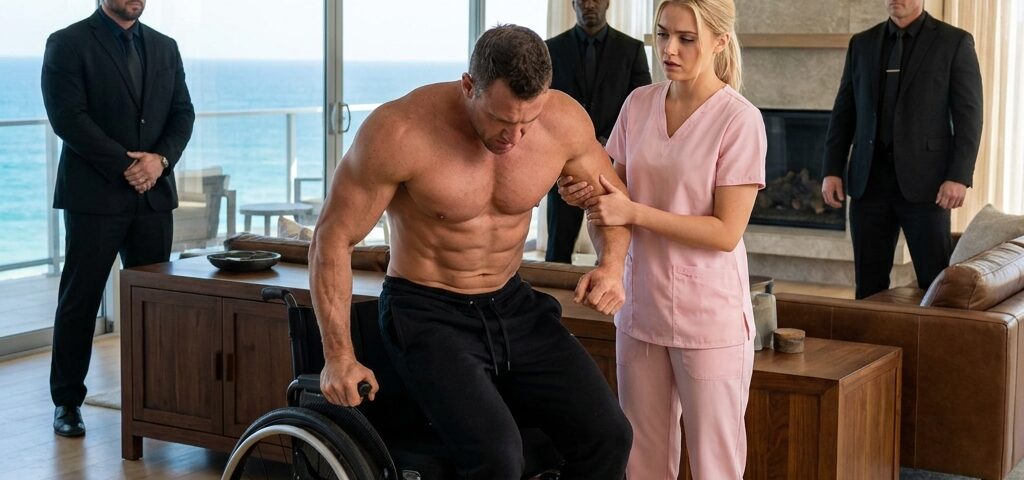
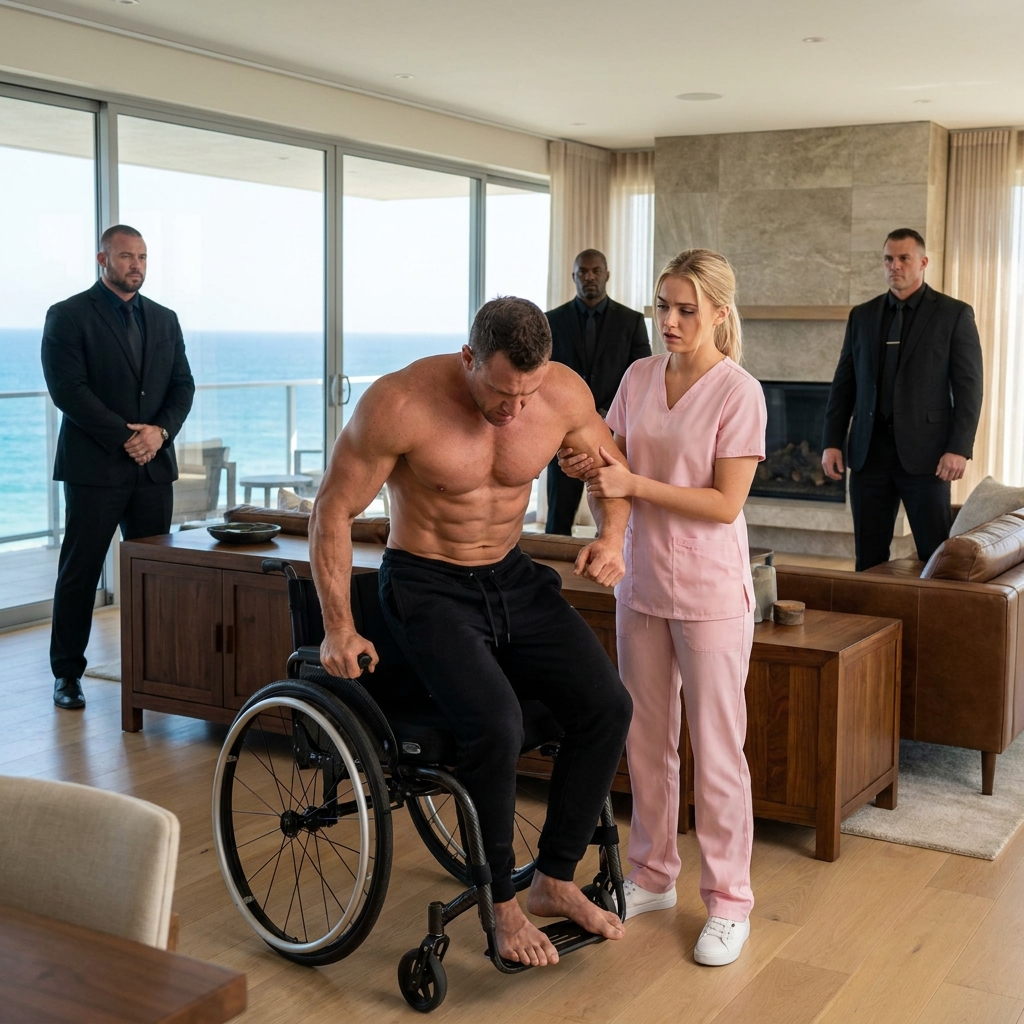
He locked the chair, placed both hands on the armrests, and lifted himself with practiced strength. His shoulders trembled for only a second, but I saw the cost of it. I moved the transfer board into place without touching him until he nodded. Together, with more silence than grace, we got him onto the treatment table.
The room felt different with him lying face down. Less like an office of power, more like a room where pain had been waiting for years to be named.
His back was a map.
Surgical scars ran pale and uneven along his spine. Older scars from the explosion scattered across his ribs and lower back in small silver fragments. There was muscle there, more than expected, but it had hardened around trauma like earth around buried metal.
I warmed my hands before touching him.
“Tell me what you feel.”
“Hands.”
I paused. “You feel my hands?”
“On my upper back.”
“Only upper?”
“Yes.”
I moved lower, slowly, pressing along the thoracic spine.
“Here?”
“Pressure.”
“Here?”
“Less.”
“Here?”
“No.”
But as my fingers reached the area just above his pelvis, the muscles beneath my hand reacted.
Not dramatically.
Not enough for anyone untrained to notice.
But they tightened.
Protective guarding.
“You said you don’t feel that.”
“I don’t.”
“Your body does.”
His voice turned quiet. “Bodies lie.”
“No. Bodies compensate. People lie.”
For a long moment, he said nothing.
I worked carefully, mapping tension, temperature, scar mobility, and tissue density. I found places where his skin was cold, others where it was too warm. I found scars that moved and scars that seemed anchored to bone. Near the lower left side of his spine, my fingers stopped.
There.
A band of tissue sat deep beneath the surface, hard and rope-like, pulling across the pelvis at an angle that made no sense unless something had been held in distortion for years.
“Did you ever have abdominal surgery after the injury?” I asked.
“No.”
“Pelvic fracture?”
“Several.”
“Metal hardware?”
“Yes.”
“Did anyone remove shrapnel from this area?”
“Some. Not all.”
I pressed lightly along the band.
Sebastian inhaled sharply.
I froze. “Pain?”
He didn’t answer.
“Mr. Lombardi.”
“Not pain.”
“What, then?”
His hands gripped the edge of the table. “Heat.”
My heart began beating harder.
“Where?”
“My left hip.”
“Only hip?”
A long pause.
Then, almost unwillingly, he said, “Down the thigh.”
I looked toward his legs.
His left foot rested motionless at the end of the table.
“How far?”
Another pause.
“Knee.”
I kept my voice steady because his wasn’t. “Still there?”
“Yes.”
“Good. Breathe.”
“I am breathing.”
“No, you’re holding your breath and arguing with me.”
A strange sound escaped him. It might have been a laugh if it hadn’t been so strained.
I adjusted my hand position and softened the pressure. The technique was not mystical, not dramatic. It was the kind of patient, specific release work that never looked impressive to anyone watching. Skin, fascia, scar tissue, nerve pathways, joint position. Years of protection layered over injury.
The body remembered everything.
Sometimes it remembered too well.
Sebastian’s back slowly changed beneath my hands. The right side softened first. Then the left. The hard band near his pelvis shifted, not releasing fully, but giving way like a knot loosening in old rope.
His entire body went still.
“What?” I whispered.
“I felt…” He stopped.
“What did you feel?”
“Don’t ask me that.”
“I need to know.”
“No.” His voice roughened. “Because if I say it and it disappears, I will hate you.”
The honesty landed between us.
Not anger.
Fear.
I kept one hand steady on his back. “Then don’t say it yet.”
Rain struck the glass. The fire hissed. Somewhere beyond the door, Gabriel was probably standing like a statue with a gun under his jacket, unaware that the real battle inside the room was happening in a space smaller than the palm of my hand.
I moved to the right side, checking the corresponding tissue. Different. Less fixed. More responsive. His nervous system was not quiet. It was buried.
“Your doctors said complete injury?” I asked.
“Yes.”
“Every one?”
“Eventually.”
“Eventually?”
“At first there were debates. Swelling. Shock. Unclear imaging. Then the senior surgeon told my family the cord damage was irreversible.”
“Who was the surgeon?”
“Dr. Leonard Vale.”
The name sounded familiar, though I couldn’t immediately place it.
“Do you still have your old records?”
His head turned slightly. “Somewhere.”
“I need them.”
“You think the doctors missed something?”
“I think the body in front of me doesn’t match a simple story.”
His voice lowered. “There was nothing simple about what happened to me.”
“No,” I said gently. “I can see that.”
I worked another few minutes, then moved toward his legs again.
“I’m going to position your left hip.”
“No one moves my legs without warning.”
“I just warned you.”
“Maya.”
It was the first time he had used my name.
Not Mrs. Bennett.
Not therapist.
Maya.
I looked at him.
His face was turned toward the windows now, but I could see the tension in his cheek.
“I need a second,” he said.
So I gave him one.
A powerful man asking for time to be touched was still a patient asking for dignity.
When he nodded, I bent his knee slightly and adjusted the position of his hip. His leg was heavy in my hands, but not lifeless. That word had always bothered me. Lifeless. As if paralysis erased the person inside the limb. His leg was quiet, yes. Disconnected in ways medicine had named. But it was still part of him.
I placed one hand beneath his knee and the other near the ankle.
“Don’t try to move,” I said.
“That won’t be difficult.”
“I mean it. Don’t force anything. Just notice.”
“I have spent twenty years noticing nothing.”
“Then notice that.”
He turned his head and stared at me.
I pressed gently into the sole of his foot, then released. Pressed, then released. Checked the calf. Checked the hip. Returned to the band near his lower back with one hand and maintained the ankle position with the other.
There was a sequence to it, a conversation between points in the body that had stopped speaking to each other.
At first, nothing happened.
Then Sebastian’s breathing changed.
His fingers curled against the sheet.
“Heat again?” I asked.
“Yes.”
“Where?”
“Thigh.”
“Where now?”
“Knee.”
“And now?”
He didn’t answer.
His left foot moved.
Not a twitch from a tendon tap.
Not a spasm.
His foot moved.
The toes drew upward slightly, as if answering a question from somewhere deep and forgotten.
The motion was small, fragile, and absolutely impossible.
Sebastian saw it before I did, because he was staring at his leg with the expression of a man watching a ghost return to the room.
Neither of us spoke.
Then the foot moved again.
This time the ankle flexed barely half an inch.
A breath left him. It sounded almost broken.
I pulled my hands away.
The movement stopped.
For a long moment, the only sound was rain.
Sebastian pushed himself up on one elbow, staring at his foot.
“Did you do that?” he asked.
“No.”
My own voice shook.
“Did I?”
“I don’t know.”
His eyes lifted to mine.
There was no coldness in them now. No empire. No legend. Just a man who had spent twenty years building walls around an absence, only to watch that absence answer back.
“Don’t lie to me,” he said.
“I’m not.”
“Don’t make this into something it isn’t.”
“I won’t.”
“Then what was it?”
I looked at his leg, then at his back, then at the scar tissue beneath my hand.
“A sign,” I said carefully. “Not a guarantee. Not a cure. A sign.”
His face tightened as if the word hurt.
Hope again.
Small enough to fit inside a single moving foot.
Large enough to destroy a man if it vanished.
The door opened before either of us could say more.
Gabriel stepped inside. “Everything all right?”
Sebastian didn’t look away from his leg.
“No,” he said quietly. “It isn’t.”
Gabriel’s gaze moved from him to me. “What happened?”
Sebastian answered before I could.
“My foot moved.”
Gabriel went still.
The air in the room changed so sharply that I understood something important: Gabriel had known Sebastian a long time. He wasn’t just an employee. Whatever else he was, he cared.
“Sir?” Gabriel said.
Sebastian’s voice hardened, but not enough to hide the tremor beneath it. “You heard me.”
Gabriel looked at the foot as if he expected it to perform on command.
It didn’t.
Of course it didn’t.
Miracles, if that was what people insisted on calling them, never behaved like trained animals.
“I need his medical records,” I said. “All of them. Surgery reports, imaging, rehab notes, medication history, everything from the first five years after the injury.”
Gabriel’s expression returned to its usual guarded blankness. “Why?”
“Because either every specialist missed something, or something in those records explains why his body is responding now.”
Sebastian watched me carefully. “You think someone made a mistake.”
“I think mistakes happen.”
“And if it wasn’t a mistake?”
I didn’t answer right away.
Outside, lightning flashed over the lake, turning the windows white for a split second.
Then I said, “Then we need to know that too.”
Gabriel left to make calls.
Sebastian transferred back to his chair with my assistance, but he was quieter now. Not softer, exactly. Sebastian Lombardi did not become soft in one evening. But something had shifted. He wasn’t performing indifference for me anymore.
He kept glancing at his foot.
Each time, his mouth tightened.
“I hate this,” he said suddenly.
I was packing my tools. “Most patients do.”
“I’m not most patients.”
“No, most patients don’t have armed men outside the door.”
He looked at me. “You make jokes when you’re afraid.”
“I also make jokes when rich men are dramatic.”
That surprised another almost-laugh out of him.
Then his face sobered. “If this is real, what happens next?”
“Nothing fast.”
His expression darkened.
I held up a hand. “That’s not me being discouraging. That’s me being careful. Twenty years of paralysis means your muscles, joints, nerves, circulation, and brain all adapted to one reality. Even if there is a pathway left, it won’t become a road overnight.”
“But there is a pathway?”
“There may be.”
“May be.” He repeated the words as if testing their strength and finding them insufficient.
“Mr. Lombardi, I watched your foot move. I also watched it stop. I don’t know yet what that means.”
“But you want to find out.”
“Yes.”
“Why?”
The question caught me off guard.
“For the money,” I said.
He didn’t believe me.
I sighed. “Partly for the money. I need it. My son needs it. But also because bodies are puzzles, and yours has been locked in a room for twenty years with everyone insisting there is no key.”
“And you think you have one?”
“No. I think I heard something turn in the lock.”
He looked toward the fire.
For the first time, I noticed a framed photograph on the mantel. It showed a young Sebastian standing beside an older man with broad shoulders and proud eyes. His father, probably. Both of them wore suits. Both looked like they were trying not to smile.
The boy in the photograph had strong legs and careless confidence.
The man in the chair did not look at it.
Gabriel returned with a thin black folder, not nearly enough to contain twenty years of medical history.
“This is what we have here,” he said. “The rest will take time.”
Sebastian gave him a look.
Gabriel corrected himself. “The rest will be collected.”
I opened the folder on a side table.
There were summary reports, medication lists, and copies of old surgical notes. Some pages were faded. Others had been copied so many times that entire sections were difficult to read. I scanned quickly, looking for injury level, classification, complications.
T11-L1 trauma.
Spinal stabilization.
Pelvic fractures.
Retained metallic fragments.
Neuropathic pain.
Complete motor and sensory loss below…
I stopped.
Below what?
The line had been cut off in the copy.
“Do you have the original of this page?” I asked.
Gabriel leaned closer. “Not here.”
I turned to the next page.
There was a handwritten note in the margin. I couldn’t read all of it, but three words stood out.
Response inconsistent. Reassess.
My fingers went cold.
“Who wrote this?” I asked.
Sebastian rolled closer.
I showed him the note.
He stared at it, then shook his head. “I’ve never seen that.”
“It’s from early rehab.”
“I said I’ve never seen it.”
Gabriel looked at the page too. Something moved behind his eyes.
“What?” I asked him.
“Nothing.”
But it wasn’t nothing.
Sebastian noticed as well. “Gabriel.”
The other man’s jaw tightened. “Your aunt managed many of the medical decisions after the accident.”
“My aunt managed flowers and guest lists.”
“She managed more while you were sedated.”
Sebastian’s face became unreadable again, but this time the coldness had direction.
“Call her.”
“It’s late.”
“Call her.”
Gabriel stepped away.
I closed the folder gently. The last thing I wanted was to get pulled into old family politics inside a house where even the walls felt like they kept secrets.
“I should go,” I said.
Sebastian turned sharply. “No.”
My spine stiffened.
He saw it and immediately corrected his tone. “Please.”
The word did not sound natural in his mouth. That made it matter more.
“I need to get home to Oliver,” I said.
“Of course.”
He looked at Gabriel, who had ended the call before it began.
“Have a driver take her wherever she wants to go. No blindfold.”
Gabriel’s eyes flicked toward him.
Sebastian’s voice hardened. “No blindfold.”
A strange relief moved through me. Not trust. Not yet. But something less suffocating than before.
I collected my bag.
At the door, Sebastian said, “Maya.”
I turned.
He was sitting in the firelight, one hand resting on his thigh as if waiting for it to speak again.
“Will it happen again?”
I could have given him a comforting lie. People paid well for those. They built entire careers on polished certainty.
Instead, I gave him the only thing I had.
“I don’t know.”
He looked down.
“But your body answered once,” I added. “That matters.”
His fingers curled slightly against his leg.
When I left the room, Gabriel walked beside me through hallways lined with art worth more than every apartment I had ever rented. The estate was quieter than I expected. No shouting, no music, no crowds of dangerous men. Just polished floors, rain against old windows, and the distant hum of a house built to keep the world out.
At the front entrance, Gabriel stopped.
“About your son,” he said.
I faced him. “Choose your next words carefully.”
His expression did not change, but his voice lowered. “I have a daughter.”
That was the last thing I expected him to say.
“She was born early. Lungs weren’t ready. For two years, every cold was a hospital visit.” He looked past me toward the rain. “I should not have used your boy’s illness that way.”
It wasn’t quite an apology.
But it was close enough to surprise me.
“No,” I said. “You shouldn’t have.”
He nodded once.
A black car waited outside.
This time, no one covered my eyes.
As the gates opened and the estate disappeared behind me, I pressed my forehead lightly to the cool window and watched the city return in pieces. Streetlights. Wet pavement. Corner stores. Apartment buildings with glowing windows. Ordinary lives stacked on top of one another.
By the time I reached home, it was almost midnight.
My apartment smelled faintly of lavender detergent and the chicken soup I had reheated for Oliver before leaving him with Mrs. Alvarez from downstairs. She was asleep in the recliner, a blanket over her knees, while Oliver lay curled on the couch with his dinosaur inhaler clutched in one hand.
I paid her more than I could afford before remembering I could afford it now.
That thought made me feel both grateful and ashamed.
After she left, I knelt beside my son.
Oliver’s breathing was steady.
In.
Out.
A soft whistle at the edge, but not the dangerous kind.
His eyelashes fluttered. “Mom?”
“I’m here, baby.”
“Did you help somebody?”
I brushed hair off his forehead. “I tried.”
“Did it work?”
I thought of Sebastian’s foot moving in the firelight.
“I don’t know yet.”
Oliver opened one sleepy eye. “That’s what you say when you don’t want to say yes.”
I smiled despite everything. “Go back to sleep.”
He shifted, making room for me on the couch even though he was getting too big for that. I lay beside him carefully, listening to his breathing until it became the only sound in the apartment.
But sleep did not come easily.
Every time I closed my eyes, I saw the handwritten note.
Response inconsistent. Reassess.
I saw Sebastian’s expression when his foot moved.
I saw Gabriel’s face when he mentioned my son.
And I saw something else I couldn’t explain: the name Dr. Leonard Vale turning over and over in my memory like a key I had once held.
The next morning, I woke before dawn and searched through an old storage box beneath my bed.
Certificates.
Expired licenses.
Insurance letters.
Photographs from a version of my life that looked almost fictional now.
At the bottom, inside a cracked plastic folder, I found a stack of papers from my hospital internship twenty-two years earlier. Northwestern Memorial. Rehabilitation rotation. I had been twenty years old, exhausted, idealistic, and convinced that every patient could teach me something if I paid attention.
I flipped through old notes with growing unease.
Then I found it.
A seminar handout from a guest lecture.
ADVANCED SPINAL TRAUMA REASSESSMENT
Presented by Leonard Vale, M.D.
My stomach tightened.
I remembered him now.
Not clearly. Not as a villain from a story or a monster from a nightmare. Just a polished surgeon with silver hair and expensive shoes who had spoken to a room full of students about certainty. He had said that false hope was a kind of cruelty.
At the time, I had written the sentence down.
Now it looked different.
At seven, Oliver woke coughing, and the morning swallowed my questions. Medication. Steam from the shower. Breakfast. School forms. A missing shoe. The ordinary chaos of motherhood, which had no respect for mysteries or wealthy men with impossible movement.
By nine, I was at my clinic.
By nine-fifteen, Gabriel was at the door.
He did not lock it this time.
That was progress, I supposed.
“Mr. Lombardi requests daily sessions,” he said.
“Mr. Lombardi can request anything he likes. My schedule is full.”
Gabriel looked around the empty waiting room.
I crossed my arms. “Emotionally full.”
A hint of amusement touched his eyes. “He will pay double.”
“Of course he will.”
“He also said to tell you that no one will investigate your clients, your finances, or your past unless you give him reason.”
“That is still a threat.”
“It was intended as reassurance.”
“He needs practice.”
This time Gabriel almost smiled.
I hated that it made him seem human.
“I can come three evenings a week,” I said. “No more. My son comes first.”
“Agreed.”
“And I want copies of all medical records before the next session.”
“They’re being obtained.”
“From whom?”
Gabriel hesitated.
That hesitation told me everything.
“From the aunt,” I said.
“Among others.”
“What is her name?”
“Vivian Lombardi.”
I knew that name too, though everyone in Chicago did. Vivian Lombardi chaired charity boards, funded hospital wings, and appeared in society magazines wearing pearls and expressions of tasteful sorrow. She was Sebastian’s last living close relative, the elegant aunt who had stood beside him after the bombing.
“Does Sebastian trust her?” I asked.
“Sebastian trusts very few people.”
“That wasn’t my question.”
Gabriel looked toward the street outside my clinic. “He used to.”
That evening, I returned to the estate without a blindfold.
The difference should have made me feel safer.
It didn’t.
Now I knew where I was going. That made the house more real, not less threatening. It rose above the lake behind iron gates and wet black trees, all stone and glass and quiet authority. Inside, the staff moved with the careful silence of people trained not to be noticed.
Sebastian was waiting in a room I hadn’t seen before.
Not the bedroom this time.
A therapy room.
Or what had once tried to be one.
It contained parallel bars, resistance machines, an adjustable treatment table, shelves of abandoned braces, and equipment so expensive it looked untouched. Dust gathered on the handles of machines designed for hope no one had used in years.
Sebastian followed my gaze.
“I had enthusiastic doctors,” he said.
“You had doctors with budgets.”
“Those too.”
I set my bag down. “How do you feel today?”
“Annoyed.”
“Physically.”
“Also annoyed.”
I gave him a look.
He sighed. “My back is sore. My left thigh burned for two hours after you left. Then nothing.”
“Any movement?”
“No.”
“Any dreams?”
The question surprised him. “What?”
“Patients sometimes dream of movement after neurological changes.”
His face closed slightly. “I dreamed I was standing in my father’s office.”
I waited.
He looked away. “Then I woke up.”
The grief in that simple sentence was too private to touch.
So I didn’t.
We worked for ninety minutes.
Nothing dramatic happened.
That was important too.
Recovery, real recovery, was mostly repetition without applause. Careful positioning. Breath. Scar release. Joint mobility. Testing. Waiting. Listening. Sebastian hated waiting. He hated not controlling the outcome. He hated needing help, and he especially hated needing mine.
But he did not quit.
He questioned everything.
“Why there?”
“Because your hip isn’t moving.”
“It hasn’t moved in twenty years.”
“Exactly.”
“Why does my breathing matter?”
“Because your ribs attach to your spine, and your spine affects your pelvis, and your pelvis affects your legs.”
“So my foot is stubborn because I breathe badly.”
“Your foot has many complaints. I am only translating.”
At one point, his mouth twitched. “Do all your patients get sarcasm?”
“Only the difficult ones.”
“Then I should be honored.”
“You should be still.”
He became still.
Not obedient. Never that.
But cooperative.
Near the end, I felt the same deep band near his pelvis soften again. His fingers tightened around the edge of the table.
“Heat?” I asked.
“Yes.”
“Where?”
“Hip. Thigh.”
“Foot?”
A pause.
“No.”
His disappointment filled the room before he could hide it.
“That’s still information,” I said.
“It’s not movement.”
“No. But sensation often returns unevenly.”
“You said it might not be sensation.”
“I said your body is complicated.”
“My body is a ruined building with expensive security.”
“Maybe. But some buildings can be rewired.”
He turned his head toward me. “You always talk like that?”
“Like what?”
“As if broken things are inconvenient, not final.”
I thought of my bank account. My marriage. My career. Oliver’s lungs.
“No,” I said. “Only when I need to believe it.”
He didn’t respond.
After the session, Gabriel handed me a larger box of records.
“These arrived from storage,” he said.
I took them home and read until two in the morning.
The records told a story in fragments.
Sebastian’s initial injury had been catastrophic, but not clean. There had been swelling, bleeding, bone fragments, and severe trauma around the lower spine. Early notes described “uncertain preservation of limited pathways” and “possible incomplete presentation masked by spinal shock.” Then, over the following weeks, the language shifted.
Poor prognosis.
Minimal response.
Complete functional loss.
Rehabilitation focus: adaptation.
By month three, no one mentioned reassessment.
By month six, his future had been written in permanent ink.
I found Dr. Vale’s signature on the decisive report.
I also found Vivian Lombardi’s name on consent forms, insurance authorizations, and private care decisions.
Then, near the bottom of the box, I found a sealed envelope.
It was not medical.
It was personal stationery, thick and cream-colored.
My name was written on it.
MAYA BENNETT.
Not Mrs. Bennett.
Not Therapist.
Maya Bennett.
My hands went cold.
The envelope looked old. Yellowed at the edges. Sealed, but not recently. The ink had faded slightly, as if it had been waiting years for me to open it.
I checked the box again.
The shipping label said it had come from Lombardi family storage.
Not from Gabriel.
Not from Sebastian.
From storage.
I opened the envelope carefully.
Inside was a single photograph.
At first, I didn’t understand what I was seeing.
It showed a hospital rehab room from decades ago. A younger version of me stood in the background wearing student scrubs and holding a clipboard. I was half-turned away from the camera, my hair pulled into a messy bun, my face thinner and unmarked by the exhaustion that would come later.
In the foreground, sitting in a hospital bed, was a young man with dark hair, bruised eyes, and a rigid brace around his torso.
Sebastian.
Twenty-two years old.
I sat down hard on the floor.
I had met him before.
No memory came at first. Only sensation. Fluorescent lights. The smell of antiseptic. A young trauma patient surrounded by serious men. A student being told to leave because the case was private.
Then a voice from the past surfaced.
Dr. Vale saying, “This patient is not for teaching rounds.”
Another voice, a woman’s, smooth and controlled.
“Make sure no unnecessary notes remain in the file.”
My heartbeat became loud in my ears.
I turned the photograph over.
There was writing on the back.
Not mine.
Not Sebastian’s.
Three words.
She noticed it.
The room seemed to shrink around me.
I read the words again.
She noticed it.
Not he.
She.
Me.
I covered my mouth with one hand, trying not to wake Oliver asleep in the next room.
What had I noticed?
And why had someone kept a photograph of me inside Sebastian Lombardi’s medical records for twenty years?
PART 3
For several minutes, I sat on the apartment floor with the photograph trembling in my hands.
The city outside my window had gone quiet in that strange way Chicago sometimes did after midnight, as if the buildings themselves were holding their breath. A thin line of yellow light spilled from the hallway into the living room. Oliver’s small backpack leaned against the couch. His sneakers sat by the door, one upright, one fallen on its side.
Everything around me looked ordinary.
But nothing felt ordinary anymore.
I turned the photograph over again.
She noticed it.
Three words.
Three simple words that made the past tilt beneath my feet.
I looked at the younger version of myself in the background of the hospital room. Twenty years ago, I had been a student with tired eyes, cheap shoes, and a pen clipped to my collar. I had been trying to learn how to help broken bodies heal. I had not known that one of those bodies belonged to a man who would someday become the most feared name in Chicago.
And apparently, someone had noticed me noticing something.
The problem was, I had no idea what it was.
I pressed my fingers against my forehead and tried to force the memory open.
Fluorescent lights.
The squeak of shoes on polished hospital floors.
A young man lying in a bed with a brace around his torso.
Doctors speaking in lowered voices.
A woman in pearls standing near the window.
A surgeon with silver hair saying, “This patient is not for teaching rounds.”
Then something else.
A clipboard.
A chart.
My own handwriting?
The memory vanished as soon as I reached for it.
From the bedroom, Oliver coughed once.
I froze.
It was a soft cough, the kind that usually came with sleep. Still, I was on my feet in seconds, photograph forgotten on the rug as I hurried to his room.
He lay curled beneath his blue blanket, one hand tucked under his cheek. His dinosaur inhaler rested on the nightstand beside a half-empty glass of water. I watched his chest rise and fall.
In.
Out.
A faint whistle, but steady.
I sat on the edge of his bed and gently touched his hair.
“Mom?” he murmured without opening his eyes.
“I’m here.”
“You okay?”
The question hurt more than it should have. Children were supposed to ask for water, for stories, for one more minute before bedtime. They were not supposed to listen for the cracks in their mother’s breathing.
“I’m okay,” I whispered.
His eyes opened halfway. “You’re doing the worried thing.”
“What worried thing?”
“The quiet thing.”
I smiled because he knew me too well. “Go back to sleep, detective.”
He shifted, then patted the blanket beside him. “You can sit here.”
So I did.
I sat in the blue glow of his night-light while his breathing softened again. I stayed there until my pulse slowed, until the photograph in the other room stopped feeling like a flame waiting to burn through the floor.
But sleep never came.
By morning, the photograph was hidden inside my medical bag, tucked between Sebastian’s copied records and an old anatomy notebook from my student days. I told myself I would ask him about it calmly. Professionally. Rationally.
Then Oliver spilled cereal across the kitchen counter, couldn’t find his science worksheet, and announced five minutes before leaving that his chest felt “a little tight but not emergency tight.”
The mystery waited while motherhood took over.
I checked his breathing, gave him his medication, cleaned the counter, signed the worksheet, and walked him to school beneath a sky the color of wet stone. At the gate, he looked up at me with his backpack hanging from both shoulders.
“Are you going to help the man again today?”
I nodded. “Yes.”
“The man who can’t walk?”
I hesitated. I had never told Oliver Sebastian’s name. I had only said I was treating a patient with an old injury.
“Yes,” I said carefully.
Oliver thought about that. “Maybe his legs forgot they’re legs.”
Despite everything, I laughed softly. “Maybe.”
“You should remind them nicely. Sometimes when people forget things, they don’t like being yelled at.”
I crouched in front of him and zipped his jacket higher. “That is surprisingly good medical advice.”
He smiled, proud of himself.
Then his expression changed. “Mom?”
“Yes?”
“Are we safe?”
The question stole the breath from me.
I wanted to lie instantly, the way parents do when love outruns truth. Of course we’re safe. Nothing bad will happen. I’ve got everything under control.
But Oliver had lived through too many ambulance rides and too many whispered phone calls to trust easy answers.
So I took his small hands in mine.
“I am being careful,” I said. “And I will always choose you first. No matter what.”
That seemed to satisfy him, though not completely. He hugged me quickly, then ran toward the school doors, joining a stream of children carrying lunch boxes and winter coats.
I watched until he disappeared inside.
Only then did I allow myself to breathe.
That evening, the estate looked different.
Not smaller.
Never smaller.
But less like a fortress and more like a house that had forgotten how to be lived in. Rain had given way to cold, clean air. The lake stretched black and silver beyond the windows, restless beneath a rising moon. Somewhere inside, a piano played a few uncertain notes, then stopped.
Gabriel met me at the door.
“You look like you didn’t sleep,” he said.
“You look like you say that to people who might hit you.”
“Usually, they don’t.”
“That sounds disappointing for them.”
His mouth twitched. Then his eyes dropped to my bag. “You found something.”
I stopped.
He knew.
The silence between us lengthened.
“What do you know about that photograph?” I asked.
Gabriel looked toward the hallway before answering. “Not enough.”
“That isn’t an answer.”
“It’s the only honest one I have.”
“Does Sebastian know?”
“No.”
I studied him. “Why not?”
“Because I didn’t know what was in the envelope until this morning.”
A chill moved through me. “You opened the records?”
“I checked the inventory. The envelope was logged separately years ago under a private family archive code.”
“Whose code?”
Gabriel’s jaw tightened.
“Vivian’s,” I said.
He didn’t deny it.
The name hung between us like a door left open in a dark room.
I stepped closer, lowering my voice. “Gabriel, twenty years ago someone kept a photograph of me in Sebastian’s medical records with a note that said I noticed something. If you know what that means, now is the time to tell me.”
“I don’t,” he said quietly. “But I know this: after the accident, anyone who questioned Dr. Vale’s final assessment was removed from Sebastian’s care team.”
“Removed how?”
“Transferred. Reassigned. Paid to leave. Sometimes just frightened enough to stop asking questions.”
My stomach turned.
Not because the words were dramatic. Because they were believable. Hospitals had politics. Wealth had gravity. Powerful families could bend a room without raising their voices.
“And you never asked why?”
His face closed. “I was twenty-six. I drove cars. Opened doors. Followed instructions. By the time I understood that silence could be a choice, years had already passed.”
For the first time, Gabriel sounded older than he looked.
I thought of his daughter with fragile lungs. Of my son asking if we were safe. Of all the parents who learned too late that love did not protect anyone unless it also became courage.
“Take me to him,” I said.
Sebastian was in the therapy room, waiting beside the parallel bars.
He wore a dark sweater today instead of a suit, the sleeves pushed up to his elbows. Without the armor of formal clothing, he looked less like a man built from reputation and more like someone still recovering from a war no one else could see.
His gaze moved from my face to Gabriel’s.
“What happened?”
I took the photograph from my bag.
Gabriel remained by the door.
Sebastian watched me cross the room. “Maya.”
“I need to show you something.”
I handed him the photograph.
He looked down.
At first, his expression did not change. Then his fingers tightened around the edge of the paper.
He stared at the young man in the hospital bed.
At the brace.
At the room.
Then at me.
“That’s you,” he said.
“Yes.”
“You were there.”
“I think so.”
His eyes sharpened. “You think so?”
“I was a student. I rotated through dozens of cases. Some I remember clearly. Some are fragments.”
He turned the photo over.
I watched him read the words.
She noticed it.
The color changed in his face so subtly that someone else might have missed it.
I didn’t.
“What did you notice?” he asked.
“I don’t know.”
His gaze lifted slowly. “Maya.”
“I’m telling you the truth. I remember being told to leave your room. I remember Dr. Vale. I remember a woman by the window.”
“My aunt.”
“I think so.”
He looked back at the photograph. The fire from the previous night had made him vulnerable. This made him dangerous in a quieter way. Not dangerous to me, I realized. Dangerous to the lie he had lived inside.
“Gabriel,” Sebastian said.
“Yes.”
“Find Vivian.”
“She’s at the Lincoln Park house.”
“Bring her here.”
Gabriel hesitated. “Tonight?”
Sebastian’s voice dropped. “Tonight.”
I stepped forward. “Before you do that, we need to keep our heads.”
Both men looked at me.
I nearly laughed at the absurdity of it. Me, in worn scrubs and old sneakers, telling Sebastian Lombardi and his most trusted man to be reasonable.
But I stood my ground.
“This photograph is not proof of anything by itself,” I said. “It means someone was watching. It means someone thought I saw something important. But if you confront Vivian without knowing what that something is, she’ll deny it or bury it deeper.”
Sebastian’s eyes remained fixed on mine.
“And what do you suggest?”
“We work.”
A bitter smile touched his mouth. “You want physical therapy right now?”
“Yes.”
“Why?”
“Because your body may remember what your mind can’t. Mine might too.”
For a long moment, he said nothing.
Then he placed the photograph on the table with great care.
“Then let’s see what else the past remembers.”
The session began with silence.
Not empty silence.
Full silence.
The kind that holds too much.
Sebastian transferred to the table without complaint. His movements were precise, controlled, almost elegant from years of practice. But I saw the tension beneath them. I saw the way his hand lingered near the photograph before he turned away from it.
I warmed my hands and placed them against his back.
“Breathe,” I said.
“I am.”
“No, you’re preparing for battle.”
“I often am.”
“Not with me.”
The words slipped out before I could stop them.
His head turned slightly.
Neither of us spoke for a moment.
Then his shoulders lowered a fraction.
I began with the same area near his lower spine, working slowly through layers of guarded tissue. I asked him to describe sensations without interpreting them. Heat. Pressure. Pulling. Static. Nothing. Then heat again.
As I worked, I let my own memory drift.
Not forcing.
Not chasing.
Just listening.
Hospital lights.
A chart slipping from a stack.
My hand catching it.
A line drawing of the spine.
A note about movement in the left foot.
My younger self frowning.
Someone saying, “That shouldn’t be in there.”
I stopped moving.
Sebastian noticed instantly. “What?”
“I remembered something.”
His voice was barely above a whisper. “Tell me.”
“There was a chart page. I think it said there was movement. Early movement. In your left foot.”
His eyes closed.
Gabriel stepped closer from the door.
“And?” Sebastian asked.
“I remember being confused because the attending was telling everyone your injury was complete, but the note didn’t match. I think I asked about it.”
The room went still.
“What did they say?” Gabriel asked.
I pressed my fingers to my temple. “Someone took the page. Dr. Vale maybe. Or a nurse. I remember being embarrassed, like I had spoken out of turn.”
Sebastian’s breathing changed beneath my hands.
“Did I know?” he asked.
The question was not angry.
It was worse.
It was wounded.
“I don’t know,” I said gently.
He was quiet for so long that I thought the session was over.
Then he said, “Keep going.”
I did.
This time, when I worked along the left side of his pelvis, the response came faster. His back softened beneath my hand. His thigh muscles tightened faintly. His breath caught, and he did not make a joke to cover it.
“Heat?” I asked.
“Yes.”
“Where?”
“Hip. Thigh. Knee.”
“Foot?”
He swallowed. “Maybe.”
“Don’t chase it. Just notice.”
“I hate that word.”
“I know.”
I moved to his ankle and positioned his foot. Gabriel stood near the wall, so still he might have been carved from shadow. The moonlight reflected off the windows. Machines around us waited like witnesses.
Sebastian’s toes moved.
This time, all of us saw it.
A small upward lift.
Then a second one.
His hand gripped the edge of the table.
I kept my voice low and steady. “Good. Don’t force it.”
“I’m not doing anything.”
“I know.”
His ankle flexed slightly.
Gabriel exhaled.
Sebastian turned his face away, but not before I saw moisture gather at the corner of his eye.
He did not let it fall.
That was all right.
Some men cried by holding still.
The movement lasted less than ten seconds. Then it faded, leaving the room ringing with what had happened.
Sebastian lay there, breathing hard.
I stepped back to give him space.
Gabriel moved first. He approached slowly, as if nearing a wild animal that might bolt if startled.
“Sebastian,” he said, and for the first time I heard him use his employer’s name without a title.
Sebastian did not look at him. “Don’t.”
Gabriel stopped.
“Don’t make it into something yet,” Sebastian said.
Gabriel nodded. “All right.”
But his voice was thick.
I looked away, pretending to adjust my equipment, because some moments deserved privacy even when they happened in a room full of people.
Afterward, Sebastian sat in his chair near the windows, quieter than I had ever seen him. The photograph lay on his lap. He held it with both hands.
“I don’t remember you,” he said.
“I barely remember myself from that time.”
“You were very young.”
“So were you.”
He looked at the young man in the hospital bed. “I don’t think of him as me.”
“I understand that.”
“Do you?”
I thought of the woman I had been before divorce, before bills, before watching my child struggle for breath. The woman with a clinic, a plan, a marriage she believed would last.
“Yes,” I said. “I do.”
His gaze shifted to me.
Something passed between us then. Not romance. Not trust exactly. Something more fragile and more useful.
Recognition.
Two people sitting across from the lives they had lost, realizing neither loss had been the whole story.
“My aunt raised me after my mother died,” Sebastian said. “My father was busy building his empire. Vivian taught me manners, languages, which fork to use at dinners where everyone hated each other politely. After the bombing, she sat beside my hospital bed every day.”
His thumb brushed the edge of the photograph.
“She told me I had survived for a reason.”
“That sounds comforting.”
“It was.” His voice hardened slightly. “Until now.”
“You don’t know what she did.”
“No. But I know what she controlled.”
Before I could answer, Gabriel’s phone buzzed.
He looked at the screen. His expression changed.
“What is it?” Sebastian asked.
“Vivian isn’t at the Lincoln Park house.”
“Where is she?”
“Her staff says she left an hour ago.”
“To come here?”
Gabriel looked at me, then back at Sebastian. “No. To see Dr. Vale.”
The name struck the room like a cold draft.
Sebastian smiled once, without humor. “Of course she did.”
I folded my arms. “That means she knows something is moving.”
Gabriel nodded. “Or someone told her the old records were pulled.”
Sebastian’s eyes went to him.
Gabriel did not look away. “There are still people loyal to her.”
A strange calm settled over Sebastian. It was not the icy calm from stories. This was different. Focused. Awake.
“Then we stop asking people who lied to us,” he said. “We ask the records.”
“I’ve reviewed what came,” I said. “There are gaps.”
“Where would the originals be?”
“Hospital archive, private physician storage, maybe legal files.”
Gabriel said, “Vale retired years ago.”
“Retired doctors still keep copies,” I said. “Especially ones who make important decisions for wealthy families.”
Sebastian turned his chair toward me. “Can you get them?”
“Not legally without authorization.”
“You have mine.”
“That helps with medical records. But if they were altered or removed, the official request may not be enough.”
Gabriel’s phone buzzed again. He glanced down. “There’s something else.”
Sebastian waited.
Gabriel looked uncomfortable, which made me nervous.
“When Vivian left, she took a file box from her private safe.”
“What file box?”
“The house manager didn’t know. But he said it had a red hospital sticker.”
My mouth went dry.
Sebastian’s gaze moved to the photograph.
Then to me.
“She kept the originals,” he said.
No one needed to answer.
The therapy room suddenly felt too bright, too quiet, too full of things no one had dared name.
I packed my bag with hands that were steadier than I felt.
“You should go home,” Sebastian said.
I looked at him sharply. “That sounds like an order.”
“It’s concern.”
“You need practice with that too.”
His face softened in the smallest possible way. “Probably.”
I zipped my bag. “I’m not walking away from this.”
“I didn’t ask you to.”
“You were about to.”
He looked toward the lake. “Twenty years ago, a lot of people close to me made decisions while I was powerless. I won’t let that happen to you because of me.”
The words landed quietly.
Not dramatic.
Not polished.
Just real.
I thought of Oliver at the school gate asking if we were safe. I thought of the photograph hidden for two decades. I thought of Sebastian’s toes lifting twice beneath the moonlight.
“You are not the only person who lost something because adults in expensive rooms decided what truth should survive,” I said.
His eyes returned to mine.
“I need to know what I noticed,” I continued. “Not just for you. For me too.”
Gabriel drove me home that night himself.
At first, neither of us spoke. The city slid past in wet reflections and late-night traffic. Restaurants glowed. Buses sighed at curbs. People crossed streets under umbrellas, carrying groceries, flowers, takeout bags, ordinary little proofs that life continued even when the ground shifted beneath someone else.
“Sebastian wasn’t always like people say,” Gabriel said finally.
I watched his profile in the passing light. “Were any of us?”
“He was reckless. Proud. Too charming for his own good. But he wasn’t cruel.” Gabriel paused. “After the injury, people stopped expecting him to be whole in any way. Some feared him. Some pitied him. Both changed him.”
“What did you do?”
“I stayed.”
“That matters.”
“Not enough.”
I understood that answer.
Sometimes staying was love.
Sometimes it was guilt wearing love’s coat.
When we reached my apartment building, Gabriel turned off the engine but did not unlock the doors immediately.
“Your son,” he said. “Oliver.”
My body tightened.
“He and my daughter see the same pulmonologist.”
I stared at him. “What?”
“Dr. Hirsch. Children’s respiratory clinic near Mercy.”
“How do you know that?”
“Because I was there last month. I saw your name on the appointment board. I didn’t know who you were then.”
Something in his tone stopped my fear from rising too far.
“What’s your daughter’s name?”
“Sofia.”
The name changed his face.
Only a little.
Enough.
“She’s twelve,” he said. “Plays violin badly but with confidence. Hates soup. Thinks I worry too much.”
“That sounds familiar.”
He looked toward my building. “When I mentioned Oliver that first night, I told myself it was strategy. It wasn’t. It was fear. I knew exactly what pressure point I was touching.”
I said nothing.
“I’m sorry,” he said.
This time, it was an apology.
Plain.
Unarmed.
I nodded slowly. “Don’t do it again.”
“I won’t.”
The doors unlocked.
I was halfway out when he added, “Maya.”
I looked back.
“If Vivian has those records, she won’t hand them over because Sebastian asks.”
“I know.”
“And Dr. Vale won’t admit anything.”
“I know that too.”
“Then why aren’t you more afraid?”
I thought about it.
Then I looked up at my apartment window, where a soft lamp glowed behind thin curtains and my son slept inside.
“I am afraid,” I said. “I’m just tired of letting fear make all my decisions.”
That night, I dreamed of the hospital.
Not as it was now, renovated and shining, but as it had been twenty years ago. Narrower halls. Beige walls. A vending machine that ate dollar bills. I walked barefoot through the rehab unit holding a clipboard I could not read.
Behind one door, someone was crying.
Behind another, a monitor beeped steadily.
At the end of the hall, young Sebastian sat in a wheelchair for the first time, his hands clenched around the wheels, his face pale with fury and terror.
Dr. Vale stood beside him.
Vivian stood behind him.
And my younger self stood in the doorway, staring at Sebastian’s left foot.
It moved.
Not much.
But it moved.
In the dream, I heard myself say, “He responded.”
Dr. Vale turned slowly.
His face was calm.
Too calm.
Then Vivian stepped between us and said, “Some things are kinder when forgotten.”
I woke before dawn with my heart racing.
For once, Oliver was still asleep.
I grabbed the old anatomy notebook from my bag and flipped through it under the kitchen light. The pages smelled faintly of dust and coffee. Most of my notes were ordinary student scribbles—muscle origins, gait patterns, rehab goals.
Then, tucked into the back cover, I found a folded sheet of paper.
I knew before opening it that it mattered.
The paper was thin, almost brittle, and covered in my handwriting from twenty years ago.
Clinical Observation – Lombardi, S.
Date: March 14
Student: M. Bennett
My breath stopped.
I had written an observation note.
Not in the official chart.
In my own notebook.
I read, barely breathing.
Patient demonstrated involuntary dorsiflexion of left foot during assisted positioning. Possible preserved motor response. Reported to supervising physician. Chart note removed before end of shift. Advised by Dr. L. Vale that observation was “irrelevant due to prognosis.” Patient was not informed during session.
My hand flew to my mouth.
There it was.
The thing I had noticed.
The thing someone had hidden.
Not a cure.
Not certainty.
But evidence that Sebastian’s body had responded from the beginning.
A sound escaped me, half sob, half disbelief.
Oliver appeared in the doorway rubbing his eyes. “Mom?”
I folded the paper quickly, but he had already seen my face.
“What happened?”
I crossed the kitchen and pulled him into my arms.
For a moment, I held him too tightly.
He didn’t complain.
“Mom,” he mumbled into my shirt, “I need air.”
I loosened my hold immediately. “Sorry, baby.”
He looked up. “Is it bad?”
I looked at the folded note on the counter.
“No,” I said slowly. “I think it might be the beginning of something good.”
His eyes brightened. “For the man whose legs forgot?”
“Yes.”
“Then you should tell him.”
“I will.”
He nodded as if the matter were settled. Then he yawned. “After pancakes?”
I laughed through the emotion in my throat.
“Yes. After pancakes.”
The next session was different from the moment I arrived.
Sebastian was not in the therapy room.
He was in the library.
The room rose two stories high, with shelves of dark wood and a ladder running along brass rails. A fire burned low in the hearth. On the desk lay the photograph, the copied records, and a blank legal authorization form waiting for his signature.
He looked tired.
But not defeated.
“Gabriel said you found something,” he said.
I placed the folded student note on the desk.
“This is mine. From twenty years ago.”
He did not touch it immediately.
His fingers hovered above the paper like he feared it might vanish.
Then he opened it.
I watched him read.
The silence stretched.
His face changed once, then changed back. His eyes moved over the words again.
Patient demonstrated involuntary dorsiflexion of left foot.
Patient was not informed.
When he finally looked up, he was not angry in the way I expected.
He looked devastated.
“They knew,” he said.
“At least Dr. Vale knew there was a response.”
“And Vivian?”
“I don’t know.”
“But she kept the photograph.”
“Yes.”
His gaze dropped to the paper again.
For twenty years, everyone had told him his body had been silent from the beginning. For twenty years, he had built a life around that silence.
Now a note from a student therapist said otherwise.
I sat across from him.
“I’m sorry,” I said.
He gave a faint, humorless breath. “People say that when there’s nothing useful left to say.”
“Sometimes it’s still true.”
His eyes met mine.
This time, he did not look away.
“I spent years hating my body,” he said. “Then years ignoring it. Then years punishing it for not being what it was.” His hand closed around the paper, carefully, not crushing it. “And all this time, maybe it was trying.”
The words broke something open in the room.
Not loudly.
Quietly.
Like ice thawing.
“It was trying,” I said. “And now we know how to listen.”
His jaw tightened.
For a moment, I thought he might turn away. Instead, he pressed his fingers against his eyes, one hand still holding the note.
Gabriel, standing near the shelves, looked down.
I stayed seated.
Sometimes dignity meant not looking away from pain.
Sometimes it meant not crowding it.
After a while, Sebastian lowered his hand.
“All right,” he said.
His voice was rough, but steadier.
“What now?”
I slid the authorization form toward him. “Now we request everything officially. Hospital archives. Dr. Vale’s records. Rehab department files. Imaging. Any legal correspondence related to your care.”
“And Vivian?”
“You don’t confront her yet.”
His eyebrow lifted.
“You asked me what now,” I said. “That’s what now.”
He studied me for a long second.
Then he signed.
That small act felt larger than it looked. Not because of the signature itself, but because of what it meant. Sebastian Lombardi was no longer only reacting to the past. He was choosing to enter it with his eyes open.
We worked afterward.
Not because everything was fine.
Because healing rarely waited for perfect circumstances.
In the therapy room, I guided him through breath work and positioning. He was quieter than usual, but more present. When sensation moved down his thigh, he did not demand more. When his foot failed to respond the first few attempts, he did not shut down.
“Again,” he said.
“Rest first.”
“I’m not tired.”
“You’re lying.”
He looked at me. “You say that to all feared men?”
“Only the ones who need hydration.”
Gabriel handed him water without being asked.
Sebastian accepted it.
That, too, felt like progress.
Near the end of the session, I positioned his left foot and waited. Nothing happened at first. Then his toes lifted slightly.
Once.
Twice.
Then, for the first time, Sebastian looked at the movement and smiled.
Not much.
Not enough for anyone outside that room to recognize.
But it was real.
And it changed his whole face.
“There you are,” he whispered.
I looked away quickly because my own eyes were burning.
For that one moment, the mystery did not disappear, but it stepped back. The room held something warmer than suspicion.
Possibility.
When the session ended, Sebastian insisted I take the copied records home again.
“Review everything,” he said. “Tell me what you see.”
“I already am.”
“No. This time, tell me everything. Even what you think sounds impossible.”
I nodded.
At the door, he added, “Maya.”
I turned.
“Bring Oliver here sometime.”
I stiffened.
His expression remained calm. “Not into this. Not into the records or the questions. Just here. There’s a conservatory on the east side of the house. Clean air system, filtered humidity. My mother built it because she loved winter flowers.”
I did not know what to say.
He looked slightly uncomfortable, as if kindness fit him badly and he knew it.
“I thought he might like it,” he said.
For a second, all I could see was Oliver breathing carefully through cold Chicago mornings, his world narrowed by triggers other children never had to think about. A warm glass room full of clean air and flowers would feel like magic to him.
“That’s very generous,” I said.
Sebastian glanced away. “It’s just a room.”
No, I thought.
It was not just a room.
Not from a man who had spent two decades building walls.
“It would mean a lot to him,” I said.
His eyes returned to mine. “Then bring him.”
The next afternoon was Saturday, and Oliver wore his best sweater even though he claimed he did not care.
“Is the house like a castle?” he asked in the car Gabriel sent.
“Sort of.”
“Does the man have guards?”
“Some.”
“Are they nice?”
I looked at Gabriel in the front seat.
He caught my gaze in the mirror. “Some,” he said.
Oliver considered this. “Do they have snacks?”
Gabriel looked briefly unprepared. “I can arrange snacks.”
Oliver nodded approvingly. “Good.”
The conservatory was more beautiful than I expected.
Glass walls rose toward a high arched ceiling, catching winter light and turning it soft. Orange trees grew in large ceramic pots. White orchids climbed a trellis near a fountain that whispered over smooth stones. The air was warm, clean, and faintly sweet.
Oliver stepped inside and stopped.
His mouth opened.
“Mom,” he whispered, “it’s summer in here.”
Sebastian waited near the fountain in his wheelchair.
For the first time since I had met him, he looked uncertain.
Oliver walked toward him with the fearless curiosity only children and saints seemed to possess.
“Are you Mr. Sebastian?”
“I am.”
“I’m Oliver. My legs work, but my lungs are dramatic.”
Sebastian stared at him.
Then he laughed.
Not a rusty almost-laugh.
A real one.
It startled Gabriel so much he turned around.
Oliver grinned. “Mom says dramatic means something wants attention.”
“Your mother has said similar things about me.”
“She says your legs forgot they’re legs.”
I closed my eyes. “Oliver.”
Sebastian looked at me, amusement warming his face. “Did she?”
Oliver leaned closer to Sebastian’s chair. “It’s okay. Forgetting happens. I forgot my lunchbox twice this week.”
Sebastian’s smile faded into something softer.
“That gives me hope,” he said.
Oliver nodded seriously. “You need reminders.”
For an hour, the conservatory held a life none of us had expected.
Oliver asked questions about the plants. Sebastian answered more patiently than I would have imagined. Gabriel produced snacks, including apple slices and crackers, which Oliver accepted with great seriousness. I watched from a bench near the orchids, feeling something inside me unclench one careful inch at a time.
Not safety exactly.
But rest.
Sebastian showed Oliver a small lemon tree near the window.
“My mother planted this,” he said.
“Can you eat the lemons?”
“They’re very sour.”
Oliver looked delighted. “That means yes.”
Sebastian asked about school. Oliver explained his science project on air quality with sweeping hand gestures. When he began to cough, every adult in the room went still, but Oliver waved us off.
“Not emergency,” he said, taking his inhaler from his pocket like a professional.
Sebastian watched him with quiet intensity.
Afterward, while Oliver examined the fountain with Gabriel, Sebastian rolled his chair beside me.
“He’s remarkable,” he said.
“He has had to be.”
“So have you.”
I looked at him, unsure what to do with the gentleness in his voice.
Before I could answer, my phone buzzed.
Unknown number.
I almost ignored it.
Then a voicemail appeared.
A second later, Gabriel’s phone rang too.
He answered, listened, and his face changed.
Sebastian noticed first. “What?”
Gabriel ended the call slowly. “Dr. Vale is dead.”
The conservatory seemed to lose its warmth.
Oliver looked over from the fountain, sensing the shift but not understanding it.
I stood. “What happened?”
“Heart failure, according to the first report. This morning.”
Sebastian’s expression hardened, but grief was not in it. Neither was satisfaction. Only the cold recognition of a door closing.
“He was our best chance at answers,” he said.
My phone felt heavy in my hand.
I looked at the voicemail.
Unknown number.
Something told me to play it.
I put it on speaker before I could change my mind.
Static crackled.
Then an elderly man’s voice filled the conservatory.
Weak.
Urgent.
“Maya Bennett. If this number still belongs to you, then you found what I hoped you would. I don’t have much time. Sebastian was never the only patient. Look for the children’s wing records. March fifteenth. The boy’s name was Oliver.”
My blood turned cold.
The message ended.
For one heartbeat, no one moved.
Then my son’s small voice came from beside the fountain.
“Mom?” Oliver whispered. “Why did that man say my name?”