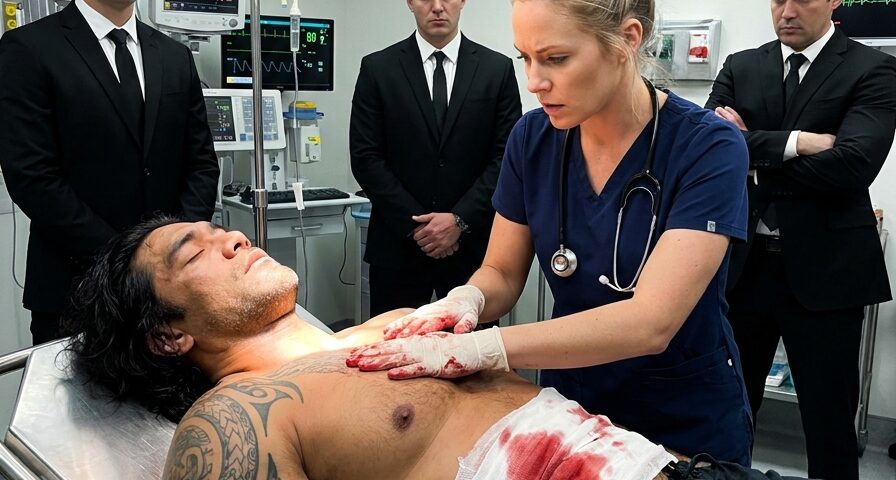
PART 2: The Nurse Who Became the Only Touch Chicago’s Most Feared Man Could Bear
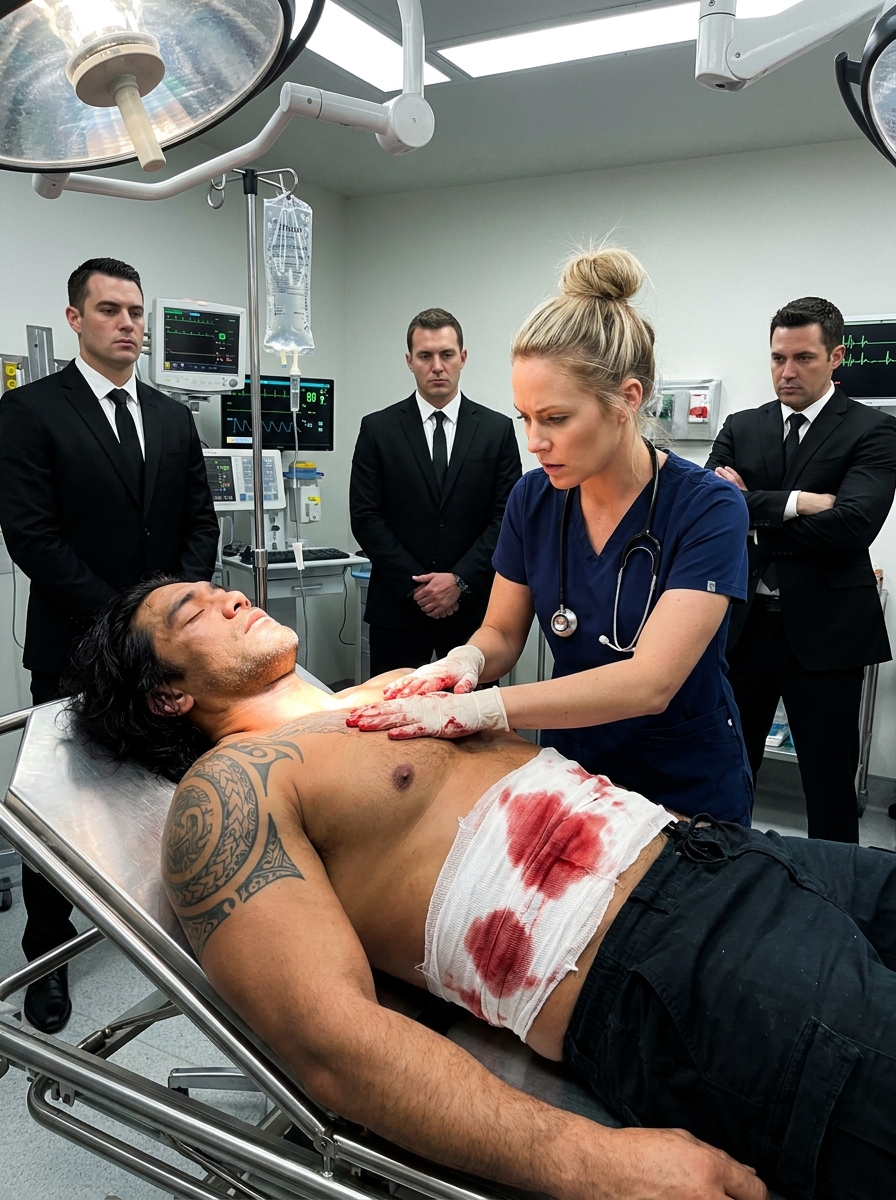
The man Chicago whispered about in restaurants, elevators, courtrooms, and police stations was not threatening me.
He was asking me to stay.
“I’m here,” I said, forcing my voice to remain steady. “I won’t move without telling you first.”
His gray eyes locked on mine. They were sharp even through pain, but something raw lived beneath that sharpness. Something younger. Something that had never left the burning house.
Behind the glass doors, the staff stared at us as if the laws of the world had changed.
Caleb Rourke stood closest, one hand braced against the window, his face pale beneath all that fury. The other men behind him looked stunned, almost afraid to breathe too loudly.
I did not look at them for long. Vincent’s blood was still warm beneath my palm, and the monitor above him was still warning us that wonder would not save him.
“Pressure dressing,” I called. “Now.”
No one moved.
I lifted my head, finally letting irritation sharpen my voice. “I said now.”
Melissa Grant jerked as though I had slapped the word across the room. She grabbed a sterile pack from the cart and pushed through the trauma bay doors.
The second she entered, Vincent’s body tightened.
His fingers clamped around my wrist.
“Stop,” I said.
Melissa froze.
I looked down at Vincent. “She’s bringing supplies. She won’t touch you. I’ll keep my hand here. You are still in control.”
His breathing turned shallow.
“Vincent,” I said quietly, using his name before fear could swallow him whole. “Look at me.”
His eyes found mine again.
“She puts the supplies on the tray,” I said. “Then she steps back. That’s all.”
A faint tremor moved through his jaw.
Then, barely, he nodded.
Melissa placed the dressing kit on the metal tray and retreated faster than dignity allowed. Under ordinary circumstances, I might have felt satisfaction. Tonight, I felt only focus.
I tore open the sterile gauze with one hand. My other palm remained pressed to his chest, applying pressure below his ribs. Working around his grip was awkward, but trauma nursing had taught me that bodies rarely waited for perfect conditions. You learned to work with what the moment gave you.
And the moment had given me Vincent Mercer’s trust.
“Your blood pressure is low,” I told him. “I’m going to add more pressure. It will hurt.”
“It already hurts.”
“I know. I’m sorry.”
He stared at me, almost suspicious of the apology.
Maybe people did not apologize to him often.
Maybe they apologized constantly and never meant it.
I layered the gauze carefully, then pressed harder.
His back arched off the bed. A strangled sound tore from his throat, and his hand tightened so fiercely around my wrist that pain shot up my arm.
I did not pull away.
“Hospital,” I said. “Trauma bay. Surgical lights. My hand on your chest. No fire.”
His eyes squeezed shut.
“No smoke,” I continued. “No locked doors. No flames. You are here. You are alive.”
A shudder passed through him.
Then his body settled back against the bed.
The monitor’s shrill rhythm slowed by a fraction.
Not safe. Not stable.
But less chaotic.
“Good,” I whispered. “That was good.”
He opened his eyes, glassy with pain. “Don’t talk to me like I’m a child.”
“Then stop scaring everyone like one.”
For a second, I regretted it.
Everyone outside the room visibly stiffened.
Vincent looked at me.
Then, impossibly, something like a breath of laughter moved through him and vanished just as quickly.
“You have a poor sense of self-preservation.”
“I’ve been told worse.”
“By who?”
I adjusted the gauze. “People with less blood loss.”
The corner of his mouth twitched.
The doors opened again, and Dr. Leona Imani entered.
Unlike the first surgeon, she did not rush and did not hesitate. She moved with the calm of someone who knew that panic was contagious and refused to carry it into a room. Tall, composed, and sharp-eyed, she stopped several feet from the bed and held both hands where Vincent could see them.
“Mr. Mercer,” she said, “I’m Dr. Imani. I need to stop the bleeding near your ribs and repair the wound at your shoulder. Nora appears to be helping you tolerate contact. I will not touch you without telling you first.”
Vincent’s eyes shifted toward her, cold returning like armor.
“No more hands.”
“I understand.”
“You don’t.”
“No,” Dr. Imani said evenly. “I probably don’t. But I do understand that if we do not operate, you may die. So we will do this with as much control as possible. Nora stays where she is. No unnecessary staff. Every touch announced first. Do I have your consent?”
His breathing trembled.
His gaze returned to me.
“You trust her?”
I knew the room was listening.
“With surgery,” I said. “Yes.”
“With me?”
The question carried more than it should have.
I looked at Dr. Imani, then back at him. “She listened before she moved. That matters.”
Vincent closed his eyes for one second.
Then he said, “Fine.”
Dr. Imani nodded once. “Let’s work.”
The next hour blurred into light, blood, instructions, and breath.
Vincent never stopped fighting the memories, but he stopped fighting us.
That difference saved his life.
Every time another instrument touched him, I warned him first. Every time his pulse spiked, I brought him back.
“You are in Lakeshore Crown.”
“Caleb is outside the door.”
“The pain is from the wound, not fire.”
“My hand is still here.”
“You are not alone.”
Again and again, I watched him drag himself out of the past with nothing but my voice and the pressure of my palm.
At one point, Dr. Imani glanced up at me and said, “Nora, keep talking.”
No one at that hospital had ever asked me to keep talking before.
Usually, people wanted the opposite. Less of me. Less voice. Less presence. Less body taking up space in narrow halls and break rooms where laughter stopped when I walked in.
But here, under the harsh surgical lights, my voice had become a line thrown across dark water.
So I talked.
I told Vincent when we inserted another line. I told him when anesthesia would begin to pull at him. I told him the bleeding was slowing. I told him Dr. Imani was still with him. I told him he was doing something difficult and surviving it.
When the medication finally began to take him under, his fingers loosened around my wrist.
His eyes fought to stay open.
“Nora,” he whispered.
“I’m here.”
“If I wake up—”
“You’ll wake up in recovery.”
His voice was faint. “Don’t let them crowd me.”
“I won’t.”
His lashes lowered.
“Don’t let go.”
“I won’t until you’re under.”
His hand slipped away from my wrist only after unconsciousness took him fully.
I kept my palm against his chest three seconds longer than necessary.
Then I stepped back and realized my knees were shaking.
Dr. Imani looked over the surgical field. “Nurse Bennett.”
I straightened instinctively, waiting for correction.
Instead, she said, “You stay close. If he wakes disoriented, I want your voice in the room.”
Something deep in my chest loosened.
“Yes, Doctor.”
Outside the trauma bay, Caleb looked like he had aged ten years.
He approached as soon as I emerged, but stopped just short of entering my space. I noticed that. A man built like him did not stop unless he chose to.
“Is he alive?”
“Yes.”
“Will he stay alive?”
“Dr. Imani is controlling the bleeding. He’s not out of danger yet, but he made it through the first part.”
Caleb’s eyes dropped to my wrist. Vincent’s grip had left red marks there.
His expression changed in a way I could not name.
“He held on to you,” he said.
“Yes.”
“He hasn’t done that in eleven years.”
The hallway seemed quieter around us.
I looked back through the glass. Vincent lay beneath lights, surrounded by people who had finally learned to move carefully around him.
“What happened in that fire?” I asked.
Caleb’s jaw tightened. “You know the story.”
“I know the version people repeat when they’re scared.”
His eyes met mine. For the first time, I saw exhaustion behind the anger.
“Then you know almost nothing.”
Before he could say more, Melissa appeared at my shoulder.
“Nora,” she said. “Supply room. Now.”
The old reflex rose automatically: apologize, obey, make myself smaller before someone else did it for me.
But I was still standing with Vincent’s blood on my gloves and his plea echoing in my ears.
Don’t let go.
I turned to Melissa. “Dr. Imani asked me to stay near recovery.”
Her lips thinned. “You are not assigned to private recovery.”
“I am now.”
“That decision isn’t yours.”
“No,” I said. “It’s Dr. Imani’s.”
A faint color rose in her cheeks.
Caleb watched us with sudden interest.
Melissa stepped closer, lowering her voice. “Do not let one unusual moment confuse you about your position here.”
My position.
Inventory.
Back hallways.
The nurse they sent in because my body, to them, made me useful as a shield.
I looked at her carefully. “My position is wherever the patient needs a nurse.”
Her mouth opened.
The intercom crackled overhead.
“Nurse Bennett to surgical recovery. Nurse Bennett to surgical recovery.”
Melissa’s face tightened.
I did not wait for permission.
Vincent woke just before dawn.
The recovery room lights were dimmed, the blinds drawn halfway against the first blue hint of morning. Machines hummed softly. Rain tapped against the windows in a gentle, restless rhythm. Caleb sat outside the door, visible through the narrow glass panel, refusing every cup of coffee offered to him.
Vincent’s fingers moved first.
Then his eyes opened.
For half a second, confusion clouded them.
Then awareness struck.
His breath caught. His body tensed against bandages, tubes, and unfamiliar sheets. The monitor spiked sharply.
“Vincent,” I said, stepping into his line of sight. “You’re in recovery. Surgery is finished. You’re alive.”
His eyes found me.
The panic did not vanish, but it slowed.
“You’re in a hospital bed,” I continued. “Your ribs and shoulder are bandaged. No one is touching your skin. Caleb is outside. Dr. Imani is nearby. You are safe.”
His breathing remained rough.
“Nora?”
“Yes.”
His eyelids lowered briefly, as if the confirmation cost him something.
Then he looked down at my wrist.
The marks had darkened.
His face changed.
“I hurt you.”
“No.”
“I grabbed you.”
“You held on.”
“That’s the polite version.”
“It’s the accurate version.”
His gaze moved over my face, searching for fear or flattery or accusation. I gave him none.
“Why did you stay?” he asked.
“Because you asked me to.”
“People usually don’t.”
There was no self-pity in the statement. That made it hurt more.
I checked his IV line. “People usually weren’t trained by my grandmother.”
His brow moved slightly.
“She used to say, if someone asks for help while drowning, you don’t ask whether they deserve water.”
Vincent watched me as if he did not know what to do with that.
The door opened quietly.
Caleb entered, stopping several feet from the bed. His hands were empty and visible. Maybe he had learned from watching. Maybe he had always known and simply been helpless to use the knowledge.
“You look terrible,” Vincent rasped.
Caleb let out a breath that sounded dangerously close to relief. “That’s touching, boss.”
“You let them bring me here.”
“You were unconscious and bleeding through my jacket.”
“Excuses.”
Caleb smiled faintly, then looked away.
For all his size, all his hard edges, he looked shaken.
“Who did it?” Vincent asked.
The room changed.
Caleb’s eyes flicked toward me.
Vincent noticed. Even half-conscious, he noticed everything.
“Say it.”
“Not now.”
“Caleb.”
The warning in Vincent’s voice was thin but still present.
Caleb looked at the monitor, then at me, then back at Vincent.
“The men at the warehouse weren’t outsiders.”
Vincent went utterly still.
The monitor began to climb again.
I stepped closer. “This conversation can wait.”
“It can’t,” Vincent said.
“It can. Your body just filed a complaint with every machine in this room.”
Caleb blinked.
Vincent slowly turned his head toward me. “Did you just interrupt me?”
“Yes.”
“You know who I am?”
“A patient with fresh stitches and poor timing.”
Caleb coughed once into his fist. Suspiciously.
Vincent’s eyes narrowed, but the monitor slowed.
“Leave us,” he said to Caleb.
Caleb’s amusement disappeared.
“Boss—”
“Not her.”
The words slipped out too quickly.
Silence followed.
Caleb looked from him to me, and something quiet passed across his face. Not judgment. Not surprise, exactly. More like the painful relief of seeing a locked door open one inch after eleven years.
“I’ll be outside,” he said.
When he left, Vincent closed his eyes.
“You heard too much,” he said.
“I heard a sentence.”
“In my world, a sentence can be too much.”
“Then your world sounds exhausting.”
His eyes opened.
For a moment, I thought I had gone too far.
Then he said, “It is.”
That honest answer changed the room more than anger would have.
I adjusted the blanket near his hand without touching his skin. “You should sleep.”
“You should leave.”
“I’m assigned here.”
“I can have that changed.”
“I’m sure you can.”
His mouth tightened. “You’re not afraid of me.”
“That isn’t true.”
He looked at me closely.
“I’m afraid,” I said. “But not only of you.”
Something in his expression shifted.
“Of what?”
I almost laughed. “You nearly died, and you’re interviewing me?”
“You keep answering.”
I looked toward the window. Dawn had reached the glass, pale and gray. My reflection stared back from it: round face, tired eyes, hair escaping its clip, scrubs stained from a night that had rearranged something inside me.
“People can be cruel without ever raising a hand,” I said. “That scares me too.”
He followed my gaze to the reflection.
“Melissa,” he said.
I turned back sharply. “What?”
“She sent you in because she thought you could take impact.”
My silence answered for me.
Vincent’s jaw hardened.
“No,” I said immediately.
His eyes narrowed. “No what?”
“No retaliation. No threatening my supervisor. No dramatic Mercer solution.”
For the first time, actual surprise entered his face.
“You give orders confidently for someone in danger of being fired.”
“I’m a nurse. We give orders to people with scalpels for a living.”
His mouth twitched.
Then he winced because even almost smiling hurt.
“Don’t do that,” I said.
“Smile?”
“If it pulls your stitches, yes.”
He stared at me.
Then, very quietly, he said, “I don’t do that much.”
I pretended to note something on the chart because the honesty in his voice was too tender to look at directly.
By midmorning, Vincent Mercer’s survival had changed the entire hospital.
Administrators who had ignored night-shift shortages appeared in suits. Security doubled near elevators. Reporters gathered outside the main entrance, held back by police and hospital policy. Nurses whispered near medication carts. Residents who had avoided the trauma bay now spoke about the case as if they had participated in saving him.
My name moved through the halls too.
Not always kindly.
Not openly cruel either.
That almost made it worse.
People looked at me with curiosity, disbelief, and a new uncertainty. The same coworkers who had once joked that I took up too much space now seemed unsure whether that space had become important.
Melissa cornered me near the supply closet just before noon.
“You’re being temporarily reassigned,” she said.
“To where?”
“Private recovery.”
“Vincent Mercer’s room?”
Her expression tightened. “His representative requested you specifically.”
“I’m not private staff.”
“You are staff assigned where administration places you.”
“And last night I was inventory.”
Her eyes flashed. “Be careful, Nora.”
There was that word again.
Careful.
People loved asking women to be careful when they meant quiet.
I folded my hands in front of me to hide that they had begun to shake.
“I want my assignment documented,” I said.
“It will be.”
“And I want documented that I am not to be placed in unsafe situations because of assumptions about my body.”
Melissa’s face went blank. “Excuse me?”
“You told me he was going to hurt someone and it might as well be someone who could take the impact.”
Her mouth parted.
For years, I had laughed along. At comments about squeezing through narrow spaces. At jokes about my scrubs. At coworkers who offered diet tips disguised as concern. I had swallowed anger until it became part of my posture.
Now, the words felt heavy in my mouth, but they came out.
“I’m good at my job,” I said. “My size does not make me disposable.”
Melissa looked away first.
It was not an apology.
But it was something.
“I’ll note your reassignment,” she said stiffly.
“Thank you.”
I walked away before my courage could collapse in front of her.
Vincent was moved that afternoon to a secure private suite on the top floor. The room overlooked Lake Michigan, gray-blue beneath a sky still threatening rain. Security stood outside. Caleb occupied the chair nearest the door like he had been carved there.
Vincent lay propped against pillows, pale beneath his bandages but awake. His right hand was gloved again.
I noticed.
He noticed me noticing.
“Clinical observation?” he asked.
“Always.”
“Say it.”
“You put the glove back on.”
“It’s my hand.”
“I didn’t say it wasn’t.”
Caleb leaned back in his chair. “She always like this?”
Vincent did not look away from me. “Apparently.”
I checked the monitors. “Vitals are better.”
“Your enthusiasm is overwhelming,” Vincent said.
“You survived surgery after threatening half the hospital. I’m rationing praise.”
Caleb smiled into his coffee.
Vincent looked at him. “Don’t you have men to frighten?”
“Several. Unfortunately, you keep getting shot.”
“That was inconsiderate of me.”
“Very.”
There was affection beneath the dry exchange. Buried deeply, but there. Like an old photograph tucked inside a legal file.
I adjusted Vincent’s IV. “Dr. Imani wants you resting. No business conversations.”
Vincent’s eyes shifted to Caleb.
Caleb looked uncomfortable.
Which immediately told me a business conversation had arrived.
“What?” Vincent asked.
Caleb set his coffee down and pulled a tablet from his coat. “We got warehouse camera footage.”
Vincent’s face changed.
The room tightened.
I stepped back. “I can leave.”
“No,” Vincent said.
Too quickly again.
Caleb studied him.
Vincent’s jaw hardened. “She already knows enough to be in danger.”
“That isn’t comforting,” I said.
“It wasn’t meant to be.”
Caleb placed the tablet on the rolling table and turned it toward Vincent.
The footage was grainy. A warehouse corridor. Shadows. Rain streaking across a high window. A figure moved near the loading bay, face hidden by a hood. Two men entered the frame. Then the image cut to another angle, where muzzle flashes lit the screen briefly.
Vincent watched without blinking.
Caleb tapped the screen. “This is ten seconds before.”
A woman appeared at the edge of the frame.
Dark coat. Dark hair. Face partially turned away.
The effect on Vincent was immediate.
Not fear.
Recognition.
His breath stopped so abruptly the monitor complained.
“Pause,” he said.
Caleb froze the image.
Vincent stared at the woman’s blurred profile.
“That isn’t possible.”
Caleb’s voice was low. “I thought the same.”
“Who is she?” I asked.
Neither answered.
Vincent reached toward the tablet, winced, and let his hand fall.
Caleb enlarged the image. The woman’s face blurred further, but a silver pendant near her throat caught the light.
Vincent’s gloved hand curled into the blanket.
“Say her name,” Caleb said quietly.
Vincent’s eyes never left the screen.
“Elena Vale.”
The name carried weight. Not just history. Grief.
Caleb looked at me. “The woman who set the fire.”
I felt the air leave the room.
“But you said she died,” I said.
Vincent closed his eyes.
“She did.”
Caleb’s voice roughened. “We saw them carry her out.”
Vincent opened his eyes again. “Play it.”
“Boss—”
“Play it.”
Caleb did.
The woman moved across the grainy frame, turned slightly, then vanished behind a stack of shipping crates.
Vincent watched three times.
On the fourth, his breathing began to change.
I stepped closer but did not touch him.
“Vincent.”
No response.
“Hospital room,” I said softly.
His eyes remained locked on the screen.
“Lake outside,” I continued. “Caleb near the door. Tablet on the table. Your shoulder hurts because of surgery, not fire.”
His jaw tightened.
“Elena is dead,” he said, but it did not sound like certainty. It sounded like a man trying to nail reality back into place.
“Then either someone wants you to think she isn’t,” I said, “or something about that night was never what you were told.”
His gaze snapped to me.
For a second, I saw the danger everyone feared.
Then I saw what lived beneath it.
The terrible exhaustion of doubting the worst memory of your life.
Caleb turned off the tablet.
“No more today.”
Vincent glared at him. “You don’t decide that.”
“Today, I do.”
The room went still.
Caleb had refused him.
Not challenged. Not rebelled.
Refused.
Vincent’s voice dropped. “Careful.”
Caleb leaned forward. “You almost died twelve hours ago. Elena may be dead, alive, or somebody’s cruel trick. But you are not tearing yourself open over a blurry video before your stitches dry.”
I expected Vincent’s temper.
Instead, he looked away.
That told me more about Caleb than any explanation could have.
He was not merely muscle. Not a servant. Not a soldier.
He was the person left standing outside every locked door Vincent built.
After a long silence, Vincent said, “Leave the tablet.”
“No.”
“Caleb.”
“No.”
I almost smiled.
Vincent saw it.
“This amuses you?”
“A little.”
“I’m surrounded by disloyalty.”
Caleb stood. “You’re surrounded by people keeping you alive against your will. Tragic.”
He walked out with the tablet.
Vincent watched the door close.
Then he looked down at his gloved hand.
“Elena hated gloves,” he said.
The words surprised me.
I stayed quiet.
“She said they made me look like I thought the world was dirty.”
“Did you?”
“No.” His voice was distant. “I thought the world could leave fingerprints.”
The rain began again against the window, soft and steady.
I adjusted the blanket near his side. “Were you engaged?”
His eyes lifted to mine.
“Caleb told me enough,” I said.
Vincent turned toward the lake. “Yes.”
I waited.
“She was a musician,” he said after a while. “Not famous. Not trying to be. She played piano in a restaurant near the river three nights a week because she said music sounded better when people weren’t listening too hard.”
The image was so unlike the fire, the fear, the man in the bed, that it almost hurt.
“She knew your world?”
“Enough to dislike it.”
“But she stayed.”
“For a while.”
“What happened?”
His jaw tightened.
I thought he would stop.
Instead, he said, “The official story is simple. Elena drugged me during dinner. Disabled security. Set the house on fire. Tried to leave with documents from my safe. She died when part of the east wing collapsed.”
“And the unofficial story?”
His eyes met mine.
“I never believed she could leave me to burn.”
The confession was quiet enough to be mistaken for breath.
“Then why did you accept it?”
“Because accepting betrayal is easier than accepting that you don’t understand your own life.”
I had no answer for that.
I thought of Ethan—no, not Ethan. That was another life, another story. I thought of the people in this hospital who had made me accept their version of me because fighting it every day was exhausting. I thought of how easy it was to live inside a lie when truth demanded rebuilding everything.
“Maybe the video is a chance,” I said.
“For what?”
“To understand.”
He looked back toward the rain. “Understanding doesn’t undo scars.”
“No,” I said. “But sometimes it tells you where they really came from.”
That evening, when Vincent slept, Caleb found me near the vending machines.
He stood staring at the rows of chips and candy as though they had personally insulted him.
“You look lost,” I said.
“I hate machines that demand exact change.”
“It takes cards.”
“That seems worse.”
I stepped beside him and bought him a granola bar.
He looked at it. “Is this food?”
“Technically.”
He accepted it with reluctance.
We stood by the window at the end of the hall, watching rain blur the city lights.
“He told you about Elena,” Caleb said.
“A little.”
“He doesn’t talk about her.”
“He barely talked.”
“That’s more than most get.”
I leaned against the wall. My feet ached. My wrist still hurt faintly where Vincent had held on.
“Did you believe she set the fire?”
Caleb unwrapped the granola bar slowly.
“No.”
I looked at him.
“But I believed the evidence,” he said.
“What evidence?”
“Security footage. Burn patterns. Missing files. Her fingerprints on the sedative bottle.”
“That sounds convincing.”
“It was.” He stared through the glass. “Too convincing, maybe.”
“Why didn’t you say something?”
“To who? The police? Half were afraid of Vincent. The other half wanted him gone. His enemies were celebrating. His allies were trying to keep him from falling apart.” Caleb’s voice lowered. “And Vincent woke up from that fire unable to bear another human hand. Whatever doubt I had, pain drowned it.”
I looked toward Vincent’s room. Through the narrow window, I could see his silhouette beneath blankets, still even in sleep.
“Why did the touch start after the fire?”
Caleb did not answer immediately.
“When they found him, he was clawing at a locked interior door. The skin on his hands was burned from trying to force it open.” His face tightened. “He kept saying Elena had touched his face right before everything went dark. After that, touch and fire became the same memory.”
I swallowed.
The hallway noises seemed suddenly far away.
“That’s awful.”
“Yes.”
“Do you think the woman in the footage is Elena?”
Caleb looked at the granola bar as if remembering it existed, then shoved it into his coat pocket unopened.
“I think if Elena is alive, everything Vincent survived was built on a lie.”
“And if she isn’t?”
“Then someone knows exactly which ghost to use against him.”
The next morning, Vincent surprised everyone by asking for Dr. Imani, Caleb, and me in the room at the same time.
He was stronger, though still pale. The uninjured side of his face held the same quiet severity, but his eyes seemed clearer. On the bedside table lay a single black glove.
Only one.
His right hand was bare.
Caleb noticed first.
His expression changed, then carefully changed back.
Dr. Imani entered with her usual calm. “Mr. Mercer.”
“Doctor.”
“I hear you insisted on a conversation before breakfast.”
“I dislike hospital schedules.”
“You dislike most things.”
“That too.”
She checked his chart. “Make it brief.”
Vincent looked at me.
Then at his bare hand.
I understood before he spoke.
“You want to try again,” I said.
Dr. Imani glanced between us. “Try what?”
Vincent’s hand tightened slightly in the blanket.
“Touch,” Caleb said quietly.
The room stilled.
Dr. Imani’s face softened by a fraction. “Are you certain?”
“No.”
It was the most honest answer he could have given.
I stepped beside the bed but left several inches between us.
“You don’t have to prove anything,” I said.
“I know.”
“Then why?”
Vincent looked out at the lake. Morning light silvered the water beyond the glass.
“Because yesterday, when I touched your hand, I was still in pain. I don’t know if it was real or desperation.”
“What are you hoping for?”
His voice dropped. “A second answer.”
I placed my hand palm-up on the blanket.
“Your choice.”
For a long moment, he did not move.
Caleb stood by the window, arms crossed tightly. Dr. Imani waited near the foot of the bed, silent and watchful.
Vincent lifted one finger.
His hand shook.
He lowered that finger onto my palm.
The contact was light enough to be mistaken for air.
His eyes closed immediately.
The monitor rose.
“Hospital room,” I said. “Morning. Lake outside. Caleb is pretending not to worry. Dr. Imani is pretending not to stare. My hand is under yours. No smoke. No flames.”
Caleb muttered, “I’m not pretending.”
Dr. Imani said, “I am absolutely staring.”
A breath left Vincent, almost a laugh, almost a sob.
His finger pressed more firmly.
Then another joined it.
Then his hand settled slowly into mine.
Bare skin to bare skin.
The monitor climbed, held, then gradually eased.
Vincent opened his eyes.
He looked down at our hands as if witnessing something impossible and ordinary at once.
“It doesn’t burn,” he whispered.
“No,” I said. “It doesn’t.”
Caleb turned away toward the window.
Dr. Imani’s eyes shone, though her voice remained practical. “Thirty seconds. Then stop before the nervous system decides to be dramatic.”
Vincent’s mouth curved faintly. “My nervous system is offended.”
“Good. Offended patients are alive patients.”
At thirty seconds, he pulled back on his own.
Not because terror took him.
Because he chose to stop.
That difference mattered.
He flexed his fingers slowly, staring at them.
“I forgot,” he said.
“What?”
“What hands feel like when they’re not hurting you.”
No one spoke.
Some sentences deserve room.
Later that day, the hospital administrator arrived to discuss additional security protocols. Melissa came with him, holding a folder and avoiding my eyes. Vincent listened from his bed with the expression of a man tolerating insects.
“We want to ensure Mr. Mercer’s comfort,” the administrator said. “Given the delicate nature of his care team, we can arrange a rotation of senior staff.”
“No,” Vincent said.
The administrator blinked. “No?”
“Nora stays.”
Melissa’s lips tightened.
I stepped forward. “My assignment should be based on medical need and hospital policy, not personal preference.”
Everyone looked at me.
Even Vincent.
Especially Vincent.
I lifted my chin. “I’m willing to continue as part of the care plan because continuity helps the patient. But I’m not private property.”
For a moment, silence filled the room.
Then Dr. Imani, standing near the chart station, said, “Correct. Nurse Bennett will remain assigned for clinical continuity, with appropriate staffing support and scheduled rest.”
Vincent studied me.
Something like respect moved across his face.
The administrator cleared his throat. “Of course.”
Melissa looked smaller than usual. Not weak. Just less certain of her authority.
After they left, Vincent said, “You could have let me demand it.”
“I know.”
“Most people do.”
“I’m not most people.”
“No,” he said quietly. “You’re not.”
That afternoon, Caleb returned with the warehouse footage, clearer this time. A digital technician had enhanced several frames.
Vincent insisted on watching.
Dr. Imani allowed ten minutes.
I stood near the monitor, arms folded, ready to interrupt if his vitals rebelled.
The woman in the footage appeared again.
Dark coat. Dark hair. Silver pendant.
This time, her face turned more clearly toward the camera.
Vincent’s breath stopped.
Caleb whispered, “Elena.”
There was no doubt now.
Older, perhaps. Thinner. But the same high cheekbones. The same mouth. The same haunted eyes.
Alive.
Or perfectly made to seem so.
Vincent did not speak for several seconds.
Then he said, “Find her.”
Caleb nodded. “Already working.”
“No,” Vincent said. “Quietly.”
Caleb looked surprised.
Vincent’s gaze remained on the frozen image. “If she wanted me dead, she had better chances. If someone is using her face, I want to know why.” His voice lowered. “And if she is alive, I want to hear from her before anyone else decides what she is.”
The choice seemed to cost him.
It also seemed to steady him.
I watched him turn away from vengeance and toward truth. Not easily. Not cleanly. But deliberately.
That was the first time I wondered whether the man everyone feared had spent years being feared because fear was simpler than grief.
The answer came that evening.
Not from Caleb’s men.
Not from police.
Not from hospital security.
From a woman carrying flowers.
She appeared at the nurses’ station just after sunset, wearing a cream coat and a pale scarf over her hair. She was older than the footage suggested, but something in the angle of her face made me stop mid-step.
Her hands held a simple bouquet of white lilies.
Security moved immediately.
“Ma’am,” one guard said. “This floor is restricted.”
She did not resist. She did not run.
Her eyes found mine across the hallway.
“Nora Bennett?” she asked.
My name in her mouth felt wrong. Familiar and impossible.
“Yes?”
She reached slowly into her coat pocket.
The guards stiffened.
She withdrew a small sealed envelope and held it out.
“Please give this to Vincent.”
Caleb emerged from Vincent’s room at the sound of voices.
The moment he saw her, his face went white.
“Elena,” he breathed.
The hallway froze.
The woman’s eyes filled with tears, but she did not look at him. She looked toward Vincent’s closed door.
“I don’t have much time,” she said.
Caleb stepped closer, anger and shock twisting together. “You’re dead.”
“I was supposed to be.”
His hands curled into fists, but he did not touch her.
The guard looked between them, uncertain.
I took one careful step forward. “Why come here?”
Elena finally looked at me fully.
Up close, I saw exhaustion beneath her elegance. Lines carved by years of hiding. Eyes that had carried too many unsentences.
“Because he touched you,” she said.
My breath caught.
“What?”
“I needed to know if he could survive the truth.” Her voice trembled. “If he still couldn’t bear a hand near him, what I know would destroy him.”
Caleb’s voice was rough. “What truth?”
Elena looked at him then.
“The fire was not meant to kill Vincent,” she said. “It was meant to hide who I was protecting.”
The doors behind Caleb opened.
Vincent stood there.
He should not have been standing. His face was pale with pain, one hand gripping the doorframe, bandages visible beneath his hospital gown. But his eyes were fixed on Elena with an expression I had no name for.
The hallway disappeared around them.
“Elena,” he said.
She pressed the envelope to her chest.
“I’m sorry,” she whispered.
Vincent’s face was unreadable. “For the fire?”
“For letting you believe I chose to leave you in it.”
His bare hand tightened against the doorframe.
I stepped closer, ready to steady him, but stopped before touching.
He noticed. Even then, he noticed.
“Elena,” he said again, and this time her name broke.
She began to cry silently.
Caleb looked from one to the other, shaken beyond anger.
“Who were you protecting?” he asked.
Elena looked at Vincent.
Then at me.
That was when I felt the ground shift.
“Her,” Elena said.
Everyone turned toward me.
I stared at her. “Me?”
Elena’s eyes filled with sorrow.
“You were never supposed to be sent into that trauma room by chance, Nora.”
My heart began to pound.
Vincent looked at me sharply. “What does that mean?”
Elena held out the envelope with a trembling hand.
Inside was a photograph.
I knew it before I touched it. Not the scene, not the place, but the girl in the center.
Me.
At eight years old.
Standing beside Elena Vale outside a small clinic, wearing a yellow sweater I had not thought about in twenty years.
On the back of the photograph, written in careful blue ink, were four words:
Keep Nora hidden safely.
My fingers went cold.
The hallway blurred at the edges.
Vincent stared at the photograph, then at Elena.
“What is this?” he asked.
Elena’s voice came barely above a whisper.
“The reason I disappeared.”
I looked down at the picture again, at my child-self smiling uncertainly beside a woman I did not remember.
Then Elena said the sentence that made every machine, every light, every breath in the hallway seem to stop.
“Nora Bennett isn’t her real name.”