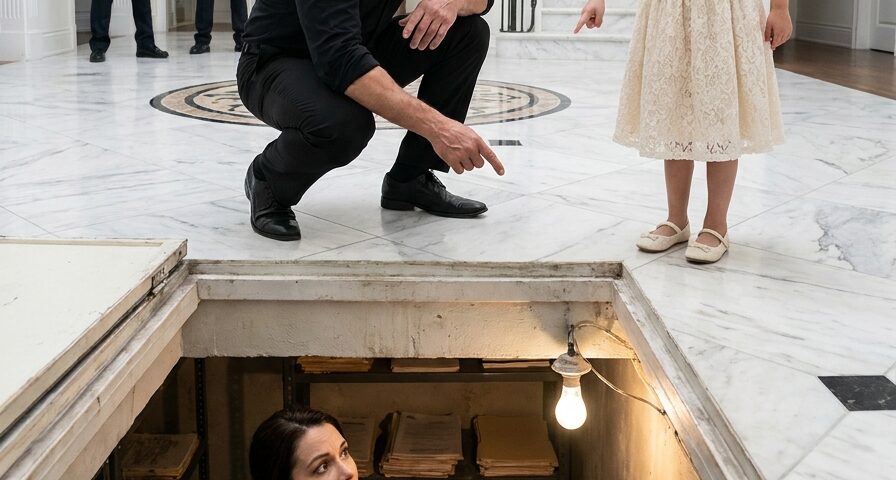
PART 2: A Little Girl Said Her Mother Was Missing Beneath My Mansion—When I Opened the Cellar Door, the Betrayal Pointed Straight at the People I Trusted Most
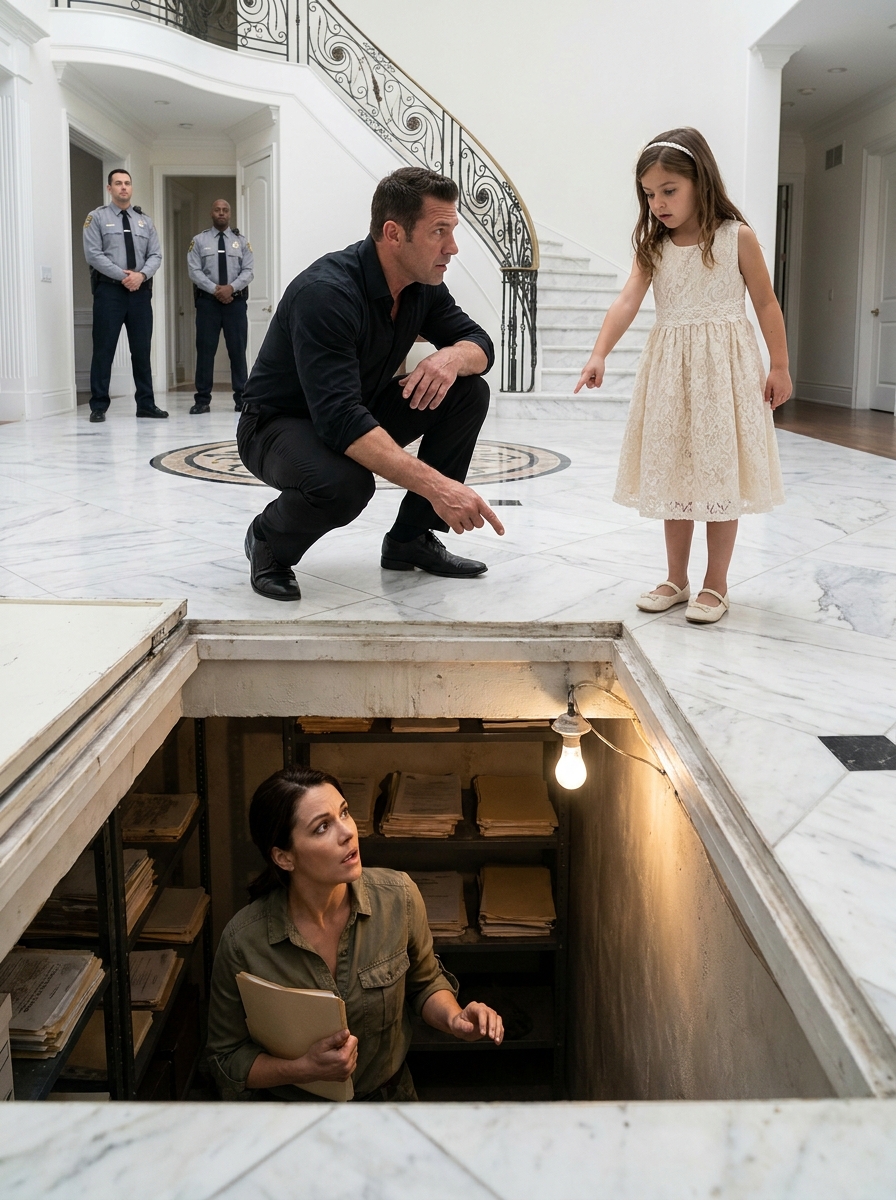
Mia Carter sat slumped against the wooden wine rack, wrists bound with strips of cloth, her face pale beneath bruises and exhaustion. Her lips were cracked. Her eyes, when they opened, searched only for one person.
“Harper,” she whispered.
The little girl broke away from my leg with a sob.
I caught her gently around the waist before she could run across the broken glass scattered on the floor.
“Wait,” I said softly. “Let me get her safe first.”
Harper struggled for half a second, then went still, trembling in my arms. “Mommy.”
Mia tried to lift her head. “Baby, I’m here.”
Her voice was barely more than air, but it was enough.
Harper began crying in that quiet, broken way children cry when they have been trying too hard to be brave. No screaming. No drama. Just a small body shaking because the world had finally admitted she was right.
I looked at Marcus. “Cut her loose. Carefully.”
Marcus moved forward, stepping over a spilled crate. Daniel followed, scanning the corners of the cellar. Both men had been with me long enough to know that discovering the victim was not the end of danger. Sometimes it was only where danger wanted your attention to go.
Nathan remained in the doorway.
Too still.
I turned slightly, keeping Harper against my side. “Call Dr. Reeves.”
Daniel already had his phone out. “On it.”
“And the police,” I said.
That made Nathan look at me.
Only for an instant.
But I saw it.
The smallest fracture in his calm.
“Dom,” he said quietly, “maybe we should understand what happened before bringing outsiders into the house.”
Outsiders.
The word landed between us like a coin dropped down a well.
I faced him fully. “A woman was tied up in my cellar for three days.”
“I can see that.”
“Then you understand why the police are coming.”
His jaw worked once. “Of course.”
But he didn’t like it.
I turned back to Mia as Marcus freed her wrists. The cloth had bitten into her skin. She winced but made no sound. When her hands came loose, she reached weakly toward Harper.
This time, I carried the child over.
Harper threw herself into her mother’s arms, and Mia held her with what little strength she had, pressing her face into her daughter’s tangled hair.
“I told them,” Harper sobbed. “I told them you didn’t kiss me goodbye.”
“I know, baby,” Mia whispered. “I know.”
There are moments when a man sees himself clearly.
Not the version built by reputation, wealth, fear, or success. The real one.
I stood in that cellar, surrounded by armed men and old stone, and watched a four-year-old cling to the mother no one had believed. I thought of all the adults in my house who had told her to be quiet, to stop worrying, to accept an explanation that made no sense to her heart.
And I felt something colder than anger.
Responsibility.
This was my house.
My people.
My failure.
I removed my coat and wrapped it around Mia’s shoulders. “Can you stand?”
She nodded, then immediately swayed when Marcus helped her up.
“I’ve got her,” he said.
Mia’s eyes darted toward the doorway.
Toward Nathan.
Fear passed through her face so quickly another man might have missed it.
I did not.
“Nathan,” I said.
He looked at me. “Yes?”
“Go upstairs. Tell everyone to gather in the east sitting room. Staff, security, guests. Everyone.”
His brows lifted faintly. “You want me to leave you here?”
“I want you to do what I said.”
For a second, the old rhythm between us appeared. The instinctive push and pull of two men who had survived too much together. Nathan had questioned me privately a hundred times. He had challenged bad decisions, argued strategy, saved me from my own pride more than once.
But he had never hesitated in front of others.
Not until now.
Then he nodded. “Of course.”
He turned and climbed the stairs.
I watched until he disappeared.
Daniel ended his call. “Dr. Reeves is on the way. Police dispatch says nearest unit is twelve minutes.”
“Good.”
Marcus lifted Mia carefully into his arms. Harper refused to let go, so I carried her beside them, one small hand still locked around her mother’s fingers.
As we left the cellar, I glanced back once.
The broken padlock lay on the stone floor.
New brass. Recently purchased.
A small detail, but details were how lies confessed.
Upstairs, the mansion had changed in my absence.
It was the same house I had built over years of disciplined ambition: high ceilings, marble floors, walnut doors, art chosen by consultants who spoke softly about investment value. But now every polished surface seemed to ask what had happened while I was gone.
The staff had begun gathering near the east sitting room, whispers moving through them like wind through dry leaves. Cooks, housekeepers, drivers, groundsmen. Faces I recognized. Faces I paid. Faces I had trusted to keep the house running like a private kingdom.
At the foot of the main staircase stood Claire.
My fiancée.
She wore a cream cashmere sweater, pearl earrings, and the expression of someone interrupted in the middle of a life she had already planned. Her hair was smooth, her makeup perfect, but her eyes went wide when she saw Mia in Marcus’s arms.
“Oh my God,” she breathed. “Mia?”
Mia turned her face away.
Harper noticed.
So did I.
Claire took a step forward. “What happened?”
I stopped in front of her.
“You tell me.”
The color shifted beneath her skin. Not enough for panic. Enough for calculation.
“I don’t understand.”
“Harper says Mia went downstairs with you three days ago.”
Claire blinked. “With me?”
“Yes.”
“That’s not true.”
Harper’s hand tightened around mine. “It is.”
Claire looked down at the child. “Harper, sweetheart, you must have been confused.”
The words were soft.
Too soft.
Harper shrank closer to me.
I felt something inside me harden.
“Do not call her confused,” I said.
Claire looked back at me, wounded. “Dominic, I’m not accusing her of lying. She’s four years old. She was frightened.”
“She was ignored.”
“That’s not fair.”
“No,” I said. “It isn’t.”
For the first time since I had known her, Claire had no immediate reply.
When I met Claire Bennett eighteen months earlier at a charity auction, she had seemed like still water in a room full of noise. Intelligent, elegant, unflustered by wealth because she had grown up near it but not dependent on it. She worked with children’s literacy foundations and spoke with a warmth that made donors open their wallets without feeling handled.
She had met Harper twice before and brought her picture books both times.
Now the child would not look at her.
That mattered.
“Dr. Reeves is coming,” I told Marcus. “Take Mia to the blue guest room. Daniel, stay with them. No one enters without my permission.”
Mia’s eyes met mine briefly.
There was something she wanted to say.
Something she couldn’t say in front of Claire.
I gave her the smallest nod.
Not now.
But soon.
Once Marcus carried her upstairs, I turned to the waiting staff.
“No one leaves the property,” I said.
A ripple of fear moved through them.
My assistant, Elise, stepped forward, tablet clutched to her chest. “Mr. Vale, several vendors are scheduled—”
“Cancel them.”
“The police are coming?”
“Yes.”
A few whispers rose.
I did not raise my voice.
That was rarely necessary.
“A woman was found locked in the wine cellar. She works in this house. Her child asked for help for three days. Anyone who knows anything and chooses silence from this moment forward will answer for it legally.”
Not to me.
Legally.
That distinction mattered today.
For much of my life, people had assumed I preferred private solutions. Sometimes I had. In certain rooms, with certain men, reputation accomplished what courts could not. But Mia was not a rival. Harper was not collateral. This was not business.
This was a crime inside my home.
And the only way to clean rot was to expose it to light.
Nathan entered the sitting room from the far doorway, returning just in time to hear the end of my statement.
His expression revealed nothing.
“Everyone is here,” he said.
“Not everyone.”
His brow lifted. “Who’s missing?”
“Claire’s personal driver.”
Claire stiffened.
I looked at her. “Where is Owen?”
“I don’t know. He had the morning off.”
“Convenient.”
Her face flushed. “You can’t honestly think Owen had anything to do with this.”
“I don’t think yet. I count.”
Nathan stepped closer. “Dom, the police are on their way. Maybe we should let them handle staff interviews.”
“We will.”
“You’re already frightening people.”
“Good.”
His eyes hardened. “Fear makes people lie.”
“So does loyalty to the wrong person.”
The sentence struck him. I saw it land.
For a long moment, he held my gaze. Then he looked away first.
That had never happened before.
Dr. Reeves arrived before the police.
She was a sharp-eyed woman in her sixties who had patched enough members of my household over the years to know when not to ask questions in the foyer. She went upstairs with her medical bag and returned twenty minutes later looking grim.
“She’s dehydrated and exhausted,” she said quietly. “Bruising, rope burns, mild fever. I want her at a hospital.”
“Will she be able to speak first?”
“A little. Not for long.”
“Can it wait until police arrive?”
Dr. Reeves studied me. “Physically, yes. Emotionally, I would be careful.”
Careful.
The word seemed inadequate for the day.
The first patrol car arrived minutes later, then a second. Detective Laura Penn took charge—a composed woman with dark hair pulled back tight and eyes that missed very little. I knew her professionally in the way men like me know detectives: respectfully, cautiously, and always with an attorney nearby.
Today, I called my attorney and told him to come, but not to interfere.
Detective Penn took in the mansion, the staff gathered under watch, the broken lock bagged on a side table, and the child sitting in my lap because Harper refused to go anywhere else.
“You found her?” she asked me.
“Harper found her,” I said.
Detective Penn looked at the little girl.
Her face softened, just enough. “You were very brave.”
Harper pressed her cheek against my vest and said nothing.
The detective did not push.
That made me respect her.
Statements began.
Quietly. Methodically. Staff were separated into rooms. Security footage was requested. Phones were preserved. The wine cellar was photographed. The padlock was collected. The house that usually ran on discretion began producing facts.
Facts were less loyal than people.
They did not care whom they embarrassed.
I waited upstairs in the hallway outside the blue guest room until Detective Penn allowed me in for Mia’s first statement. Harper sat beside her mother on the bed, holding her hand. Dr. Reeves stood near the window.
Mia looked impossibly small beneath the blanket.
For three years, I had known her as capable, brisk, and kind without sentimentality. She ran the household with a discipline that rivaled any operations chief I had ever employed. Seeing her weakened unsettled me more than I expected.
Detective Penn turned on a recorder with Mia’s permission.
“Tell me what you remember,” she said gently.
Mia’s eyes moved to Harper, then me.
“You can speak freely,” I said.
Her lips trembled.
“Three nights ago, Miss Bennett asked me to help choose wine for Dominic’s return dinner. She said she wanted something from the lower cellar.”
Claire.
I kept my face still.
“Had she ever asked you that before?” Detective Penn asked.
“No. But it didn’t seem strange. She was planning the wedding dinners. She asked about household things all the time.”
“Did you go with her?”
“Yes. Harper was in the playroom. I told her I’d be right back.”
Harper whimpered.
Mia squeezed her hand weakly. “I’m sorry, baby.”
“What happened downstairs?” the detective asked.
“We entered the cellar. The light was off, which was unusual. I stepped ahead to pull the cord. Someone grabbed me from behind.”
“Did you see who?”
“No. I smelled tobacco. Not cigarettes. Pipe tobacco maybe.” Her eyes flicked to me. “And cedar.”
Nathan smoked pipe tobacco occasionally on the terrace after dinner. Claire hated it. I had teased him about smelling like a grandfather.
My jaw tightened.
Detective Penn noticed but did not comment.
“Did you hear voices?” she asked.
“Yes. A man and a woman.”
“Could you identify them?”
Mia closed her eyes.
The room seemed to hold its breath.
“The woman sounded like Miss Bennett,” she whispered.
Claire.
Again.
“And the man?” Detective Penn asked.
Mia’s fingers tightened around Harper’s. “I don’t know.”
Not Nathan.
Not yet.
“What did they say?” I asked before I could stop myself.
Detective Penn glanced at me, but allowed it.
Mia swallowed. “The woman said, ‘We only need until Dominic signs.’ The man said, ‘Then keep the child quiet.’”
The room went cold.
Harper began to cry.
I stood, every muscle locked.
Dr. Reeves stepped closer to the bed. “That’s enough.”
“No,” Mia whispered. “I need to say it.”
Detective Penn leaned forward. “Until Dominic signs what?”
“I don’t know. But they kept asking me where Mr. Vale kept the old family ledger.”
The old family ledger.
For a second, I did not understand.
Then memory opened.
My grandfather’s ledger. A leather-bound book from the early days of Vale Imports, long before the company became legitimate enough to have glass offices and compliance departments. He had recorded everything in it: debts, partnerships, property arrangements, family agreements. Not all of it official. Not all of it clean. But some old contracts still referenced entries in that ledger as supporting evidence.
I had inherited it when my father died.
Very few people knew it existed.
Nathan knew.
My attorney knew.
And Claire knew because I had mentioned it once during a discussion about prenuptial paperwork.
I had thought nothing of it.
That, I was learning, had been my most dangerous habit.
Assuming my trust was harmless.
“Why would they ask you?” Detective Penn said.
“Because I manage storage,” Mia replied. “Old files, seasonal rooms, guest inventories. But I don’t handle Mr. Vale’s private documents. I told them I didn’t know.”
“And then?”
“They tied me there. They gave me water once. Maybe twice. I lost track.”
Her voice broke.
I turned away, not because I couldn’t look at her, but because I could not let Harper see what moved across my face.
Detective Penn asked a few more questions, then stopped when Dr. Reeves insisted. Mia was taken by ambulance to the hospital with Harper beside her. I arranged for Daniel and a female officer to accompany them. Harper refused to release my hand until I promised I would come later.
“You’ll find who hurt Mommy?” she whispered.
I knelt before her at the ambulance doors.
“Yes,” I said.
It was not a threat.
It was a vow.
When the ambulance left, I returned to the mansion and found Claire in the library with her attorney.
Nathan stood near the fireplace.
Of course he did.
For years, Nathan had belonged beside the fire in difficult moments. He had been there when my father died, when federal agents once searched our office, when I ended a partnership that could have started a war. He had always stood half in shadow, calm and loyal.
Now the shadow seemed less like position and more like choice.
Detective Penn entered behind me. “Miss Bennett, we’d like to ask you some questions.”
Claire looked at me first.
Not the detective.
Me.
“Dominic,” she said, “you know I would never hurt Mia.”
“I know what I want to believe.”
Pain flashed across her face. “That’s not the same.”
“No.”
Her attorney touched her arm. “Claire, let me handle this.”
She ignored him. “Harper misunderstood. Mia misunderstood. Someone is using my name because they knew you would doubt me.”
“Who?” I asked.
“I don’t know.”
“Nathan approved the lock.”
Nathan’s eyes narrowed slightly. “I approved a lock on the cellar at Claire’s request because she said vendors had access during wedding preparation.”
Detective Penn turned to him. “And you didn’t find that unusual?”
“No. There are several million dollars’ worth of wine in that cellar.”
“There was also a woman inside it.”
His mouth tightened. “I didn’t know that.”
Claire stepped toward me. “I asked for the lock because Owen told me one of the temporary staff had been seen downstairs.”
“Owen,” I repeated.
Her driver.
The missing man.
“Yes.”
“And where is Owen now?”
“I told you, I don’t know.”
Detective Penn asked, “Full name?”
“Owen Vale,” Claire said.
The room went silent.
Even my attorney, who had just arrived in the doorway, stopped walking.
I looked at her.
“Owen what?”
Claire blinked. “Vale. It’s just his surname. I assumed he mentioned—”
“He did not.”
Nathan looked genuinely surprised.
That was interesting.
My family name was not common enough to dismiss as coincidence, not in this house, not attached to a man working for my fiancée six weeks before our wedding.
“How long has Owen worked for you?” Detective Penn asked.
“Eight months,” Claire said, now visibly shaken. “He came recommended by Celeste.”
“Celeste who?”
“Celeste Rowan. My wedding coordinator.”
A quiet, bitter laugh almost left me.
Of course.
There was always a coordinator. Someone with access. Someone who knew schedules, layouts, guest lists, deliveries. Someone invisible because people with money trained themselves not to notice labor unless it failed them.
“Where is Celeste?” I asked.
Claire went pale.
“She was supposed to be here this morning.”
“She isn’t.”
“No.”
Detective Penn made a note. “We’ll need her information.”
Claire gave it with trembling hands.
For the first time since the cellar, I believed her fear was real.
But real fear did not mean innocence.
“Dominic,” she said softly, “I didn’t know Owen’s surname mattered.”
“It matters if he chose this house because of it.”
Her eyes filled. “I swear to you, I didn’t know.”
I wanted to believe her.
That was the problem.
Want had deceived better men than me.
While Detective Penn’s team searched staff records and pulled security footage, my attorney, Samuel Price, drew me aside.
Samuel was seventy-one, elegant, and unshockable. He had represented my family through three generations of ambition and consequence. He knew where most bodies were buried metaphorically, and perhaps a few literally, though he had always preferred not to confirm either category.
“You need to be careful,” he said.
“I’m not the suspect.”
“In your own home, everyone is a suspect until the police decide otherwise.”
“Comforting.”
“I’m not here to comfort you.”
“Clearly.”
His expression did not change. “Mia mentioned the family ledger.”
“Yes.”
“Where is it?”
“In the private safe.”
“Check.”
I studied him. “You think it’s gone.”
“I think people rarely imprison a housekeeper for three days over an object they already possess.”
The safe was hidden behind a panel in my private study. Only three people had the code: me, Samuel, and Nathan for emergencies.
At least, that was what I believed.
Detective Penn insisted on accompanying us. Nathan followed, uninvited but not stopped. Claire remained with her attorney in the library.
The study smelled of leather, old paper, and the faint smoke from the fireplace I had not lit. My desk was exactly as I had left it: files stacked, fountain pen aligned, Atlantic City meeting notes clipped together.
Order had always reassured me.
Now it seemed like another costume.
I opened the wall panel and entered the code.
The safe unlocked.
Inside were passports, deeds, backup drives, sealed envelopes, and the old leather ledger wrapped in archival cloth.
Still there.
Samuel let out the smallest breath.
I reached for it.
Detective Penn stopped me. “May I?”
I stepped back.
She put on gloves, lifted the ledger, and examined the shelf beneath it.
“There’s something else,” she said.
Behind the ledger, tucked flat against the back of the safe, was a small white envelope.
Not mine.
My name was written on it in black ink.
Dominic Vale.
I felt Nathan shift beside me.
Detective Penn opened it carefully.
Inside was a photograph.
A boy of about ten stood on the front steps of my mansion, though the picture was decades old. He had dark hair, solemn eyes, and a stubborn set to his mouth.
Beside him stood my father.
On the back, in my father’s handwriting, were three words.
Owen. My son.
For the first time that day, the room truly spun.
Samuel closed his eyes.
Nathan whispered, “No.”
I looked at him.
His shock appeared real.
But I no longer trusted appearances.
“My father had another son,” I said.
Samuel was silent.
“Samuel.”
He opened his eyes slowly. “Your father made provisions in private. I was bound by legal confidentiality.”
“My father is dead.”
“Yes.”
“And you said nothing.”
“Because the provisions were conditional.”
Detective Penn watched us carefully. “Conditional how?”
Samuel’s mouth tightened. “Owen was born outside the marriage. Dominic’s father established a trust for him and his mother. Owen had no claim to Vale Holdings unless certain documents were executed before Vincent Vale’s death.”
“And were they?” I asked.
“No.”
“Why?”
“Because your father changed his mind.”
A bitter taste filled my mouth.
My father, Vincent Vale, had been many things: brilliant, ruthless, charming when it suited him, cold when charm cost too much. I had spent half my life trying not to become him and the other half discovering how much of him had already been built into me.
“Where is Owen’s mother?” Detective Penn asked.
“Dead,” Samuel said. “Years ago.”
“And Owen?”
“He disappeared from the records in his twenties. I believed he had left the country.”
“But he came back,” I said. “As Claire’s driver.”
Samuel looked older than he had minutes before. “It appears so.”
Nathan stepped toward the safe. “Dom, I swear I didn’t know.”
I turned on him.
“The code.”
He stopped.
“You had the code.”
“Yes.”
“Did you put that envelope in my safe?”
“No.”
“Did you tell anyone the ledger was here?”
“No.”
“Did you approve the cellar lock?”
“Yes.”
“Did Harper tell you she heard knocking?”
His face changed.
There.
Not guilt exactly.
Something worse.
Avoidance.
“She came to me,” he said.
“And?”
“She was upset. She said she missed her mother. Claire had told us Mia went to Pennsylvania. I thought the child was imagining things.”
“You thought Harper imagined knocking behind a basement door?”
His voice hardened. “I made a mistake.”
“A woman nearly died in my cellar.”
“I know.”
“Do you?”
He stepped closer, grief and anger battling in his face. “Don’t do this as if I’m your enemy.”
“I don’t know what you are right now.”
That wounded him.
Good.
I needed the truth, not his comfort.
Detective Penn closed the safe and held up the photograph. “This is now evidence.”
“Take it.”
Samuel looked as if he wanted to object, then thought better of it.
Downstairs, the investigation widened.
Owen Vale became the center of it. His employee file was thin but perfect—too perfect. References checked through numbers that now went unanswered. Background documents that looked authentic until examined by police databases. A driver’s license valid but recently issued. A mailing address belonging to a furnished apartment paid in cash.
Celeste Rowan, the wedding coordinator who had recommended him, was even more elusive. Her business website was elegant. Her social media polished. Her clients real enough, though many now turned out to be events staffed through subcontractors who never met her in person.
Claire sat on the sofa in the library, hands clasped so tightly her knuckles had gone white.
“I hired Celeste because Victoria recommended her,” she said.
“Victoria who?” Detective Penn asked.
“Victoria Lang. She chaired the children’s literacy gala last spring. Dominic met her.”
I remembered Victoria vaguely: silver hair, diamonds, an accent that wandered between continents, the kind of woman who knew everyone and belonged nowhere.
“She introduced you to Celeste?” I asked.
Claire nodded. “She said Celeste was discreet.”
Discreet.
Another word that had become dangerous.
Detective Penn noted it. “We’ll contact Ms. Lang.”
But by then, the day had developed a rhythm. Every answer revealed a person who was conveniently absent. Owen gone. Celeste gone. Victoria unreachable. Mia hospitalized. Harper traumatized. Nathan defensive. Claire frightened. Samuel withholding old secrets behind legal language.
And me, at the center of a house I owned but no longer understood.
Near sunset, Detective Penn allowed me fifteen minutes alone in the west terrace garden while her team continued their work. She did not say it was because she thought I might explode if I stayed inside, but that was likely part of it.
The winter air was sharp. Beyond the garden, the Hudson moved gray and slow under a pale sky. Bare trees lined the hillside, their branches black against the fading light. I stood near the stone railing and tried to think.
Owen was my half-brother.
Mia had been hidden because someone wanted the ledger.
Claire had asked for the lock because Owen told her to.
Nathan had approved it.
My father had left a photograph in my safe or someone wanted me to believe he had.
And Harper had been the only one in the mansion honest enough to trust what she knew.
The terrace door opened behind me.
I did not turn.
“Nathan,” I said.
He came to stand a few feet away.
For a while, neither of us spoke.
Then he said, “I failed her.”
“Yes.”
The word was plain.
He accepted it like a blow.
“I failed you too.”
“Yes.”
He stared out at the river. “When Harper came to me, I thought she was upset because Mia had left unexpectedly. Claire said Mia had family trouble. She said Harper wasn’t handling it well. I believed her.”
“Why?”
“Because believing her was easier than believing something terrible happened under our feet.”
That answer had the shape of truth.
Cowardly truth, perhaps, but truth.
I looked at him.
“Did you know Owen?”
“No.”
“Did you know about my father’s other son?”
“No.”
“Did you tell anyone about the ledger?”
“No.”
“Would you swear that under oath?”
“Yes.”
I studied the man who had stood beside me for seventeen years. His face was lined with exhaustion. There was no performance now. No friendly smile. No easy loyalty. Just a man facing the consequences of a mistake that might never be forgiven.
“I want to believe you,” I said.
His jaw tightened. “That almost sounds worse than not believing me.”
“It is.”
He nodded once, looking back toward the river.
“I’ll step away,” he said.
“From what?”
“Everything. Security command. House access. Your side. Until this is over.”
I had not expected that.
“Are you offering because you’re innocent or because you’re cornered?”
“Because Harper hid behind you when I came near her.”
His voice broke slightly on the child’s name.
“That’s not a thing I get to ignore.”
For the first time that day, my anger loosened enough to allow grief beside it.
“Nathan.”
He shook his head. “Don’t absolve me.”
“I wasn’t going to.”
A faint, sad smile crossed his face. “Good.”
Then he reached into his coat and removed his house access card, security badge, and keys. He placed them on the stone railing between us.
“Detective Penn has my phone,” he said. “I’ll cooperate.”
He walked back inside without waiting for a response.
I looked at the keys.
Seventeen years of trust reduced to metal and plastic.
But perhaps that was where rebuilding had to begin—not with declarations, but with things surrendered.
Night fell early.
The police remained. Staff were released in small groups after statements, though some chose to stay because they had nowhere else to go or because leaving felt like guilt. Claire stayed in the library, refusing to go home. Her attorney advised silence. For once, she listened.
I went to the hospital at eight.
Mia was awake.
Harper slept curled beside her on the bed, one small hand tucked beneath her cheek. A uniformed officer sat outside the room. Daniel stood in the hallway, exhausted but alert.
Inside, Mia looked better beneath hospital light, though fragile. An IV ran into her arm. Her hair had been combed back. Someone had found Harper socks and a sweater.
“Mr. Vale,” Mia said.
“Dominic,” I corrected.
Her eyes softened faintly. “Dominic.”
I sat in the chair beside the bed.
For a moment, we watched Harper sleep.
“She saved me,” Mia whispered.
“Yes.”
“No one listened.”
“I know.”
Her eyes filled.
I leaned forward. “That will stay with me for the rest of my life.”
She nodded, accepting the apology beneath the words without forcing me to dress it up.
“There’s something I didn’t say earlier,” she whispered.
I became still. “Tell me.”
“The man in the cellar. I didn’t see his face, but I heard him cough.” Her gaze flicked toward the door, then back. “Not Nathan.”
I waited.
“Owen.”
“How do you know?”
“He had a cough all week. Dry. He joked that the mansion was too cold for people without rich blood.”
For some reason, that detail hit harder than the revelation.
Rich blood.
Owen had been in my house making jokes about blood while planning to claim mine.
“What else?” I asked.
“He argued with the woman. She said you only needed to sign the revised prenuptial agreement. He said that wasn’t enough. He wanted the ledger.”
Claire’s prenup.
My blood went cold.
Six weeks before the wedding, Samuel had drafted a revised prenuptial agreement at Claire’s request. She had said it was to reassure her family that the marriage was not about money. I had not signed yet because Atlantic City delayed our meeting.
Until Dominic signs.
Not a business contract.
The prenup.
Mia swallowed. “The woman said, ‘Once Claire is his wife, we’ll have standing.’”
I sat back slowly.
Standing.
A legal word.
A claim.
Claire might have been a pawn.
Or worse, a doorway.
“Mia,” I said carefully, “did the woman sound like Claire?”
Tears slipped from the corners of her eyes. “Sometimes.”
“Sometimes?”
“She whispered most of the time. But once she got angry, and I wasn’t sure anymore.”
“Could it have been someone imitating her?”
“I don’t know.”
That uncertainty changed everything again.
I thanked her and told her to rest. At the door, she called my name.
“Dominic?”
I turned.
“Harper said you would come home.”
The words struck me softly.
“She waited by the window all morning,” Mia continued. “She said Mr. Vale listens.”
I looked at the sleeping child, then back at her.
“I should have listened sooner.”
“You weren’t here.”
“It was still my house.”
Mia closed her eyes. “Then make it a house where people listen.”
I carried those words back with me.
At the mansion, Detective Penn was waiting.
“We found Owen’s apartment,” she said.
“Empty?”
“Mostly.”
“What did you find?”
“A laptop wiped clean, several burner phones, and printed floor plans of your house.”
She handed me a photograph.
It showed the floor plan marked in red.
The cellar.
The safe room.
The library.
And the nursery wing.
“Nursery wing?” I asked.
Detective Penn watched me. “Is that what you call it?”
“No. We don’t use that wing.”
“Someone labeled it.”
I looked closer.
In red ink, beside the unused rooms on the second floor, someone had written:
Future Vale heir.
A chill moved through me.
Claire and I had discussed children in vague terms, never plans. Six weeks from marriage, the idea had seemed distant, softened by future tense.
Someone else had made it strategy.
Detective Penn continued, “We also found a draft petition saved on one of the phones. It references inheritance claims, family recognition, and potential guardianship.”
“Guardianship of whom?”
“We don’t know yet.”
My mind went to Harper, then rejected it.
No.
But Detective Penn’s face told me she had considered the same possibility.
“She isn’t my child,” I said.
“No one said she was.”
But she had been living in my house.
Dependent on my staff.
Loved by me in the quiet, unclaimed way a man loves a child he has no right to call his.
A child could be leverage without being blood.
I looked toward the stairs.
“Where is Claire?”
“In the library.”
“Has she asked to leave?”
“No.”
“Has she asked for me?”
“Yes.”
I found her sitting alone, her attorney asleep in a chair nearby. She looked up when I entered.
“I didn’t know,” she said immediately.
I closed the door behind me.
“I need better than that.”
She nodded, tears rising. “I know.”
I sat across from her.
For the first time since I had proposed, I looked at Claire not as my future wife, not as the elegant woman who had softened the edges of my life, but as a person made of choices I did not fully know.
“How did you meet Owen?”
“Through Celeste.”
“How did you meet Celeste?”
“Victoria Lang.”
“How did Victoria know you?”
“Charity work. She donated to the literacy foundation.”
“Did Celeste suggest revising the prenup?”
Claire hesitated.
That hesitation told me enough.
“Yes,” she whispered. “But not the way you think. She said it would make me look independent. That people would accuse me of marrying you for money unless I insisted on clear terms.”
“And Owen?”
“He said the same. Casually. Once in the car. I thought he was being protective.”
“Protective.”
The word tasted bitter.
Claire wiped her eyes. “I was embarrassed. Your world is… enormous. Everyone around you has history, rules, loyalties. I wanted to enter it with dignity.”
“So you let strangers advise you on our marriage.”
Her face crumpled. “Yes.”
It was not the answer I wanted.
It was probably the truth.
“Did you ask Mia to go to the cellar?”
“No.”
“Did you tell Harper her mother went to Pennsylvania?”
“Yes.”
I went still.
Claire’s voice broke. “Owen told me Mia had left suddenly because her grandmother was ill. He said she’d asked him to tell us because she was embarrassed about leaving during wedding preparations. Harper was crying, and I thought…” She covered her mouth. “I thought I was comforting her.”
“You told a child her mother left without saying goodbye.”
“I know.”
“No, you don’t.”
She flinched.
I stood because if I remained seated, I might say things that could not be unsaid.
“Dominic,” she whispered, “do you still believe me?”
I looked at the woman I had planned to marry in six weeks.
“I believe you were used,” I said.
Hope flickered in her eyes.
Then I finished.
“I don’t yet know whether you made it easy.”
I left her there.
The house had grown quiet by midnight. Police occupied the front rooms. My attorney slept in a chair outside the study. Nathan had gone to the guesthouse under police knowledge, stripped of access but not yet accused. Claire remained in the library. Staff quarters were guarded.
I should have slept.
Instead, I went to the old portrait hall.
My father’s portrait hung at the far end, larger than necessary, his painted eyes fixed on a future he had expected to control even after death. Vincent Vale had always believed secrets were assets. He collected them, traded them, buried them in trusts and ledgers and whispered obligations.
Now one of those secrets had walked back into my house under the name Owen.
My phone buzzed.
Unknown number.
I answered without speaking.
For a moment, there was only faint static.
Then a man’s voice said, “Hello, brother.”
I closed my eyes.
Owen.
His voice was calm. Educated. Almost amused.
“You hurt Mia,” I said.
“I regret that.”
“No, you regret that she lived.”
A soft sigh. “You always did inherit Father’s talent for ugly interpretations.”
“You never knew my father.”
“I knew him well enough to know he kept me outside the gates while teaching you how to own them.”
“Where are you?”
“Close enough to know Nathan gave you his keys. Touching, really.”
I turned slowly toward the dark windows.
My reflection looked back at me.
Behind it, the grounds were black.
“You’re watching the house.”
“I watched it for years before you noticed.”
My grip tightened on the phone.
“What do you want?”
“The same thing I wanted before your housekeeper complicated matters. Recognition. The ledger. And what Father promised my mother.”
“Then why involve Claire?”
He laughed softly. “Claire involved herself by wanting to belong. People who want badly are easy to guide.”
“She didn’t know?”
“Not enough to be useful in court, if that’s what you’re asking.”
Even in that moment, part of me registered the precision of his answer.
Not enough.
Not innocence.
Not guilt.
Something between.
“Celeste?” I asked.
“Better at her job than most people you pay.”
“Victoria Lang?”
“A name that opens doors.”
“And Nathan?”
A pause.
The first.
Then Owen said, “Nathan is loyal to a fault.”
“To me?”
“To the version of you he needs to exist.”
Before I could press him, he continued.
“You found the photograph.”
“Yes.”
“Then you know Father acknowledged me.”
“In writing on the back of a picture is not acknowledgment. It’s cowardice with a pen.”
Owen was silent for a moment.
When he spoke again, the amusement had thinned.
“Careful, Dominic. You and I may disagree on many things, but we share the same dead man.”
“What do you want now?”
“Open the ledger.”
“It’s with the police.”
“No, it isn’t.”
I went still.
He knew.
Detective Penn had photographed the ledger but left it sealed in my safe pending a warrant dispute my attorney was still handling. Too many old legal complications, not enough immediate probable cause to seize the entire book. That had been Samuel’s argument.
Someone had told Owen.
Or he had eyes inside the house.
“You have until morning,” Owen said. “Read page one hundred twelve. Then decide whether you want police, lawyers, and your pretty fiancée learning what Father really built.”
“You think I’m afraid of old secrets?”
“I think you’re afraid of becoming him.”
That struck harder than I wanted.
Owen knew it too.
He lowered his voice.
“And Dominic? Ask yourself why Mia was kept alive.”
The line went dead.
I stood in the portrait hall with the phone in my hand, the painted eyes of my father above me, and felt the house settle around its secrets.
I should have gone directly to Detective Penn.
Instead, I went to the study.
Not to hide.
To know.
Samuel woke as I passed him. “Dominic?”
“Page one hundred twelve,” I said.
His face changed.
So he knew.
Of course he knew.
“Don’t,” he said.
I stopped.
“What is on page one hundred twelve?”
He looked toward the closed study door.
“Your father’s final amendment.”
“To what?”
“The family succession.”
I opened the study door.
The safe waited behind its panel.
Samuel followed me in, suddenly looking every one of his seventy-one years.
“Dominic, listen to me.”
“No.”
I opened the safe, removed the ledger, and set it on the desk.
The leather was cracked, the pages thick and yellowed. My grandfather’s handwriting filled the early sections. My father’s began later—sharper, cleaner, more controlled.
I turned to page one hundred twelve.
At first, I saw only dense lines of ink, dates, initials, signatures.
Then I saw my name.
Dominic Vale.
Beneath it, Owen Vale.
And beneath both, one line written in my father’s unmistakable hand:
In the event Dominic proves unwilling or unable to preserve the Vale estate, stewardship shall pass to the blood heir raised outside the house, provided he returns with the original Carter witness statement.
Carter.
Mia Carter.
My mind went cold.
“Mia,” I said.
Samuel closed his eyes.
“What witness statement?”
He did not answer.
I looked up slowly.
“Samuel.”
He swallowed.
“Mia’s mother worked for your father,” he said. “Years ago. She witnessed him sign documents acknowledging Owen. Her statement was sealed with the ledger.”
“And Mia?”
“May have inherited her mother’s papers.”
The truth rearranged itself with terrible clarity.
Mia had not been taken because she managed storage.
She had been taken because her family held proof.
Harper had not stumbled into a mystery by accident.
Her mother had been connected to it before she was born.
My phone buzzed again.
This time, a photo appeared from an unknown number.
It showed Harper asleep in the hospital bed beside Mia.
Taken from inside the room.
Below it was a message.
Page 112 was only the beginning.
Then another message came through.
Ask Mia what her mother hid in the yellow nightgown.
I stared at the words.
The yellow nightgown.
Harper’s nightgown.
The one she had been wearing when she grabbed my coat on the marble steps.
The one she had worn for three days because no one had thought to change a grieving child’s clothes.
I turned and ran.
By the time I reached the front hall, Detective Penn was already answering a call. Her face changed as she listened.
I knew before she spoke.
The officer outside Mia’s hospital room had stepped away for less than two minutes to help a nurse with an emergency alarm.
When he returned, Harper was still asleep.
Mia was safe.
But the yellow nightgown folded on the chair beside the bed was gone.
And pinned in its place was a note addressed to me.
Detective Penn read it aloud, her voice tight.
Dominic,
Your father stole one heir.
Do not make me take another.