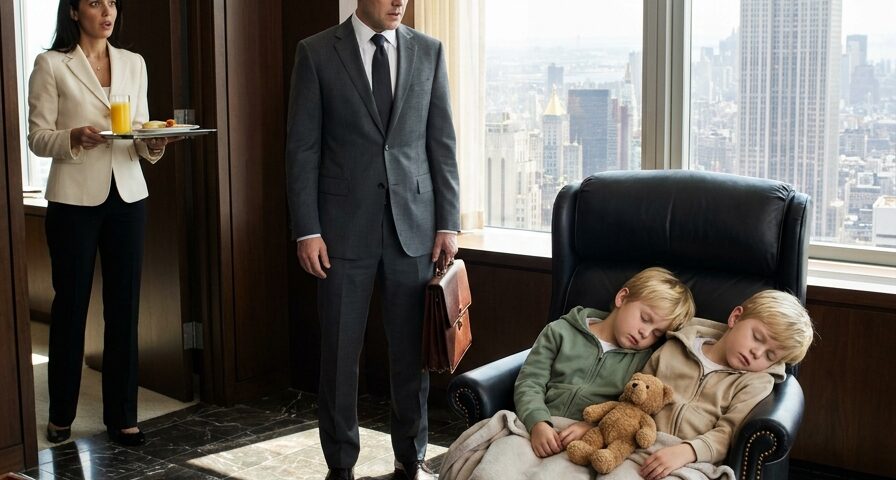
PART 2: Two Little Boys Appeared in a Crime Boss’s Office—Then One Name From His Past Changed Everything
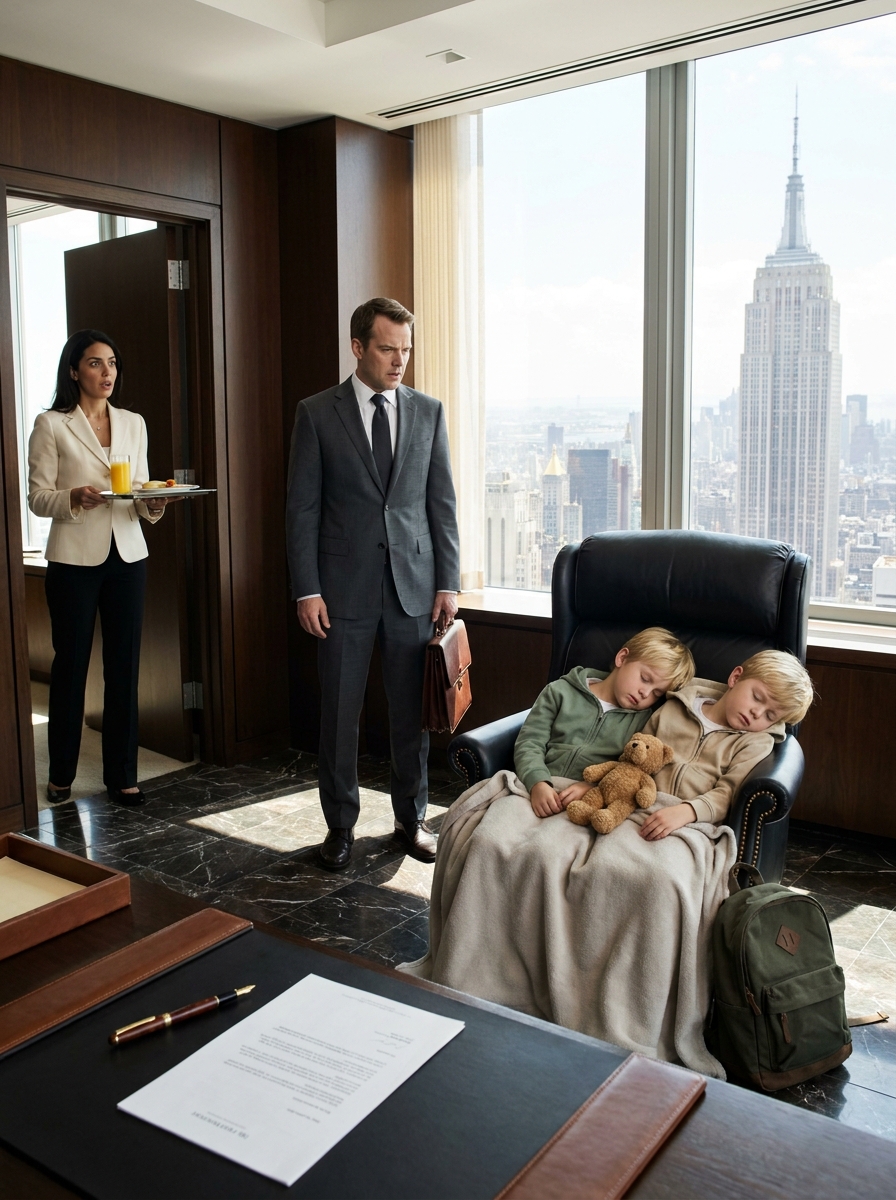
Claire was still standing near the door, hands clasped around her tablet. She had been with me for eight years and had watched men twice her size lose their voices in my presence. But now she looked at me as if she had just realized I was not made of steel after all.
“Emma Hart?” I asked, though my voice no longer sounded like mine.
Liam nodded. Lucas watched me carefully over the rim of his milk cup.
I leaned back slowly. The leather chair creaked beneath me.
Emma.
I had not spoken her name aloud in five years.
“What did your mother tell you about me?” I asked.
Liam glanced at Lucas, as if the younger boy might know whether it was safe to answer.
“She said you were important,” Liam replied.
“That’s all?”
“She said you lived in a tall building,” Lucas whispered. “And you had people who listened when you talked.”
Despite everything, something inside me twisted. That sounded like Emma—translating a dangerous truth into words a child could understand.
“Did she say I was your father?”
Both boys went very still.
The question floated between us, too large for the room.
Lucas lowered his cup. Liam pressed his lips together, then reached for the small dinosaur on the front of his sweatshirt and pinched the fabric between his fingers.
“She said…” He swallowed. “She said you were the one who would come if we needed you.”
It was not an answer.
That made it worse.
Claire cleared her throat carefully. “Mr. Miller, should I contact Dr. Reynolds?”
I knew what she meant. A private doctor. Someone discreet. Someone loyal enough not to ask questions. Someone who could examine the boys and make sure they were unharmed.
“Yes,” I said. “Tell him to come through the service entrance. No records. No calls.”
Claire nodded, then paused. “And security footage?”
“Everything from midnight until now. Lobby, street entrance, garage, service elevator. I want to know how they got here.”
“Yes, sir.”
She left, closing the door gently behind her.
The boys finished breakfast in silence. Children should have made noise. They should have spilled milk, argued over syrup, asked foolish questions. These boys ate like they were afraid food might vanish if they looked away.
I stood and walked to the windows, giving myself a few seconds to breathe.
Manhattan stretched below us in hard lines and silver light. The city had always felt like something I owned from this height. Now it looked too wide, too loud, too full of places where a woman could disappear.
I turned back. “Where were you before you came here?”
Lucas looked at Liam again.
“A lady brought us in a car,” Liam said.
“What lady?”
“I don’t know her name.”
“What did she look like?”
“Gray hair,” Lucas said. “Pretty scarf.”
“What color scarf?”
“Blue,” Liam answered. “With birds.”
The details came quickly now, small pieces gathered from frightened children.
The woman had picked them up from an apartment they did not call home. Emma had kissed them both before leaving, told them to listen to Mrs. Bird Scarf, and promised she would come soon. Then there had been a car, a long ride, darkness outside the windows, and a stop near the tower. The woman had walked them into the lobby just before dawn, spoken to a guard, then disappeared before anyone thought to stop her.
“Did your mother seem afraid?” I asked.
Liam shook his head first, then hesitated. “She smiled.”
Lucas’s eyes filled with tears. “But her hands were shaking.”
That tiny sentence did what no rival had managed in years. It cut straight through me.
I crossed the room and lowered myself onto one knee before them. Both boys stiffened, but neither moved away.
“Listen to me,” I said, making my voice gentler than I knew how to make it. “No one in this building is going to hurt you. You’re safe here.”
Lucas studied me. “Are you a bad man?”
The question struck cleanly, without accusation. Children did not know how to flatter or negotiate. They only asked what adults spent years avoiding.
I looked at Liam. Then Lucas.
“I’ve done bad things,” I said. “But I won’t do them to you.”
Lucas seemed to consider that. Then he nodded, as if the answer was acceptable enough for now.
A knock came at the door.
Claire entered with a man in his early sixties carrying a medical bag. Dr. Samuel Reynolds had stitched my shoulder in a hotel bathroom, removed a bullet from one of my captains, and once told a federal prosecutor he had been at a charity dinner when I knew he had been saving my life three blocks away.
He stopped when he saw the boys.
His eyebrows rose.
“Jason,” he said quietly.
“Check them.”
He gave me a long look but asked no questions. That was why he was still alive in my world.
The examination happened on the sofa. Dr. Reynolds spoke softly, offered them lollipops from his bag, and treated them not like evidence but like children. I stood across the room with my arms folded, fighting the urge to interrupt every time Lucas flinched at the cold stethoscope.
“They’re tired,” Reynolds told me afterward, stepping aside while Claire helped Lucas tie his shoelace. “Hungry, likely under stress, but no signs of recent physical harm. They need rest, routine, proper care.”
“Can you confirm paternity?”
He glanced toward the boys. “A DNA test can confirm it. But not instantly.”
“How long?”
“Expedited? A day or two, maybe less if I lean hard on the lab.”
“Lean.”
Reynolds sighed. “Jason—”
“Lean.”
His mouth tightened. “Fine. But while science catches up, you should prepare yourself.”
“For what?”
“For the possibility that you already know the answer.”
I said nothing.
He packed his bag. At the door, he paused. “Whatever else is happening, don’t let your enemies learn they’re here.”
“I know.”
“No,” he said, turning back. “I don’t think you do. You protect assets. Territory. Secrets. These are children. That kind of protection is different.”
After he left, Claire returned with the security footage on a tablet.
“There’s a problem,” she said.
There was always a problem.
She placed the tablet on my desk and played the lobby feed.
At 5:12 a.m., the front doors opened. A gray-haired woman entered, holding the boys by their hands. She wore a navy coat and a blue scarf printed with white birds. Her posture was straight, her face turned slightly away from the camera.
The boys looked half-asleep.
The woman spoke to one of the overnight guards, who leaned down to hear Liam say something. Then the guard stepped away, clearly calling someone through his earpiece.
In that brief moment, the woman bent and kissed both boys on the forehead.
Then she walked out.
“Pause,” I said.
Claire froze the image as the woman turned toward the doors.
“Zoom in.”
The picture sharpened as much as it could.
Something in my chest tightened.
I knew that face.
Not well. Not as someone from my world.
From Emma’s.
“Her name is Margaret Vale,” I said.
Claire looked surprised. “You know her?”
“She was Emma’s neighbor.”
Years ago, when Emma and I were still impossible enough to pretend we could work, Margaret had lived across the hall. A widow with silver hair, bird scarves, and a habit of watering plants outside her door. She had never liked me. Not fearfully. Not dramatically. She had simply looked at me once and decided I brought shadows wherever I went.
“She disappeared from the lobby,” Claire said.
“Find her.”
“We tried tracing the car. Street cameras caught a dark sedan, but the plates were covered by road grime. Not fake. Just obscured.”
“Convenient.”
“Yes.”
“Where was Emma living?”
Claire’s silence answered before she did. “We’re checking.”
I looked up sharply.
She held my gaze. “Jason, there are dozens of Emma Harts in the region. The address we had on file from years ago is empty. She left no forwarding information. No bank activity under that name in our usual channels.”
“Our usual channels don’t cover women who don’t want to be found.”
“No,” Claire said. “They don’t.”
A sound from the sofa stopped me.
Lucas had fallen asleep sitting upright, his head tipped against Liam’s shoulder. Liam was trying to stay awake, blinking hard, one arm around his brother.
The sight rearranged something in me.
“Get them a room,” I said.
Claire hesitated. “Here?”
“No. My residence.”
Her expression shifted, just slightly.
My residence occupied the top three floors of Emerald Tower, above the office levels. Few people had ever been invited there. Fewer had stayed. It was not a home as much as a fortress with expensive furniture.
“They need beds,” I said.
Claire nodded. “I’ll have the guest suite prepared.”
“No staff gossip.”
“I’ll handle it.”
“You’ll do more than handle it. Anyone who speaks of them outside this building answers to me.”
The words came out cold, familiar.
Liam heard them.
His eyes lifted to mine.
I regretted it instantly.
Not because the warning was unnecessary, but because his face changed. He did not look reassured. He looked like a child measuring the danger of the man who claimed he would keep him safe.
So I tried again.
“Only people we trust will know you’re here,” I said to him.
“Mommy said trust is hard,” Liam murmured.
“She was right.”
“Do you trust people?”
The honest answer was no.
But this morning was already full of impossible things.
“I trust Claire,” I said.
Claire, standing near the desk, looked down as if I had handed her something fragile.
Liam seemed to accept this. He gently shook Lucas awake, and Claire led them toward the private elevator.
Before the doors closed, Lucas looked back.
“Are you coming?”
The question was simple. It should have been easy.
I had meetings. Calls. Men waiting for orders. A city of moving pieces balanced on my word.
“Yes,” I said.
Lucas leaned into Liam, satisfied.
And I followed them.
The private elevator rose silently to the penthouse level. The boys stood close together, their small shoulders brushing. Claire held the backpack, which Lucas had reluctantly surrendered after I promised no one would throw it away.
The doors opened into marble, muted lights, and panoramic glass.
The boys stared.
My residence had been designed to impress adults who understood money. To a child, it must have looked like a museum no one was allowed to touch.
Lucas whispered, “Do you live in a hotel?”
“No,” Claire said warmly. “But it does feel like one, doesn’t it?”
Liam looked around. “Where are your toys?”
I almost laughed, but it caught somewhere in my throat.
“I don’t have any.”
Lucas frowned. “Not even cars?”
“No.”
“Blocks?”
“No.”
“Dinosaurs?”
“No.”
He looked deeply concerned. “That’s sad.”
Claire turned away, pretending to check her phone.
For the first time that morning, a smile touched my mouth.
The guest suite had two beds, white blankets, a low sofa, and windows looking east over the city. Claire had already ordered children’s clothes, pajamas, toothbrushes, and more food than two little boys could eat in a week.
Lucas ran a hand over the blanket as if testing whether it was real.
Liam stood by the door.
“Can we stay together?” he asked.
“Yes.”
“Can the door stay open?”
“Yes.”
“Can we keep the light on?”
“Yes.”
Every answer seemed to loosen one thread of tension in him.
Claire placed the backpack on the sofa. Lucas immediately unzipped it and pulled out a stuffed rabbit with one missing eye, a small plastic fire truck, two folded shirts, and a children’s book with worn corners.
Then he pulled out a photograph.
I saw it upside down in his hand and still recognized Emma’s smile.
“May I see that?” I asked.
Lucas hugged it to his chest.
I stopped moving.
“It’s okay,” I said. “You don’t have to.”
He watched me for a long second before crossing the room. He handed me the photo with both hands, as if lending me something sacred.
Emma sat on a park bench between the boys, one arm around each of them. Her hair was shorter than I remembered, tucked behind her ears. There were faint lines near her eyes, the kind life carves without asking permission. But she was still Emma.
Warm. Alert. Beautiful in a way that had never needed attention.
On the back, written in blue ink, were three words.
For someday. E.
The handwriting was hers.
I stared until the letters blurred.
“Is she coming back?” Lucas asked.
I looked at him.
A lifetime of lies waited on my tongue, each one more convenient than the last.
“I don’t know,” I said.
His face fell, but Liam nodded, as if he preferred a painful truth to a pretty lie.
“Then we should find her,” Liam said.
“We will.”
The promise entered the room quietly, but once spoken, it changed everything.
After the boys fell asleep, curled on separate beds but holding hands across the small space between them, I stood in the doorway longer than I meant to.
Claire came to stand beside me.
“You should rest too,” she said.
“I don’t rest when people leave children in my lobby.”
“No,” she said. “You usually make other people stop resting.”
I glanced at her.
A faint smile passed over her face and vanished. “Sorry.”
“Don’t be.”
She folded her arms. “What do you want me to do?”
“Find Margaret Vale. Find Emma. Quietly. No street panic, no pressure that sends people running. I want information, not theater.”
“That sounds almost reasonable.”
“I’m capable of reasonable.”
“Today?”
I deserved that.
I walked into the hall, lowering my voice. “Who knows?”
“Me. Dr. Reynolds. Three guards from the morning shift. House staff preparing the suite.”
“Replace the guards on shift. Not punishment. Just keep them away from anyone curious.”
“Already done.”
“And my lieutenants?”
“They’re waiting downstairs. Victor has called twice.”
Victor Sloane had been with me since the beginning. He was sharp, loyal in the way ambitious men are loyal when their interests align, and dangerous when bored. He would smell disruption before anyone else.
“What did you tell him?”
“That you’re dealing with a private matter.”
“He’ll hate that.”
“He did.”
“Good.”
Claire hesitated. “Jason, there’s something else.”
She handed me a second item from the backpack. A plain white envelope, sealed, my name written across the front.
My stomach tightened.
“Where did you find this?”
“In the lining. There’s a small tear inside the backpack. It had slipped down between the fabric.”
I took it.
For several seconds, I only looked at my name.
Not Mr. Miller.
Not Jason Miller.
Jason.
Emma’s handwriting again.
I opened it carefully.
Inside was a single sheet of paper.
Jason,
If you are reading this, then every other plan failed.
I know I have no right to ask anything of you after the way I left. I know there are things I kept from you that you may never forgive. But Liam and Lucas are innocent of all of it, and I am asking you to protect them until I can return.
Do not trust anyone who claims I sent them unless they know what happened in Bell Harbor.
Do not let the boys be photographed.
Do not contact the police unless you are certain who receives the call.
I am sorry.
Emma
Below her name was a line that made the air leave my lungs.
They are yours.
I read it once.
Then again.
Claire did not ask to see it. She watched my face and understood enough.
For years, men had accused me of having no weakness. They had built strategies around that belief. I had encouraged it. I had made it useful.
Now two sleeping boys and one letter had exposed the lie.
“Bell Harbor,” Claire said softly. “What is that?”
“A place.”
“That’s all?”
“It was where Emma and I went when she left the city.”
“When she disappeared?”
“No.” My fingers tightened around the paper. “Before that.”
The memory came unwillingly.
A gray coastal town, rain on narrow streets, Emma laughing in a diner because I had never eaten pie with a plastic fork. Three days where my phone stayed off and I pretended there was a version of my life simple enough to hold her. On the last night, she had asked what would happen if someone ever used her to get to me.
I told her no one would dare.
She looked at me with such sadness that I still remembered it.
Two weeks later, she was gone.
Claire’s voice pulled me back. “Who knows about Bell Harbor?”
“Almost no one.”
“Almost?”
I looked at the letter again.
“Victor.”
Downstairs, the empire waited.
I left the boys sleeping under Claire’s protection and returned to my office just before noon. The sunlight had shifted, throwing long white lines across the floor. The chair where the boys had slept looked ordinary again, which felt impossible.
Victor Sloane stood near the bar cart, pouring himself sparkling water he had not been offered.
He was lean, dark-haired, and always dressed as if he expected cameras. Behind him stood Marco and Ellis, two senior men who kept their expressions carefully blank.
“You canceled the shipping call,” Victor said.
“I moved it.”
“You canceled lunch with Alderman Price.”
“He’ll survive.”
Victor smiled without warmth. “I’m sure he will. The question is whether we will, if our political friends start feeling ignored.”
I walked behind my desk. “You worried about my manners now?”
“I’m worried about surprises.” His gaze moved around the office. “Claire said it was personal.”
“It is.”
“Personal things become business when they interrupt business.”
I sat down slowly. “Careful.”
The room cooled.
Victor raised both hands in a mild gesture. “I’m not challenging you.”
“No. You’re circling the edge of it.”
Marco looked at the floor. Ellis found interest in his cufflinks.
Victor’s smile thinned. “Then let me speak plainly. Rumors move fast. The morning guards were reassigned. Your doctor came in through the service entrance. Claire ordered children’s clothing to the penthouse. Whatever this is, people are going to notice.”
“Then make sure they notice something else.”
“What do you want spread?”
“That my doctor came because I collapsed from exhaustion.”
Victor blinked.
It was not often I surprised him.
“You want people thinking you’re weak?”
“I want people thinking they know the secret.”
His expression shifted into reluctant approval. “That could work.”
“It will work.”
“And the actual secret?”
“Is mine.”
Victor studied me for several seconds too long.
I leaned back. “You have something to say.”
“A woman came through the lobby this morning,” he said.
My face did not move.
He reached inside his jacket and placed a printed image on the desk.
Margaret Vale.
“Who gave you this?” I asked.
“Someone loyal.”
“Name.”
“Jason—”
“Name.”
His jaw tightened. “Dennis, from overnight security. He was concerned.”
“Dennis is paid to follow instructions, not feed you images.”
“He thought I should know a stranger delivered children into our building.”
“Did he?”
Victor’s eyes sharpened. “Children?”
I had given him that.
Or he had made me give it.
A small mistake. The kind that used to get other men killed.
I stood. “Leave.”
Victor’s expression hardened. “You’re shutting me out.”
“Yes.”
“I’ve protected this organization for fifteen years.”
“You’ve served it.”
“And you.”
“Then keep serving by leaving this room.”
For one second, the old Victor looked back at me—the man who had dragged me behind a dumpster when gunfire tore through a restaurant in Queens, the man who had built routes and alliances and alibis while I built fear. There had been friendship once, or something close enough to be mistaken for it.
Then the mask returned.
“As you wish.”
He turned and walked out, Marco and Ellis following him.
But at the door, Victor paused.
“Bell Harbor,” he said quietly. “Funny how the past never stays buried.”
Every instinct in me went still.
He did not look back.
The door closed.
I remained standing behind my desk, listening to the echo of words that should not have been spoken.
A few minutes later, Claire entered without knocking. Her face told me she already knew something was wrong.
“Victor knows Bell Harbor,” I said.
“You told me he did.”
“No,” I said. “He knows it matters today.”
Claire absorbed that quickly. “How?”
“That’s what we find out.”
Her tablet buzzed. She looked down, then went still.
“What?”
“We found Margaret Vale.”
“Where?”
Claire’s eyes lifted. “In a church basement in Brooklyn.”
Margaret Vale refused to come to Emerald Tower.
That alone made me respect her.
So I went to her.
Not with a convoy. Not with visible guards. Just me, Claire, and one driver who knew how to keep distance without looking like he was keeping distance.
The church sat between a laundromat and a bakery, its brick walls darkened by rain and time. Inside, the basement smelled of coffee, old wood, and lemon cleaner. Folding chairs lined the walls. A bulletin board advertised winter coat donations and piano lessons.
Margaret Vale sat at a plastic table with a paper cup of tea in front of her.
She looked older than the lobby footage, but her eyes were clear. Her blue bird scarf was folded neatly beside her purse.
“You came quickly,” she said.
“You left quickly.”
“I had to.”
“Where is Emma?”
Margaret looked at Claire, then back at me. “Still direct. That hasn’t changed.”
“Where is she?”
“I don’t know.”
I believed her, which annoyed me.
“When did you last see her?”
“This morning.”
“Where?”
“In Queens. A furnished apartment above a closed tailor shop. She had been there three nights.”
“Why?”
“She said it was temporary.”
“Temporary because of what?”
Margaret’s mouth trembled, but only once. “Because someone found them.”
“Them?”
“Emma and the boys.”
I sat across from her. The chair was too small, the table too flimsy. In another life, it might have made the conversation less threatening. In this one, it only made me aware of how large my shadow looked under fluorescent lights.
“Start at the beginning,” I said.
Margaret’s fingers curled around the paper cup. “Emma came to me four years ago. Pregnant, scared, stubborn. She said she couldn’t stay near you. She said if you knew about the babies, you would either take them into your world or burn the world down trying to protect them. She didn’t want either.”
Something heavy settled behind my ribs.
“She should have told me.”
“Yes,” Margaret said. “She should have. And you should have been a man she could tell.”
Claire looked away.
Margaret did not.
I found I could not argue.
“She built a life,” Margaret continued. “A quiet one. Different names in different places, but not criminal. Don’t look at me like that. She worked. She paid rent. She took those boys to the library every Wednesday. She made pancakes shaped like animals. She did not use your money.”
“I never offered any.”
“She wouldn’t have taken it.”
No, she wouldn’t.
“What changed?”
“Three weeks ago, she saw a man watching the playground.”
“What man?”
“She didn’t know. Not police, she said. Not ordinary either. After that, she began moving. She called me two days ago and asked if I still remembered the emergency plan.”
“The plan was bringing them to me?”
Margaret’s eyes softened. “No. You were the last plan.”
The words landed harder than they should have.
“Then why now?”
“Because last night she received a message.”
“What message?”
Margaret reached into her purse and withdrew a folded napkin. She slid it across the table.
Written in black ink were six words.
Bell Harbor wasn’t the only witness.
I stared at the sentence until the church basement seemed to fade.
“What happened in Bell Harbor?” Claire asked.
Margaret shook her head. “Emma never told me. She only said if those words ever appeared, Jason had to know.”
“Know what?” I asked.
Margaret’s gaze held mine.
“That the danger didn’t begin with the boys. It began with you.”
On the ride back to Emerald Tower, the city passed in wet streaks beyond the tinted glass. Claire sat beside me, quiet longer than usual.
Finally she said, “Are you going to tell me?”
I kept my eyes on the window.
“In Bell Harbor, Emma saw something she wasn’t supposed to see.”
“What?”
“A meeting.”
“Yours?”
“Yes.”
“With who?”
I exhaled slowly. “A federal agent named Daniel Price.”
Claire turned toward me. “Alderman Price?”
“His brother.”
The past unfolded in pieces I had kept sealed for years.
Daniel Price had been an ambitious federal investigator with clean suits and dirty methods. He wanted to bring down half the city and build his career on the wreckage. But he also had debts, secrets, and a weakness for leverage. Bell Harbor had been neutral ground for a meeting meant to keep a war from spilling into the streets.
Emma was never supposed to be there.
She had come back to the motel early because rain ruined her walk along the pier. She heard voices through the wall. Mine. Daniel’s. Victor’s.
She heard enough to understand that the lines between law and crime were not where people thought they were.
The next morning, she asked me if I had ever told her the truth about anything.
I told her truth was dangerous.
She said lies were worse.
Two weeks later, she vanished.
“And Daniel Price?” Claire asked.
“Died six months after Bell Harbor. Car accident.”
“You don’t believe it was an accident.”
“I didn’t care enough at the time to decide.”
She was silent.
Then she said, “But Emma did.”
I closed my eyes briefly.
Yes.
Emma had always cared about the pieces everyone else stepped over.
When we returned, Claire went to check on the boys while I remained in the elevator, riding up alone to the penthouse. The doors opened on quiet.
Not the sterile quiet I was used to.
A different kind.
Soft footsteps. A cartoon murmuring from the living room. The faint smell of grilled cheese.
I followed it.
Lucas sat cross-legged on a rug that had cost more than most cars, pushing his plastic fire truck along the pattern. Liam sat nearby, reading the same page of his children’s book without turning it.
Both looked up when I entered.
“Margaret is safe,” I said.
Liam’s shoulders dropped a little. “She said she had to go away.”
“She’s all right.”
“Did she know where Mommy is?”
“No.”
Lucas’s lower lip trembled.
I sat on the sofa, leaving space. “But she helped us understand where to look.”
Liam closed the book. “Can we help?”
“You already have.”
“How?”
“You remembered the scarf. The car. The woman. That matters.”
He seemed to sit taller.
Lucas pushed the fire truck toward me. “You can play.”
I stared at the toy near my shoe.
The last time someone had invited me into something so ordinary, I had been a different man.
“I don’t know how.”
Lucas frowned, as though I had confessed to not knowing how to breathe. “You just drive it.”
So I picked up the fire truck.
It was red, chipped along one side, with a tiny ladder that no longer moved properly. Lucas watched to make sure I did it right.
I rolled it slowly across the rug.
“No,” he said. “You need the siren.”
“I see.”
“You say wee-oo.”
I looked at Liam. He was waiting too.
So I, Jason Miller, who had once made a room full of armed men go silent with one glance, pushed a plastic fire truck across my penthouse rug and said, quietly, “Wee-oo.”
Lucas laughed.
It was a small sound.
It changed the room.
Later, after dinner, Liam asked for paper.
Claire brought crayons, notebooks, pencils, and half a stationery drawer. The boys sat at the kitchen island drawing. Lucas made lopsided dinosaurs. Liam drew a house with three windows, a tree, two stick figures, then paused and added a third larger figure standing apart.
“Who’s that?” I asked.
He shrugged. “Maybe you.”
“Why am I so far away?”
“Because I don’t know where you go.”
The answer stayed with me.
Children did not need speeches. They needed presence. A person either stayed or didn’t.
That night, after Claire tucked them in because I had no idea how, Liam called my name from the doorway.
Not Mr. Miller.
Not Jason Miller.
“Jason?”
I turned.
He stood in borrowed pajamas too big at the sleeves. “Mommy said you liked black coffee.”
“I do.”
“She said it tasted like burnt rain.”
Despite myself, I smiled. “She said that?”
“She said you pretended to like it because you thought smiling was suspicious.”
That one hurt more than I expected.
“She knew me pretty well.”
Liam looked down at his feet. “Did you love her?”
The hallway became impossibly still.
“Yes,” I said.
“Then why didn’t you come with us?”
Because I didn’t know.
Because she left.
Because I let pride make silence look like dignity.
Because I was better at hunting enemies than holding on to someone who wanted me to become less dangerous.
“I made mistakes,” I said.
Liam considered that. “Grown-ups say that when they don’t want to explain.”
I huffed a quiet laugh. “Smart kid.”
“Mommy says so.”
“She’s right.”
He turned back toward the bedroom, then paused. “Lucas thinks you’re scary.”
“I know.”
“I think you’re sad.”
Then he went inside and closed the door halfway, leaving the light on.
I stood there for a long time.
At 1:17 a.m., Claire called.
I answered from the penthouse study.
“We found something,” she said. “Emma used the name Elise Warren at the Queens apartment. Paid cash. No digital trail.”
“That’s not enough for a call at one in the morning.”
“No. It isn’t.”
Paper rustled on her end.
“The apartment owner said Emma left behind a storage key by accident. We found the unit. Jason, you need to see this.”
The storage facility was in Long Island City, wedged beneath elevated tracks that rattled every few minutes. Rain slicked the pavement. A sleepy manager took one look at me and decided not to ask why I wanted access after midnight.
The unit was small. Five by ten. Claire stood beside me as the metal door rolled up.
Inside were boxes stacked neatly, a folded stroller, winter coats in plastic, two tiny bicycles with training wheels, and a locked fireproof case.
Not the hidden arsenal some would have expected.
A life.
A secret, careful life.
Claire opened the case with the key taped beneath the lid of a cardboard box marked BOOKS.
Inside were documents.
Birth certificates.
Medical records.
Photographs.
A small bundle of letters tied with string.
The birth certificates listed Liam Hart and Lucas Hart.
Father: Unknown.
I touched the paper with two fingers.
Unknown.
Claire quietly examined another folder. “Jason.”
She handed me a photograph.
Emma stood outside a school, holding the boys’ hands. Behind her, blurred but visible near a parked car, was a man in a gray coat.
“Playground watcher?” Claire asked.
I knew him.
Not by name.
By association.
He worked for Alderman Richard Price.
Daniel Price’s brother.
The same man I had been scheduled to meet for lunch that day.
“The alderman has been looking for Emma,” Claire said.
“Or watching her.”
“Why?”
I opened the bundle of letters.
Most were addressed to no one, dated over several years. Emma had written them and never sent them.
Jason,
Liam has your stare. Lucas has your temper, though he mostly uses it on peas.
I almost called you today.
I didn’t.
I tell myself it is safer this way.
Another:
Jason,
They asked about their father today. I told them you were far away. It felt like a lie and not a lie at the same time.
Another:
If Bell Harbor ever comes back, I may have to trust the one person I ran from.
I read until I could not.
At the bottom of the case was a flash drive taped inside an envelope.
On the envelope, Emma had written:
For Jason, if I disappear.
Claire’s phone buzzed before either of us spoke.
She looked at it and went pale.
“What?”
“The penthouse alarm tripped.”
My blood turned cold.
“Boys?”
“House staff says they’re safe. But someone accessed the private elevator from your office level.”
We were in the car before the storage door finished closing.
No sirens. No chaos. Just speed and silence.
I called the penthouse. Claire patched the feed to her tablet.
The hallway camera outside the guest suite showed nothing at first. Then a figure stepped into frame.
Not an intruder in black.
Not an enemy with a weapon.
Victor.
He stood outside the boys’ door, one hand raised as if about to knock.
Then he looked directly into the camera.
And smiled.
By the time we reached Emerald Tower, Victor was gone.
The boys were unharmed. Lucas had slept through everything. Liam had not.
He sat upright in bed, clutching the one-eyed rabbit, eyes wide in the dim light.
“He said he was your friend,” Liam whispered when I entered.
My hands curled at my sides. I forced them open.
“Did he come inside?”
Liam shook his head. “He stood there. He asked if we liked it here.”
“What did you say?”
“I said I wanted Mommy.”
The words broke in the middle.
I crossed the room and sat on the edge of the other bed, not too close. “That was a good answer.”
“He knew her name,” Liam said.
I went still.
“What exactly did he say?”
Liam’s voice dropped lower. “He said Emma always did know how to make you weak.”
The room sharpened around me.
Claire stood in the doorway, her face controlled but pale.
I looked at Liam. “Did he give you anything?”
He nodded.
From beneath his pillow, he pulled out a small folded paper.
I took it carefully.
Only one sentence was written inside.
Ask Jason what really happened to Daniel Price.
Liam watched my face. “Who’s Daniel?”
I folded the paper.
“A man from a long time ago.”
“Did you hurt him?”
The question landed between us with terrible innocence.
I wanted to say no quickly, cleanly, easily.
But Bell Harbor rose behind my eyes. Daniel Price’s nervous smile. Victor’s hand closing a motel room door. Emma’s face the next morning, pale with something deeper than anger.
“I don’t know,” I said.
Liam stared at me.
It was the first answer I had given him that made him look afraid of me.
Not because it was cruel.
Because it was true.
I left the room before my presence could frighten him more.
In the hall, Claire spoke first. “Victor crossed a line.”
“Yes.”
“What are you going to do?”
A younger version of me would have answered immediately. Brutally. Permanently.
But two children slept behind the door, and the woman I had once loved had left me a trail made of trust and fear. If I moved like the man Victor expected, I might destroy the only path to Emma.
So I said, “Nothing loud.”
Claire nodded slowly. “Good.”
“Lock down every internal access point. Quietly. I want Victor watched, not warned.”
“And Price?”
“Cancel tomorrow’s meeting.”
“Reason?”
I looked toward the boys’ room. “Tell him I’m unwell.”
Claire almost smiled. “The exhaustion story?”
“Let’s see who believes it.”
By morning, rain had washed the city clean but left the sky gray.
The boys ate toast at the kitchen island. Lucas had syrup in his hair. Liam watched me over his orange juice with a guarded expression that made him look heartbreakingly like Emma.
I wanted to explain everything to him. I wanted to tell him that adults could carry guilt without being monsters, that not knowing the truth did not mean hiding from it, that I would find his mother even if I had to unmake my whole life to do it.
Instead, I buttered a piece of toast and asked, “Do you like strawberries?”
Lucas nodded enthusiastically.
Liam said, “Mommy cuts them into stars.”
“I don’t know how to do that.”
“I can show you.”
So he did.
He took a small knife from Claire, safe and dull, and demonstrated careful little cuts until the fruit became uneven star shapes. Lucas clapped. Claire blinked too much and turned toward the coffee machine.
For ten minutes, the world narrowed to strawberries, toast, and a child teaching me something gentle.
Then my phone rang.
Unknown number.
Everyone in the room seemed to feel the change.
I answered.
No one spoke at first.
Then a woman’s voice, faint and rough with exhaustion, whispered, “Jason?”
My entire body locked.
“Emma.”
Liam slid off his stool. Lucas froze with a strawberry halfway to his mouth.
“Don’t talk,” she said quickly. “Just listen. Are they safe?”
“Yes.”
A breath broke on the other end.
“Thank God.”
“Where are you?”
“I can’t say.”
“Emma—”
“No. Not yet. You have to listen to me. The flash drive is not the whole truth. It’s only insurance. Bell Harbor was never about Daniel Price alone.”
I glanced at Claire, who had gone utterly still.
“Who are you running from?”
Emma’s voice trembled. “Someone inside your circle.”
“Victor?”
Silence.
“Emma, is it Victor?”
“I don’t know anymore. I thought I did. But the person who found me knew things Victor shouldn’t have known.”
“What things?”
A sound came through the line. Not static. Movement.
Emma inhaled sharply.
“Listen to the recording from the pier,” she whispered. “Not the motel. The pier. And Jason…”
Her voice softened in a way that tore years open.
“Don’t let the boys hate you for what they’re about to learn.”
The line clicked dead.
Liam stood a few feet away, his face pale. “Was that Mommy?”
I lowered the phone.
“Yes.”
Lucas began to cry.
Liam didn’t. He just looked at me with those icy blue eyes that were mine and not mine, waiting to see whether I would become a liar.
“She’s alive,” I said. “And she wants us to find something.”
Claire opened her laptop at once. The flash drive from the storage unit lay on the table between us like a loaded secret.
It contained folders organized by date.
Bell Harbor.
Motel.
Pier.
Daniel Price.
Victor.
One folder had no label at all.
Claire clicked PIER.
There were three audio files.
The first was wind, rain, distant gulls, and voices too muffled to understand.
The second was clearer.
Daniel Price: “You said Miller would never know.”
Victor: “Miller knows what I decide he knows.”
Daniel: “And the woman?”
Victor: “Emma heard enough to become inconvenient.”
My chair scraped back.
Claire’s hand flew to her mouth.
The recording continued, the wind distorting Victor’s voice but not enough.
Victor: “If anything happens to Daniel, his brother steps in. Richard is easier to manage. Cleaner. Hungrier.”
Daniel: “You’re insane.”
Victor: “No. I’m practical.”
Then another voice entered.
A woman.
Not Emma.
Calm. Familiar.
“Practical men always think they’re the only ones making plans.”
The recording ended.
Claire stared at the screen.
I knew that woman’s voice.
I had heard it every day for eight years.
Slowly, I turned toward her.
Claire’s face had lost all color.
“Jason,” she whispered, “I need to tell you something before you listen to the next file.”