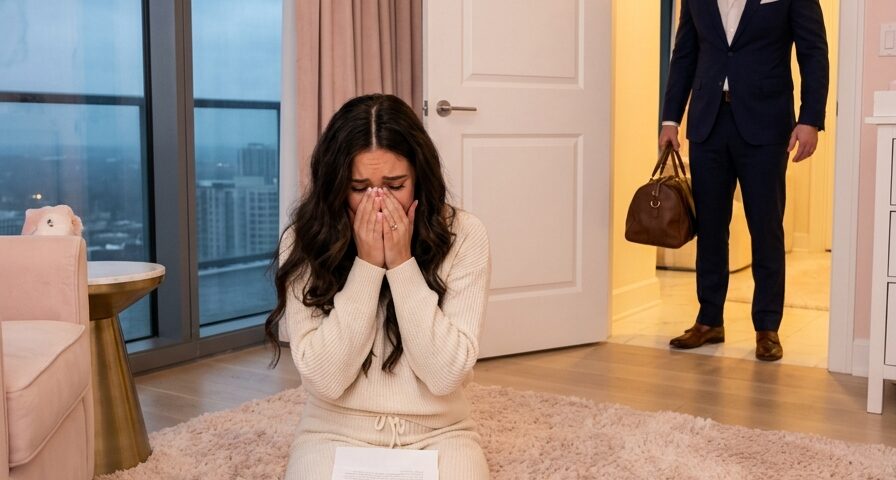
PART 2: My Husband Left Me Bleeding After Childbirth—Three Days Later, He Came Home to an Empty Nursery and a Secret He Never Saw Coming
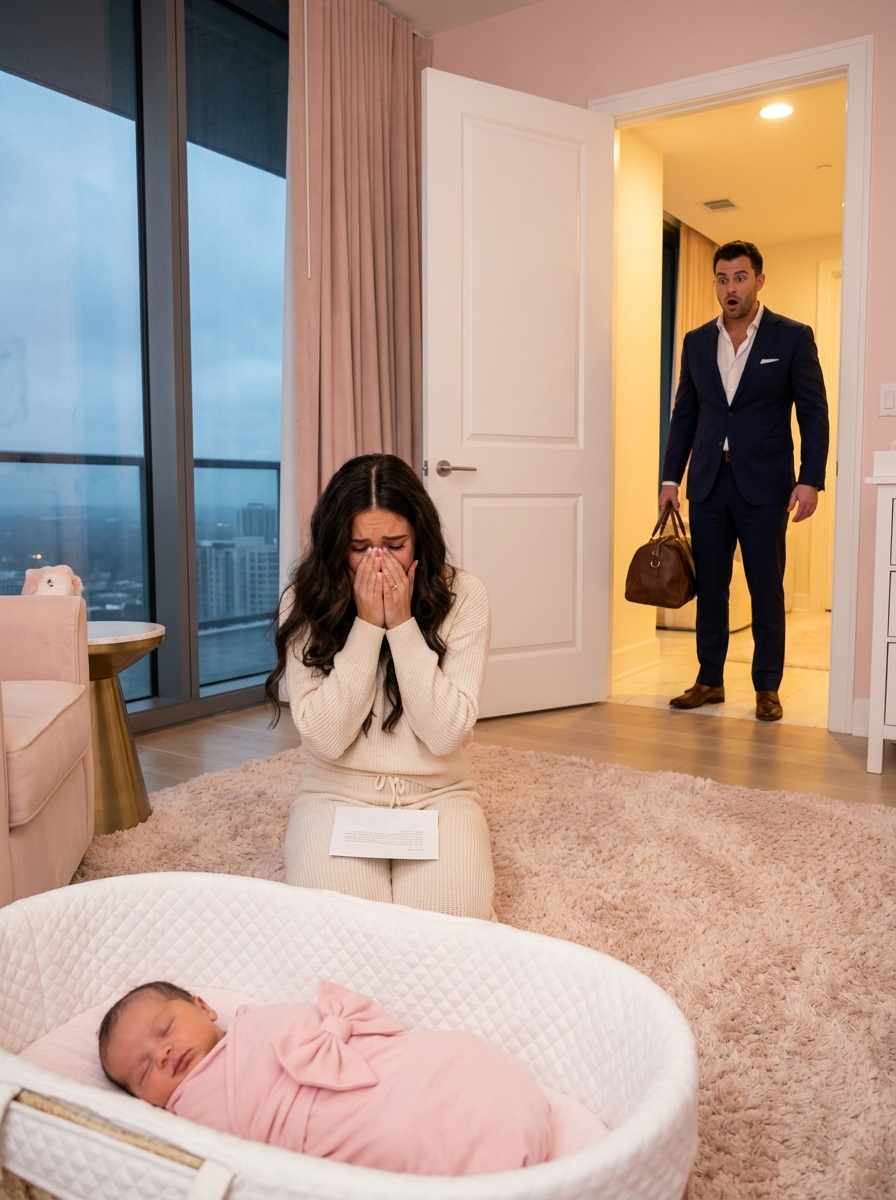
He backed out of the nursery and stumbled down the hall, opening doors as he went. The master bedroom was untouched. The guest room was neat. The bathroom held a towel on the floor, a half-empty bottle of prenatal vitamins on the counter, and Emma’s robe hanging from the hook behind the door.
Her phone was not on the nightstand.
Ethan’s diaper bag was gone.
So was the car seat.
Ryan moved through the house faster now, panic loosening his breath. In the kitchen, a mug sat in the sink with a tea bag dried against the porcelain. On the counter was the small notebook Emma used to track Ethan’s feedings. The last entry was from three days earlier.
2:10 p.m. — fed. Sleepy. Sweet boy.
Underneath, the pen had drawn a long, uneven line down the page, as though her hand had slipped.
Ryan stared at it until the words blurred.
His brand-new designer watch lay broken near the front door where the shopping bag had fallen. The face was cracked clean through, the second hand twitching uselessly beneath the glass. He had bought it for himself in Aspen because, as he told his friends, “Nobody else understands what I actually deserve.”
Now the watch ticked against the floor like a small, cruel joke.
He grabbed his phone and called Emma.
Straight to voicemail.
He called again.
Voicemail.
His hands shook so badly he almost dropped the phone. He opened his messages, expecting to see something from her—angry words, desperate words, any words at all. There were none. The last messages between them were from Friday morning, before he left.
Emma: Please don’t go. I’m not feeling right.
Ryan: You’re fine.
Emma: I’m scared.
Ryan: I can’t keep doing this drama. I’ll be back Sunday night.
He had not come back Sunday night.
A snowstorm had rolled over the mountains, delaying traffic and giving him an excuse to stay one extra day. Then one extra brunch became one extra afternoon. His friends had laughed when he said Emma would “survive without him.”
Now the silence in his home seemed to answer that joke.
Ryan dialed 911.
“What is your emergency?” the dispatcher asked.
“My wife,” he said, barely able to form the words. “My wife and newborn son are missing. There’s blood in the nursery. A lot of blood.”
The dispatcher’s voice became calm and precise. “Sir, what is your address?”
He gave it.
“When did you last see your wife?”
“Friday afternoon.”
A pause. Not long, but he heard it.
“Today is Monday, sir.”
“I know,” Ryan said. “I know. I was out of town.”
“Was your wife injured when you left?”
He closed his eyes.
The nursery came back to him. Emma on the floor. Pale. Trembling. Begging him to help her.
“I thought she was just…” His voice failed. “She had just had a baby. She said she was bleeding.”
“Emergency services are on the way,” the dispatcher said. “Remain at the residence. Do not disturb anything further.”
Ryan looked around the kitchen, suddenly aware that the house was no longer his home. It had become a place of evidence.
Evidence of absence.
Evidence of neglect.
Evidence of a decision he could no longer explain away.
Police arrived first. Then paramedics, though there was no one left for them to treat. A young officer with serious eyes asked Ryan to sit at the kitchen table. Another officer photographed the nursery. Their radios murmured softly. Rubber soles moved through the hallway. Someone asked whether there were security cameras.
Ryan nodded toward the front porch and the nursery monitor app on his phone.
The officer looked at him. “We’ll need access to both.”
“Of course,” Ryan said.
His voice sounded obedient. Small.
He tried to call Emma again while an officer stood nearby. Voicemail. He tried her friend Maya, whose number he barely knew because he had always considered Emma’s friendships “too emotional.” It rang five times.
“Hello?” Maya answered cautiously.
“Maya, it’s Ryan. Is Emma with you?”
Silence.
“Maya?”
Her voice turned cold. “Where are you?”
“At home.”
“Now you’re home?”
Ryan gripped the edge of the table. “Please. Is she with you?”
Another silence followed, heavier this time.
“I’m not telling you anything,” Maya said. “You can speak to the hospital or the police.”
“The hospital?” he breathed. “Which hospital?”
But Maya had already hung up.
Ryan stood so quickly the chair scraped the tile.
The officer stepped forward. “Mr. Parker.”
“She’s at a hospital,” Ryan said. “She’s alive.”
The words should have brought relief. Instead, they opened a new chamber of fear.
Because if Emma was alive and had not called him, then she had chosen not to.
Or someone had helped her choose.
The officer asked for Maya’s number. Ryan gave it. He gave them Emma’s obstetrician’s name, Ethan’s pediatrician, the name of the nanny who was supposed to start that morning. Each answer made him feel more exposed. He knew the practical details of his life the way he knew the features of his car: payment amounts, schedules, warranties. But he did not know the things a husband should have known without thinking.
He did not know Emma’s current blood pressure medication.
He did not know the name of the nurse she liked at her OB’s office.
He did not know where she kept the emergency folder she had once told him about while he was looking at his phone.
The officers eventually stepped into the hallway to speak privately. Ryan heard fragments.
Postpartum hemorrhage.
Delayed care.
Neighbor statement.
Infant removed safely.
Neighbor.
Ryan’s head lifted.
“Which neighbor?” he asked.
The older officer, Sergeant Hall, turned back toward him. “Mr. Parker, we’re still gathering information.”
“Who found them?”
Sergeant Hall studied him for a moment. “A woman named Ruth Bellamy.”
Ryan blinked. “Ruth?”
Ruth Bellamy lived next door in the old brick house with blue shutters. She was in her seventies, maybe older. Emma had taken banana bread to her after a hip surgery last year. Ryan remembered being annoyed because Emma had asked him to shovel Ruth’s walkway once during a storm.
“She heard the baby crying,” Sergeant Hall said. “Your front door was unlocked.”
Ryan looked toward the entryway.
He had left in a hurry Friday. Suitcase in one hand, phone in the other, angry at Emma for making him feel guilty.
Had he even locked the door?
The sergeant continued. “Mrs. Bellamy called emergency services. She also performed basic first aid until paramedics arrived.”
Ryan sank back into the chair.
Ruth Bellamy had heard his son crying.
A woman he had barely acknowledged had walked into his house and done what he refused to do.
By late afternoon, Ryan learned the hospital name from the police, not from Emma. St. Anne’s Medical Center. Twenty-two minutes away. He tried to leave immediately, but Sergeant Hall stopped him.
“Mr. Parker, you should understand something before you go,” he said.
Ryan paused with his keys in hand.
“Your wife has requested that you not be admitted to her room without approval.”
The sentence hit harder than any accusation.
“She’s my wife.”
“She is also a patient recovering from a medical emergency.”
“And Ethan?”
“Your son is under medical observation, but stable. Access is restricted.”
Ryan’s mouth went dry. “Restricted from me?”
“For now.”
“For now,” he repeated.
Sergeant Hall’s expression did not change. “I suggest you contact an attorney before attempting anything impulsive.”
Ryan almost snapped that he did not need advice from a policeman standing in his kitchen. The words rose automatically, shaped by years of believing irritation was the same as authority.
Then he looked past the sergeant into the nursery.
The bloodstain silenced him.
At St. Anne’s, the maternity recovery ward smelled faintly of antiseptic, coffee, and the artificial lavender used in waiting rooms to soften fear. Ryan walked in still wearing the clothes he had driven home in: dark jeans, a cashmere sweater, expensive boots dusted with mountain slush. He felt suddenly ridiculous. Like a man dressed for a life that had ended without telling him.
At the nurses’ station, he gave his name.
The nurse’s expression became guarded.
“I’m here to see my wife and son,” Ryan said.
“Please wait here.”
“I came from our house. The police said—”
“Please wait here,” she repeated.
He waited.
A minute later, a woman stepped through the double doors.
She was small, white-haired, and stood with a cane in one hand, but there was nothing fragile about her gaze.
Ruth Bellamy.
Ryan recognized her from the glimpses he had bothered to notice over the years: watering hydrangeas, collecting mail, waving to Emma from across the lawn. She wore a soft gray cardigan over a navy dress. Her shoes were sensible. Her face was lined, tired, and deeply awake.
“Ryan,” she said.
He swallowed. “Mrs. Bellamy.”
“You came back.”
The words were not cruel. That made them worse.
“Is Emma okay?”
Ruth looked at him for a long moment before answering. “She is alive.”
He closed his eyes, relief rushing through him so violently he had to grip the counter.
“And Ethan?”
“Alive too. Hungry, frightened, but alive.”
The nurse looked away politely.
“I need to see them,” Ryan said.
“No,” Ruth replied.
His eyes opened. “You can’t decide that.”
“No,” she said. “Emma did.”
“She’s upset.”
“She nearly died.”
The waiting area seemed to tilt.
Ryan lowered his voice. “I know I made a mistake.”
Ruth’s eyes flashed, not with rage, but with disbelief.
“A mistake is forgetting milk at the store. A mistake is leaving laundry in the washer overnight.” Her voice remained quiet, which forced him to listen. “Your wife begged you for medical help while holding your ten-day-old child in the next room. You chose a birthday party.”
He flinched.
A younger version of Ryan would have argued. He would have said she didn’t understand, that Emma exaggerated, that he had been under stress, that everyone expected too much from him. Those defenses were still inside him, familiar as old furniture.
But he had seen the nursery floor.
“Can I speak to her?” he asked.
Ruth’s expression softened by the smallest measure, not toward forgiveness, but toward humanity.
“She is sleeping.”
“I’ll wait.”
“That may not change her answer.”
“I’ll wait anyway.”
So Ryan waited.
He sat in a vinyl chair beneath a framed print of a sailboat and watched families move through the hallway. Grandparents carrying flowers. Fathers with car seats. A mother in slippers leaning on her partner’s arm, both of them smiling with exhaustion and awe.
Every sight pressed against him.
He remembered Ethan’s first cry in the delivery room. Thin and startled, like a bird blown into the world too early. Emma had sobbed when she heard it. Ryan had felt proud, but it had been a strange kind of pride, distant and performative. He had taken photos. Sent texts. Posted a caption.
My son has arrived.
My son.
Not our son.
He had liked the idea of fatherhood when it looked good from the outside. The tiny sneakers. The congratulations. The admiration from colleagues. The way people looked at him and said, “Your life is about to change,” as though change were an award.
But the reality had been crying at 3 a.m., bottles to sterilize, Emma moving slowly through the house with one hand pressed to her abdomen, her eyes hollow with fatigue. He had resented how much the baby needed. He had resented how much Emma needed. Most of all, he had resented the quiet truth that being needed did not automatically make him generous.
Two hours passed.
Then Maya arrived.
She wore a long camel coat over scrubs and carried a paper bag from a café. Her dark hair was pinned back, her expression controlled. When she saw Ryan, she stopped.
“You shouldn’t be here,” she said.
“I know you hate me.”
“I don’t hate you,” Maya said. “I’m busy being grateful my friend is alive.”
Ryan looked down. “Can you tell her I’m here?”
“She knows.”
“She does?”
“Yes.”
The fact that Emma knew he was waiting and had still not asked for him cut through him.
Maya stepped closer. “I’m going to say something, and you’re going to listen without interrupting.”
Ryan nodded.
“I met Emma when she was nineteen,” Maya said. “She was working two jobs and taking night classes, and she still showed up whenever anyone needed her. She has spent her whole life making herself easy to love. Quiet. Helpful. Not too needy. Not too angry. Not too much trouble.”
Ryan could not meet her eyes.
“She married you because she thought confidence meant safety. She thought your certainty would give her a place to rest.” Maya’s voice shook, but she held it steady. “Instead, she kept shrinking her needs so they would fit inside your patience.”
The words landed with terrible accuracy.
Maya handed the paper bag to Ruth. “Her soup is in there. Dr. Patel said she can try a few spoonfuls when she wakes.”
Ruth nodded. “Thank you, dear.”
Ryan looked between them. “You’ve all been here?”
“Since Friday,” Maya said.
Friday.
The day he left.
The day Emma fell.
The day Ruth found her.
Ryan pressed his hands together to keep them from shaking. “What happened?”
Maya glanced at Ruth.
Ruth sat slowly in the chair across from him. Her cane rested against her knee.
“I was in my kitchen,” she said. “The windows were closed, but I kept hearing something. At first I thought it was a cat. Then I realized it was a baby.”
Ryan listened without breathing.
“I called Emma’s phone. No answer. I called your phone.” Ruth paused. “No answer.”
Ryan remembered declining a call from an unknown number while standing at a resort bar. He had laughed and said, “Probably someone trying to sell me gutters.”
Ruth continued. “I went next door. The front door wasn’t latched. I found Emma on the nursery floor. Ethan was in the bassinet, crying so hard he barely had a voice left.”
Ryan covered his face.
“She was conscious for a few seconds,” Ruth said. “She kept saying, ‘My baby. Please get my baby.’ Not herself. Not pain. Her baby.”
Ryan bent forward, elbows on knees.
“I picked Ethan up,” Ruth said softly. “Then I called 911 again and stayed with her until help came.”
“Thank you,” Ryan whispered.
Ruth looked at him. “Don’t thank me in a hallway. Become someone your son does not need saving from.”
He looked up at her, stunned.
She did not apologize for the sentence.
Before Ryan could answer, the double doors opened. A doctor stepped out, followed by a hospital social worker. The doctor was a woman in her forties with kind eyes and a tired posture.
“Mr. Parker?” she asked.
Ryan stood.
“I’m Dr. Patel. Emma has agreed to let you receive a medical update, but she does not want a visit at this time.”
His throat tightened. “Okay.”
“She experienced a severe postpartum hemorrhage. She required emergency intervention and transfusions. She is stable now, but physically weak and emotionally overwhelmed. Ethan was dehydrated and distressed when he arrived, but he is doing much better. We’re monitoring him closely.”
Ryan nodded because speaking felt impossible.
Dr. Patel’s gaze held his. “Postpartum complications can become life-threatening quickly. When a recovering mother says something is wrong, it must be taken seriously.”
“I know,” he said.
“You know now,” she replied.
The social worker stepped forward. “Emma has requested time and space. Any communication should go through her chosen support person for now.”
“Who is that?”
Ruth rose carefully with her cane. “Me.”
Ryan looked at her.
A neighbor.
Not him. Not her husband. Not the father of her child.
A neighbor had become the person Emma trusted.
“Can I at least see Ethan through the nursery window?” he asked.
Dr. Patel hesitated. “I’ll ask Emma.”
Those three words became his world for the next twenty minutes.
I’ll ask Emma.
He had reduced her to weakness in his mind for so long that he had forgotten she was the gatekeeper of her own life. Now everything passed through the woman he had ignored.
At last, Dr. Patel returned.
“You may see him briefly through the glass,” she said. “No contact today.”
Ryan followed her down the hall.
Behind a large window, several infants slept in clear bassinets. A nurse adjusted a blanket. Another checked a chart. Dr. Patel pointed gently.
“That’s Ethan.”
Ryan stepped close to the glass.
His son was wrapped in a white blanket with blue stripes. A tiny cap covered his head. His face was softer than Ryan remembered, his mouth moving slightly as he slept.
Something inside Ryan gave way.
Not dramatically. There was no lightning strike of transformation, no instant redemption waiting in the hospital corridor. But seeing Ethan alive—alive because someone else had come when he had not—opened a wound Ryan could not close with excuses.
He placed one hand against the glass.
“Hi, buddy,” he whispered.
Ethan slept on.
Ryan stayed until Dr. Patel told him it was time to leave.
That night, he did not go back to the house immediately. He sat in his car in the hospital parking lot while snow gathered on the windshield and his phone buzzed with messages from Aspen.
Bro, where did you disappear to?
You missed the best run this morning.
That video is going viral in our group chat lol.
Ryan stared at the last message.
The video.
With cold dread, he opened the social media app. There it was, posted by his friend Marcus: Ryan on the balcony, glass lifted, laughing into the mountain air.
Here’s to surviving high-maintenance wives! Sometimes you’ve got to put yourself first. Happy birthday to me!
The comments underneath had started as jokes.
Legend.
Man needed a break.
Then, sometime later, the tone changed.
Isn’t his wife ten days postpartum?
This is gross.
Hope she’s okay.
Ryan deleted nothing. It was not his post to delete. He texted Marcus.
Take it down.
Marcus replied with a laughing emoji first. Then:
Why? Trouble at home?
Ryan threw the phone onto the passenger seat.
Trouble at home.
At home there was blood on the carpet and an empty bassinet.
At home there was a nursery Emma had painted herself because Ryan said he was too busy.
At home there were bottles in the drying rack, diapers stacked in tidy rows, and a rocking chair where she had imagined singing their son to sleep.
Ryan rested his forehead against the steering wheel.
For the first time in years, he did not feel wronged.
He felt seen.
And what he saw frightened him.
The next morning, he returned to the house with a cleaning service number pulled up on his phone, then stopped in the nursery doorway. He knew immediately that he could not simply have the rug removed before Emma saw it again. That felt like another erasure. Another decision made over her life because the evidence made him uncomfortable.
Instead, he called the police liaison and asked what could be touched. Then he called Ruth.
She answered after four rings.
“What is it, Ryan?”
“I’m at the house,” he said. “I don’t want to make anything worse. The nursery…”
His voice broke.
Ruth was quiet for a moment. “Don’t touch the rug yet.”
“I wasn’t going to.”
“Good.”
“I need to bring Emma things. Clothes. Her charger. Ethan’s blanket. But I don’t know what she wants.”
“I’ll send a list.”
“Thank you.”
“Ryan.”
“Yes?”
“Do not use this as a reason to come to the hospital.”
He closed his eyes. “I won’t.”
Ruth sent the list ten minutes later. It was practical and precise.
Loose pajamas. Nursing bras. Phone charger. Hairbrush. Blue folder from top drawer. Ethan’s gray blanket. Three onesies. Insurance cards. Emma’s glasses. The small framed photo from the dresser.
Ryan packed everything slowly. Each item felt intimate in a way he had not expected. Emma’s hairbrush with strands of brown hair caught in the bristles. Her soft pajamas folded in the drawer. Her glasses beside a novel with a bookmark halfway through.
The blue folder was in the top drawer of her nightstand.
He almost opened it.
Then he stopped.
For years, he had treated privacy as something he granted, not something Emma owned. The realization made him set the folder on top of the bag unopened.
As he turned to leave, he noticed an envelope tucked behind the nightstand.
It had fallen partly behind the baseboard, just visible from the edge.
Emma’s name was written across the front.
Not in his handwriting.
He picked it up, frowning.
Emma Parker.
Below her name, in smaller letters:
For when you are ready to stop forgiving the wrong person.
Ryan stood very still.
The envelope was unsealed.
He knew he should put it back. He knew with sudden clarity that touching it was another line.
But fear moved faster than wisdom.
He opened it.
Inside was a handwritten letter and several printed photographs. The photos showed Ryan at restaurants, in hotel lobbies, walking beside a blonde woman he recognized as Amber Lyle from his office. The pictures were not recent. They were from the previous year, during the months Emma had been undergoing fertility treatments and blaming herself for every failed appointment.
Ryan’s stomach turned.
The letter was brief.
Emma,
I wanted to tell you in person, but I lost my nerve. You deserve honesty. Ryan has not been who he says he is. I am ashamed of my part in this, and I am sorry. Please know that he told me your marriage was already over. I believed him until I saw your pregnancy announcement.
There is more, especially about the company account he used, but I don’t want to cause you more pain unless you want the truth.
—Amber
Ryan read it twice.
Then a third time.
Emma had known.
Or she could have known.
Had she opened this? The envelope was unsealed, but the letter looked carefully refolded. Had she read it and chosen silence while pregnant? Had she carried this too, along with their child, along with fear, along with the slow collapse of trust?
His phone rang.
Unknown number.
He answered automatically.
“Ryan Parker?” a man asked.
“Yes.”
“This is Daniel Cho. I represent Emma Parker.”
Ryan closed his eyes.
Of course.
“Mr. Parker, I’m calling to inform you that Emma has initiated a temporary separation and is seeking emergency protective arrangements regarding the home environment and child access while medical and family assessments are completed.”
Ryan sat on the edge of the bed.
“I understand.”
There was a pause on the line, as if the attorney had expected argument.
“Emma has requested that you communicate through counsel only.”
“Can I send her a message? Just one?”
“You may send it to me. I will determine whether to forward it.”
Ryan almost laughed at the dignity of that punishment. His words, once tossed carelessly at Emma whenever he pleased, now required permission to reach her.
“I’ll send it,” he said.
After the call ended, he placed Amber’s letter and photos back into the envelope. He put the envelope on Emma’s dresser, where she would see it if she returned. Then he added a note of his own, but after staring at the blank paper for ten minutes, he threw it away.
Sorry was too small.
Explanation was too selfish.
Promises were too cheap.
So he packed the bag Ruth had requested and drove it to the hospital, leaving it at the nurses’ station without asking to be seen.
For the next several days, Ryan existed on the edge of his old life.
He slept on the couch because the bedroom felt like a place he had forfeited. He took calls from an attorney. He gave statements to a social worker. He contacted his office and requested leave. His assistant sounded surprised. Ryan had never taken leave for anything that did not involve skiing, golf, or something he could photograph.
He also called his mother.
When she answered, bright and cheerful, he almost hung up.
“Ryan? How was Aspen?”
He closed his eyes. “Emma almost died.”
Silence.
“What?”
He told her.
Not all of it at first. He began with the medical facts, because facts felt safer than guilt. Then, under the weight of his mother’s horrified silence, he told her the rest. That Emma had asked for help. That he left. That Ruth found her. That Ethan had been hospitalized too.
His mother did not speak for a long time.
Then she said, “I am coming over.”
“No, Mom—”
“I am coming over.”
She arrived an hour later, still wearing her work blouse under a winter coat, her face pale and drawn. Linda Parker had always been proud of Ryan. Too proud, Emma had once said gently, though Ryan dismissed it. Linda praised his ambition, excused his impatience, and called his selfishness “drive.”
Now she stood in the nursery doorway and covered her mouth with both hands.
“Oh, Ryan,” she whispered.
He stood behind her, unable to look away from the rug.
“She asked me to help her,” he said.
Linda turned slowly. “And you left?”
He nodded.
His mother’s eyes filled with tears.
For one bitter, childish second, Ryan wanted her to comfort him. To say he was not a monster, that he had been tired, that everyone made mistakes. But Linda only looked at him with heartbreak.
“I raised you better than this,” she said.
Ryan shook his head. “Did you?”
The question surprised them both.
Linda stepped back slightly.
He rubbed his hands over his face. “You raised me to win. To be impressive. To never let anyone hold me back. Every time I was cruel, you called it confidence. Every time I ignored someone, you said I was focused.”
Pain crossed her face.
“I loved you,” she said.
“I know. But sometimes you loved me by explaining me away.”
Linda sank into the rocking chair, the one Emma had chosen.
For the first time Ryan could remember, his mother looked small.
“I thought I was protecting you,” she said.
“From consequences?”
“From shame.”
Ryan looked at her. “Maybe I needed shame sooner.”
Neither of them spoke for a while.
The house settled around them. Heat clicked through the vents. Outside, a delivery truck passed and faded down the street.
Linda wiped her eyes. “What can I do?”
“Help Emma,” Ryan said.
“She may not want help from me.”
“Then respect that.”
His mother nodded slowly.
That evening, Ruth called.
“Emma has agreed to receive a letter from you,” she said.
Ryan sat up. “She has?”
“One letter. No pressure. No demands. No explanations disguised as apologies.”
“I understand.”
“I hope so.”
He wrote for three hours.
The first version was full of reasons. He tore it up.
The second was full of promises. He tore that up too.
The third was shorter.
Emma,
I have tried to write this many times, and every version became about making myself sound less terrible. I’m not going to do that.
You asked me for help. I left.
Ethan needed protection. I left.
You both survived because Ruth came when I didn’t.
I am sorry for what I did, and I know those words do not repair anything. I will not ask you to forgive me, see me, speak to me, or reassure me. I will follow every boundary you set. I will cooperate with every doctor, lawyer, and social worker. I will provide support without turning it into a way to reach you.
I hope you heal. I hope Ethan grows surrounded by steadiness. I hope one day I become the kind of man who understands love before loss has to teach him.
Ryan
He sent it to Daniel Cho.
Then he waited.
No response came.
That was fair.
On Friday, one week after Ryan left for Aspen, Emma was discharged from the hospital.
Ryan was not told until after she was gone.
He found out from Daniel Cho, who informed him in a calm email that Emma and Ethan had been released to a safe private location, with continuing medical follow-up. Ryan read the message six times.
A safe private location.
Not home.
Not with him.
He walked into the nursery and sat on the floor beside the bloodstained rug.
For the first time, he cried there.
Not because he wanted anyone to see. Not because crying made him good. It did not. It simply meant that something frozen in him had begun to thaw, and thawing hurt.
At the same time, across town, Emma sat in Ruth Bellamy’s guest room with Ethan asleep in a bassinet beside the bed.
The room smelled faintly of lavender detergent and old books. Snowlight filtered through lace curtains. Ruth had set a small lamp on the dresser and placed a glass of water, medication schedule, and phone charger within Emma’s reach.
Maya had stocked the mini-fridge with soups, yogurts, and tiny containers labeled in black marker. Linda Parker had sent a basket of baby supplies with a note that said only: I am sorry. I will wait until you are ready.
Emma had read that note twice, then tucked it into the drawer.
Her body was weak, but her mind was awake in a way it had not been for months.
She looked at Ethan, at his tiny mouth and sleeping fists, and felt a love so fierce it frightened her.
“I’m sorry,” she whispered to him. “I thought keeping peace would keep us safe.”
Ethan sighed in his sleep.
Ruth appeared in the doorway carrying tea.
“You’re doing it again,” she said.
Emma looked up. “Doing what?”
“Apologizing to a baby who only wants you to keep breathing.”
Emma laughed softly, then winced from the pull in her abdomen.
Ruth set the tea beside her. “Careful.”
“I don’t know how to be this dependent,” Emma admitted.
“No one does at first.”
“I hate it.”
“I know.”
Emma looked around the guest room. “You didn’t have to do all this.”
Ruth sat in the chair beside the bed. “Yes, I did.”
“Why?”
Ruth’s face changed.
The question seemed to settle deep inside her, touching something old.
“Because once,” Ruth said slowly, “I heard another baby crying through a wall, and I did nothing.”
Emma grew still.
Ruth looked down at her hands. “I was twenty-seven. Living in an apartment in Chicago. There was a woman next door with a little girl. The husband shouted often. The baby cried often. One night, I heard the mother begging. I told myself it was private. I told myself people fight. I told myself I didn’t know enough to interfere.”
Her voice thinned.
“The next morning, an ambulance came.”
Emma reached for her hand.
Ruth let her take it.
“The mother survived,” Ruth said. “The little girl did not. I have carried that sound for fifty years.”
Emma’s eyes filled.
“So when I heard Ethan,” Ruth continued, “I knew exactly what kind of silence comes after waiting too long.”
For a while, neither woman spoke.
Ethan made a small squeaking sound, and Emma reached into the bassinet to rest one finger against his blanket. Ruth watched her with a tenderness that seemed almost grandmotherly, but heavier with memory.
“I’m grateful,” Emma whispered.
“I know.”
That afternoon, Daniel Cho arrived with a stack of paperwork and a kind expression. He explained the temporary separation, the financial protections, the process ahead. Emma listened carefully, asking questions when she needed to, taking breaks when fatigue made the room blur.
“There’s one more matter,” Daniel said near the end.
Emma looked up. “What is it?”
He removed a sealed plastic sleeve from his briefcase.
Inside was the envelope Amber had written.
Emma’s stomach tightened.
“Where did you get that?”
“Ryan disclosed finding it at the house. He says he opened it and then placed it on your dresser. Ruth retrieved it with your permission when she collected additional items.”
Emma stared at the envelope.
Ruth’s expression sharpened. “He opened your mail?”
Daniel’s mouth tightened. “Yes.”
Emma closed her eyes.
It was strange how some betrayals were enormous but unsurprising, while others were small and somehow exhausted you more. Ryan opening that envelope felt like a perfect summary of their marriage. Even at the edge of losing her, he had reached for something that was not his.
“I read it before,” Emma said quietly.
Daniel nodded. “I wondered.”
Ruth looked at her. “You knew?”
“Not everything. Enough.”
Emma remembered the day the envelope arrived. She had been seven months pregnant, her feet swollen, her back aching. She had opened it while sitting at the kitchen table, sunlight spread across the floor. The photos had slipped into her lap one by one.
Ryan laughing with Amber.
Ryan touching Amber’s waist.
Ryan entering a hotel where he had told Emma he was meeting a client.
Emma had not screamed. She had not thrown anything. She had placed one hand on her stomach and felt Ethan move inside her.
Then she had folded the letter, put everything back in the envelope, and hidden it behind the nightstand because she could not bear to decide while carrying their child.
“I thought I was choosing stability,” Emma said.
Ruth squeezed her hand.
Daniel leaned forward. “Amber contacted my office this morning.”
Emma blinked. “She did?”
“She heard about Ryan’s Aspen video from someone at the company. She asked whether you had representation. She says there are financial records you need to see.”
Emma felt the room tilt slightly.
“Financial records?”
Daniel nodded. “Business accounts. Personal charges. Possible misuse of marital assets. I can’t confirm anything yet, but she wants to provide documentation.”
Ruth’s lips pressed together.
Emma looked at Ethan.
The old Emma—the Emma who smoothed over discomfort, who waited for the right moment, who believed truth could be survived later—would have said no. Not now. Too much. Let things calm down first.
But the old Emma had nearly died on a nursery floor.
“Tell her I’ll receive them,” Emma said.
Daniel nodded. “There is also something else. Amber says Ryan recently increased his life insurance policy.”
Emma frowned. “That doesn’t sound unusual. We had a baby.”
“No,” Daniel said carefully. “Not his policy. Yours.”
The room went quiet.
Ruth sat straighter. “Can he do that?”
“He should not be able to without consent,” Daniel said. “Which is why we need to review the documents.”
Emma’s skin went cold.
“I didn’t sign anything.”
“I believe you,” Daniel said.
Ruth stood abruptly, then gripped her cane, forcing herself to remain calm.
Emma looked down at her hands. They had trembled often since the hemorrhage, but now they were still.
Oddly still.
There are moments when fear becomes so complete that it turns into clarity.
“Find out,” she said.
Daniel’s expression softened. “We will.”
That night, after Daniel left and Ruth went downstairs to make dinner, Emma sat awake beside Ethan’s bassinet.
Snow tapped lightly against the window.
Her phone rested on the blanket near her knee. She had not replied to Ryan’s letter. She did not know if she ever would.
Part of her believed he was sorry.
Part of her believed sorry was the first honest thing he had offered in years.
But sorry did not erase the image of him standing in the hallway with his suitcase while she begged from the floor. Sorry did not restore the blood she had lost. Sorry did not quiet the question now forming in the darkest corner of her mind.
What had Ryan known?
And when?
Her phone buzzed.
A message from Daniel appeared.
Amber has sent documents. Some are concerning. We’ll discuss tomorrow.
A second message followed.
Emma, one item cannot wait. There is a signed medical power of attorney dated six weeks ago naming Ryan as your sole decision-maker if incapacitated. Signature appears questionable. Did you sign anything at his office holiday event?
Emma stared at the screen.
Six weeks ago.
The holiday event.
She remembered Ryan handing her a folder while she stood near the coat check, exhausted and heavily pregnant. “Just the pediatric insurance pre-enrollment,” he had said. “Sign here so I can submit it Monday.”
She had trusted him.
Her chest tightened.
Before she could respond, another text arrived.
This one was from an unknown number.
Emma opened it.
It was a photograph.
Not of Ryan.
Not of Amber.
Not of a document.
It was a picture of her nursery taken from the doorway on the morning Ryan left for Aspen. In the photo, Emma was visible in the rocking chair, one hand on her abdomen, Ethan asleep against her chest.
Below the image was a message.
I tried to warn you before he left. Please don’t trust the story Ryan is telling. He wasn’t the only person who knew you were in danger.
Emma stopped breathing for a moment.
At the bottom of the message was a name she had not expected to see.
Linda Parker.
Ryan’s mother.