Part 2
Gabriela stared at the banking app until the numbers blurred.
For a few seconds, her mind refused to understand what she was seeing. The rent money. The grocery money. The little emergency cushion she had built one coin, one skipped lunch, one extra shift at a time.
Gone.
Transferred to Vanessa Alvarez.
Her mother.
The apartment was silent except for the hum of the old refrigerator and Willow’s soft breathing from the bedroom. Outside, rain tapped lightly against the window, making the streetlights smear gold across the glass.
Gabriela sat on the edge of the couch, still wearing her supermarket name tag, her hand trembling around the phone.
At first, grief rose in her throat.
Then shame.
Then a cold, steady anger unlike anything she had ever felt before.
She had spent her whole life apologizing for wounds other people gave her. She had swallowed insults, forgiven cruelty, made excuses for her family because they were family. But tonight, something inside her finally went still.
Not broken.
Still.
She opened the banking menu, froze her account, changed every password, and called the fraud department.
“Yes,” she said when the woman on the phone asked whether she recognized the recipient. “I know exactly who did it.”
The woman’s voice softened. “Ma’am, are you safe?”
Gabriela looked toward Willow’s bedroom.
Her daughter was curled around a worn teddy bear, her cheeks still damp from silent tears.
“No,” Gabriela whispered. “But I’m going to be.”
After the bank call ended, Gabriela sat at the kitchen table with a notebook and wrote down everything.
The date.
The store.
The doll.
The transfer.
Her mother’s words.
Her father’s words.
Your daughter is a mistake.
Her pen stopped there.
She pressed the tip so hard into the paper that the ink bled through.
Then she called the police non-emergency line and filed a report.
The officer who came an hour later was a tired-looking woman named Officer Miller, with rain on her jacket and patient eyes. She listened without interrupting while Gabriela spoke in a voice so calm it frightened even her.
When Gabriela finished, Officer Miller looked at the notebook.
“You did the right thing documenting everything,” she said.
Gabriela gave a hollow laugh. “I don’t feel like I did anything right.”
“You protected yourself,” Officer Miller replied. “That counts.”
Gabriela wrapped both hands around a chipped mug of cold tea. “They’re my parents.”
Officer Miller’s expression did not change, but her voice became quieter. “That doesn’t make what they did legal.”
Gabriela nodded, though the words felt strange. Legal. Illegal. Report. Fraud. Those were words for strangers on television, not mothers who once braided your hair or fathers who taught you how to ride a bike.
But Vanessa had crossed a line.
Ronald had crossed another.
And Janice had stood there smiling while Willow learned what humiliation felt like.
Officer Miller gave Gabriela a case number and told her to call immediately if any of them came to the apartment.
After she left, Gabriela locked the door, slid the chain into place, and pushed a chair beneath the knob even though she knew it would not stop anyone determined.
Then she went to Willow’s room.
Her daughter was awake.
Gabriela could tell by the way she held her breath.
“Mommy?” Willow whispered.
Gabriela sat beside her. “I’m here, baby.”
“Are you mad because of me?”
The question was so small it could have disappeared into the dark.
Gabriela lowered herself onto the bed and pulled Willow close. “No. Never because of you.”
“Grandpa said—”
“I know what he said.” Gabriela closed her eyes. “And he was wrong.”
Willow was quiet for a long time.
Then she asked, “Do we have to see them again?”
Gabriela looked at the rain sliding down the window.
“No,” she said. “Not unless I say so.”
It was the first promise that night she knew she could keep.
At 6:12 the next morning, her phone began buzzing.
Vanessa.
Gabriela did not answer.
Then Ronald.
Then Janice.
Then Vanessa again.
By seven, the messages began.
You embarrassed us.
You called the police on your own mother?
That money was family money.
Don’t be dramatic.
You need to fix this before your father gets angry.
Gabriela read each message once, took screenshots, and sent them to Officer Miller’s email.
Then she blocked all three numbers.
The silence afterward felt almost holy.
But silence did not last.
At work, Gabriela moved through her shift like a ghost. She smiled at customers. She folded receipts. She cleaned counters. She pretended her chest did not tighten every time the automatic doors opened.
At noon, her manager, Denise, found her in the stockroom gripping a box of paper bags as though it were the only thing keeping her upright.
“Gabby,” Denise said gently. “What happened?”
Gabriela shook her head.
That was all it took.
Denise had known her for six years. She had seen Gabriela pregnant and abandoned, seen her return from maternity leave too soon because bills did not care about healing, seen her work double shifts with fever-bright eyes.
Denise closed the stockroom door.
And Gabriela told her everything.
Not dramatically. Not loudly. Just the facts.
By the time she finished, Denise’s face had gone hard.
“You’re not closing tonight,” Denise said.
“I need the hours.”
“You need to get your daughter and go home before dark.”
“I can’t lose money.”
Denise pulled her phone from her pocket. “You won’t. I’m putting you under emergency paid leave for the rest of the day.”
Gabriela blinked. “You can do that?”
Denise raised an eyebrow. “Today I can.”
For the first time in nearly twenty-four hours, Gabriela almost cried.
Instead, she whispered, “Thank you.”
When she picked Willow up from kindergarten, the little girl was waiting at the classroom door with her backpack clutched to her chest.
Her teacher, Ms. Ellis, leaned close to Gabriela. “She was quiet today.”
Gabriela swallowed. “Yesterday was hard.”
Ms. Ellis glanced at Willow, then back at Gabriela. “Let me know if there’s anything we should be aware of.”
Gabriela almost said no.
Years of family conditioning rose automatically inside her. Don’t tell outsiders. Don’t make things look bad. Don’t embarrass the family.
Then she remembered Ronald’s face in the store.
Your daughter is a mistake.
Gabriela looked at Ms. Ellis and said, “My parents are not allowed to pick her up. Neither is my sister. No one except me.”
Ms. Ellis’s expression sharpened immediately. “I’ll update the file right now.”
“Thank you.”
As they walked home, Willow held Gabriela’s hand with both of hers.
“Mommy,” she said after two blocks.
“Yes?”
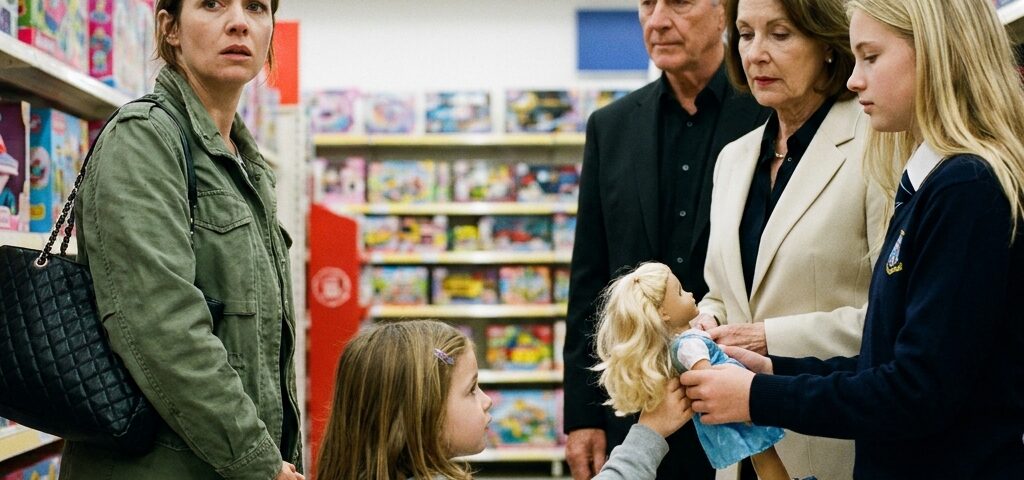
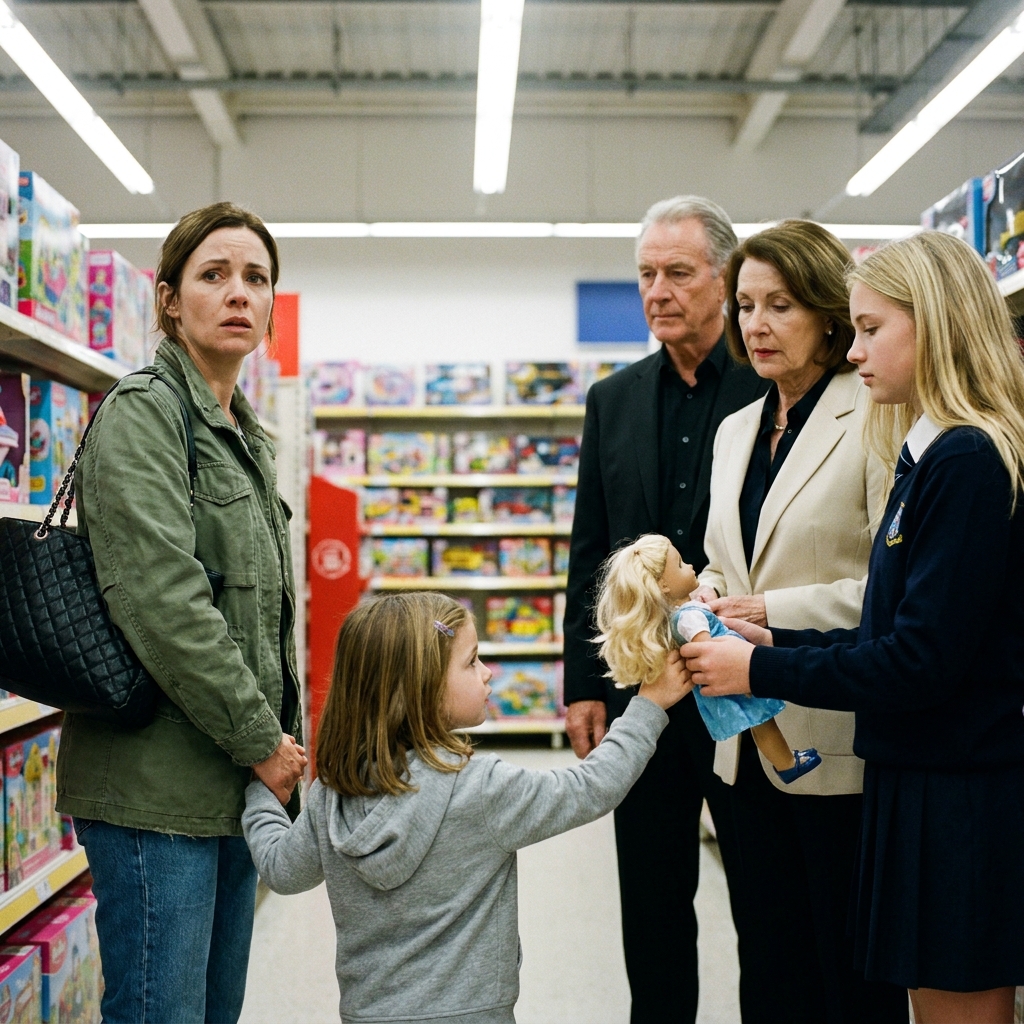
“Did my doll go to Piper’s house?”
Gabriela’s throat tightened. “Probably.”
Willow nodded solemnly.
Then she said, “I hope she brushes her hair.”
Gabriela stopped walking.
Willow looked up, confused.
And Gabriela knelt right there on the sidewalk and hugged her daughter so tightly the backpack squeaked between them.
That evening, they ate tomato soup and toast at the wobbly kitchen table. Gabriela had just convinced Willow to take three more bites when someone knocked on the door.
Not a friendly knock.
Three hard strikes.
Gabriela froze.
Willow’s spoon hovered over her bowl.
Another knock came.
Then Vanessa’s voice.
“Open this door, Gabriela.”
Willow’s face went pale.
Gabriela stood slowly. “Go to your room, baby.”
“But—”
“Now.”
Willow slipped off the chair and hurried down the hall.
Gabriela walked to the door but did not open it.
“What do you want?” she asked.
“Do not speak to me through a door like I’m a stranger.”
Gabriela’s laugh came out flat. “You stole from me. You became a stranger yesterday.”
A pause.
Then Ronald’s voice, low and dangerous. “Open the door.”
Gabriela’s hand tightened around her phone. “I filed a police report.”
“You stupid girl,” Vanessa hissed. “Do you have any idea what you’ve done?”
“Yes.”
“You think police care about your little complaint?” Janice said from behind them. “You’re making yourself look unstable.”
Gabriela’s blood went cold.
There it was.
Not anger.
A plan.
She stepped silently to the peephole.
Vanessa stood closest to the door, her lipstick perfect, her face twisted with outrage. Ronald loomed behind her in a dark coat. Janice stood at his side, holding a folder against her chest.
A folder.
Gabriela’s stomach dropped.
“What’s in the folder?” she asked.
The three of them went still.
Vanessa recovered first. “Family business.”
“I’m not part of your family business anymore.”
Ronald stepped closer. “You don’t get to decide that.”
Gabriela pressed record on her phone.
“I’m recording this,” she said clearly. “You need to leave.”
Janice laughed. “Good. Record it. Record how irrational you sound.”
Then Vanessa’s voice changed.
It became soft.
Almost kind.
That frightened Gabriela more than the yelling.
“Gabby,” her mother said. “You’re tired. You’re overwhelmed. No one blames you. Being a single mother is hard. Maybe too hard.”
Gabriela stopped breathing.
Ronald continued, “We spoke to someone today.”
Gabriela’s hand went numb around the phone.
Janice opened the folder and slid one paper partly beneath the door.
Gabriela did not touch it.
“We’re willing to help,” Vanessa said. “Temporarily.”
“Help with what?” Gabriela asked.
“With Willow,” Janice said.
The apartment seemed to tilt.
From the hallway, Gabriela heard the faint creak of Willow’s bedroom door.
“Go back inside,” Gabriela called, trying to keep her voice steady.
Willow did not answer.
Vanessa sighed. “You see? She’s scared of you.”
Gabriela’s eyes burned. “She’s scared of you.”
“That’s not what the court will hear,” Janice said.
Ronald’s voice lowered. “We have statements. Concerns. Financial instability. Emotional distress. Poor judgment. A fraud accusation against your own mother. A police report that makes you look vindictive.”
Gabriela stared at the paper under the door.
At the top, she could see the words:
Petition for Emergency Temporary Guardianship.
For a moment, she could not move.
The money had not been the worst thing.
The doll had not been the worst thing.
They had come back for Willow.
Vanessa tapped the door with one manicured fingernail. “Open the door and let us discuss this like adults.”
Gabriela backed away.
Then she called 911.
Vanessa must have heard the dispatcher answer because her voice sharpened instantly.
“Don’t you dare.”
“My parents and sister are at my apartment,” Gabriela said into the phone. “They are refusing to leave and they’re threatening to take my daughter.”
Ronald cursed.
Janice whispered, “Dad, stop.”
Vanessa slapped the door with her palm. “You ungrateful little brat!”
Willow began crying in the hallway.
Gabriela moved toward her daughter, keeping the phone to her ear.
“I’m here,” she whispered, pulling Willow into her arms.
“Mommy, are they taking me?”
“No.”
“But they said—”
“No,” Gabriela repeated, stronger now. “Nobody is taking you.”
Outside, Ronald’s voice boomed. “You can’t hide forever!”
Gabriela held Willow against her chest and felt something old inside her finally die.
The daughter who begged for approval.
The child who believed love had to be earned.
The woman who thought obedience might one day become safety.
All gone.
In their place stood Willow’s mother.
Police lights washed the windows blue and red ten minutes later.
Vanessa immediately began crying.
Gabriela heard it through the door.
“My daughter is unstable,” Vanessa sobbed. “We’re worried about the child.”
Officer Miller’s voice cut through the hallway. “Ma’am, step away from the door.”
“She has always been difficult,” Ronald said. “You don’t understand our family.”
“I understand you were told to leave,” Officer Miller replied.
Gabriela opened the door only when Officer Miller asked her to.
Willow hid behind her legs.
Vanessa’s eyes locked onto the little girl.
For one second, the mask slipped.
It was not love on her face.
It was possession.
Officer Miller took statements. Janice tried to present the guardianship papers as though they were official, but Officer Miller inspected them and frowned.
“This hasn’t been filed,” she said.
Janice flushed. “Not yet.”
“So you came here at night with unfiled paperwork to intimidate her?”
“We came to help,” Vanessa snapped.
Officer Miller looked at Gabriela. “Do you want them trespassed from the property?”
Gabriela felt every eye on her.
Her mother’s.
Her father’s.
Her sister’s.
Willow’s.
“Yes,” Gabriela said.
Vanessa gasped as though struck.
Ronald’s jaw clenched.
Janice’s face twisted. “You’ll regret this.”
Officer Miller turned to her. “That sounded like a threat.”
Janice shut her mouth.
They were escorted out of the building under the cold hallway lights, Vanessa weeping loudly enough for neighbors to peek through their doors.
But Gabriela did not feel triumph.
Only exhaustion.
After the police left, she bolted the door again and sat on the floor with Willow in her lap until her daughter’s sobs became hiccups.
“I’m not going with Grandma?” Willow whispered.
“No.”
“Promise?”
Gabriela kissed her hair. “Promise.”
Later, after Willow finally fell asleep, Gabriela picked up the paper Janice had shoved under the door.
She read it once.
Then again.
It listed her as emotionally unstable.
Financially negligent.
Unfit.
It claimed Willow lacked proper care.
It claimed Vanessa and Ronald had provided “consistent support” since birth.
Gabriela laughed once, a sharp, ugly sound.
They had given her nothing but shame.
At the bottom, beside Janice’s neat handwriting, was a sticky note.
Gabriela almost missed it.
Call Mr. Harlan first thing. The child must be secured before probate hearing.
Probate.
Gabriela stared at the word.
Why would a guardianship petition have anything to do with probate?
Her hands began moving before her mind caught up. She searched the name “Mr. Harlan” on her phone. Three results appeared nearby. One of them was an estate attorney.
Arthur Harlan.
Her chest tightened.
The name was familiar.
Years ago, when Gabriela was little, there had been an older woman who visited at Christmas with silver hair and a laugh like wind chimes. Aunt Elise. Ronald’s older sister. She had stopped coming after a terrible fight with Vanessa, and Gabriela had been told never to ask about her again.
Gabriela searched Elise Alvarez obituary.
There it was.
Elise Marisol Alvarez, age seventy-six, passed away three weeks ago.
Three weeks.
Before the supermarket.
Before the stolen money.
Before the guardianship petition.
The obituary said Elise had no children.
Gabriela’s pulse thudded in her ears.
She searched deeper, clicking through old local notices until she found a probate calendar listing.
Estate of Elise Marisol Alvarez.
Hearing scheduled Monday, July 22.
Gabriela looked again at the sticky note.
The child must be secured before probate hearing.
Her mouth went dry.
She barely slept that night.
The next morning, she called every legal aid number she could find. Most went to voicemail. One receptionist said the earliest appointment was in three weeks.
Gabriela almost hung up.
Then the woman asked, “Is there a child involved?”
“Yes.”
“Are relatives trying to take custody?”
“Yes.”
A pause.
“Can you come in today at two?”
Gabriela closed her eyes. “Yes.”
At the legal aid office, an attorney named Mara Singh listened while Gabriela laid out the papers, screenshots, police report number, and bank fraud complaint across the desk.
Mara read silently.
Her expression grew more severe with each page.
Finally, she picked up the sticky note.
“Do you know what this means?” Mara asked.
“No.”
Mara leaned back. “It means this may not be about concern for Willow at all.”
Gabriela folded her hands tightly in her lap.
Mara turned to her computer. “Let me check the probate docket.”
The office was so quiet Gabriela could hear the clicking of the keyboard.
Then Mara stopped.
“Oh,” she said softly.
Gabriela’s stomach sank. “What?”
Mara looked at her. “Elise Alvarez left a will.”
“And?”
“The public summary says there is a trust.”
Gabriela’s heartbeat turned slow and heavy.
Mara continued, “The trust beneficiary is listed as ‘my niece Gabriela Alvarez and her living child, Willow Alvarez, for the purpose of housing, education, and protection from family interference.’”
Gabriela stared at her.
The words did not make sense at first.
Housing.
Education.
Protection.
From family interference.
Mara’s voice softened. “Your aunt knew something.”
Gabriela covered her mouth.
A memory returned then, sudden and bright.
She was seven years old, hiding behind a couch while Vanessa screamed in the kitchen. Aunt Elise had found her, knelt down, and tucked a butterscotch candy into her palm.
“One day,” Elise had whispered, “you’ll leave this house. And when you do, don’t look back just because they call your name.”
Gabriela had forgotten.
Or maybe she had buried it.
Mara printed several documents and slid them into a folder.
“Listen carefully,” she said. “Your family may be trying to establish control over Willow to access or influence the trust. If they can argue you’re unfit and they become guardians, they may gain leverage.”
Gabriela felt sick. “They called her a mistake.”
Mara’s jaw tightened. “Then tried to profit from her existence.”
For the first time since the supermarket, Gabriela cried in front of another adult.
Not loudly.
Just silent tears slipping down her face while Mara pushed a box of tissues across the desk.
“We’re filing an emergency protective response,” Mara said. “And I want you to request a copy of Willow’s birth certificate and Social Security records. Make sure nothing has been altered or requested.”
Gabriela looked up. “Altered?”
“I’ve seen uglier things than this.”
By the time Gabriela returned home with Willow, the afternoon sky had turned the color of wet cement.
There was an envelope taped to her apartment door.
No stamp.
No return address.
Her name written in Vanessa’s handwriting.
Gabriela’s first instinct was to tear it in half.
Instead, she put on gloves, photographed it, and opened it carefully.
Inside was the blue-dressed doll.
Its hair had been cut jaggedly short.
Its porcelain face was cracked from forehead to chin.
Across the doll’s blue skirt, someone had written in black marker:
Mistakes don’t get fairy tales.
Willow saw it before Gabriela could hide it.
The little girl made no sound.
She simply stepped backward until her shoulder hit the wall.
Gabriela’s vision went white.
She did not scream.
She photographed the doll.
She bagged it.
She sent the images to Officer Miller and Mara Singh.
Then she ordered pizza with the last cash in her wallet and sat on the living room floor with Willow watching cartoons neither of them laughed at.
That night, after Willow fell asleep beside her on the couch, Gabriela heard a sound at the door.
Not knocking.
Scratching.
Metal against metal.
Her entire body went rigid.
Someone was trying to pick the lock.
Gabriela reached for her phone with one hand and gently covered Willow’s mouth with the other before the child could wake fully and cry out.
The lock clicked once.
Then stopped.
A whisper came from the hallway.
“Hurry up.”
Janice.
Gabriela’s blood turned to ice.
Another voice answered, male and unfamiliar. “I’m trying.”
Gabriela called 911 and whispered her address.
The dispatcher told her to stay on the line.
The lock clicked again.
The chair beneath the knob scraped as pressure pushed against the door.
Willow’s eyes opened wide in terror.
Gabriela lifted a finger to her lips.
The chain snapped tight as the door opened an inch.
A man’s hand reached through.
Gabriela grabbed the heaviest thing near her—the cast-iron skillet Denise had given her when Willow was born—and slammed it against the door with all her strength.
The hand vanished with a cry.
Gabriela shoved the door closed, locked it again, and dragged Willow toward the bathroom, the only room with no window large enough for a person.
They sat in the bathtub, Willow shaking against her, while sirens rose in the distance.
By the time police arrived, the hallway was empty.
But not completely.
On the floor outside Gabriela’s door lay a dropped manila envelope.
Officer Miller opened it with gloved hands.
Inside were blank school withdrawal forms, a copy request for Willow’s birth certificate, and a typed letter authorizing Vanessa Alvarez to collect Willow from school.
At the bottom of the letter was Gabriela’s signature.
Except Gabriela had never signed it.
Officer Miller looked at the forged name.
Then at Gabriela.
“This changes things,” she said.
Across town, two hours later, Janice sat in her car behind a closed pharmacy and listened to her voicemail with trembling hands.
Her mother had called seven times.
Her father had called four.
But the message that made her face go pale was from Arthur Harlan’s office.
“Ms. Janice Alvarez, this is regarding your inquiry into the Elise Alvarez estate. Be advised that the trustee has reviewed the family contact history and will not recognize any guardianship claim not approved by the court. Also, per Ms. Elise Alvarez’s sealed instruction, any attempt to remove the child from her mother may trigger immediate disclosure of the supplemental evidence.”
Janice replayed the final words.
Supplemental evidence.
Her hand tightened around the phone.
In the rearview mirror, she saw Piper asleep in the back seat, still clutching the stolen blue doll’s matching ribbon.
Janice turned sharply.
“Where did you get that?” she whispered.
Piper stirred. “Grandma gave it to me.”
Janice reached back and snatched the ribbon.
Something small and silver fell from the fabric onto the car floor.
A flash drive.
Janice stared at it.
Then her phone buzzed again.
A new message.
Unknown number.
Only one sentence.
Elise kept copies of everything.
Janice stopped breathing.
Back in the apartment, Gabriela sat under a blanket with Willow sleeping against her side while Officer Miller stood by the window, speaking quietly into her radio.
The doll, the forged forms, the attempted break-in, the trust—everything was now part of something larger and darker than family cruelty.
Mara Singh arrived just before midnight, her coat thrown over pajamas, her hair tied in a hurried knot.
“I got your message,” she said, stepping inside. “Where’s the envelope?”
Officer Miller handed it to her.
Mara reviewed the documents and went very still.
“What is it?” Gabriela asked.
Mara lifted the forged authorization letter.
“This notary stamp,” she said. “It belongs to Arthur Harlan’s office.”
Gabriela frowned. “The estate attorney?”
“Yes.”
“But why would his office notarize a fake letter?”
Mara did not answer immediately.
Then she looked toward the sleeping child.
“I don’t think your family is working alone.”
Gabriela felt the room shrink around her.
Before she could speak, her phone buzzed.
An unknown number.
For one wild second, she thought it would be Vanessa. Or Janice. Or Ronald.
But the message contained only a photo.
It was old and faded.
Aunt Elise stood in a hospital room, younger than Gabriela remembered, holding a newborn baby wrapped in a pink blanket.
On the back of the photo, someone had written:
Gabriela, one day they will lie about where you came from. When they do, find the blue doll.
Gabriela stared at the screen.
Her breath left her body.
Because the baby in the photo was not Willow.
It was her.
And in Aunt Elise’s arms, tucked beside baby Gabriela, was the same blue-dressed doll her mother had stolen, broken, and returned.
Mara read the message over her shoulder.
“Gabriela,” she whispered, “who sent this?”
Another message arrived before Gabriela could answer.
The blue doll was never a toy. It was proof.
From the hallway outside, the elevator doors opened.
Heavy footsteps approached.
Officer Miller turned toward the door.
Gabriela pulled Willow closer.
Then a voice came from the other side, calm and unfamiliar.
“Gabriela Alvarez? My name is Thomas Reed. I was your aunt’s private investigator. Please open the door. Before your parents destroy the last thing Elise left behind.”
Gabriela looked at Mara.
Mara looked at Officer Miller.
And in that breathless silence, Willow woke, pointed toward the bagged, broken doll on the table, and whispered five words that made every adult in the room turn cold.
“Mommy… there’s something inside her.”