PART 2: They Excluded My Daughter From a School Trip—Then the Janitor Revealed She Wasn’t the First
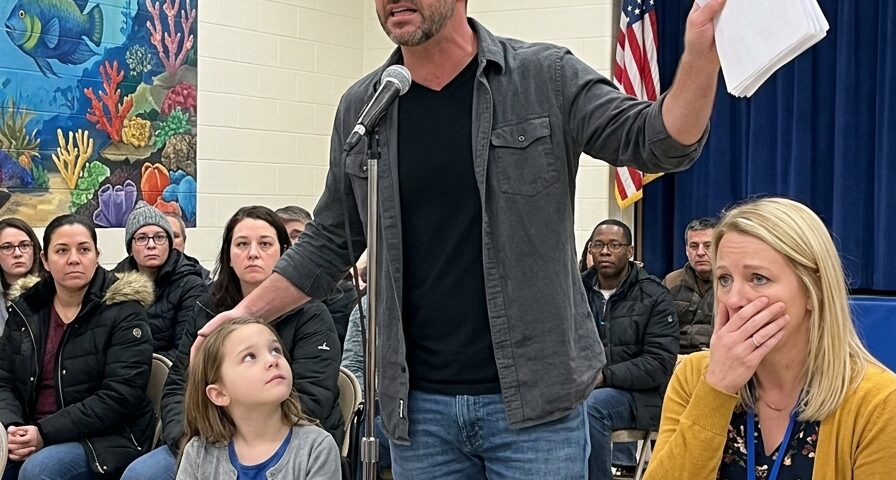
“Lily Hayes isn’t the first child we’ve pushed out.”
For one long second, the sentence hung in the auditorium like smoke after a fire.
Nobody moved.
Nobody even breathed.
Then the room erupted.
Parents stood all at once, chairs scraping against the floor, voices rising over one another in shock and anger. Someone shouted, “What does that mean?” Another yelled, “Whose children?” A woman near the front began crying before she even knew why.
On the stage, Principal Decker looked as if someone had pulled the bones out of him. Mrs. Calloway’s face had gone pale except for two bright spots of red burning high on her cheeks.
The superintendent—Dr. Evelyn Marsh, according to the name tag clipped to her jacket—walked toward Mr. Alden with slow, careful steps.
“Mr. Alden,” she said, “give me the tablet.”
The janitor tightened his grip on it.
“No,” he said.
The auditorium went quiet again.
Dr. Marsh blinked. She was a tall woman with silver-streaked hair and the calm voice of someone used to being obeyed.
“I’m the superintendent of this district,” she said.
“And I’m the man who cleans up after all of you,” Mr. Alden replied. “Which means I know where you hide what you don’t want people to see.”
A murmur moved through the room.
I felt Lily press closer to my side. Her fingers were still curled around my sleeve, but they no longer trembled. She stared at Mr. Alden with wide eyes, as if the quiet old janitor who waved to her every morning had suddenly become a knight stepping out from behind a broom closet.
Mr. Alden raised the tablet again.
“There are names,” he said. “Dates. Meeting recordings. Notes about children whose parents were called ‘problematic.’ Children who needed aides. Children who used wheelchairs. Children with autism. Children who had anxiety attacks. Children who made the school look less perfect on paper.”
A mother in the third row covered her mouth.
Mr. Alden looked straight at her.
“Sophie Kim,” he said softly.
The woman broke down.
Beside her, a man stood so fast his chair tipped backward. “What did you say?”
“Sophie was moved out of the spring concert last year,” Mr. Alden said. “The official reason was that the noise bothered her. But in the meeting, they said she made the performance ‘unpredictable.’”
The man turned toward Principal Decker. “You told us Sophie chose not to perform.”
Principal Decker opened his mouth, but nothing came out.
Another parent stepped into the aisle. “Mateo Rivas,” Mr. Alden continued. “Told there wasn’t room in the after-school science club because his aide couldn’t stay late. But the files say his mother ‘asks too many questions.’”
A woman screamed his name like it had been torn from her.
Then came more.
Noah Pike.
Amelia Torres.
Devon Reed.
Children whose parents had been told gentle lies. Children who had been quietly moved out, left behind, redirected, discouraged, delayed until their families gave up.
Lily looked up at me.
“Daddy,” she whispered, “there are more kids?”
I swallowed hard.
“Yeah, baby.”
Her face crumpled—not because she was afraid, but because she understood. Not fully. Not like an adult. But enough.
Enough to know her hurt had not been an accident.
Enough to know it had been practiced.
Dr. Marsh stepped onto the stage and held both hands up.
“This meeting is over,” she announced. “The district will conduct a full internal investigation.”
“No!” Janelle Whitfield shouted from the front row. “Not internal.”
A chorus of agreement followed.
“State investigation!”
“Lawyers!”
“Call the news!”
“Show us the files!”
Dr. Marsh’s mouth tightened. “There are privacy issues involving minors—”
“My child’s privacy didn’t matter when you used her like a number,” Sophie’s mother snapped.
Mr. Alden turned to me.
“Mr. Hayes,” he said, “you need to get Lily out of here.”
I did not want to leave. Every nerve in my body was on fire. I wanted names. I wanted answers. I wanted to stand there until the entire building cracked open and spilled every secret onto the floor.
But Lily was small beside me.
Too small for that room.
Too small for adults shouting over her pain.
I crouched in front of her wheelchair. “You okay?”
She nodded, but her eyes were wet.
“I want to go home,” she said.
That was all it took.
I lifted her backpack from the handle of her chair and guided her down the ramp at the side of the stage. Parents parted for us. Some reached out, not touching Lily, just offering trembling nods. A few whispered apologies, though they had done nothing wrong.
At the exit, Mrs. Calloway stepped in front of us.
“Mr. Hayes,” she said, voice low, “you have no idea what you’re doing.”
I stopped.
For a moment, all I could hear was the faint squeak of Lily’s wheels beneath my hands.
Then I leaned closer.
“You’re right,” I said. “I don’t. But I know exactly what you did.”
Her eyes flicked to Lily.
Lily looked back at her.
Not afraid.
Not ashamed.
Just looking.
Mrs. Calloway stepped aside.
Outside, the evening air hit us cold and clean. The sky had gone purple over the school roof. For a few seconds, the building behind us still roared with voices, muffled by glass and brick.
Then Lily whispered, “Did I do something bad?”
I knelt in front of her so fast my knees struck the pavement.
“No,” I said. “No, Lily. You hear me? You did nothing bad.”
“But they didn’t want me.”
Her words were quiet.
That made them worse.
I took her hands in mine.
“They were wrong,” I said. “Not because they didn’t want you. Because they thought they had the right to decide where you belonged.”
She thought about that.
“Do I belong with the sharks?”
A laugh broke out of me, cracked and wet.
“Yeah,” I said. “You belong with the sharks.”
She nodded seriously.
“Then we still have to go.”
And somehow, in the middle of all that anger, my daughter reminded me what the fight was really about.
Not punishment.
Not revenge.
A seat on the bus.
A place in the room.
A child seeing sharks with her class.
The next morning, reporters were outside Brookside Elementary before the first bell rang.
I found out because my phone began vibrating at 5:42 a.m. and did not stop.
Unknown numbers.
Local news.
Parents.
A woman from the state disability rights office.
An attorney whose message began with, “Mr. Hayes, I saw the video.”
I had not posted the video. I had not even known someone was recording.
But someone had.
By sunrise, the clip of Lily leaning toward the microphone and saying, “I just wanted to see the sharks with my class,” had spread across town. By noon, it had crossed county lines. By dinner, people who had never heard of Brookside Elementary were saying my daughter’s name like they knew her.
Lily did not understand any of it.
She sat at the kitchen table eating cereal from her favorite blue bowl, wearing her shark pajamas, while my phone lit up beside the coffee maker.
“Am I famous?” she asked.
“No,” I said carefully. “People just heard what happened.”
She considered this.
“Do famous people still have to eat peas?”
“Yes.”
“Then I don’t want it.”
I laughed for the first time in two days.
At 8:15, an email arrived from the district.
Principal Decker had been placed on administrative leave.
Mrs. Calloway too.
The school promised “a thorough review of inclusion practices.”
It was exactly the kind of sentence that sounded important until you realized it meant nothing.
At 9:03, Dr. Marsh called.
I almost didn’t answer.
“Mr. Hayes,” she said, her voice polished smooth. “I want to begin by saying how deeply sorry I am for what Lily experienced.”
“What she experienced,” I said, “was discrimination.”
A pause.
“Yes,” she replied. “And if discrimination occurred—”
“If?”
Another pause.
“Mr. Hayes, I understand your anger.”
“No,” I said. “You understand liability.”
This time, she said nothing.
I looked across the kitchen at Lily, who was making her spoon swim through milk like a submarine.
“I want every record,” I said. “Every email. Every meeting note. Every child affected.”
“That may not be legally possible.”
“Then I’ll find someone who can make it legally possible.”
Her voice lowered. “You should be careful. Public attention can be difficult for a child.”
I turned away from Lily.
“Was that concern,” I asked, “or a threat?”
“I’m trying to protect your daughter.”
“You had the chance to protect my daughter yesterday.”
I hung up.
Ten minutes later, Mr. Alden called from a blocked number.
“Can you meet me tonight?” he asked.
“Where?”
“The laundromat on Pierce Street. Eight o’clock. Don’t bring Lily.”
The line went dead.
I stared at the phone for a long time.
Then I looked toward the living room, where Lily had wheeled herself close to the television and was watching a documentary about ocean predators.
A great white shark cut through blue water, silent and unstoppable.
That night, Janelle came over to stay with Lily.
She arrived with a casserole, a folder, and the expression of a woman who had already decided she was at war.
“I made calls,” she said.
“Of course you did.”
“My cousin works at Channel Six. My sister’s neighbor is a civil rights attorney. And the mother of a boy named Mateo Rivas wants to talk to you.”
I blinked.
“You did all that since yesterday?”
She shrugged. “I’m a PTA mom. We organize bake sales in hurricanes.”
I almost smiled.
Before I left, Lily caught my wrist.
“Are you going to fix it more?”
“I’m going to try.”
“Will Mr. Alden help?”
“I think so.”
She nodded.
“He always saves the purple markers for me.”
That nearly broke me.
The laundromat on Pierce Street was empty except for Mr. Alden and one dryer thumping unevenly in the back.
He sat under fluorescent lights, wearing the same gray jacket he wore when he emptied trash cans at Brookside. A brown envelope lay on the plastic table in front of him.
“You were followed?” he asked.
I glanced toward the dark windows.
“I don’t think so.”
“You wouldn’t.”
He pushed the envelope toward me.
Inside was a flash drive, a stack of printed pages, and a photograph.
The photograph showed Mr. Alden standing beside a boy in a red baseball cap. The boy had one arm around his waist and one hand gripping a set of crutches.
“My grandson,” Mr. Alden said. “Elliot.”
I looked up.
“He went to Brookside?”
“For two years.”
“What happened?”
Mr. Alden’s face changed. It did not collapse. It closed.
“They made him feel like every doorway was doing him a favor by opening,” he said. “Little things at first. Forgotten accommodations. Missing chair. A field day event he couldn’t participate in. Then bigger things. They told my daughter another school might be a better fit.”
“Was it?”
“No.”
The dryer thumped again.
“He stopped wanting to go anywhere,” Mr. Alden continued. “Not just school. Anywhere. Said people got tired when he needed help.”
I looked down at the photograph.
“What happened to him?”
“He’s alive,” Mr. Alden said, and his voice made it clear life had not meant safety. “But he isn’t the same boy.”
I gripped the envelope.
“Why didn’t you come forward before?”
“I tried. Quietly. Sent emails. Called the board. Reported missing records. Every time, it disappeared.” He tapped the flash drive. “So I learned how they disappeared things.”
“You hacked them?”
“I cleaned the IT closet for twelve years,” he said. “People write passwords on sticky notes when they think janitors don’t read.”
Despite everything, I let out a breath that almost became a laugh.
Then he leaned forward.
“This is bigger than Decker.”
I went still.
Mr. Alden pulled out one printed page and slid it across the table.
At the top was a district letterhead.
Below it was a title: STUDENT RESOURCE OPTIMIZATION PLAN.
My eyes moved down the page.
There were categories.
High support.
Parent escalation risk.
Program burden.
Alternative placement recommendation.
At the bottom, one line had been highlighted.
“Schools are encouraged to reduce participation in non-mandated enrichment activities for students requiring disproportionate logistical support.”
I read it twice.
Then a third time.
“Who wrote this?”
Mr. Alden did not answer.
He didn’t have to.
At the bottom was a signature.
Dr. Evelyn Marsh.
The room seemed to tilt.
“She knew,” I said.
“She didn’t just know,” Mr. Alden replied. “She taught them how.”
The next few days passed like a storm that had learned my address.
Parents began contacting me one by one.
Some came angry.
Some came embarrassed.
Most came with stories they had buried because they thought they were alone.
Mateo’s mother told me her son had been removed from science club after asking for written instructions instead of verbal ones. Sophie’s parents told me their daughter had spent six months believing she had ruined the spring concert by being “too much work.” Noah Pike’s father sent a photo of his son sitting alone during field day while other children ran past him in matching T-shirts.
Every story had a different shape.
Every story had the same center.
A child had been made smaller so adults could avoid discomfort.
Janelle turned my dining room into a command center. She brought sticky notes, poster boards, colored folders, and a level of rage so efficient it frightened me.
“We need a timeline,” she said.
“I need coffee.”
“We need both.”
Lily loved having Janelle there because Janelle let her put stickers on the folders.
“Pink means bad people?” Lily asked.
“Pink means evidence,” Janelle said.
“What color means sharks?”
“Blue.”
By Friday, there were many blue stickers and too many pink ones.
The district announced an emergency board meeting for Monday night.
Public comment allowed.
Three minutes per speaker.
Janelle said, “Three minutes is plenty of time to start a fire.”
But before Monday came, the fire came to us.
On Saturday morning, I found a white envelope taped to my front door.
No stamp.
No return address.
Inside was a single sheet of paper.
A copy of Lily’s medical file.
Across the top, someone had written in black marker:
DO YOU REALLY WANT EVERYONE LOOKING AT HER?
For a moment, my vision blurred red.
Not fear.
Something older.
Something closer to the animal part of a parent’s heart.
Janelle read it and went completely silent.
That frightened me more than if she had screamed.
“They’re using private records now,” she said.
I called the police.
The officer who came was polite but careful. He took the envelope, asked if I had cameras, and said it could be difficult to prove who left it.
Lily watched from the hallway.
“What is it?” she asked.
“Nothing you need to worry about,” I said.
She narrowed her eyes.
“I’m seven, not a lamp.”
Janelle coughed to hide a laugh.
I knelt in front of Lily.
“Someone tried to scare me.”
“Did it work?”
I looked at the paper in the officer’s evidence bag.
Then at my daughter.
“No.”
Lily nodded.
“Good. Sharks don’t get scared of paper.”
On Monday night, the district building overflowed.
People stood along walls, filled hallways, and crowded outside under the yellow glow of security lights. News vans lined the curb. Parents held folders. Children held hands. Someone had made signs that read LET THEM BELONG.
I had not asked anyone to do that.
Somehow, that made it harder to look at.
Lily insisted on coming.
At first, I refused.
Then she said, “It’s my school too.”
There was no answer to that.
So she came wearing her blue cardigan and shark hair clips, her chin lifted like she was attending court.
Dr. Marsh sat at the center of the board table.
Principal Decker’s chair was empty.
Mrs. Calloway was not there.
The meeting began with the board president reading a statement about community trust, student dignity, and due process. He sounded like a man trying to wrap smoke in ribbon.
Then public comment began.
Sophie’s mother spoke first.
Her voice shook, but she did not stop.
“My daughter thought she was the problem,” she said. “She cried every Friday for a year because someone in this district decided it was easier to exclude her than support her.”
Mateo’s mother spoke next.
Then Noah’s father.
Then a grandmother raising twin boys with autism.
Then Mr. Alden.
When his name was called, the room went still.
He walked to the microphone with a folder under one arm. His steps were slow. Not weak. Deliberate.
“My job,” he said, “was to clean classrooms after children left. I wiped down desks. Picked up crayons. Emptied trash. Sometimes I found notes children wrote and threw away.”
He opened the folder.
“This one was written by my grandson, Elliot, when he was eight.”
He unfolded a small piece of lined paper.
His hands trembled only once.
“It says, ‘I wish I was easy.’”
No one spoke.
Not even the board.
Mr. Alden folded the paper again.
“I am here tonight because too many children in this district have been taught to wish that.”
He placed the district memo on the projector.
STUDENT RESOURCE OPTIMIZATION PLAN.
A sound moved through the room.
Dr. Marsh sat very still.
Mr. Alden pointed to her signature.
“This did not begin with one principal. It did not begin with one teacher. It began with leadership that turned children into expenses and called it efficiency.”
The board president leaned toward his microphone.
“Mr. Alden, your time has expired.”
The room exploded.
“Let him speak!”
“Shame!”
“Three minutes for a child’s life?”
Mr. Alden calmly closed his folder.
“That’s all right,” he said. “The state investigator has the rest.”
For the first time that night, Dr. Marsh’s face changed.
Just barely.
But I saw it.
So did Janelle.
She leaned close to me and whispered, “Got her.”
Then my name was called.
I had written a speech.
Three pages.
Careful sentences.
Facts in order.
But when I reached the microphone and looked back at Lily, the paper felt useless in my hand.
So I folded it.
“My daughter wanted to see sharks,” I said.
A few people laughed softly through tears.
“She didn’t ask for special treatment. She didn’t ask for the world to bend. She asked to sit beside her classmates on a bus and go where they went.”
I turned toward the board.
“You made that sound impossible. But what was impossible was never the bus. It was your willingness.”
Dr. Marsh looked down.
I kept going.
“You told us this was about logistics. But your own records show it was about reputation. Scores. Budgets. Convenience. You created a system where children who needed support became children to be managed out of sight.”
I felt my voice tighten.
“And then, when they were hurt, you let them believe it was their fault.”
Behind me, someone began crying.
I did not turn.
“I don’t want an apology written by your lawyer,” I said. “I want every family notified. I want every record released to the proper authorities. I want every policy changed in public, not behind closed doors. And I want my daughter’s class trip rescheduled with every child included.”
For a moment, no one moved.
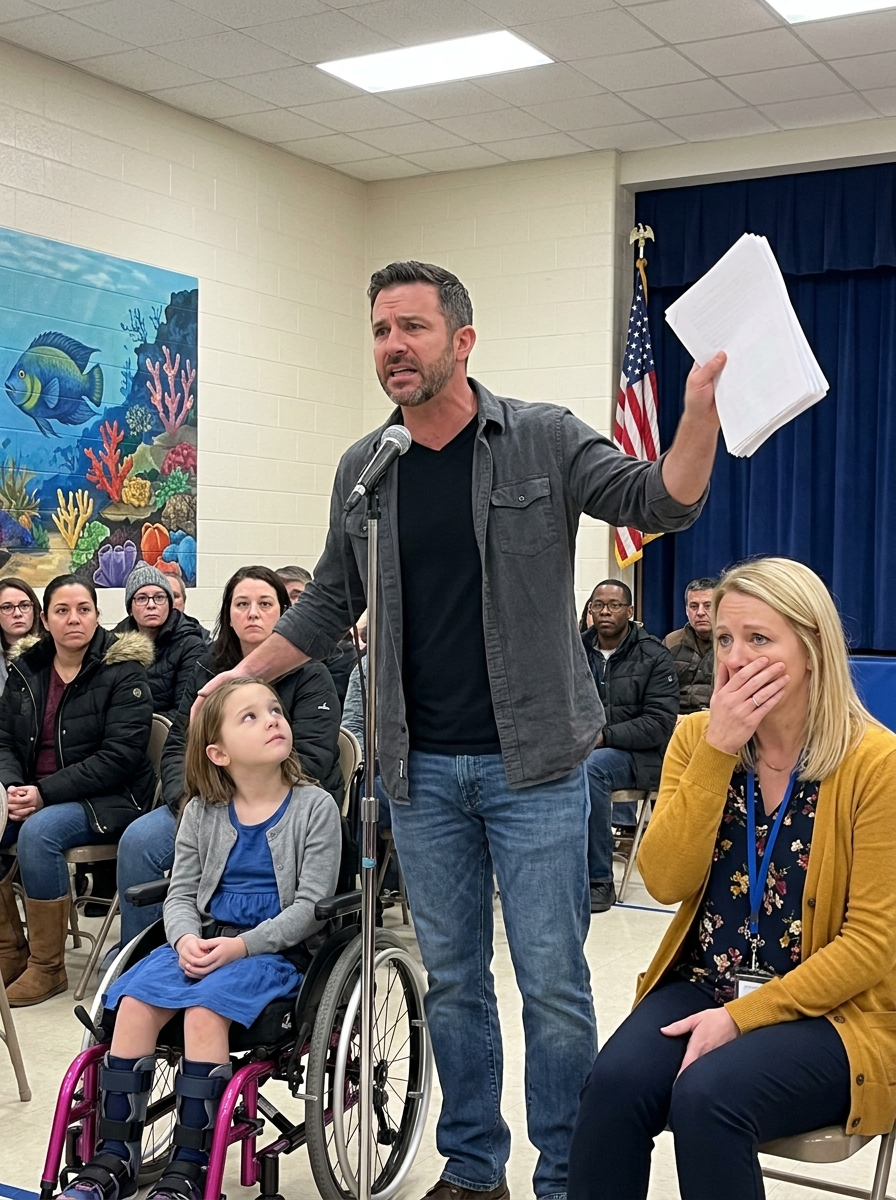
Then Lily raised her hand.
The board president looked startled.
“Does the child wish to speak?”
I turned.
“Lily?”
She nodded.
I pushed her chair to the microphone.
She pulled it down with both hands.
“My name is Lily Hayes,” she said.
The entire room leaned toward her.
“I don’t want people to be fired because they hate me.”
Dr. Marsh looked up quickly.
Lily continued, “I want them to stop pretending they don’t.”
The room broke open.
Not with noise at first.
With silence.
The kind of silence that admits a child has said what adults were too cowardly to name.
Then applause rose, not sharp and cheerful, but heavy. Grateful. Grieving.
Lily looked back at me.
“Was that okay?”
I wiped my eyes before she could see.
“Yeah, baby,” I said. “That was perfect.”
By midnight, the board voted to place Dr. Marsh on leave pending an outside investigation.
The crowd cheered, but I did not.
Something about it felt too easy.
Dr. Marsh gathered her papers without speaking. As she passed me, she paused.
“You think you’ve won,” she said quietly.
I looked at her.
“I think you’re scared.”
She smiled then.
Not warmly.
Not nervously.
Almost sadly.
“Mr. Hayes,” she whispered, “I’m not the one who started this.”
Then she walked away.
I told myself she was bluffing.
People like her always wanted you to believe there was a bigger monster behind them. It made them feel smaller. Less responsible.
But that night, after Lily fell asleep with her shark plush tucked under her arm, I sat alone in the kitchen and plugged Mr. Alden’s flash drive into my laptop.
Folders opened across the screen.
Brookside.
Hillcrest.
Maple Ridge.
Westford Middle.
District Office.
My stomach tightened.
There were more schools.
More names.
More meetings.
I opened the district office folder.
Most files were ordinary—budgets, staff memos, transportation charts.
Then I found one labeled ARCHIVE.
Inside was another folder.
LOCKED PLACEMENT REVIEW.
I clicked it.
A password box appeared.
I tried the obvious ones first.
Brookside.
Marsh.
Inclusion.
Nothing.
Then I remembered what Lily had said about Mr. Alden saving purple markers.
Purple.
The folder opened.
I froze.
There were scanned documents going back nearly twenty years.
Long before Dr. Marsh.
Long before Principal Decker.
Before Lily was born.
Before I had even moved to town.
The first file was a photograph of a woman standing outside Brookside Elementary, holding a sign.
Every nerve in my body went cold.
I knew that face.
Not from the news.
Not from school.
From the framed picture on Lily’s nightstand.
My wife.
Emma.
I stopped breathing.
The file name read:
HAYES, EMMA — PARENT DISRUPTION INCIDENT — 2009.
My hands shook so badly I almost knocked the laptop off the table.
Emma had died when Lily was three. A sudden aneurysm, the doctors said. One minute making pancakes, the next on the kitchen floor while Lily screamed and I called 911.
She had never told me she protested outside Brookside.
She had never told me she had a file.
I opened it.
A scanned incident report appeared.
Subject: Emma Hayes.
Concern: Repeated interference with administrative placement recommendations.
Child involved: Not applicable.
I read that line again.
Not applicable.
Emma had not even had a child in the school then.
So why was she there?
I scrolled down.
Attached witness statement.
Attached photographs.
Attached correspondence.
Then one email stopped me cold.
From: E. Hayes
To: District Board
Subject: You are building a machine that will erase children
My wife had written those words.
My Emma.
The woman who danced barefoot in the kitchen. The woman who sang off-key to Lily in the bathtub. The woman who used to squeeze my hand whenever she saw a child sitting alone.
I opened the email.
The first line read:
If anything happens to me, ask why the district keeps a private list of children they call “unplaceable.”
A sound escaped me.
Not a word.
Not a cry.
Something between the two.
Behind me, the floor creaked.
I turned so fast my chair toppled.
Lily stood in the doorway in her pajamas, rubbing one eye.
“Daddy?” she whispered. “Why is Mommy on your computer?”
I couldn’t answer.
Because at that exact moment, a new message appeared on the screen.
No sender.
No subject.
Just one sentence.
EMMA FOUND THE FIRST LIST. LILY IS ON THE SECOND.
THE END OF PART 2