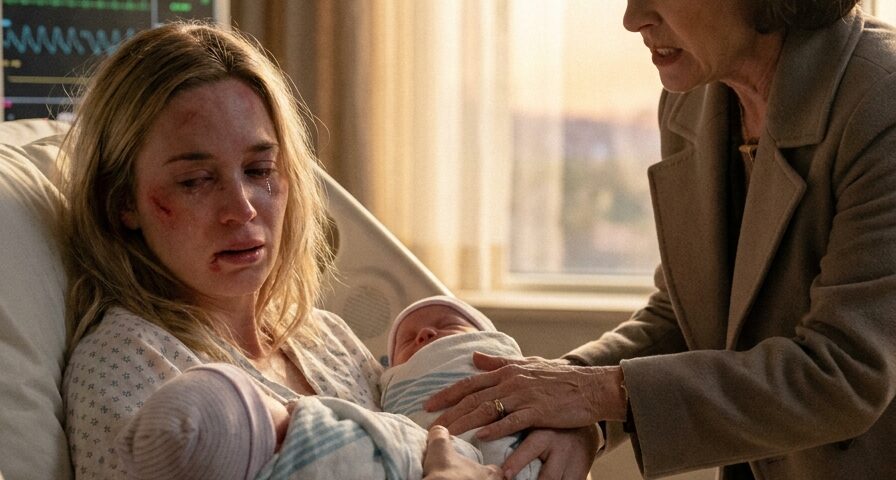
PART 2: I Thought My Son Was Safe Until Five Words Changed Everything
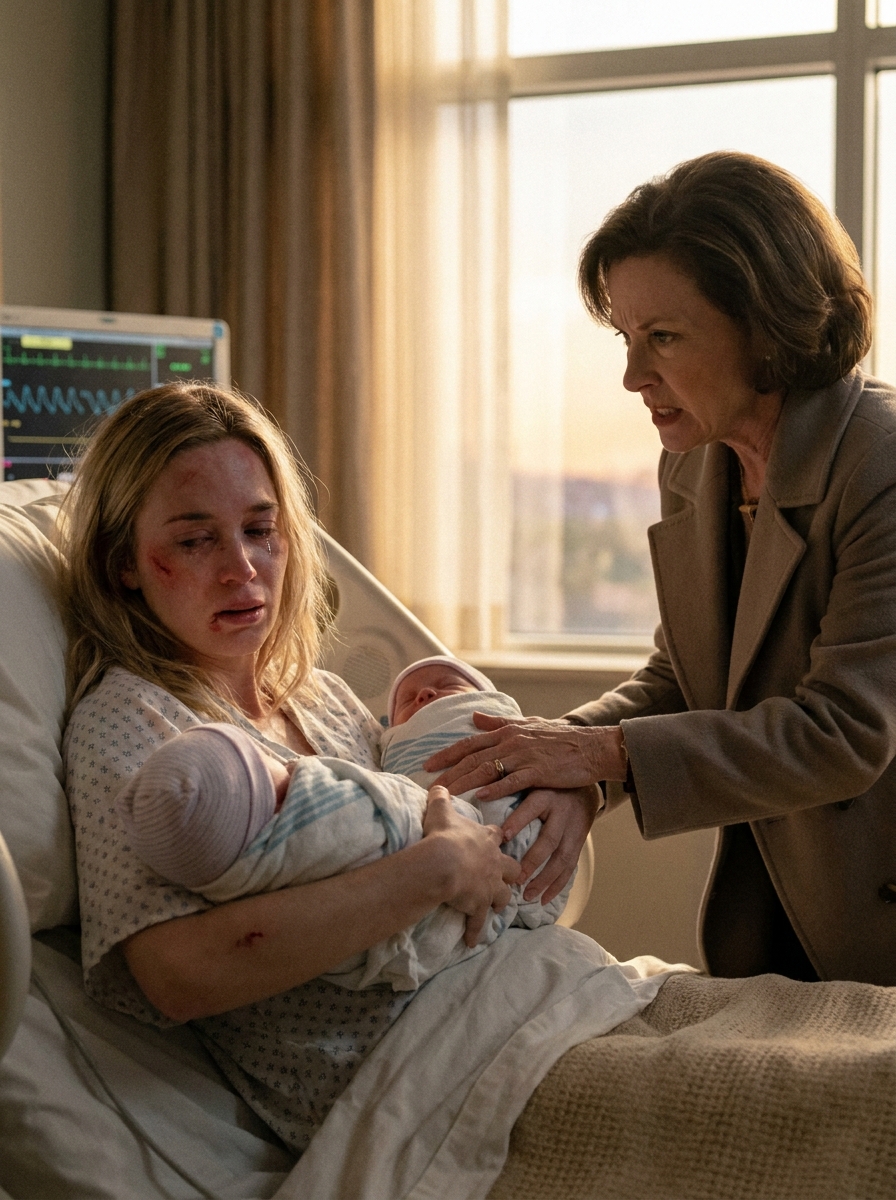
Lily Whitfield did not run.
That was the first thing I noticed.
A guilty person would have turned away from the glass wall, would have hidden the bracelet, folded the birth certificate form, pretended she had wandered into the wrong corridor. Lily did none of that. She stood there in her pale blue coat, her glossy hair tucked behind one ear, holding the proof of her betrayal as calmly as if she had arrived to deliver flowers.
My hospital bracelet dangled from her fingers.
The form in her other hand caught the cold fluorescent light.
On the father’s signature line, Ethan’s name had already been written.
The room became too quiet.
Even Ava stopped fussing against my chest. My newborn daughter’s warm cheek rested over my heartbeat, and for one terrifying second, I imagined that the entire hospital could hear it.
Ethan moved first.
“Lily,” he said, voice barely there.
His sister looked at him through the glass. Her eyes were red, but not from surprise. She had been crying before she arrived. Or before she was caught.
Daniel Mercer’s face hardened. Chief Mike placed one hand on his radio.
Mrs. Whitfield, who only moments ago had been shrieking like an insulted queen, suddenly became still. That stillness frightened me more than her rage. She looked at Lily not with shock, but with warning.
“Don’t say a word,” she commanded.
Lily’s chin trembled.
The glass door opened.
An officer stepped into the hallway and took the bracelet from her hand. Another officer removed the birth certificate form. Lily allowed it. Her gaze never left mine.
“I wasn’t going to take her,” she whispered.
Her voice cracked on the last word.
Mrs. Whitfield lunged forward. “Be quiet.”
Chief Mike blocked her. “You don’t give orders here.”
Lily took one shaky breath and looked at Ethan.
“Mom said Caroline agreed.”
Something inside me went numb.
Ethan turned slowly toward his mother. His mouth opened, closed, opened again. No sound came out.
Mrs. Whitfield lifted her chin. “I said what needed to be said.”
“You told me she didn’t want both babies,” Lily said, tears spilling now. “You told me she was overwhelmed. You told me the doctors were worried about her judgment.”
I almost laughed.
Not because it was funny, but because grief sometimes wears the wrong mask.
I had carried my twins for thirty-seven weeks while Mrs. Whitfield sent articles about weak women, unstable mothers, and babies needing “proper families.” I had endured her sudden interest in my appointments, her visits with casseroles I never trusted, her comments about Lily’s empty nursery.
And now she had built an entire lie around my exhaustion.
“A doctor told you that?” Daniel asked.
Lily swallowed. “No. Mom did.”
Daniel’s jaw tightened.
“Lily,” I said.
My voice sounded strange, scraped raw.
She looked at me then, and I saw the truth in her face. She had wanted my child. Maybe she had even convinced herself it was mercy. But want can be a blade, and she had carried it into my recovery room.
“Where is my son?” I asked.
Everyone moved at once.
Ethan went pale.
Chief Mike spoke into his radio. Daniel stepped to my bed and pressed the call button. Nurses rushed in before the silence could break completely.
“Noah is in the nursery,” one of them said quickly. “He’s safe. I just checked him five minutes ago.”
“Bring him to me,” I said.
The nurse hesitated. She saw the officers, the folders, Mrs. Whitfield’s furious face.
“Now,” Daniel said.
She left at once.
Mrs. Whitfield made a strangled sound. “This is absurd. You people are turning a misunderstanding into a crime.”
“A misunderstanding?” Ethan repeated.
He looked at his mother as if seeing her bones beneath her skin.
“You arranged payment for my son.”
“For your sister’s child,” she snapped. “For a baby who would have been loved.”
“For my son,” he said again.
But there was no anger in his voice yet. Only disbelief. Ethan had always been slow to rage. It was one of the reasons I had loved him. He gave people space to explain themselves, even when they did not deserve it.
His mother had mistaken that kindness for weakness.
Lily pressed both hands to her mouth. “Payment?”
Daniel picked up the second folder and opened it. “A transfer of two hundred thousand dollars from Whitfield Family Holdings to an account in your name. Labeled private medical placement. Dated three weeks ago.”
Lily shook her head. “No. That was for the house.”
“What house?” Ethan asked.
Her face collapsed.
“The one Mom said she was buying for us. For me and the baby.”
The baby.
Not my nephew. Not a hypothetical adoption. Not a child in need.
The baby.
Ava stirred. I held her tighter, my stitches screaming as pain tore through my abdomen.
“Caroline,” Ethan said, taking a step toward me.
I raised my hand, stopping him.
His pain had finally arrived. Mine had been living in the room the entire time.
The nurse returned with Noah in a clear bassinet. His tiny face was scrunched with sleep, one fist curled beside his cheek. He looked impossibly peaceful, unaware that adults had already tried to divide his life into contracts and signatures.
When they placed him beside me, I put one hand on his swaddled chest.
There were my children.
Ava and Noah.
Mine.
No judge, no grandmother, no forged signature, no grieving sister-in-law would change that.
“Take them out,” I said.
Chief Mike nodded.
Mrs. Whitfield’s expression twisted. “Ethan, stop this.”
Ethan did not move.
“Ethan,” she said again, sharper. “I am your mother.”
He looked at her then.
“And she is my wife.”
For one second, I saw the man I had married.
The one who had held my hand during the first ultrasound. The one who cried when we heard two heartbeats. The one who painted the nursery yellow because we decided our children should wake up inside sunlight.
But love does not erase absence. For months, Ethan had brushed aside my fears. He had said his mother was dramatic, that Lily was fragile, that I was hormonal, that nobody was trying to take our babies.
Now the truth stood in the room with fingerprints.
The officers escorted Mrs. Whitfield toward the door.
She did not fight. That would have been too common for her. Instead, she looked back at me with a smile so thin it almost vanished.
“You have no idea what you’ve started,” she said.
Then she was gone.
Lily remained.
No one had touched her yet. Maybe because she looked broken. Maybe because there are different kinds of guilt, and hers had not decided whether to kneel or run.
Daniel turned to her. “Did you remove Mrs. Whitfield’s hospital bracelet?”
Lily shook her head. “Mom gave it to me.”
“Did you know the signature was forged?”
Her eyes flicked to Ethan.
“No.”
“Did you intend to submit this document?”
A long silence followed.
Lily’s lips parted. “I don’t know.”
It was the most honest answer anyone in that family had ever given me.
Chief Mike stepped forward. “Lily Whitfield, you’ll need to come with us and make a statement.”
She nodded.
As she passed my bed, she stopped.
“I’m sorry,” she whispered.
I looked down at my twins.
“No,” I said. “You’re afraid.”
Her face crumpled.
“That isn’t the same thing.”
They took her out after that.
The room emptied slowly, leaving behind the smell of antiseptic, old flowers, and ruined secrets.
Only Ethan, Daniel, the nurse, my twins, and I remained.
For a while, no one spoke.
Then Ethan sat in the chair beside my bed and bent forward, elbows on knees, hands clasped like prayer.
“I didn’t sign it,” he said.
“I know.”
His head snapped up.
The answer had escaped me before I could stop it, but it was true. I knew Ethan’s signature. I had seen it on mortgage papers, birthday cards, grocery receipts, and hastily signed notes left on the kitchen counter. The signature on that form had been close, but too smooth. Too practiced.
A forgery.
That did not make him innocent.
“You didn’t believe me,” I said.
His face folded inward.
“I thought you were scared.”
“I was.”
“I thought my mother was being overbearing.”
“She was building a market for our child.”
He flinched.
Good.
Daniel cleared his throat. “Judge Mercer, security is moving you to a protected wing for the remainder of your stay. The hospital administrator has agreed to restrict all visitors pending your approval.”
Ethan looked at Daniel, then at me.
“Judge Mercer?” he said softly.
The name hung between us.
I had kept my maiden name professionally. In courtrooms, on orders, in chambers, on every sealed threat assessment filed after a defendant’s brother promised to cut my baby from me if I sentenced him. Ethan knew I worked long hours. He knew I had clerks, hearings, calendars, opinions stacked in boxes at home.
But Ethan’s family had never asked what kind of lawyer I was.
They had decided I was decoration.
I looked at him. “Presiding judge of the Ninth Family Court. Three years.”
His face went blank.
“You told me you worked in family law.”
“I do.”
Daniel looked away, hiding what might have been a smile.
Ethan rubbed both hands over his face. “My mother told everyone you were doing document review.”
“She told everyone I was barren before I got pregnant.”
“I didn’t know that.”
“You didn’t want to.”
That landed harder than shouting would have.
Ava made a soft sound. Noah answered with a tiny grunt. Their newborn language filled the silence better than forgiveness could have.
Ethan reached toward the bassinet, then stopped and looked at me for permission.
I gave the smallest nod.
He touched Noah’s blanket with one finger.
“I failed you,” he said.
“Yes.”
“I failed them.”
“Yes.”
He swallowed. “Can I fix it?”
I looked at him for a long time.
The man beside me was not the enemy. Not yet. But he had been the door the enemy walked through.
“I don’t know,” I said.
Daniel closed the folders. “Caroline, we should talk privately.”
Ethan stood immediately. “I’ll go.”
“No,” I said.
Both men looked at me.
I had spent too long being spoken about in rooms. I would not begin motherhood by being managed.
“Anything about my children can be said in front of their father.”
Daniel nodded. “The state police are opening a parallel investigation because of your judicial position. Your mother-in-law’s actions may intersect with prior threats against you.”
Ethan stiffened. “Prior threats?”
I almost laughed again.
“Yes, Ethan. Threats. Courthouse threats. The reason Daniel was assigned to me. The reason my car has a tracker. The reason I stopped taking the same route home twice.”
His eyes filled with horror.
“You never told me.”
“I did,” I said quietly. “You said your mother thought I was exaggerating.”
There it was.
A sentence small enough to fit in a kitchen, sharp enough to gut a marriage.
Daniel placed a photograph on the bedside table. It showed a printed note left under my windshield wiper six months earlier.
Judges lose children too.
Ethan stared at it.
His hands began to shake.
“Caroline,” he whispered.
“Your mother knew about that note,” Daniel said.
The air seemed to disappear from the room.
Ethan turned toward him. “What?”
“She called courthouse administration two days later demanding to know why Caroline required a security detail. She was told there had been threats. The details were not disclosed, but she knew enough.”
Daniel opened another page.
“Three weeks after that, she contacted a private investigator. He ran unauthorized searches on Caroline, the pregnancy, hospital registration systems, and family court filings.”
“Why would she do that?” Ethan asked.
Daniel’s expression was flat. “That is what we are determining.”
I looked at the photograph, at the neat black letters promising loss.
A terrible thought stirred inside me.
“Daniel,” I said. “The timing.”
He met my eyes. He had already thought of it.
“What timing?” Ethan asked.
I touched Ava’s cheek. “The threat came before your mother started pushing Lily’s adoption fantasy. Before she cared about my pregnancy as anything except an embarrassment.”
Daniel nodded once. “Someone may have given her the idea.”
Ethan’s voice dropped. “Who?”
Before Daniel could answer, a nurse entered with two hospital security officers.
“We’re moving you now.”
The protected wing was not advertised on any directory. It sat behind two locked doors, past an elevator that required a badge and a code. The room looked almost identical to the first, but its windows did not open, and there was a camera outside the door.
Ethan pushed the bassinet himself.
I watched him through the haze of pain medication and exhaustion. His shoulders were rounded, his face gray. Every few steps, he checked the twins as if afraid they might vanish between one breath and the next.
At the new room, Daniel remained near the door while nurses settled us in. One took my vitals. Another checked my incision. A third scanned Ava and Noah’s bracelets twice, then asked me to verify every number.
I did.
I would have memorized their blood types, footprints, and tiny sleeping sounds if it meant no one could ever again claim them.
When the nurses left, Daniel handed me my phone.
“You have missed calls,” he said.
There were twenty-seven.
Unknown numbers. Courthouse numbers. My clerk. The hospital administrator. And one from my father.
That stopped me.
My father had not called me in eight months.
Not since he told me marrying into the Whitfield family was like stepping into a room full of mirrors and refusing to notice none of the reflections moved correctly.
I had been offended then.
I was less offended now.
I called him back.
He answered before the first ring finished.
“Caroline.”
His voice was low, steady, dangerous in the old way. Before retirement, Arthur Mercer had spent thirty-four years as a prosecutor. He could make a confession sound like the only warm place left in the world.
“Dad.”
“Are the babies with you?”
“Yes.”
“Both of them?”
“Yes.”
He exhaled.
Only then did I realize he had been afraid to breathe.
“I’m coming.”
“You don’t have to.”
“I wasn’t asking.”
I closed my eyes.
For the first time that day, I felt like someone older than me had arrived. Not to take charge. Not to silence me. Just to stand between me and the storm.
“Dad,” I said, voice breaking. “She tried to take Noah.”
“I know.”
My eyes opened. “How?”
A pause.
Then he said, “Because your mother-in-law called me yesterday.”
The room tilted.
Ethan looked up.
“What did she say?” I asked.
My father’s voice changed. It became the voice he used with witnesses who thought they were clever.
“She asked whether you had ever been treated for postpartum psychosis.”
I gripped the phone so hard my knuckles hurt.
“I hadn’t even delivered yet.”
“I told her that.”
“What else?”
“She asked whether judicial ethics rules would allow you to retain custody if you were under investigation.”
Daniel stepped closer.
Ethan whispered, “Jesus.”
My father continued. “I asked what investigation. She hung up.”
A cold clarity settled over me.
Mrs. Whitfield had not improvised today. She had built a bridge, plank by plank, from rumor to emergency to paperwork. If I became unstable, dangerous, unfit, then someone else would need to protect the babies.
A grieving sister.
A wealthy grandmother.
A husband too stunned to object.
“Caroline,” my father said. “Listen carefully. Do not let Ethan’s family near those children. Not one of them.”
Ethan stood very still.
I looked at him. “I won’t.”
My father arrived forty minutes later in a charcoal coat, carrying a leather folder and a rage he kept polished behind his eyes.
He kissed my forehead first.
Then he looked at the twins.
Ava sneezed.
My father, who had once cross-examined a murderer until the man wept, covered his mouth and turned away.
“She’s tiny,” he said.
“They both are,” I whispered.
He nodded, collected himself, and turned to Ethan.
For a moment, I thought he might strike him.
Instead, he extended a hand.
Ethan took it.
My father leaned close and said quietly, “My daughter nearly died giving you children. Your mother tried to steal one. Choose your next words carefully every day for the rest of your life.”
Ethan did not defend himself.
“I will,” he said.
That answer saved him from whatever came next.
My father sat beside me, opened his folder, and removed copies of emails, notes, phone logs, and one printed photograph that made my blood run cold.
It was Lily.
Standing outside our house.
Three months earlier.
Beside her was a man I recognized only from nightmares whispered at courthouse briefings.
Caleb Rusk.
The brother of Adrian Rusk, the defendant I had sentenced last spring.
The same man who had shouted across my courtroom that blood answers blood.
I stared at the photograph.
“What is this?”
My father’s voice was grim. “A private investigator sent it to me anonymously this morning.”
Daniel took the photo.
His face changed.
“Where did this come from?”
“No return address. No message. Just the picture.”
Ethan looked between us. “Who is he?”
I could barely hear myself. “A courthouse threat.”
Ethan reached for the foot of the bed, as if the room had rolled beneath him.
My father continued. “Caleb Rusk disappeared after violating parole. State police have been looking for him for two months.”
Daniel’s phone vibrated. He read the screen, and the last of the color left his face.
“What?” I asked.
He looked at me, then at my father.
“Lily is gone.”
The words did not make sense.
“She was with police,” Ethan said.
“She requested to use the restroom during intake at the hospital security office. Female officer outside the door. Window was sealed. When they opened it, she was gone.”
“That’s impossible,” I said.
Daniel’s jaw flexed. “There was a maintenance access panel behind the linen cabinet.”
Ethan whispered, “She escaped?”
“No,” my father said.
We all looked at him.
He tapped the photograph of Lily and Caleb Rusk.
“She was taken before she ever walked into this hospital.”
The room fell silent.
Then my phone buzzed.
A message appeared from an unknown number.
No words.
Only a photograph.
Lily sat in the back seat of a car, face bruised, eyes wide with terror. In her lap was a folded piece of paper.
Across the paper, written in black marker, were five words:
ASK YOUR HUSBAND ABOUT NOAH.
My breath stopped.
Ethan stared at the screen.
His face did not look confused.
It looked destroyed.
“Ethan,” I said.
He closed his eyes.
And in that moment, before he spoke, I understood the most terrifying truth of the day.
There was still a secret in the room.
It had not belonged to Mrs. Whitfield.
It had belonged to him.
THE END OF PART 2