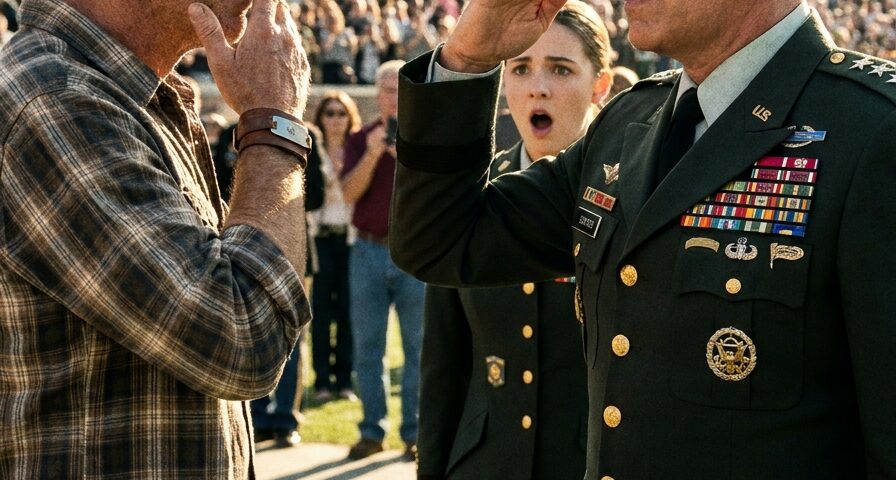
PART 2: At Her Graduation, A General Revealed My Daughter’s Real Name—And The Secret I Buried Came Back Alive
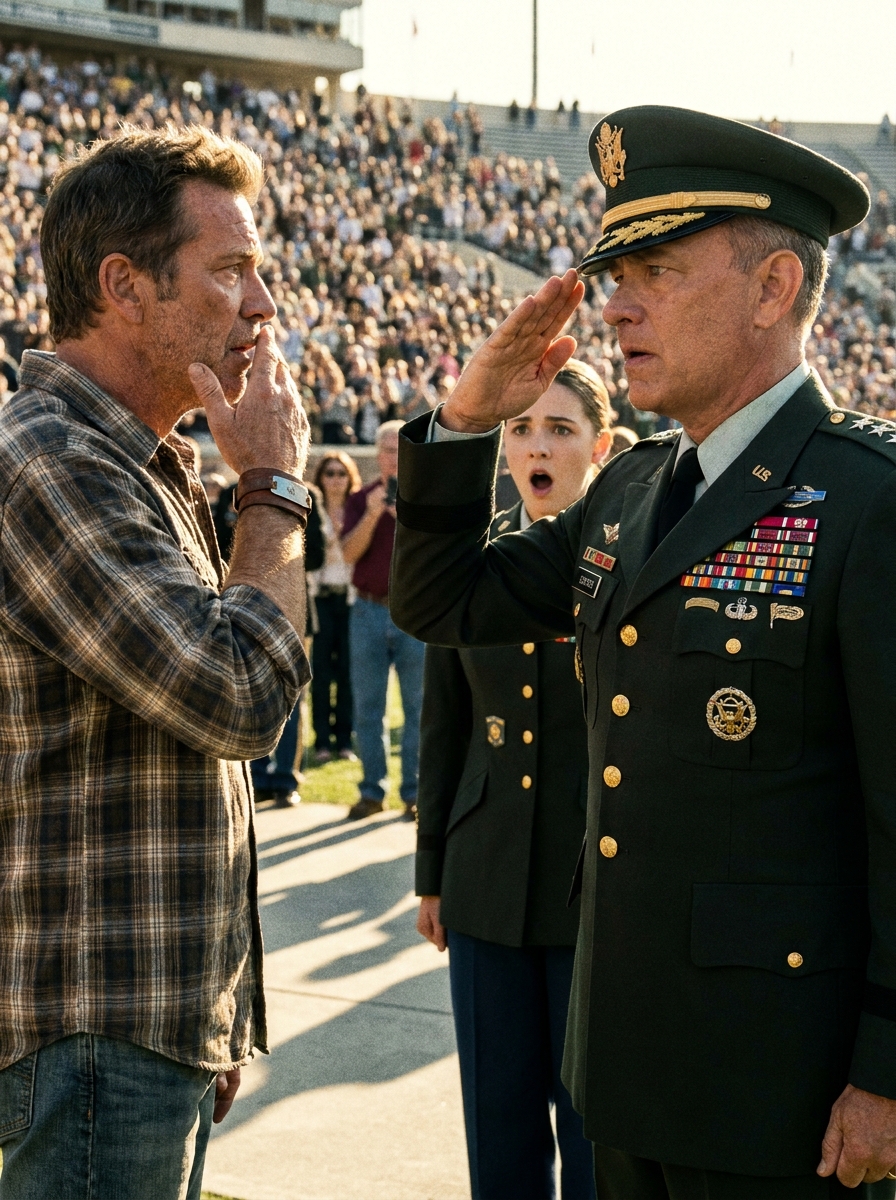
The name on the back of the bracelet seemed to burn hotter than the afternoon sun.
JESSICA ANNE BURTON.
For a moment, none of us moved. Not Henderson. Not Jessica. Not me. The stadium roared around us, but it came to me as if through water, distant and warped.
Jessica stared at the engraving, her fingers tightening around mine.
“My name,” she whispered.
I swallowed. “Jess—”
“No.” She pulled her hand away. “Dad, why is my name on Sergeant Burton’s bracelet?”
General Henderson’s eyes shifted to me, and in them I saw the same question, sharpened by command and years of buried grief.
Before I could answer, a dozen reporters began pushing toward us. Security guards rushed in, forming a loose wall. Phones were raised. Someone shouted, “Sir, is she Burton’s daughter?” Another voice cried, “General, can you confirm?”
Henderson snapped back into the man the country knew.
“Clear this area,” he ordered.
Within seconds, soldiers and stadium staff guided us off the field. Jessica walked beside me without touching me. That hurt more than any shrapnel ever had.
We were taken beneath the stands into a small athletic training room that smelled of rubber mats, antiseptic, and old sweat. Henderson shut the door himself. Outside, the crowd thundered on, celebrating graduates who still believed life moved in straight lines.
Inside, my daughter looked at me as if I had become a stranger.
“Tell me,” she said.
I sat down heavily on a bench. My knees had begun to shake.
“I should have told you years ago.”
Her face hardened. “That isn’t an answer.”
“No,” I said. “It isn’t.”
Henderson stood near the door, arms folded, silent but listening.
I touched the leather band. “Burton wore this every day. Said it reminded him why he had to survive. I thought the name was his wife’s at first. I didn’t learn the truth until after the attack.”
Jessica’s voice broke. “After what attack?”
“The convoy outside Fallujah.”
She knew pieces of it. All children of broken soldiers know pieces. Nightmares. Locked doors. The smell of gasoline making me leave a restaurant. The way I never sat with my back to a window.
But I had never given her the whole story.
“After Burton died,” I said, “I tried to return the bracelet to his family. I owed him that much. He had talked about a wife named Laura and a baby girl. He never showed pictures. Said he was afraid if he looked at her too long, he wouldn’t be able to go back outside the wire.”
Jessica’s eyes filled, but she refused to cry.
“I went to the address in Ohio,” I continued. “But the house was empty. Burned on one side. Neighbors said Laura Burton had died two weeks earlier. Officially, it was an accident. Gas leak. Fire. They said the baby had been taken by relatives.”
Henderson frowned. “Burton had no relatives listed.”
“I know.”
The room grew colder.
I looked at Jessica. “Three nights later, I was in a motel outside Dayton. I couldn’t sleep. Around two in the morning, someone knocked on my door. When I opened it, there was a woman standing there with a baby in her arms.”
Jessica stopped breathing again.
“She was old,” I said. “Maybe seventy. Maybe older. She had blood on her sleeve. She put the baby in my arms and said, ‘For Sergeant Burton. Keep her from the men who salute too easily.’ Then she walked away.”
Henderson’s jaw tightened.
“I tried to follow her, but the baby started crying. By the time I stepped outside, the woman was gone.”
“And the baby was me,” Jessica said.
I nodded.
Her lips trembled. “You never told me I was adopted.”
“Your mother wanted to.”
“My mother?” she said bitterly. “Grace Mercer?”
“The woman who raised you,” I said softly. “The woman who stayed up with you when you had fevers. The woman who taught you to ride a bike. Yes. Your mother.”
Jessica turned away, pressing her fist against her mouth.
I forced myself to keep talking. “Grace and I went to the police. Twice. The first officer laughed at us and said grief made men imagine things. The second took one look at Burton’s name and told me to forget whatever I thought I knew. That night, a black car sat outside our house for six hours.”
Henderson looked sharply at me. “Why didn’t you contact the Army?”
“I did. My calls were transferred until they died. Then a man came to see me. No uniform. No name. He knew things about Fallujah that were never in the report. He told me the baby would vanish into a system no one could trace, and if I loved my wife, I’d stop asking questions.”
Jessica turned back to me. “So you lied.”
“Yes.”
“For twenty-two years.”
“Yes.”
“Was Jessica even my real name?”
I closed my eyes. “It was the only name we had. The bracelet said Jessica Anne Burton. Grace wanted to give you a clean start, but I couldn’t erase that. So we kept Jessica and gave you her mother’s middle name, Rose.”
Jessica laughed once, a small wounded sound. “A clean start built on a grave.”
No words came to me.
Then Henderson spoke. “Mr. Mercer, who else knows this?”
“No one living,” I said. “Grace died with it.”
Henderson’s face changed. It was subtle, but I saw it. A soldier recognizes fear in another soldier, even when it wears medals.
Before he could ask another question, the door opened.
A man in a dark suit stepped inside without knocking. He had silver hair, polished shoes, and eyes that measured people like property. Two military police stood behind him.
“General Henderson,” he said smoothly. “We need to secure the artifact.”
Henderson did not move. “Colonel Voss.”
The name struck me somewhere deep, though I did not know why.
Voss smiled at Jessica. “And you must be Miss Mercer.”
Jessica lifted her chin. “That’s my name.”
“For now,” Voss said.
Henderson stepped between them. “Leave.”
“With respect, General, this is now a matter of national security.”
“A dead sergeant’s bracelet?”
“A missing child tied to a classified incident in Iraq,” Voss replied. “You said enough on an open microphone to awaken every buried file in Washington.”
He looked at me then.
“Mr. Mercer, you have carried government property for two decades. Hand it over.”
My fingers closed around the leather band.
“No,” Jessica said.
All eyes turned to her.
“It has my name on it.”
Voss’s smile thinned. “That remains to be verified.”
Henderson opened the door wider. “Colonel, you can walk out with dignity, or I can have you removed in front of every camera in that hallway.”
For a moment, neither man blinked.
Then Voss gave a small nod. “Of course. But this is larger than sentiment.”
His gaze flicked to Jessica again.
“Enjoy your graduation day, Miss Burton.”
The door closed behind him.
Jessica went pale.
Henderson cursed under his breath.
“You said her real name where he could hear,” I said.
“No,” Henderson replied. “He knew it before he walked in.”
That was the moment I understood the past had not returned by accident.
It had been waiting.
We left the stadium through a service tunnel while the ceremony continued above us. Henderson assigned a young captain to drive Jessica’s car around to a maintenance gate, but Jessica refused to ride with anyone except me. She sat in the passenger seat, still in her cap and gown, staring through the windshield as if the road ahead might split open.
For a long time, neither of us spoke.
Finally she said, “Did you love me because I was his daughter?”
The question nearly broke me.
“No,” I said. “I loved you because you were you.”
“But at first?”
“At first, you were a baby who needed someone. Then one night you fell asleep on my chest, and when Grace tried to lift you away, you grabbed my shirt with both fists. Like you had chosen your hill to die on.”
Jessica looked down.
“That was the first time I laughed after Iraq,” I said.
She wiped her cheek angrily. “I don’t know who I am.”
“You’re my daughter.”
“That’s not enough right now.”
I nodded. “I know.”
Home was a narrow blue house at the edge of town, the kind with a porch that sagged in the middle and roses Grace had planted along the fence. Reporters were already waiting on the curb. Cameras turned as we pulled in.
“Keep walking,” I told Jessica.
A woman shouted, “Jessica, when did you learn your father was a war hero?”
Jessica stopped so suddenly I almost ran into her.
“He’s my father,” she said, voice cold as steel. “That’s all you get.”
Then she went inside.
I followed and locked the door.
The house seemed smaller with the truth inside it. Every family photo on the wall became evidence. Jessica at six missing her front teeth. Jessica at twelve holding a science fair ribbon. Jessica and Grace covered in flour one Thanksgiving morning. Jessica asleep on the couch with her head in my lap after her first heartbreak.
She stood before those pictures like a detective at a crime scene.
“Show me everything,” she said.
I went to Grace’s old sewing room. Behind a cabinet of folded quilts was a loose floorboard. I had not lifted it since the week after Grace’s funeral.
Underneath was a metal box.
Jessica watched as I opened it.
Inside lay a blue baby blanket, yellowed at the edges. A hospital bracelet with half the letters melted away. A photograph of Daniel Burton in desert camouflage, holding a newborn wrapped in pink. On the back, in hurried handwriting, someone had written: My Jess. My reason.
Jessica reached for the photo with trembling fingers.
He was younger than I remembered him. War ages men twice—once in life and once in memory. In the picture, Burton smiled like a man who had not yet learned how much the world could take.
Jessica touched his face.
“I look like him,” she whispered.
“You have his eyes.”
She closed hers.
At the bottom of the box was an envelope addressed to me in Grace’s handwriting. I had never opened it. Some grief waits patiently for courage.
Jessica saw my hesitation. “Open it.”
So I did.
Jack,
If the day ever comes when Jessica learns the truth, do not let shame make you quiet. We did what we did because every official door led to danger. But there is one thing I never told you.
My hands went numb.
Jessica leaned closer.
I read on.
A year after we brought her home, a woman came to the library asking for me. She said Daniel Burton had hidden something in the bracelet, something no one could open unless Jessica herself was present. I thought she was mad. I sent her away. That night, someone broke into the house and searched the nursery.
I remembered that night. I had told myself it was a drunk or a thief. Nothing was taken.
Grace’s letter continued.
I kept the bracelet from you afterward because I was afraid you would run toward the danger. But you always found it again. Maybe promises have their own gravity.
There is a seam beneath the metal plate.
Forgive me,
Grace
Jessica and I stared at the bracelet.
With shaking fingers, I turned it over. I had touched that plate ten thousand times and never noticed the line along the edge. Jessica took it from me, her fear giving way to focus. She had always been better than me with small things. Machines, locks, puzzles, wounded birds.
“Do you have a thin blade?” she asked.
I brought Grace’s old sewing knife.
Jessica slid it beneath the plate. For a moment nothing happened. Then there was a soft click.
The metal plate lifted.
Inside the leather was a sliver of black material no larger than a fingernail, sealed beneath cloudy plastic. Beside it, etched into the inner steel, were three words:
ST. BARTHOLOMEW. 19.
Jessica looked up. “What is St. Bartholomew?”
I knew.
It was where Daniel Burton was buried.
We waited until dark.
That was Jessica’s decision, not mine. She changed out of her graduation gown into jeans and one of Grace’s old sweaters. I told her she did not have to come. She looked at me as if I had learned nothing.
“I’ve been protected from my own life long enough,” she said.
St. Bartholomew Cemetery lay forty miles north, behind a church that had closed before Jessica was born. The road there wound through fields silvered by moonlight. Twice, I thought headlights followed us. Twice, they vanished when I slowed.
Burton’s grave was near the back fence under a sycamore tree.
The headstone was simple.
SERGEANT DANIEL MICHAEL BURTON
BELOVED HUSBAND AND FATHER
A SOLDIER WHO BROUGHT OTHERS HOME
Jessica knelt before it.
For a while, she said nothing. Then she placed her palm on the stone.
“Hello,” she whispered, and that one word carried twenty-two lost years.
I looked away.
There are moments too private even for fathers.
When she was ready, we searched the grave marker. On the lower right corner, nearly hidden beneath moss, was a small carved number.
Jessica brushed away dirt at the base of the stone. Her fingers found a metal ring set into the concrete foundation. I helped her pull.
A narrow compartment opened beneath the headstone.
Inside was a watertight cylinder.
Jessica’s breath caught. “Dad.”
I did not correct her. Not then. Maybe not ever.
We took the cylinder back to the car before opening it. Inside was an old digital recorder, a folded letter sealed in plastic, and a second photograph.
The photograph showed Burton with three men in uniform.
One was me.
One was Henderson.
The third was Colonel Voss.
I felt the blood drain from my face.
On the back, Burton had written:
One of them sold the road.
Jessica looked at me. “What does that mean?”
I turned on the recorder.
Static hissed. Then Daniel Burton’s voice filled the car.
“If you’re hearing this, then I failed to get home.”
Jessica covered her mouth.
The voice was younger than the name on the stone, tired but steady.
“My daughter’s name is Jessica Anne Burton. If she is alive, protect her from anyone who says this is about honor. Honor is the first word liars use when they need a coffin closed.”
The wind moved through the cemetery trees.
“The convoy outside Fallujah was not random. Someone changed the route after I reported missing cargo. Medical supplies, radios, cash, and documents were being moved under humanitarian cover. I copied what I could. I hid the proof where only my daughter’s name could point.”
The recording crackled.
“Jack Mercer, if this reached you, I’m sorry. I gave you the bracelet because you were the only man in that convoy too stubborn to obey a bad order and too decent to abandon a stranger. You thought you found it in the dirt. You didn’t. I put it in your truck before we rolled out.”
I stopped breathing.
Jessica stared at me.
Burton’s voice continued.
“I knew they might come for Laura. I prayed I was wrong. I was not wrong about many things in Iraq.”
A long pause.
Then softer:
“Jess, if you ever hear my voice, I need you to know I wanted to be your father. Not a ghost. Not a name under stone. Your father. I carried your picture through dust storms and gunfire. I kissed it before every mission. I am sorry my love reached you as a mystery.”
Jessica began to cry then, silently, her shoulders shaking.
I put a hand near her but did not touch her until she leaned into me.
The recorder clicked.
“One more thing. Do not trust—”
The sound cut off.
Jessica lifted her head. “No. No, no.”
She rewound it. Played it again.
“One more thing. Do not trust—”
Nothing.
The file had been damaged or erased.
A beam of headlights swept across the cemetery.
I killed the recorder and ducked.
A black SUV rolled slowly past the church gate.
Jessica whispered, “They followed us.”
The SUV stopped.
Two men got out.
I grabbed the cylinder, the photos, and the recorder. “Move.”
We ran low between the headstones, keeping the sycamores between us and the road. My bad knee screamed. Jessica stayed beside me, refusing to leave me behind even when I hissed at her to go faster.
A voice called from the gate.
“Mr. Mercer. Miss Burton. We only want to talk.”
Colonel Voss.
Jessica’s face hardened in the dark.
“This way,” she whispered.
She led me through a break in the fence I had not seen. Beyond it was a drainage ditch, then a line of trees. We stumbled through mud, branches whipping our faces. Behind us, flashlights sliced through the cemetery.
My lungs burned like Fallujah smoke.
At the far end of the trees, another set of headlights flashed twice.
I pulled Jessica back.
Then a window rolled down.
General Henderson leaned across the seat. “Get in.”
I hesitated.
He saw it. “You don’t have time to decide whether I’m a good man.”
That was true.
We got in.
Henderson drove without headlights for the first half mile, then turned onto a gravel road and accelerated. In the rear window, distant beams swung wildly through the trees.
No one spoke until the cemetery was gone behind us.
Henderson glanced at the cylinder in Jessica’s lap. “You found it.”
“You knew?” I asked.
“I suspected.”
“That grave is empty, isn’t it?”
His silence answered.
Jessica turned toward him. “What happened to my father?”
Henderson’s hands tightened around the wheel. “I don’t know.”
“You said he never came back out.”
“He didn’t,” Henderson said. “Not that I saw. The official report listed him killed in action. But there were no remains recovered. There was pressure to close the file fast.”
“From Voss?” I asked.
“Among others.”
Jessica held up the photograph. “It says one of you sold the road.”
Henderson glanced at it once, then looked back at the road.
“I have spent twenty-two years afraid it was me.”
The words landed heavily.
“What does that mean?” Jessica demanded.
“I signed the route change,” he said. “I was a captain then. The order came through proper channels. I didn’t question it.”
“And men died,” I said.
“Yes.”
His voice was raw now.
“Burton confronted me before the convoy. Told me something was wrong. I told him to follow the order. An hour later, he pulled me out of a burning truck.”
No one spoke.
Henderson drove us to a hunting cabin deep in state forest, a place he said belonged to a friend who owed him his life. There was no electricity except a generator, no neighbors, and no cell signal unless you climbed the ridge behind it.
Inside, Jessica sat at a wooden table beneath a lantern while Henderson examined the black sliver from the bracelet.
“It’s a storage wafer,” he said. “Military prototype. Early 2000s. Rugged, encrypted.”
“Can you open it?” Jessica asked.
“No. But I know someone who can.”
I shook my head. “No more strangers.”
Henderson looked at me. “Then we sit here until Voss finds us.”
Jessica took the wafer from him. “My father hid this for me. Not for the Army. Not for you.”
Henderson nodded slowly. “Then it’s yours.”
That surprised me.
For the first time that day, Jessica looked at him not as a general, but as a man.
“Why help us?” she asked.
Henderson’s answer was quiet.
“Because Daniel Burton saved my life, and I built a career on a report that buried his.”
Later, while Henderson checked the perimeter, Jessica and I sat beside the cold fireplace.
“I’m angry at you,” she said.
“I know.”
“I might be angry for a long time.”
“I know that too.”
She turned the photograph of Burton over in her hands. “But when Voss called me Miss Burton, I hated it.”
I looked at her.
“Not because of him,” she said. “Because for one second, I thought it meant losing you.”
I could not speak.
She leaned her head against my shoulder, just as she had when she was small.
“You lied,” she whispered. “But you stayed.”
I closed my eyes. “Every day.”
Near dawn, Henderson returned with a satellite phone and an old laptop sealed in a hard case. He said the laptop had belonged to a signals officer who died before he could testify about missing convoy records.
Jessica inserted the wafer with careful hands.
The screen remained black.
Then a line of text appeared.
ENTER NAME.
Jessica typed: JESSICA ANNE BURTON.
The screen flickered.
ACCESS DENIED.
She looked at me. “What else?”
I thought of Grace. Of the woman at the motel. Of Burton’s voice.
“Try the name on the photo,” I said. “My Jess. My reason.”
Jessica typed:
MY REASON.
The laptop clicked.
Files bloomed across the screen.
Maps. Payment records. Route changes. Photographs. Names.
Then one video file appeared at the bottom.
Its timestamp was impossible.
June 15, 2026.
Today.
Jessica went still.
“That can’t be right,” Henderson said.
She opened it.
The screen filled with darkness. Then a face leaned into view.
Older. Scarred. Beard streaked gray. One eye clouded, the other unmistakably Jessica’s.
Daniel Burton looked into the camera.
“Jack,” he said, voice rough but alive, “if you are seeing this, then my daughter has come into the light.”
Jessica made a sound I will hear until I die.
Burton looked over his shoulder as if someone had moved behind him.
“You have less time than you think. Voss is only the hand. The man beside you is the door.”
Henderson stepped closer to the screen. “Daniel?”
Burton’s face tightened.
“Do not trust General Henderson,” he said. “The man wearing his name is not the man I pulled from the fire.”
Behind us, a floorboard creaked.
We turned.
General Henderson stood in the cabin doorway, pistol in hand, his face unreadable in the lantern light.
“Jack,” he said softly, “step away from my daughter.”
THE END OF PART 2