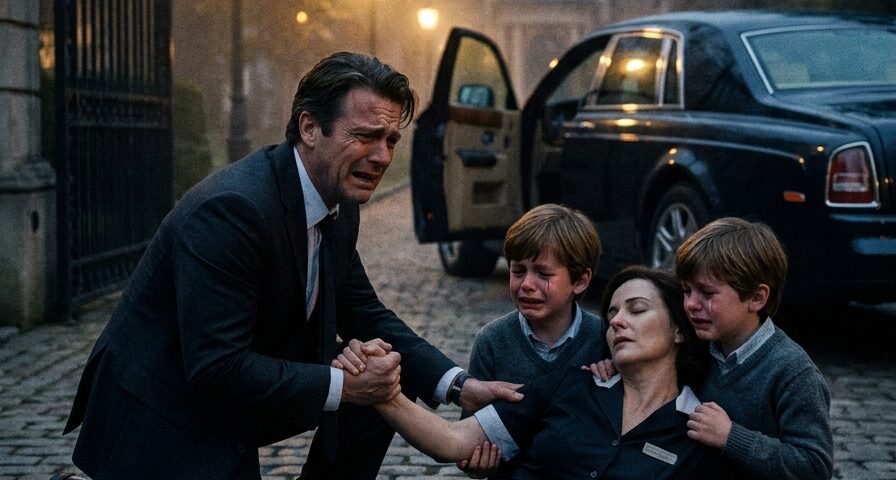
PART 2 – Millionaire Father Finds His Housekeeper Unconscious
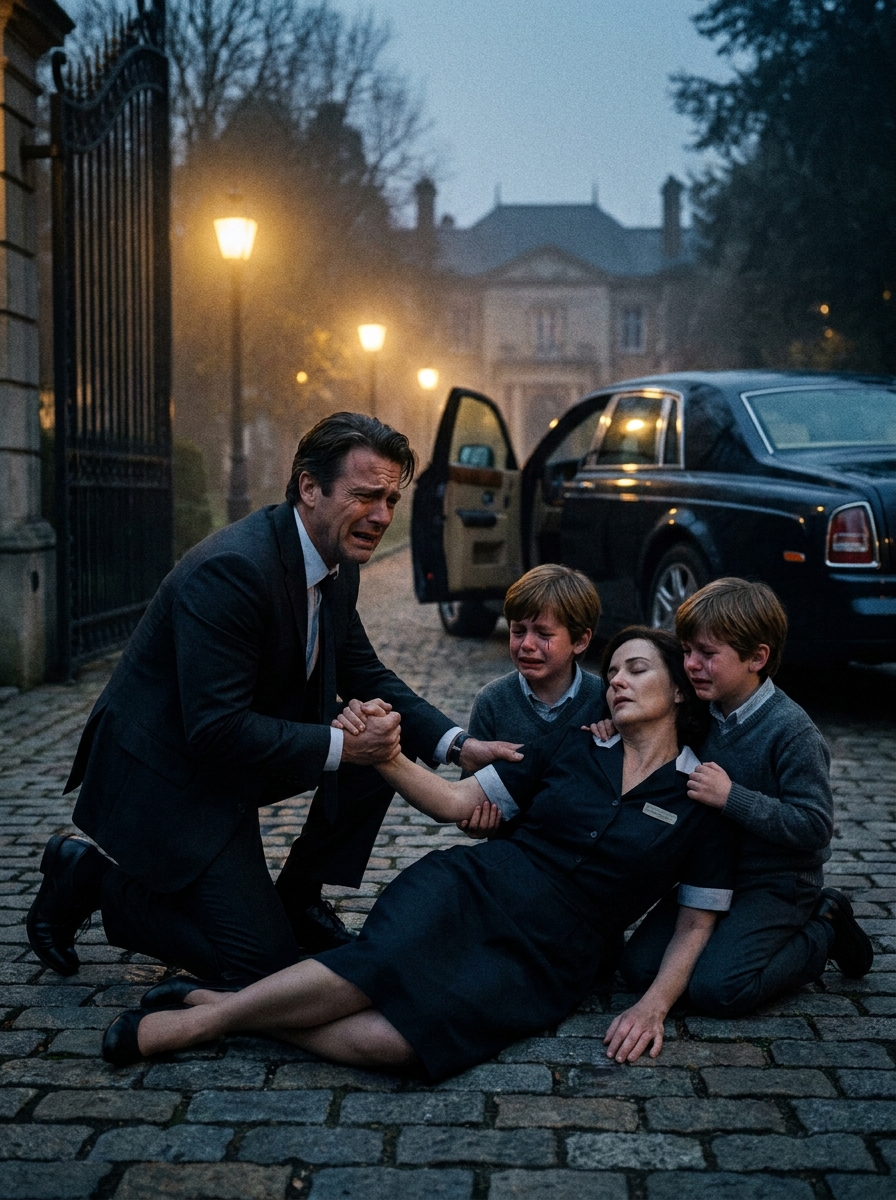
The doctor’s words seemed to stop the entire emergency room around me.
There were people moving everywhere—nurses crossing the hall with clipboards, a toddler crying near the vending machines, an older man coughing into a paper mask—but all I could hear was the careful weight in the doctor’s voice.
“We know why Claire collapsed,” he said again, softer this time. “She is severely dehydrated and exhausted. Her blood pressure dropped dangerously low. We’re treating her now.”
I exhaled, but relief didn’t come.
Because he was still looking at me as if the worst part had not yet been said.
“What else?” I asked.
The doctor glanced at Lucas and Owen, who were sitting close together on the plastic chairs behind me, their faces blotchy from crying.
“Perhaps we should speak privately.”
“No,” Owen said immediately.
His small voice cracked through the hall.
He slid off the chair and ran to my side, grabbing my coat. Lucas followed, trying to look brave but trembling at the mouth.
“She’s our Aunt Claire,” Lucas said. “We can know.”
The doctor’s expression softened.
I placed one hand on each boy’s shoulder. “Tell me what I need to know.”
He hesitated, then nodded.
“Claire has old surgical scarring,” he said. “It appears she donated part of her liver some years ago. That doesn’t explain today’s collapse by itself, but it does mean her body may not tolerate prolonged stress, missed meals, or improper medication well.”
My throat tightened.
A liver donation.
Claire Bennett, quiet, invisible Claire, had once given away part of herself to save someone else.
I looked down at my sons.
Lucas was staring at the doctor with wide eyes.
Owen whispered, “She has a scar?”
The doctor knelt slightly so he wouldn’t tower over them. “Yes, but it healed a long time ago.”
“Did it hurt?” Owen asked.
“I imagine it did,” he answered honestly. “But people usually do something like that because they love someone very much.”
Love.
The word followed me like a shadow.
I thought of Claire moving through our house before sunrise, folding tiny shirts, packing school lunches, remembering which cup Owen liked and which stuffed animal Lucas needed when thunderstorms came. I thought of her quiet laugh in the kitchen, the one I had heard from the hallway but never stepped in to join. I thought of her standing beside the twins at the garden fountain last week, teaching them how to float leaves like boats.
I had walked past her that day while reading an acquisition report.
She had smiled politely.
I had barely nodded.
“Can we see her?” Lucas asked.
“Not yet,” the doctor said. “She needs rest. But she’s stable.”
Stable.
The word should have comforted me.
Instead, it accused me.
I thanked the doctor and turned back toward the waiting area, but my legs felt heavier than they had during any boardroom battle. I lowered myself into a chair between my sons. Lucas climbed into my lap without asking. Owen pressed against my side, still clutching the sleeve of my jacket with both hands.
I could not remember the last time both boys had sat this close to me.
Maybe they had stopped trying.
Maybe I had trained them to expect distance.
For three years after Evelyn died, I told myself I was providing. I built larger portfolios, expanded into new markets, bought the estate she had once admired from a magazine photo because I thought giving our sons beauty might compensate for the absence of their mother.
But marble floors did not kiss scraped knees.
Security gates did not sing lullabies.
A chef could make perfect pancakes, but he could not know that Owen liked them shaped like stars because Evelyn once told him stars were little windows in heaven.
Claire knew.
“How did Claire learn the star song?” I asked.
Lucas looked at Owen.
That small exchange told me they had been keeping secrets.
Not dangerous secrets.
Child secrets.
Treasures.
“She heard us humming it,” Lucas said. “At night.”
Owen nodded. “We couldn’t remember all the words.”
“So she helped you?”
“She said maybe if we remembered together, it wouldn’t feel so far away.”
My chest ached.
“She knew about your mom?”
Lucas looked down at his shoes. “We told her. You don’t like when we talk about Mommy.”
I almost denied it.
The words rose automatically, a defense built from shame. Of course I liked when they talked about Evelyn. Of course I wanted them to remember her. Of course I had not meant to make grief feel forbidden.
But children did not measure intentions.
They measured reactions.
The way I left the room when Evelyn’s name came up.
The way I became silent when I heard the lullaby.
The way I put away every photograph except one framed portrait in the formal hall, where no one lived.
“I’m sorry,” I whispered.
Both boys looked up.
“I didn’t know I made you feel that way.”
Owen’s eyes filled again. “Sometimes you look sad, so we stop.”
I pulled him closer.
For years, people had told me I was strong. They admired how quickly I returned to work after Evelyn’s funeral, how disciplined I remained, how neatly I managed tragedy.
No one had told me my strength might be teaching my children to hide their hearts.
“I want to hear about her,” I said, though my voice nearly broke. “I want to hear everything you remember.”
Lucas leaned against my chest. “Claire said memories don’t disappear when people cry.”
I closed my eyes.
Claire had been in our house three weeks.
Three weeks.
And somehow she had reached places I had sealed shut for years.
My phone remained off in my pocket. For the first time, I did not wonder who was trying to reach me. I did not imagine the board waiting, the contracts cooling, the messages piling up like snow against a locked door.
The world I had built could stand without me for one afternoon.
My sons could not.
A nurse approached an hour later and told us Claire was awake but weak. Only one visitor could enter at first.
Both boys jumped up.
“Dad,” Lucas pleaded.
“Please,” Owen said. “Tell her we stayed.”
“I will.”
I followed the nurse down a quiet corridor washed in pale blue light. With every step, guilt pressed heavier against my ribs. I was not family. Not really. I was her employer, a man who signed checks someone else processed. A man who knew her work schedule but not her birthday. A man whose children called her aunt while he still called her Miss Bennett in his head.
Claire lay in a narrow hospital bed near the window, an IV taped to her arm. Without the neat uniform and composed posture, she looked painfully young. Her dark hair was loose around her face. Her eyes opened when I entered.
For one brief second, fear crossed her expression.
Then she tried to sit up.
“Mr. Whitmore,” she whispered. “The boys—”
“They’re safe,” I said quickly. “They’re outside. They refused to leave.”
Her eyes filled with relief so immediate it humbled me.
“Good,” she breathed.
I stood awkwardly near the foot of the bed, suddenly unsure what to do with my hands. I had spoken before hundreds of investors without notes. Now I could barely form a sentence.
“The doctor said you collapsed from dehydration and exhaustion.”
Claire looked away. “I’m sorry.”
The apology startled me.
“Claire, you were unconscious outside my gate. You don’t need to apologize.”
“I should have told Ruth I wasn’t feeling well.”
“Ruth should have told me. And I should have been paying attention.”
Her gaze flicked back to mine.
There it was again—that quiet caution, as if kindness from me was unfamiliar enough to be suspicious.
I deserved that.
“I didn’t know about the liver donation,” I said gently.
Her fingers tightened on the blanket.
“You didn’t need to.”
“Maybe not as your employer. But as the father of two children who clearly love you, I should have known enough to make sure you were safe in my home.”
A faint crease appeared between her brows.
“They’re good boys,” she said.
“I know.”
“Do you?” The question came out softly, not accusing, which somehow made it hurt more.
I looked toward the window. Evening light had begun to gather over the parking lot, turning every windshield silver.
“I’m learning how much I’ve missed.”
Claire’s expression changed, but she said nothing.
I pulled a chair closer and sat.
“Why didn’t you tell anyone you were unwell?”
She stared at her hands. “I needed the job.”
“You would not have been fired for being sick.”
She gave me a look that was almost sad. “You didn’t know that.”
The room went quiet.
She was right.
I had created a household where everyone knew the standards and no one knew the mercy. Meals appeared. Laundry folded itself. Rooms stayed immaculate. Employees rotated through my life like functions, not people.
Claire had no reason to believe compassion lived there.
“I’m sorry,” I said again.
This time, she seemed to believe I meant it.
The door opened slightly, and a nurse leaned in. “The boys are asking every thirty seconds whether Aunt Claire can have visitors.”
Claire smiled faintly. It transformed her face.
“They can come in,” she said.
Lucas and Owen entered carefully, as if loud footsteps might break her. Then Owen burst into tears and ran to the bed. Lucas followed, climbing onto the chair beside her.
“You scared us,” Lucas said.
“I know,” Claire whispered. “I’m sorry.”
“You promised pancakes,” Owen said, crying into her blanket.
“I remember.”
“You have to get better first,” Lucas said in his stern little voice. “No pancakes if you fall down again.”
Claire laughed softly, and the sound carried warmth into the sterile room.
“I’ll try very hard not to fall down again.”
I watched them, feeling like a stranger outside a window.
Claire brushed Owen’s hair back with the tenderness of someone who had done it many times. Lucas took her water cup and held the straw to her lips. She thanked him as if he had performed a grand service.
They had a rhythm together.
A language.
A small, ordinary love built in the hours I had given away to meetings.
I thought of all the nights I returned home after they were asleep, asking Ruth whether the boys had behaved, whether homework was done, whether dinner had gone well. I had treated fatherhood like an update to receive, not a life to enter.
“Claire,” Lucas said suddenly, “Dad said we can talk about Mommy.”
Claire’s eyes lifted to mine.
Something passed between us.
Not surprise exactly.
Permission.
Owen nodded eagerly. “He said he wants to hear.”
“I do,” I said.
Claire looked back at the boys. “That’s wonderful.”
Lucas leaned close to her. “Can we tell him about the blue scarf?”
My breath caught.
Evelyn’s blue scarf.
I had not seen it in years.
Claire hesitated. “That’s your story to tell.”
Lucas turned to me. “We found Mommy’s scarf in the cedar chest.”
Owen added, “Claire said it smelled like lavender.”
“She didn’t take it,” Lucas said quickly, as if defending her. “We asked her to help us fold it.”
“I wasn’t angry,” I said.
But I might have been, once.
The thought made me ashamed.
Claire watched me carefully. “They wanted something that felt close to her.”
I nodded. “I should have given them that.”
“You were grieving too,” she said.
I almost laughed at the undeserved grace of it. “That doesn’t excuse disappearing while standing in the same house.”
“No,” Claire said quietly. “But it explains why you couldn’t see everything.”
Her words settled into me.
I wondered what else I had not seen.
A nurse came to check Claire’s vitals, and the boys reluctantly stepped back. The numbers seemed to satisfy her. She told us Claire would remain overnight for observation.
“Overnight?” Claire said, alarmed.
“Yes,” the nurse replied firmly. “Your body needs rest.”
Claire looked at me. “Mr. Whitmore, I can return tomorrow afternoon if—”
“No,” I said.
Her face tightened.
I softened my voice. “No work. Not until your doctor clears you. Your position and salary remain exactly as they are.”
She stared at me.
“And when you return,” I continued, “your schedule changes. Real breaks. Proper meals. Medical information on file only with your consent. No more pretending exhaustion is loyalty.”
Her eyes shone, but she blinked it away. “Thank you.”
Lucas tugged my sleeve. “Can we stay here tonight?”
“There are rules,” I said.
Owen’s face fell.
“But we can stay nearby until visiting hours end. And tomorrow morning, we’ll come back before breakfast.”
“Promise?” Lucas asked.
“Yes.”
It was the second promise I had made that day, and I intended to keep it.
After Claire fell asleep, the boys and I returned to the waiting area. Ruth arrived twenty minutes later, her face pale and drawn. She had worked for my family for eleven years, long enough to remember Evelyn, long enough to have seen my decline and said nothing.
Or perhaps she had said things I was too absent to hear.
“Mr. Whitmore,” she began, wringing her hands, “I am so sorry.”
I looked at her and felt the old impulse to be severe.
It would have been easy. Too easy.
Anger gives a person somewhere to stand when guilt makes the ground unstable.
But the boys were watching me.
So I chose carefully.
“What happened with the blood pressure pill can never happen again,” I said. “Not with Claire. Not with anyone on staff.”
Ruth nodded quickly. “I know. I panicked. She was shaking, and she kept saying she just needed to finish the boys’ laundry.”
“Why was she so afraid of losing the job?”
Ruth looked down.
“Ruth.”
“She had nowhere stable to go,” Ruth admitted. “She told me she was renting a room from a woman in Cicero, but the woman’s son came back from out of state and wanted the room. Claire was sleeping in her car some nights before you hired her.”
I felt the words physically.
Sleeping in her car.
The woman who had tucked my children into bed had been sleeping in a car.
“Why didn’t she ask for help?”
Ruth gave me a sad look. “From whom, sir?”
The answer landed with brutal simplicity.
From whom.
Certainly not from the man who hurried through his own home like a guest late for departure.
Lucas leaned against my leg. “Claire slept in a car?”
Ruth’s face crumpled. “Oh, sweetheart, I shouldn’t have said that.”
“Was she cold?” Owen asked.
I knelt before them. “She’s safe tonight.”
“But before?” Lucas asked.
I could not lie.
“Before, I don’t know.”
Owen looked toward the hospital doors. “We have lots of rooms.”
I closed my eyes briefly.
Yes.
We had lots of rooms.
Rooms no one entered. Rooms dusted weekly for ghosts. Rooms preserved around a life that had stopped three years ago while the living people inside the house learned to whisper.
“We do,” I said.
Lucas’s chin lifted. “Aunt Claire can have one.”
Ruth glanced at me.
So did Owen.
The decision should have required thought. Boundaries. Employment considerations. Practical arrangements. Human resources would have had a paragraph ready.
But family was often born long before paperwork noticed.
“We’ll talk to Claire when she’s well enough,” I said. “And we’ll make sure she has somewhere safe, whether it’s with us or somewhere she chooses.”
Owen nodded solemnly. “She chooses pancakes too.”
I smiled despite myself. “I’ll remember.”
By the time we left the hospital, night had settled over the city. The boys were quiet in the back seat, exhausted from fear and relief. I drove slowly this time. No phone. No calls. No invisible conference table waiting inside my head.
At a red light, Lucas asked, “Daddy?”
“Yes?”
“Did Mommy send Claire?”
The question slipped into the car like a secret.
I looked at him in the mirror. “What do you mean?”
He shrugged, embarrassed. “Claire knows things.”
“What things?”
“The star song. The blue scarf. The way Mommy used to make toast soldiers with soft eggs.”
Owen added sleepily, “And the garden story.”
My fingers tightened on the steering wheel.
“What garden story?”
“About the white roses,” Lucas said. “Mommy said white roses were for new beginnings.”
I pulled into the estate driveway moments later, but instead of going straight to the house, I stopped near the garden.
Evelyn’s garden had been neglected after her death. Not ruined—nothing at Whitmore House was ever allowed to look ruined—but simplified. Landscapers kept it neat. The roses were trimmed. The paths were swept. Yet its soul had faded.
Three weeks ago, I noticed fresh white roses near the east wall.
I assumed the gardeners had replaced a dead bed.
Now I wondered.
The boys had fallen asleep by the time I carried them upstairs. Lucas mumbled Claire’s name once. Owen clutched my collar and whispered the first line of the star song.
I stood in their doorway longer than I usually did.
Their room was warmer than I remembered. Drawings on the dresser. Dinosaurs under the bed. Two paper stars taped crookedly beside the window. On the nightstand between their beds sat a small framed photograph of Evelyn that I had not placed there.
Claire must have.
Evelyn was laughing in the picture, her hair blown across her cheek, one hand resting over her heart. I remembered taking it at Lake Geneva before the boys were born, before diagnosis, before hospitals, before I learned that fear could live permanently beneath the ribs.
I sat on the edge of Owen’s bed and finally sang.
The star song came out broken at first. My voice stumbled over words I had avoided for years. But Lucas’s breathing softened. Owen relaxed against his pillow. And somewhere between the second verse and the last, grief stopped being a locked room and became a door I could open without disappearing inside.
Downstairs, Ruth waited in the kitchen with tea untouched in front of her.
“There is something else,” she said before I could speak.
I was beginning to dread those words.
“What?”
Ruth stood and opened the small drawer beneath the household message board. She removed a folded sheet of paper.
“I found this in Claire’s apron yesterday. I thought it was a grocery list. Then I saw Mrs. Whitmore’s name.”
My heartbeat changed.
Evelyn’s name was written across the top in Claire’s careful handwriting.
I took the paper.
It was not a grocery list.
It was a letter, unfinished.
Dear Evelyn,
I don’t know if people are allowed to write to someone they never met, but sometimes this house feels so full of you that I catch myself expecting an answer.
Your boys miss you in ways they don’t know how to say. Lucas pretends to be brave. Owen carries sadness like a blanket. Their father loves them, but he is lost behind a wall he may not know he built.
I promised someone once that if I ever found them, I would make sure they were not alone.
I stopped reading.
“Promised someone?” I whispered.
Ruth looked frightened. “I don’t know what it means.”
The house seemed suddenly too quiet.
I turned the page over.
On the back was a small sketch of the east garden, with an X marked beneath the white roses.
Beneath it, Claire had written one line:
Evelyn said he would understand when he found the locket.
My breath left me.
“Ruth,” I said slowly, “did Claire ever say she knew my wife?”
“No, sir.”
I looked toward the dark windows, toward the garden where white roses gleamed faintly under the moon.
At dawn, before the boys woke, I walked outside with a small spade from the gardening shed. The air smelled of wet earth and early summer. For several minutes, I stood before the roses, afraid of what I might find and more afraid of finding nothing.
Then I dug where Claire’s sketch had marked the soil.
Four inches down, metal struck metal.
I brushed away dirt with shaking hands and uncovered a small silver locket wrapped in oilcloth.
It had belonged to Evelyn.
I knew because I had given it to her on our first anniversary.
Inside should have been a tiny photograph of us.
Instead, there was a folded slip of paper, brittle with age but protected from the damp.
The handwriting was Evelyn’s.
My dearest Daniel,
If Claire ever comes to you, trust her. She is not a stranger. She is the sister I was never allowed to keep.
END OF PART 2