Part 2: The Door Nathan Never Should Have Closed
Nathan Harrison stood in the narrow hallway outside Emma Parker’s apartment, staring at the faded brass number on her door as if it were a judge’s sentence.
3B.
A cracked porch light flickered above him. Somewhere behind another door, a television murmured. The hallway smelled faintly of old paint, laundry detergent, and the kind of life Nathan had spent years building high above, never beneath.
He had stood before presidents of banks, royal investors, ruthless competitors, and men who could ruin cities with a signature.
But this door made him afraid.
Emma had not buzzed him in through the front entrance. She had simply said, “Come upstairs,” and the downstairs door had opened seconds later. She had known he was there.
Of course she had.
Emma always knew when something was wrong before anyone said a word.
Nathan lifted his hand and knocked.
The door opened almost immediately.
Emma stood there in a gray sweater and worn jeans, her face pale but composed. She looked smaller than he remembered, yet there was something sharper about her now. Something forged in exhaustion, humiliation, and survival.
Behind her, the apartment was modest but clean. A small kitchen. A secondhand sofa. Stacks of children’s books. A tiny dining table covered with crayons, worksheets, and two plastic cups decorated with cartoon dinosaurs.
Nathan’s eyes moved past her before he could stop himself.
Down the hall, through a half-open bedroom door, he saw two small beds. On one blanket, rockets flew among stars. On the other, blue whales drifted through painted waves.
His throat tightened.
Emma noticed where he was looking.
“They’re asleep,” she said.
Nathan nodded, unable to speak.
Emma stepped aside.
He entered slowly, as if the floor might collapse beneath him. The apartment seemed too small to hold the truth he had brought with him.
Emma closed the door.
For several seconds, neither of them moved.
Then she turned to him.
“You wanted to talk,” she said.
Nathan inhaled. “I saw you yesterday.”
“At the bakery.”
He looked at her. “You knew?”
“I saw your reflection in the glass when you left.”
The confession struck him harder than he expected. He had thought he had escaped unnoticed. He had thought he still possessed some control over the situation.
He was wrong.
“I didn’t know what to do,” he said quietly.
Emma let out a short, humorless breath. “You were always good at that.”
His face tightened.
“I deserved that.”
“No,” she said. “You deserved worse.”
The words hung between them.
Nathan looked down at his hands. Hands that had signed documents worth more than the building Emma lived in. Hands that had once worn a wedding ring she had given him. Hands that had walked away from a marriage without knowing what had been left behind.
“I read about the boys,” he said.
Emma’s expression did not change, but something in her eyes turned dangerous.
“You investigated me.”
“I needed to know.”
“No, Nathan. You wanted to know quietly. There’s a difference.”
He looked at her.
She crossed her arms. “Did you get everything? My income? My debts? My hospital bills? The collection notices? The fact that I take the boys to free dental clinics? Did your people put that in a neat folder for you?”
“Emma—”
“Did they write down how many times I had to choose between paying rent and buying asthma medication?”
Nathan went still.
“Asthma?”
“Noah,” she said. “Cold weather makes it worse.”
He closed his eyes briefly, and the pain that crossed his face was not polished or controlled. It was raw. Human.
“I didn’t know.”
Emma laughed once, but it broke before it became a sound.
“That is exactly the problem.”
Nathan stepped closer, then stopped himself.
“Why didn’t you tell me?”
Her eyes flashed.
“Tell you?”
“Yes.”
“Tell you?” she repeated, softer this time, more dangerous. “Nathan, I tried.”
The room went silent.
He stared at her.
Emma walked to the small table near the window and opened the drawer beneath it. She pulled out a faded envelope, its edges bent and softened with age. She did not hand it to him immediately.
For a moment, she simply held it.
Then she placed it against his chest.
Nathan took it.
His name was written across the front.
Nathan Harrison.
In Emma’s handwriting.
The sight of it made his stomach twist.
“What is this?”
“The letter I sent you five years ago.”
His fingers tightened around the envelope.
“I never got this.”
“I know.”
He looked up.
Emma’s face had gone still, too still.
“I sent three,” she said. “One to your office. One to the house in Lake Forest. One through your attorney.”
Nathan’s pulse began to pound.
“There were no letters.”
“There were.”
“No.” His voice sharpened, more from panic than anger. “Emma, I swear to you, I never saw them.”
“I believe you.”
That stopped him.
She moved toward the kitchen, filled a glass with water, and held it with both hands.
“I didn’t at first,” she admitted. “For a long time, I thought you had read them and chosen silence. Then one day I received an envelope from your company.”
Nathan frowned.
Emma opened another drawer and removed a second envelope. This one bore the embossed seal of Harrison Development Group.
She gave it to him.
Nathan opened it.
Inside was a single page.
Ms. Parker,
Mr. Harrison has no interest in further communication regarding personal matters. Any future attempt to contact him outside established legal channels will be considered harassment.
Regards,
Victor Lang
Chief Legal Counsel
Nathan read it twice.
Then a third time.
His face drained of color.
Victor Lang.
The man who had sat across from him that morning with three acquisition contracts and a smile like polished marble. The man who had been with Harrison Development for eight years. The man Nathan trusted with mergers, lawsuits, political relationships, and secrets that could bury rivals.
Nathan looked at Emma.
“I didn’t authorize this.”
“I know.”
“How?”
Emma’s mouth trembled once before she steadied it.
“Because when I called your office after receiving that letter, your assistant cried.”
Nathan’s heart gave a sick, slow thud.
“My assistant?”
“Not your current one. Her name was Marlene. She said she was sorry. She said she tried to get the first letter to you, but Mr. Lang intercepted it. Then she begged me not to call again.”
Nathan could not breathe properly.
“Marlene resigned suddenly,” he whispered. “I thought she left for personal reasons.”
“She did,” Emma said. “Fear is personal.”
Nathan turned toward the window, pressing the heel of his hand against his brow. The city lights shimmered outside, distant and indifferent.
For years, he had believed Emma had vanished after the divorce because she wanted nothing from him. No money. No apology. No confrontation. He had mistaken silence for closure.
But silence had been manufactured.
By someone inside his own walls.
He turned back.
“What did the letters say?”
Emma held his gaze.
“The first one said I was pregnant.”
Nathan’s breath left him.
“The second one said the pregnancy was high-risk, and the doctors thought there were two babies.”
His fingers curled.
“The third one said they were born early. That Ethan needed oxygen. That Noah was too small to latch. That I didn’t know how I was going to pay the hospital bill.” Her voice cracked, but she forced it steady. “And that I was not asking you to come back to me. I was asking you to know your sons existed.”
Nathan lowered himself into the chair at the small table as if his body had lost structure.
The room blurred.
Emma did not comfort him.
She had spent too many nights without comfort.
Finally, Nathan said, “I left because I thought you betrayed me.”
Emma’s eyes hardened again.
There it was.
The wound beneath all the others.
“You thought I leaked the Westbridge proposal.”
“That file came from your laptop.”
“No,” Emma said. “That file was found on my laptop.”
Nathan looked up.
“I didn’t know the difference then.”
“You didn’t want to know the difference.”
Her words landed cleanly.
He could not deny them.
Five years ago, Harrison Development had nearly lost the Westbridge Harbor project, the deal that later made Nathan famous. Confidential plans had appeared in the hands of a competitor days before final bidding. Internal security traced the breach to Emma’s personal laptop, which she sometimes used while helping Nathan organize charity guest lists and event materials.
Nathan had been furious, humiliated, and certain.
Emma had denied everything.
He had not believed her.
Their marriage had collapsed in three weeks.
The divorce was signed before spring ended.
“I was angry,” Nathan said.
“You were cruel.”
“Yes.”
He did not defend himself. Not this time.
Emma looked away first.
“That deal made you the King of Concrete.”
“It cost me everything,” he said.
She turned back sharply. “No. It cost me everything. You still had your company, your penthouse, your reputation, your lawyers. I had two premature babies, a teacher’s salary, and your legal counsel threatening me not to contact you.”
Nathan flinched.
From the bedroom, one of the boys coughed.
Emma immediately moved toward the hall. Nathan rose instinctively, but she lifted one hand.
“Don’t.”
He froze.
She disappeared into the bedroom. Nathan stood alone in the living room, listening.
A child murmured, sleepy and small.
“Mom?”
“I’m here, Noah.”
“My chest feels funny.”
“I know, sweetheart. Sit up for me.”
Nathan heard the soft shake of an inhaler, then Emma’s gentle counting.
“One… two… breathe…”
He gripped the back of the chair.
This was his son.
His son had struggled to breathe while Nathan attended rooftop parties. His son had needed medicine while Nathan toasted investors in Dubai. His son had grown up drawing rockets on cheap paper while Nathan built towers named after himself.
Emma came back several minutes later.
“He’s okay,” she said before he could ask.
Nathan nodded, his face pale.
“I want to meet them.”
“No.”
The answer came instantly.
He swallowed.
“I understand why you’d say that.”
“No, you don’t.”
“Emma—”
“You don’t get to appear in their lives because guilt finally found you.”
“I’m their father.”
Her eyes filled, but her voice stayed firm.
“You were their father five years ago too.”
Nathan took the blow silently.
Then he reached into his coat and removed a folder.
Emma stared at it. “What is that?”
“Something I should have done before coming here.”
He placed it on the table but did not push it toward her.
“I contacted my private physician this morning. There’s a DNA test arranged. No press. No company involvement. Only if you agree.”
Emma’s expression shifted. Surprise, anger, suspicion.
“You need proof?”
“No,” he said. “You might.”
She stared at him.
Nathan continued, “If I am going to enter their lives, the truth should be something no one can take from them. Not Victor Lang. Not lawyers. Not rumors. Not me.”
Emma said nothing.
Then, quietly, he added, “But I don’t need a test to know.”
Her lips parted slightly.
“They’re yours,” she said.
“I know.”
“How?”
Nathan looked toward the bedroom.
“The quiet one gives up what he wants so nobody else has to suffer.”
Emma’s eyes glistened.
“And the other one?” she asked.
“He draws worlds because this one is too small for him.”
A tear slid down her cheek before she could stop it.
Nathan looked away, giving her the dignity of not being watched.
For the first time that night, Emma seemed tired enough to collapse.
She sank onto the sofa.
“Why now?” she whispered. “Why did you donate the money to my school?”
“Because I saw you counting coins.”
Her jaw tightened.
“I didn’t want your pity.”
“It wasn’t pity.”
“What was it?”
Nathan answered honestly.
“Panic.”
Emma looked at him.
“I panicked because I saw the life you were living, and I realized it was real. Not some abstract mistake. Not history. Real.” His voice lowered. “And because when Ethan said he didn’t need bread, I wanted to tear the world apart.”
Emma closed her eyes.
“You don’t even know which one is Ethan.”
“The one with the rockets.”
She opened her eyes.
Nathan gave a sad, faint smile. “I remember things when they hurt enough.”
For a moment, the room softened.
Then Emma stood.
“This doesn’t fix anything.”
“I know.”
“Five million dollars to a school doesn’t erase five years.”
“I know.”
“You can’t buy your way into their hearts.”
“I know.”
Her voice rose. “Then what do you want from me?”
Nathan looked at her with the ruins of his certainty.
“A chance to earn the right to be known.”
Emma stared at him for a long time.
Before she could respond, Nathan’s phone began vibrating.
He ignored it.
It stopped.
Then started again.
Emma glanced at his pocket. “Answer it.”
“No.”
“Answer it, Nathan.”
Reluctantly, he pulled it out.
Victor Lang.
The name glowed on the screen like a threat.
Nathan answered without speaking.
Victor’s smooth voice filled the quiet.
“Nathan, where are you?”
“With my family,” Nathan said.
Silence.
Then Victor said, carefully, “That’s not wise.”
Emma’s gaze snapped to Nathan.
Nathan turned on speaker.
Victor continued, unaware.
“You need to come back to the office. The Armitage delegation is arriving in two hours. If you’re not there to sign, this entire waterfront redevelopment collapses.”
The deal.
The one that had dominated every conversation for six months.
A twelve-billion-dollar private city on the lakefront. Hotels, towers, luxury residences, a marina, a performing arts district. The kind of project that would crown Nathan not only as the King of Concrete, but as something untouchable.
“I’m not signing tonight,” Nathan said.
Victor’s tone sharpened. “You don’t have the luxury of emotional timing.”
Nathan looked at Emma.
“I do now.”
Another silence.
Then Victor’s voice changed. Less polished. Colder.
“You found her.”
Emma’s hand went to her throat.
Nathan’s eyes narrowed.
“You knew where she was?”
Victor sighed. “Of course I knew.”
The room seemed to tilt.
Nathan spoke slowly. “What did you do?”
“What was necessary.”
Emma’s face went white.
Victor continued, “Your wife had become a liability. The Westbridge leak created a clean break. You recovered. The company recovered. Everyone benefited.”
Nathan’s grip tightened around the phone.
“You framed her.”
“No,” Victor said. “I solved a problem you were too sentimental to solve.”
Nathan looked as though something inside him had gone silent forever.
“You sent the letter threatening her.”
“I protected you.”
“You kept my children from me.”
Victor’s reply came after a pause.
“Children complicate succession.”
Emma looked at Nathan sharply.
Succession.
Not reputation. Not scandal.
Succession.
Nathan’s voice dropped. “What are you talking about?”
Victor exhaled, annoyed now. “Do you honestly think Armitage is investing twelve billion because of your charm? They want Harrison Development clean, streamlined, controllable. No ex-wife with a grievance. No unknown heirs. No custody battles. No emotional exposure.”
Nathan stared at the phone.
“And you knew about the boys?”
“I knew enough.”
Emma covered her mouth.
Nathan’s face hardened.
“You’re done.”
Victor laughed softly. “No, Nathan. You are tired, emotional, and standing in a teacher’s apartment thinking fatherhood is more important than empire. By morning, you’ll remember who you are.”
“I remember now.”
“Good. Then remember this too.” Victor’s voice became flat. “The board received documents an hour ago showing unauthorized transfers from company-linked charitable accounts. Five million dollars, Nathan. To a public school. A noble gesture, yes, but legally messy.”
Nathan went still.
Emma whispered, “The donation.”
Victor said, “You used company channels. I made sure of that. If you walk away from Armitage tonight, the board will remove you by Monday. The press will call it fraud by breakfast.”
Nathan looked at the folder on Emma’s table.
Victor had not just hidden the past.
He had prepared the future.
“And Emma?” Victor added.
Nathan’s blood chilled.
Victor’s tone softened, almost amused. “Single mother. Debt. Sudden connection to a billionaire. Questions will be asked. People will wonder. Questions whether she manipulated you. Whether those children really are yours. Whether she targeted your company for money after years of silence.”
Emma stood frozen, trembling.
Nathan turned off speaker and lifted the phone to his ear.
His voice was quiet enough to be terrifying.
“If you speak about my sons, I will burn every room you ever felt safe in.”
Victor chuckled.
“There he is.”
Nathan ended the call.
For several seconds, no one moved.
Then Emma whispered, “He knew.”
Nathan lowered the phone.
“Yes.”
“He knew they existed.”
“Yes.”
“And he still—”
Her voice broke.
Nathan stepped forward, but she backed away, arms wrapped around herself.
“Don’t touch me.”
He stopped.
Emma’s eyes were full of something beyond anger now. Not hatred. Not fear.
Recognition.
The enemy had not been the man standing in her apartment alone. Not entirely.
But he had handed the enemy the keys.
Nathan’s phone buzzed again.
This time, it was not Victor.
It was a message from his current assistant, Claire.
Sir, I know you told me not to disturb you. Victor called an emergency board session. They’re moving tonight. Also—there’s something else. I found archived mail from five years ago. You need to see it.
A second message arrived.
Marlene is downstairs.
Nathan’s head snapped up.
Emma saw his expression. “What?”
“Marlene,” he said. “She’s here.”
Emma’s face changed.
Nathan moved to the door, opened it, and looked down the stairwell.
A woman in her early sixties stood one floor below, clutching a purse against her chest. Her hair was silver now, her posture bent by years of carrying fear.
Marlene looked up at him.
“I’m sorry, Mr. Harrison,” she said, her voice shaking. “I should have come sooner.”
Emma stepped into the doorway behind Nathan.
Marlene saw her and began to cry.
“Ms. Parker.”
Emma did not move.
Marlene climbed the remaining steps slowly. Nathan let her inside.
She sat at the table, hands trembling so badly that Emma, despite everything, placed a glass of water before her.
Marlene stared at it, ashamed.
“I kept copies,” she said.
Nathan’s voice was low. “Of what?”
“Everything Mr. Lang told me to destroy.”
From her purse, she removed a small flash drive and a folded packet of papers.
“The letters. The internal emails. The altered security report from Westbridge. The payment record to the technician who planted files on Ms. Parker’s laptop.”
Emma gripped the back of the sofa.
Nathan looked as if he had been struck.
Marlene continued, “I didn’t understand all of it then. I only knew Mr. Lang said your marriage was distracting you and that the board needed you focused. He said Ms. Parker would take half the company if she stayed.”
“I never wanted his company,” Emma whispered.
“I know,” Marlene said, crying harder. “I know that now.”
Nathan reached for the packet.
Marlene pulled it back.
“There’s more.”
His eyes lifted.
She looked at Emma, then Nathan.
“Mr. Lang wasn’t acting alone.”
Nathan’s expression turned to stone.
“Who?”
Marlene swallowed.
“The original order came from your father.”
The apartment went silent.
Emma stared at Nathan.
Nathan did not blink.
His father, Charles Harrison, had died three years earlier from a heart attack in Geneva. At the funeral, Nathan had stood beside a marble coffin while senators, bankers, and developers mourned the passing of a visionary. Charles Harrison had built the company from nothing, then shaped his son into a weapon sharp enough to inherit it.
Nathan had loved him.
Feared him.
Obeyed him longer than he cared to admit.
“No,” Nathan said.
Marlene’s voice cracked. “I’m sorry.”
Nathan shook his head once, slowly. “My father liked Emma.”
“No, sir,” Marlene said softly. “He liked what she made you look like.”
Emma’s face tightened.
Marlene opened the packet and removed a memo bearing Charles Harrison’s initials.
Nathan read it.
Contain domestic vulnerability. Preserve Westbridge. Remove Parker influence permanently.
Beneath it was another line.
If pregnancy claim emerges, route through Lang. No acknowledgement without strategic review.
Nathan’s fingers loosened.
The page fell to the floor.
Emma’s hand flew to her mouth.
For years, Nathan had thought his greatest failure had been anger.
Now he saw the truth.
He had been managed.
His grief. His marriage. His sons. His rage.
All of it.
He had not been a king.
He had been an heir trained to mistake obedience for power.
Then a small voice came from the hallway.
“Mom?”
Everyone turned.
Ethan stood barefoot at the edge of the hall, clutching his rocket notebook to his chest. His hair was messy from sleep. His eyes moved from Emma to Nathan, then to Marlene.
Noah appeared behind him, sleepy and pale.
Emma immediately wiped her face.
“Go back to bed, boys.”
Ethan looked at Nathan.
“Are you the man from the bakery?”
Nathan’s chest tightened.
Emma closed her eyes briefly.
Nathan crouched slowly, making himself smaller.
“Yes,” he said. “I am.”
Noah peered around his brother. “Did you buy the science lab?”
Nathan looked at Emma.
Then at the boys.
“I helped with it.”
Ethan studied him with unsettling seriousness.
“Mom said we don’t take things from people who want something back.”
Nathan’s eyes burned.
“She’s right.”
“What do you want back?” Noah asked.
Nathan could barely answer.
“Nothing.”
Ethan frowned. “Everybody wants something.”
Nathan nodded.
“I want to fix something I broke.”
The boys looked at each other.
Emma stepped between them gently.
“That’s enough for tonight.”
But Ethan kept looking at Nathan.
“You look like Noah when he’s trying not to cry.”
Noah elbowed him. “I don’t do that.”
“Yes, you do.”
Nathan let out a broken laugh that sounded almost like pain.
Emma guided the boys back toward the bedroom.
Before disappearing, Ethan turned again.
“Are you a bad guy?”
The question sliced through the room.
Nathan could have lied.
He did not.
“I was,” he said. “To your mother.”
Emma froze.
The boys looked up at her.
Nathan continued, “And I’m sorry.”
Ethan watched him for another second, then nodded as if filing the information away.
“Mom says sorry only counts if you change.”
“She’s right again.”
Emma led them back to bed.
When she returned, her eyes were unreadable.
Nathan stood by the window, staring at the city he had once believed belonged to him.
“What are you going to do?” she asked.
He turned.
“The only thing Victor doesn’t expect.”
“And what is that?”
Nathan picked up the Armitage contract folder he had brought without realizing it, the one meant to be signed that night.
He opened it, took out the final signature page, and tore it cleanly in half.
Emma stared.
Marlene gasped.
Nathan dropped the pieces onto the table.
“I’m walking away.”
Emma’s voice was barely a whisper. “From twelve billion dollars?”
“From a throne built over my family.”
His phone began ringing again.
Victor.
Nathan rejected the call.
Then he dialed another number.
“Claire,” he said when she answered. “Send a secure copy of everything Marlene gives us to federal counsel, our external auditors, and the board members who aren’t on Lang’s payroll.”
Claire was silent for one stunned second.
Then she said, “Yes, sir.”
“And Claire?”
“Yes?”
“Lock Victor out of every system.”
“He’ll know.”
Nathan looked at Emma.
“Good.”
He ended the call.
Outside, thunder rolled over Chicago, low and distant.
Emma touched the torn contract page.
“You understand what this means?”
“Yes.”
“They’ll come after you.”
“Yes.”
“They’ll come after me.”
Nathan’s face darkened. “I won’t let them.”
Emma looked up sharply.
“You don’t get to make promises like that. Not yet.”
He absorbed that.
“You’re right.”
Marlene stood, wiping her cheeks. “There’s one more file on the drive. I never opened it. It was password protected.”
Nathan looked at her. “What file?”
Marlene hesitated.
“The name was Ethan_Noah.”
Emma went still.
Nathan’s blood turned cold.
Marlene whispered, “It was created before they were born.”
Emma grabbed the edge of the table.
Nathan stared at the flash drive as if it had begun breathing.
Before anyone could speak, a loud knock shook the apartment door.
Not polite.
Not uncertain.
Three hard strikes.
Emma’s eyes widened.
Nathan stepped in front of her instinctively.
Another knock.
Then a man’s voice from the hallway.
“Mr. Harrison. Ms. Parker. Open the door.”
Nathan recognized the voice.
It belonged to Victor Lang.
But that was impossible.
Victor had been calling from the office minutes ago.
The knock came again.
This time, softer.
Almost friendly.
“I wouldn’t make this difficult,” Victor said through the door. “Not with the children sleeping.”
Nathan’s eyes moved to Emma.
Then to Marlene.
Then to the bedroom where his sons lay unaware beneath blankets printed with rockets and whales.
His empire had found them.
And this time, Nathan Harrison did not run.
PART 3 — The Letter That Turned a Billionaire Into a Beggar
Nathan stepped into the apartment, and the first thing he noticed was not the cracked paint near the window or the secondhand sofa with one leg propped on folded cardboard.
It was the warmth.
There were drawings taped to the walls. Rockets. Dinosaurs. Two crooked suns smiling over a blue house. On the kitchen table sat three plates, two plastic cups, and a half-finished stack of school papers covered in Emma’s neat handwriting.
This was not poverty. This was survival wearing a brave face.
Emma closed the door behind him.
For a moment, Nathan simply stood there, unable to speak.
Then she placed the old letter in his hands.
The envelope was yellowed at the edges. His name was written across the front in Emma’s handwriting.
Nathan Harrison. Personal. Urgent.
His chest tightened.
“I never got this,” he said.
Emma’s mouth curved, but it was not a smile.
“I know that now.”
Nathan looked up slowly.
“What does that mean?”
“Read it.”
His fingers trembled as he opened the envelope. The paper inside was fragile, folded into three careful sections.
He began to read.
Nathan, I know we signed the papers, but there is something you need to know before everything is final. I’m pregnant.
Nathan stopped breathing.
The room tilted.
He forced himself to continue.
I found out two weeks ago. I tried to call you, but your office said you were unreachable. I do not want your money. I do not want to trap you. I just need you to know that this child exists.
Below that, in darker ink, Emma had written another line.
Actually, the doctor thinks it might be twins.
Nathan’s knees nearly gave out.
He looked at Emma, but she was watching him with years of pain locked behind her eyes.
“There was a response,” she said.
“What response?”
Emma crossed the room, opened a drawer, and took out another piece of paper.
This one was typed on Harrison Development letterhead.
Nathan read the first sentence, and his blood turned cold.
Ms. Parker, Mr. Harrison has been informed of your condition. He does not wish to be involved now or in the future.
His voice broke.
“No.”
Emma said nothing.
He kept reading.
Any attempt to contact him further will be considered harassment. A financial settlement is enclosed. Accept it and move forward with your life.
At the bottom was his signature.
Or something that looked like it.
Nathan stared at it.
“That isn’t my signature.”
“I know,” Emma whispered.
He looked up.
Her eyes glistened, but no tears fell.
“I didn’t know then.”
Nathan’s throat tightened.
“You thought I knew about them.”
“I thought you rejected them before they were even born.”
The words landed harder than any blow.
Nathan staggered back until his shoulder hit the wall.
“Emma… I swear to you… I never saw this letter. I never knew.”
She crossed her arms tightly, as though holding herself together.
“For four years, I told myself you made your choice. Every time I sat beside an incubator, every time a doctor asked for payment, every time one of them cried because they were hungry, I told myself, Nathan Harrison knows, and Nathan Harrison does not care.”
He shut his eyes.
“Who sent it?”
Emma’s voice dropped.
“Your father’s office.”
Nathan opened his eyes.
Victor Harrison.
The man who had taught him how to negotiate without blinking. The man who had told him weakness ruined empires. The man who had called Emma a distraction from the beginning.
“No,” Nathan said, though even as he spoke, he knew.
Emma stepped closer.
“And now your company wants to buy this entire block.”
Nathan froze.
“What?”
She laughed once, cold and bitter.
“You really don’t know that either?”
Nathan’s mind raced.
The North Crown redevelopment. Eight city blocks. Luxury towers. Private retail. A deal worth more than anything he had ever touched.
His board had called it the project that would make him untouchable.
The deal that would make him king.
Emma pointed toward the boys’ bedroom.
“That deal includes my apartment building, the bakery, the clinic, and the school where I teach.”
Nathan felt the floor vanish beneath him.
“You’re wrong.”
“I wish I were.”
At that moment, a small voice came from the hallway.
“Mom?”
Nathan turned.
Two little boys stood there in matching dinosaur pajamas.
One held a rocket notebook against his chest.
The other rubbed sleep from his eyes.
Emma’s face softened instantly.
“Go back to bed, sweethearts.”
The quieter boy looked at Nathan.
“Are you the man who bought the science room?”
Nathan could not answer.
The other boy tilted his head.
“You look like Noah when he’s mad.”
Emma inhaled sharply.
Nathan stared at them.
His sons.
Four years old. Barefoot. Sleepy. Beautiful. His.
And they had no idea that the stranger in their living room was the man who should have been there from the beginning.
Noah clutched his notebook tighter.
“Mom, is he here to take our house?”
The question split Nathan open.
Before Emma could speak, Nathan lowered himself to one knee.
“No,” he said, his voice rough. “I’m not here to take anything from you.”
Ethan studied him carefully.
“Then why are you crying?”
Nathan lifted one shaking hand to his face.
He had not even realized tears were falling.
Emma looked away.
And in that small apartment, surrounded by drawings, unpaid bills, and the two children he had never held, Nathan Harrison finally understood that the tallest empire in Chicago had been built over the wreckage of his own family.
PART 4 — The Man Who Forged a Father’s Absence
Nathan did not sleep that night.
He sat in his penthouse office until sunrise, the forged letter spread across his desk like a corpse.
By eight in the morning, he had summoned three people: his attorney, his head of records, and Clara Bennett, the former executive assistant who had served his father for thirty years before quietly retiring.
Clara arrived last.
She was seventy-two, thin, elegant, and terrified.
Nathan held up the letter.
“Who did this?”
Clara’s lips parted.
Then she looked down.
That was answer enough.
Nathan’s voice turned quiet.
“Say it.”
“Your father.”
The room went still.
Nathan leaned both hands on the desk.
“Why?”
Clara’s eyes filled with old guilt.
“Because Emma was pregnant, and Victor believed a custody scandal would destroy the Dubai partnership. The investors wanted no family complications. No messy divorce. No public weakness.”
Nathan’s jaw tightened.
“So he erased my children.”
“He said he was protecting you.”
Nathan slammed his fist into the desk so hard the glass paperweight jumped.
“Protecting me from my sons?”
Clara flinched.
“He intercepted her letter. He sent the response. He forged your signature. He ordered security not to let her into the building. She came twice, Nathan. Once very pregnant. Once after the twins were born.”
Nathan went utterly still.
“She came here?”
Clara nodded, crying now.
“She was holding one baby and carrying the other in a sling. She asked to see you. Victor told the lobby to remove her.”
Nathan could no longer stand.
He turned away, staring out over Chicago.
The skyline he had once admired now looked like a row of accusations.
“Where was I?”
“Singapore. Then London. Your father controlled your schedule. Your calls. Your mail.”
Nathan remembered those months as a blur of flights, contracts, champagne, and exhaustion.
While he was signing towers into existence, Emma had been carrying two infants through winter, begging for five minutes of truth.
His attorney cleared his throat carefully.
“There’s more.”
Nathan turned.
The attorney slid a file across the desk.
“The North Crown redevelopment was structured through shell companies. Your father still holds advisory influence. The purchase zone includes the school and residential buildings. Eviction notices were scheduled to go out after your signature Monday morning.”
Nathan stared at the file.
Monday.
Three days away.
His phone buzzed.
Victor Harrison.
Nathan answered.
His father’s voice came through smooth and powerful.
“Nathan. I hear you’re asking questions.”
Nathan’s face hardened.
“You forged my name.”
A pause.
Then Victor sighed as if Nathan were being childish.
“I made a difficult decision.”
“You stole my children from me.”
“I saved you from a woman who would have trapped you.”
Nathan’s voice dropped to a dangerous whisper.
“Do not speak about Emma.”
Victor’s tone sharpened.
“You are emotional. That is exactly why I handled it. You were thirty-two, ambitious, and on the edge of becoming the most powerful developer in the country. She would have dragged you into diapers, debt, and domestic weakness.”
Nathan looked at the old letter.
“They were premature. She almost died.”
“She survived.”
The coldness of it made Nathan close his eyes.
“And the boys?”
Victor paused.
Then said, “Apparently, they survived too.”
Something inside Nathan changed forever.
A door shut.
A throne cracked.
A son disappeared, and in his place stood a father.
“You’re finished,” Nathan said.
Victor laughed softly.
“No, son. You are. If you walk away from North Crown, the board removes you. The banks call your loans. Investors sue. Everything you built collapses.”
Nathan looked at the skyline again.
For years, he had wanted to own it.
Now it looked empty.
“Then let it collapse.”
Victor’s laugh stopped.
“Nathan.”
But Nathan had already ended the call.
At noon, he drove to Emma’s school.
He did not go inside as a donor.
He stood behind the chain-link fence and watched children run across the cracked playground.
Then he saw them.
Ethan and Noah.
Emma stood nearby, helping students line up for a science fair rehearsal. Noah showed another child his rocket notebook. Ethan tried to balance two paper cups into a tower.
The tower fell.
Ethan frowned.
Then he rebuilt it.
Again and again.
Nathan felt a painful smile break across his face.
His son did not know the word surrender.
Emma noticed him from across the yard.
Their eyes met.
She did not wave.
She did not smile.
But she did not look away.
That evening, Nathan reviewed the North Crown contract.
The final page waited for his signature.
His board expected him to sign Monday and become the King of Concrete forever.
Instead, Nathan took a pen and wrote one word across the top.
NO.
PART 5 — The Day the King Refused His Crown
Monday morning arrived wrapped in cameras, champagne, and polished lies.
The Grand Meridian Hotel ballroom glittered with crystal chandeliers. Investors filled the front rows. City officials smiled for photographers. A model of the North Crown development stood beneath a silk cover, waiting to be revealed.
Nathan’s name was printed on every screen.
NATHAN HARRISON: BUILDING THE FUTURE OF CHICAGO.
Victor Harrison sat in the first row, silver-haired and smug, his cane resting across his knees like a royal scepter.
Emma was not supposed to be there.
But she came anyway.
She stood at the back of the ballroom in a navy dress she had probably worn to a dozen school functions. Her face was pale, but her posture was steady.
Nathan saw her immediately.
She had not come to forgive him.
She had come to witness what kind of man he truly was.
The mayor praised the project.
The investors applauded.
A councilman called it “historic.”
Then Nathan was called to the podium.
The room rose in a standing ovation.
He looked out at the faces waiting for him to claim his crown.
Then he looked at Emma.
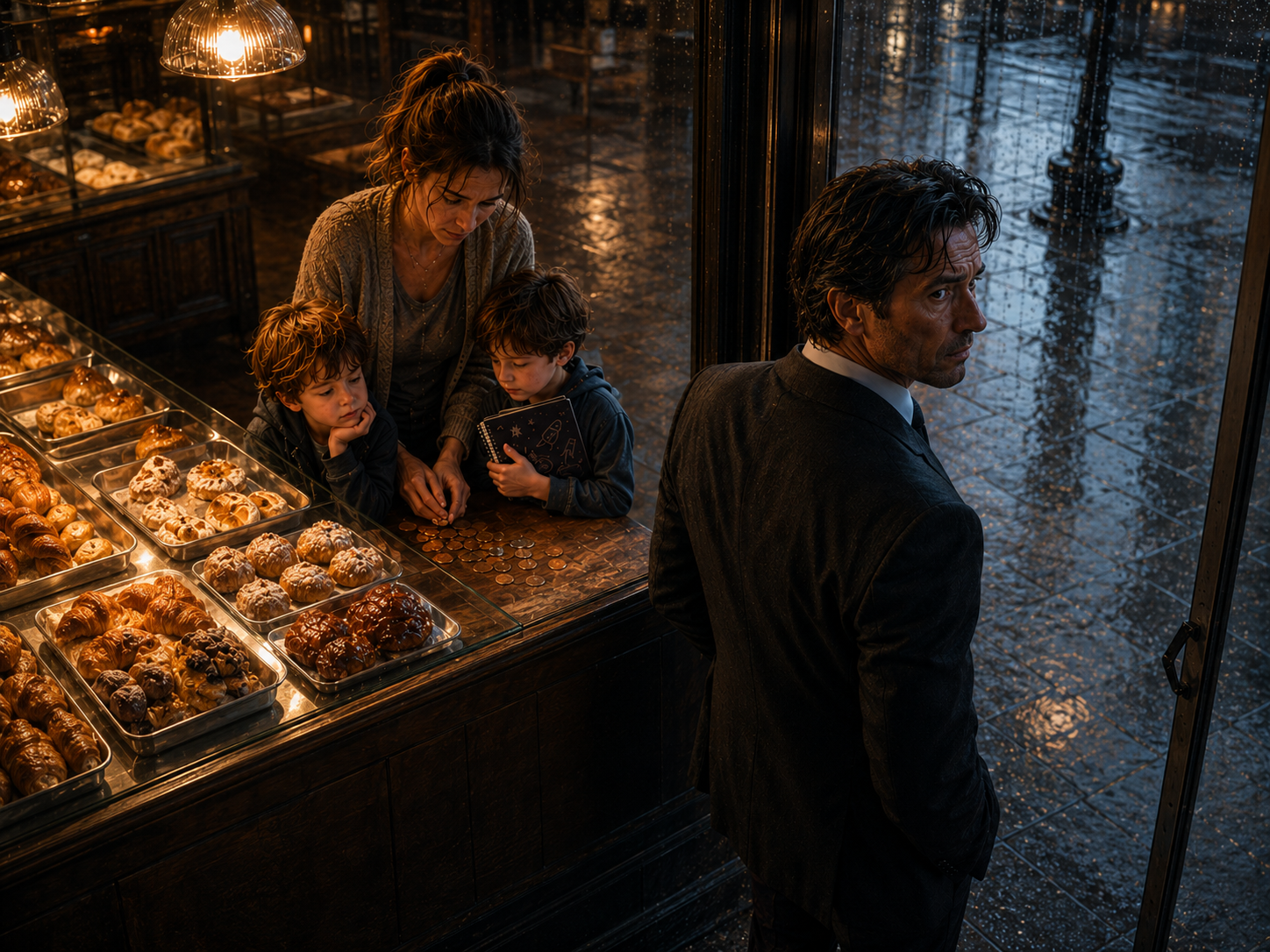
And suddenly he saw another room: a bakery, two boys watching cinnamon rolls, their mother counting coins.
Nathan adjusted the microphone.
“I spent my life believing buildings were proof of success,” he began. “The higher they rose, the more powerful I became.”
The room quieted.
Victor’s eyes narrowed.
Nathan continued.
“But a building is not progress if it crushes the people already standing there.”
Murmurs spread.
The mayor shifted in his chair.
Nathan reached into his jacket and removed the contract.
“This project would displace hundreds of families, destroy a school, close a clinic, and erase a neighborhood that has survived longer than my company has existed.”
An investor stood.
“Nathan, this is not the time.”
Nathan did not look at him.
“I agree.”
He tore the contract in half.
Gasps erupted.
Emma covered her mouth.
Victor rose slowly from his chair.
Nathan tore it again.
And again.
White paper fell across the podium like snow.
In front of cameras, billionaires, politicians, and the father who had shaped him, Nathan Harrison walked away from the deal that would have made him king.
Chaos exploded.
Reporters shouted.
Investors cursed.
Victor limped toward the side exit, already barking into his phone.
Nathan stepped away from the podium and walked straight to Emma.
For a moment, neither of them spoke.
Then Emma whispered, “You just destroyed your company.”
Nathan looked down at the torn paper scattered across the stage.
“No,” he said. “I stopped it from destroying someone else.”
Her eyes searched his face.
The anger was still there.
The hurt too.
But beneath it, something had shifted.
That afternoon, Harrison Development stock plunged.
By evening, the board announced an emergency vote to remove Nathan as CEO.
By night, three banks froze his credit lines.
His name became a headline.
BILLIONAIRE BUILDER SABOTAGES OWN MEGA-DEAL.
HARRISON HEIR IN PUBLIC MELTDOWN.
KING OF CONCRETE CRACKS.
Nathan read none of it.
He was at the hospital.
Noah had collapsed during dinner.
Emma called him by accident.
At least, that was what she said when he answered and heard panic in her voice.
But Nathan was already running.
He reached the emergency room before she finished filling out the paperwork.
Noah lay in a small bed, pale and frightened, an oxygen tube beneath his nose. Ethan sat beside him, clutching the rocket notebook with both hands.
Emma stood by the wall, shaking.
“The doctor says it’s related to the premature birth,” she said. “A complication they’ve been watching. I couldn’t afford the specialist this month. I thought we had more time.”
Nathan felt guilt rip through him.
“What does he need?”
“A procedure. Soon. They’re checking donor compatibility.”
A nurse entered.
“Ms. Parker, we need family medical history.”
Emma hesitated.
Then she looked at Nathan.
The nurse followed her gaze.
Nathan stepped forward.
“I’m his father.”
The words filled the room.
Ethan looked up sharply.
Emma closed her eyes.
Noah, weak but awake, blinked at him.
“You are?”
Nathan’s heart broke and healed in the same breath.
He sat beside the bed.
“Yes,” he whispered. “I am.”
Noah studied him.
“Were you lost?”
Nathan swallowed hard.
“Yes.”
Noah thought about that.
Then he lifted one small hand.
Nathan took it carefully, as if holding glass.
Noah squeezed his finger.
“It’s okay,” the little boy whispered. “Mom finds lost things.”
Emma turned away, crying silently.
And Nathan, who had once believed power meant never needing anyone, bent his head over his son’s hand and prayed like a man with nothing left but love.
PART 6 — The Secret Buried Under the Towers
Noah’s procedure lasted three hours.
Nathan paced every inch of the waiting room until Ethan finally tugged his sleeve.
“Mom says pacing makes holes in the floor.”
Nathan stopped.
Ethan looked serious.
“Do you build floors?”
“I used to.”
“Then don’t break this one.”
For the first time in days, Emma laughed.
It was small. Exhausted. Almost unwilling.
But Nathan heard it like music.
When the doctor finally came out, his expression was tired but kind.
“Noah is stable. The procedure went well.”
Emma covered her face with both hands.
Nathan gripped the back of a chair.
Ethan whispered, “Does stable mean not falling?”
The doctor smiled.
“It means not falling.”
Nathan sank into the chair beside Emma.
Neither of them spoke.
But when her hand slipped from her face, he reached for it.
She let him hold it for three seconds.
Then five.
Then ten.
It was not forgiveness. Not yet. But it was the first bridge across a canyon four years wide.
Two days later, while Noah recovered, Emma brought a folder to Nathan.
“My students collected soil and water samples near the old factory behind the bakery,” she said. “It was for a science project before your donation. The results were strange.”
Nathan opened the folder.
Charts. Notes. Childlike handwriting. Emma’s comments in red pen.
Lead. Benzene. Industrial solvents.
His body went cold.
“Where exactly were these samples taken?”
Emma pointed to a hand-drawn map.
“Here. Here. And here.”
Nathan recognized the locations immediately.
The center of North Crown.
He called his environmental consultant.
By midnight, a confidential report arrived.
Nathan read it twice.
Then a third time.
The North Crown site was contaminated.
Not mildly.
Not legally manageable.
Catastrophically.
And someone had hidden it.
The original environmental assessment had been buried under shell companies tied to Victor Harrison.
If Nathan had signed the contract, his company would have assumed liability. Homes would have been built over poisoned land. Families would have gotten sick. Children would have played on soil that should have been sealed and remediated for years.
Nathan sat in silence.
Emma watched him from across the hospital room.
“What is it?”
He handed her the report.
She read one page.
Then another.
Her face went pale.
“My students found this?”
“Yes.”
She looked toward Noah sleeping in the hospital bed and Ethan curled in a chair beside him.
“The children saved the neighborhood.”
Nathan shook his head slowly.
“No. They saved everything.”
By morning, Nathan released the report to federal investigators, the press, and the city inspector general.
The story detonated.
The headlines changed overnight.
DISGRACED DEVELOPER EXPOSES TOXIC LAND COVER-UP.
HARRISON WALKOUT MAY HAVE PREVENTED PUBLIC HEALTH DISASTER.
CHILDREN’S SCIENCE PROJECT UNCOVERS POISONED DEVELOPMENT SITE.
Victor denied everything.
Then Clara Bennett came forward.
She brought files. Emails. Recorded calls.
And one final envelope.
Inside was proof that Victor had not only buried the contamination report, but had used the North Crown deal to shift liability onto Nathan.
His own father had planned to let him sign the poison into his name.
Nathan read the evidence without expression.
Emma stood beside him.
“I’m sorry,” she said quietly.
He looked at her.
“For what?”
“For the father you had.”
Nathan looked through the hospital window at the sleeping boys.
“I have a different job now.”
“What job?”
He smiled faintly.
“Being the father they have.”
That night, Noah woke and asked for his rocket notebook.
Ethan climbed onto the edge of the bed.
Nathan sat beside them while Noah opened to a page covered in stars.
“This is our spaceship house,” Noah explained. “It has three rooms. One for me. One for Ethan. One for Mom.”
Ethan frowned.
“And maybe one for him.”
He pointed at Nathan.
Nathan’s chest tightened.
Noah considered this seriously.
“He can have the room if he doesn’t disappear again.”
Nathan’s voice cracked.
“I won’t.”
Ethan narrowed his eyes.
“Promise?”
Nathan looked at Emma.
She did not help him.
She made him answer alone.
Nathan placed one hand over his heart.
“I promise. Not because I’m allowed to. Because I choose to. Every day.”
Noah nodded as if accepting a business deal.
“Okay. But you have to learn pancake rules.”
Nathan blinked.
“There are pancake rules?”
Ethan looked horrified.
“There are always pancake rules.”
Emma laughed again.
This time, she did not stop herself.
And for the first time, Nathan saw a future that did not rise into the sky.
It sat around a kitchen table, sticky with syrup, loud with little voices, and stronger than concrete.
PART 7 — The Trial of the King
Victor Harrison refused to fall quietly.
He went on television in a charcoal suit and called Nathan unstable.
He claimed Emma had manipulated him.
He said the contamination report was exaggerated.
Then he made his final mistake.
He attacked the children’s science project.
“A classroom experiment is not evidence,” Victor said with a thin smile. “Children spill juice and call it chemistry.”
Emma watched the interview from her apartment, silent with fury.
Nathan turned off the television.
“He wants a public hearing,” he said.
Emma folded her arms.
“Then give him one.”
The city hearing took place one week later.
Reporters lined the walls. Residents filled every seat. Teachers, nurses, bakery workers, parents, and students stood shoulder to shoulder in the aisles.
Victor arrived with lawyers.
Nathan arrived with Emma.
Ethan and Noah were not supposed to speak.
They had been told to sit quietly.
Naturally, they did not.
When the council chair asked who had first detected the contamination pattern, Emma rose to answer.
But Noah tugged her sleeve.
“Mom, you said scientists tell the truth even when grown-ups are being weird.”
A ripple of laughter passed through the room.
Emma looked at Nathan.
Nathan gave the smallest nod.
So Noah climbed onto the chair, barely tall enough to see over the table.
Ethan stood beside him holding the notebook.
Noah opened to a page of colored dots.
“We tested dirt,” he said. “Some dirt was normal. Some dirt was bad. The bad dirt was where Mr. Harrison wanted to build shiny houses.”
Victor’s lawyer stood.
“Objection. This is absurd.”
Ethan glared at him.
“You can’t object to dirt. Dirt is already there.”
The room erupted.
Even the council chair covered a smile.
Then Emma presented the school’s lab results. Nathan presented the buried environmental report. Clara presented Victor’s emails.
One by one, the lies collapsed.
Victor’s face lost color.
Then Nathan stood.
For the first time in his life, he did not sound like a businessman.
He sounded like a son burying a ghost.
“My father taught me that winning meant taking the highest ground and never looking down. But he was wrong. The ground matters. What is buried there matters. Who gets crushed beneath your ambition matters.”
Victor stared at him with cold hatred.
Nathan held up the forged letter.
“This was buried too.”
The room fell silent.
“This letter cost me four years with my sons. It cost Emma safety, support, and peace. It cost two children a father. And it was done by a man who called cruelty strategy.”
Victor rose.
“You ungrateful fool.”
Nathan looked at him.
“No. Just finally awake.”
Federal agents entered the room before the hearing ended.
Victor Harrison was escorted out past the cameras he had invited.
But the true shock came twenty minutes later.
The city announced that all North Crown contracts were void.
Then the council chair looked directly at Nathan.
“Mr. Harrison, your company cannot develop this land for profit. However, the community has asked whether you would fund remediation and transfer the property into a public trust.”
Nathan looked at Emma.
She searched his face, waiting.
There was no hesitation.
“Yes.”
The room exploded in applause.
But Nathan raised a hand.
“One condition.”
The applause faded.
Emma stiffened.
Nathan turned toward the residents.
“The trust board must be led by the people who live here. Teachers. Parents. small business owners. Not me.”
Then he looked at Emma.
“And the first chair should be Ms. Parker.”
Emma’s eyes widened.
“No.”
“Yes,” said Mrs. Alvarez, the bakery owner from the first day.
“Yes,” called a nurse.
“Yes,” shouted someone from the back.
Soon the whole room was chanting it.
Emma stared at Nathan.
He smiled gently.
“You always built more than I did.”
Tears filled her eyes.
This time, she did not hide them.
Ethan leaned toward Noah and whispered loudly, “Does this mean Mom is queen?”
Noah shook his head.
“No. Mom is the boss scientist.”
Nathan laughed.
Emma laughed too.
And all around them, a neighborhood that had almost been erased began to clap for the woman who had quietly kept it alive.
PART 8 — The House That Concrete Could Not Build
One year later, the old North Crown model was gone.
In its place stood something no investor had imagined.
The poisoned land had been fenced, cleaned, and transformed into the beginning of a public science park. The bakery had expanded into the empty shop next door. The clinic had new equipment. Emma’s school had the best science lab in the district.
And beside the school, rising slowly brick by brick, was a new building.
Not a luxury tower.
Not a private club.
A children’s observatory and family resource center.
Its name was carved above the entrance.
THE ETHAN AND NOAH PARKER-HARRISON CENTER FOR DISCOVERY.
Nathan tried not to cry when he saw it.
He failed.
Emma stood beside him, holding a pair of scissors for the ribbon-cutting ceremony.
“You know,” she said, “you’re ruining your terrifying billionaire image.”
Nathan wiped his eyes.
“I’m retired from terrifying.”
“No, you’re not. You terrified the pancake batter this morning.”
“That batter had structural issues.”
Ethan, now five, ran past them wearing a bow tie and sneakers.
“The pancakes fell because you flipped too early!”
Noah followed with his rocket notebook under one arm.
“Structural issues,” he repeated seriously. “But emotional effort was good.”
Emma laughed.
Nathan looked at her.
A year had changed them.
Not magically. Not easily.
There had been court dates, therapy sessions, hard conversations, and nights when Emma still woke angry over everything stolen from her. Nathan never asked her to rush forgiveness. He showed up. School pickups. Doctor appointments. Bedtime stories. Burned pancakes. Science fairs. Fever nights. Ordinary mornings.
He did not buy his way back into their lives. He earned one small place at a time.
At first, the boys called him Mr. Nathan.
Then Nathan.
Then, one rainy afternoon after he fixed a broken toy rocket, Noah whispered, “Dad,” and pretended nothing had happened.
Nathan had gone into the bathroom and cried for twelve minutes.
Now the ribbon waited.
Reporters gathered.
Residents filled the street.
Mrs. Alvarez handed out cinnamon rolls from silver trays.
Clara Bennett sat in the front row, smiling through tears.
Victor Harrison was awaiting trial and had never again spoken to Nathan.
The mayor stepped to the microphone and began a speech about community resilience.
Ethan yawned.
Noah drew a rocket on the program.
Emma leaned toward Nathan.
“I have something for you.”
She handed him a small envelope.
His heart stopped for half a second.
Another letter.
But this one was new.
On the front, in crooked handwriting, were the words:
To Dad. Not lost anymore.
Nathan opened it carefully.
Inside was a drawing.
A house with four stick figures outside.
Emma. Ethan. Noah. Nathan.
Above them, written in Noah’s careful letters, was one sentence:
Our dad does not build towers anymore. He builds coming back.
Nathan pressed the paper to his chest.
Emma’s voice softened.
“They wrote it together.”
He could barely speak.
“I don’t deserve this.”
Emma looked at the boys, then back at him.
“Maybe not. But they do.”
The mayor called their names.
Emma and Nathan stepped to the ribbon.
Ethan and Noah squeezed between them, each grabbing one handle of the scissors.
“Together,” Noah ordered.
“Yes, boss scientist,” Nathan said.
They cut the ribbon.
The crowd cheered.
But the true ending did not happen in front of the cameras.
It happened later that evening, after the ceremony, when Emma found Nathan alone inside the observatory.
He was standing beneath the unfinished dome, looking up at the first visible stars.
“I used to think being king meant owning everything,” he said quietly.
Emma came to stand beside him.
“And now?”
Nathan looked through the glass at Ethan and Noah chasing each other across the courtyard, cinnamon sugar on their faces.
“Now I think it means being trusted with something you can’t own.”
Emma was silent for a long moment.
Then she slipped her hand into his.
Nathan froze.
She did not pull away.
“I’m not promising the past disappears,” she said.
“I know.”
“I’m not promising this becomes simple.”
“I know.”
She looked at him, eyes bright in the starlight.
“But I am willing to see what we can build.”
Nathan turned toward her.
Not like a king.
Not like a billionaire.
Like a man who had lost everything false and found something real.
Behind them, Ethan shouted, “Dad! Noah says rockets need snacks!”
Nathan laughed, tears in his eyes.
“They do,” he called back.
Emma smiled.
Then Noah ran inside and grabbed Nathan’s hand.
“Come on. You’re part of the launch crew.”
Nathan let himself be pulled toward the door.
At the threshold, he looked back once.
At the observatory.
At Emma.
At the boys.
At the life he had almost missed because someone else had taught him ambition without love.
The world had expected Nathan Harrison to become the King of Concrete.
Instead, he became something far greater.
A father.
A partner in repair.
A man who finally understood that the strongest foundations were not poured beneath towers.
They were built beneath forgiveness, truth, and four chairs around a kitchen table.