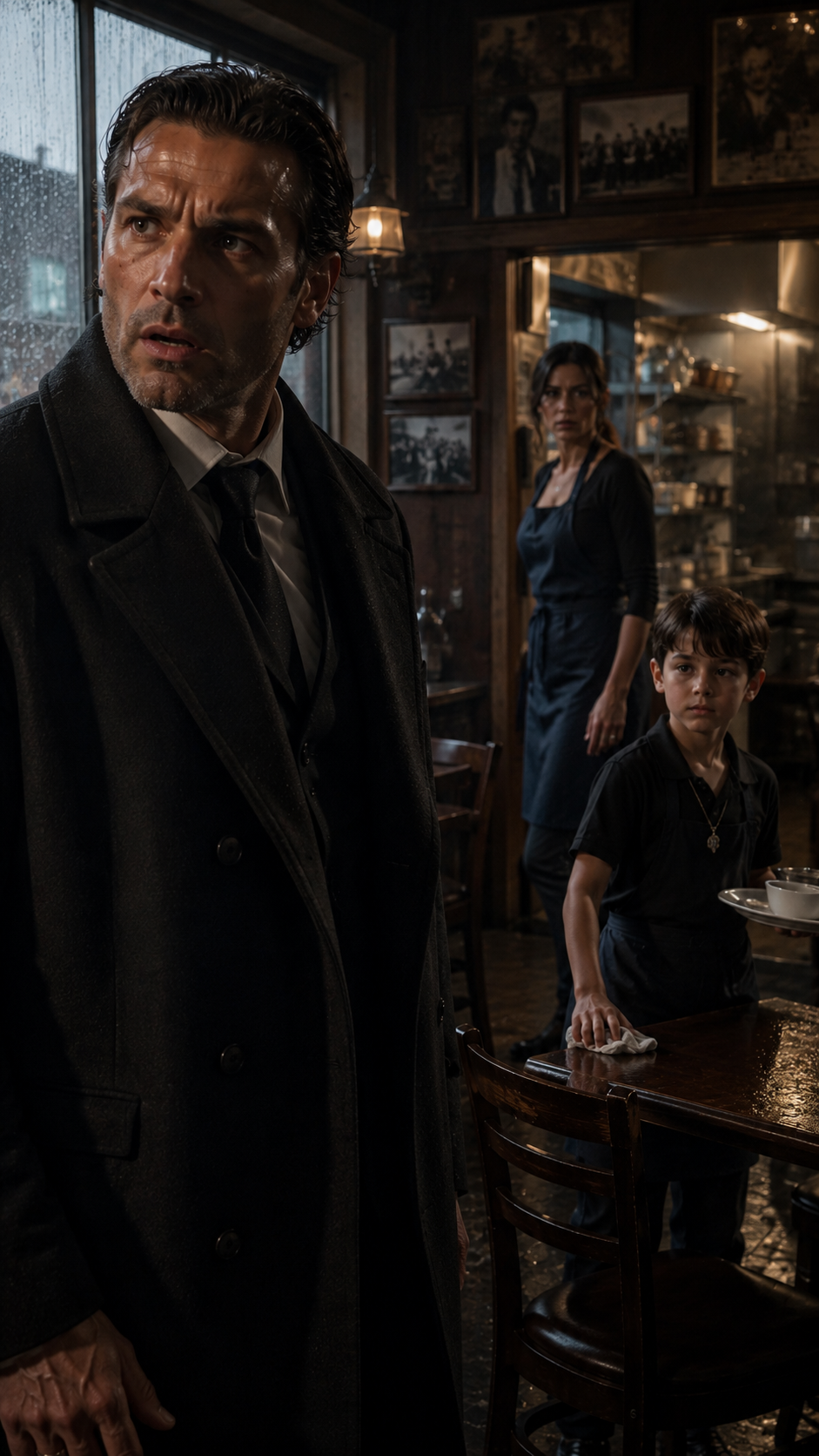
I RAISED A MAFIA KING’S SON ALONE FOR NINE YEARS AFTER A BETRAYER TOLD ME HIS FATHER WOULD DIE—THEN THE BOY’S FATHER WALKED INTO MY BROOKLYN RESTAURANT AND SAW THE CREST AROUND HIS NECK
The message on Ronan Vale’s phone was only three words.
Mercer knows. Move.
That was all it took to turn a quiet Brooklyn afternoon into a race for a child’s life.
Across the restaurant, Noah Hart was sitting at a little table near the kitchen door, doing homework with the serious focus of a boy who had learned too young how to be useful. He had no idea that the man watching him from the corner table was his father. He had no idea that his mother had spent nine years hiding the truth. And he had no idea that somewhere across New York, cars were already moving because one of the most dangerous men in Ronan Vale’s world had just learned the boy existed.
Ronan stood before the phone had even stopped vibrating.
Elena Cross saw his face from across the room, and whatever she had been holding dropped from her hands. Not fear exactly. Recognition. The kind a woman feels when the past she buried finally digs its way back up.
“We need to talk,” Ronan said. “Right now.”
Noah looked up from his homework.
That was the moment everything Elena had built—the restaurant, the apartment upstairs, the routines, the school forms, the dentist appointments, the ordinary life she had fought for with both hands—started collapsing around her.
And it had all begun eleven days earlier, on a rainy Thursday night.
Ronan Vale had not planned to stop at Hart’s Kitchen.
His black Escalade moved through Greenpoint with cars ahead and behind, carrying him toward a waterfront meeting that had already cost men their lives. He had been awake for thirty-one hours. He was hungry, but not in the way men like him admitted. Cipriani and the polished rooms where people saved his table felt like too much performance.
Then Darius, his driver of eleven years, spotted a parking space in front of a narrow little restaurant with fogged windows and a handwritten menu board.
“Pull in,” Ronan said.
Darius did not ask questions.
Inside, Hart’s Kitchen was warm, cramped, and smelled like garlic and something slow-cooked. Seven tables. Old Brooklyn photographs curling on the walls. A chalkboard of specials. Everything about the place looked like it survived on stubbornness.
Ronan took the corner table with his back to the wall. Two men posted near the entrance. The rest stayed outside.
Then he saw the boy.
Maybe nine. Small for his age. Dark hair falling across his forehead. Gray eyes. Moving between tables with a gray plastic bin like he had been doing it for years.
The boy cleared plates carefully. Wiped tables. Reset salt and pepper shakers with almost mechanical precision. Every few seconds, he pushed his hair back with his left hand, two fingers, impatient and exact.
Ronan stopped reading the menu.
The gesture was his.
Then the boy reached beneath his collar and touched something at his throat.
Ronan’s fork went still.
He knew that movement too. His father had done it. His uncle had done it. Ronan himself had done it for years when he still wore the family crest before the weight of it became too much.
He called Darius over with a look.
“The boy clearing tables,” Ronan said quietly. “What do you see?”
Darius looked once and saw a child.
“Keep looking,” Ronan said.
Darius watched the posture, the chin, the eyes, the way the boy stood like trouble was expected but not feared.
Then Darius went quiet.
A woman came out of the kitchen in a faded navy apron, carrying plates like her body knew every step without thinking. Dark hair pinned back. Early thirties. Tired in the way people get when survival has been their schedule for years.
She did not look toward Ronan at first.
When she finally came to his table, her eyes were on her notepad.
Then she looked up.
The question died in her throat.
Ten years disappeared in a single second.
“Elena,” Ronan said.
Elena Cross went white.
“No,” she whispered. “No, no, no.”
Her eyes cut across the room to the boy.
Ronan saw it. The protective panic. The involuntary glance that told him everything before she said a word.
“What’s his name?” he asked.
“Not here,” Elena said, barely breathing. “He’s right there. Not here, Ronan.”
“What’s his name?”
Her fingers tightened around the notepad.
“Noah,” she said.
Ronan looked across the room at the boy with his gray eyes, his dark hair, his posture, and the hidden thing beneath his shirt.
Something inside him tore open in a way ten years of violence had never managed.
He stood, left enough cash to cover the meal three times over, and put on his coat.
“I’m coming back tomorrow morning,” he said. “You’ll be here.”
It was not a question.
He did not sleep that night.
By seven the next morning, Marcus Hail had a preliminary file on Hart’s Kitchen. The restaurant had been operating six years under Elena Cross’s name. The lease payments were consistent but stretched. She had one part-time employee. She worked the kitchen and front of house herself. Before that, five years waitressing in Brooklyn and Queens. Before that, records that were thin in the way records get when someone is trying not to be found.
Noah Hart. Age nine. Born nine months after Elena vanished.
No father listed.
Ronan drove back to Brooklyn without the convoy. Only Darius and one other man.
Elena was prepping before opening when he walked in.
“You’re early,” she said.
“You knew I’d come.”
She looked older than the woman he remembered, but not beaten. Elena Cross had never looked beaten. She looked tired in the deep-tissue way that came from years of not enough sleep and too much worry.
“How long?” Ronan asked.
She knew what he meant.
“From the beginning,” she said. “I knew before he was born.”
“You never contacted me.”
“No.”
“For nine years.”
“Yes.”
The anger was there. Real. Deep. But Ronan kept it in his voice like a blade kept in a sheath.
“Why?”
Elena set down the cloth in her hand.
“Because I was told you were going to die.”
The people around him, she said, had made it clear. If she stayed, she would be used to get to him. He would be dead within a month. If she disappeared quietly, he would survive.
“I chose for you to survive,” she said.
“Who told you that?”
She hesitated.
“Elena.”
“Victor Mercer,” she said. “He said he was protecting both of us.”
Ronan’s face went cold.
“Victor Mercer worked for me.”
Elena’s expression shifted—not surprise, but the confirmation of something she had feared for years.
“I figured that out later,” she said quietly. “When it was too late to undo any of it.”
Mercer had run logistics for Ronan’s East Side operation. He was useful, careful, and smart enough to be dangerous. Eight years earlier, he had left the organization with a story about private consulting, and Ronan had let him walk.
Now that choice looked like one of the most expensive mistakes of his life.
“I want to meet him,” Ronan said.
“No.”
“He’s my son.”
“He doesn’t know that.” Elena’s voice cracked, then steadied. “He doesn’t know anything about you. He thinks his father is gone. He has a routine. A school he likes. He’s fine.”
“He’s clearing tables at nine years old while you work yourself into the ground.”
Her eyes hardened.
“Don’t.”
“I’m not attacking you.”
“I know exactly what you’re saying. But you walking into his life and telling him you’re his father—do you understand what that does to a child?”
“You don’t get to decide this alone anymore,” Ronan said.
The words were quiet. That made them worse.
Elena asked for weeks.
Ronan gave her two.
During those days, the investigation turned from Elena to Mercer. Marcus uncovered the ugly truth fast. Mercer had not retired. He had built a parallel network using the architecture he copied from Ronan’s organization—port contacts, suppliers, money launderers, shell companies, offshore routes. Piece by piece, he had stolen the bones of Ronan’s empire.
And he had begun by removing Elena.
She had been the one person who might have made Ronan careful. Settled. Human.
Mercer needed Ronan broken enough to build on rage.
On the ninth day after the restaurant, Elena allowed Ronan to come in as a customer during a slow afternoon. No introduction. No truth. Just presence.
Noah was doing homework near the kitchen door.
He looked up and found Ronan watching.
“Are you a friend of my mom’s?” Noah asked.
Ronan felt the question like pressure behind his ribs.
“Not yet,” he said.
Noah considered that and went back to his homework.
Ronan sat with cold coffee and realized that the most feared man in New York was afraid of a nine-year-old boy with a pencil in his hand.
Then Marcus sent the message.
Mercer knows. Move.
Ronan crossed the restaurant in four steps.
“How many exits?” he asked Elena.
“What?”
“Back door. Windows. Service entrance. How many ways out?”
She saw his face and stopped asking the wrong questions.
“Back door through the kitchen to the alley. Fire escape off the second floor. That’s the apartment.”
“You live upstairs?”
“Yes.”
He turned to Darius.
“Back exit. Car in the alley. Two minutes.”
Elena stepped closer.
“Ronan, tell me what’s happening.”
“Mercer knows about Noah.”
The blood left her face.
She recovered in seconds, which told Ronan how many years she had spent mastering fear alone.
“We’re leaving,” he said. “Pack one bag. Ten minutes. Things Noah needs. Nothing else.”
She wanted to argue. Then she looked at him and understood there was no room for argument.
Ronan went to Noah.
The boy had already put his pencil down parallel to the textbook.
“Something’s wrong,” Noah said.
Not a question.
“Your mom needs to take you somewhere for a couple days,” Ronan said.
“Where?”
“Somewhere safer than here.”
Noah looked at him.
“Are you the reason it’s not safe?”
The question hit hard.
Ronan crouched to his level.
“No,” he said. “But I’m the reason it’s going to be safe again.”
Noah touched the thing beneath his collar.
Then he nodded.
“Okay.”
The apartment above Hart’s Kitchen told the story of Elena’s life better than anything she could have said. Two bedrooms. A secondhand couch. Noah’s library books organized by size. A corkboard with school schedules, shift reminders, groceries, and a dentist appointment written in Elena’s hand.
This was not a woman waiting for rescue.
This was a woman who had built a life one exhausted day at a time.
She texted Carla, the woman who helped with morning prep, saying only that there was a family emergency. Ronan told her to keep it brief because Mercer monitored calls.
Then they left through the kitchen, out the alley, into a black sedan.
Noah sat pressed against Elena’s side without making a show of it.
“Where are we going?” she asked.
“My place,” Ronan said.
“It’s secure. Eight-man rotation. Controlled access. Safest building in Manhattan.”
“That is exactly the kind of sentence I’d expect you to say without irony,” Elena said.
From the back seat, Noah asked quietly, “What’s a mafia penthouse?”
Elena closed her eyes.
Ronan did not answer.
The penthouse took up the top two floors of a building on 57th Street. Views meant nothing to Ronan, but Noah pressed his face to the glass. Manhattan spread below him like scattered light.
“This is your house?” Noah asked.
“One of them.”
“How many houses do you have?”
“Noah,” Elena warned.
“Four,” Ronan said.
Noah did not gasp. He assessed it, filed it away, and turned back to the window.
Ronan recognized the habit because it was his own.
That night, after Noah fell asleep in his clothes, Elena sat on the far end of the couch while Ronan stood by the window.
“Tell me everything about Mercer,” she said.
He told her the truth.
Mercer’s network. His copied contacts. His money structures. His movements.
When Ronan finished, Elena said, “He needed me gone so you’d burn everything down.”
Ronan did not answer.
She gave a soft, humorless sound.
“I think you built a bigger empire on the wreckage and told yourself it was strength,” she said. “I think you did exactly what he expected you to do.”
She was not wrong.
“I grieved you,” Elena said. “Not your death. You. The version of you before all this.”
“And the version standing here now?”
She looked at him.
“I don’t know him yet.”
By morning, Mercer had moved faster than expected. Marcus arrived with names of two outer-network contacts Mercer had reached. Ronan ordered them handled quietly and increased security.
Then Marcus mentioned the lawyers.
With Noah’s existence known, there were succession concerns. A legitimate blood heir changed everything. Anyone positioned to inherit influence after Ronan now had a different calculation.
Ronan said nothing would change until he said it changed.
Minutes later, Noah walked into the kitchen in yesterday’s clothes, carrying his textbook.
“Is there coffee?” he asked.
“How old are you?” Ronan said.
“Nine. I don’t drink coffee. I was asking for my mom.”
Ronan made it.
Noah sat at the counter.
“What do you do?” he asked.
“I manage assets,” Ronan said.
Noah opened his textbook.
“My mom says when something sounds boring, it usually means it’s actually complicated.”
Then Ronan’s phone rang.
Marcus again.
“They made a move on the restaurant twenty minutes ago,” Marcus said. “Accelerant. Kitchen damage. Carla was inside.”
Ronan’s hand tightened.
“Status?”
“Minor burns. She got out.”
It was not just an attack. It was a message. A test to see who ran back to the scene.
Ronan made a decision.
“Call the Vale lawyers,” he said. “Prepare the family declaration. Full formal recognition.”
Marcus went quiet.
“That will be public.”
“That’s the point.”
If Mercer already knew, Ronan would not hide Noah. He would place him under the full protection of the Vale name and let every enemy understand the cost of touching him.
Elena came in and saw his face.
“What happened?”
“Hart’s Kitchen,” he said. “There was a fire. Carla’s okay. The restaurant took damage.”
Elena stood there holding herself together while six years of work burned inside her mind. The chalkboard. The photographs. The table where Noah did homework. The place that had kept them alive.
“Okay,” she whispered.
Then Ronan told her about the declaration.
“You’re publicly claiming him,” she said.
“Yes.”
“Without telling him who you are first.”
Silence landed hard.
She was right.
He had made the tactical move without consulting her. He had done exactly what she feared he would do.
“You made a decision about my son,” Elena said, “without asking me.”
“I had forty seconds and I used them wrong,” Ronan said. “It won’t happen again.”
Elena turned to Noah.
“Go get your shoes.”
“Why?”
“Because we’re going to have a conversation, and you should have shoes on for it.”
Noah looked between them and went.
When he returned, Elena led the truth. Ronan followed her pace. Noah sat very still as she explained that his father was alive. That Ronan had not known about him. That she had made choices she believed would protect him.
Noah listened like a child holding something too large.
Then he looked at Ronan.
“You didn’t know I existed?”
“No. Not until eleven days ago.”
“When you came into the restaurant?”
“Yes.”
Noah thought for a moment.
“The man before that,” he said. “Three weeks ago. The one who asked Mom too many questions about the lease. Was that you too?”
Ronan went still.
“No.”
Noah described him. Medium height. Gray at the sides. A ring he kept turning. Paid twenty dollars for a three-dollar coffee and never drank it.
Mercer had been watching before Ronan ever found them.
Then Ronan understood.
Mercer had wanted him to find them. Wanted Ronan to move Elena and Noah into his most fortified address. Wanted the penthouse to become a fixed target.
“The penthouse is compromised,” Ronan told Marcus. “We move secondary.”
He gave Marcus one clean address—a property under Callaway LLC, disconnected from Vale.
Forty minutes later, Marcus called back.
The Callaway address had been hit four minutes after Ronan gave it.
Only Marcus knew.
Ronan lowered the phone.
“Marcus is compromised.”
Elena’s duffel hit the floor.
“Marcus has worked for you for twelve years.”
“Yes.”
Mercer had the restaurant. The penthouse. The security rotation. The safe houses. The inner architecture of Ronan’s world.
Every file Marcus touched was poison.
So Ronan chose the only people outside Marcus’s reach: Darius, two outer-ring men named Cullen and Rafe, and Elena herself.
“You’ve been operating independently for nine years,” he told her. “You know how to move without leaving a pattern.”
They left through the service infrastructure in a plain white cargo van. No Vale vehicles. Nothing registered to the network.
Noah sat in the back with his textbook in his lap, not reading.
“The thing around my neck,” he said without looking at Ronan. “Mom always said it was from my dad.”
Ronan waited.
“It’s a crest,” Noah said. “I looked it up once. Vale family. Old lineage. Mostly private records. I knew for about two years.”
Elena turned to him.
“Noah…”
“I didn’t say anything because you weren’t ready to say anything,” he said.
There was no blame in it. Just a boy who had waited for the adults to catch up.
The safe place in Queens belonged to Stella Vain, a retired immigration attorney who had once done quiet work for Ronan. Her narrow house in Woodside looked unremarkable from the street, but the basement had been professionally soundproofed, and Stella was the kind of woman who kept emergency plans without discussing them.
She looked at Noah and asked, “Are you hungry?”
Noah said yes.
While Stella fed him, Ronan used her landline to call Holt, the one federal contact he trusted outside his compromised world.
Holt already knew more than Ronan expected. Federal intercepts had been tracking Mercer for eight months. Money laundering through shell corporations. Port contacts in Newark and Baltimore. Operational movement in the last week.
Then Holt said something that stopped Ronan cold.
They had flagged irregular communication between Marcus Hail and a Mercer-linked number four months earlier.
Four months.
Ronan asked for federal cover for Elena and Noah.
Holt offered a witness facility upstate.
“No facility,” Ronan said. “Elena won’t accept that.”
“Then what?”
“Plainclothes protective detail. Mobile. Rotating. They need to keep normal movement as much as possible.”
Holt went quiet.
“You know her well.”
“I knew her,” Ronan said.
Then he looked through the kitchen doorway and saw Elena beside Noah, hand on the back of his chair, exhausted and vigilant.
“And now I’m learning.”
The ordinary sounds of Stella’s kitchen lasted only minutes.
Then Cullen appeared in the hall.
“Rafe made a call.”
Ronan’s blood went cold.
“When?”
“Twenty minutes ago. Short call. Cell phone.”
They had been in Stella’s house thirty-five minutes. Mercer now had their location.
Ronan sent Elena and Noah to the basement with Cullen.
Then he confronted Rafe.
The twenty-six-year-old had the look of a man caught too late. Ronan took his phone. Unknown number. Thirty-eight seconds.
Rafe had been a standby asset. Mercer had approached him months ago. Offered money and a place in his network. Activated him the moment a clean location appeared.
“There are cars coming,” Ronan said.
Rafe said nothing.
That was answer enough.
Stella handed Ronan a key and told him about the tunnel behind the water heater. It connected the basement to the garage on the next property, where a blue Ford waited under a registration Ronan would not recognize.
Of course Stella had a tunnel.
Of course she had a bag packed.
Elena wanted to stay when Ronan told Cullen to take her and Noah through.
“Noah goes through that tunnel right now,” Ronan said. “Everything else is negotiable. That isn’t.”
She looked at him for half a second full of things they had no time to say.
Then she took Noah.
Ronan watched his son disappear behind the water heater.
Then he went upstairs.
The first SUV arrived four minutes later. Another came from the opposite direction. Eight men, maybe more, bracketed Stella’s house.
Then Mercer came himself.
Sixty-one years old. Straight-backed. Deliberate. A man who still carried himself like fear was an insult.
Rafe opened the door and tried to sell his lie.
Mercer listened. Then his eyes scanned the street.
They stopped where Ronan hid.
One word from Mercer, and the street erupted.
Ronan ran.
Shots cracked against the night. He cut through yards, vaulted chain-link, tore his palm, and moved through side streets with a stolen radio in his pocket. Cullen texted one word: moving.
Elena and Noah were clear of the tunnel.
That was the only fact that mattered.
Ronan climbed a walk-up, took down an elevated shooter on a fire escape, took his weapon and radio, and left him zip-tied to the railing rather than kill a young fool who had taken Mercer’s money.
Then he called Holt.
“Mercer is physically present,” Ronan said. “Woodside. Minimum eight men.”
“Federal assets are twelve minutes out,” Holt said.
Twelve minutes was too long.
Ronan circled back, used Mercer’s own radio channel to send a false sighting on Denton Avenue, and pulled three men away.
Mercer did not fully believe it. But his men moved anyway.
Now the numbers were smaller.
Ronan ran open ground.
A shot from the sedan driver passed so close he felt the air beside his ear. He slammed behind the stone pillar at Stella’s front steps, pain exploding through his shoulder.
Mercer stood fifteen feet away.
“Still doing the math?” Mercer called.
“Always.”
Mercer spoke like a man discussing business, not murder. Noah’s existence was a succession event. It reorganized the network. It changed every alliance, every future plan.
“Then you understand why I can’t allow it,” Mercer said.
“He’s nine years old,” Ronan said.
“I burned a restaurant to send a message,” Mercer replied. “The child and his mother disappear. You go back to running your operation. Nothing changes that needed to.”
“He’s my son.”
That ended the polite fiction.
Mercer ordered his men to take Ronan.
The fight was fast and brutal. Ronan dropped one, broke the grip of another, and paid for it with his shoulder. A shot shattered stone near his feet. The Denton Avenue team was coming back.
He had one clean exit.
The tunnel.
Ronan went through Stella’s house, down into the basement, through the low concrete passage, and out into the garage next door.
Cullen had gotten Elena and Noah away.
Federal teams arrived behind him, rolling up Mercer’s Queens element.
But Mercer escaped.
At a diner rendezvous before dawn, Elena sat with Noah while Ronan explained the truth. Mercer had gone to ground. Federal protective detail was active, but Mercer knew too much about protocols to trust waiting.
“So what do we do?” Elena asked.
Ronan looked at her, then at Noah.
“We stop waiting for him to come to us.”
He knew where Mercer would go.
Red Hook.
Years earlier, when Mercer ran operations inside Ronan’s network, he had used a decommissioned shipping terminal for work he wanted off the books. Ronan had found it after Mercer left and decided the departure was clean enough.
Another mistake.
Now Mercer would run there because it belonged to him. No file. No Marcus. No standard safe-house trail.
“He’ll expect you,” Elena said.
“Yes.”
“He’ll have men.”
“Yes.”
“And you’re going anyway.”
“I’m going before he regroups and makes another run at Noah.”
Noah said quietly, “I want to come.”
“No,” Elena and Ronan said together.
Noah looked between them.
“I can help.”
“You are helping,” Ronan said. “By staying alive.”
Ronan went to Red Hook alone with a bad shoulder and a small window.
The old terminal was dark and cold, full of concrete, support columns, rusted equipment, and harbor wind. He entered through the west side, moving along walls and shadows. One man at the interior door went down quietly. Another watched from a catwalk above.
At the far end, a battery lantern glowed in an old glass-walled operations room.
Victor Mercer stood beside it with two men.
Marcus Hail sat against the far wall.
When Ronan stepped into the light, Mercer did not look surprised.
“I thought you’d come here,” Mercer said.
“I know you did.”
Ronan counted the room. One man at the interior door. One catwalk. Two with Mercer. Four total.
“You came with four men because you ran out of moves,” Ronan said.
Mercer’s Queens operation was gone. His communications advantage was gone. Marcus was blown. Holt’s teams were closing city exits.
Mercer still believed he had twenty minutes.
He wanted to talk, and Ronan let him because talking was time, and time was leverage.
Mercer said Ronan had spent his life building. Networks. Alliances. Structures. But one boy clearing tables in Brooklyn had made all of it secondary.
“A child exists,” Mercer said, “and you become a different person in eleven days.”
Ronan told him not to talk about Noah.
Mercer said he had thirty years invested in a future Noah eliminated.
“What would you have done?” Mercer asked.
“I wouldn’t have burned the restaurant,” Ronan said.
Then Ronan shifted the board.
He told Mercer there was still a deal to be made—not with Ronan, but with Holt. Information on the network in exchange for staying alive long enough to matter.
Mercer understood leverage when it was real.
He ordered his men to step back.
Ronan called Holt.
Three minutes later, terms were spoken and acknowledged. Mercer chose the option that kept him alive. His men set down their weapons.
Federal agents arrived four minutes later, which meant Holt had been closer than promised. Ronan chose not to argue.
Mercer was cuffed without incident.
Marcus walked out under federal guard. When he passed Ronan, he stopped.
“Twelve years,” Marcus said.
“I know.”
“I don’t have anything to say that’s going to—”
“Then don’t say it,” Ronan said.
Marcus nodded once and walked away.
Holt came to Ronan’s side and looked at his shoulder.
“You need a hospital.”
“Later.”
“Now, ideally.”
“I said later.”
“Is it done?” Ronan asked.
“Mercer’s in custody,” Holt said. “His network will take months to map, but the operational leadership is gone tonight. Yeah. It’s done.”
Only then did Ronan call Cullen.
“It’s over,” he said. “Bring them home.”
He ended up at the hospital because Elena made him.
At 4:40 a.m., she arrived at the diner with Noah and Cullen. She saw the way Ronan held his arm, put one hand on his good side, and told Cullen to drive to the nearest emergency room.
Ronan tried to argue once.
Elena gave him a look.
He stopped.
The shoulder was not broken. Two ligaments badly pulled. One partially torn. A bone bruise. Three weeks in a sling and physical therapy after.
When Ronan came out, Noah studied the sling.
“Does it hurt?”
“Some.”
“You should have asked for something stronger,” Noah said.
“I’ll be fine.”
“I know,” Noah said. “I was just saying.”
They did not go back to the penthouse.
Elena chose a house in Park Slope. Ronan bought it through a clean structure she approved only after reading every page. It had enough room for Noah, enough exits for Ronan, and enough ordinary life for Elena to breathe.
The days after Mercer’s arrest were not simple.
Noah had questions. He asked them directly. Some were for Elena. Some were for Ronan. Some hurt both of them.
Why didn’t she tell him sooner?
Why didn’t Ronan find them?
What did the name Vale mean now?
Was he safe?
Could a person be someone’s father after eleven days?
Elena answered what belonged to her. Ronan answered what belonged to him. When Noah was angry, they let him be angry. When he went quiet, they did not crowd him. When he reached for the crest at his throat, Ronan noticed and said nothing.
Hart’s Kitchen took weeks to repair.
Elena refused to let Mercer’s fire decide what the place would become. The photographs of old Brooklyn went back on the walls. The handwritten menu board returned to the window. The corkboard went back up with school reminders and dentist appointments.
She reopened on a Thursday in March to a full house.
Carla came back. Three new evening staff joined because the neighborhood had heard what happened and showed up. Some came out of loyalty. Many stayed because Elena’s food made them feel at home.
Ronan sat at the corner table where everything had begun.
He drank coffee. He ate the food. He watched Elena move through the room with the same strength that had carried her for nine years.
Noah worked tables on weekends. Still meticulous with salt shakers. Still carrying the gray plastic bin with grave focus. Still pushing his hair back with two fingers like it was a problem to be handled later.
One evening in early summer, the three of them walked home through Brooklyn.
Noah was between them with a book under his arm, talking about a school project on New York history. Elena laughed at something he said. A real laugh. Easy.
At the corner, Noah stopped.
“Are we staying here in Brooklyn for now?” he asked.
“Does that work for you?” Elena said.
He thought about it.
“Yeah.”
Then he looked at Ronan.
“Are you here too? Like actually here?”
Ronan looked at his son, standing under a streetlight with the crest at his throat and eyes that had waited two years for the truth.
“Yeah,” Ronan said. “Actually here.”
Noah nodded, satisfied, and started walking again.
Ronan and Elena followed.
Their hands were close at their sides, not touching yet.
That would come.
It was already coming.
Six months after the rain, after the boy in the restaurant, after the lie that stole ten years, Ronan stood on the roof of the Park Slope house at seven in the evening. Manhattan was visible in the distance, but for once it did not pull at him.
Behind him, the door opened.
Elena stepped onto the roof.
Noah was downstairs, doing homework.
For a while, neither of them spoke.
Then Elena came to stand beside him.
“You’re different,” she said.
Ronan looked out over Brooklyn.
“I’m trying to be.”
She did not say she forgave him. Forgiveness was not a switch. It was not something a person handed over because the danger had passed.
But she stood beside him.
That was enough for the moment.
Below them was the life she had built without him.
Ahead of them was the life they might build carefully, slowly, without pretending the missing years had not happened.
And somewhere inside the house, Noah Vale Hart—Elena’s son, Ronan’s son, the boy who had carried the truth around his neck long before anyone was ready to say it—kept doing his homework, safe enough for the night.
Source transcript and rewrite instructions: