Part 2
For a few seconds, no one spoke.
Dylan stared at the photograph on the counter as if it had been pulled from the bottom of a grave. The younger version of him in the image looked thinner, sharper, with longer hair and a leather jacket I had never seen. He stood across the street from my mother’s old apartment, his head turned toward the second-floor window where she and I had lived.
Ten years before he had supposedly met me at a bookstore.
Ten years before he had smiled over a stack of used novels and said, “You look like someone who knows where the good stories are.”
My stomach twisted.
“You followed me,” I whispered.
Dylan’s eyes lifted to mine.
“Claire, listen to me.”
“No.” My voice cracked, but I did not look away. “You knew who I was before you ever spoke to me.”
His mouth opened, then closed.
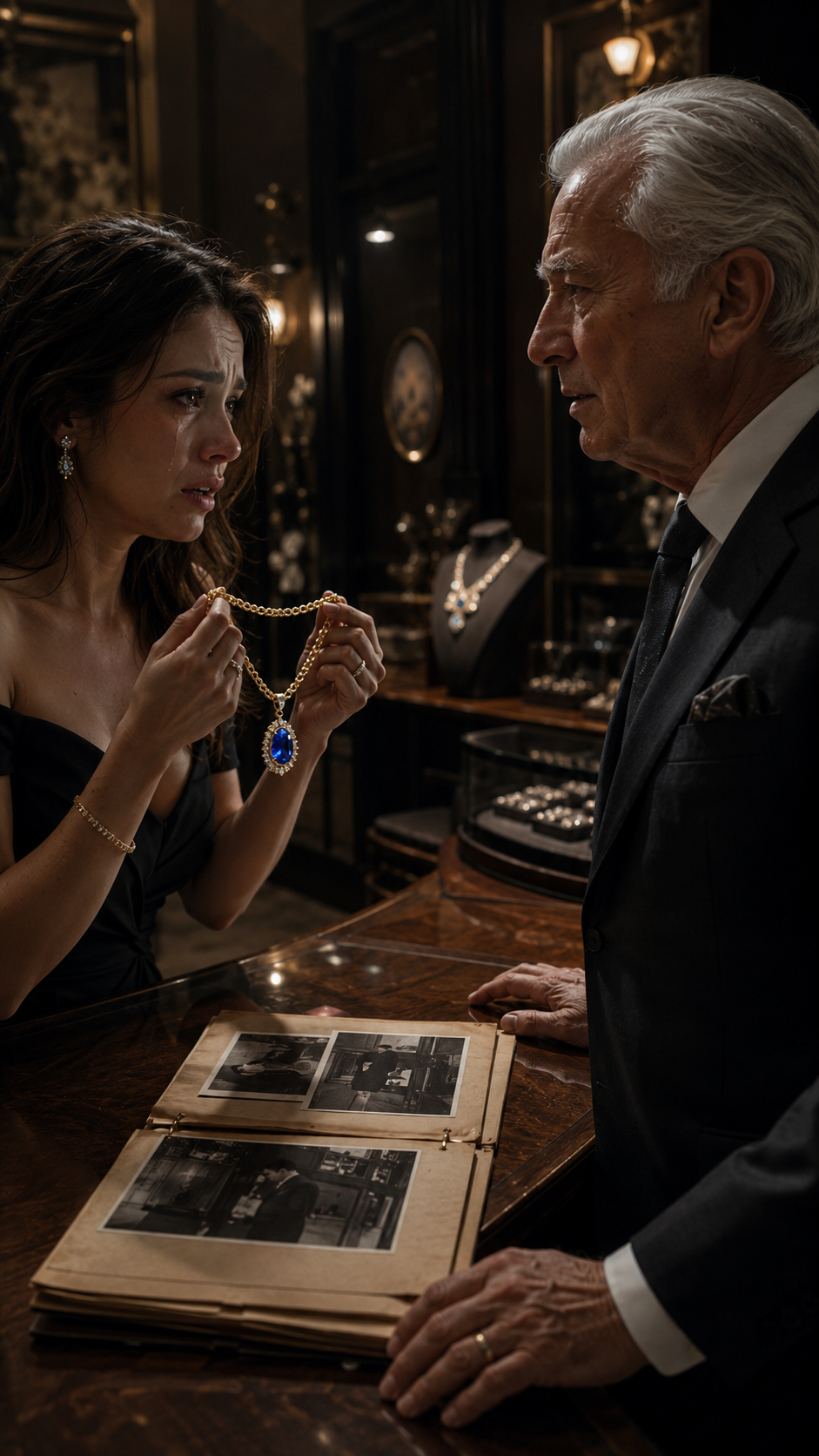
Edmund Quillan slid the photograph back into the folder with careful fingers. “Mr. Harper, this shop is under private security. The authorities have already been notified.”
Dylan gave a short laugh, but it sounded hollow. “Authorities? For what? Standing outside an apartment ten years ago?”
“For fraud,” Edmund said. “Conspiracy. Attempted coercion. And possibly much more, once we know why your family has been watching Miss Pearson since childhood.”
Dylan’s face changed at the word family.
There it was again.
A crack.
“Your father,” Edmund continued, “was an associate of Lionel Voss, the attorney who tried to seize the Ashborne estate after Margaret disappeared.”
I gripped the edge of the counter harder.
“Who is Lionel Voss?”
Dylan looked at me quickly. “Don’t listen to him.”
Edmund did not raise his voice. He did not need to.
“Lionel Voss was Theodore Quillan’s former legal adviser. He drafted the original trust documents, then attempted to alter them after Margaret vanished. When the court refused, he claimed Margaret was dead. When that failed, he claimed she was mentally unfit. When that failed too, he disappeared from public practice.”
The jeweler, silent until now, turned the necklace under the lamp. The blue pendant caught the light like deep water.
Edmund looked at Dylan. “And ten years later, Voss’s protégé’s son married Margaret’s daughter.”
Dylan’s jaw flexed.
I stepped back from him as though something poisonous had spilled between us.
“Our whole marriage,” I said. “Was any of it real?”
For the first time, Dylan looked almost angry that I had asked.
“Nine years is a long time to fake a life.”
“But you did.”
His eyes hardened.
“I did what I had to do.”
The words chilled me more than any denial could have.
One of the guards opened the door as two uniformed officers entered the jewelry shop. Dylan turned toward them, then back to me.
“Claire,” he said quietly, desperately now, “whatever they tell you, ask yourself one thing. Why would your mother rather live poor, scared, and alone than come back to them?”
Edmund’s expression did not change, but something behind his eyes tightened.
Dylan saw it too.
He smiled faintly.
Then the officers took him by the arms.
As they led him out, Dylan twisted his head over his shoulder and called back, “Ask Edmund where your father is buried.”
The bell above the door rang once.
Then he was gone.
The silence he left behind was worse than his presence.
I turned to Edmund slowly.
“My father?”
Edmund shut the folder.
“We should not discuss that here.”
A bitter laugh escaped me. “Of course not.”
“Claire—”
“No. You don’t get to say my name like you know me. Twenty minutes ago, I was trying to sell my dead mother’s necklace so I wouldn’t be evicted. Now my ex-husband may have married me for an inheritance, my mother had another name, and apparently my father is part of this too.”
The jeweler lowered his eyes.
Edmund looked older then. Not powerful. Not polished. Just tired.
“You deserve the truth,” he said.
“I deserved it years ago.”
“Yes,” he answered softly. “You did.”
That was the first thing anyone had said all day that sounded honest.
Edmund took me from the shop through a back entrance into a black car waiting in the alley. I should have refused. I should have run. But I had nowhere to go except a rented room with a red notice taped to the door and a life Dylan had already invaded.
So I sat in the back seat clutching my mother’s necklace while Portland blurred past the tinted windows.
Edmund did not speak until we crossed the bridge.
“Your grandfather is alive,” he said.
I turned sharply. “You told the jeweler the master had been searching for me.”
“Theodore Quillan. Your mother’s father.”
My throat tightened.
“Why didn’t he find us?”
“Because Margaret was good at disappearing. Better than anyone expected. She changed her name, avoided banks, avoided hospitals when she could, paid cash, moved often. By the time we found a trace, she was gone again.”
“My mother clipped coupons,” I said. “She wasn’t some fugitive mastermind.”
“She was a frightened woman protecting her child.”
I looked down at the pendant.
“What happened to her?”
Edmund’s gaze stayed on the road ahead.
“She was supposed to inherit control of the Ashborne Trust on her twenty-fifth birthday. One week before that, her car was forced off a coastal road. Her husband was with her.”
“My father.”
“Yes.”
I waited.
Edmund’s voice lowered. “His body was recovered. Hers was not. Three months later, your grandfather received an unsigned photograph of Margaret holding you. On the back were the words you saw today.”
Keep her hidden until it is safe.
Safe from whom?
The car turned through iron gates set into a wall of dark stone. Beyond them stood a house so large it barely seemed real. Ashborne House rose from the hill like something carved out of fog and old money, all slate roofs, narrow windows, ivy, and cold symmetry.
My mother had come from this.
My mother, who saved glass jars and patched my school backpack with blue thread.
A woman in a black dress met us at the door. She was thin, severe, and pale, with gray hair pulled into a knot.
“This is Mrs. Vale,” Edmund said. “She manages the house.”
Mrs. Vale looked at me, and her stern face softened for half a second.
“You have her eyes,” she said.
No one had ever told me I had my mother’s eyes. People usually said I looked tired.
Inside, the house smelled of polished wood, old flowers, and rain. Portraits lined the walls. Quillans and Ashbornes stared down at me from gilded frames, their faces proud and distant.
Then I saw her.
My mother.
Not the woman I knew in grocery-store sneakers and faded cardigans, but young Margaret Ashborne Quillan in a silver gown, her chin lifted, the blue pendant resting against her throat.
I stopped beneath the portrait.
She looked like a stranger.
And yet, beneath the paint and pearls, I could see the small sadness at the corner of her mouth. The same sadness she wore when she thought I was asleep.
Mrs. Vale led me upstairs to a room prepared with fresh clothes, towels, and a bed wide enough for three people. Everything was cream and gold and too soft.
On the dresser sat a silver tray with tea, sandwiches, and a folded envelope.
My name was written on it.
Not Claire Pearson.
Claire Margaret Ashborne.
My hands trembled as I opened it.
Inside was a single sheet of paper.
Claire,
If you are reading this inside Ashborne House, then the necklace brought you back. I am sorry. I tried to give you a smaller life because I thought it would be safer than the one I was born into. I need you to remember this: blood will open doors, but memory will show you which ones should stay closed. Trust no one who tells you the danger is over.
—Mom
I sat down hard on the edge of the bed.
Edmund had said my mother ran until she died.
But this letter had been placed here before I arrived.
“Who put this in my room?” I asked.
Mrs. Vale stood at the doorway.
“Your mother did.”
The air left my lungs.
“What?”
“She left several letters here before she disappeared. One for Theodore. One for Edmund. One for you.”
“She came back?”
Mrs. Vale’s face closed.
“Once.”
“When?”
The housekeeper’s gaze dropped to the necklace in my hand.
“The night your father died.”
Before I could ask another question, Edmund appeared behind her.
“That is enough for now, Mrs. Vale.”
The woman bowed her head and left.
I rose slowly.
“You said my father died in the crash.”
“He did.”
“But Mrs. Vale said my mother came here that night.”
“Yes.”
“With me?”
Edmund said nothing.
A sick understanding crawled through me.
“I was here,” I whispered.
His silence answered.
I stepped closer. “I was in this house the night my father died?”
“You were an infant.”
“And my mother took me and ran?”
“Yes.”
“Why?”
Edmund’s face seemed carved from stone.
“Because she believed the crash was not meant for her.”
I stared at him.
“Then who?”
For the first time, Edmund looked away.
“You.”
The room swayed.
I grabbed the dresser.
The tea rattled in its cup.
Outside, thunder rolled over the hills.
By evening, I had met the lawyer representing the Ashborne Trust, a woman named Helena Cross, whose black suit and calm eyes made her seem less like an attorney and more like someone trained to survive wars without blinking.
She laid documents across a long dining table while I sat beneath a chandelier worth more than every apartment I had ever rented.
“The trust has been in protective suspension since your mother’s disappearance,” Helena explained. “Your grandfather retained personal control, but he suffered a stroke six years ago. Mr. Quillan has acted as steward since then.”
“Edmund controls everything?”
“Temporarily,” she said. “Until the rightful heir is confirmed.”
“That’s me?”
“Pending verification.”
I almost laughed. “Verification. I have my mother’s necklace, a pile of creepy photos, and an ex-husband who apparently came with a conspiracy. What else do you need?”
“A blood test. Your mother’s letters. The pendant. And your grandfather’s recognition.”
“My grandfather had a stroke.”
“He cannot speak,” Helena said. “But he can write. Sometimes.”
Edmund stood near the fireplace, his silver hair catching the low light.
“He has waited a long time to see you.”
I looked at him.
“And after he sees me, what happens?”
Helena folded her hands.
“If confirmed, you become primary beneficiary of the Ashborne Trust. That includes real estate holdings, offshore shipping investments, art collections, mineral rights, and voting authority over Quillan Maritime.”
I stared at her.
“How much?”
She hesitated.
“Conservatively? Nine hundred million dollars.”
The number did not feel real. It did not even feel like money. It felt like a sound from another language.
My mind went to my overdue rent. My cracked phone. The diner uniform hanging in my room. The way Dylan had watched me count coins and said, “Maybe budgeting just isn’t your strength.”
Nine hundred million dollars.
And he had tried to take it before I even knew it existed.
Helena continued, “Your ex-husband’s emergency amendment has already been challenged. Given the timing and his concealed knowledge, he has little chance of succeeding.”
“Little chance isn’t no chance.”
“No,” Helena said. “It is not.”
At midnight, Mrs. Vale took me to see Theodore Quillan.
He lived in the west wing, behind double doors guarded by cameras and a private nurse. The room inside was warm, lined with books and shaded lamps. Rain tapped against the windows.
Theodore sat in a wheelchair near the fire.
He was very old. His skin looked thin as parchment, his white hair combed neatly back. But when he turned his head and saw me, his eyes sharpened with startling force.
Edmund approached him first.
“Sir,” he said gently. “She is here.”
The old man’s gaze fixed on my face.
His hand trembled against the armrest.
I did not know what to do. Cry. Speak. Run.
So I stood there clutching my mother’s necklace.
“My name is Claire,” I said.
Theodore’s mouth worked soundlessly.
The nurse placed a clipboard in his lap and curled his fingers around a pen.
He struggled. The pen scratched across the page in uneven lines.
When he was finished, Edmund took the clipboard, read it, and went still.
“What does it say?” I asked.
Edmund did not answer.
I crossed the room and took the page myself.
Four words had been written in shaky, slanted letters.
She has Margaret’s scar.
My blood chilled.
“What scar?”
Theodore raised one trembling finger and pointed at my neck.
I touched the spot beneath my left ear. A small crescent scar, pale and easy to miss. My mother had always told me I fell against a radiator when I was a baby.
Theodore began writing again, harder this time, the pen nearly tearing the paper.
Mrs. Vale made a small sound behind me.
I read the words as they appeared.
Not accident.
Then:
Knife.
The room went silent except for the rain.
I stumbled back.
Edmund caught my arm.
I pulled away.
“You knew.”
His face was pale.
“I knew there was an injury.”
“My mother said radiator.”
“Your mother lied to protect you.”
“Everyone keeps saying that.”
Theodore dropped the pen. His fingers clawed at the blanket over his knees. His eyes were wild now, desperate.
The nurse tried to calm him, but he shook his head and made a harsh sound in his throat.
Mrs. Vale whispered, “He wants the box.”
Edmund turned sharply. “No.”
Theodore slammed his hand against the armrest.
Once.
Twice.
The frail sound filled the room like a command.
Mrs. Vale moved to a cabinet and removed a small black lacquered box. Edmund stepped toward her, but Theodore struck the armrest again, harder.
Mrs. Vale gave the box to me.
The lid opened with a soft click.
Inside lay a baby bracelet, a bloodstained piece of blue cloth, and an old cassette tape labeled in my mother’s handwriting.
CLAIRE — THE NIGHT OF THE KNIFE
I could not move.
Edmund said quietly, “That tape was never authenticated.”
I looked at him. “Why not?”
“Because Margaret disappeared before—”
“Why not, Edmund?”
His mouth closed.
I took the cassette.
“I want to hear it.”
Theodore closed his eyes.
No one tried to stop me after that.
Mrs. Vale found an old player in a study down the hall. The machine hissed when she pressed play, then clicked, then filled the room with static.
For a moment, there was nothing.
Then my mother’s voice emerged.
Younger. Breathless. Terrified.
“If anything happens to me, this is Margaret Ashborne Quillan. My daughter’s name is Claire. She is six months old. Someone entered the nursery tonight. I saw his face.”
A sob broke through the recording.
“He was not a stranger.”
In the study, Edmund’s hand tightened around the back of a chair.
On the tape, my mother continued.
“Lionel said it had to look like grief. He said Father would break if the baby was gone. He said without Claire, the trust could be redirected.”
My heart pounded so hard I felt sick.
Then my mother whispered:
“But Lionel was not alone.”
The tape crackled.
A door banged somewhere in the recording. My mother gasped.
Then came another voice, faint but clear.
A man.
“Maggie, give me the child.”
The study turned to ice.
I knew that voice.
Not because I had heard it before in life.
Because I had heard its older echo all day.
I turned slowly toward Edmund.
He looked as if the tape had stabbed him.
On the recording, my mother screamed, “No, Edmund!”
The tape snapped into silence.
No one moved.
Mrs. Vale covered her mouth.
I stepped away from Edmund.
He raised one hand.
“Claire.”
“No.”
“You do not understand what happened that night.”
I laughed once, broken and raw. “That seems to be everyone’s favorite sentence.”
“I was trying to save you.”
“My mother screamed your name.”
“Because she thought I had betrayed her.”
“Had you?”
His face folded with something like grief.
Before he could answer, my cracked phone buzzed.
The screen lit up.
Unknown Number.
A video message.
I should not have opened it.
But I did.
The image was dark, shaky. A basement, maybe. A single bare bulb. Then the camera shifted, and I saw Dylan sitting in a chair, his face bruised, his hands tied.
A distorted voice spoke from behind the camera.
“Hello, Claire.”
My breath stopped.
The camera turned.
An old man leaned close enough for me to see the lower half of his face. Thin lips. White stubble. A gold signet ring marked with a crown wrapped in thorns.
“The Quillans have always told beautiful lies,” he said. “Now come hear mine.”
The camera pulled back.
Behind him, on the wall, hung a portrait of my mother.
Not young Margaret.
Not Martha Pearson.
My mother as I remembered her.
Older.
Alive.
Holding today’s newspaper.
Then she looked directly into the camera and whispered:
“Claire, don’t trust the man who brought you home.”
…If you want to know what happened next, please type “YES” and like for more.