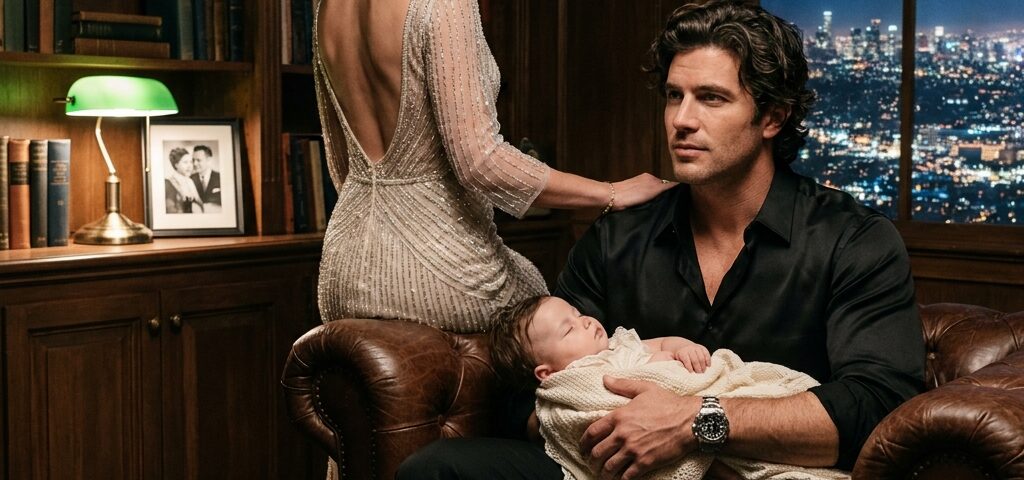
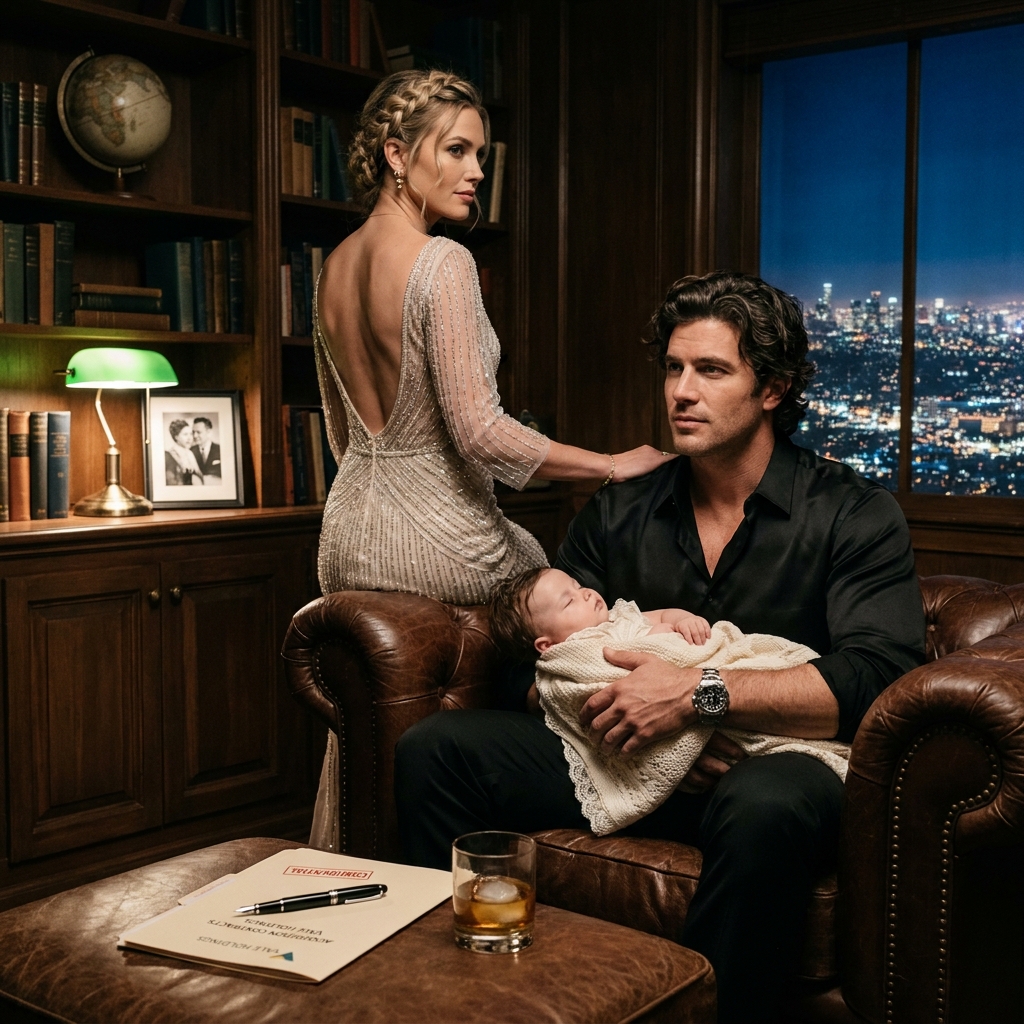
For several seconds, neither of us spoke.
The city moved beyond the glass walls of Ethan’s office—cars sliding through gray streets, trains rattling in the distance, people hurrying beneath umbrellas as if the world had not just shifted beneath my feet.
Lily stirred against Ethan’s chest.
Her small fingers tightened in his shirt.
Ethan looked down at her, and something in his face broke open.
Not completely. Ethan Callahan did not seem like a man who allowed himself to break completely.
But I saw it.
A flicker of grief.
A flash of recognition.
Then fear.
“How old is she?” he asked.
His voice had changed. It was still calm, but the calm felt deliberate now, carefully constructed.
“Eighteen months.”
His eyes closed for half a second.
“When was she born?”
I told him.
He calculated the date immediately.
I could see it happening behind his eyes.
“And you met Caleb when?”
“Almost three years ago.”
“Where?”
“At Martin’s Auto Repair on West Addison. My car wouldn’t start. He stayed after closing to fix it.”
Ethan stared at me.
“Caleb didn’t know anything about repairing cars.”
The words struck me harder than I expected.
“What?”
“He could barely change a tire.”
“That’s not true.” My voice came out sharper than I intended. “He worked there for almost a year.”
“I’m not saying you’re lying.”
“You’re saying the man I knew was.”
Ethan didn’t answer.
Lily shifted again, making a soft sound in her sleep. Instinctively, Ethan placed his palm against her back and moved it in slow circles.
The gesture looked natural.
Too natural.
As though some quiet part of him had been waiting years to protect someone small.
I stood from the sofa.
“I should take her.”
His hand tightened slightly around Lily, then relaxed.
“Yes,” he said.
But when I stepped closer, Lily turned her face into his shirt and whimpered.
Ethan froze.
I did too.
“She doesn’t usually go to strangers,” I whispered.
His gaze lifted to mine.
“I’m not sure I count as a stranger anymore.”
The sentence hung between us.
He seemed to regret it almost immediately.
Carefully, he transferred Lily into my arms. His jacket remained wrapped around her, and when I tried to remove it, he shook his head.
“Keep it on her.”
“It probably costs more than everything in my apartment.”
“It’s a jacket, Claire.”
I had never told him to call me Claire.
Of course he knew my name. He knew every employee’s name. But hearing it spoken softly, without distance or authority, made me feel exposed.
I held Lily close.
Her curls were warm beneath my chin.
Ethan rose from the chair and crossed to the window. He stood with his back to me, one hand resting against the glass.
“My brother disappeared two years and seven months ago,” he said. “He left no message. No request for money. No indication that he intended to leave Chicago.”
My heart began to pound.
“That’s around the time I met him.”
“Yes.”
“He told me he had just moved here from Indiana.”
“He grew up fifteen minutes from this building.”
I tightened my arms around Lily.
“What happened to him?”
Ethan turned.
“We don’t know.”
The way he said it frightened me more than any dramatic answer could have.
“You said he disappeared.”
“He walked away from his apartment, his work, his phone, and his family. His bank accounts were untouched. His passport remained in a desk drawer. There has been no verified sighting of him since.”
I stared at him.
“That’s impossible.”
“I’ve spent almost three years trying to prove that.”
“He was with me.”
“Yes.”
“He had a job. Friends. A rented room.”
“Under the name Caleb Parker.”
I swallowed.
“He said Parker was his mother’s last name.”
“Our mother’s maiden name was Mercer.”
The office suddenly felt too warm.
I lowered myself back onto the sofa because my knees could no longer be trusted.
Ethan remained standing, watching me carefully.
“You really didn’t know,” he said.
It wasn’t a question.
“No.”
I looked at Lily.
Her cheeks were pink from sleep. Her eyelashes rested against her skin, soft and dark.
I remembered Caleb holding her sonogram photograph beneath the yellow light of my kitchen. His eyes had filled with tears. He had pressed the picture to his chest and laughed at himself for crying.
He had seemed so real.
His joy had been real.
I could not accept that every part of him had been invented.
“He knew about Lily,” I said.
Ethan’s face tightened.
“He knew I was pregnant. He was happy. At least I thought he was.”
“When did he leave?”
“Two weeks after I told him.”
“And there was no contact afterward?”
“None.”
“No letters? Calls? Messages from unknown numbers?”
I shook my head.
“Did he ever ask you to keep your relationship secret?”
“No. There was no one to hide it from.”
“Did he talk about his family?”
“Not much.”
“What did he say?”
I tried to remember.
At the time, Caleb’s answers had seemed ordinary. He had said his father was difficult. His mother had died. He had a brother he no longer spoke to.
A brother who always needed to win.
A brother who could turn every room cold just by walking into it.
I looked at Ethan.
“He said you hated him.”
The words landed quietly.
Ethan’s expression barely moved, but the silence that followed told me they had reached somewhere deep.
“He told you about me?”
“Not your name. He only said he had an older brother.”
“And he said I hated him.”
“Yes.”
Ethan glanced toward the city.
“I never hated Caleb.”
The sentence was controlled, but pain roughened its edges.
“What happened between you?”
He took his time answering.
“Our father died when I was twenty-six and Caleb was nineteen. The company was smaller then, but unstable. There were debts, lawsuits, investors preparing to leave. I took control because someone had to.”
“And Caleb?”
“Caleb wanted nothing to do with the business.”
“That sounds reasonable.”
“It was. I didn’t understand that at the time.”
He returned to the desk and rested both hands against its surface.
“I thought responsibility was the same thing as loyalty. Caleb thought freedom was the same thing as escape. We were both wrong.”
I saw no billionaire then.
Only a man standing in the ruins of an old argument.
“What made him leave?”
“We fought.”
“About what?”
Ethan hesitated.
“My father’s will.”
Lily made another small sound, and I looked down. She was waking slowly, blinking with the heavy confusion of a child who did not know where she was.
“Mama,” she murmured.
“I’m here.”
Her eyes wandered past me and found Ethan.
For one strange second, she simply stared.
Then she lifted one hand toward him.
Ethan did not move.
Lily stretched farther.
“Up,” she said.
I almost laughed from nervousness.
“She thinks anyone in a suit should carry her now.”
Ethan looked at me as though asking permission without knowing how.
I shifted Lily toward him.
He stepped closer and accepted her with visible care. He held her too stiffly at first, one arm beneath her, the other steadying her back.
Lily did not seem concerned.
She touched his chin.
Ethan’s breath caught.
Then she said, “Cal.”
The room went silent.
I felt every hair rise along my arms.
Ethan’s eyes met mine.
“What did she say?”
“She says sounds sometimes. Not full words.”
Lily patted his cheek.
“Cal,” she repeated.
Ethan went pale.
I forced myself to breathe.
“She may be trying to say cold,” I said. “Or call. She hears me say call all the time.”
But Lily had never said it before.
Ethan looked at her as if she had reached inside him and touched a memory no one else could see.
Then his office phone rang.
The sound made all three of us jump.
Ethan shifted Lily securely onto one arm and answered.
“Yes?”
He listened.
His face returned to its usual stillness.
“Send him in.”
He set the phone down.
“My head of security is coming.”
“Security?”
“Daniel Reyes. He handled Caleb’s missing-person investigation for the family.”
My stomach tightened.
“Why is he coming now?”
“Because I sent him a message while you were sitting on the sofa.”
I stared at him.
“You contacted security without telling me?”
“I contacted the one person I trust to look at this carefully.”
“This?”
His eyes moved to Lily.
“My daughter is not an investigation.”
“No,” he said quietly. “She may be my niece.”
The office door opened before I could respond.
A tall man in his late forties entered. He wore a dark coat over a plain sweater, and nothing about him resembled the security officers stationed downstairs. His hair was threaded with gray, his posture relaxed.
His eyes noticed everything.
First Ethan.
Then Lily.
Then me.
He closed the door behind him.
“You said it was urgent.”
Ethan handed Lily back to me.
“This is Claire Monroe. She knew Caleb.”
Daniel’s attention sharpened.
“Knew him when?”
“After he disappeared.”
Daniel looked at me for a long moment.
I held his gaze because I was tired of feeling like the only person in the room without answers.
“He called himself Caleb Parker,” I said. “We were together for almost a year.”
Daniel’s face did not change.
“And the child?”
“Her name is Lily.”
“How old?”
Ethan answered for me.
“Eighteen months.”
Daniel inhaled slowly.
Then he pulled a chair away from the conference table.
“Ms. Monroe, I’m going to ask you several questions. Some may sound repetitive. That doesn’t mean I doubt you.”
“I’ve already answered questions.”
“Not mine.”
I looked at Ethan.
He gave a small nod.
It irritated me that even then I found his reassurance calming.
I sat with Lily on my lap. Daniel positioned himself across from us, not behind the desk.
“Tell me the first day you met Caleb.”
I described the broken car, the auto shop, the cold rain tapping against the garage doors. I remembered Caleb’s hands stained with oil, his crooked smile, the way he had refused payment for staying late.
Daniel asked for dates.
Descriptions.
Names.
He asked where Caleb lived.
The apartment had been above a laundromat on Kedzie Avenue, a narrow room with secondhand furniture and a fire escape outside the kitchen window.
“Did you ever see a lease?” Daniel asked.
“No.”
“Mail?”
“A few envelopes.”
“What names were on them?”
“Caleb Parker.”
“Did he drive?”
“An old blue pickup.”
“What happened to it?”
“I don’t know. It was gone when he disappeared.”
Daniel and Ethan exchanged a look.
“What?” I asked.
Daniel leaned back.
“Caleb owned a blue pickup in college. He sold it six years ago.”
“Maybe he bought another.”
“Maybe.”
I hated how calmly he said it.
“What did he do at the auto shop?” Daniel continued.
“Repairs. Oil changes. Whatever they needed.”
“Who owned the place?”
“Frank Martin.”
Daniel glanced at Ethan again.
“Frank Martin died four years ago.”
I shook my head.
“No. I spoke to him.”
“What did he look like?”
“About sixty. Gray beard. Heavyset. Always wore a Cubs cap.”
Daniel took out his phone, scrolled, then turned the screen toward me.
The photograph showed a younger man with neatly combed hair and no beard.
“That is Frank Martin.”
“I’ve never seen him before.”
“His son sold the business after his death.”
“Then the man I knew was the new owner.”
“Perhaps.”
My voice rose.
“Why does every answer sound like you think I’m confused?”
“I don’t think you’re confused,” Daniel said. “I think someone built a life for Caleb to step into.”
The room seemed to narrow.
Ethan moved away from the desk.
“Explain.”
Daniel looked toward Lily before answering.
“When Caleb disappeared, we searched hospitals, hotels, transit records, financial records. We found nothing. But we focused on Caleb Callahan.”
“Because that was his name,” Ethan said.
“Yes. Which means we may have been searching for the wrong man.”
The meaning settled over us.
Someone had given Caleb a different identity.
A job.
An apartment.
Mail.
A vehicle.
A believable past.
“Why?” I whispered.
Daniel’s eyes were steady.
“That is what we need to find out.”
Lily squirmed on my lap, restless now. I opened her diaper bag and found the small container of crackers Mrs. Jenkins always packed.
My hands shook as I opened it.
Ethan noticed.
“Claire.”
“I’m fine.”
“You’re not.”
“I brought my daughter to work because I had no babysitter. Twenty minutes later, I learned her father may have been your missing brother living under a false name. I’m allowed to be a little unsettled.”
“Yes,” he said. “You are.”
There was no argument in his tone.
That made it harder to stay angry.
Daniel rose.
“I need photographs.”
I stiffened.
“Of Lily?”
“Of Caleb, if you have any.”
I looked down.
“I deleted most of them.”
Ethan’s expression shifted.
“Why?”
“Because he left.”
The answer came too quickly.
The real answer was more painful.
I had deleted them during the final month of my pregnancy, when every image felt like proof that I had mistaken hope for permanence.
“But I kept one,” I admitted.
I took out my phone.
The photograph was buried in a hidden folder I had not opened since Lily’s birth.
Caleb stood beside the lakefront, wind lifting his dark hair. He was laughing at something I had said. One hand covered half his face, but there was no mistaking him.
I passed the phone to Ethan.
The change in him was immediate.
His shoulders lowered.
His eyes became glassy.
He touched the screen with his thumb, enlarging Caleb’s face.
“That’s him,” he whispered.
Daniel stepped beside him.
For the first time since entering the room, Daniel lost his professional calm.
“My God.”
Ethan looked at the date beneath the photograph.
“This was taken five months after he disappeared.”
“Yes.”
“Where?”
“Near Montrose Harbor.”
Ethan returned the phone with both hands.
He looked older than he had an hour earlier.
Not weak.
Not defeated.
Simply human.
Daniel asked me to send him the photograph. I did.
Then he stepped into the hallway to make a call.
Ethan and I remained with Lily.
“She has his eyes,” he said.
I looked at my daughter.
“Everyone says she has mine.”
“She has your smile.”
“You’ve seen her smile once.”
“It was enough.”
Despite everything, a faint laugh escaped me.
Ethan’s mouth almost curved.
It disappeared quickly, but I had seen it.
Lily held out a cracker to him.
He accepted it solemnly.
She watched until he took a bite.
“You don’t have to eat it,” I said.
“It appears to be a condition of the gift.”
“She is demanding.”
“So was Caleb.”
The tenderness in his voice made my chest ache.
“What was he like?” I asked.
Ethan looked at the cracker in his hand.
“Restless. Funny when he forgot to be angry. He collected records he never played and bought books he rarely finished. He could make friends in elevators.”
“That sounds like him.”
“He hated silence.”
“He slept with the radio on.”
Ethan looked at me sharply.
“What station?”
“Old country music.”
A real smile appeared then.
Small, sad, unmistakable.
“Our mother loved country music. Caleb pretended to hate it until she died. Then he listened to it every night.”
The man I knew and the man Ethan remembered moved closer together.
For the first time, I could see Caleb as both.
Not a stranger who had lied to me.
Not only a missing brother.
A complicated man carrying a past he had never learned to name.
“Why didn’t he tell me?” I asked.
Ethan’s smile faded.
“I don’t know.”
“He could have trusted me.”
“Yes.”
“He knew I loved him.”
Ethan looked at me.
“Maybe that was why he was afraid.”
I wanted to reject the idea.
Instead, I remembered the nights Caleb had nearly told me something.
He would sit at my kitchen table long after dinner, turning a coffee mug between his hands. Sometimes he opened his mouth, then changed the subject. Once he asked whether I believed a person could start over without explaining the life they had left.
I had thought he meant old mistakes.
I had kissed his forehead and said everyone deserved a second chance.
He had held me for a long time afterward.
Daniel returned.
“I spoke to a contact with the police department. We need to proceed carefully. Caleb’s case is technically still open.”
“Technically?” Ethan asked.
“There have been no leads in nearly two years.”
“There is one now.”
Daniel nodded toward Lily.
“She is not evidence,” I said.
“No,” Daniel replied. “But her existence may give us a timeline.”
Ethan moved closer to me.
“We won’t do anything without your agreement.”
I looked at him.
“You sent for security without my agreement.”
“And I should have told you first.”
The apology surprised me.
Ethan Callahan did not look like a man accustomed to admitting mistakes.
Daniel seemed equally surprised, though he hid it quickly.
“What do you need?” I asked.
“A DNA test would establish whether Lily is Caleb’s daughter.”
My instinct was immediate.
“No.”
Ethan’s face remained still.
Daniel waited.
I stood and shifted Lily onto my hip.
“I don’t know either of you. Not really. This morning, I was an employee you probably passed in the hall without seeing. Now you want my daughter’s DNA.”
“You’re right,” Ethan said.
I blinked.
“That’s it?”
“What would you prefer me to say?”
“I expected you to insist.”
“I won’t.”
Daniel folded his arms.
“Ethan.”
“She said no.”
Their eyes met.
Something passed between them—an old disagreement, perhaps. Daniel looked away first.
“We can begin elsewhere,” he said. “The auto shop. The apartment. The vehicle.”
“I’ll go with you,” I said.
“No,” Ethan replied.
I felt my anger rise again.
“You just said you wouldn’t insist.”
“On the DNA test. Not on sending you into a situation we don’t understand.”
“It was my life.”
“And someone constructed it around a false identity.”
“That makes me the person most likely to recognize what matters.”
He opened his mouth, then stopped.
Daniel looked between us.
“She has a point.”
Ethan’s jaw tightened.
“Of course you think that.”
“I think she knew Caleb during a period we know nothing about.”
“I’m standing right here,” I said.
Ethan exhaled.
“We’ll go together.”
Daniel raised an eyebrow.
“We?”
“Yes.”
“You have meetings.”
“Cancel them.”
“You have a board call at three.”
“Move it.”
I stared at him.
A few hours ago, I had been afraid he would fire me for disrupting the office.
Now he was canceling meetings to investigate the father of my child.
The speed of it frightened me.
“So that’s what you do?” I asked. “You decide, and the whole world rearranges itself?”
“Usually.”
“At least you’re honest.”
His eyes softened.
“I am trying to be.”
That sentence stayed with me.
We left the building through a private elevator.
I had never used it before. The interior was polished wood and brass, silent enough to hear Lily breathing against my coat.
Ethan stood beside us, hands in his pockets.
Without the vast office around him, he seemed different. Still controlled. Still imposing. But less untouchable.
In the underground garage, a black sedan waited.
Daniel drove.
Ethan sat in the back with Lily and me.
At first, none of us spoke.
Snow had begun to fall, thin white lines against the windows.
Lily pressed both palms to the glass.
“Pretty,” she said.
“Yes,” Ethan replied. “It is.”
She turned toward him.
“Eth.”
I stared at her.
Ethan did too.
“She learns names quickly,” I said.
“I didn’t tell her mine.”
“She heard me say it.”
“When?”
“In the office.”
He seemed to consider this important.
Lily held out her stuffed rabbit.
Ethan accepted that too.
Within ten minutes, he had been given a cracker, a rabbit, and one pink sock she had pulled off herself.
He arranged all three on his knee as though they were documents requiring careful review.
I laughed.
This time, he did smile.
“You find this amusing.”
“You look like you’re chairing a very unusual board meeting.”
“The rabbit has raised several concerns.”
“His name is Mr. Buttons.”
“Then Mr. Buttons should have come prepared.”
Lily giggled.
The sound filled the car.
Ethan went very still.
I watched him watch her.
For a moment, the mystery of Caleb faded, replaced by something simpler and perhaps more dangerous.
Connection.
By the time we reached the auto shop, the snow had thickened.
The sign still read MARTIN’S AUTO REPAIR, but several letters were faded. The garage doors were closed. A chain hung across the entrance.
Daniel parked across the street.
“This place has been shut down for fourteen months,” he said.
“That can’t be right,” I replied. “It was busy when Caleb worked here.”
“Busy with real customers?”
“Yes.”
I remembered the waiting area. The ringing phone. The mechanics moving between cars.
At least, I thought I did.
Ethan looked toward the building.
“Who owns it now?”
“A holding company registered in Delaware,” Daniel said. “I’ll trace it.”
We crossed the street.
Daniel unlocked the side door with permission obtained from the property manager. The moment I stepped inside, the smell struck me.
Oil.
Dust.
Cold metal.
Memory.
The front room was emptier than I remembered, but the counter remained. So did the cracked vinyl chairs and the coffee machine that had never worked properly.
Lily stayed in Ethan’s arms because the floor was dirty.
I moved toward the counter.
“This is where I met him.”
No one answered.
I walked through the narrow doorway into the garage.
Sunlight filtered through grimy windows, revealing suspended dust.
The repair bays were empty.
I could almost hear Caleb’s laugh echoing beneath the high ceiling.
He had stood near the second lift, wiping his hands on a red cloth.
He had looked at my hopeless little car and said, “I can fix the engine, but I can’t fix your taste.”
I had told him my taste was excellent.
He had asked for proof over dinner.
I stopped beside the second lift.
“There was a tool cabinet here.”
Daniel examined the floor.
“Anything important about it?”
“Caleb kept his things in the bottom drawer.”
“What things?”
“Receipts. Spare keys. A notebook.”
“What kind of notebook?”
“I never looked inside.”
Daniel crouched.
Four pale marks showed where the cabinet had once stood.
Ethan shifted Lily higher.
“Was anything else different?”
I turned slowly.
The garage was familiar, but wrong in small ways.
The wall clock was missing.
The red emergency phone was gone.
Then I noticed a square of clean paint near the back office.
“There was a photograph there.”
“Of what?” Daniel asked.
“A group of men standing outside the shop. Caleb said one of them was his grandfather.”
Ethan’s gaze sharpened.
“Our grandfather never worked in an auto shop.”
“I know that now.”
Daniel entered the back office.
A desk remained, along with two filing cabinets. Most drawers were empty.
I walked to the window.
From here, the owner—or the man pretending to be the owner—would have seen every customer entering.
“Claire,” Daniel called.
He held a small object in his gloved hand.
A brass key.
It had been taped beneath the desk.
Attached to it was a paper tag.
The ink had faded, but one word was visible.
PARKER.
My stomach turned.
“That was his name here.”
Daniel examined the key.
“Could be a locker.”
“Or a storage unit,” Ethan said.
I stared at the tag.
Caleb Parker.
The name had once belonged to the man I loved.
Now it felt like a door.
We searched the office for another hour.
Daniel found old invoices, all printed under the business name. Most were ordinary.
Then Ethan discovered something unusual.
A ledger page had slipped behind the bottom drawer of a filing cabinet.
It listed monthly expenses.
Rent.
Utilities.
Supplies.
Payroll.
And beneath them, one repeated entry:
C.P. — 4,500.
The payments appeared every month for nearly a year.
“Caleb was earning more than I was,” I said.
“Did he live like it?” Daniel asked.
“No. He worried about every dollar.”
“Then the money wasn’t salary,” Ethan said.
Daniel photographed the page.
“Or he never received it.”
A noise came from the front room.
We all froze.
Footsteps.
Slow.
Approaching.
Daniel moved toward the doorway.
A man appeared before he reached it.
He was elderly, thin, wearing a brown coat dusted with snow. A knitted cap covered most of his white hair.
He looked at Daniel.
Then Ethan.
Then me.
His face changed.
“Claire?”
I recognized his voice before I recognized the face.
“Frank?”
He was the man I had known as Frank Martin.
The owner who was supposed to have died years before.
He took one step backward.
Daniel blocked the exit without touching him.
“What are you doing here?” the man asked.
“I could ask you the same question,” I said.
His eyes moved to Lily.
Everything in him seemed to collapse.
He removed his cap.
“Oh,” he whispered. “She looks like him.”
Ethan stepped forward.
“Who are you?”
The man looked at him, and grief crossed his face.
“You must be Ethan.”
No one moved.
Ethan’s voice became very quiet.
“How do you know my name?”
The man sank into one of the waiting-room chairs.
“My name is Samuel Parker.”
The false name.
The key.
The payments.
My skin went cold.
“Was Caleb your son?” I asked.
“No.”
Samuel looked at Lily again.
“But for a while, he let people believe he was.”
Ethan handed Lily to me and stood over the old man.
Not threatening.
Not loud.
Somehow, his restraint was more powerful than anger.
“Start at the beginning.”
Samuel rubbed both hands over his face.
“I can’t.”
“You can.”
“You don’t understand.”
“Then help me.”
Samuel looked toward the locked garage door.
“He came to me because someone told him I knew how to disappear.”
The words settled into the room.
I held Lily tighter.
“Did you?” Daniel asked.
“Once.”
Samuel’s gaze remained on Ethan.
“Years ago, I helped people leave bad situations. Nothing criminal. Women hiding from violent husbands. Witnesses waiting for court protection. People who needed a few weeks where no one could find them.”
“And Caleb?” Ethan asked.
“He said he needed a new name. A job. Somewhere he could be seen without being recognized.”
“Why?”
Samuel’s expression hardened with remembered fear.
“Because he believed someone inside his family was watching him.”
Ethan went still.
“Who?”
“He never told me.”
“That isn’t good enough.”
“It’s the truth.”
Samuel reached into his coat slowly.
Daniel’s posture changed.
“Hands where I can see them.”
Samuel stopped.
“It’s only an envelope.”
Daniel retrieved it himself.
The envelope was worn, folded along the edges, Ethan’s name written across the front.
Ethan stared at the handwriting.
“That’s Caleb’s.”
Samuel nodded.
“He gave it to me the last night I saw him.”
“Why didn’t you deliver it?”
“He told me not to. He said to wait until someone came asking the right questions.”
“For nearly three years?”
“I was afraid.”
Ethan took the envelope.
His fingers trembled once before he steadied them.
“What were the right questions?”
Samuel looked at Lily.
“He said his brother would come looking for the truth. But only after he found the child.”
My heart seemed to stop.
Ethan tore open the envelope.
Inside was a single sheet of paper and a photograph.
He read the first line.
Then his eyes lifted to me.
“What does it say?” I asked.
He handed me the page.
The handwriting was Caleb’s.
I knew it immediately.
Ethan,
If you are reading this, then Claire has found you, or you have found her. Either way, Lily is alive.
I covered my mouth.
The letter blurred.
“He knew her name,” I whispered.
Ethan read over my shoulder.
The next lines were worse.
I wanted to tell you everything. I wanted to tell Claire too. But I was no longer certain the danger came from outside the family. Do not trust the story we were told about Father’s will. Do not trust the accident that killed our mother. And before you decide Lily is the only child you need to protect, look at the photograph.
The letter ended there.
No signature.
No explanation.
Only the photograph remained.
Ethan turned it over.
It showed Caleb standing outside a small white house beside a young boy.
The child appeared to be about six years old.
He had dark curls.
A stubborn little mouth.
And Ethan’s unmistakable gray eyes.
On the back, Caleb had written a date from four years earlier.
Beneath it were seven words.
His name is Noah. He is yours.
Ethan stared at the photograph without breathing.
I read the sentence again.
Then again.
Samuel rose slowly from the chair.
“There is more,” he said.
Ethan lifted his head.
“What do you mean?”
Samuel’s eyes moved toward the locked office at the back of the garage.
“Caleb didn’t disappear to protect himself.”
The snow tapped softly against the windows.
“He disappeared,” Samuel continued, “because he believed someone was searching for that boy.”
For a long moment, Ethan did not move.
The photograph trembled between his fingers.
The little boy stood beside Caleb in front of a white house with blue shutters. His dark curls were windblown, one shoelace untied, and his expression carried the solemn patience children wore when adults asked them to stand still.
But it was his eyes that held Ethan.
Gray.
Clear.
Unmistakably familiar.
His name is Noah. He is yours.
The words on the back of the photograph seemed to change the air inside the abandoned garage.
I watched Ethan read them again.
His face had gone still in the way it did when he was fighting to keep something enormous from showing.
“That’s impossible,” he said.
Samuel Parker lowered his gaze.
“I thought you might say that.”
Ethan looked up sharply.
“You don’t know anything about me.”
“I know enough to understand why Caleb was afraid you wouldn’t believe him.”
Daniel stepped closer.
“Samuel, we need facts. Who is the boy? Where is he now?”
Samuel glanced toward the back office.
“There’s another room.”
“We searched the office,” Daniel said.
“Not the room behind it.”
He crossed the garage slowly, his shoes scraping over the dusty concrete. At the rear wall, he moved a dented metal shelf aside, revealing a narrow door nearly invisible beneath layers of gray paint.
Daniel gave Ethan a questioning look.
Ethan nodded.
Samuel took the brass key marked PARKER from Daniel and fitted it into the lock.
The door opened with a reluctant creak.
A small room lay beyond it.
No windows.
No furniture except a wooden chair, a low filing cabinet, and a child’s red backpack.
The sight of the backpack made my heart clench.
It was too clean for the abandoned garage.
Too recent.
Ethan saw it at the same time I did.
“Is Noah here?” he asked.
“No,” Samuel replied. “He hasn’t been here in more than a year.”
“Then why keep his things?”
“Because Caleb told me not to destroy anything.”
Daniel entered first, checking the room by instinct. When he was satisfied, he motioned us inside.
The space smelled faintly of old paper and cedar. Children’s drawings had been taped to one wall.
A house.
A dog.
A man with black hair standing beneath a yellow sun.
In one picture, two taller figures stood beside a small boy. One wore a blue shirt. The other wore gray.
Above them, in uncertain block letters, someone had written:
UNCLE CALEB. ME. DAD.
Ethan stopped in front of the drawing.
His eyes remained fixed on the figure labeled DAD.
The figure had no face.
Only a blank circle.
“He didn’t know what I looked like,” Ethan said.
Samuel stood in the doorway.
“No.”
“But he knew about me.”
“Yes.”
“How?”
“Caleb told him.”
The answer seemed to wound Ethan more than the photograph had.
Caleb had spoken to Noah about him.
Had called him Dad.
Yet Ethan had never known the child existed.
I shifted Lily higher on my hip. She had grown quiet, sensing the tension around her. Her cheek rested against my shoulder, but her eyes stayed on Ethan.
“Who is Noah’s mother?” I asked.
Samuel rubbed his thumb against the edge of the key.
“Her name was Mara Bell.”
Ethan turned away from the drawing.
“I don’t know anyone named Mara Bell.”
“She may not have used that name when you knew her.”
“I would remember having a child with someone.”
Samuel’s gaze held no accusation.
“Would you remember every person who came into your life during the year after your father died?”
Ethan’s jaw tightened.
“That year was difficult. I was working constantly.”
“I know.”
“How could you possibly know?”
“Because Caleb told me.”
Ethan stepped closer.
“And what else did my brother tell you?”
Samuel did not retreat.
“That you were sleeping four hours a night. That you were drinking more than you should. That half the people around you wanted something from you and the other half were afraid to tell you the truth.”
Daniel’s eyes flicked toward Ethan.
I said nothing.
Ethan’s voice dropped.
“Did Caleb say I was incapable of remembering my own life?”
“No. He said there were parts of it you refused to look at.”
The words landed hard.
Ethan turned toward the filing cabinet.
“Open it.”
Samuel knelt and unlocked the top drawer.
Inside were folders arranged by year. Daniel removed them one by one, laying them on the desk in the front office.
There were school records.
Medical receipts.
Photocopies of identification cards.
A birth certificate.
Ethan reached for it.
NOAH JAMES BELL.
Mother: Mara Evelyn Bell.
The line for the father was blank.
Date of birth: seven years earlier.
Ethan calculated silently.
Then his expression changed.
I saw recognition.
Not certainty.
Not yet.
But something had moved inside him.
“What is it?” I asked.
He kept staring at the certificate.
“The date.”
Daniel waited.
Ethan looked toward the snow-covered garage windows.
“I was in Lake Geneva around the time he would have been conceived.”
“On vacation?” I asked.
A humorless breath left him.
“I didn’t take vacations.”
“Then why were you there?”
“For a company retreat. Three days. My father had been dead six months, and the board wanted everyone to believe the transition was stable.”
“Was Mara there?” Daniel asked.
“I don’t know.”
Samuel opened another folder.
“There’s a photograph.”
Ethan took it.
The picture had been taken at a hotel terrace beside a lake. A younger Ethan stood among a group of executives and guests. His expression was familiar—composed, distant, already carrying more responsibility than anyone should have asked of him.
Near the edge of the frame stood a woman in a pale green dress.
She was turned partly away.
Only her profile was visible.
Ethan stared.
“I remember her.”
No one spoke.
“She worked for the event company,” he continued. “Or said she did.”
“What was her name?” Daniel asked.
“Maria.”
Samuel nodded.
“Mara used several versions of her name.”
Ethan’s fingers tightened around the photograph.
“I spoke to her once.”
Samuel’s expression was unreadable.
“Only once?”
Ethan looked at him.
The room fell silent.
I could see the battle behind Ethan’s eyes. The man who controlled every detail of his world had been handed a memory he could neither fully recover nor dismiss.
Finally, he said, “I don’t remember enough.”
There was no defensiveness in it.
Only honesty.
It was the first time I had heard Ethan Callahan admit uncertainty without trying to conquer it.
Daniel closed the folder.
“Memory can be checked against records. Hotel reservations, event schedules, staff lists.”
“And Noah?” Ethan asked. “Where is he?”
Samuel looked toward the child’s backpack.
“With people Caleb trusted.”
“That isn’t an answer.”
“It’s the only one I can give until I know you’re ready.”
Ethan’s restraint broke—not loudly, but visibly.
He placed both hands on the desk and leaned forward.
“You show me a photograph of a child. You tell me he is my son. You tell me my brother disappeared to protect him. Then you expect me to stand here while you decide whether I deserve to know where he is?”
Samuel’s face softened.
“No.”
“Then tell me.”
“I’m deciding whether it is safe.”
“For whom?”
“For Noah.”
Ethan straightened.
Something in his expression cooled, but not with anger. With understanding.
“You think I’m the danger.”
“I think Caleb believed the danger was connected to your family.”
“My family consists of me and a missing brother.”
Samuel looked at Lily.
“Not anymore.”
Lily lifted her head at the sound of his voice.
Ethan followed Samuel’s gaze.
His face changed.
The anger went out of him.
He looked at Lily, then at the photograph of Noah, then back at the drawing taped to the wall.
When he spoke again, his voice was quieter.
“What do I need to do?”
Samuel studied him.
“Accept that finding Noah is not the same as claiming him.”
Ethan flinched slightly.
“I wouldn’t claim a child like property.”
“You’re accustomed to solving problems by taking control.”
“That doesn’t mean I don’t understand people.”
“Doesn’t it?”
Daniel stepped between them before the moment hardened.
“We are losing time. Samuel, if Noah is safe, say so plainly.”
“He is safe.”
“Have you seen him recently?”
“Three weeks ago.”
“Was Caleb with him?”
Samuel looked away.
“No.”
The hope I had not allowed myself to feel vanished.
Ethan noticed.
“Did Caleb leave Noah with you?”
“Not directly.”
“Then with whom?”
Samuel’s mouth tightened.
“A woman named Ruth.”
“Ruth who?”
“I promised not to say.”
Ethan’s voice sharpened.
“You have spent years keeping promises to a man who may be dead while leaving the living in the dark.”
Samuel absorbed the words without protest.
Then he looked at the photograph in Ethan’s hand.
“I made those promises because Caleb believed someone powerful had already discovered Noah existed.”
“Who?”
“He didn’t know.”
“Then what did he know?”
Samuel sank into the wooden chair.
For the first time, he looked tired rather than guarded.
“He knew someone had accessed Mara’s medical records. He knew her apartment had been searched. Nothing was stolen, but photographs of Noah had been moved.”
Daniel leaned against the desk.
“When did this happen?”
“Shortly before Mara died.”
I glanced at Ethan.
“How did she die?”
“A car accident,” Samuel said.
The room went very still.
Caleb’s letter came back to me.
Do not trust the accident that killed our mother.
Ethan had made the same connection.
“Was Caleb suggesting the two accidents were related?” I asked.
Samuel looked at him.
“He never said that directly.”
“But he believed it.”
“Yes.”
Ethan walked away from the desk.
Through the open garage doors, snow gathered against the street in pale ridges. He stood with his back to us, the photograph hanging at his side.
For a moment, I wanted to go to him.
Then I stopped myself.
This was not my grief.
But when Lily reached for him, I understood that grief did not always respect ownership.
“Eth,” she called softly.
Ethan turned.
Lily held out both arms.
He looked at me.
I nodded.
He crossed the room and took her.
She placed one hand against his cheek as if checking that he was still there.
His eyes closed.
Only for a second.
When they opened, the fear in them was no longer hidden.
“I don’t know how to do this,” he said.
No one asked what he meant.
Be an uncle.
Possibly be a father.
Mourn Caleb.
Search for him.
Trust people.
All of it was written across his face.
I stepped closer.
“You don’t have to know everything today.”
He looked at me.
“I built my entire life around knowing what came next.”
“And did it help?”
His mouth almost curved.
“No.”
“Then maybe this part has to be different.”
Lily curled one fist into his coat.
Ethan looked down at her.
“I missed eighteen months of her life.”
The words surprised me.
“You didn’t know she existed.”
“That doesn’t make the time come back.”
“No.”
“And Noah is seven.”
“We don’t know yet that he’s yours.”
He glanced at the photograph.
“But you think he is.”
I could not lie.
“Yes.”
He breathed out slowly.
“So do I.”
The admission settled between us.
Not proof.
Not certainty.
But the beginning of belief.
Daniel’s phone rang.
He stepped into the garage to answer it.
Samuel began gathering the files.
“No,” Ethan said.
Samuel stopped.
“These come with us.”
“I can’t allow that.”
“They concern my family.”
“They concern a child I promised to protect.”
Ethan looked at him steadily.
“Then come with us.”
Samuel blinked.
“You want me to go with you?”
“I want you where Daniel can verify every word you’ve said.”
“That sounds more like custody than hospitality.”
“It can be both.”
To my surprise, Samuel laughed.
It was a small, rusty sound.
“Caleb said you were impossible.”
“He was frequently wrong.”
“He said that too.”
For the first time, Ethan smiled without sadness taking it away.
It did not last long.
But it changed the room.
Daniel returned with snow melting across his shoulders.
“I found the holding company that owns this building.”
Ethan shifted Lily to one arm.
“And?”
“It belongs to a trust.”
“Whose?”
“That’s the problem. The trust is sealed behind two layers of legal entities.”
“You can break through them.”
“I will. But there’s something else.”
Daniel held up his phone.
“I ran Samuel Parker’s name.”
Samuel’s face tightened.
Daniel continued.
“No current driver’s license. No tax records in fifteen years. No property. No active bank account.”
Ethan looked at Samuel.
“Is that your real name?”
“It was.”
“What does that mean?”
Samuel sat down again.
“It means I disappeared too.”
Daniel folded his arms.
“From what?”
Samuel’s eyes shifted to the photograph of Mara.
“From the Callahan family.”
Ethan went completely still.
I felt Lily’s fingers tighten around my sleeve.
Samuel looked directly at Ethan.
“Your father hired me thirty-two years ago.”
“For what?”
“To find out who was sending letters to your mother.”
Ethan’s face lost color.
“What letters?”
“Warnings.”
“About what?”
Samuel glanced at Daniel, then at me.
“About the company. About the marriage. About things your father had done before either of you boys were born.”
Ethan set Lily carefully in my arms.
He did not seem aware he was doing it.
“What did my father do?”
Samuel shook his head.
“I never learned all of it. Your mother stopped trusting me before I could.”
“Why?”
“Because she discovered your father was paying me.”
The words struck with quiet force.
Ethan’s eyes hardened.
“You were spying on her.”
“At first.”
“And later?”
“I tried to help her.”
Samuel pulled the wooden chair closer to the desk.
“She was frightened. Not of your father exactly. Of the people around him. Lawyers. Investors. Men who smiled at dinner and made problems disappear the next morning.”
Daniel looked skeptical.
“Callahan Global was a regional property company thirty-two years ago.”
“On paper,” Samuel said. “But there were partnerships beneath it. Private arrangements. Money moving through businesses that never existed.”
Ethan’s expression closed.
“My father made mistakes. He also spent years rebuilding the company legitimately.”
“I’m not asking you to condemn him.”
“Then what are you asking?”
“To accept that Caleb may have uncovered something your father tried to bury.”
Ethan’s voice grew quieter.
“And my mother?”
“She wanted to leave.”
The answer seemed to empty the room.
Ethan lowered himself into the chair across from Samuel.
“No.”
“She had made arrangements.”
“No.”
“She had packed documents and clothes.”
“My mother died driving home from a charity dinner.”
“That was the official account.”
Ethan’s hands curled slowly against his knees.
“She was alone in the car.”
Samuel hesitated.
“I don’t believe she was.”
Lily began to fuss.
The adults had been still too long. The room was cold, unfamiliar, heavy with words she could not understand.
I carried her toward the front window.
Outside, the snow had softened the city. Cars passed carefully, tires whispering over wet pavement.
Behind me, Ethan asked, “Who was with her?”
“I don’t know.”
“Then why say it?”
“Because she called me that night.”
Ethan stood so abruptly that the chair scraped backward.
“What?”
“She said someone had agreed to help her leave. She wouldn’t give me a name. She only said she had finally found a person inside the family she could trust.”
“Inside the family?”
“Yes.”
“Caleb was a child.”
“He was six.”
“And I was thirteen.”
Samuel nodded.
“She may not have meant either of you.”
Ethan stared at him.
“Our father had no brothers. My mother was an only child.”
Samuel’s expression turned grave.
“That is what you were told.”
Before Ethan could respond, Daniel’s phone rang again.
This time, he answered immediately.
“Reyes.”
He listened.
His eyes moved toward me.
Then Lily.
“What hospital?”
My heart stopped.
“What happened?” I asked.
Daniel held up one hand and continued listening.
“We’re leaving now.”
He ended the call.
“Mrs. Jenkins has been admitted to St. Catherine’s.”
I felt the room tilt.
“What?”
“Her knee injury was more serious than she realized. A neighbor found her trying to get back upstairs.”
Guilt rushed through me.
“I left her alone.”
“You got her help this morning,” Daniel said. “The building manager called an ambulance.”
“I need to go.”
Ethan was already reaching for his coat.
“We’ll take you.”
“No, you need to stay here.”
He looked at me as if the suggestion made no sense.
“Claire.”
“This is your family.”
“So is Lily.”
The words came without hesitation.
Everyone heard them.
Ethan did too.
His expression shifted, but he did not take them back.
I looked at Lily in my arms.
Then at him.
Something warm and frightening moved through my chest.
Trust, perhaps.
Not complete.
Not yet.
But growing.
Samuel closed the file drawer.
“I’ll go with Daniel.”
Ethan shook his head.
“No. We all leave.”
“You haven’t finished asking questions.”
“They will still exist in an hour.”
“And if I disappear?”
Daniel held out his hand.
“I’ll keep the key.”
Samuel considered him, then placed it in his palm.
As we walked toward the garage door, Ethan stopped beside the wall of children’s drawings.
He removed the picture labeled UNCLE CALEB. ME. DAD.
Carefully.
Without tearing the tape.
He folded it once, then changed his mind and slid it flat inside the folder.
That small act told me more than anything he had said.
He was already making room for Noah.
We reached the hospital in less than twenty minutes.
Mrs. Jenkins was in a curtained treatment bay with her injured leg elevated and a paper cup of tea in her hands.
The moment she saw Lily, she smiled.
“There’s my girl.”
Relief nearly took my knees out from under me.
I crossed the room and hugged her carefully.
“I’m so sorry.”
“For what?”
“I left you.”
“You went to work.”
“You were hurt.”
“And I am apparently too stubborn to remain seated when instructed.”
The nurse beside her smiled.
“She’s going to be fine. A small fracture near the knee. No surgery, but she’ll need help at home for a while.”
Mrs. Jenkins noticed Ethan standing near the curtain.
Her eyebrows rose.
“And who is this?”
I opened my mouth.
Nothing sensible came out.
Ethan stepped forward.
“Ethan Callahan.”
Mrs. Jenkins looked at his expensive coat, then at Lily’s stuffed rabbit still tucked beneath his arm.
“The Ethan Callahan?”
“I’m told there is only one.”
She studied him.
“I’ve read about you.”
“I apologize.”
She laughed.
The sound eased something in all of us.
Lily reached for Mrs. Jenkins, and I settled her carefully beside the bed.
Mrs. Jenkins touched her curls.
“You brought her to work, didn’t you?”
“I had no choice.”
“You always have choices.”
Her tone was gentle.
“Sometimes they’re simply all difficult.”
I sat beside her.
“I thought I would lose my job.”
Mrs. Jenkins glanced at Ethan.
“Did she?”
“No.”
“Good.”
“She will also have access to emergency childcare through the company beginning tomorrow.”
I turned toward him.
“What?”
Ethan’s expression remained calm.
“Human resources has been instructed to create a temporary program.”
“For me?”
“For any employee who needs it.”
Mrs. Jenkins smiled knowingly.
“Smart man.”
I stared at Ethan.
“You did that today?”
“It should have existed already.”
There was no performance in his answer.
No expectation of gratitude.
He had seen a weakness in the structure around him, and instead of pretending it was only my problem, he had changed it.
The gesture reached somewhere deep inside me.
Not because it solved everything.
Because he had listened.
Mrs. Jenkins looked between us.
“Well,” she said, “this morning seems to have become complicated.”
“You have no idea,” I replied.
Her gaze moved to Lily.
Then to Ethan.
Something unreadable passed across her face.
“Actually,” she said slowly, “I may.”
I straightened.
“What does that mean?”
She picked up her tea, buying herself a moment.
“Nothing. I’m tired.”
But Ethan had noticed too.
He stepped closer.
“Mrs. Jenkins, have we met?”
“No.”
The answer came too quickly.
“Have you met my brother?”
Her hand stopped halfway to the cup.
My breath caught.
“Mrs. Jenkins?”
She looked at me.
The warmth in her face had been replaced by worry.
“Claire, I need you not to be angry.”
“That usually means I’m going to be.”
She set the cup down.
“Caleb came to see me once.”
The hospital sounds continued around us—wheels rolling over tile, distant voices, a monitor chiming behind another curtain.
Inside our small space, everything went silent.
“When?” I whispered.
“After Lily was born.”
I could not make sense of the words.
“No.”
“He came late one evening.”
“No, he didn’t.”
“He didn’t come inside.”
“You would have told me.”
“He begged me not to.”
My chest tightened.
“What did he say?”
Mrs. Jenkins looked toward Lily.
“He asked whether you were safe. Whether the baby was healthy. Whether anyone had been asking questions.”
Ethan moved beside me.
“How long after Lily’s birth?”
“About six weeks.”
I gripped the edge of the chair.
All those sleepless nights.
All those mornings when I had stood at the window with Lily in my arms, wondering whether Caleb knew she had been born.
He had known.
He had been close enough to come to our building.
“Did he see her?”
Mrs. Jenkins’s eyes filled.
“From the courtyard.”
The pain of it came quietly.
Not rage.
Not even betrayal.
Something heavier.
“He watched us?”
“Only for a few minutes.”
“Why didn’t he come upstairs?”
“He said he couldn’t.”
“He could have knocked.”
“I told him that.”
“What did he say?”
Mrs. Jenkins swallowed.
“He said if he came into your life again, the people looking for him might follow.”
My anger wavered.
Ethan placed one hand on the back of my chair, not touching me, only near enough that I could feel his steadiness.
“Did he leave anything?” Daniel asked.
Mrs. Jenkins looked at him.
“Who are you?”
“Daniel Reyes. I’m trying to find Caleb.”
She considered him.
Then she reached toward the small handbag beside the bed.
“I kept it because I hoped he would come back for it.”
From an inner pocket, she removed a silver chain.
A small key hung from it.
Ethan inhaled sharply.
“That was my mother’s.”
He took the chain with trembling fingers.
The key was delicate, old-fashioned, engraved with two letters.
E.C.
“Evelyn Callahan,” Ethan whispered.
Mrs. Jenkins nodded.
“Caleb said his mother wore it every day.”
“She did.”
“What does it open?” I asked.
Ethan turned the key over in his palm.
“I don’t know.”
Samuel, who had remained near the curtain, stepped forward.
“I do.”
Every eye turned toward him.
He looked older beneath the hospital lights.
“There was a private box Evelyn kept at the old Callahan house.”
“What kind of box?” Ethan asked.
“A document chest built into the wall of her dressing room.”
Ethan frowned.
“That room was renovated after she died.”
“By your father?”
“Yes.”
Samuel’s expression darkened.
“Then he may have been looking for it.”
Ethan closed his hand around the key.
“The house was sold fifteen years ago.”
Daniel had already taken out his phone.
“Who owns it now?”
“A private buyer. The sale was handled through an agency.”
Daniel began searching.
I looked at Mrs. Jenkins.
“Did Caleb say anything else?”
She nodded reluctantly.
“He said there were two children.”
Ethan’s gaze shifted to the photograph folder beneath Daniel’s arm.
“Noah and Lily,” he said.
Mrs. Jenkins shook her head.
“No.”
My skin went cold.
“What do you mean, no?”
“He said, ‘Tell Claire the children are the reason I had to disappear.’”
“Lily wasn’t born yet when he first disappeared,” I said.
“He came after she was born,” Mrs. Jenkins reminded me.
“But Noah already existed.”
“Yes.”
I looked at Ethan.
“Then who was the second child?”
No one answered.
Lily had fallen asleep beside Mrs. Jenkins, one small hand wrapped around the edge of the blanket.
Ethan opened his fist.
His mother’s key rested in his palm.
Daniel looked up from his phone.
“I found the current owner of the old Callahan house.”
“Who?” Ethan asked.
Daniel’s expression changed.
Not alarm.
Recognition.
“The property was purchased through a trust six months after your mother died.”
“That doesn’t make sense. My father owned it for years afterward.”
“According to the public records, he didn’t.”
Ethan stared at him.
“Then who did?”
Daniel turned the phone around.
The trust had a single listed beneficiary.
A name none of us expected.
Mara Evelyn Bell.
Noah’s mother.
Ethan read it twice.
“That is impossible.”
Samuel stepped closer to the screen.
“No,” he said quietly. “It means Evelyn found a way to hide the house before she died.”
“Why would my mother leave property to a woman I met years later?”
Samuel looked at him.
“Perhaps Mara didn’t enter your life by accident.”
The possibility shifted everything.
The hotel.
The forgotten night.
Noah.
Caleb’s disappearance.
Maybe none of them had begun with Ethan.
Maybe they had begun with his mother.
Daniel’s phone chimed with a new message.
He read it.
Then read it again.
“What is it?” Ethan asked.
Daniel did not answer immediately.
“Daniel.”
“The trust was amended three months ago.”
“By whom?”
“That information is sealed.”
“And the beneficiary?”
“Changed.”
Ethan’s voice was barely audible.
“To whom?”
Daniel lifted his eyes.
“To a minor.”
My arms tightened around Lily instinctively.
“Noah?”
Daniel shook his head.
“The document lists only initials.”
He turned the screen toward us.
The new beneficiary was identified as L.C.M.
Lily Claire Monroe.
For several seconds, I could not breathe.
“That’s my daughter.”
Ethan looked at Lily sleeping peacefully beside Mrs. Jenkins.
Then at me.
Someone had placed the Callahan family home into a trust for Lily only three months earlier.
Someone who knew her full name.
Someone who knew she existed.
Someone with legal access to a secret created decades ago.
Ethan closed his fingers around his mother’s key.
“Caleb is alive,” he said.
Samuel’s face was pale.
“Maybe.”
Ethan looked toward the hospital window, where snow fell in slow, silent sheets across Chicago.
“No,” he replied. “Someone changed that trust three months ago.”
His gaze returned to Lily.
“And whoever did it has been watching over her all along.”