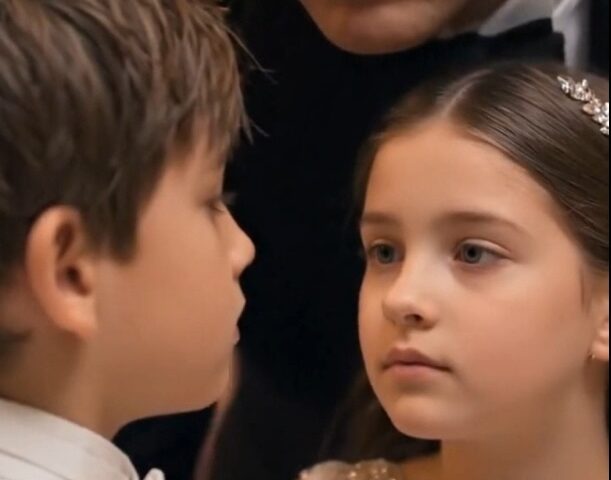
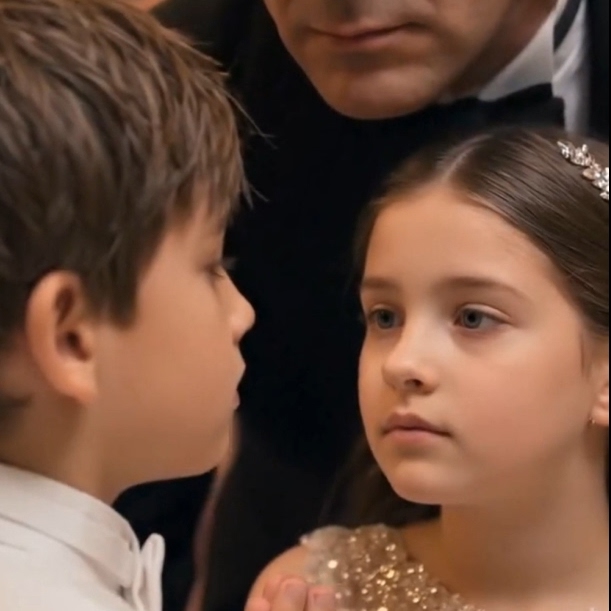
The father took a step forward, his hands trembling, instinct demanding he catch her.
But he stopped.
Because for the first time, she was not looking at him for help.
The boy did not pull her. He merely anchored her. With infinite patience, he shifted his weight backward, his bare, dusty foot sliding against the polished marble.
“One,” the boy whispered.
The girl’s right foot dragged across the floor. The heavy, lifeless limb that had kept her caged for so long moved. It was a clumsy, agonizing shuffle, but it was a step.
“Two,” the boy breathed, his eyes locked on hers, holding her entire world steady.
Her left foot followed.
A collective breath shuddered through the ballroom. The string quartet, frozen in the corner, instinctively drew a single, long bow across a cello—a low, weeping note that filled the cavernous space.
It wasn’t a waltz. It was a slow, swaying struggle, built on trembling muscles and sheer, impossible will. But as they turned, the boy in the oversized shirt and the girl in the pristine pink dress, they were the only two people in the room.
Tears spilled over the father’s cheeks, catching the golden light of the chandeliers. The fierce protector, the man who had bought every doctor and built every ramp, finally understood. He had tried to protect her from falling, but this boy had simply asked if she wanted to stand.
She rested her forehead against the boy’s dusty shoulder, her breathing ragged, her smile radiant and absolute. She was exhausted, her legs buckling with every shifting motion, but she did not sit down.
She was dancing.
The father sank slowly to his knees, burying his face in his hands, undone by the beautiful, impossible weight of the moment. The golden ballroom blurred into silence, leaving only the sound of two children, stepping together into the light.