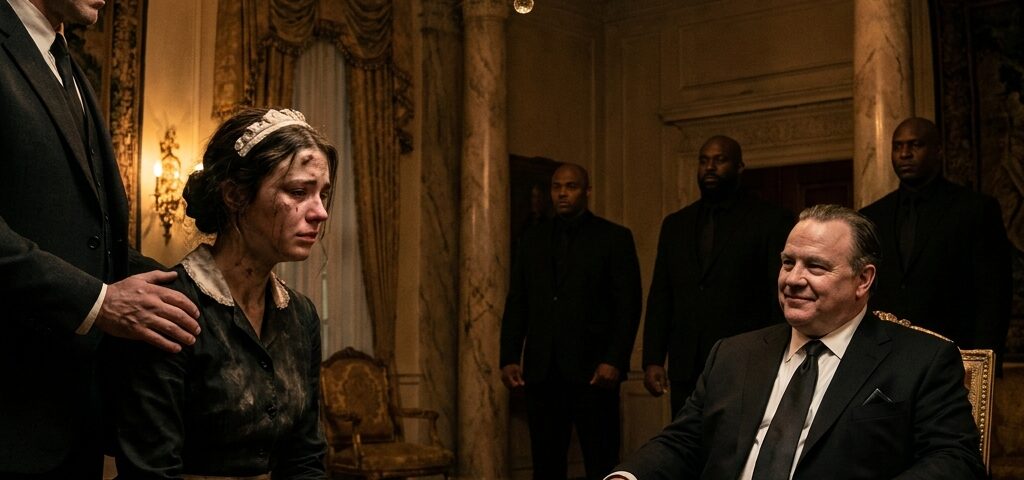
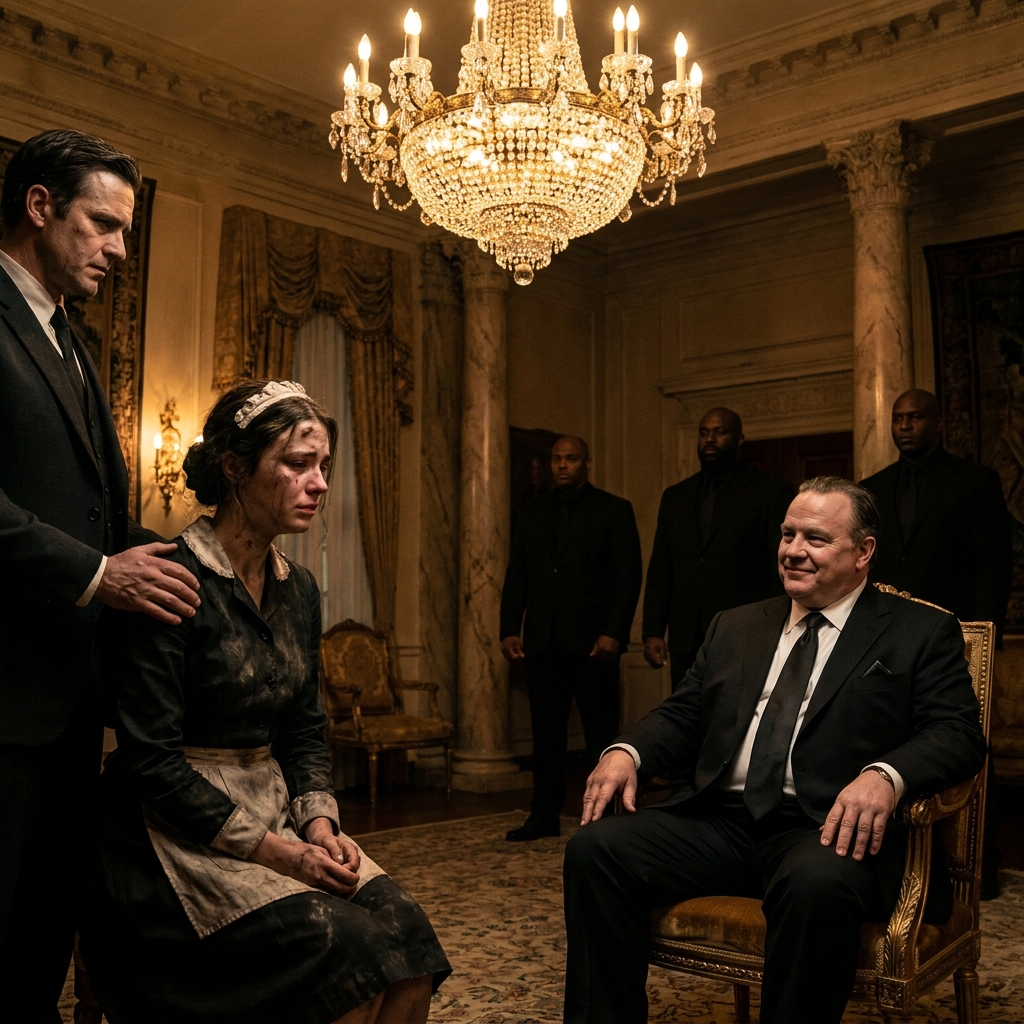
The gunshot seemed to remain in the air long after the echo faded.
Bailey stood beneath the chandelier, the black ledger open in her hands, her mother’s name written across the cover in faded gold.
Evelyn Smith.
Not Evelyn Vane. Not Evelyn anything else.
Smith.
The name Bailey had spent her whole life carrying like an apology now looked different beneath the amber light. Older. Heavier. Deliberate.
Above her, the wounded guard gripped the balcony rail. Blood darkened the sleeve of his jacket, but he remained upright.
Stefan moved first.
“Lock the east corridor,” he ordered. “No one leaves the grounds. Check the windows before you check the doors.”
His voice was calm, but the room changed around it. Men who had been standing like statues suddenly moved with purpose. One hurried up the stairs toward the injured guard. Another crossed to the fireplace and pressed a hidden switch beneath the mantel.
A steel panel slid over the nearest window.
Bailey stared.
Her father took one step toward the front doors.
“Alaric,” Stefan said.
He did not raise his voice.
Alaric stopped.
“Surely,” he began, forcing a laugh that convinced no one, “this has nothing to do with me.”
Stefan turned slowly.
“Someone fired inside my house five minutes after you arrived.”
“I was searched.”
“You were expected.”
That silenced him.
Bailey looked down at the ledger. The pages were thin, covered with compact handwriting, dates, shipping codes, initials, and numbers arranged in narrow columns. Some entries were marked with blue ink. Others with red.
Her mother’s handwriting.
Bailey knew it at once.
She remembered seeing it on birthday cards delivered through servants, always signed with the same neat curve beneath the final letter.
With love, Mother.
Her mother had never been warm in public. She had been composed, distant, graceful in the way Alaric considered useful. Yet late at night, when Bailey was young, Evelyn had sometimes sat at the edge of her bed and drawn imaginary maps across the blanket.
“This is the harbor,” she would whisper, tracing a line near Bailey’s knees. “And here is the northern passage. If the storm comes from the east, where do you send the ship?”
Bailey had thought it was a game.
Now she wondered if it had been a lesson.
A sharp crack sounded somewhere beyond the walls.
Bailey flinched.
“Not a gunshot,” Stefan said, noticing. “A branch against the shutters.”
She hated that he had read her fear so easily.
“I’m not frightened.”
“I didn’t say you were.”
Alaric gave a humorless smile. “She has always been stubborn about admitting weakness.”
Bailey closed the ledger.
“And you’ve always confused silence with weakness.”
Her father’s expression tightened.
For years, Bailey had imagined saying something like that to him. In those fantasies, the words had been sharper. The room had fallen silent. Alaric had finally understood every humiliation he had caused.
The reality felt quieter.
She did not feel triumphant.
She felt tired.
Stefan stepped between them, though Bailey could not tell whether the gesture was protective or practical.
“Your father will remain here until we know who entered the house.”
“I did not enter with an assassin,” Alaric said.
“No,” Stefan replied. “You usually hire people to stand behind you.”
A hint of embarrassment passed over Alaric’s face. Not guilt. Never guilt. Only discomfort at being accurately seen.
The guard from the balcony was guided down the stairs. Up close, Bailey saw that the wound in his arm was shallow.
“What happened?” Stefan asked.
“Movement in the portrait gallery. I went to check. Someone fired through the display door.”
“Did you see them?”
“No. But they knew the service stairs.”
Stefan’s gaze shifted toward Alaric.
Alaric raised both hands. “I have never been inside this house.”
“You have employed people who have.”
“I employ hundreds.”
“Not anymore,” Bailey said.
The words came before she could stop them.
Alaric looked at her.
She held up the leather folder.
“If this contract is genuine, Smith Shipping belongs to me.”
A strange flicker crossed her father’s face.
For one brief second, he looked less angry than afraid.
Then the expression vanished.
“You know nothing about running the company.”
“I know enough to understand that you nearly lost it.”
“It is more complicated than that.”
“It always is when you explain your failures.”
“Bailey.”
Her name sounded like a warning, but it no longer carried the same weight. Perhaps because Stefan’s men stood nearby. Perhaps because Alaric no longer controlled the doors.
Or perhaps because Bailey had finally seen fear in his eyes.
Stefan held out his hand.
“The ledger.”
She drew it closer to her chest.
“No.”
The refusal surprised both of them.
Stefan studied her for a moment. Then he lowered his hand.
“It may contain information that puts everyone here in danger.”
“It has my mother’s name on it.”
“I’m aware.”
“Then you’re also aware it belongs to me.”
“I’m aware that ownership and safety are not always the same thing.”
Bailey met his gaze.
He was accustomed to being obeyed. She could see it in the stillness of his posture, in the patience that did not feel like patience at all. Yet he did not attempt to take the ledger.
That restraint unsettled her more than force would have.
“What is the commission?” she asked.
Alaric looked toward the sealed windows.
Stefan’s face revealed nothing.
Bailey waited.
When neither man answered, she laughed once.
It was not a pleasant sound.
“You brought me here under a false marriage agreement, gave me control of a company I have never been allowed to enter, hid my mother’s book inside the contract, and now someone is shooting through your walls.” She held the ledger tighter. “I think I’ve earned a complete sentence.”
Stefan turned to the men around them.
“Clear the room.”
Within seconds, everyone moved toward the hall. The injured guard objected until Stefan gave him a look. Then he left as well.
Only Bailey, Stefan, and Alaric remained.
Rain struck the steel-covered windows in a soft, steady rhythm.
Stefan walked to the fireplace.
“The commission is not a government office,” he said. “It is a private council formed by shipping families after the war. Officially, it settles disputes, protects trade routes, and prevents outside investors from destroying local ports.”
“And unofficially?”
“It decides who is allowed to survive.”
Bailey looked at her father.
He stared into the fire.
Stefan continued. “The commission controls insurance firms, harbor permits, customs brokers, and several banks. No single member owns enough to attract attention. Together, they can stop a vessel from leaving port without ever issuing an order.”
“Smith Shipping was part of it?”
“Your grandfather was.”
“My mother?”
Stefan’s eyes dropped briefly to the ledger.
“She investigated it.”
Alaric turned from the fire.
“That is enough.”
Bailey almost smiled at the absurdity of his command.
“Enough for whom?”
“You do not know what you are asking.”
“That has never stopped you from answering on my behalf.”
“I was protecting you.”
The room seemed to narrow around those words.
Bailey looked at him carefully.
“From what?”
Alaric said nothing.
Stefan’s jaw tightened, but he remained silent too.
Bailey stepped closer to her father.
“Mother died in a boating accident.”
Alaric’s face changed.
Not much. A faint movement near his mouth. A blink that came too late.
Bailey’s heartbeat slowed.
It was the same sensation she had felt as a child when she opened a door and found adults suddenly quiet. The same awareness that truth had been present moments before she entered the room.
“She did die in an accident,” Alaric said.
“That isn’t what I asked.”
“You didn’t ask a question.”
“Then here it is. Was my mother investigating the commission when she died?”
Alaric looked toward Stefan.
Stefan did not help him.
Finally, Alaric exhaled.
“Yes.”
The answer was so simple that Bailey almost missed its force.
Her fingers went numb around the ledger.
“How long did you know?”
“I knew she had concerns.”
“How long?”
“Several months.”
“And you told me nothing.”
“You were seventeen.”
“I was her daughter.”
“You were a child.”
“I stopped being a child the morning you sent a secretary to tell me she was dead.”
Alaric winced.
It was slight, but real.
Bailey remembered that morning with terrible clarity. The blue curtains in her bedroom. The untouched breakfast tray. Her father’s secretary standing beside the door with a folded handkerchief and eyes that would not meet hers.
There had been no embrace from Alaric.
No explanation.
Only a funeral arranged like a business event, filled with men Bailey did not know and women who praised Evelyn’s elegance.
She had believed her father’s coldness meant grief.
Now she wondered whether it had meant fear.
Stefan moved to a cabinet beside the fireplace and poured water into a glass.
He handed it to Bailey.
She nearly refused, then realized her throat had gone dry.
“Why give me the company?” she asked after drinking.
“Because the commission believes your father still owns it.”
Alaric turned sharply. “That was not our agreement.”
“The contract is the agreement.”
“You said you needed leverage.”
“I did.”
“You said nothing about transferring every voting share.”
“You didn’t read the pages.”
“You concealed the clause.”
“I placed it directly above your signature.”
Alaric stared at him.
For the first time, Bailey saw the shape of what had happened. Her father had not merely been careless. He had been confident. Confident that the deal would cost him only the daughter he had already decided was expendable.
That realization hurt more than the insults she had expected.
She set the glass down before her hand began to shake.
“Why me?” she asked Stefan. “And don’t tell me I’m the intelligent Smith. You don’t know me.”
“I know you corrected the Rotterdam route projections when you were nineteen.”
Bailey went still.
Those projections had been a stack of papers left in the library. She had found an error in the fuel calculations and sent an unsigned note to the company office.
No one had acknowledged it.
Stefan continued. “I know you warned your father against selling the North Wharf warehouse because the land beneath it was worth more than the building.”
Alaric’s face darkened.
“I know you discovered that three ships were being billed twice for maintenance by a firm partially owned by one of the commission’s members.”
Bailey stared at him.
“How?”
“Your mother kept copies of your letters.”
“My mother died before the maintenance invoices.”
“Yes.”
The word hung between them.
Bailey glanced at the black ledger.
“You said she kept them.”
Stefan did not answer immediately.
Alaric stepped forward. “Do not.”
Bailey turned.
“Do not what?”
Her father’s face had gone pale again.
Stefan reached into the inner pocket of his coat.
Slowly, he withdrew a small cream envelope.
Bailey recognized the handwriting before he handed it to her.
Her own name was written across the front.
Bailey.
The last stroke curved upward in the way she remembered.
Her mother’s handwriting.
She could not take it.
“When was this written?”
“Six weeks ago,” Stefan said.
Alaric closed his eyes.
Bailey’s hand moved at last.
The envelope was unsealed. Inside was a single sheet of paper.
She unfolded it.
My dearest Bailey,
If this reaches you, then Stefan has decided the time for silence has passed. You will be angry. You have every right to be.
There are truths I could not tell you while you lived beneath your father’s roof. There are others I could not tell you because I did not yet know whom to trust.
Please believe only this for now: I did not leave because I stopped loving you.
I left because staying would have made you visible to people who had already begun asking questions.
The company should have been yours years ago. Your grandfather intended it that way, though certain papers disappeared before his death. The ledger contains enough to prove what was taken, but not enough to reveal who arranged it.
Do not trust the red entries.
Trust the blue.
And when you are ready, ask Stefan what happened in Bellweather.
With all my love,
Mother
Bailey read the letter twice.
Then a third time.
The fire cracked softly.
Somewhere beyond the room, footsteps moved through the corridor, careful and controlled.
“My mother is alive.”
Neither man answered.
Bailey lifted her head.
“My mother is alive.”
“Yes,” Stefan said.
The room tilted, though nothing moved.
Bailey reached for the back of a chair and gripped it.
For nine years, she had visited a grave marked with her mother’s name. She had brought white lilies every spring because Evelyn had once said they made a room feel peaceful. She had stood beside that grave and apologized for not having been a better daughter.
All the while, her mother had been somewhere in the world.
Breathing.
Writing letters.
Keeping copies of Bailey’s work.
“Where is she?”
Stefan’s expression closed.
“I don’t know.”
“You expect me to believe that?”
“I knew where she was until two months ago.”
“What happened two months ago?”
“She stopped contacting me.”
Bailey turned to her father.
“You knew.”
Alaric said nothing.
“You knew she was alive.”
“I knew there was a possibility.”
“The letter is six weeks old.”
“I did not see the letter.”
“But you knew before tonight.”
His silence answered.
Bailey crossed the distance between them before she realized she had moved.
She did not strike him. She did not shout.
She simply stood close enough to see the fine lines around his eyes and the silver beginning at his temples.
“Why?” she asked.
Alaric’s composure faltered.
“You think there is one answer.”
“I think there is a truthful one.”
“She left.”
“She says she left to protect me.”
“That is what she tells herself.”
“Then tell me what you tell yourself.”
The words landed harder than anger.
Alaric looked toward the covered windows.
“When Evelyn began investigating the commission, she became convinced someone inside Smith Shipping was altering manifests. She believed the company was being used to move unregistered cargo through our ports.”
“What kind of cargo?”
“Documents. Money. Occasionally people traveling under false names.”
Bailey absorbed this.
“Did you know?”
“Not at first.”
“And later?”
Alaric’s shoulders lowered.
“Later, I knew enough to understand that asking questions would destroy the company.”
“So you stopped asking.”
“I had thousands of employees.”
“You had a choice.”
“I had consequences.”
Bailey stared at him.
There it was—the principle that had governed his life. Not loyalty. Not courage. Consequences.
Alaric had never cared whether something was wrong. He cared whether it was costly.
“Mother kept asking,” Bailey said.
“Yes.”
“And then her boat went down.”
“Yes.”
“But she survived.”
“Yes.”
“Did you help her disappear?”
He shook his head.
“I helped the world believe she was dead.”
The admission made the room feel colder.
“Why?”
“Because after the accident, she came to me. She was injured, terrified, and convinced the commission had arranged it. She asked me to take you and leave the country.”
Bailey could barely picture it. Her mother wounded and frightened. Her father faced with a decision.
“You refused.”
“I had creditors, contracts, employees—”
“You refused.”
Alaric’s mouth tightened.
“Yes.”
“And she left without me.”
“She believed taking you would make you a target.”
Bailey looked down at the letter.
Do not trust the red entries.
Trust the blue.
She opened the ledger again and turned several pages.
Red marks appeared beside names, dates, and payments. Blue circles enclosed shipping routes and account numbers.
“What happened in Bellweather?” she asked.
Stefan did not move.
Her mother’s letter had named him directly. Not her father. Not the commission.
Stefan.
He looked toward Alaric.
Alaric gave a bitter laugh.
“Now you discover what it is like to be the one holding back the truth.”
Stefan ignored him.
“Bellweather is a coastal town three hours north,” he said. “Nine years ago, one of your mother’s ships docked there during a storm.”
“One of her ships?”
“She controlled several vessels through a holding company your father never knew about.”
Alaric’s expression suggested this was not entirely true, but he remained silent.
Stefan continued. “The official report said the vessel was damaged and remained in port for repairs. In reality, your mother used it as a meeting place. She planned to give evidence against the commission to a federal investigator.”
Bailey glanced at the ledger.
“This evidence?”
“Part of it.”
“What happened?”
“The investigator never arrived.”
“And my mother?”
“She did. So did I.”
A faint unease moved through Bailey.
“How did you know her?”
Stefan’s eyes held hers.
“She saved my brother’s life.”
The answer was not what Bailey expected.
“When?”
“Years earlier. My brother worked on one of the southern routes. A crane cable snapped during loading. The company wanted to blame him for the damage and leave him without medical care. Evelyn paid for his treatment and proved the equipment had not been inspected.”
Bailey thought of her mother at formal dinners, speaking softly while men spoke over her.
“You owed her.”
“I did.”
“So she trusted you.”
“For a time.”
“What happened at Bellweather?”
Before Stefan could answer, the door opened.
A young woman stepped inside, rain on her shoulders and a pistol lowered at her side.
“House is secure,” she said. “We found the shooter.”
Stefan’s expression sharpened.
“Alive?”
“Yes.”
Bailey noticed the disappointment the woman tried to hide when she looked at Alaric.
She was perhaps thirty, with dark hair cut at her jaw and a narrow scar along her chin. Unlike the others, she wore no formal jacket, only a gray sweater and black trousers.
“Who is she?” Bailey asked.
The woman looked directly at her.
“Mara Vane.”
Stefan’s sister, Bailey guessed.
Mara nodded toward Alaric. “The shooter entered through the old kitchen tunnel. He had a map.”
Alaric’s face remained blank.
“Where did he get it?” Stefan asked.
“He says it was sent anonymously.”
“Convenient.”
“He also had this.”
Mara crossed the room and placed a small brass key on the table.
Bailey recognized the crest stamped into its handle.
Smith Shipping.
Alaric picked it up.
“That key belongs to the archive room.”
“No,” Bailey said.
She remembered the archive room at the company’s headquarters. It had been locked for as long as she could remember. Once, when she was twelve, she had asked what was inside.
Her father had told her it contained records ruined by a flood.
“This isn’t the archive key,” Bailey continued. “The archive key is longer.”
Alaric looked at her sharply.
“How would you know?”
“I saw you use it.”
“When?”
“The week before Mother died.”
The memory arrived intact.
Her father standing in the upstairs corridor after midnight. A brass key in his hand. Her mother waiting near the archive door, wearing a dark green coat.
They had been arguing quietly.
Bailey had watched from the stairwell.
At the time, she had thought they were planning a trip.
Now she remembered her mother’s face.
Not angry.
Afraid.
Mara leaned closer to the key.
“Then what does this open?”
Bailey took it from her father.
The crest was worn at the edges, as though it had been handled often.
“There used to be private boxes at the harbor office,” she said. “Before the renovation. Grandfather gave one to every family member.”
Alaric’s gaze dropped.
Bailey noticed.
“You still have yours.”
“No.”
“You looked at the key.”
“I looked because you were speaking.”
“You looked because you recognized it.”
Stefan watched them both.
“Where are the boxes now?”
Bailey thought back.
After the harbor renovation, the private offices had been closed. Documents were moved to the headquarters archive. Furniture was auctioned. The building itself had remained empty for years because Alaric refused to sell it.
“The old customs house,” she said.
Alaric’s head lifted.
Bailey felt certain.
“The boxes are still there.”
“That building is condemned,” he said.
“Then why did you renew the private security contract last year?”
The question escaped before she considered how she knew.
Her father stared at her.
Bailey had seen the payment while reviewing the maintenance invoices. At the time, it had seemed like another example of careless accounting.
Now it looked like something else.
Mara smiled faintly.
“I think I like her.”
Stefan did not smile.
“If the shooter carried a key to that building, someone wanted us to find it.”
“Or wanted the key returned,” Bailey said.
Stefan looked at her with new attention.
She turned the brass key between her fingers.
“The man fired once, wounded a guard, and stayed inside the house long enough to be caught. That doesn’t sound like someone sent to kill us.”
Mara’s expression sobered.
“No. It doesn’t.”
“He wanted you to search him,” Bailey continued. “He wanted you to find the key.”
Stefan nodded slightly.
“A message.”
“Or an invitation.”
Alaric moved toward Bailey.
“You are not going to the customs house.”
She almost laughed.
“You no longer decide where I go.”
“You have no idea what is waiting there.”
“Do you?”
He stopped.
That was enough.
Bailey placed the key beside the ledger.
“We go tonight.”
“No,” Stefan said.
She turned on him.
“You brought me into this.”
“I brought you here because the transfer had to occur before the commission forced your father into bankruptcy.”
“And you hid my mother’s ledger inside the contract.”
“Yes.”
“You knew someone might come for it.”
“Yes.”
“You knew my mother was alive.”
“Yes.”
“Then you do not get to decide which truth I’m allowed to face.”
Something changed in Stefan’s eyes. Not anger. Recognition.
Perhaps he had heard those words before.
From Evelyn.
“The customs house may be watched,” he said.
“Then we do not arrive like people who are hiding.”
Mara leaned against the table.
“What do you suggest?”
Bailey looked at the leather folder.
“The contract gives me control of Smith Shipping.”
“It does,” Stefan said.
“Then by morning, the transfer will be public.”
Alaric stepped forward.
“You cannot announce it without speaking to the board.”
“I control the board.”
“You have never met them.”
“Then the meeting is overdue.”
Bailey could hear the steadiness returning to her own voice. It felt unfamiliar but not false.
She turned to Stefan.
“I’ll call an emergency inspection of the customs house. Structural review, inventory, whatever is believable. We go with company employees, not armed men.”
“You want witnesses.”
“I want protection that does not look like a threat.”
Mara nodded.
“She’s right. If the commission is watching, secrecy only gives them room to act.”
Stefan looked displeased, which Bailey decided was not the same as unconvinced.
“The shooter may have been sent to separate us from the house,” he said.
“Then some of us remain.”
“Who?”
Bailey glanced at her father.
“Alaric.”
His face hardened.
“You would leave me here as a prisoner?”
“No. As a guest.”
Mara’s smile returned.
“A locked guest room can be arranged.”
Alaric turned to Stefan.
“You cannot permit this.”
Stefan’s gaze moved to Bailey.
“It is her company.”
Those four words settled something between them.
Not trust.
Not yet.
But perhaps the beginning of an agreement.
An hour later, Bailey stood alone in an upstairs bedroom while rainwater ran down the glass beyond the partially raised steel shutter.
Someone had brought her dry clothes. A cream sweater, dark trousers, and a coat that fit so well she wondered whether Stefan had known her measurements.
The thought unsettled her.
On the bed lay the ledger, her mother’s letter, and the ownership contract.
Three objects that had rearranged her entire life.
Bailey sat on the edge of the mattress and read the letter again.
I did not leave because I stopped loving you.
She wanted to believe it.
That was the most painful part.
Anger would have been easier if Evelyn had abandoned her carelessly. But love complicated absence. Love raised questions that resentment had kept buried.
Why had her mother never sent for her?
Why had she allowed Bailey to mourn for nine years?
Why had she trusted Stefan with the truth?
A knock sounded.
Bailey folded the letter.
“Come in.”
Mara entered carrying two cups of tea.
“I was told you take it without sugar.”
Bailey accepted one.
“Who told you?”
“Stefan.”
“And who told him?”
Mara sat in the chair near the window.
“Your mother.”
Bailey looked into the tea.
“Did you know her?”
“Yes.”
“How well?”
“Well enough to know she could walk into a room full of angry men and make them lower their voices without asking.”
That sounded like Evelyn.
Bailey felt an ache beneath her ribs.
“Why didn’t she come back?”
Mara’s hands tightened around her cup.
“She tried once.”
Bailey looked up.
“When?”
“Seven years ago.”
“Where?”
“She reached the city. Stefan arranged a meeting at the train station.”
“And?”
“She saw two commission men following you.”
Bailey’s breath caught.
“You were at a school concert,” Mara continued. “Your father’s driver brought you home. Evelyn watched from across the street.”
A memory stirred.
Rain against the car window. A woman in a red scarf beneath a station awning. Bailey had looked back because something about the woman’s posture seemed familiar.
The car had turned before she saw her face.
“She was there,” Bailey whispered.
Mara nodded.
“She left that night.”
“Why didn’t Stefan tell me?”
“He promised her he wouldn’t.”
“And now?”
“Now she is missing.”
The words sharpened the room.
“Stefan thinks the commission found her.”
“Stefan thinks many things and proves only what he can.”
“That isn’t an answer.”
“No,” Mara said quietly. “It isn’t.”
Bailey studied her.
There was something in Mara’s tone. A carefulness that suggested another truth just beyond reach.
“What happened in Bellweather?”
Mara looked toward the door.
“Stefan will tell you.”
“My mother told me to ask him. That doesn’t mean he’s the only one who knows.”
For several seconds, Mara said nothing.
Then she placed her cup on the table.
“At Bellweather, Stefan was supposed to bring the investigator to Evelyn’s ship. Instead, he arrived alone.”
“Why?”
“He received a message saying the investigator had changed the meeting place.”
“From whom?”
“We never found out.”
“What happened after he arrived?”
“The ship caught fire.”
Bailey stared at her.
“Was my mother aboard?”
“Yes.”
“How did she survive?”
“Stefan pulled her from the water.”
The scar through his eyebrow.
Bailey remembered how it cut across his face, pale and uneven.
“Was he injured?”
“Burned. Cut by broken glass. He nearly drowned.”
“Why didn’t the commission know she survived?”
“Because Stefan told them he found her body.”
Bailey understood then why her father disliked him.
Stefan had not merely hidden Evelyn.
He had become the keeper of her second life.
A soft knock came at the open door.
Stefan stood in the hall.
“We’re ready.”
Mara rose and moved past him without speaking.
Bailey gathered the ledger and letter, then paused.
“Did you hear us?”
“Enough.”
“What happened to the investigator?”
“He disappeared.”
“Was he ever found?”
“No.”
Bailey placed the ledger inside the leather folder.
“And Bellweather?”
Stefan’s expression became distant.
“The fire was not meant to kill your mother.”
“How can you know that?”
“Because the cabin was searched before it burned. Someone wanted the ledger.”
Bailey looked at the black book.
“And she kept it all these years?”
“No.”
A quiet tension entered his voice.
“She told me the ledger was lost in the fire.”
Bailey looked down.
“Then how did it end up inside the contract?”
“That,” Stefan said, “is what I hoped you could tell me.”
They left the manor shortly before midnight.
No convoy followed them. No dramatic line of vehicles cut through the rain.
Bailey rode in the back seat of a plain company sedan beside Stefan, while Mara drove. Two Smith Shipping managers followed in a second car, summoned under the explanation of an emergency property inspection.
The city thinned around them.
Warehouses replaced houses. Streetlights grew farther apart. Beyond the glass, cargo cranes stood against the clouds like enormous motionless birds.
Bailey had passed the old customs house many times but had not entered since childhood.
It stood at the edge of the harbor, a long brick building with arched windows and a clock tower that had stopped at 4:17.
The rain had softened to mist.
A security guard waited beneath the entrance canopy. He looked alarmed by Bailey’s arrival and more alarmed when she introduced herself as the new controlling owner of Smith Shipping.
Inside, the air smelled of damp wood and old paper.
Their footsteps echoed across the tiled floor.
The building seemed smaller than Bailey remembered, yet certain details remained unchanged: brass railings worn smooth by generations of hands, faded signs pointing toward customs offices, a painted compass in the center of the lobby.
One of the managers began discussing insurance liabilities.
Bailey barely heard him.
The key felt warm in her palm.
“Where were the private boxes?” she asked.
The security guard pointed toward the rear stairs.
“Basement level. But that section was sealed after the flood.”
“There was no flood,” Bailey said.
The guard looked confused.
“My father said there was.”
“No, ma’am. Pipe burst in the west storage room, but the private vault was untouched.”
Stefan glanced at her.
Another lie from Alaric.
They descended into the basement.
The walls narrowed around them, lined with old green tiles. At the end of the corridor stood a steel door beneath a sign that read AUTHORIZED PERSONNEL ONLY.
The brass key fit.
Bailey hesitated before turning it.
“Your mother used to say doors are rarely frightening,” Stefan said beside her. “What waits behind them is only truth delayed.”
Bailey looked at him.
“She said that?”
“Often.”
It bothered her how much of Evelyn he had known.
It comforted her too.
Bailey turned the key.
The lock opened with a heavy click.
Inside, rows of narrow metal boxes lined the walls. Each bore a number instead of a name.
Most were covered in dust.
One was not.
Box 17.
Bailey approached it.
The key fit that lock too.
Behind her, the room had gone silent.
She opened the box.
Inside lay no money, no documents, no second ledger.
Only a small cassette recorder and a recent photograph.
Bailey picked up the photograph first.
It showed her mother standing outside a white cottage beside the sea.
Evelyn’s hair was shorter and silver at the temples, but she was unmistakably alive.
Beside her stood a man Bailey had never seen.
On the back of the photograph, someone had written a date.
Three weeks ago.
Below it were five words.
He knows who betrayed us.
Bailey turned the photograph toward Stefan.
His face lost all color.
“You know him,” she said.
Stefan did not answer.
Mara stepped closer and looked over Bailey’s shoulder.
The moment she saw the man in the photograph, she gripped the edge of the open box.
“That’s impossible.”
“Who is he?” Bailey asked.
Mara looked at her brother.
Stefan’s eyes remained fixed on the photograph.
When he finally spoke, his voice was almost a whisper.
“The federal investigator from Bellweather.”
Bailey looked back at the image.
The man who had supposedly disappeared nine years ago stood beside her mother three weeks earlier, one hand resting on the gate of a seaside cottage.
The cassette recorder lay beneath the photograph.
A strip of white tape had been fixed across its surface.
In Evelyn’s handwriting were the words:
FOR BAILEY ONLY.
Bailey pressed play.
For several seconds, there was only static.
Then her mother’s voice filled the vault.
“Bailey, if you are hearing this, then the transfer succeeded. Smith Shipping is finally yours.”
Bailey closed her eyes.
The voice was older, softer, but real.
“I wish I could explain everything at once,” Evelyn continued. “I wish I could ask you to forgive me. But forgiveness must wait until you know what I did.”
A pause followed.
In the background, a clock chimed faintly.
“Your father did not betray me at Bellweather.”
Bailey opened her eyes.
Beside her, Stefan had become completely still.
Evelyn’s voice lowered.
“Stefan did.”
The recording clicked off.
No one moved.
Bailey turned slowly toward the man who had welcomed her into his home, protected her mother’s secrets, and handed her an empire.
Stefan looked at the silent recorder.
Then he raised his eyes to Bailey.
“She’s right,” he said. “But not for the reason you think.”
END OF PART 2 – LIKE, SHARE AND COMMENT “THE ENTIRE STORY” IF YOU WANT TO READ THE FULL STORY.