
PART 2 – My Six-Year-Old Daughter Whispered, “Mommy, We Have to Run”
PART2
My breath stopped halfway up my throat.
For one impossible moment, the whole house seemed to hold itself still: the ticking clock above the stove, the faint hum of the refrigerator, Lily’s tiny fingers digging into mine. I stared at the deadbolt as though I might be able to will it back into place.
Then the voice came again, low and careful.
“Claire. It’s Martin. Don’t scream.”
Martin Vale was our next-door neighbor, a retired history teacher with a bad knee, a kind smile, and a habit of leaving tomatoes from his garden on our porch in summer. He was also the last person I expected to find whispering outside my locked door minutes after my daughter warned me we had to run.
I didn’t answer.
Lily looked up at me, her eyes wide and wet.
“Mommy?” she breathed.
I pressed one finger to my lips.
“Claire,” Martin said, even softer now. “I saw Derek leave. I saw someone else park down the block after him. Dark sedan. Tinted windows. The man inside hasn’t moved for twenty minutes.”
The blue folder under my arm suddenly felt heavier.
I leaned close to the door. “How did you unlock it?”
There was a pause.
“I didn’t. He did.”
My blood went cold.
“What do you mean?”
“The man came onto your porch five minutes ago. I watched him use something on the lock. He left when my motion light came on. I came over as soon as he walked back to his car.”
I looked at the lock. The turn piece was angled wrong. Whoever had been there had not finished, or had finished and changed his mind.
I pulled Lily backward into the hallway.
“Are you alone?” I whispered.
“Yes,” Martin said. “But don’t open the front door. Go through the garage if you can.”
The garage.
Derek had installed a keypad on the side door last spring after claiming I was always losing keys. I had never liked it. At the time, I thought it was another small attempt to manage me.
Now it felt like a trap.
I took Lily’s backpack from the hook and slid it over her trembling shoulders.
“Stay quiet,” I whispered.
She nodded so quickly that her chin quivered.
We moved down the hallway past the family photographs Derek had chosen for the wall. In each one, he stood slightly in front of us, smiling with perfect confidence. In the largest frame, taken at Lily’s kindergarten graduation, his hand rested on my shoulder like a claim.
At the laundry room door, I paused.
Something smelled wrong.
Not smoke. Not gas exactly. Something chemical and sharp beneath the lemon cleaner, like a garage after a spill.
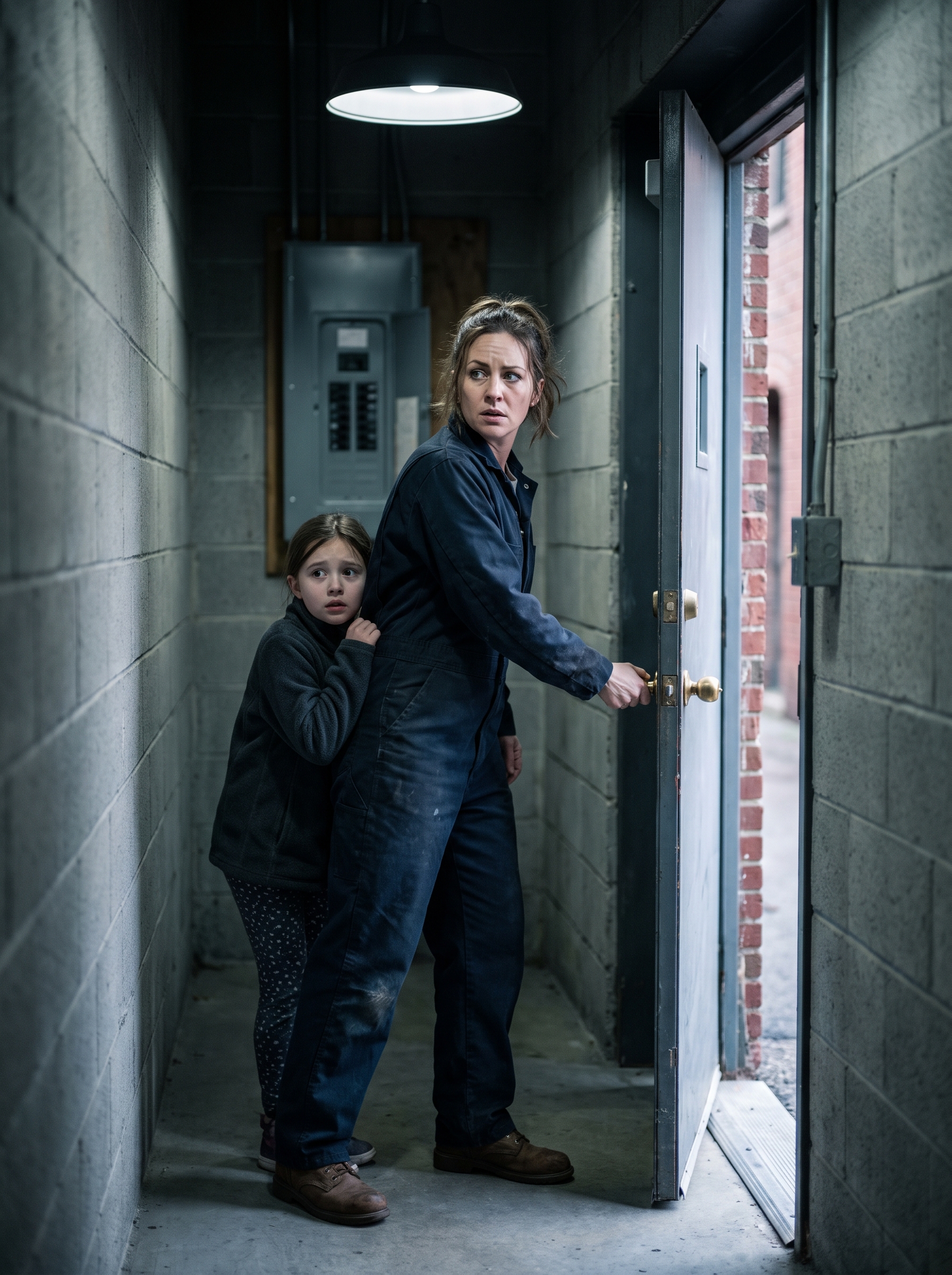
I opened the door slowly.
The garage was dim. Derek’s side was empty. My older silver Honda sat where it always did, facing the closed door. A strip of gray morning light glowed under the garage panels.
Lily made a small choking sound.
On the concrete beside my front tire was a wet dark patch.
I crouched, careful not to touch it. The smell grew stronger.
Brake fluid.
I knew because my father had been a mechanic and had taught me the basics before I was old enough to drive. I could still hear his voice: clear fluid under the tire is not something you ignore.
I stood up too fast and nearly lost my balance.
“Don’t get in the car,” Lily whispered.
I pulled her against me. “I won’t.”
A knock sounded from the laundry room window. Three light taps.
Martin’s face appeared beyond the glass, pale beneath his cap. He pointed toward the side yard, then held up his phone.
I opened the window just enough to hear him.
“I called my daughter,” he whispered. “She’s ten minutes away. She can drive you somewhere safe.”
“Why not call the police?”
“I did,” he said. “They said they’d send someone.”
His expression told me what his words did not. Someone was coming, but not fast enough.
A car engine started outside.
Lily clamped both hands over her mouth.
Martin turned his head toward the street. “He’s moving.”
The next seconds stretched thin as wire.
I grabbed Lily’s hand, opened the laundry room window wider, and lifted her through into Martin’s arms. She went without a sound, clutching her rabbit by one ear. Then I pushed the blue folder and my purse out after her.
I was halfway through when the garage door groaned.
Not opening.
Locking.
The automatic opener made a mechanical click, then fell silent. Someone had disabled it remotely.
I shoved myself out the window and landed hard in the wet grass. Pain flashed through my ankle, but I forced myself upright.
Martin grabbed my elbow. “This way.”
We hurried through the narrow strip between our houses. The air smelled of rain and damp soil. The curtains in neighboring homes remained closed, and the world looked offensively normal. A child’s bicycle lay in a driveway. A sprinkler clicked somewhere, absurdly cheerful.
Lily stumbled once. I scooped her up despite the pain in my ankle.
Behind us, a car door closed.
Martin did not look back. “Faster.”
We reached his back gate. It squeaked as he opened it, loud enough to make me flinch. In his yard, climbing roses trembled along the fence, and a ceramic birdbath stood filled with last night’s rain.
His back door was already unlocked.
Inside, the house smelled of old books, peppermint tea, and dust. Martin guided us into the den and closed the curtains.
“Basement,” he said. “Now.”
I hesitated. “Martin, what is happening?”
He looked at Lily, then back at me.
“I don’t know all of it,” he said. “But I know Derek lied to you about leaving town.”
I felt the floor shift under me.
“I took a picture of his itinerary,” I said. “Flight at eight forty-five.”
Martin’s mouth tightened. “His car turned left at the main road. Airport is right.”
For a second, there was no sound except Lily’s breathing against my neck.
Then Martin’s phone buzzed.
He answered in a whisper. “Annie?”
I heard a woman’s voice, urgent and distant.
Martin’s face changed.
“No,” he said. “Don’t pull into the driveway. Circle the block. There’s a sedan near the Thompsons’ mailbox.”
He listened, his jaw tightening.
“What license plate?”
Another pause.
Then he looked at me.
“Claire,” he said carefully, “do you know someone named Everett?”
The name struck so hard I almost dropped Lily.
Everett.
My father’s middle name.
Also the name of the law firm Derek insisted we stop using after my father died.
“No,” I lied automatically.
Martin noticed.
His gaze softened. “We need to get downstairs.”
The basement stairs creaked under our weight. Lily refused to let go of me, so I carried her even though my ankle throbbed with each step. Martin followed, locking the door at the top and sliding a bolt I had never noticed before.
The basement was partly finished, with shelves of canned peaches, old lesson plans, holiday decorations, and a worn couch facing an unplugged television. Martin led us behind the furnace to a small storage room.
“This house was built in 1941,” he said. “There’s a coal chute behind those shelves. It opens near the alley. I haven’t used it in years, but it still moves.”
I stared at him. “Why do you have a hidden exit?”
He gave a tired little smile. “Because my late wife hated tornadoes and trusted contractors less than weather reports.”
Lily did not smile.
She leaned close to my ear. “Mommy, Daddy knows I heard.”
My chest tightened.
“How?”
“I dropped my cup,” she whispered. “In the hallway. He stopped talking. I ran back to bed, but later he came into my room. He thought I was asleep.”
“What did he do?”
“He just stood there,” she said. “A long time.”
I closed my eyes.
Derek standing in the dark, watching our child pretend to sleep. I knew his silence. I knew the way he could make a room feel smaller without raising his voice.
Martin shifted the shelves with surprising strength. Behind them was a square wooden panel painted the same gray as the wall.
His phone buzzed again.
He read the screen. “Annie says the sedan is gone.”
Relief almost reached me.
Then something thudded upstairs.
Once.
Then again.
A knock.
Not at Martin’s front door.
Inside the house.
Martin’s face drained of color.
“That’s the mudroom,” he whispered. “No one uses that door.”
We all froze.
From above came the faintest scrape, like a shoe against tile.
Lily buried her face in my sweater.
Martin opened the coal chute panel. Cold air breathed in from the dark.
“You first,” he mouthed.
The passage was narrow, sloping upward through old brick. I pushed the folder and purse ahead, then helped Lily climb in. She was small enough to crawl easily, but she kept looking back.
“Go to the light,” I whispered. “I’m right behind you.”
She crawled.
I followed, scraping my shoulder against brick. Dust filled my nose. My ankle screamed each time my foot found purchase. Behind me, Martin pulled himself into the chute and slid the panel into place.
We moved in darkness for perhaps thirty feet. It felt like a mile.
Above us, somewhere inside Martin’s house, a man called out.
“Mr. Vale?”
The voice was polite.
That somehow made it worse.
Martin’s hand touched my shoe, urging me forward.
At the end of the chute, Lily had pushed open a rusted metal hatch just enough for gray daylight to show. I squeezed beside her and lifted it fully.
We emerged behind Martin’s garage, hidden by overgrown hydrangeas and the leaning fence that separated his property from the alley.
A blue compact car idled ten yards away.
A woman with Martin’s same gray eyes leaned across the passenger seat and pushed open the door.
“Get in,” she hissed.
Annie.
I helped Lily into the back, then slid in beside her. Martin climbed into the front seat with difficulty, breathing hard. Annie drove before his door was fully closed.
We bumped down the alley, past garbage bins and wet leaves, then turned onto a side street. No one followed.
For five minutes, nobody spoke.
Lily’s head rested against my arm, but her eyes stayed open.
Annie glanced at me in the rearview mirror. “Where can I take you?”
The obvious answer was my mother’s house.
Derek would expect that.
“My bank,” I said suddenly.
Martin turned. “Your bank?”
“I have a safe deposit box. My father left me some papers. Derek didn’t know about it.”
That was not entirely true.
Derek knew there had been papers. He just thought I had destroyed them years ago after he told me keeping old family documents was unhealthy, a sign I could not let go.
My father had died two months before our wedding. A heart attack, the doctors said. Sudden, unfair, and final. Derek had stepped into the wreckage with flowers, casseroles, and firm opinions about how I should manage everything. He had seemed steady then. Protective.
Now I wondered how long I had mistaken control for care.
Annie drove toward downtown using quiet streets. Rain began to fall in thin silver lines across the windshield.
“What did Lily hear exactly?” Martin asked.
I looked at my daughter.
She sat very still, clutching her rabbit.
“You don’t have to repeat it,” I said.
“Yes, I do,” Lily whispered.
The courage in her small voice broke something in me.
She swallowed. “Daddy said the lady was getting nervous. He said he couldn’t wait anymore. The man said, ‘What about the child?’ Daddy said, ‘She’ll be with Claire.’ Then Daddy said to make it look like an accident.”
Annie’s hands tightened on the steering wheel.
“The lady,” I repeated. “What lady?”
Lily shook her head. “I don’t know. Daddy called her Mar.”
“Mar?” Martin asked.
“Maybe short for Margaret,” Annie said.
Or Marissa.
The name arrived like a stone through glass.
Marissa Cole had been Derek’s bookkeeper three years ago. Young, efficient, always dressed in cream sweaters and gold jewelry. Derek had said she moved to Denver after accepting a better job. Her name had not entered our house since.
“What is it?” Annie asked.
I stared at the rain sliding down the window.
“I think I know her.”
The bank opened at nine. We arrived at 8:46 and waited behind a bakery delivery van in the lot. I borrowed Annie’s phone because mine, I realized with a jolt, had no service.
Not no signal.
No service.
Derek had removed me from the plan.
I stared at the useless screen in my hand, anger warming the edges of my fear.
“How long has it been like that?” Martin asked.
“I used it last night.”
“Then he timed it.”
Yes.
He had timed everything.
At nine sharp, I walked into the bank with Lily at my side and Annie behind us. Martin stayed in the car to watch the lot. The lobby smelled of carpet cleaner and coffee. A teller smiled brightly until she saw my face.
“I need access to my safe deposit box,” I said.
Within minutes, I was seated in a small private room with beige walls and a polished table. The bank manager, a careful woman named Ms. Nair, set the long metal box before me.
My hands shook as I opened it.
Inside were my mother’s pearl earrings, my father’s watch, a small stack of savings bonds, and a sealed envelope with my name written in my father’s slanted handwriting.
Claire, only open this when you are ready to stop explaining him away.
The room blurred.
I had seen that envelope once before.
On the day after my father’s funeral, Derek found me holding it at our apartment table. He had read the outside, then gently told me grief made people suspicious. He said my father had never liked him because no man seemed good enough for me.
I wanted to believe that.
So I locked the envelope away and spent seven years not being ready.
Now I tore it open.
Inside was a handwritten letter, a flash drive, and three photographs.
The first photograph showed Derek standing outside a motel beside Marissa Cole.
The second showed Marissa heavily pregnant, one hand pressed protectively to her stomach.
The third showed my father sitting across from Derek in a diner, his expression grave, Derek’s face turned sharply toward the camera as if he had just realized he was being watched.
I unfolded the letter.
My dearest Claire,
I hope I am wrong. More than anything, I hope this letter becomes an embarrassment from an overprotective father. But if you are reading it, I suspect you have reached the point where love and fear have become difficult to tell apart.
Derek is not the man he says he is.
He has debts under names that are not his own. He has been using documents connected to his employer and possibly to my accounts. I confronted him today. He denied everything until I mentioned Marissa Cole. Then he stopped smiling.
I have copies of what I found on the drive. Take them to Everett & Lowe. Not the police first. Not Derek. And do not go alone.
I pressed my hand over my mouth.
Annie leaned closer. “Claire?”
I read the final lines.
There is one more thing, sweetheart. Marissa’s child may be Derek’s. If so, he has hidden more than an affair. He has hidden a life.
My father had signed it, Love always, Dad.
Under his signature was a postscript added in shakier handwriting.
If anything happens to me before the wedding, ask Martin Vale what he saw.
I looked up.
Martin.
The room tilted.
Annie took the letter from me, read the postscript, and went pale.
“My father?” she whispered.
“I need to talk to him,” I said.
We rushed back to the car.
Martin was not inside.
For one terrible second, I thought the sedan had returned. Then I saw him near the entrance, speaking to a uniformed police officer. Relief came sharp and brief.
Until Martin turned and saw the letter in my hand.
He knew.
He had always known something.
The officer approached. “Mrs. Harlan?”
I straightened. “Yes.”
“I’m Officer Ruiz. We received a call about a possible break-in at your neighbor’s residence and a welfare concern at your address. Are you safe?”
It was such a simple question.
I almost laughed.
“I don’t know,” I said honestly.
Ruiz’s expression softened without losing focus. “Your husband contacted the department ten minutes ago.”
My stomach dropped.
“What did he say?”
“He reported you and your daughter missing. He said you’ve been under severe stress and may be confused. He asked us to notify him immediately if we found you.”
Derek’s favorite move: arrive first, sound reasonable, leave me sounding unstable before I spoke.
Lily moved behind my leg.
Officer Ruiz noticed, then crouched slightly, keeping his voice gentle.
“Hi, Lily. I’m Carlos. Nobody is in trouble. Are you okay?”
Lily studied him.
Then she whispered, “Daddy lied.”
Ruiz did not rush her. “What did he lie about?”
“He said he was going on a plane,” she said. “But he didn’t. And someone hurt Mommy’s car.”
A second officer had arrived and was now speaking with Martin. Ruiz looked back at me.
“Mrs. Harlan, we’re going to check your vehicle and your home. I’d like you to come to the station voluntarily and make a statement.”
I glanced at Martin. “I need answers first.”
Martin’s shoulders sagged.
“Claire,” he said, “your father came to me the week before he died.”
Annie stared at him. “Dad?”
“He asked whether my doorbell camera still covered part of his driveway. It did. He wanted footage of Derek visiting late at night while Claire was out with her mother.”
My hands curled around the envelope.
“You never told me.”
“I tried,” Martin said quietly. “After the funeral. Derek was always there. Then you stopped coming outside. Your mother said you were overwhelmed. I thought pushing would hurt you more.”
“Did my father think Derek hurt him?”
Martin closed his eyes. “He thought Derek was desperate. Not violent. Not then.”
The words not then hung between us.
Officer Ruiz’s radio crackled. He listened, his expression changing with each clipped phrase.
Then he turned to me.
“They found your car,” he said. “Brake line damaged. Garage door opener disabled. Back kitchen window unlocked.”
My knees weakened.
Annie put an arm around me.
Ruiz continued, careful now. “They also found a suitcase in your husband’s closet. Packed. Not for a business trip. Cash, documents, and passports.”
“Passports?” I said. “His?”
Ruiz looked at Lily.
Then back at me.
“His, yours, and your daughter’s.”
Lily began to cry then, silently at first, tears spilling down her cheeks as if she had been holding them back for hours. I knelt and wrapped my arms around her. She clung to me with both hands, small and fierce.
“You did so well,” I whispered into her hair. “You saved us.”
“I was scared,” she sobbed.
“I know.”
“I thought you wouldn’t believe me.”
That hurt worse than anything Derek had done. My daughter had needed to measure her fear against the possibility of my disbelief.
I held her tighter. “I will always listen.”
Across the lot, Martin looked older than he had that morning. Annie stood beside him, one hand pressed to her lips. Officer Ruiz spoke quietly into his radio, turning away to give us privacy he probably knew we did not really have.
At the station, the interview room smelled of paper, burnt coffee, and rain-wet coats. Ruiz brought Lily crayons and a stack of printer paper. She drew our house with a black car outside and three small figures holding hands.
Not two.
Three.
“Who is that?” I asked softly, pointing to the third figure.
“Mr. Martin,” she said.
Martin sat outside the room, waiting to give his statement.
I looked through the glass panel in the door. He held my father’s letter in both hands, staring at it as if the paper itself had weight.
The next hours came in pieces.
A detective named Harris joined us. She had silver hair pulled into a bun and a calm voice that did not waste words. She asked about Derek’s finances, his trips, his temper, his routines, his friends. I answered what I could and felt ashamed by how many answers were I don’t know.
When I mentioned Marissa Cole, Detective Harris wrote the name down.
“Do you know where she is now?”
“Denver, according to Derek.”
Harris and Ruiz exchanged a look.
“What?” I asked.
Harris opened a folder. “A Marissa Cole filed a protection request three years ago in this county. It was withdrawn two days later.”
“Against Derek?”
“We’ll confirm,” she said.
But her face had already answered.
I thought of the photograph in the box. Marissa pregnant, unsmiling, one hand over her child.
A hidden life, my father had written.
Where was that child now?
At four in the afternoon, Officer Ruiz returned with my phone sealed in an evidence bag and a temporary device from the department’s victim assistance office. He told me Derek had not been located. His car had been found at a motel near the interstate, abandoned.
The room seemed to shrink.
“He’s gone?” I asked.
“For now,” Ruiz said. “We’re looking.”
Detective Harris placed my father’s flash drive into evidence, but not before making a copy for the digital unit. She promised nothing, which somehow made me trust her more.
My mother arrived at five, pale and shaking, her raincoat buttoned wrong. When she saw Lily, she began crying before she reached us.
“I thought it was a misunderstanding,” she said, holding my face between her hands. “When Derek called, he sounded so calm. He said you were confused.”
Of course he had called her.
“He always sounds calm,” I said.
My mother closed her eyes, and something like guilt moved through her face.
“I should have listened to your father,” she whispered.
I pulled back. “You knew?”
“Not everything.” Her voice trembled. “He told me he was worried about Derek. I thought he was grieving the idea of losing you. Then after he died, Derek was so helpful. So present. I let myself be grateful.”
We sat together on a bench outside the interview room while Lily slept curled against my side. Rain painted the station windows in wavering lines.
For the first time all day, stillness settled over me.
Not peace.
Something harder.
Clarity.
I had spent years trying to make Derek’s version of our life fit over the one I felt underneath. I had called discomfort anxiety. I had called isolation marriage. I had called his secrets stress, his control concern, his lies complexity.
Lily had heard one conversation and named danger without needing proof.
Children, I realized, do not always understand the adult world. But sometimes they hear its truth before adults are ready to admit it.
At 7:18 that evening, exactly twelve hours after Lily first whispered we had to run, Detective Harris returned.
She carried a single printed photograph.
“Claire,” she said, “we found something on the motel security footage.”
My mother sat upright. “Derek?”
“Yes,” Harris said. “But not alone.”
She placed the photograph on the table.
It was grainy, taken from above, the motel parking lot washed in blue-gray light. Derek stood beside his abandoned car. Beside him was a woman in a dark coat, her face partly turned away.
Marissa Cole.
But she was not what made my breath catch.
A little boy stood between them, holding Derek’s hand.
He looked about six years old.
The same age as Lily.
Same dark blond hair. Same narrow chin. Same solemn eyes.
Lily woke as if she felt the room change.
“Mommy?” she murmured.
I could not look away from the photograph.
Detective Harris slid another sheet across the table.
“We enhanced the image enough to read the motel timestamp,” she said. “This was taken at 7:12 this morning.”
Six minutes before Lily came into the kitchen.
Before Derek’s suitcase wheels had even faded from our driveway.
Before the lock clicked.
I looked from the boy’s face to Derek’s hand wrapped around his.
Then I saw the detail in the corner of the photograph.
The boy was wearing Lily’s red raincoat.
The one that had gone missing from our hall closet last week.
Detective Harris leaned forward, her voice quiet but urgent.
“Claire, do you recognize this child?”
My answer should have been no.
But on the photograph, tucked beneath the boy’s arm, was a stuffed rabbit with one torn ear.
The same rabbit Lily was holding against her chest.