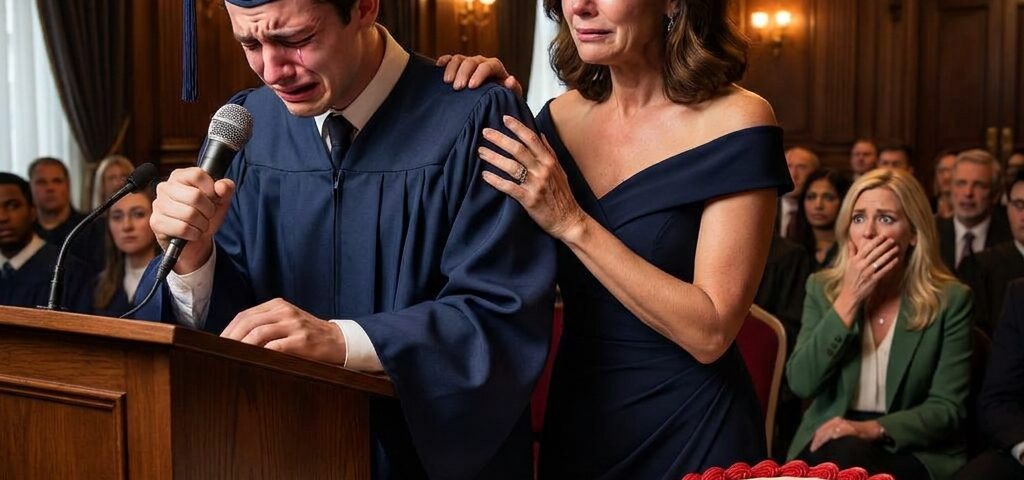
PART 2
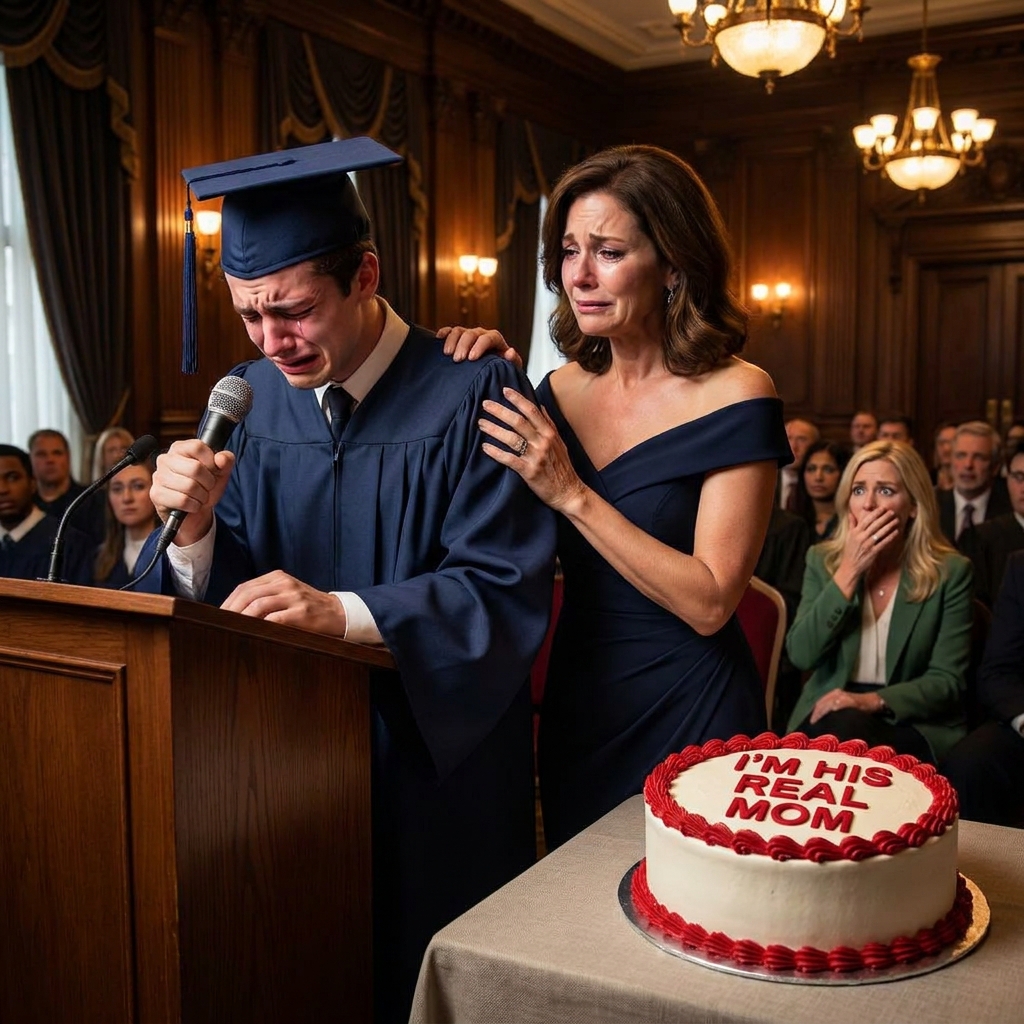
Simon’s voice did not shake.
That was the first thing I noticed.
The auditorium, which had been rustling with programs and quiet coughs only a moment earlier, went so still that even the fluorescent lights seemed loud. My son stood behind the microphone in his black graduation gown, tall and calm, with the folded speech resting beneath one hand.
Denise’s phone remained raised in the aisle.
My parents stood behind her, the cake box tilted between them, those red icing words practically glowing beneath the plastic lid.
Congratulations from your real mom.
Simon looked over the crowd, then found me again.
Not Denise.
Not my parents.
Me.
“The woman I’m talking about,” he continued, “is sitting in the third row. Her name is Joanna Miller. Most of you know her as my mom.”
A murmur moved through the audience.
My chest tightened so painfully I pressed my hand to my collarbone.
Denise’s smile faltered. Jonathan lowered his chin slightly, as if he had just realized he had walked into the middle of a story no one had explained to him honestly.
Simon drew a breath.
“When I was three weeks old, Aunt Joanna became the person who woke up for every bottle, every fever, every nightmare. She worked jobs that hurt her back and missed opportunities she deserved, not because anyone forced her to love me, but because she chose me every single day.”
My eyes blurred.
I wanted to disappear and run to him at the same time.
Beside me, Mrs. Alvarez from the bakery reached over and squeezed my hand. She had watched Simon grow up between flour sacks and cooling trays, doing homework at the back table while I packaged desserts for extra cash.
Onstage, Simon unfolded one page after all.
“I wrote a speech about ambition,” he said. “About college, success, and the future. But I realized this morning that ambition means nothing if you forget who carried you when you couldn’t walk.”
There was a soft sound from somewhere near the back.
Denise had stopped recording.
Simon’s expression changed. Not angry. Not dramatic. Just steady in that quiet way he had when he had already made up his mind.
“I know families can be complicated,” he said. “I know people make mistakes. I’m not here to embarrass anyone. But I won’t let anyone rewrite my life in front of the woman who lived it with me.”
My mother whispered, “Simon,” as though warning him.
He did not look at her.
“Joanna Miller is not my nanny,” he said. “She is not a placeholder. She is not the woman who kept me warm until someone else decided to come back. She is my mother because she stayed.”
The applause began softly.
Then it spread.
Teachers stood first. Then students. Then parents who had seen me at bake sales, parent-teacher conferences, and rainy football games with a thermos of soup tucked under my coat.
I couldn’t move.
All I could do was cry quietly into my hands while the auditorium rose around me.
Denise looked as if the floor had shifted beneath her.
Jonathan said something to her, too low for me to hear. She shook her head hard, still staring at Simon, but he had already turned toward Principal Harris.
“May I finish?” Simon asked politely.
The principal, whose eyes were damp behind her glasses, nodded. “Please do.”
Simon smiled for the first time that day.
“To my classmates,” he said, “I hope we all become people who keep showing up. That is the kind of success I understand now.”
When he stepped away from the microphone, the applause followed him like a wave.
I stood because my body finally remembered how. Simon crossed the stage to receive his diploma, and when he looked back, I mouthed the only words I could manage.
I love you.
He mouthed them back.
After the ceremony, the courtyard filled with families, balloons, flowers, and cameras. The late May sun painted everything gold. Graduates shouted names across the lawn. Mothers adjusted crooked caps. Fathers pretended not to cry.
I found Simon near the brick fountain, surrounded by friends.
He excused himself the moment he saw me.
Then he hugged me so tightly I nearly lost my balance.
“You didn’t have to do that,” I whispered.
“Yes,” he said against my shoulder. “I did.”
I pulled back and touched his face the way I had when he was little and feverish. “Are you okay?”
He nodded, though his eyes were bright. “Better than I thought I’d be.”
“Simon.”
Denise’s voice came from behind us.
His shoulders stiffened, but he did not step away from me.
Denise approached slowly now, without the triumphant sway she had entered with. Jonathan stayed several feet behind her, holding the cake box awkwardly in both hands. My parents followed, Mom pale and Dad frowning like someone had broken a rule he had never bothered to explain.
Denise looked at Simon first.
“That speech was hurtful,” she said.
Simon’s face remained calm. “It was true.”
“I am your mother.”
“You gave birth to me,” he replied gently. “That matters. But it’s not the whole story.”
Her mouth tightened. “You don’t understand what I went through.”
“No,” Simon said. “Because no one told me. You came for pictures and holidays. You brought shoes that didn’t fit and toys I was too old for. You called me your baby online, then left before bedtime.”
I saw Denise flinch.
For years, I had imagined what I would say if this moment ever came. I had rehearsed speeches while washing dishes, while folding laundry, while sitting in dark hospital rooms during Simon’s asthma attacks. But standing there, I found I had no desire to wound her.
I was simply tired.
“Denise,” I said, “why today?”
She turned to me. “Because he’s grown now. Because he should know where he came from.”
“He knows,” I said.
“No, he knows what you told him.”
Simon’s jaw tightened. “Mom never lied about you.”
Denise blinked at the word.
Mom.
It landed between us, small and final.
Jonathan cleared his throat. “Denise, maybe this is a conversation for another time.”
She ignored him. “You kept him from me.”
I stared at her, stunned. “You had my address for nineteen years.”
“You made me feel unwelcome.”
“You left him in my arms.”
Mom stepped forward. “Girls, please. Not here.”
Something inside me went quiet.
Not weak. Not frightened. Quiet.
“Not here?” I repeated. “Where, then? The hospital when he had pneumonia and Denise didn’t answer? The school office when they asked for a parent signature and you told me not to make trouble? The kitchen table when I sold my necklace to pay his science camp fee?”
Dad looked away.
Simon’s hand found mine.
Denise’s eyes filled with tears, but I could not tell whether they came from shame, anger, or surprise that the story had not gone as she expected.
“I was young,” she said.
“So was I,” I answered.
For the first time, she had no reply.
Jonathan set the cake carefully on the fountain ledge. The icing had smeared against the lid.
“I think,” he said carefully, “there are things I haven’t been told.”
Denise shot him a warning look.
That look told me more than any confession could.
Simon noticed it too.
“What does he mean?” he asked.
“No one means anything,” Denise said quickly. “This day is emotional.”
“Denise,” Jonathan said, “you told me Joanna agreed to raise Simon temporarily while you built a stable home.”
I stared at him.
“She told me,” Jonathan continued, his voice lower now, “that you refused to give him back.”
The courtyard sounds faded around me.
Simon released my hand.
“Is that what you’ve been telling people?” he asked.
Denise swallowed. “I simplified it.”
“You changed it.”
Her face hardened. “You have no idea what it felt like to watch my own child call someone else Mom.”
Simon’s voice softened. “You taught me to.”
That broke something in her expression.
The five of us stood there beneath the bright sky, surrounded by families taking photos, while nineteen years of silence pressed in from every side.
Then Principal Harris approached with a careful smile.
“Simon, there are a few scholarship donors who’d like to meet you,” she said. Her eyes moved over our faces, understanding enough to pretend she didn’t. “Whenever you’re ready.”
Simon nodded. “I’ll be there in a minute.”
“No,” I said, wiping my cheeks. “Go now. This is your day.”
He hesitated.
I smiled, though it wobbled. “I’m not going anywhere.”
He looked at Denise, then at me.
“Promise?”
That one word carried nineteen years.
“I promise.”
Simon followed Principal Harris inside.
The moment he was gone, Denise’s posture changed.
“You enjoyed that,” she said.
I stared at her. “Enjoyed what?”
“Being praised. Being saint Joanna.”
“Don’t do that.”
“Do what?”
“Turn pain into theater because you don’t know how to sit with it.”
Her eyes flashed. “You think you’re better than me.”
“No,” I said. “I think I was there.”
Jonathan looked between us. “Denise, did you sign custody papers?”
Her face went pale.
I turned slowly toward her.
My parents froze.
“What papers?” I asked.
Denise opened her mouth, then closed it.
Dad muttered, “This isn’t the time.”
“It became the time when she brought a cake,” I said, still staring at my sister. “What papers?”
Mom pressed her lips together.
Jonathan answered when no one else did. “She told me there was an informal family arrangement. No legal transfer.”
My stomach tightened.
“There was a paper,” I said. “Mom and Dad had me sign something when Simon was six months old. They said it let me take him to doctors.”
“It did,” Mom whispered.
“But?”
No one answered.
The sun suddenly felt too hot.
“But what?”
Dad rubbed a hand over his face. “It was temporary guardianship.”
My heart began pounding.
“Temporary?”
Mom’s eyes filled. “We thought Denise would come back sooner.”
I almost laughed, but it would have sounded broken. “You let me build nineteen years on temporary?”
Denise crossed her arms. “I never gave up my rights.”
The sentence was quiet.
It was also a door opening beneath my feet.
Jonathan stepped back from her as though seeing a stranger take shape.
“You said Joanna took advantage of your depression,” he said.
“I was depressed,” Denise snapped.
“I’m not questioning that. I’m questioning everything else.”
I should have felt vindicated.
Instead, I felt sick.
Because Simon was eighteen now. Almost nineteen. Maybe the papers no longer mattered legally in the way they once had. But emotionally, they mattered more than Denise understood. They meant my parents had watched me live in constant devotion while leaving a thread tied around Simon’s life, one Denise could pull whenever she pleased.
“You knew,” I said to Mom.
She began to cry. “We were trying to keep the family together.”
“No,” I said. “You were trying to keep Denise from feeling guilty.”
Denise wiped at her face. “You always make yourself the victim.”
“I made myself breakfast at four in the morning so I could get to work before Simon woke up,” I said. “I made Halloween costumes out of thrift-store curtains. I made parent meetings, dentist appointments, savings jars, birthday cakes, and a home. I never made myself the victim.”
My voice did not rise.
That made Denise look away.
Jonathan picked up the cake again, then seemed to think better of it and set it down. “I need some air,” he said.
“You’re already outside,” Denise replied sharply.
“I mean away from this.”
He walked toward the parking lot.
Denise watched him go, panic flickering through her anger.
For a moment, I saw the girl she had been before life disappointed her. My older sister, who once curled my hair for school dances and taught me how to hide tears with mascara. She had not always been this person. Or maybe I had spent years remembering only the parts of her I could still love.
“I didn’t come to ruin his day,” she said, quieter now.
“You came with that cake.”
Her face crumpled. “I thought he’d be happy.”
“Why?”
“Because I’m his mother.”
I shook my head gently. “Denise, love isn’t a title you can reclaim at a ceremony.”
She looked toward the auditorium doors. “I want a chance.”
“Then ask for one like a person who knows she lost something. Don’t announce yourself like nothing happened.”
Before she could answer, Simon returned alone, carrying a folder and two envelopes.
He looked from me to Denise. “What happened?”
I could not lie. Not anymore.
“There may be things about your guardianship I didn’t know,” I said.
His face changed. Not dramatically. Just enough that I knew the words had reached him.
Denise stepped forward. “Simon, I wanted to explain.”
He lifted one hand. “Not here.”
The same phrase Mom had used, but from him it sounded different. Not avoidance. Boundary.
He handed me one envelope. “This came from the scholarship table. They said it was mailed to the school and marked for my family.”
I frowned. “From who?”
“I don’t know. There’s no return address.”
The envelope was cream-colored and thick, the kind used for wedding invitations. My name was written across the front in careful blue ink.
Joanna Miller.
I opened it with unsteady fingers.
Inside was a photograph.
For a second, I did not understand what I was seeing.
It showed Denise in a hospital bed, younger and exhausted, holding newborn Simon wrapped in the yellow blanket I remembered. Beside her stood a man I had never seen before. He was tall, with sandy hair and gentle eyes, one hand resting on the edge of the crib.
On the back, someone had written:
He deserves the truth before they choose it for him again.
My mouth went dry.
Simon leaned closer. “Mom?”
Denise saw the photograph and went completely still.
The color drained from her face so quickly I thought she might faint.
“Where did you get that?” she whispered.
“It came to the school,” Simon said.
Dad reached for it. I pulled it back.
“No,” I said.
Mom covered her mouth.
“Who is he?” Simon asked.
No one spoke.
The courtyard seemed to tilt, every sound too far away.
Denise looked at our parents, then at me. Her eyes were no longer angry. They were terrified.
“Joanna,” she said, “please don’t.”
“Don’t what?” My voice barely came out.
Simon took the photograph from my hand and stared at the man beside his hospital crib.
Then he looked at Denise.
“Is he my father?”
Denise’s lips trembled.
Before she could answer, Principal Harris appeared at the auditorium doors again, holding a second cream envelope.
Her expression was uneasy.
“Joanna,” she said, “I’m sorry, but someone asked me to give you this only after Simon opened the first one.”
I took it slowly.
Inside was one folded sheet of paper.
There were only seven words written on it.
Ask Dorothy what happened at Lake Erie.
I looked at my mother.
She sank onto the fountain ledge as though her knees had finally given out.
END OF PART 2 – LIKE, SHARE AND COMMENT “THE ENTIRE STORY” IF YOU WANT TO READ THE FULL STORY