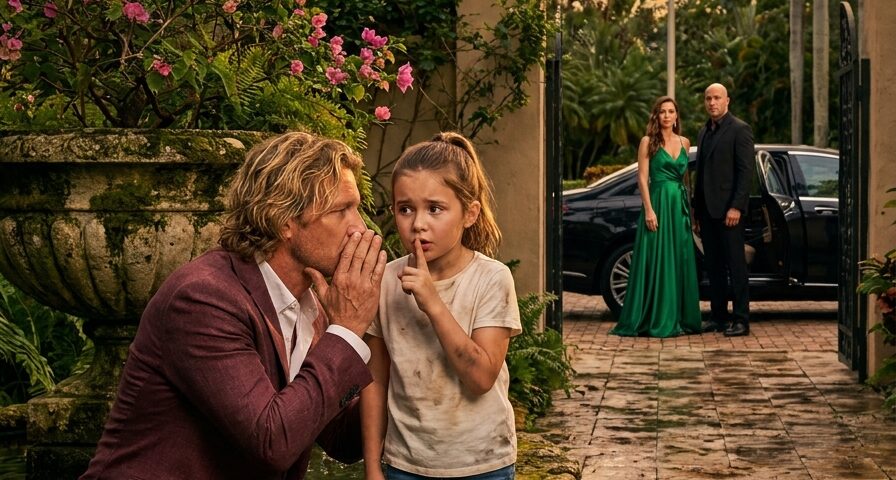
“Don’t Move—Follow Me,” the Housekeeper’s Son Whispered to the Millionaire Before His Wife’s Black Car Arrived; Minutes Later, a Terrifying Secret Nearly Sent Him to the Bottom of a California Reservoir…

PART 2
Nathan and Noah slipped around the side of the mansion, keeping low beneath a line of tall Italian cypress trees. The estate, which had always seemed like a fortress of wealth, suddenly felt like a trap built from glass. Every window became an eye. Every polished surface felt like it might reflect him back to someone waiting to see if he had made the mistake they needed.
They reached the rear garden, where the Pacific light poured over white stone terraces and the lawn rolled down toward a guesthouse Nathan rarely visited. Behind a wall of jasmine, Noah stopped and pointed.
Caroline was on the patio.
She was not alone.
The man sitting across from her was maybe forty-five, with dark hair combed too carefully and a face that looked handsome until you studied it too long. Then it looked empty. He wore a charcoal blazer over a black shirt, no tie, one hand resting near Caroline’s coffee cup.
Nathan recognized the intimacy instantly.
Not because they touched. They didn’t.
Because they didn’t have to.
Caroline leaned toward the man and whispered something. He smiled. She reached across the table and laid her fingers over his wrist.
“By lunch,” she said, just loud enough for Nathan to hear, “it will be done.”
The man lifted her hand and kissed her knuckles.
“And after a respectable year,” he said, “Mrs. Whitaker becomes Mrs. Grant Hale.”
Nathan stepped back before the fury could move his body for him.
Grant Hale.
He burned the name into memory.
Noah stared at the ground, as if ashamed to have witnessed an adult sin. Nathan put a hand lightly on his shoulder.
“You did nothing wrong,” he whispered.
“My mom works for her,” Noah said. “If Mrs. Whitaker finds out I heard—”
“She won’t,” Nathan said. “Not if we do this carefully.”
They entered through the laundry room. Nathan had owned the mansion for eighteen years and could not have described the laundry room if asked. That fact felt like an indictment. Noah and his mother lived in a cottage behind the south wing. They knew every hallway, every service entrance, every camera blind spot. Nathan owned the property, but others survived inside it.
He pulled out his phone and called his lawyer.
Eleanor Voss answered on the second ring.
“Nathan, you should already be on the road.”
“Eleanor,” he said, “I need you to listen and not interrupt. Someone replaced my driver. Caroline is involved. There is an audio recording. The plan is to kill me this morning and make it look like an accident near Lake Hodges.”
Silence.
Then Eleanor’s voice changed completely.
“Where are you?”
“Inside the house.”
“Get out.”
“I need information first.”
“No. You need oxygen first. Information comes after you are not standing inside a murder plan.”
Nathan almost smiled. Eleanor had been his attorney for sixteen years, a sharp woman from Baltimore who could make federal regulators apologize for wasting her time.
“I’m leaving through the pedestrian gate,” he said. “Call Martin. My real driver. Tell him to park two blocks east, near the old church. Tell him not to use the main road.”
“I’ll do that. Then I’m calling Detective Marisol Keene.”
“No police yet.”
“Yes, police,” Eleanor snapped. “You are not turning attempted murder into a corporate negotiation.”
“Give me twenty minutes,” Nathan said. “Caroline doesn’t know I know. If we move too fast, Hale disappears.”
Eleanor exhaled sharply. “Fine. Twenty minutes. Then I stop asking.”
Nathan ended the call.
Noah stood by the dryer, clutching the hem of his shirt.
“Go to your mother,” Nathan said. “Tell her your stomach hurts. Stay in your cottage. Don’t mention me. Don’t mention the recording.”
Noah nodded, then hesitated. “Mr. Whitaker?”
“Yes?”
“Are you going to die?”
The question struck him harder than the recording.
Nathan knelt again. “Not today.”
The boy nodded once and slipped away.
Nathan walked into his study, opened a drawer, removed a meaningless blue folder, and made sure the hallway camera caught him doing it. If Caroline checked, she would see him behaving exactly as he had claimed. A man looking for a forgotten file.
Then he went to the foyer.
Caroline was waiting by the mirror.
“There you are,” she said. Her face was perfect concern. “Did you find it?”
Nathan held up the folder.
“I found it.”
She stepped closer, smoothing his tie. “You scared me for a second.”
“Did I?”
“A little.” She laughed. “You looked strange when you walked back.”
Nathan looked at his wife’s face and tried to find the woman he had married in a small chapel outside San Diego, when he owned one warehouse, two trucks, and a future so uncertain that Diana, Caroline’s mother, had cried in the bathroom because her daughter was “throwing herself away.”
Caroline had chosen him then.
Or maybe she had chosen the man she thought he would become.
Nathan leaned in and kissed her cheek.
“I’ll call you after the meeting,” he said.
“Please do.”
He walked out the front door.
The fake driver straightened. The rear door remained open like a mouth.
Nathan walked down the path, eyes on his phone, thumb moving across a screen he wasn’t reading. Fifteen feet from the car, he shifted his direction just enough to pass the open door.
“Mr. Whitaker?” the driver said.
Nathan raised his phone to his ear. “I’m walking to the corner now,” he said loudly. “The driveway’s blocked. Meet me there.”
He kept walking.
The fake driver did not follow. He had instructions for a predictable man. Nathan was no longer predictable.
At the corner, a silver sedan waited.
Martin Bell sat behind the wheel, his father’s cracked leather watch on his wrist.
Nathan got in the front seat instead of the back.
“Drive,” he said.
Martin pulled away.
Only when they were three blocks from the estate did Nathan allow himself to breathe.
PART 3
Eleanor Voss was waiting in a private room above a coffee shop in downtown San Diego, the kind of place where attorneys met clients who did not want their names overheard. She had already ordered black coffee, printed documents, and placed two burner phones on the table.
Nathan sat across from her, still holding Noah’s cracked phone.
Martin stood near the window, arms folded, watching the street below.
“Play it,” Eleanor said.
Nathan did.
When Caroline’s voice filled the room, Eleanor’s expression did not change, but her fingers tightened around her pen. By the time the man on the recording described the reservoir curve, she had stopped writing. By the time Caroline mentioned the policy, Eleanor’s face had become hard enough to frighten a jury.
“This is conspiracy,” she said. “Attempted murder. Insurance fraud. Identity fraud if the driver replacement involved forged credentials. We take this to Keene now.”
“First,” Nathan said, “tell me about the policy.”
Eleanor slid a stack of papers across the table.
“I pulled everything after your call. Your original life insurance policy was ten million. Increased to twenty-five after the Pacific merger. Last year, someone raised it to thirty-five million and added an accidental death rider. Double payout. Seventy million.”
Nathan stared at his signature on the page.
“I didn’t sign this.”
“I believe you.”
“But that is my signature.”
“It is a very good imitation, or it was lifted from another document. The notary was in Orange County. Retired three months ago. His office is closed.”
Nathan looked at the beneficiary clause.
Caroline Whitaker, sole beneficiary.
No trust limitations. No board restrictions. No staged release.
Everything to her.
“She always said she hated paperwork,” Nathan said quietly.
“She hated paperwork when it didn’t serve her.”
The words landed with brutal simplicity.
Eleanor turned another page. “There’s more. Grant Hale is not Grant Hale.”
Nathan looked up.
“I had my investigator run him from a photo Martin pulled from your gate camera last month. His real name appears to be Evan Mercer. Born in Wisconsin. Changed his name at least twice. First wife died in a hiking accident in Michigan. Insurance payout: three point one million. Second wealthy partner died in a house fire outside Phoenix. Payout: nearly five million.”
Martin cursed under his breath.
Nathan felt strangely calm. “And now Caroline.”
“Yes,” Eleanor said. “But I don’t think Caroline understands what he is.”
“She knows enough.”
“She knows she planned to kill you,” Eleanor said. “That makes her guilty. But Mercer may have been grooming her for years. We found records of him attending charity events where Caroline served on boards. He appeared at a San Diego museum gala eighteen months ago. Then a veterans’ fundraiser. Then a private political dinner in Washington, D.C., where Caroline was photographed standing near him.”
Nathan remembered that dinner. Caroline had worn a red dress. Preston had gotten drunk and called Nathan “the family ATM” in front of a senator’s wife. Nathan had left early to take a call from Tokyo.
Had Mercer been there, watching?
Had Caroline already been angry enough to listen?
Nathan rubbed his eyes.
“What does Detective Keene say?”
Eleanor gave him a look. “I called her fifteen minutes ago.”
“I asked for twenty.”
“You are my client, not my commander.”
Before Nathan could answer, the door opened.
Detective Marisol Keene entered in a navy blazer, gray hair cut to her jaw, eyes sharp and tired. She carried no visible drama with her. No raised voice. No performance. Just the steady presence of someone who had seen human betrayal in every costume it could wear.
“Mr. Whitaker,” she said, sitting down, “I heard the recording. I also have two officers watching your estate from outside the property line. Quietly.”
“My housekeeper and her son?”
“Covered.”
Nathan nodded. “Thank you.”
Keene placed a folder on the table. “Here’s the problem. The recording is powerful, but defense attorneys love recordings made by frightened children near doors. They’ll challenge quality, context, intent, chain of custody. The insurance documents are strong but will take forensic time. Mercer’s history is disturbing but not yet proof he intended to kill you today.”
“He replaced my driver.”
“We’re working on that. But the fake driver is gone. The car left your gate twelve minutes after you walked away. We’re trying to identify the vehicle.”
Nathan leaned back. “So you need them to try again.”
Eleanor said, “No.”
Keene said nothing.
Nathan looked at the detective. “You were thinking it.”
Keene’s expression remained unreadable. “I was thinking that people like Mercer hate loose ends. He’ll either run or attempt to salvage the plan. If he runs, we track him. If he salvages, we catch him. But I am not asking you to put yourself in danger.”
“You don’t have to ask.”
Eleanor slapped her pen on the table. “Absolutely not.”
Nathan looked at her. “He killed two women before me.”
“Allegedly,” Eleanor said.
“Eleanor.”
Her anger faltered. Not because he had convinced her, but because she understood the part of him that could not leave a predator half-exposed.
Keene folded her hands. “If we do this, we do it under control. You return home. You act as though you believe the fake car was a robbery setup. You do not confront your wife. You do not mention the recording. You create an opening. We watch Mercer. We watch Caroline. We control the route. If anything changes, we stop it.”
Nathan looked down at Noah’s cracked phone.
An eleven-year-old boy had risked everything because adults had failed to notice evil whispering on a patio.
Nathan could not waste that courage.
“When?” he asked.
Keene answered quietly.
“Friday morning.”
PART 4
Returning to the estate that evening was harder than Nathan expected.
He had negotiated billion-dollar contracts without sweating. He had testified before Congress. He had fired men twice his size and watched them threaten lawsuits, ruin, even violence. But walking through his own front door while knowing Caroline might kiss him with murder still drying on her thoughts made his stomach twist.
She was waiting in the foyer.
“Oh, thank God,” she whispered, hurrying toward him. “Nathan, I was so worried.”
Her arms wrapped around him.
He held her gently.
Her hair smelled like orange blossom shampoo. Her cheek pressed against his jacket. For one terrible second, his mind betrayed him by remembering a younger Caroline in a denim jacket, sitting in the passenger seat of his first delivery truck, laughing because the heater was broken and she had to hold coffee against her hands to stay warm.
Then the memory dissolved.
“I’m fine,” he said.
“What happened?”
“Eleanor thinks someone impersonated the car service,” he replied. “Maybe a robbery attempt. Wealthy men, black sedans, predictable schedules. The police are looking into it.”
Caroline pulled back. Her eyes searched his face.
“Police?”
“Quietly. Nothing public.”
A tiny relaxation touched her mouth.
There it was.
Relief.
Not because he was safe.
Because he was misled.
“That’s frightening,” she said. “You did the right thing.”
“I got lucky.”
She touched his cheek. “Maybe we both did.”
Dinner was served in the garden room. Caroline had told the cook to prepare his favorite meal: roasted sea bass, lemon potatoes, grilled asparagus, and a bottle of California Chardonnay they had bought on their twentieth anniversary. Nathan ate because refusing would be suspicious. He answered her questions. He let her pour his wine. He even smiled when Preston called halfway through dinner and Caroline declined the call with visible annoyance.
“My brother is impossible,” she said.
“He’s been impossible for twenty years.”
“He thinks the family deserves more from you.”
Nathan looked at her. “Does he?”
She gave a soft laugh. “Preston thinks everyone deserves more from you. Especially Preston.”
“Is that what this morning was about?” Nathan asked.
Caroline stilled.
He let the silence stretch just long enough.
“At breakfast,” he added. “Your mother. Preston. The usual performance.”
She exhaled. “I’m sorry. Mother has been anxious about money.”
“Your mother owns three homes.”
“She owns three mortgages.”
Nathan looked down at his plate.
Family.
There it was, the old wound. Caroline had been raised in a wealthy-looking family that had quietly gone broke twice. Diana wore pearls to hide panic. Preston wore arrogance to hide failure. Caroline had married Nathan when he was poor and then spent two decades insisting she had sacrificed status for love. Somewhere along the way, love had become a debt she believed he owed.
“Your family has received enough from me,” Nathan said quietly.
Caroline’s smile tightened. “That sounds cruel.”
“No. Cruel is letting people believe they can spend forever without consequence.”
Her eyes cooled for half a second.
Then she recovered.
“I don’t want to fight tonight.”
“Neither do I.”
After dinner, she went upstairs early. Nathan waited twenty minutes, then slipped out the side door toward the staff cottage.
Tessa Porter opened before he knocked twice.
She had already been crying.
“Noah told me some,” she said. “Not all. Enough.”
Nathan stepped inside. The cottage was small but clean, warm with lamplight and the smell of chamomile tea. Noah sat on the couch beneath a blanket, sketchbook closed on his lap.
When he saw Nathan, he stood quickly.
“Sir—”
Nathan crossed the room and lowered himself into the chair across from him.
“Noah,” he said, “you did something most adults would have been too afraid to do.”
The boy’s face crumpled. He tried to hold it in. Failed. Tessa sat beside him and wrapped an arm around his shoulders.
Nathan told Tessa what he could. Not every detail, not Mercer’s past, but enough for her to understand that danger still moved around the house wearing expensive shoes.
“I need you both to behave normally for two more days,” he said. “Detective Keene has people watching. You won’t see them, but they’re there.”
Tessa’s jaw tightened. “And after two days?”
“After two days, Caroline and Mercer will either be in custody or running from people better at chasing than they are.”
Noah looked up. “Are you scared?”
Nathan considered lying.
Then he didn’t.
“Yes.”
The boy nodded, almost relieved.
“My dad used to say brave doesn’t mean not scared,” Noah said. “It means scared but still doing it.”
Nathan looked at Tessa.
“My husband,” she said softly. “He was a firefighter. Died when Noah was four.”
“I’m sorry.”
“He would’ve liked what Noah did.”
Nathan’s throat tightened unexpectedly.
“He would’ve been proud,” he said.
When he returned to the mansion, Caroline was standing at the top of the stairs in a silk robe.
“Where were you?”
Nathan looked up at her.
“Walking.”
“At midnight?”
“I needed air.”
She smiled faintly, but her eyes were alert.
“Come to bed, Nathan.”
For twenty-four years, those words had meant home.
Now they sounded like an invitation into a room where trust had died first.
PART 5
Thursday was a theater performance, and Nathan played his role perfectly.
He took calls in his study. He complained about the board. He asked the cook for more coffee. He let Caroline overhear him telling Eleanor that the company had rescheduled the Rancho Santa Fe meeting for Friday morning and that Martin would drive him personally.
At lunch, Preston arrived uninvited.
He came in wearing sunglasses indoors, smelling of cologne and resentment. Diana followed twenty minutes later, dressed as though she were attending a charity luncheon instead of ambushing her son-in-law in his own home.
Caroline claimed she hadn’t known they were coming.
Nathan no longer believed in coincidences.
They gathered in the sunroom, where Diana accepted tea from Tessa without looking at her.
“Nathan,” Diana began, “this family has been under stress.”
“This family,” Nathan said, “is always under stress when Preston runs out of money.”
Preston removed his sunglasses. “Careful.”
“Or what?”
Caroline touched Nathan’s arm. “Please.”
Diana sighed dramatically. “This is exactly what I mean. You treat us like beggars.”
“No,” Nathan said. “I treat you like adults who keep sending bills to my office.”
Preston stood. “You think you’re untouchable because you have lawyers and trucks and government contracts.”
Nathan looked at him calmly. “No, Preston. I think I’m tired.”
Caroline went pale.
It was the most honest thing he had said in that room for years.
Diana leaned forward. “You married my daughter when you had nothing.”
“And she married me when your family needed someone with ambition instead of debt.”
The words hit their mark.
For a moment, Diana’s polished mask slipped, revealing something ugly and frightened beneath it.
Caroline stood abruptly. “Enough.”
Nathan rose too. “Yes. Enough.”
He left them in the sunroom and walked to his study, heart pounding not from fear but from the satisfaction of finally refusing the old family script. Behind him, voices rose. Caroline’s sharp whisper. Preston’s anger. Diana’s wounded pride.
He wondered how much of Caroline’s hatred had been fed by that room. How many years of her mother telling her she deserved more. How many dinners of Preston joking that Nathan would never have fit into their world if he hadn’t bought the table.
But resentment was not murder.
Plenty of unhappy people walked away.
Caroline had chosen a reservoir.
That evening, Eleanor called from a secure line.
“Mercer moved,” she said. “He met with the fake driver in a parking garage near Mission Valley. Keene’s team recorded part of it. They discussed Friday. Mercer believes you suspect a robbery attempt and nothing more.”
“Caroline?”
“She called Mercer twice after your lunch with Diana and Preston. First call lasted six minutes. Second lasted eighteen. We don’t have audio yet, but location data puts Mercer near your estate tonight.”
Nathan looked toward the dark patio windows.
“Is he here?”
“Close. Not inside the property.”
“What about Noah and Tessa?”
“Protected.”
Nathan closed his eyes. “Good.”
“Nathan,” Eleanor said, her voice softening, “tomorrow ends this. But endings don’t always feel like victories.”
“I know.”
“Do you?”
He looked around his study: the first contract he had ever signed framed on the wall, a photograph of himself and Caroline at Yosemite, a crystal award from a logistics association in D.C., books he had bought and never read because he liked the way they made the room look.
“No,” he admitted. “Probably not.”
After midnight, Nathan woke to the sound of Caroline crying.
She sat on the edge of the bed, face in her hands, shoulders shaking.
For a moment he thought it was an act. Then she looked at him, and the grief on her face was too disorganized to be staged.
“I used to love you,” she said.
Nathan did not move.
“I know,” he answered.
Her expression changed.
Maybe she heard something in his voice. Maybe guilt sharpened her instincts. Maybe some surviving part of their marriage recognized that he had already stepped emotionally beyond her reach.
“What does that mean?” she asked.
“It means I know.”
She stared at him.
Then she laughed once, softly. “You know what?”
Nathan held her gaze.
Outside, somewhere beyond the lawn, police watched in silence.
He could end it now. Say the words. Watch her collapse. Watch her deny. Watch the house explode before the trap was ready.
Instead, he turned away.
“Go to sleep, Caroline.”
She sat there for a long time.
Then she lay down beside him without touching him.
Neither slept.
At dawn, Nathan dressed in a charcoal suit and blue tie. Caroline stood by the bedroom window, arms folded.
“You’re still going?”
“The meeting matters.”
She turned. “After everything this week?”
“Especially after everything this week.”
Downstairs, she handed him coffee in the kitchen. Her hand shook once, barely.
At the front door, she straightened his tie.
“Be careful,” she whispered.
Nathan looked at her for a long second.
Then he said, “I intend to be.”
PART 6
The black sedan waited at the gate.
This time, Martin stood beside it.
The cracked leather watch was on his wrist.
Nathan walked down the marble path without looking at his phone. Morning light spilled over the estate walls. Somewhere behind the curtains, Caroline watched. Somewhere beyond the property line, Detective Keene’s people waited. Somewhere on the road to Lake Hodges, Mercer believed he was about to recover a failed murder plan.
Martin opened the rear door.
Nathan got in.
The gate rolled open, and the car slid into the street.
For ten minutes, neither man spoke. San Diego fell away behind them, all glass, ocean light, and expensive silence. The highway carried them inland, toward hills brushed gold by dry summer grass.
Martin checked the mirror.
“Gray SUV behind us,” he said. “Two cars back. Picked us up after the exit.”
Nathan nodded.
“Are you all right, sir?”
“No.”
Martin’s eyes flicked up.
Nathan almost smiled. “But drive anyway.”
“Yes, sir.”
They left the freeway and took the road toward Lake Hodges. It narrowed quickly, bending between scrub-covered hills and old trees. The reservoir appeared to the left, wide and steel-blue beneath the morning sky.
Nathan looked at the water and imagined another version of the day.
A version where Noah stayed silent.
A version where Nathan got into the fake car.
A version where Caroline received a call, cried for cameras, buried him beneath marble, and inherited everything.
The thought did not frighten him.
It clarified him.
Ahead, a white pickup sat near a turnout.
A man leaned against it, pretending to check his phone.
Martin slowed slightly.
“That’s the fake driver from Monday,” he said.
Behind them, the gray SUV closed distance.
Nathan touched the small microphone beneath his jacket cuff.
“Confirm visual,” he said quietly.
Detective Keene’s voice came through the hidden earpiece.
“Confirmed. Keep moving. Do not stop unless blocked.”
The pickup pulled out ahead of them.
The gray SUV moved closer behind.
The road curved along the reservoir. The guardrail was older here, patched in places, scarred by past accidents. Nathan saw how easy it would have been. A staged mechanical issue. A sudden shove. A drugged passenger. A car through metal and into deep water.
The pickup slowed abruptly.
Martin braked.
The SUV behind them accelerated.
For one suspended second, the trap became real enough to kill them.
Then two unmarked black vehicles shot from a side road and blocked the pickup. Another SUV came hard behind the gray one, boxing it in. Sirens burst alive. Men and women in tactical vests emerged with weapons drawn.
“Hands! Hands where we can see them!”
Martin swore and pulled to the shoulder.
Nathan watched as the fake driver tried to run. He made it six steps before an officer took him down on the gravel. The gray SUV’s doors opened. Two men were dragged out, cuffed, and searched.
Then Nathan saw him.
Grant Hale.
Evan Mercer.
He stepped out of the passenger side slowly, hands raised, face calm. Even now he looked offended rather than afraid, as though the world had made a scheduling error.
Detective Keene approached him.
Nathan could not hear what she said, but he saw Mercer’s expression shift when she spoke his real name.
Evan Mercer.
For the first time, the mask cracked.
Nathan opened his door.
Martin turned sharply. “Sir, stay in the car.”
Nathan stepped out anyway.
Keene saw him and frowned, but she did not stop him.
Mercer looked over.
Their eyes met across the road.
Nathan expected hatred. He expected triumph. He expected some dramatic confession hiding in that empty face.
Instead, Mercer smiled faintly.
“She wanted it,” he called. “I only showed her the door.”
Nathan walked closer until an officer blocked him with one arm.
Mercer continued, voice smooth. “Ask her how long she hated you before I arrived.”
Nathan said nothing.
Mercer’s smile widened. “That’s the part men like you never understand. Money builds beautiful cages. Eventually someone inside starts dreaming of fire.”
Nathan looked at him, then at the reservoir.
“You killed Margaret Holst,” Nathan said. “You killed Renee Castle. You tried to kill me. Whatever Caroline felt, whatever she wanted, you chose dead bodies as your business model.”
Mercer’s smile disappeared.
Keene nodded to her officers. “Put him in the car.”
As they led him away, Nathan’s phone vibrated.
Eleanor.
“They moved on the estate,” she said. “Caroline is in custody.”
Nathan closed his eyes.
“What did she say?”
Eleanor was silent for a beat.
“She said, ‘He told me he had done this before.’ Then she said it again.”
Nathan lowered the phone.
The reservoir wind moved against his face.
Martin stood beside him.
“It’s over,” Martin said softly.
Nathan looked at the water one last time.
“No,” he said. “Now comes the part where we live with it.”
PART 7
The trial became national news.
Not because Nathan wanted it to. He didn’t. He refused interviews from cable networks, newspapers, podcasts, and a documentary producer from Los Angeles who called Eleanor’s office eleven times in three days. But the story had all the things America could not look away from: a millionaire husband, a beautiful wife, a secret lover with multiple names, a seventy-million-dollar insurance policy, a fake driver, a reservoir, and an eleven-year-old boy with a cracked phone.
Reporters called Noah “the boy who stopped a murder.”
Tessa hated that.
“He is a child,” she told Nathan. “Not a headline.”
Nathan agreed.
He paid for security at their cottage, then moved Tessa and Noah into the larger guest residence near the east garden. When Tessa protested, he told her the truth.
“This house owes him more than safety,” he said.
“No,” Tessa replied. “You owe him honesty. Don’t turn gratitude into ownership.”
The words struck him.
She was right.
So he asked instead of commanded. Tessa took two days to think. Then she accepted on three conditions: Noah would remain a normal child, Nathan would not parade him before donors, and any school Nathan paid for would be discussed with her first.
Nathan agreed to all of it.
Caroline pleaded guilty before the full trial began.
Her statement was read in court on a gray November morning. She admitted to conspiracy, insurance fraud, and helping Mercer access Nathan’s personal documents. She claimed Mercer had manipulated her, but she did not deny knowing the plan required Nathan to die.
Nathan sat in the back row.
For twenty minutes, he listened to the woman he had loved explain the mechanics of his planned death in a voice so flat it sounded borrowed.
When the judge asked whether she understood that her actions could have resulted in her husband’s murder, Caroline looked toward Nathan.
“I understood,” she said.
That was the moment he finally stopped waiting for an apology.
Mercer fought.
He hired attorneys. He claimed the recordings were fabricated, that Caroline was unstable, that Nathan had staged the events to avoid divorce and preserve corporate control. But old ghosts rose against him. Investigators reopened Margaret Holst’s hiking death in Michigan. A retired ranger remembered seeing Mercer near the trailhead. Renee Castle’s fire report was reexamined, and new evidence showed accelerant near a locked rear door.
Women who had once dated Mercer came forward.
A pattern emerged.
He did not seduce women because he loved them.
He studied loneliness, resentment, wealth, pride, and grief. Then he entered through whichever door had been left unlocked.
The fake driver made a deal. So did one of the men in the gray SUV.
By spring, Mercer was convicted on the California charges. The other states prepared their own.
Nathan did not celebrate.
He sold the La Jolla mansion.
That surprised everyone.
Preston called him a coward in a drunken voicemail. Diana sent a handwritten letter blaming him for “destroying Caroline instead of protecting her.” Nathan read neither twice.
He moved to a smaller house in Coronado with white walls, an ocean-facing porch, and no staff quarters hidden behind hedges. Martin became head of security for Whitaker Global, though he still drove Nathan on difficult days because loyalty, he said, did not always fit inside a job description.
Eleanor remained Eleanor: sharp, loyal, allergic to sentiment.
Detective Keene sent one message after sentencing.
You survived. Now make it mean something.
Nathan printed it and placed it inside his desk drawer.
One year later, on a bright Saturday morning, Nathan visited Noah’s school art fair. Tessa stood beside him in the gymnasium while children and parents moved between folding tables covered with paintings, clay bowls, and science posters.
Noah’s drawing hung near the center.
It showed a large house surrounded by roses. A black car waited at a gate. In the corner stood a small boy, one hand lifted, warning a tall man not to move.
But the drawing was not dark.
The sky above the house was full of light.
Nathan stared at it for a long time.
Noah came up beside him, suddenly shy.
“It’s not exactly how it looked,” he said.
“No,” Nathan replied. “It’s better.”
“I changed the ending.”
Nathan looked at him.
“In the drawing,” Noah said, “the man listens the first time.”
Nathan felt something inside his chest loosen.
“That is a very good ending.”
Noah smiled.
Later, they walked outside into the school parking lot. The American flag moved gently on a pole near the entrance. Tessa went ahead to take a call from Noah’s teacher, leaving Nathan and the boy alone beneath the afternoon sun.
“Mr. Whitaker,” Noah said, “do you still have nightmares?”
“Sometimes.”
“About the car?”
“Mostly about almost ignoring you.”
Noah looked down. “I almost didn’t say anything.”
Nathan stopped walking.
“Why did you?”
The boy thought about it.
“Because my dad died saving people he didn’t know,” Noah said. “And I thought… if I knew something bad was going to happen and I stayed quiet, I’d be the opposite of him.”
Nathan looked toward Tessa, then toward the flag, then back at the boy whose courage had changed the shape of his life.
“You are not the opposite of him,” Nathan said. “You are proof of him.”
Noah’s eyes filled, but he smiled anyway.
Years passed.
Noah grew taller. His drawings became sharper, then astonishing. Nathan helped him apply to art programs but never pushed. Tessa eventually left household work and opened a small bakery in Coronado, where Nathan became a regular customer and terrible unpaid taste-tester.
Whitaker Global changed too.
Nathan created a foundation for children of domestic workers, drivers, caregivers, and household staff—children who lived close to power but were often invisible to it. He named it the Porter Trust only after Tessa agreed. Its first scholarship recipient was not Noah. Tessa insisted on that.
“No special treatment,” she said.
Nathan laughed for the first time in months.
Caroline wrote him once from prison.
The letter was six pages long. It contained regret, explanation, self-pity, memory, and one sentence that mattered.
I became cruel before I became criminal, and I blamed you for not noticing.
Nathan folded the letter and put it away.
He did not write back.
Forgiveness, he learned, was not the same as reopening a door.
On the fifth anniversary of the morning by the roses, Nathan returned to Lake Hodges alone. He stood near the curve where the road bent along the water and watched sunlight break across the reservoir.
No memorial marked the place.
No headline remained fresh.
The world had moved on, as it always did.
But Nathan remembered.
He remembered the engine humming at the gate. Caroline’s warm voice on the phone. Noah’s small hand gripping his sleeve. The cracked phone. The whisper.
Don’t move. Follow me.
A warning.
A command.
A gift.
Nathan closed his eyes and breathed in the dry California air.
He had spent most of his life believing power came from money, contracts, signatures, and control.
But the truth had arrived in a faded T-shirt, with frightened eyes and trembling hands, brave enough to speak when silence would have been safer.
That was the voice that saved him.
Not the loudest voice.
Not the richest.
Not the most powerful.
Just the honest one.
And sometimes, Nathan finally understood, one honest voice is enough to stop a car, expose a lie, break a family curse, and pull a man back from the edge of a grave he never saw coming.
THE END