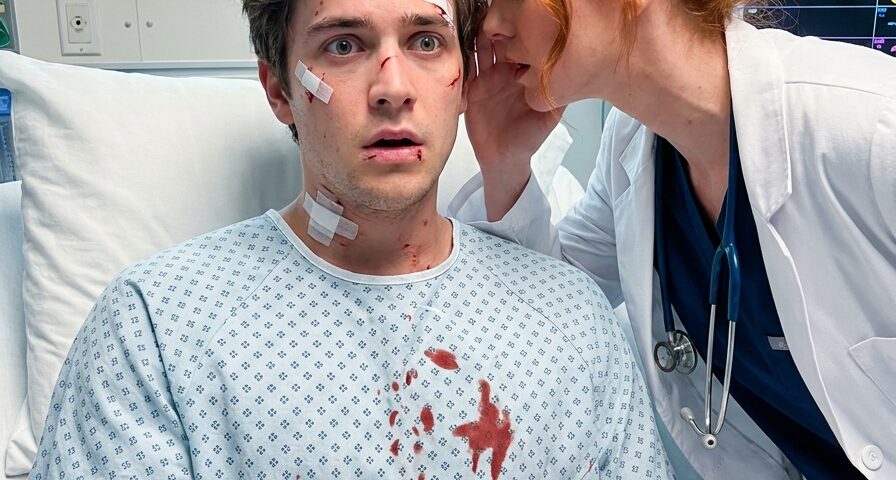
My High School Crush Treated Me in the ER After My Motorcycle Crash—Then She Whispered, “Do You Remember Me?” Seconds Before Her Rich Family Stormed In…
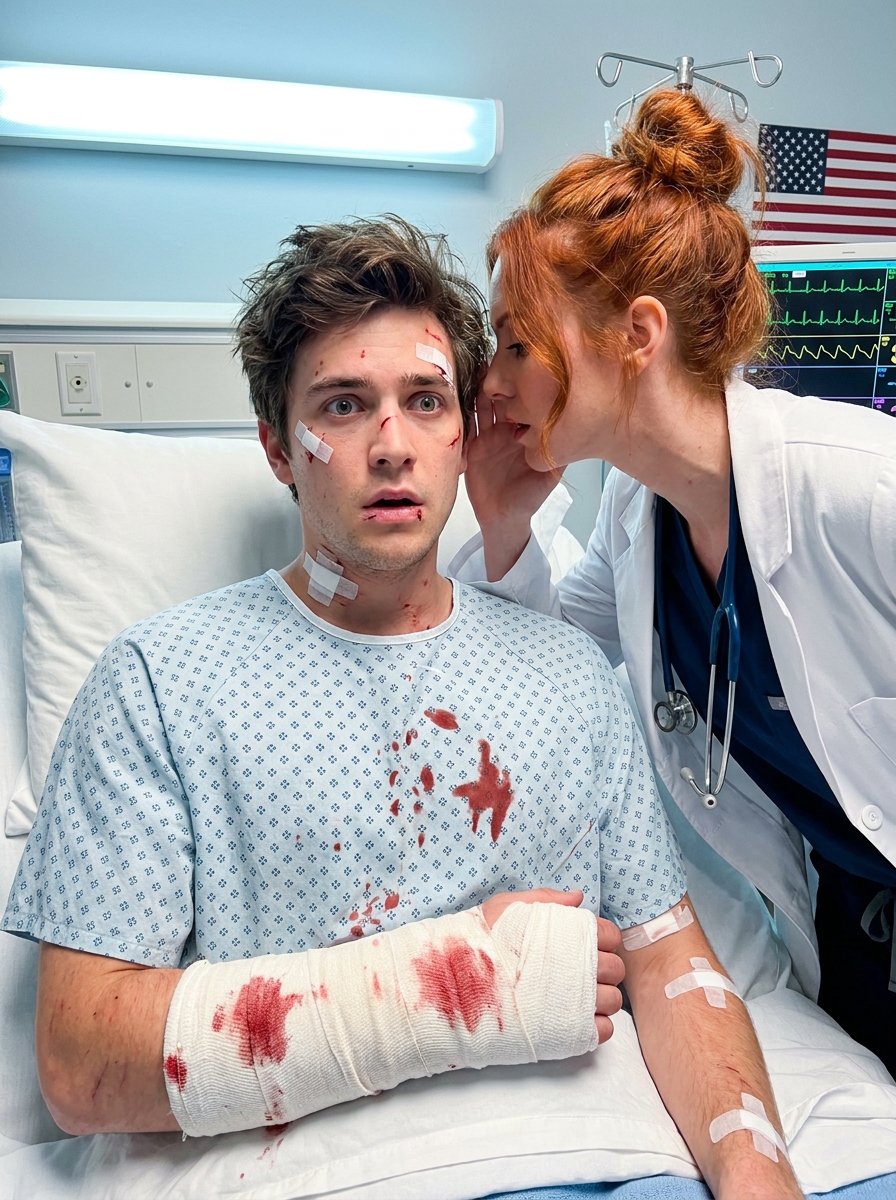
PART 2
They took me for scans before anyone could say another word.
Two orderlies rolled my bed down the hall while Savannah walked beside me, one hand on the rail, her expression locked back into the calm professional mask she must have worn through a thousand emergencies. But her eyes betrayed her. Every few steps, she glanced behind us, as though expecting Grant or her mother to follow.
“Savannah,” I said.
“Don’t try to talk.”
“I’ve been waiting fifteen years to talk.”
Her mouth trembled. “Then wait fifteen more minutes. Your skull matters too.”
Even hurt, I almost smiled. That was the Savannah I remembered—sharp when scared, gentle when she thought no one noticed.
The CT scanner was cold and loud. As the machine circled my head, I closed my eyes and tried to force the past into shape.
Graduation night.
Mission Bay High’s football field had been wrapped in fog rolling in from the coast. My mother had sat alone in the bleachers wearing her diner uniform because she had come straight from work. My father hadn’t come at all. Savannah’s family had occupied the front row like royalty. Her father, Charles Reed, owned clinics across California. Her mother chaired charity boards. Everyone said Savannah was going to Stanford, then medical school, then some grand life already framed in gold.
After the ceremony, I found her outside the gym.
She was crying so hard she couldn’t breathe.
“Hey,” I had said, awkward and terrified. “Are you okay?”
She laughed through tears. “Do I look okay?”
“No.”
That made her laugh again. Somehow, because I was eighteen and stupid and in love, I gave her my jacket. She wore it while her parents argued near the curb. Her father kept saying Boston. Her mother kept saying reputation. Savannah kept staring at the ground like she wanted it to open.
When she asked me to drive, I did.
We went to the overlook above Mission Bay, where teenagers went to drink cheap beer and make promises they couldn’t keep. We did neither. We sat in my Honda while rain tapped the roof and she told me her whole life had been selected for her like a dress laid out on a bed.
“I don’t want to be a Reed tonight,” she whispered.
“Then don’t be.”
She looked at me. “Who should I be?”
“Savannah.”
That was when she kissed me.
Not like a high school crush. Not like a dare. Like she had been drowning and found air.
I remembered that kiss for fifteen years.
But after that, everything blurred. I remembered dropping her near her house at dawn. I remembered her touching my cheek and saying, “Don’t let me disappear.” I remembered promising I wouldn’t.
Then she vanished anyway.
When they rolled me back to the ER, Savannah was waiting outside the imaging room. Grant stood with her, speaking in a low, furious voice. He stopped when he saw me.
“Clean scan,” the tech announced. “No brain bleed.”
“Thank God,” Savannah whispered.
Grant glanced at her. “You’re relieved.”
She stared at him. “He almost died.”
“He was always dramatic.”
The words sliced through the air.
I turned my head toward him. “Always?”
Savannah stepped closer. “Grant, how exactly do you know Caleb?”
Grant adjusted his cuff. “I told you. Your family talked about him.”
“No,” she said. “You knew him.”
His lips flattened.
The ER around us moved fast—nurses, doctors, patients, ringing phones—but the space between the three of us slowed to a crawl.
“I knew of him,” Grant said.
Savannah’s voice dropped. “From when?”
Grant looked at me then, and the polished man cracked enough for me to see the ugly boy underneath. Suddenly I remembered him—not from school, not exactly, but from the edges of Savannah’s world. Grant Whitmore had been the son of her father’s business partner. Private-school rich. Country-club rich. The kind of guy who showed up to public school events in loafers and looked at the rest of us like we were temporary staff.
“You worked at the airport that summer,” he said to me.
I did. Baggage service at San Diego International. Night shifts, ugly vest, minimum wage, hands always smelling like rubber and jet fuel.
Savannah looked between us. “What does that have to do with anything?”
Grant sighed, as if the truth were an inconvenience. “Your father was concerned. You were emotional after graduation. He asked me to make sure certain distractions didn’t follow you to Boston.”
My pulse jumped.
Savannah’s face went white. “What distractions?”
Grant didn’t answer.
I did.
“Letters,” I said.
Savannah turned toward me slowly. “You wrote?”
“Three times.”
Her hand flew to her mouth.
“I sent one to your house,” I said. “I gave one to the housekeeper because your mother wouldn’t let me past the gate. And I mailed one to Boston.”
Tears gathered in her eyes. “I wrote you too.”
“I never got anything.”
Grant looked bored now, but his hand had curled into a fist.
Savannah whispered, “You took them.”
He shrugged. “I protected your future.”
“No,” she said. “You stole my choice.”
“You were eighteen. You didn’t know what you wanted.”
She laughed once, broken and bitter. “I knew exactly what I wanted. That was the problem.”
The monitor beside me beeped faster.
Grant looked at it with contempt. “This is ridiculous. You’re romanticizing a teenage mistake because he showed up bleeding on a stretcher.”
Savannah stepped between him and my bed. “Get out of my patient’s bay.”
“Your patient?” he said. “Or your unfinished fantasy?”
Her cheeks flushed.
I wanted to stand. I wanted to put myself between them. But my ribs screamed when I moved one inch.
Grant leaned close to her. “Your father is sick. Your mother is desperate. The board is unstable. And you want to blow up everything for a man who couldn’t even afford a college application?”
Savannah recoiled as if he had slapped her.
That was when I understood: this wasn’t only about old letters.
This was about money, power, and a daughter her family still believed they owned.
Savannah straightened. Her voice was quiet when she spoke, but it carried more force than any scream.
“I am done being useful to people who call it love.”
Grant’s expression changed. The charm disappeared completely.
“You’ll regret this.”
Savannah reached into her pocket, pulled out a pen, and wrote something on the back of a discharge instruction card. Then she placed it in my hand.
Her phone number.
“This time,” she said, “no one touches the message before it reaches you.”
Grant stared at our hands.
Then he walked out of the bay and raised his voice toward the security desk.
“That patient is harassing medical staff.”
Savannah closed her eyes.
When she opened them, the girl I lost was gone.
The woman standing there was furious.
“Oh,” she said softly. “He should not have done that.”
PART 3
Two hospital security officers appeared at the curtain less than a minute later.
The taller one looked uncomfortable before he even spoke. That told me Grant’s name carried weight around St. Catherine’s Medical Center. The shorter guard kept glancing over his shoulder like he expected a board member to materialize behind him and fire everyone within ten feet.
“Mr. Mercer?” the tall guard asked.
I lifted my uninjured hand. “Present. Currently threatening nobody except maybe this blanket.”
Savannah did not laugh. Her face had gone icy. “Who filed the report?”
“Ma’am, we just need to ask—”
“Who?”
The guard sighed. “Mr. Whitmore said the patient made inappropriate comments and refused to let you leave.”
Savannah folded her arms. “That is false. Document that the complaint was retaliatory.”
“Savannah,” the guard said carefully, “maybe we should step into—”
“No. We won’t step anywhere. This patient was brought in after a motorcycle crash. Mr. Whitmore entered a restricted care area without authorization, interfered with my assessment, intimidated me, and then filed a false complaint when I asked him to leave.”
The shorter guard swallowed. “We’ll make a note.”
“A note?” Savannah said. “Make a report.”
Before they could answer, a woman in a white coat pulled the curtain back. She was in her sixties, Black, with close-cropped gray hair and eyes that had clearly survived every kind of hospital politics. Her badge read: Dr. Marlene Price, Chief Medical Officer.
“Savannah,” she said, “my office.”
Grant stood behind her, wearing victory like cologne.
Savannah didn’t turn. “My patient needs observation.”
“He’ll be reassigned.”
The words hit me harder than I expected.
Savannah looked down at me, and for a moment the anger slipped. Underneath was fear—the same fear I had seen when her mother entered the bay.
Not fear of leaving her job.
Fear of leaving me alone with people who had already rewritten our lives once.
“I’ll be fine,” I said.
Her eyes searched mine. “You sure?”
“No. But I’m good at pretending.”
That almost got a smile.
She looked at Dr. Price. “Security stays posted here until discharge. And Mr. Whitmore does not come near him.”
Dr. Price studied her. Then she looked at Grant. “Agreed.”
Grant’s jaw clenched. “That’s unnecessary.”
“So was your complaint,” Dr. Price said.
For the first time, Grant had no smooth reply.
Savannah walked away with Dr. Price, but not before looking back once. I held up the card with her number. She saw it. Her face softened just enough to keep me breathing.
The next hours crawled.
A different nurse came in, kind but distant. She cleaned my arm, wrapped my wrist, and explained that I had two cracked ribs, a bruised hip, a mild concussion, and enough road rash to make showers miserable for weeks.
“Helmet saved you,” she said.
“Tell the helmet I owe it dinner.”
She laughed politely.
My phone came back in a plastic bag with my wallet, keys, and the shredded remains of my jacket. I had eleven missed calls from my older sister, Rachel.
I called before she involved the police.
“You absolute idiot!” she shouted, already crying. “A hospital called me and said motorcycle accident. Do you know what that does to a person?”
“Raises blood pressure?”
“Caleb.”
“I’m okay.”
“You are in the emergency room.”
“Okay-ish.”
She exhaled shakily. In the background, one of her kids asked if Uncle Caleb was dead.
“Tell Owen I said not yet,” I said.
“Do not joke about that.”
“Sorry.”
Her voice softened. “Are you alone?”
I looked at the security guard outside my curtain. “No. Long story.”
“A woman?”
“How did you—”
“You have a tone.”
“I have cracked ribs. I don’t have a tone.”
“You have many tones. This one is trouble with pretty eyes.”
I closed mine.
Rachel knew about Savannah. Not every detail. But sisters have a way of knowing the names that live in the quiet parts of you.
“Is it her?” she asked.
I didn’t answer.
“Oh, Caleb.”
“She works here.”
“Of course she does.”
“And her family apparently stole our letters.”
There was a long silence.
Then Rachel said, “I’m coming.”
“No. You have three sleeping children.”
“I will wake them.”
“Do not bring children into an ER drama involving hospital security and stolen mail.”
Another pause. “Hospital security?”
“I said long story.”
“Caleb, listen to me. You got hurt tonight. You’re lonely. You’re divorced. You’re vulnerable. Don’t let the past look like destiny just because it arrived in scrubs.”
I wanted to argue.
But she wasn’t wrong. My divorce from Natalie had been quiet, almost polite. No cheating. No screaming. Just two tired people who discovered one day that love could leave without slamming the door. Since then, I had lived in a one-bedroom apartment in North Park with one balcony chair, one coffee mug I liked, and a silence I pretended was peace.
“I hear you,” I said.
“Do you?”
“Yes.”
“And?”
“And I think she was in love with me too.”
Rachel whispered something I couldn’t hear.
“What?”
“I said, God help you.”
After we hung up, the curtain shifted.
Not Savannah.
Eleanor Reed stepped into my bay as if security were ornamental.
The guard moved. “Ma’am, you can’t—”
“It’s fine,” I said, though every nerve in my body disagreed.
Eleanor looked down at me with the same polished cruelty I remembered from fifteen years ago.
“You need to leave my daughter alone.”
I laughed once, and pain stabbed through my ribs. “I’m in a hospital bed.”
“Don’t be clever.”
“Hard not to be. I’m heavily medicated and emotionally cornered.”
Her mouth tightened. “Savannah has responsibilities you can’t understand.”
“You mean the board? The clinics? Grant’s family money?”
Her eyes flickered.
I smiled without humor. “He mentioned enough.”
“She was raised for more than a small life with a man who works airport gates.”
“There it is.”
“What?”
“The reason you were always scared of me.” I held her gaze. “I had nothing. And somehow I was still enough to threaten everything.”
For the first time, Eleanor looked uncertain.
Then Savannah appeared behind her.
She had heard every word.
“Mom,” Savannah said, voice trembling, “tell me the truth.”
Eleanor closed her eyes.
Savannah stepped closer. “Did you help hide his letters?”
Her mother didn’t answer.
That was answer enough.
Savannah turned pale, then furious.
“I spent fifteen years thinking he forgot me.”
Eleanor whispered, “We did what was best.”
“No,” Savannah said. “You did what was useful.”
Then, in front of her mother, security, nurses, and every ghost between us, Savannah walked to my bed and took my hand.
“Caleb,” she said, “when you’re discharged, I’m driving you home.”
Eleanor’s face hardened.
From the hallway, Grant watched with his phone pressed to his ear.
And I knew the next person coming for us would be Savannah’s father.
PART 4
Charles Reed arrived forty minutes later in a wheelchair.
That was the first thing that shook Savannah.
Not his anger. Not his power. His frailty.
Fifteen years ago, Charles Reed had looked like a man carved from old California money: tall, silver-haired, tanned from golf courses and yacht decks, always wearing a suit even when everyone else wore sweaters. The man who entered the ER now had the same silver hair, but thinner. His skin sagged at the jaw. A nurse pushed him forward while an oxygen tube curved beneath his nose.
Still, when he spoke, everyone listened.
“Savannah.”
His voice moved through the hall like a command.
Savannah’s hand tightened around mine before she let go. “Dad.”
Grant stood behind him. Eleanor stood beside him. Together they looked like a family portrait with a gun hidden behind the frame.
Dr. Price appeared from the nurses’ station. “Mr. Reed, this is a patient care area.”
Charles lifted one hand. “My daughter is having a breakdown.”
Savannah flinched.
I hated him for that.
“She’s not,” I said.
Every face turned toward me.
I should have stayed quiet. I was shirtless under a hospital gown, bruised, scraped, and dependent on a plastic cup of ice chips. Not exactly the ideal position for confronting a medical dynasty. But I had been silent at eighteen because rich adults spoke with certainty and I mistook that for truth.
I was thirty-four now.
Old enough to know certainty could be just another weapon.
Charles looked at me. “Caleb Mercer.”
“Mr. Reed.”
“You should have stayed a memory.”
Savannah stepped forward. “Don’t talk to him like that.”
“I’m talking to the man who has poisoned my daughter against her family in one night.”
“One night?” Savannah’s voice cracked. “You stole fifteen years from me.”
Charles’s face changed. Not guilt. Irritation.
“I preserved your future.”
Grant nodded slightly, as if they had rehearsed this.
“My future?” Savannah said. “Or your company?”
Eleanor whispered, “Savannah, please.”
“No. I want to hear it. Is that why you pushed Grant back into my life? Because Whitmore Capital can keep the clinics from being sold?”
Charles’s hand curled over the armrest of his wheelchair. “Those clinics employ eight hundred people.”
“And that makes me currency?”
“You are a Reed.”
“I am a person.”
The sentence landed with more force than a scream.
For a moment, Charles looked almost wounded. Then pride covered it.
“You don’t understand sacrifice.”
Savannah laughed through tears. “I understand it perfectly. I have been sacrificing myself on your altar since I was a child.”
Grant stepped in. “This is emotional blackmail.”
Savannah turned on him. “You don’t get to say that after hiding letters from me.”
Dr. Price’s eyes narrowed. “Letters?”
Grant stiffened.
I saw the mistake immediately. So did Savannah.
Dr. Price looked from Grant to Charles to Eleanor. “Would someone like to explain why a board director is being accused of interfering with personal correspondence and patient care in my emergency department?”
Grant tried to smile. “Doctor, this is a family matter.”
“You made it a hospital matter when you filed a false security complaint.”
Charles lifted his chin. “Dr. Price, my family has donated more than—”
“I know exactly how much your family has donated,” she said. “And I know exactly where the donor wall is. This is still my ER.”
I liked her instantly.
Savannah looked at Dr. Price with something like gratitude.
Then Charles coughed. It started small, then deepened until Eleanor rushed to his side. For a moment, Savannah’s anger vanished and she moved toward him automatically.
He caught her wrist.
Not hard, but enough.
“Come home,” he said, voice lower now. “We’ll fix this before it becomes public.”
Savannah stared at his hand around her wrist.
There it was. The whole family history in one gesture. Love as a grip. Protection as a cage.
She gently pulled free.
“No.”
Charles blinked. “What?”
“No.”
Eleanor looked horrified. Grant looked furious. Dr. Price looked proud.
I looked at Savannah and saw the girl from the overlook, finally doing what she had begged herself to do at eighteen.
Charles’s voice hardened. “If you walk away, you lose everything.”
Savannah smiled sadly. “Dad, I already did.”
He stared at her.
“I lost Caleb. I lost my own choices. I lost fifteen years believing I wasn’t worth a reply. I lost sleep, peace, trust. What exactly are you threatening to take now?”
No one answered.
Grant recovered first. “Your position. Your reputation. Your access to every facility connected to Caldwell-Reed Health.”
Savannah nodded slowly. “Thank you for clarifying.”
She took off her badge.
The little plastic card swung once in her hand. Savannah Reed, ER Nurse Practitioner.
Then she handed it to Dr. Price.
“I resign, effective immediately.”
Eleanor gasped. “Savannah!”
Dr. Price did not take the badge.
“Absolutely not,” she said. “You’re on administrative leave pending a formal review of Mr. Whitmore’s conduct. You do not resign because powerful men create a scene in your workplace.”
Grant went red. “That is not what happened.”
Dr. Price turned to the security guards. “Please escort Mr. Whitmore out of the emergency department.”
For one beautiful second, nobody moved.
Then the taller guard stepped forward. “Sir.”
Grant looked at Charles, expecting rescue.
Charles said nothing.
That silence told me everything: Grant was useful until he became inconvenient.
Grant’s face twisted. He pointed at Savannah. “You think he loves you? He loves a version of you that died in high school.”
Savannah’s eyes filled, but she didn’t look away.
“Maybe,” she said. “But at least he loved a version of me I chose.”
The guards led Grant down the hall.
Eleanor followed Charles’s wheelchair as a nurse turned him around. But before they left, Charles looked back at me.
“You won’t survive our world,” he said.
I believed him.
That was the strange part.
I believed every word. I didn’t belong in their world of boardrooms, donor wings, and family reputations polished with other people’s pain.
But Savannah looked at me, bruised by them and still standing.
“I don’t want him in your world,” she told her father. “I want out of it.”
Then the Reed family disappeared down the corridor.
Savannah turned back toward me, shaking so hard she had to hold the bed rail.
I reached for her hand.
She took it.
Neither of us knew what came next.
But for the first time in fifteen years, no one else was writing it.
PART 5
I was discharged at 3:17 in the morning.
Savannah insisted on wheeling me out, even though she was technically off duty, possibly suspended, and definitely at war with half the hospital’s donor class. I told her I could walk. She looked at my bandaged wrist, my taped ribs, and the dried blood still caught in my hairline.
“Caleb,” she said, “you nearly lost a fight with pavement.”
“The pavement sucker-punched me.”
“Sit down.”
I sat.
Outside, San Diego smelled like rain and brake dust. The hospital entrance glowed behind us. Ambulance lights washed the sidewalk in red, then disappeared.
Savannah stopped beside a dark blue Subaru.
“This is yours?” I asked.
“Yes.”
“Very responsible.”
“I save my recklessness for emotional decisions in emergency rooms.”
I laughed and immediately regretted it. She helped me into the passenger seat, careful with my ribs. For a moment, her face was close to mine. Too close for two people who had just survived an ambush by her family and a confession fifteen years late.
She looked at my mouth.
Then away.
“I should say something before this becomes another beautiful misunderstanding,” she whispered.
“Okay.”
“I am not eighteen anymore.”
“I noticed. The badge helped.”
“I’m serious.” She gripped the open car door. “I’m tired. I work too much. I have spent my whole life being managed by people who call control love. I was engaged to Grant because my family made him sound like stability, and because I was too exhausted to fight another war. I ended it three months ago, but he never accepted that. My parents never accepted that.”
I listened.
“I’m complicated,” she said. “And I’m scared. Not of you. Of wanting something that can still be taken.”
The city hummed around us.
I thought about Rachel’s warning. Don’t let the past look like destiny just because it arrived in scrubs.
“I’m divorced,” I said. “I live alone. I eat cereal from the box and pretend it’s because dishes are a social construct. I have one chair on my balcony because buying two felt like optimism, and optimism felt embarrassing.”
Savannah’s eyes softened.
“My ex-wife didn’t destroy me,” I continued. “That almost made it worse. We just faded. Quietly. Like a photograph left in the sun. So I don’t know if I’m good at holding onto good things either.”
She nodded slowly.
“So we’re a mess,” she said.
“Completely.”
“And fifteen years late.”
“Also that.”
She smiled, small and real. “But this time, we have each other’s numbers.”
“And security reports.”
“And possibly an ethics investigation.”
“Romantic.”
She laughed then, and the sound loosened something in my chest that painkillers hadn’t touched.
She drove me to my apartment in North Park. The streets were wet and empty, palm trees black against the sky. Neither of us said much. The silence wasn’t awkward. It was full—crowded with everything we had lost and everything we were afraid to name.
At my building, she parked but didn’t turn off the engine.
“I can get upstairs,” I said.
“You have cracked ribs.”
“I also have dignity.”
“Not tonight.”
She walked me to my door.
My apartment looked exactly as lonely as I feared it would: one chair by the balcony, one mug in the sink, one pair of shoes by the door, one life arranged to avoid evidence that anyone else might belong there.
Savannah noticed. Of course she did.
“I wasn’t lying about the chair,” I said.
“I see that.”
“Minimalism.”
“Self-protection.”
“Rude.”
“Accurate.”
She helped me settle onto the couch. Then she found a glass, filled it with water, and placed my discharge papers on the coffee table. She moved around my apartment like someone trying not to disturb a museum exhibit.
Before she left, she stood by the door with her arms wrapped around herself.
“I kept them,” she said.
“What?”
“The letters I wrote you.”
I couldn’t breathe for a second. “You did?”
She nodded. “All three. I thought you never answered because you didn’t feel the same. But I couldn’t throw them away. That felt like admitting I had imagined it.”
“You didn’t.”
Her eyes shone.
“I know that now.”
The distance between us was only ten feet, but it held fifteen years, a stolen future, my divorce, her broken engagement, both our fears, and a family powerful enough to punish her for choosing herself.
I wanted to ask her to stay.
I didn’t.
She wanted me to ask.
She didn’t say it.
Instead, she walked over and gently touched my cheek, the same way she had at eighteen before dawn stole her from me.
“Sleep,” she said.
“Savannah.”
She paused.
“I would have come for you.”
Her face crumpled.
“I know,” she whispered. “That’s what hurts.”
After she left, I sat in the dark with the glass of water untouched.
At 4:02 a.m., my phone buzzed.
A text from Savannah.
“I got home. No one intercepted this message.”
I stared at it until my eyes burned.
Then I wrote back.
“I remember everything now.”
Three dots appeared. Disappeared. Appeared again.
Finally, her reply came.
“Then don’t let me disappear this time.”
I didn’t sleep.
At sunrise, Rachel arrived with coffee, groceries, and the expression of a woman ready to interrogate a corpse.
She looked at my bandages, then at the second coffee cup on the table.
“Did she stay?”
“No.”
“But you wanted her to.”
“Yes.”
Rachel sighed and sat in the only chair.
“Caleb,” she said, “love that survives in your imagination for fifteen years can become dangerous. You have to learn who she is now, not just who she was then.”
“I know.”
“Do you?”
I showed her Savannah’s text.
Rachel read it twice. Her face softened despite herself.
“Oh,” she said.
“Yeah.”
“That poor woman.”
“Me too?”
“No. You’re an idiot. But yes, you too.”
Over the next week, Savannah and I texted like people building a bridge over a canyon.
Slowly.
Carefully.
No grand promises. No midnight declarations. She told me Dr. Price had opened a formal investigation into Grant’s conduct. I told her my motorcycle was totaled and my sister was celebrating like it had personally wronged her. She told me her mother called sixteen times in one day. I told her my mother cried when she heard Savannah’s name because she remembered how sad I had been that summer.
Then, on the eighth night, Savannah asked if she could come over.
She arrived carrying a shoebox.
And my past was inside it.
PART 6
The shoebox was pale blue, faded at the corners, with a water stain across the lid.
Savannah held it with both hands as if it contained something fragile and living. She stood in my doorway wearing jeans, a gray sweater, and no makeup. She looked younger without the hospital badge, and more exhausted.
“I almost turned around six times,” she said.
“I almost cleaned.”
She looked past me at the apartment. “Almost is generous.”
“I’m injured.”
“You were messy before the crash, weren’t you?”
“Allegedly.”
She smiled, but it didn’t last.
I stepped aside. “Come in.”
By then, I had purchased a second chair. Rachel called it a red flag. I called it furniture. Savannah noticed immediately and ran her fingers over the back of it.
“You bought another chair.”
“I needed somewhere for guests to sit.”
“Guests?”
“Very exclusive list.”
She lowered her eyes, and I saw the blush she tried to hide.
We sat on the balcony because the evening was warm. San Diego stretched around us in gold windows and distant traffic. Savannah placed the shoebox between us on the small table.
“For fifteen years,” she said, “I thought these were proof that I had been foolish.”
She opened the lid.
Inside were three envelopes, never mailed. My name written across each one in teenage handwriting.
Caleb Mercer.
My throat tightened.
“I wrote the first one the day after I got to Boston,” she said. “My father took my phone. My mother said you had already stopped by, angry, demanding money, saying I had led you on.”
I stared at her. “What?”
“I didn’t fully believe it. But I was eighteen and scared, and they kept saying you were embarrassed because I was leaving. They said you wanted to hurt me before I hurt you.”
I shook my head. “I never said anything like that.”
“I know.” She touched the letters. “Now.”
She handed me the first envelope.
My hands shook as I opened it.
Dear Caleb,
I don’t know if you hate me. I don’t know what they told you. They took my phone before the plane landed. I keep thinking about the overlook. I keep thinking about your jacket. I keep thinking about what you said—that I could just be Savannah. I don’t know how to do that here. Everyone calls me Ms. Reed like I’m already somebody else.
I miss you. That sounds stupid because we only had one night, except it didn’t feel like one night to me. It felt like the first honest thing that ever happened.
Please write back.
S.
I couldn’t read the rest out loud.
Savannah wiped her face with her sleeve.
“I waited,” she said. “Every day. Then my mother brought me a letter.”
My head snapped up. “From me?”
She nodded. “Except it wasn’t.”
Cold moved through me.
“What did it say?”
“That you were sorry if I misunderstood. That you had gotten caught up in the moment. That you needed to focus on work and didn’t want drama with my family.”
“I didn’t write that.”
“I know.”
“Grant?”
“I think so. Or my father. Maybe all of them.” Her voice hardened. “They were efficient when they wanted to hurt me.”
I leaned back, ribs aching. “I wrote that I loved you.”
Savannah closed her eyes.
“I didn’t use fancy words,” I said. “I probably spelled something wrong. But I wrote it.”
A tear slipped down her cheek.
She opened the second letter. “I wrote this after Thanksgiving.”
I didn’t read it immediately. I looked at her instead. The woman before me had become real in a way memory could never hold. She wasn’t the untouchable girl from high school anymore. She had lines at the corners of her eyes from long shifts. She had scars from a family that smiled in public and cut in private. She had survived by becoming competent, controlled, useful.
And somehow, underneath all of it, she had kept a shoebox.
“Savannah,” I said, “what do you want now?”
The question startled her.
“What?”
“Not what your parents want. Not what Grant wants. Not what eighteen-year-old us wanted. You. Now.”
She looked out over the balcony.
“I want to work somewhere nobody cares about my last name,” she said. “I want a kitchen with music in it. I want to stop flinching when my phone rings. I want to sleep through the night. I want Sunday mornings that don’t feel like court appearances.”
Then she looked at me.
“And I want to know you again.”
My chest ached in a place no scan could see.
“I want that too.”
“But slowly,” she said quickly. “Please. I can’t survive another person turning into a cage.”
“I don’t want to be a cage.”
“I know. That’s why I’m here.”
We didn’t kiss that night.
Instead, we read the letters.
All three.
In one, she described Boston snow and how it made her feel erased. In another, she wrote that she had started nursing classes instead of the pre-approved track her father wanted. In the last, written months later, she said goodbye to me because she believed I had already said goodbye to her.
When we finished, the city had gone dark.
Savannah folded the letters and placed them back into the box.
“I thought bringing these would make me feel better,” she said.
“Did it?”
“No.” She laughed softly. “But I think it made me feel free.”
Two days later, Grant’s scandal became public.
Not through Savannah. Not through me.
Through Dr. Price.
The hospital’s internal review found hallway footage, false security reports, unauthorized access logs, and emails between Grant and Charles Reed discussing “family alignment,” “risk containment,” and “Savannah’s emotional instability.” Those words appeared in a local San Diego news article by Friday morning.
By noon, Caldwell-Reed Health issued a statement.
By evening, Grant resigned from the board.
By Monday, Charles Reed’s partners began distancing themselves.
Savannah didn’t celebrate. She turned off her phone, came to my apartment, sat on the floor beside my couch, and cried with her whole body.
I slid down carefully beside her.
“Does it make me terrible,” she whispered, “that I still love them?”
“No.”
“They hurt me.”
“I know.”
“And I still want my mother to call and say she’s sorry.”
“I know.”
She leaned against my shoulder, careful of my ribs.
“My family taught me love had to cost something.”
I looked at the shoebox on my shelf.
“Maybe it does,” I said. “But it shouldn’t cost you yourself.”
She cried harder then.
I held her as gently as I could.
Outside, rain started again.
And for once, neither of us disappeared.
PART 7
Six months later, Savannah Reed no longer worked at St. Catherine’s Medical Center.
Dr. Price helped her transfer to a community clinic in Chula Vista where nobody cared that her father owned buildings with marble lobbies. The patients cared that she remembered their names, explained prescriptions in plain English, and could calm a terrified child with three words and a sticker shaped like a dinosaur.
She loved it.
Not immediately. At first, she came home exhausted and suspicious of peace. She would sit on my balcony—now with two chairs, then three when Rachel insisted I needed “human furniture”—and wait for disaster to arrive.
It did, in pieces.
Her mother sent long messages that began with “I love you” and ended with instructions. Savannah stopped answering the instructions. Her father left voicemails in which apology and accusation wrestled for dominance. Grant sent one email from a private address saying she had embarrassed herself.
She forwarded it to Dr. Price’s legal team and blocked him.
I healed slowly.
My ribs stopped screaming when I laughed. My wrist came out of its brace. The road rash faded into shiny pink marks along my arm. My motorcycle, according to Rachel, “went to hell where it belonged.” I bought a used Subaru because Savannah said if I ever rode again before she forgave physics, she would personally sedate me.
We did not fall into love like a movie.
We walked into it like people entering a house after a fire, testing each floorboard before trusting it with our weight.
She learned my ordinary habits: I hated peas, loved thunderstorms, and got quiet when I was overwhelmed. I learned hers: she sang off-key while doing dishes, cried at videos of old dogs being adopted, and arranged books by emotional damage instead of author.
I met her outside the clinic after long shifts. She met Rachel’s kids and became Aunt Savannah within one afternoon because she knew how to remove splinters and listen to dinosaur facts with sincere concern.
One Sunday, my mother invited us to dinner.
Savannah stood outside my childhood apartment building in Logan Heights, holding a pie she had bought because she was too nervous to arrive empty-handed.
“What if she hates me?” she asked.
“My mother?”
“Yes.”
“She has hated exactly three people in her life. My father, a landlord from 2007, and the woman who cut her in line at a pharmacy while she had the flu.”
“That’s oddly specific.”
“She keeps a list.”
My mother opened the door before we knocked.
For one long second, she just looked at Savannah.
Then she pulled her into a hug.
Savannah froze.
My mother held on.
“You poor girl,” she whispered.
Savannah broke.
Not loudly. Not dramatically. She simply folded into my mother’s arms like someone who had been waiting fifteen years for one adult to be kind without asking for anything in return.
After dinner, my mother gave Savannah something wrapped in tissue paper.
My old denim jacket.
The one from graduation night.
“I kept it,” Mom said. “Caleb said he lost it, but I found it in his closet years ago. I figured something that made him that sad had to matter.”
Savannah held it like a sacred thing.
“I thought your mother threw it away,” she whispered to me.
“So did I.”
She put it on. It was faded, worn thin at the elbows, and too big on her shoulders.
It fit the moment perfectly.
A year after the crash, Savannah asked me to drive her to the old overlook above Mission Bay.
We went in the Subaru. Practical. Safe. Deeply unromantic, according to me. Savannah disagreed. She said survival was romantic when you understood the alternative.
Rain began just as we parked.
For a while, we sat without speaking.
The bay glittered below us. The windshield blurred with water. Fifteen years folded in on itself until the boy I had been and the man I was sat side by side inside me.
Savannah reached into her bag and took out the shoebox.
“I brought them,” she said.
“The letters?”
She nodded. “I don’t want them to be a shrine anymore.”
“What do you want them to be?”
“A beginning.”
She opened the box and removed one more envelope I had never seen.
My name was on it, but the handwriting was recent.
“I wrote this last night,” she said.
I took it carefully.
Dear Caleb,
I used to think love was the thing people could steal from me if they were powerful enough, cruel enough, or close enough. I was wrong.
They stole letters. They stole time. They stole the truth for a while. But they did not steal what was real. What was real waited. Bruised, confused, angry, older—but alive.
You once told me I could just be Savannah.
I am trying.
And I want to try beside you.
S.
When I looked up, she was crying.
I was too, though I planned to deny it if Rachel ever asked.
Savannah took my hand. “Do you remember now?”
The question was the same one she had whispered over me in the ER, when my blood was still on her gloves and our past was still buried under other people’s lies.
This time, I knew the answer.
“I remember the rain,” I said. “I remember your mascara on my jacket. I remember the way you asked me not to let you disappear. I remember loving you before I knew what to do with love.”
She smiled through tears.
“And I remember,” I continued, “that the next day I thought you were gone forever.”
“I was,” she whispered. “For a while.”
I touched her cheek. “Not anymore.”
She kissed me then.
Not like a memory.
Not like a rescue.
Like a choice.
Two years after the accident, we married in a small garden behind the clinic in Chula Vista. Rachel’s kids threw flower petals with violent enthusiasm. My mother cried into three napkins. Dr. Price officiated because, as she said, she had already handled the emergency intake on our relationship.
Savannah’s mother came alone.
She stood at the back in a pale blue dress, older and smaller than I remembered. Savannah saw her before the ceremony began. For a moment, everything inside me tensed.
Then Eleanor walked forward.
“I’m not here to ask you to come back,” she said.
Savannah said nothing.
Eleanor’s eyes filled. “I’m here because I should have chosen you over the family name. And I didn’t.”
It was not enough to erase the past.
Nothing could.
But Savannah reached for my hand and held it while she answered.
“I don’t know how to forgive you yet.”
Eleanor nodded, tears slipping down her face. “Then I’ll start by not asking you to.”
That was the first honest thing I had ever heard her say.
Charles did not come. He sent a letter. Savannah read it privately, cried for an hour, then placed it in a drawer instead of the shoebox. Some things belonged to the past. Some things did not deserve display.
Grant never came back into our lives. The ethics investigation followed him for years. He moved to Washington, D.C., joined another firm, and became a man people described with careful pauses. I wished him nothing dramatic. Only the kind of life where his own reflection asked questions he could not silence.
Savannah kept the denim jacket.
Sometimes she wore it on rainy nights when we sat on the balcony—now with four chairs, because life had expanded around us. Sometimes she placed the shoebox between us and reread the letters, not to mourn what was stolen, but to honor what survived.
On the third anniversary of the crash, we drove past St. Catherine’s.
I looked at the emergency entrance and shook my head.
“What?” Savannah asked.
“I went in with cracked ribs and came out with a war against a medical dynasty.”
She laughed. “You also came out with my number.”
“Best discharge instruction I ever received.”
At a red light, she took my hand.
The scar near her lip caught the evening sun.
For years, I had believed love was something that could vanish if the wrong people stood between you and the truth. But love, real love, is stubborn. It hides in old jackets. It waits inside shoeboxes. It survives false letters, locked gates, family threats, and fifteen years of silence.
And sometimes, if life is merciful in the strangest possible way, it finds you again under hospital lights, with a cracked helmet on the floor and the girl you never forgot whispering your name like she has been carrying it too.
“Caleb,” Savannah said as the light turned green. “Do you remember me?”
I looked at my wife, my past, my future, the woman who saved me twice.
“Every day,” I said.
THE END