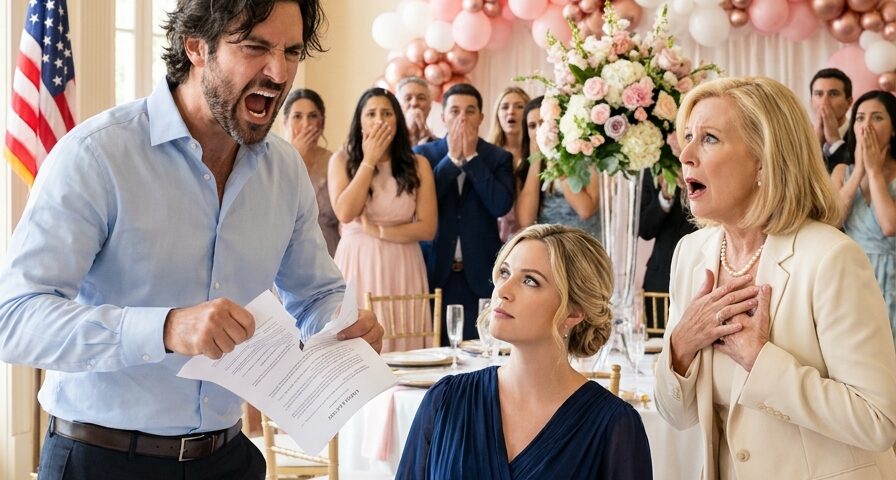
At My Baby Shower, My Mother-In-Law Handed Me “47 Reasons My Son Should Leave You”—But When My Husband Read The Final Page, He Laughed, Went Silent, Then Tore The Paper To Shreds. A Few Days Later…
PART 2
Three years before Patricia Whitmore tried to destroy me in front of her friends, I was just Emily Harper from Bakersfield, California, standing barefoot on a hotel dance floor in Santa Barbara with a glass of cheap champagne in my hand.
I had gone to the wedding of a nursing school friend. Daniel was one of the groomsmen. He was tall, kind-eyed, slightly awkward in a black tuxedo, and laughing at himself because he had spilled salsa on his cuff before the reception even started.
I liked him immediately.
Not because he was handsome, though he was.
Not because he came from money, though I learned that later.
I liked him because when the bride’s grandmother dropped her cane near the dance floor, Daniel was the first person to kneel and pick it up. He did it without making a show of himself. He just helped.
That matters to a nurse.
We notice who moves toward trouble and who waits for someone else to handle it.
Daniel taught English literature at a public high school in San Diego and coached the girls’ basketball team. I worked in labor and delivery at Mercy Coastal Hospital. I had student loans, a used Honda Civic, and a father who drove freight trucks for twenty-nine years before his knees gave out. My mother worked the front desk at a dental clinic and still clipped grocery coupons even after I told her she didn’t have to save them for me anymore.
Daniel and I married fourteen months after that wedding.
Small ceremony. Fifty guests. A rented garden behind a historic inn in Coronado. My dress cost $480 and fit perfectly after my mother altered it by hand. Daniel cried when I walked down the aisle. His mother did not.
Patricia Whitmore wore pale gray, brought her own photographer, and told three people during cocktail hour that she hoped I understood “the responsibility of marrying into a family with a name people recognized.”
I thought she meant I was welcome.
She meant I was being watched.
At first, the insults came wrapped in silk.
“Oh, Emily, that casserole is so practical. I forget not everyone grew up with proper dinner service.”
“Your accent gets stronger when you’re nervous, sweetheart. It’s charming.”
“You work nights? How brave. I could never let strangers raise my children during the day, but every family makes its own choices.”
When I defended myself, she blinked like I had slapped her.
When I stayed quiet, she smiled like she had won.
Daniel always said the same thing.
“That’s just how Mom is.”
He said it when she rearranged my kitchen during Thanksgiving.
He said it when she introduced me at a charity luncheon as “Daniel’s little nurse wife.”
He said it when she gave me etiquette books for Christmas.
And because I loved him, because he was gentle and funny and packed snacks for me when I worked twelve-hour shifts, I tried to believe him.
Then I got pregnant.
Patricia found out at Sunday dinner.
Daniel squeezed my hand beneath the table and said, “We have news.”
For half a second, Patricia looked at my face, then my stomach, then Daniel. Not joy. Calculation. I watched her measure the future like square footage.
Then the smile appeared.
“Oh, Daniel,” she said, standing to embrace him. “A Whitmore baby.”
She hugged him for a long time.
She hugged me for three seconds.
Before dessert, she said, “Naturally, you’ll stop working after the baby is born.”
I told her I planned to return to the hospital after maternity leave.
The spoon paused halfway to her mouth.
“Return?” she asked, as if I had said I planned to leave the newborn in a train station.
“We need both incomes,” I said. “And I love my work.”
She laughed softly.
“Women always say that before the baby comes.”
That was when things shifted.
Patricia began sending Daniel articles about stay-at-home mothers. She offered to pay for a nanny, but only if the nanny came from an agency she selected. She told women at church I was “overwhelmed.” She told her real estate partners I was “emotionally fragile during pregnancy.” She began constructing a version of me before I could defend the real one.
Daniel’s older sister, Caroline, joined in.
Caroline was thirty-eight, divorced, and living in the guesthouse behind Patricia’s La Jolla property with her ten-year-old daughter, Maddie. Before her divorce, she had been the marketing director at Whitmore & Lane. Afterward, Patricia demoted her to office coordinator and called it “giving her stability.”
Caroline smiled more than Patricia, but her bitterness leaked through.
One afternoon, she came over to help with the nursery and spent forty minutes refolding onesies I had already folded.
Then she sat in the rocking chair and said, “You’re lucky, you know.”
I was on my knees organizing diapers.
“Lucky?”
She looked at my belly.
“You got pregnant before Mom had time to push you out.”
I stopped moving.
“What does that mean?”
Caroline stood, smoothed her blouse, and avoided my eyes.
“Nothing. Forget I said it.”
I did not forget.
Two weeks later, Patricia called to inform me she had reserved Magnolia Crest Estate in Del Mar for my baby shower.
I had planned cupcakes at home with ten friends.
Patricia planned thirty-seven guests, plated appetizers, imported flowers, a harpist, custom invitations, and a cake from a bakery that charged more than my monthly car payment.
“Patricia, that’s too much,” I told her.
“Nonsense,” she said. “This is Daniel’s first child.”
Daniel stood in our kitchen eating cereal from a mug because the dishwasher was running. He gave me the look I knew too well.
Let her have this.
So I did.
That was my mistake.
I thought she wanted control over a party.
I did not know she was building a stage.
PART 3
The Sunday before the shower, Patricia invited us to dinner at her house in La Jolla.
Her home sat on a hill above the ocean, all glass, pale stone, and curated warmth. Nothing in that house looked accidental. Not the flowers. Not the art books. Not the silver-framed photographs of Daniel as a child, Daniel at Stanford, Daniel beside his late father on a sailboat, Daniel smiling with Lauren Hargrove at some long-ago university fundraiser.
There were no framed photos of me.
Dinner was roasted halibut, asparagus, and a lemon tart Patricia claimed she made herself, though I recognized the bakery box in the recycling bin.
Halfway through dinner, I excused myself to use the bathroom. The downstairs powder room was occupied because Maddie had locked herself inside to avoid eating asparagus. So I walked down the hall toward the guest bathroom beside Patricia’s office.
The office door was open.
The printer light blinked orange.
I almost kept walking.
Then I saw the paper in the tray.
A title.
A number.
47.
I cannot explain why my body knew before my mind did. Nurses develop instincts. We hear the tiny change in a woman’s breathing before labor turns dangerous. We notice the pale lips, the shaking hand, the husband who stops making eye contact.
That blinking printer felt like a monitor alarm.
I did not touch it then.
I went to the bathroom, washed my hands, and returned to the table.
Patricia asked if I was feeling all right.
I said yes.
I ate lemon tart.
I laughed when Daniel talked about his basketball team making the regional playoffs.
I helped clear plates.
Then I went home and did not sleep.
The next morning, after Daniel left for school, I called Patricia.
“I think I left my gray cardigan at your house.”
She sounded distracted.
“I’m showing a property in La Jolla at nine. Caroline is taking Maddie to school. Use the spare key under the planter.”
I drove there with my heart beating so hard I could feel it in my throat.
Her house was quiet. Sunlight poured through the glass walls. The ocean looked calm and expensive.
I went straight to the office.
The pages were still there.
I took them out.
Read them.
Photographed them.
Read the email.
Photographed that too.
Then I sat in Patricia’s chair, staring at the last page.
Lauren Hargrove.
I knew that name.
Daniel had dated her in college. They had broken up senior year, friendly but final, according to him. She had gone to law school in D.C. and later became a policy consultant. Patricia mentioned her often enough that Lauren felt less like a person and more like a weapon stored in a drawer.
“Lauren always had such grace.”
“Lauren understood formal dinners.”
“Lauren came from a family that valued tradition.”
Now Patricia had booked her a flight to San Diego two days after the baby shower.
Not before.
After.
The sequence was brutally clear.
Humiliate me publicly.
Make Daniel doubt me.
Bring Lauren in while he was vulnerable.
Use a trust attorney to protect the family money and property.
Push me out before the baby came.
I put the pages back exactly as I had found them.
Then I walked out, locked the door, replaced the key beneath the planter, and sat in my car for twenty minutes.
I did not cry.
That surprised me.
Instead, I thought.
If I confronted Patricia privately, she would deny everything. She would say the list was therapeutic. She would say the email was misunderstood. She would say pregnancy had made me paranoid.
If I told Daniel immediately, he would call her. She would cry. He would soften. The conversation would become about Patricia’s intentions instead of Patricia’s actions.
If I canceled the shower, she would control the story.
Poor Patricia tried to throw Emily a beautiful party, and Emily became unstable.
No.
Patricia had chosen an audience.
So I would let her use it.
That night, I saved every photo to the cloud. I printed a backup and sealed it in an envelope. I put the envelope in my purse between my wallet and a packet of mints.
Then I researched.
Lauren Hargrove had a public Instagram. Blonde, elegant, smiling in Washington cocktail dresses. She had recently liked three of Daniel’s Facebook posts: one about his basketball team, one about our nursery, and one photo of the sunset from our porch.
I checked Daniel’s phone.
We had always known each other’s passwords. No secret rule. No drama. Just trust.
There were no messages from Lauren.
But there was one from Patricia.
An old friend of yours may be in San Diego next week. Lauren Hargrove. Remember her?
Daniel had replied:
Wow. Haven’t heard that name in years. Sure, I’ll say hello if she’s around.
He had not told me.
Not because he was hiding something.
Because Patricia had trained him to treat her interference as weather.
Annoying. Inevitable. Not worth discussing.
Two days before the shower, I asked him a question while we sat on the sofa.
“Do you trust me?”
He muted the basketball game.
“Of course.”
“If something strange happens at the shower, will you trust that I handled it the only way I could?”
His face changed.
“Emily, what’s going on?”
I touched my stomach.
“Just promise me.”
He looked at me for a long time.
Then he said, “I promise.”
PART 4
Saturday arrived bright and cloudless, the kind of Southern California day that makes betrayal look cinematic.
I woke at 6:10 because hospital shifts had ruined my ability to sleep late. Daniel was still asleep, one arm over the pillow where my head had been. I showered, curled my hair, and put on the navy maternity dress Patricia had not approved of.
She wanted pale pink.
I was not part of her color scheme.
I ate scrambled eggs and toast because no nurse walks into a crisis hungry. I checked my phone. The photos were there. The backup envelope was in my purse.
Daniel came downstairs wearing a blue shirt and gray slacks, tying his tie in the hallway mirror.
“You look beautiful,” he said.
I believed him.
That hurt more.
We drove to Magnolia Crest Estate in Del Mar mostly in silence. Pink balloons were tied to the iron gate. White roses lined the entrance. A valet opened my car door and called me Mrs. Whitmore before I had even put one foot on the ground.
Inside, Patricia had created a world where I was both honored and erased.
The cake said Welcome Baby Whitmore.
Not Welcome Baby Clara, the name Daniel and I had chosen.
The welcome sign had Patricia’s real estate logo embossed at the bottom.
The seating chart placed my five nursing friends near the kitchen.
Patricia’s church friends occupied the best tables. Her real estate partners sat near the front. Her charity board members floated around in silk dresses, praising the flowers, the estate, Patricia’s taste.
My mother, Linda Harper, sat near the exit.
When I bent to kiss her cheek, she whispered, “You sure you’re okay?”
“No,” I said softly. “But I’m ready.”
She squeezed my wrist once.
Daniel guided me to the head table. Patricia kissed the air beside my cheek.
“Emily, darling, you wore navy.”
“I did.”
“For a baby shower.”
“Yes.”
Her smile tightened, but only for a second.
The first hour passed like a performance.
I opened gifts. Silver rattles. Monogrammed blankets with the wrong initials because Patricia had assumed we would use Whitmore family names. A designer stroller so expensive that one of my nurses mouthed, Are you kidding me? from across the room.
There were games Patricia had chosen.
Guess the Baby Food.
Advice for the Mother.
Write a Blessing for Baby Whitmore.
I smiled. I thanked people. I rested one hand over my daughter and waited.
Caroline sat beside Patricia, nervous and pale, twisting her napkin. She knew. Maybe not all of it, but enough. She avoided my eyes all afternoon.
At 3:17, Patricia stood.
She tapped a champagne flute with one manicured fingernail.
The room quieted.
“Everyone,” she said, glowing beneath the chandelier, “thank you for being here to celebrate this new chapter in the Whitmore family legacy.”
Legacy.
There it was again.
She looked at me.
“I prepared something very personal for Emily. Something honest. Something from the heart.”
She lifted the cream envelope.
My mother shifted in her chair.
My nurses stopped smiling.
Daniel looked pleased, then uncertain.
Patricia walked toward me slowly, making sure every eye followed her.
“For you,” she said.
I took it.
The envelope felt heavier than paper should.
I broke the seal.
I pulled out the pages.
I read the title aloud because I wanted nobody to mistake what was happening.
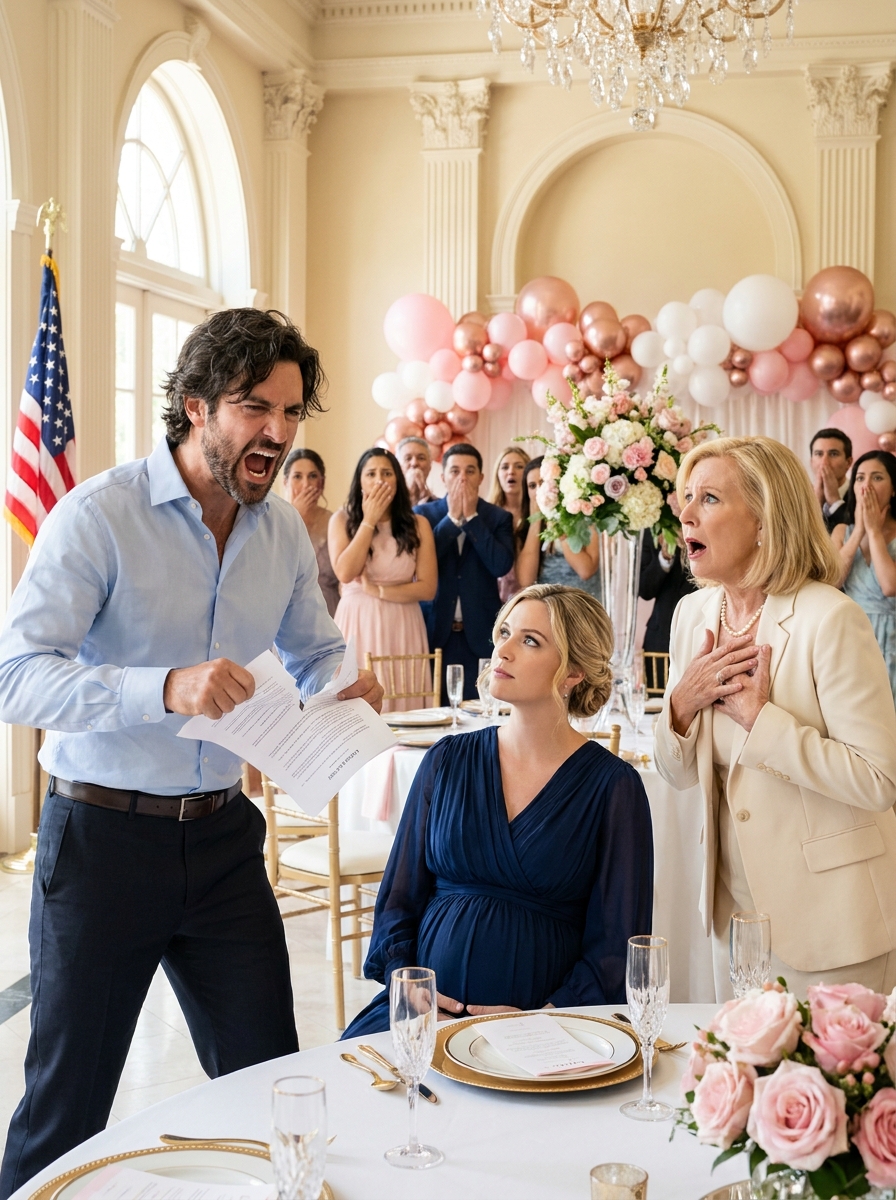
“Forty-seven reasons my son should leave you.”
The room cracked open.
A woman near the front whispered, “What?”
Daniel laughed once, a sharp confused sound.
“Mom?”
Patricia lifted her chin.
“Read it, Daniel.”
His face went blank.
“What did you say?”
“I said read it. If everyone has been too polite to protect you, then I will.”
A glass hit the table somewhere behind me.
Caroline whispered, “Mom, maybe not like this.”
Patricia ignored her.
Daniel took the pages from my hand.
He read the first page.
Then the second.
The color drained from his face.
“Mom,” he said quietly. “This is disgusting.”
Patricia’s eyes flashed.
“It is necessary.”
“No. It’s cruel.”
“She trapped you.”
The room gasped.
My daughter kicked so hard I nearly winced.
Daniel looked at me.
I did not cry.
I did not defend myself.
I simply said, “Read the last page.”
Something in my voice made him stop.
He turned to the final page.
His eyes moved across the email.
Once.
Twice.
Then a third time.
The paper began to tremble in his hand.
When he looked up, he was not confused anymore.
He was awake.
“How long have you been talking to Lauren?”
Patricia froze.
The name landed across the room like a dropped knife.
Several older women exchanged looks. They knew exactly who Lauren was.
Patricia smiled again, but it was thinner now.
“I don’t know what you mean.”
Daniel lifted the paper.
“Your email says her flight is booked for Monday.”
Caroline closed her eyes.
Daniel read aloud, voice low and shaking.
“Once Emily understands that everyone agrees she does not belong, she will leave before the baby comes.”
The silence afterward was not empty.
It was full of people rearranging everything they thought they knew.
Patricia’s hand rose to her pearls.
“That is taken out of context.”
Daniel looked at her.
“You wrote a plan to break up my marriage at my wife’s baby shower.”
“I wrote what needed to be said.”
“You contacted my ex-girlfriend.”
“I contacted someone who loved you before this mistake.”
Mistake.
The word sat between us.
Daniel looked down at my stomach.
Then back at his mother.
“My daughter is not a mistake.”
Patricia’s smile finally broke.
PART 5
For the first time since I had known her, Patricia Whitmore lost control of a room.
Not loudly.
Not completely.
But enough.
Her eyes darted from Daniel to the guests, from the guests to Caroline, from Caroline to me. She had expected tears. She had expected panic. She had expected me to run to the bathroom, sobbing, while she stood in the center of the wreckage and offered calm explanations.
She had not expected Daniel to read the final page aloud.
She had not expected her own words to betray her.
“You don’t understand,” she said, voice rising. “Everything I did was to protect this family.”
Daniel held the pages in both hands.
“From my wife?”
“From instability.”
“Emily is eight months pregnant.”
“That does not make her suitable.”
My mother stood.
Slowly.
Not dramatically. My mother was not rich, not polished, not the kind of woman Patricia considered important. She wore a blue dress from a department store sale and sensible shoes because her feet hurt after years of standing behind dental office counters.
But when she stood, the room noticed.
“My daughter has held dying mothers while their babies cried,” my mother said. “She has worked nights, holidays, and double shifts. She has paid her bills, loved your son, and carried your granddaughter. Don’t you dare call her unstable because she refused to bow.”
Patricia stared at her as if the furniture had started speaking.
“This is a family matter,” Patricia said.
My mother nodded.
“Yes. And Emily is family.”
That was when Caroline tried to intervene.
She rose from her chair, pale and shaking.
“Daniel, Mom was harsh, but she was worried. We all were.”
Daniel turned to her.
“We?”
Caroline swallowed.
“You know how Mom gets.”
“No,” Daniel said. “Did you help write this?”
Caroline looked at Patricia automatically.
A child asking permission.
Patricia gave her nothing.
Caroline’s lips parted.
“I contributed a few thoughts.”
“Which ones?”
“Daniel—”
“Which ones?”
Her eyes filled.
Daniel scanned the pages.
“Reason thirty-one. She prioritizes her career over her duties as a wife. That sounds like you.”
Caroline flinched.
Daniel continued, quieter now.
“You live in Mom’s guesthouse. You work at Mom’s company. You eat at Mom’s table. And you helped her write reasons to kick my pregnant wife out of the family.”
Caroline sank back into her chair.
Across the room, her daughter Maddie watched with wide eyes, a forgotten pink cupcake in front of her.
That hurt me.
Maddie was ten. She had not written the list. She had not booked Lauren’s flight. She had not asked to watch her mother collapse under the weight of a family pattern older than she was.
Patricia saw me look at Maddie and seized the moment.
“See?” she said sharply. “This is exactly what I mean. You enjoy public humiliation.”
I finally spoke to her directly.
“You chose the public.”
Her mouth tightened.
“You planned this.”
“You left it on your printer.”
“You invaded my home.”
“I photographed what you printed about me.”
Gasps again. Patricia’s friends shifted uncomfortably, because even rich women who enjoy gossip understand evidence.
Daniel looked at me then, really looked.
“You knew?”
“For a week.”
His face twisted.
“Why didn’t you tell me?”
“Because you would have called her.”
He opened his mouth, then stopped.
“You would have,” I said softly. “She would have cried. She would have denied. She would have said I was hormonal, insecure, unstable. And part of you would have wanted to believe her because believing this about your mother hurts.”
He looked down.
That was answer enough.
Patricia’s voice sharpened.
“She manipulated you, Daniel.”
He laughed once, without humor.
“No. She waited for you to tell the truth in front of the people you invited.”
Then he looked at the guests.
All thirty-seven of them.
“My wife delivers babies for a living,” he said. “She holds women’s hands during the hardest hours of their lives. She comes home exhausted and still asks about my students. She moved into a family that treated her like an applicant for a position she never requested.”
His voice caught, but he continued.
“She has never asked my mother for money, permission, or approval. She only asked to be respected.”
He turned toward Patricia.
“And you gave her this.”
He tore the pages in half.
The sound was shockingly loud.
Then he tore them again.
Four pieces.
Eight.
He placed the torn paper on the table in front of Patricia.
“There are your reasons.”
Patricia stared at them.
A gold ribbon from a gift bag had fallen across the pile like decoration on a funeral.
Then she whispered the oldest accusation in families like theirs.
“You are choosing her over your own mother.”
Daniel did not hesitate.
“I am choosing my wife and my daughter.”
Patricia’s eyes filled.
“You’ll regret this.”
“No,” he said. “I regret not doing it sooner.”
Then he said something that changed her face completely.
“Dad chose you when Grandma Eleanor tried to destroy your marriage. You used to tell me that story. You said she made you feel small for fifteen years.”
The room seemed to inhale.
Patricia went still.
Daniel’s voice softened, but not with weakness.
“You became the woman who hurt you.”
For one moment, I saw her.
Not the real estate queen. Not the widow in pearls. Not the woman with forty-seven reasons.
I saw a young bride, humiliated by a cruel mother-in-law decades ago.
Then the moment vanished.
Patricia picked up her purse.
Caroline grabbed Maddie’s hand.
Without another word, they walked out.
The door closed gently behind them.
That was somehow worse than if it had slammed.
PART 6
After Patricia left, the party did not continue.
It dissolved.
People stood in small clusters, whispering in low voices. A few came to hug me. Others avoided my eyes because witnessing cruelty makes some people ashamed, even when they are not the ones who committed it.
One of Patricia’s church friends, a silver-haired woman named Mrs. Bell, touched my arm.
“I’m so sorry, sweetheart,” she said. “I had no idea.”
“I know,” I said.
And I meant it.
Most people had not known.
That was Patricia’s gift and curse. She was skilled at making malice look like standards.
My nurses surrounded me after the guests began leaving.
Jasmine put one hand on my shoulder.
“You knew for a week?” she asked.
“Yes.”
“And you still played baby shower games?”
“I had to let her finish.”
Mara shook her head slowly.
“You are terrifying.”
“For the record,” said Tessa, “I mean that as a compliment.”
My mother sat beside me and wrapped an arm around my shoulders. I finally leaned into her. I was tired suddenly. Not sad exactly. Not relieved either. Just emptied out, as if I had been holding my breath for seven days and my body had only now remembered oxygen.
Daniel sat on my other side.
“I’m sorry,” he said.
I looked at him.
“You didn’t write the list.”
“No. But I made it easier for her to believe she could.”
That was true.
And because it was true, neither of us rushed to soften it.
He took my hand.
“I should have listened.”
“You’re listening now.”
His eyes were red.
“I don’t want her near you right now. Or the baby.”
I nodded.
“Neither do I.”
That night, we went home with a car full of gifts and a silence full of things we would eventually have to say.
Daniel changed the locks the next morning.
Not because Patricia had threatened us.
Because boundaries should not require threats.
He called the attorney named in the email, Charles Redding, a trust specialist in downtown San Diego. The office confirmed Patricia had requested information about restructuring family assets and protecting property from “future marital claims.” They were careful with details, but enough was said.
The plan had been real.
Daniel emailed Lauren Hargrove himself.
He showed me before sending it.
Lauren, my mother contacted you without my consent and misrepresented my life. Please do not come to San Diego. I am married, I love my wife, and my mother does not speak for me.
Lauren replied four hours later.
Daniel, I’m sorry. Patricia made it sound like you needed support. I won’t come. I wish you and Emily well.
Daniel deleted the thread, then placed his phone on the kitchen counter like something heavy.
For three days, Patricia did not call.
Then the texts began.
First to Daniel.
I acted out of love.
You embarrassed me in front of everyone.
Your father would be heartbroken.
That woman has turned you against your blood.
Daniel did not respond.
Then she texted me.
You have no idea what you have done.
I blocked her.
Caroline sent one message.
I’m sorry for how things happened.
I read it twice.
Then I replied:
Are you sorry for how it happened, or for what you helped do?
She did not answer.
Two weeks later, Clara Grace Whitmore arrived at 2:43 in the morning during a rare San Diego thunderstorm.
Labor humbled me.
It always does.
No matter how many births you attend, your own body becomes a country you do not fully control. My co-workers became my anchors. Jasmine counted my breathing. Mara watched the monitor. Tessa told Daniel exactly where to stand so he could be useful instead of terrified.
When Clara finally cried, the room changed.
That is the only way to describe it.
One second there was pain, pressure, fear.
Then sound.
Tiny. Furious. Alive.
Daniel cried so hard he laughed.
They placed Clara on my chest, warm and slippery and perfect, with dark hair plastered to her head and one fist pressed against her mouth.
“Hi,” I whispered. “I’m your mom.”
Daniel bent over us.
“She’s here,” he said.
As if Clara had traveled a long distance and finally found the right door.
Patricia was not in the waiting room.
We had not told her I was in labor.
Three hours after Clara was born, Caroline texted:
Congratulations. She’s beautiful.
Daniel had sent one photo to her, not to Patricia.
I answered:
Thank you.
That was all.
When Clara was five days old, a white box arrived at our door. Inside was a baby blanket embroidered with her name.
No note.
Daniel stared at it.
“What do you want to do?”
I touched the soft edge.
“Put it in the closet.”
Not the trash.
Not the nursery.
The closet.
Some gifts need time before they become innocent.
PART 7
Motherhood did not heal everything.
People say babies bring families together, but that is only true when the family was willing to come together before the baby arrived. Clara did not fix Patricia. She did not erase Caroline’s resentment. She did not undo Daniel’s years of surrender disguised as peacekeeping.
But she clarified things.
A month after Clara was born, Daniel and I started therapy.
He suggested it.
That mattered.
Our therapist was a calm woman named Dr. Renee Mason who had an office in Mission Valley and a talent for saying devastating things in a gentle voice.
During the second session, Daniel said, “I feel guilty cutting my mom off.”
Dr. Mason asked, “Guilty because you did something wrong, or guilty because you stopped doing what kept you safe as a child?”
Daniel went silent for almost a full minute.
That night, he wrote something on a yellow sticky note and placed it on our bathroom mirror.
Love your mother. Protect your wife. They are not the same action.
I read it every morning while brushing my teeth with Clara sleeping in a bassinet beside the sink.
Patricia’s public world changed too.
People talked.
Of course they did.
The real estate agents at the shower talked. The church women talked. The charity board talked. By the end of the month, Patricia stepped down from two committees “to spend time with family.” Her firm kept running, but the billboards disappeared faster than expected when the campaign expired.
For a woman like Patricia, shame was not private.
It was bad branding.
Caroline reached out when Clara was three months old.
She asked to meet at a coffee shop in Little Italy.
I almost said no.
Then I thought of Maddie’s face at the shower.
So I went.
Caroline arrived without Patricia. No pearls. No performance. Just a tired woman in jeans, looking older than thirty-eight.
She sat across from me and said, “I was wrong.”
I waited.
She swallowed.
“I helped because I was angry. Not because you deserved it. Because I hated that you had a husband who came home, a baby coming, a house that felt like yours. I hated that Mom still wanted to impress you while controlling you. I hated myself most of all, but I handed it to you because that was easier.”
It was not a perfect apology.
Perfect apologies are rare.
But it was honest.
I said, “You hurt me.”
“I know.”
“You helped your mother try to remove me from my own marriage before my daughter was born.”
Her eyes filled.
“I know.”
“I can’t give you trust because you cried in a coffee shop.”
“I’m not asking for that.”
“Good.”
We sat there for a long time.
Then she said, “Maddie keeps asking why Grandma was so mean at the baby party.”
“What did you tell her?”
“That Grandma forgot how it felt when someone was mean to her.”
That answer stayed with me.
I did not forgive Caroline that day.
But I left the door unlocked.
Not open.
Unlocked.
There is a difference.
Patricia did not meet Clara until Clara was seven months old.
It happened at our house, on our terms, after Daniel sent one message:
If you want to meet Clara, you will first acknowledge what you did to Emily. No excuses. No blaming pregnancy. No legacy speeches. Just the truth.
Patricia did not respond for nine days.
Then she wrote:
I humiliated Emily at her baby shower. I tried to interfere in your marriage. I contacted Lauren. I was wrong.
Daniel showed me the message.
I read it three times.
It was bare. Stiff. Humiliating for her to type.
That was why I believed it enough to allow one visit.
She arrived on a Sunday afternoon wearing beige slacks and a blouse without pearls. I noticed that immediately. Patricia without pearls looked less armored.
She stood in our living room holding a small stuffed rabbit.
Clara sat on a blanket, chewing on a rubber teether, unimpressed by generational conflict.
Patricia looked at me.
“I was cruel,” she said.
I said nothing.
Her mouth trembled.
“My mother-in-law treated me like I was dirt she found on her rug. I promised myself I would never be powerless again. Somewhere along the way, I confused power with love.”
Daniel stood beside me but did not rescue her from the silence.
Patricia continued.
“I am sorry, Emily.”
I believed that she regretted it.
I was not sure yet that she had changed.
Those are not the same thing.
“You can meet Clara,” I said. “But you don’t get private access to her. You don’t make decisions. You don’t use gifts as control. And if you ever disrespect me in front of my daughter, the visit ends.”
Patricia nodded.
No argument.
No defense.
Just nodded.
When she knelt on the rug and held out the rabbit, Clara stared at her for five serious seconds, then threw the teether at Daniel’s shoe.
Daniel laughed.
I laughed.
Even Patricia laughed, softly, almost carefully.
It was not a happy ending in the way movies promise.
It was better than that.
It was honest.
One year after the baby shower, I sat on our porch at sunset with Clara asleep against my chest. Daniel was inside grading essays. The house smelled like coffee and laundry and the roasted chicken I had finally learned to make well, though not because Patricia had demanded it.
On my phone, the photos were still there.
Every page.
Every reason.
Every line of the email.
I had not deleted them.
Not because I planned to use them.
Because sometimes a woman needs proof that the worst thing really happened and she still survived it.
Patricia had written forty-seven reasons why I did not belong in her family.
But she forgot the only reason that mattered.
Daniel chose me.
And later, more importantly, I chose myself.
I chose not to beg for a place at a table where my chair came with conditions. I chose not to mistake silence for peace. I chose not to hand my daughter a family legacy built from fear and call it tradition.
Clara stirred against me, opened her eyes, and looked up like she had just remembered the world existed.
“Hi, baby,” I whispered.
Inside, Daniel called, “Em, where’s the extra pack of wipes?”
I smiled.
“Second drawer!”
Normal life answered back.
Not perfect.
Not polished.
Not Patricia’s version of legacy.
Ours.
And that was enough.
THE END