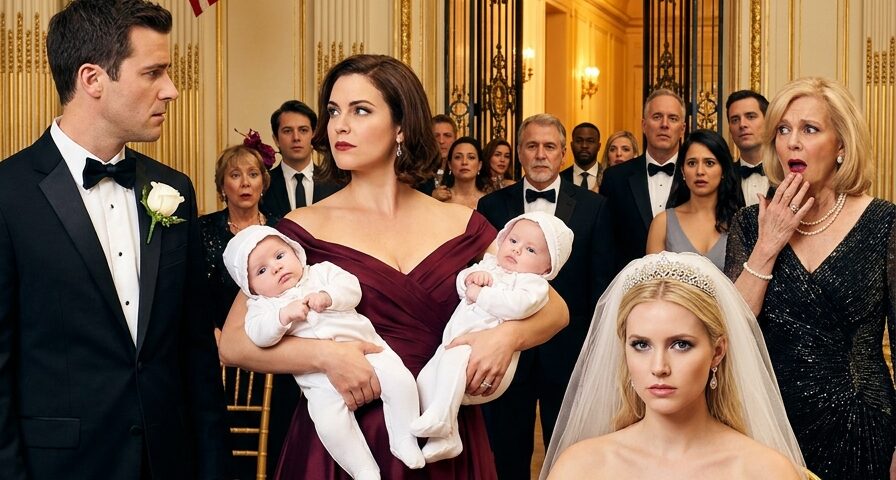
On My Wedding Day, My Husband Walked In Holding Newborn Twins With My Stepsister—So I Signed the Divorce Papers Calmly…
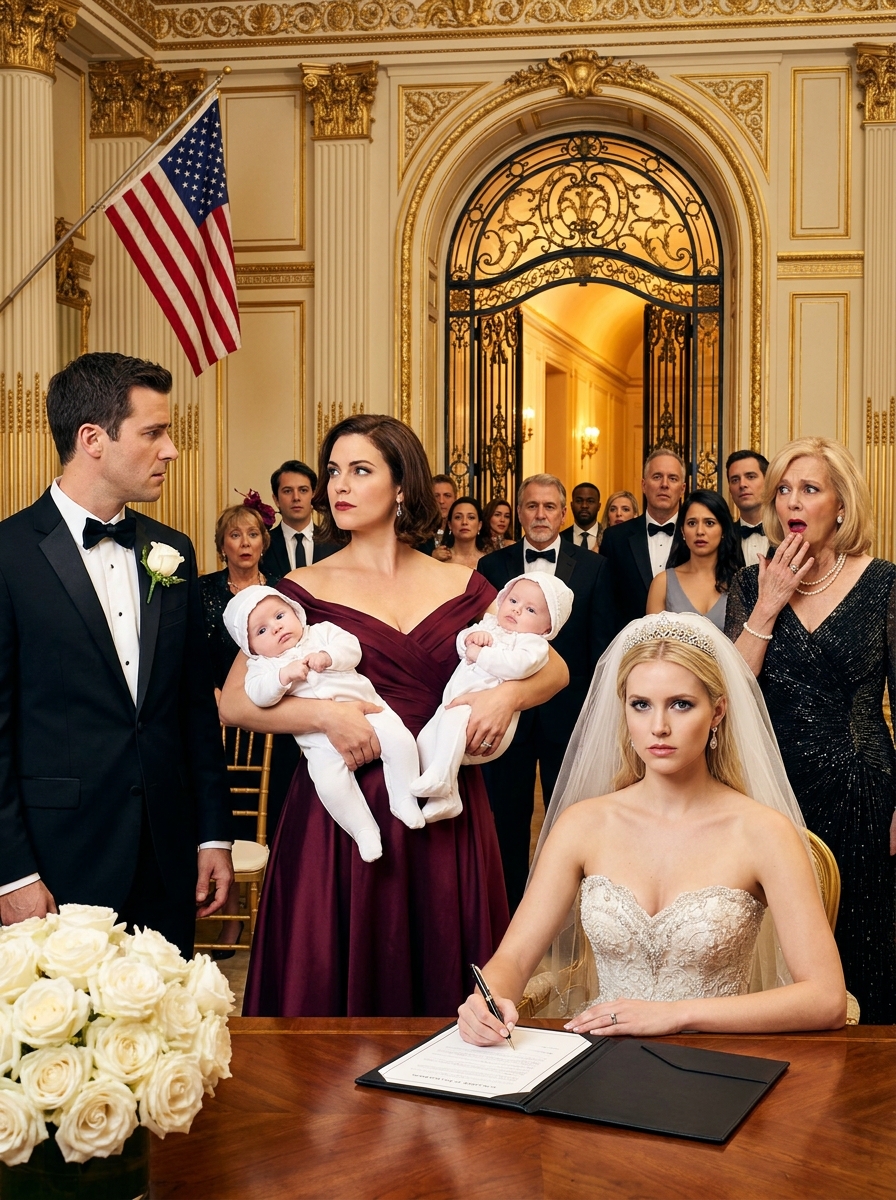
Part 2
My driver, Marcus, stood beside the black town car at the curb, his face professionally blank. Behind me, the garden hall roared like a fire had started inside it. Maybe one had.
“Where to, Miss Montgomery?” he asked.
I looked down at my left hand. The diamond engagement ring and wedding band were still there, bright and obscene under the Chicago afternoon sun. I pulled them off and dropped them into the cup holder. They landed with two cold clicks.
“The office,” I said. “And call Ethan.”
By the time we reached Montgomery Hospitality Group’s headquarters on Michigan Avenue, my phone had thirty-nine missed calls. Twelve from my mother. Nine from Preston. Four from my father. The rest were from friends who wanted to pretend concern while begging for details.
Ethan answered on the second ring.
“I told you he was trash,” he said.
“Hello to you too.”
“I’m at O’Hare. I landed twenty minutes ago. I had a bad feeling.”
My brother was a software architect with a doctorate from MIT, a sharp tongue, and the emotional range of a locked filing cabinet. He was also the only person in my family who had never fallen for Chloe.
“I need everything,” I said. “Every suspicion you ever had. Every file. Every pattern.”
“I already have them.”
Of course he did.
Three hours later, I stood barefoot in my office, my wedding dress pooled around my feet like a dead swan. Ethan sat on my sofa with a laptop balanced on his knees and a glass of my best bourbon in his hand.
“She’s been doing this since she arrived,” he said.
“I know.”
“No. You suspected. I documented.”
He turned the screen toward me.
There it was, a timeline of sabotage so clean it looked like a corporate presentation. The summer scholarship essay Chloe had corrupted. The recommendation letter that vanished before Wharton admissions. The internal hotel strategy memo she had “accidentally” forwarded to our father’s most conservative advisor, making me look reckless. The anonymous email to a board member claiming I wanted to push my father out.
“She didn’t just want attention,” Ethan said. “She wanted your position.”
I stared at the screen until the letters blurred.
When Chloe came to us at ten, my parents introduced her as a miracle we had been chosen to protect. She had big brown eyes, tangled blond curls, and a way of flinching at raised voices that made adults feel heroic. My mother gave her my corner bedroom because Chloe needed light. My father bought her a pony because Chloe needed confidence. I was told I needed to be patient, generous, mature.
Chloe learned quickly that if she cried first, she won.
At eleven, she cut the hair off my favorite doll and sobbed so hard my mother comforted her instead of me.
At fifteen, she told my father I had mocked his old-fashioned business instincts, then “helpfully” presented my hotel modernization plan as if it were hers.
At twenty-two, she stood beside me at a charity gala and told a donor, “Evelyn works too hard because she thinks love has to be earned.” Everyone laughed. I did not.
Now, at thirty-two, she had walked into my wedding holding proof that she had been sleeping with my fiancé for months.
My phone lit up.
Chloe had posted on Instagram.
A black-and-white photograph showed two tiny hands wrapped around Preston’s finger. The caption read:
In the middle of life’s storms, God sends unexpected blessings. My beautiful twins, Hope and Preston Jr., and the man brave enough to stand beside us. Our family may not be traditional, but it is built on truth.
Truth.
I almost admired the nerve.
Then I saw my mother’s comment.
My brave Chloe. Grandma loves these precious babies more than words.
Grandma.
I put the phone down slowly.
Ethan looked over my shoulder. “She’s taking the narrative.”
“She can have the narrative,” I said. “I’ll take the company.”
Another call came in. My mother.
I answered on speaker.
“Evelyn,” she said, breathless. “Thank God. We need a statement immediately. Something gracious. Something about modern family and forgiveness. Preston is devastated. Chloe thinks you hate her. Your father is worried about the stock price.”
“The stock price,” I repeated.
“Don’t take that tone. This is painful for everyone.”
I looked at my wedding dress on the floor.
“Everyone?”
“Yes, everyone. Those babies are innocent. Chloe is your sister. Preston made a mistake, but he loves you. If you stand together publicly, this can be managed.”
Ethan’s jaw tightened.
“No,” I said.
Silence.
“What did you say?”
“I said no. I will not issue a statement. I will not smile beside my husband’s mistress. I will not become the generous aunt in Chloe’s little morality play.”
My mother’s voice hardened. “You are being cruel.”
“No. I am being accurate.”
“Family means sacrifice.”
I laughed then, but there was no humor in it.
“You’ve been asking me to sacrifice for Chloe since I was ten years old. My room. My reputation. My peace. My work. Today she asked for my husband and my future. Tell her the answer is no.”
I hung up.
For a moment, the office was silent except for the faint noise of traffic below.
Ethan raised his glass. “Finally.”
I walked to my desk and opened the emergency board calendar. Montgomery Hospitality Group had been my father’s company on paper, but I had saved it in practice. I had led the Chicago redevelopment, the San Diego coastal acquisition, the Washington, D.C. luxury conversion. Ethan’s SmartSuite hotel technology had doubled our valuation. Preston wanted that technology. His family needed it. The Whitaker hotel group was drowning under debt and nostalgia.
Now I understood the real wedding.
It was never romance.
It was a rescue operation.
Preston needed my company. Chloe needed my name. My parents needed their fantasy. They all thought I would protect the image.
I began typing.
Emergency board meeting. Monday. 9:00 a.m.
Ethan leaned forward. “What do you need from me?”
“The SmartSuite system. Can Preston access anything?”
“He saw pitch documents. Not source architecture.”
“If he gets desperate, he’ll try.”
Ethan smiled, slow and dangerous. “Then I’ll build a trap.”
“A trap?”
“A honeypot. Something that looks like the core system. If anyone tries to copy or transfer it, it records everything and gives them files that are legally useless and technically poisonous.”
I looked at my brother, the only real family I had left.
“Do it.”
He lifted his glass again. “To the shortest marriage in Chicago history.”
I picked up the annulment folder.
“No,” I said. “To the longest lesson.”
Outside, the city lights came on one by one. Somewhere across town, Chloe was probably crying beautifully for cameras that had not arrived yet. Preston was probably shouting into a phone. My parents were probably deciding how to turn me into the villain.
Let them.
For twenty-two years, I had played defense.
Tomorrow, I would begin removing people from my life with the precision of a surgeon and the patience of a woman who had finally stopped begging to be loved by people addicted to using her.
Part 3
At 8:55 Monday morning, the boardroom of Montgomery Hospitality Group felt like a courtroom before the verdict.
My father sat at the head of the long walnut table, looking smaller than he had two days earlier. Richard Montgomery had built the company from three boutique hotels and a stubborn belief in old money service. I had expanded it into a national luxury brand with properties in Chicago, San Diego, Washington, D.C., Aspen, and Savannah. He called me aggressive when I was right and brilliant when strangers praised me.
My mother sat behind him in pearls, though she held no official role. She had insisted on attending “for family support.” I knew which family she meant.
Gerald Finch, our chief operating officer and Chloe’s longtime secret ally, sat two seats away, sweating through his collar.
I entered at exactly nine.
No wedding dress. No diamonds. No softness.
Just a black suit, red lipstick, and a stack of files.
“Given the unfortunate personal matter over the weekend,” my father began, “I propose that we postpone all major votes. The company must project unity and stability.”
Several older board members nodded.
I waited until the murmurs settled.
Then I placed a folder in front of Gerald.
“Unity is a fascinating word,” I said. “Does it include funneling renovation funds from the Savannah property into a shell company owned by your brother-in-law?”
Gerald’s mouth opened.
Nothing came out.
My father stiffened. “Evelyn, this is not appropriate.”
“It is extremely appropriate. Especially since that shell company billed us $4.2 million for restoration work never performed.”
The room went still.
I slid copies of the preliminary audit around the table.
“Gerald will be suspended immediately pending external investigation. If he prefers, we can invite federal investigators into the discussion now.”
Gerald’s face turned gray.
“This is a personal attack,” he sputtered.
“No,” I said. “My husband bringing newborn twins to our wedding was personal. This is corporate hygiene.”
A few board members looked down to hide their reactions.
I turned to my father.
“Motion two. Creation of a new executive role: Chief Technology and Innovation Officer. I nominate Dr. Ethan Montgomery, inventor of the SmartSuite platform and the reason our valuation increased by thirty-eight percent in eighteen months.”
A murmur moved through the room. Ethan rarely appeared in person, but everyone knew his technology had saved us.
“Motion three,” I continued. “A vote to transition Richard Montgomery from CEO to Chairman Emeritus, focusing on legacy relationships and philanthropic outreach.”
My mother stood. “You cannot humiliate your father like this.”
I looked at her.
“You brought my husband’s mistress into your home last night and called her babies your grandchildren on social media. Please sit down before I start discussing humiliation in detail.”
She sat.
My father stared at me with wounded disbelief. “You would do this to me?”
“You did this to yourself. Every time you ignored warnings. Every time you let Gerald undermine me. Every time you chose Chloe’s tears over my work.”
Susanna Bell, a venture capitalist who had joined our board after the San Diego expansion, raised her hand.
“I call for a vote.”
The votes came slowly at first, then all at once.
Gerald was suspended. Ethan was appointed. My father was promoted into ceremonial irrelevance.
By 10:17, I controlled the company.
By noon, the market stabilized.
By 2:00, Preston called me seventeen times.
I did not answer.
Instead, I met with my attorney, Claire Whitman, in a private conference room overlooking the river. Claire had the kind of calm that made panic feel embarrassed.
“The annulment petition is strong,” she said. “Fraud, concealment, reputational harm. The prenup protects you. Preston gets nothing.”
“And Chloe?”
“Legally? Nothing from you. Emotionally? She’ll try to bleed you in public.”
“She already started.”
Claire nodded. “Then we prepare for both court and spectacle.”
I handed her another folder. “I need a private investigator.”
“For Preston?”
“For everyone.”
Claire studied me. “How far back?”
“Twelve months for Preston. Twenty years for Chloe if necessary.”
Her expression did not change. “That will be expensive.”
“So was the wedding.”
That evening, the investigator sent his first update.
Preston had spent sixty-four nights in my Lake Geneva house while I was traveling for work. Not alone. Credit card receipts. Security gate logs. Restaurant charges for two. Boutique baby purchases under an alias. A private paternity test charged to a Whitaker family account.
The twins were his.
No doubt.
I stared at the evidence in my office until the city outside became a blur of lights.
Then came the second update.
Chloe had recently contacted three estate attorneys asking whether adopted children could challenge family trusts if “emotional promises” had been made.
There it was.
The babies were not only weapons of shame.
They were anchors.
Chloe wanted to tie herself permanently to the Montgomery fortune. Preston wanted the SmartSuite technology. The Whitaker family wanted our valuation. My parents wanted a fairy tale where the wounded girl was rewarded and the difficult daughter finally became generous enough to disappear.
I called Margaret Whitaker.
She answered in a low voice. “Evelyn.”
“You said you wanted to talk woman to woman.”
“I did.”
“Tomorrow. The Langham. Noon. Bring the truth.”
The next morning, I met her in a quiet corner of the hotel restaurant, where old money drank tea and pretended not to read financial news.
Margaret looked tired. Not sad. Tired. There is a difference.
“I tried to stop it,” she said.
“No, you tried to manage it.”
Her lips tightened.
“You knew Preston was sleeping with Chloe?”
“I knew there was an attachment. I thought it was temporary.”
“Pregnancy is rarely temporary.”
She looked away.
“When Chloe told me she was pregnant, she said Preston loved her. She said you were cold, strategic, incapable of tenderness. I told her Preston would never risk the merger for a woman without shares, without voting rights, without real inheritance. She promised she would tell him before the wedding.”
“And you believed her?”
“I wanted to.”
The honesty was ugly, but useful.
Margaret leaned closer. “My son is vain. Chloe fed the weakest part of him. She made him feel heroic. You made him feel measured.”
“He was measured,” I said. “And found lacking.”
A flicker of respect passed over her face.
“What do you want from me?”
“Control your son. He signs the annulment. He stays away from my company. He stops speaking to the press.”
“And if he doesn’t?”
“Then I release everything. The affair timeline. The paternity test. The attempted access to proprietary systems, if he is foolish enough to try.”
Margaret went pale.
“You have proof?”
“I will.”
At that exact moment, my phone buzzed.
A message from Ethan:
Trap is live.
I placed the phone facedown.
Margaret stared at me as if seeing me clearly for the first time.
“You’re not trying to survive this,” she said.
“No.”
“What are you trying to do?”
I stood, buttoning my blazer.
“I’m trying to make sure no one ever mistakes my silence for permission again.”
Part 4
My parents’ penthouse on Lake Shore Drive still smelled like lilies, furniture polish, and the expensive denial my mother had worn like perfume for decades.
I let myself in with the key I had carried since college.
The living room looked staged for a magazine spread about forgiveness. Chloe sat on the cream sofa in a soft blue robe, one baby tucked against her shoulder. My mother cradled the other with wet-eyed devotion. My father stood by the fireplace, holding a drink though it was barely eleven in the morning.
“Evelyn,” my mother said, carefully warm. “Good. We need to talk as a family.”
I glanced at Chloe.
“We stopped being a family when you turned my childhood into her audition.”
Chloe’s eyes filled instantly.
“Please,” she whispered. “Hate me if you need to. But don’t punish the babies.”
“They have a father,” I said. “And a mother who brought them to a wedding like props.”
My father slammed his glass down. “Enough. I will not let you speak to your sister that way.”
“She is not my sister.”
My mother gasped as if I had struck her.
“She is not related to me by blood,” I continued. “And after Saturday, certainly not by loyalty.”
Chloe’s tears vanished for half a second. I saw the hatred beneath them before she covered it.
“You think blood makes you better?” she asked softly.
“No. Conduct does.”
I turned to my parents.
“As of this morning, your discretionary company accounts are frozen. Your monthly family allowance has been reduced to $25,000. The Aspen house is going on the market. The Lake Geneva property is being sold. Staff will receive severance packages. You will keep this penthouse for now, provided you pay its maintenance from your personal funds.”
My mother stared at me.
“You can’t do that.”
“I already did.”
My father’s face reddened. “This is revenge.”
“This is budgeting.”
“We gave you everything,” my mother said.
“No,” I replied. “You gave Chloe everything and told me to be grateful for the leftovers.”
Chloe stood, still holding the baby.
“You are exactly what everyone says,” she hissed. “Cold. Bitter. Alone. Preston loves me. These are his children. We are the family now.”
For once, her voice did not tremble. For once, she sounded like herself.
I smiled.
“There she is.”
My mother looked confused. My father looked frightened. Chloe looked furious because she understood: I had wanted them to see it.
“You have until Friday to leave any property controlled by the Montgomery trust,” I said to Chloe. “After that, security will escort you out.”
“Where am I supposed to go?”
“To Preston. Since this was love.”
Her jaw tightened.
My father pointed toward the door. “If you leave now, do not come back. You will no longer be my daughter.”
I paused with my hand on the knob.
“I stopped being your daughter the day you made me compete with a tragedy for your love.”
Then I walked out.
Preston called before I reached the elevator.
This time I answered.
“What the hell are you doing?” he shouted. “My board is panicking. My mother says you threatened litigation. Your parents are hysterical. Chloe is crying so hard she can barely feed the babies.”
“Sounds busy.”
“You think this is funny?”
“No. I think it is overdue.”
He lowered his voice. “Evelyn, listen to me. Chloe manipulated me.”
“That was fast.”
“She lied. She said she had a trust. She said your parents planned to divide things equally. She said you would forgive us because you care about appearances.”
“And you believed her because it benefited you.”
Silence.
Then, softer, desperate: “I’ll leave her. Today. I’ll sign whatever you want. We can fix this. We can say the babies were conceived before us, or through a private arrangement, or—”
“Stop.”
“She means nothing compared to what you and I can build.”
“No, Preston. She means exactly what you were willing to lose me for.”
His breathing grew rough.
“You can’t destroy me.”
“I don’t have to. You’re doing it yourself.”
His voice changed then. The charm burned away.
“If you push me, I’ll go to the press. I have documents. Inspection approvals from your San Diego property. Environmental exemptions in Colorado. Accounting adjustments in Savannah. Enough gray areas to drown you in investigations for years.”
My hand tightened around the phone.
He had been collecting insurance.
“Drop the annulment fight,” he said. “Issue a statement saying I had authorized access to any company files. Calm the police concern my mother mentioned. Or I bury you.”
“You should talk to your lawyer.”
“I’m talking to my wife.”
“No,” I said. “You’re talking to the woman you underestimated.”
I hung up.
Thirty seconds later, Ethan called.
“He took the bait,” he said.
My pulse steadied. “How bad?”
“Bad for him. Beautiful for us. Preston attempted to copy the SmartSuite core architecture to an external drive named Whitaker Strategic Backup. Then he tried to route it through a server connected to a Singapore hospitality investor.”
“He’s selling it?”
“He was trying to. The files he copied are decoys. Legally marked. Digitally signed. Every keystroke recorded.”
I closed my eyes.
I had expected theft.
The proof still hurt.
“There’s more,” Ethan said. “The documents he threatened you with? I checked our audit mirror. Those files were altered from a Whitaker Group IP address. Some from Preston’s personal laptop. He wasn’t collecting dirt, Evelyn. He was manufacturing it.”
The elevator doors opened onto the lobby. Chicago sunlight flashed off the marble floor.
“What do we do?” Ethan asked.
I thought of Chloe smiling through tears. My mother nodding at the wedding. Preston carrying his son like a king presenting an heir.
“We stop reacting,” I said. “Call Claire. Call the U.S. Attorney’s office. Package everything.”
“And the press?”
I looked through the glass doors at the city waiting outside.
“We give them something better than scandal.”
“What?”
“The truth.”
Part 5
By breakfast the next morning, Preston Whitaker was in handcuffs.
The footage appeared first on a local Chicago news account: Preston, unshaven and furious, being escorted from the Whitaker Group headquarters by federal agents. By 9:00 a.m., national business outlets had picked it up. By 10:00, Montgomery stock was up six percent and Whitaker trading was suspended.
I allowed myself one cup of coffee before the counterattack arrived.
It came wearing my mother’s pearls.
At 10:30, a morning television show aired an exclusive interview with Chloe, my parents, and the twins. They sat in what looked like a modest family room, though I recognized the rented staging furniture. Chloe wore no makeup, which meant she had paid someone to make her look like she wore no makeup. My mother held her hand. My father looked old and morally injured.
The host leaned forward with practiced sympathy.
“Chloe, how are you surviving this?”
Chloe looked down at the babies.
“I’m trying to stay strong for them,” she whispered. “I never wanted to hurt Evelyn. I loved Preston. It was wrong, but love is not always clean. Evelyn was always working, traveling, building the company. Preston was lonely. I was lonely. We found comfort.”
My mother dabbed her eyes.
“Evelyn has always been intense,” she said. “Ambitious. Controlling. We loved that about her until it became cruelty.”
My father nodded gravely.
“She is punishing innocent children because she cannot control the story.”
Then came the messages.
Edited screenshots appeared on the screen.
Chloe, remember your place.
Stay away from what is mine or I will erase you.
You are a charity case. Never forget it.
I stared.
The words were fragments. Stolen, spliced, rearranged. The first message had been about Chloe wearing white to my engagement party. The second about her interfering with corporate strategy. The third was not mine at all, though she had built it from enough pieces to sound like me.
The host looked horrified.
“Did you live in fear of Evelyn?”
Chloe nodded, tears spilling.
“All my life.”
The segment ended with the hashtag:
#JusticeForChloe
Claire turned off the screen in my office.
“It’s effective,” she said. “False, but effective.”
Ethan’s voice came through my speaker. “Public sympathy loves a pretty victim with babies.”
“We sue,” Claire said. “Defamation, emotional distress, tortious interference.”
“No,” I said.
They both looked at me.
“We don’t chase gossip. We bury it under evidence.”
My phone rang.
Unknown number.
I answered.
“You heartless bitch,” Preston said.
“Bold opening for someone calling from federal custody.”
“You trapped me.”
“You stole from me.”
“That code was bait.”
“My property was bait because thieves bite.”
His laugh was broken. “You think you’ve won? Chloe’s interview is nothing. I still have the files. The inspection reports. The exemptions. The accounting adjustments. I’ll give them to every regulator in America unless you make this go away.”
“You mean the documents you altered?”
Silence.
I continued, softly. “Ethan kept a mirror server. Every original. Every edit. Every IP address. Every timestamp. Including yours.”
His breathing changed.
“You’re bluffing.”
“Preston, you tried to frame me with files you modified from your own laptop. That is not clever. That is a confession with formatting.”
For the first time since I had known him, Preston had nothing to say.
I ended the call.
At 4:00 p.m., the lobby of Montgomery Hospitality Group filled with cameras.
I wore a simple black dress. Claire stood to my left. Ethan, who hated public appearances, stood to my right in a wrinkled navy suit and an expression that warned reporters not to ask him anything stupid.
The surprise came last.
Margaret Whitaker entered through the side door.
The room erupted.
Preston’s mother stood beside me.
I stepped to the podium.
“I will be brief,” I said. “This weekend, my marriage ended publicly. That is painful, but private pain is not why we are here. We are here because Preston Whitaker attempted to steal proprietary technology from Montgomery Hospitality Group, transmit it to a foreign buyer, and then blackmail me with forged corporate documents.”
A screen lit up behind me.
On the left: Chloe’s edited text messages.
On the right: the complete threads, with dates, context, and original wording.
“This is how lies are built,” I said. “Not always from nothing. Sometimes from broken pieces of truth arranged into a weapon.”
The next slide showed file metadata. Ethan had made the visuals brutally simple: original document, alteration date, source IP, user credentials.
“These are the documents Preston threatened to leak. They were not evidence of my misconduct. They were evidence of his forgery.”
Reporters shouted.
I raised a hand.
“My parents chose to participate in a public lie. That is their decision. As of today, they hold no advisory or operational position connected to Montgomery Hospitality Group. Chloe Bennett is not a Montgomery shareholder, officer, or beneficiary. Preston Whitaker is the confirmed father of her children. Their choices belong to them. My company, my work, and my name belong to me.”
Then Margaret stepped forward.
The lobby fell silent.
“My name is Margaret Whitaker,” she said. “My son has disgraced his family. I made excuses for him. I tried to manage the truth instead of telling it. That was cowardice. The evidence presented today is real. Preston must face the consequences of his actions.”
Her voice trembled only once.
“There are moments when loyalty becomes corruption. I will not confuse them again.”
She stepped back.
The questions exploded.
I did not answer them.
I had said enough.
In the private elevator, Margaret leaned against the wall, suddenly older.
“He’ll never forgive me,” she whispered.
“No,” I said. “But you may forgive yourself sooner than you think.”
Claire’s phone buzzed.
She read the message and looked up.
“The U.S. Attorney is adding charges. Wire fraud, attempted theft of trade secrets, obstruction, blackmail, and document forgery. Bail will be opposed.”
Ethan exhaled. “That escalated efficiently.”
For the first time in days, I almost smiled.
Outside, the city was rewriting the story in real time.
The Ice Queen was no longer trending.
The new headline was everywhere:
The Wedding Betrayal That Exposed a Corporate Crime.
Chloe had wanted a stage.
I had given her one.
She just had not understood that lights reveal everything.
Part 6
The trial began eight months later in federal court in downtown Chicago.
By then, Preston looked less like an heir and more like a man who had spent too long realizing inheritance could not cross every locked door. His suits still fit, but he did not. His confidence hung loose on him. The press called it the Whitaker-Montgomery scandal. Business schools were already turning it into case studies about governance failure, insider access, and the dangers of marrying badly.
Chloe arrived on the first day in oversized sunglasses, pushing a double stroller, dressed for cameras rather than court. My parents came with her. My mother refused to look at me. My father looked at me once, then down at his shoes.
Ethan sat beside me, tapping silently on his phone.
“Are you nervous?” he asked.
“No.”
“Good. Because his defense is terrible.”
Preston’s attorneys argued misunderstanding. They claimed he had authorized access. They claimed marital confusion, corporate overlap, emotional distress, and temporary panic. Then the prosecution played the access logs.
Seventeen attempts to bypass restricted folders.
Three attempted downloads.
One external transfer.
A decoy file clearly labeled:
MONTGOMERY PROPRIETARY — DO NOT TRANSFER.
The courtroom watched Preston convict himself in metadata.
Then came the forged documents.
Ethan testified for two hours. He was precise, dry, and devastating. He explained the mirror server, the original files, the alteration timestamps, the source locations. A juror actually leaned forward when he demonstrated how Preston’s laptop had inserted false approvals into the San Diego inspection file three weeks before threatening me with it.
The prosecutor asked, “Dr. Montgomery, could these alterations have been accidental?”
Ethan blinked.
“No.”
“Could they have been made by Ms. Montgomery?”
“No.”
“How certain are you?”
“As certain as I am that gravity remains unpopular but effective.”
The judge told him to answer plainly.
“Completely certain,” Ethan said.
The jury loved him.
Preston did not testify.
On the last day, Chloe was called as a witness for the defense. It was a mistake born from desperation.
She wore a pale dress and a fragile expression. She spoke softly about love, fear, and my lifelong cruelty. She said Preston had only wanted to protect her. She said I had always made her feel like an outsider.
The prosecutor waited.
Then she showed Chloe the estate attorney emails.
“Ms. Bennett, did you contact three attorneys asking whether an adopted child could challenge a family trust?”
Chloe’s mouth opened.
“I was scared.”
“Of what?”
“Being abandoned.”
“Or being left without money?”
Objection.
Sustained.
But the jury heard it.
Then came the staged text messages. Under oath, Chloe admitted she had “summarized” conversations. Then “combined” them. Then “reconstructed the emotional truth.”
The prosecutor repeated the phrase slowly.
“Emotional truth?”
Chloe began to cry.
This time, no one moved to comfort her.
When the verdict came, it was raining.
Guilty on attempted theft of trade secrets.
Guilty on wire fraud.
Guilty on obstruction.
Guilty on attempted blackmail.
Guilty on corporate document forgery.
Preston stood very still, as if stillness could keep him from falling.
Margaret sat alone in the back row. Her hands were folded tightly in her lap. She did not cry.
As marshals took Preston away, he finally turned toward me.
His eyes were full of hatred.
I felt nothing.
That was the victory no article could describe.
Not his conviction.
Not the restored stock price.
Not the public apology from two networks that had aired Chloe’s lies.
The victory was the absence of pain where he used to matter.
Outside the courtroom, Chloe waited near the elevators. Her hair was messy. Her mascara had run. The twins were not with her.
“You did this,” she said.
I kept walking.
She stepped into my path. “My children won’t have their father because of you.”
I looked at her then.
“They have a father. He is going to prison because of what he did. You chose him. You built your future on him. Now live in it.”
Her face twisted.
“You think you won because you have money?”
“No,” I said. “I won because I finally stopped paying people to love me.”
For once, she had no reply.
Three days later, Chloe tried to leave the country.
She made it as far as O’Hare.
The plan, according to the later police report, was simple and stupid. She had found an old Whitaker cloud drive password and attempted to sell archived company files to a tabloid editor for $300,000. The editor, who apparently preferred prison documentaries to becoming featured in one, forwarded everything to federal investigators.
Chloe was arrested near the international terminal with a one-way ticket to Naples, Florida, though she had told everyone she was going to “start over somewhere peaceful.” A social worker took custody of the twins while Chloe screamed my name so loudly that strangers filmed it.
The video went viral.
Not because people pitied her.
Because America loves a downfall almost as much as it loves a comeback.
My parents called after her arrest.
I let it go to voicemail.
My mother cried. My father apologized without admitting anything specific. He said things had gotten out of hand. He said Chloe had misled them. He said they missed me.
I deleted the message.
Not because I hated them.
Because I believed them capable of missing the version of me that paid their bills, protected their image, and absorbed their mistakes.
That woman was gone.
Part 7
Six months after Preston’s conviction, I stood on a stage in Washington, D.C., beneath lights hot enough to make honesty feel theatrical.
The conference was about leadership after crisis. The organizers wanted me to discuss corporate resilience, reputational recovery, and innovation governance. I had agreed because those were safe words for ugly things.
The audience expected strategy.
I gave them truth.
“When people talk about betrayal,” I began, “they usually imagine a dramatic wound. A single knife. A single night. A single person who breaks your heart.”
The room went quiet.
“But the worst betrayals are often administrative. They happen in small approvals. In swallowed objections. In family stories where your pain is inconvenient. In rooms where everyone knows something is wrong, but silence protects the furniture.”
A few people laughed softly.
I smiled.
“I built a company while begging to be chosen by people who benefited from never choosing me. I confused usefulness with love. I confused endurance with strength. I confused keeping peace with having peace.”
On the screen behind me appeared one word.
No.
“The most powerful word I ever learned was not yes. Yes made me successful. Yes made me reliable. Yes made me rich. But no made me free.”
I did not mention Preston by name. I did not mention Chloe. I did not mention my parents. Everyone knew. They did not need details.
“I said no to a marriage built on fraud. No to a family narrative that required my humiliation. No to parents who loved my obedience more than my truth. No to being turned into the villain because I refused to applaud my own replacement.”
The silence became something alive.
“And after no, there was grief. Then space. Then air. Then the strange and beautiful terror of asking: Who am I when I am not proving my worth to people committed to misunderstanding me?”
I paused.
“I am still answering that. But I can tell you this. What remains after the fire is not emptiness. It is foundation.”
When I finished, the applause rose slowly, then thundered.
Backstage, Ethan handed me a bottle of water.
“You didn’t embarrass the family,” he said.
I raised an eyebrow.
“I mean the real family,” he added.
That was as sentimental as Ethan got.
Claire hugged me. “Three publishers just emailed. Two documentary producers. One senator wants you on a women’s economic leadership panel.”
“No senators tonight.”
My phone buzzed.
A message from Daniel Reyes.
Daniel ran Reyes Capital, one of our fiercest competitors in sustainable luxury development. Six months before my wedding, at a hospitality summit in San Diego, he had told me, “You are the only person in this room who negotiates like you’re not afraid of being disliked.” I had found him arrogant, irritating, and dangerously attractive.
His message read:
I watched the talk. You’re wrong about fire. It doesn’t reveal foundation. It creates fertile ground. Dinner when you’re back in Chicago?
I stared at it longer than necessary.
Ethan looked over my shoulder. “Absolutely not.”
“You don’t even know what it says.”
“I know your face.”
Claire smiled. “Go to dinner.”
“I just survived one disastrous man with legacy money.”
“Daniel has self-made money,” Ethan said. “Different disease.”
I laughed.
A real laugh.
It startled me.
For years, laughter had been something I used at parties to smooth edges. This came from somewhere lighter.
“I’ll think about it,” I said.
That night, from my hotel window, I looked over Washington, D.C. The city glowed with monuments to ambition, compromise, ego, and survival. For once, none of it made me feel small.
Preston was serving his sentence in a federal facility in Pennsylvania. Chloe was awaiting trial for attempted extortion and trafficking stolen corporate material. The twins had been placed with a foster family approved by child services while the court determined guardianship. Margaret Whitaker had quietly petitioned to support them financially through a monitored trust, not as a grandmother seeking redemption, but as a woman finally doing one clean thing.
My parents had moved into a modest condo outside Oak Park. They sent letters sometimes. I read none of them. Maybe one day I would. Maybe not.
Forgiveness, I had learned, was not a door other people could bang on until you opened it.
It was a house you built inside yourself.
And mine had locks.
Part 8
A year after the wedding that never became a marriage, Montgomery Hospitality opened its newest property in San Diego: a glass-and-stone hotel overlooking the Pacific, powered by Ethan’s upgraded SmartSuite technology and funded through a joint venture with Reyes Capital.
Daniel stood beside me on opening night, holding two glasses of champagne.
“You know,” he said, “most people celebrate hotel openings with speeches, not security audits.”
“Most people are careless.”
“Most people did not nearly marry a corporate burglar.”
“Nearly is doing a lot of work in that sentence.”
He laughed and handed me a glass.
We had been having dinner for eight months. Slowly. Carefully. Without promises sharp enough to become cages. Daniel did not ask me to be softer. He did not call my boundaries walls. He did not mistake my independence for a challenge to defeat. He argued with me about market strategy, brought coffee to board meetings he was not invited to, and once told Ethan his code documentation was “beautifully hostile,” which won my brother’s reluctant respect.
It was not a fairy tale.
That was why I trusted it.
Across the terrace, Ethan was explaining something terrifyingly technical to investors who nodded like they understood. Claire stood near the bar, laughing with Susanna from the board. Marcus, promoted from driver to executive security director after proving he knew more about crisis logistics than half our consultants, supervised the guest list with military focus.
This was my family now.
Not perfect.
Real.
My assistant approached quietly. “Ms. Montgomery, there’s a letter for you. It was delivered by courier.”
The envelope had my mother’s handwriting.
For a moment, the ocean noise faded.
Daniel noticed. “You don’t have to open it.”
“I know.”
That was the difference.
I opened it because I chose to, not because guilt dragged my hand.
Inside was one page.
Evelyn,
Your father and I watched your Washington speech. We have watched it many times. I do not know how to apologize properly for making you feel like love had to be earned. I don’t know whether you will ever want to see us again. I am not asking for money. I am not asking for access. I am only saying that I understand now that we failed you before Chloe ever hurt you.
Your mother,
Marianne
I read it twice.
No excuses.
No demand.
No “but family.”
Just failure, named plainly.
I folded the letter and put it back in the envelope.
Daniel watched me carefully.
“Are you okay?”
I looked toward the water. The Pacific was black and endless, silvered by moonlight. A year ago, I would have searched the letter for a hidden hook. Maybe there was one. Maybe not. Healing did not require becoming naïve.
“I’m okay,” I said.
“Do you want to respond?”
“Not tonight.”
He nodded. No pressure. No performance.
Inside the hotel ballroom, a journalist was preparing to interview me. The headline tomorrow would probably mention the wedding again. It always did. America had attached that image to me: the calm bride, the cheating groom, the stepsister with twins, the divorce papers drawn like a blade.
For a while, I had hated that.
Now I understood.
People remembered the moment I walked away because everyone has a room they dream of leaving with dignity. Everyone has someone who expects them to swallow disrespect for the sake of peace. Everyone wants to believe that one day, when the performance becomes unbearable, they will find the envelope in their own hand and choose themselves.
Daniel touched my elbow gently.
“Ready?”
I looked through the glass doors at the ballroom full of investors, staff, partners, and press. Not enemies. Not judges. Just witnesses to what came after.
“Yes,” I said.
As we stepped inside, applause rose.
Not the shocked gasp of wedding guests.
Not the hungry noise of scandal.
This was different.
This was recognition.
I walked to the microphone, not as a betrayed bride, not as the Ice Queen, not as the daughter who was never chosen, but as Evelyn Montgomery—founder, sister, leader, survivor, and owner of her own name.
“Good evening,” I said, smiling at the room. “Welcome to the future.”
And for the first time in my life, I did not look over my shoulder to see who approved.
THE END