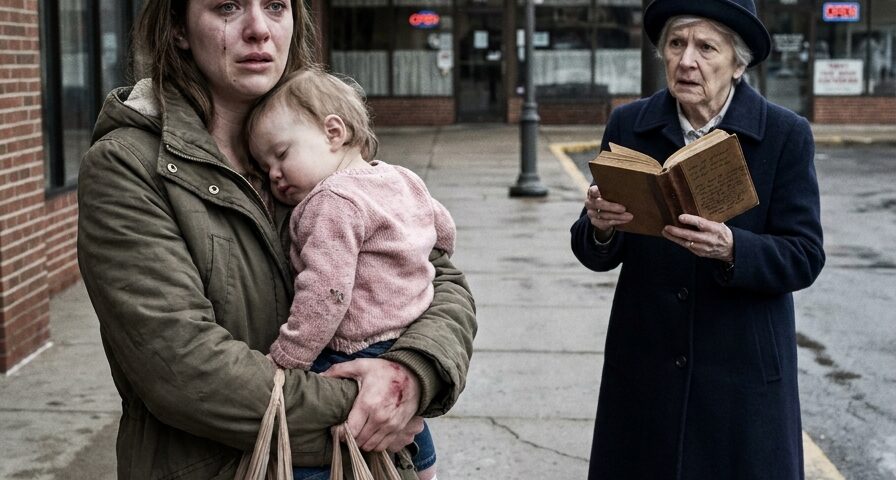
When my grandmother saw me carrying my baby…
When My Grandma Saw Me Carrying My Baby In Threadbare Clothes, She Asked, “Wasn’t $180,000 Enough?”
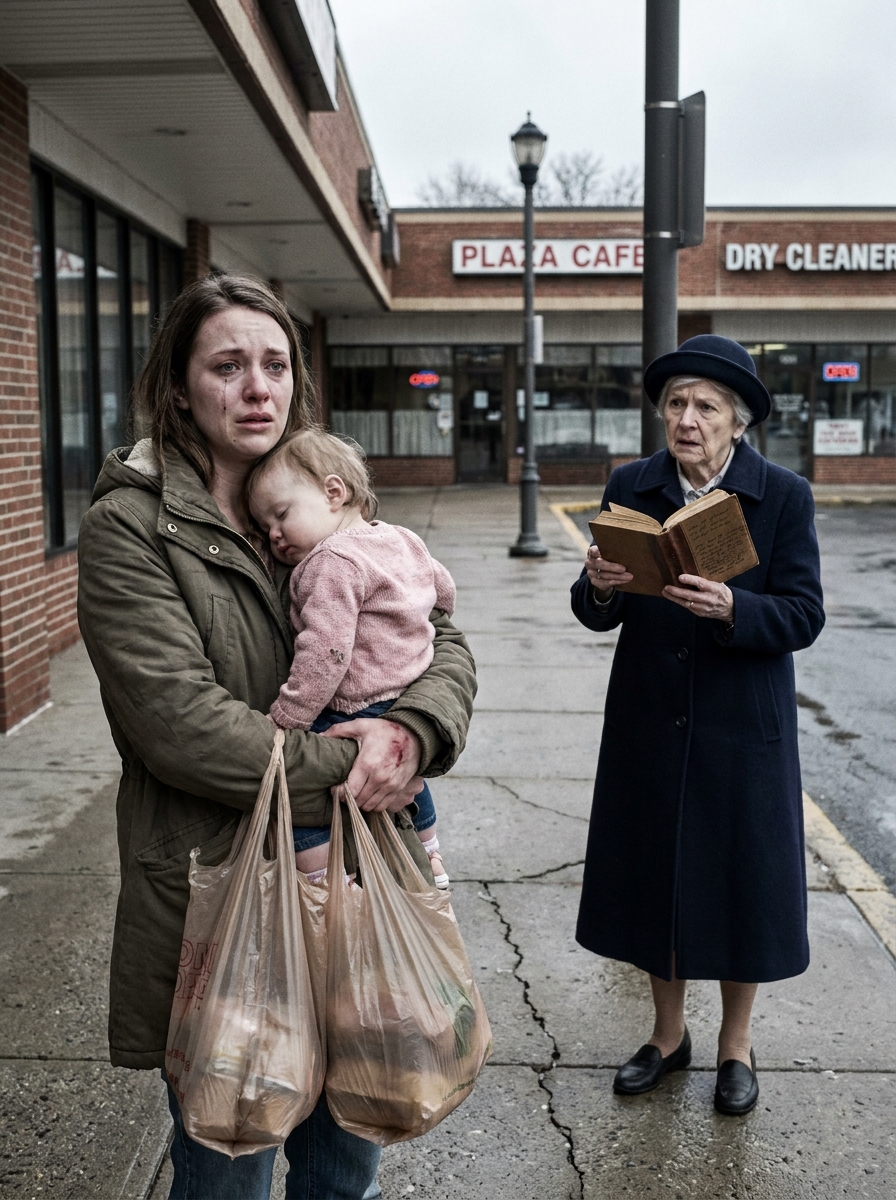
The shopping bags dug into my wrist as I shifted my baby higher against my shoulder.
She was getting heavier every week, but I had long since stopped noticing the ache. A mother learns to carry weight quietly. Groceries. Diapers. Rent. A child’s whole little world pressed against one side of her body while the other hand tries to hold everything else together.
What I could not ignore were the stares.
My daughter’s little sweater had been washed so many times that the soft pink had faded into something closer to gray. My own coat had frayed sleeves I kept folding inward so no one would notice. My shoes were worn at the edges, the kind of worn that tells strangers too much before you ever open your mouth.
I was trying to get home before the wind picked up.
Then I heard my name.
“Lauren.”
The voice stopped me cold.
I turned, and for one impossible second, the noise of the busy sidewalk disappeared.
My grandmother was standing only a few feet away.
I had not seen her in nearly six years.
For that one second, I thought she was going to hug me. I thought she would reach for me the way she used to when I was small, smelling faintly of lavender soap and peppermint tea, pulling me close like the rest of the world could wait.
But she did not move.
Her eyes dropped to my daughter.
Then to my worn shoes.
Then to my coat.
The warmth on her face vanished, replaced by confusion so complete it almost looked like fear.
“Wasn’t the one hundred eighty thousand dollars I sent you enough?”
The words made no sense.
They simply hung there between us while strangers moved around us, shopping bags rustling, cars passing, my daughter sleeping against my shoulder like the world had not just tilted under my feet.
I stared at her.
Finally, I whispered, “Grandma, I never received a single dollar.”
She did not argue.
She did not accuse me.
She only looked into my eyes for several long seconds, searching for something. The truth, maybe. Or the first crack in a lie she had been living inside for years.
Then she reached into her purse, pulled out her phone, and said in a voice so quiet it scared me more than shouting would have.
“Call my attorneys right now.”
I stood frozen on that sidewalk, clutching my baby tighter as people walked around us.
Whatever was happening, neither of us had expected this meeting to change our lives.
But it had already begun.
For years, I believed my grandmother had forgotten me after my mother died.
She had been the only person in my family who ever made me feel completely safe. When I was little, she made pancakes shaped like hearts, kept spare pajamas for me in the bottom drawer of her guest room, and let me fall asleep on her couch while old movies played softly in the background.
After my mother’s funeral, everything changed.
The calls stopped.
The birthday cards stopped.
Every holiday passed in silence.
My father, Richard, always had an explanation.
“She’s traveling.”
“She’s getting older.”
“She says she needs her space.”
Eventually, I stopped asking. There did not seem to be any point in chasing someone who clearly did not want to be reached.
Life became smaller with each passing year.
I worked every job I could find. Cleaning offices before sunrise. Stocking grocery shelves at night. Taking extra shifts whenever someone called in sick. Every paycheck disappeared into rent, diapers, and groceries before I could even pretend it belonged to me.
Some weeks, I skipped meals so my daughter would not have to.
Standing in front of my grandmother now, I saw something that made my stomach tighten.
She looked just as shocked as I felt.
“You truly never received it?” she asked.
I shook my head.
“Not one cent.”
She inhaled slowly, steadying herself before she spoke again.
“I wired the money over several years after your mother passed away. Every transfer. Every letter. I wanted you to have a home, an education, a future.”
I could barely process the words.
Letters.
Transfers.
A future.
None of it had ever reached me.
My grandmother slowly lowered her phone and looked directly at me.
Her voice was calm, but there was something frightening underneath it.
“Lauren,” she said. “Someone has taken far more than money.”
She did not take me back to her house.
Instead, she led me into a quiet cafe a few blocks away, tucked behind the shopping district where the lunch crowd had not reached yet. She chose a booth in the corner, away from curious eyes.
“Order whatever you want,” she said gently.
I glanced at the prices on the menu and closed it.
“I’m fine.”
“No,” she replied. “You have been saying that for far too long.”
Before I could protest, she ordered lunch for both of us and asked for warm milk for my daughter.
As the waitress walked away, silence settled between us.
Neither of us knew where to begin.
Grandma reached across the table.
“When was the last time we spoke?”
I searched my memory.
“The week after Mom’s funeral.”
Her hand slowly pulled back.
“I called you every Sunday for nearly six months.”
I blinked.
“You never called.”
“I did.”
“I never got a single call.”
We stared at each other.
For years, each of us had believed the other had simply walked away.
Grandma opened her purse and carefully removed a worn leather notebook.
“I wrote everything down,” she said.
She flipped through page after page.
“March twelfth. Wired fifteen thousand dollars to help Lauren with school.”
Another page.
“July fifth. Sent twenty thousand after hearing she was expecting a baby.”
Another.
“Christmas. Sent gifts and another transfer because babies grow so fast.”
Her voice became quieter with every entry.
“I never wanted you to worry about money.”
I looked down at my daughter, sleeping peacefully against my chest.
“I spent my pregnancy working double shifts,” I whispered.
Grandma froze.
“I was evicted once.”
Another silence.
“I sold my engagement ring after Emma was born just to pay hospital bills.”
She covered her mouth.
“I skipped dinner more nights than I can count.”
Tears filled her eyes.
“I thought,” she whispered, “I thought you were comfortable.”
I slowly shook my head.
“I thought you stopped loving me.”
For several seconds, neither of us spoke.
The waitress returned with our food, but immediately sensed something was wrong. She placed the plates on the table quietly and walked away without interrupting.
Grandma unfolded a napkin with trembling hands.
“I also wrote you letters.”
“I never received one.”
“I mailed birthday cards.”
“I never saw them.”
“I sent photographs.”
“I don’t have any.”
Every answer made her shoulders sink a little lower.
Then something changed in her expression.
She was not simply heartbroken anymore.
She was remembering.
“Your father insisted on handling everything,” she said slowly.
I frowned.
“He said it would make things easier. He offered to deliver documents, collect receipts, even confirm the transfers.”
That sounded painfully familiar.
“Dad always said you were overwhelmed,” I replied. “Whenever I asked if I could visit, he’d tell me, ‘Your grandmother doesn’t want any surprises right now.’”
Grandma looked up sharply.
“I never said that.”
I swallowed.
“He also told me you preferred communicating through him.”
“I have never preferred that.”
The pieces still did not fit together, but for the first time, they were all pointing in the same direction.
Grandma leaned back in her chair.
“Every transfer required confirmation.”
“What kind of confirmation?”
“A signed acknowledgment that you had received the funds.”
I stared at her.
“I’ve never signed anything.”
She did not answer immediately.
Instead, she slowly reached for her phone again.
This time, she was not calling out of shock.
She was calling with purpose.
“My attorneys need every transfer record,” she said firmly when someone answered. “Every wire receipt. Every signed acknowledgment. Every piece of correspondence connected to Lauren.”
She listened for a moment, then replied, “No, don’t send copies.”
Her expression hardened.
“I want the originals.”
She ended the call and looked at me.
“If someone intercepted this money…”
She did not finish the sentence.
Just then, her attorney called back. She put the phone on speaker.
His voice was calm, but the question he asked made both of us go completely still.
“Mrs. Bennett, who had access to every payment before Lauren could?”
Three days later, every member of the family received the same message.
My grandmother was calling an emergency family meeting at her home.
No explanation.
Attendance required.
By the time I arrived with my daughter, nearly everyone was already there. My aunts stood in small groups whispering. My cousins looked confused. Even relatives who rarely attended family gatherings had shown up.
My father, Richard, looked completely at ease.
He smiled when he saw me.
“I didn’t expect you to come.”
“I was invited,” I said.
He gave a short laugh.
“Interesting.”
Whatever he thought this meeting was about, he clearly was not worried.
A few minutes later, my grandmother entered the living room with two attorneys carrying thick folders.
The conversations stopped immediately.
Richard smiled.
“Mother, if this is about updating your estate plans, we can schedule another day.”
She remained standing.
“No.”
Her voice was calm.
“This meeting isn’t about my estate.”
She looked directly at him.
“It’s about the one hundred eighty thousand dollars I sent Lauren.”
The room fell silent.
Richard’s smile disappeared.
Grandma continued, “I want you to explain why my granddaughter says she never received a single dollar.”
For a brief moment, my father looked genuinely surprised.
Then his expression shifted into practiced confidence.
He gave a disappointed sigh and shook his head.
“So that’s what this is.”
He turned toward the rest of the family.
“I was wondering when she’d try something like this.”
Several relatives looked at me.
One of my aunts frowned.
“What do you mean?”
Richard spread his hands.
“Lauren has been struggling financially for years. Apparently, she has decided the easiest solution is convincing Mother that money went missing.”
I felt every eye in the room land on me.
“I never said that.”
“You didn’t have to.”
He looked back at Grandma.
“Mother, she’s manipulating your memory. At your age, it’s understandable to confuse dates and amounts.”
Grandma did not react.
She simply nodded toward one of her attorneys.
“Show everyone.”
The attorney opened the first folder.
Inside were organized records stretching back several years.
“Mrs. Bennett authorized multiple wire transfers totaling one hundred eighty thousand dollars,” he explained. “Each transfer successfully left her accounts.”
He placed copies on the table.
Several relatives leaned forward.
My uncle quietly read the amounts.
“These transfers definitely happened.”
Richard folded his arms.
“Exactly.”
Then he looked at me.
“So perhaps the question is what happened after Lauren received them.”
I could not believe what I was hearing.
“I never received anything.”
“You expect everyone here to believe that every transfer somehow disappeared?”
“I don’t know what happened because I never saw the money.”
Before the discussion could spiral further, Richard reached into his briefcase.
“I anticipated something like this.”
He removed another folder.
“I kept records too.”
He handed several documents to the attorneys.
“There,” he said, pointing confidently. “Those are Lauren’s signed acknowledgments confirming every payment.”
A murmur spread through the room.
One by one, family members examined the pages.
Every document appeared to bear my signature.
One cousin looked at me with disbelief.
“Lauren…”
“I didn’t sign those,” I said immediately.
Richard shrugged.
“Now you’re claiming someone forged years of paperwork?”
“I’ve never even seen those documents.”
My grandmother looked directly at me.
“Are you certain?”
I did not hesitate.
“Yes.”
She held my gaze for several seconds.
Then she turned toward her attorneys.
“I want forensic document examiners.”
Richard’s confidence flickered.
“That’s unnecessary.”
“I disagree.”
“They’ll only waste everyone’s time.”
She interrupted him.
“I also want forensic accountants tracing every transfer from the moment it left my account.”
The room became uncomfortably quiet.
Richard forced a smile.
“If that’s what gives everyone peace of mind.”
But his voice no longer carried the certainty it had only minutes earlier.
The meeting ended shortly afterward. Relatives left in uneasy silence, unsure whom to believe.
As people gathered their coats, I remained seated beside my grandmother while her attorneys carefully collected every original document into evidence boxes.
Out of the corner of my eye, I noticed movement.
Richard had quietly stepped behind the conference table. His hand reached toward the stack containing the original acknowledgments.
He lifted the top file just enough to slide it away.
Before he could take another step, one of the attorneys firmly placed a hand over the folder.
“I’m afraid those documents stay with us.”
Richard froze.
For the first time since the meeting began, the color drained from his face.
He slowly removed his hand from the folder.
“I was only trying to help organize the paperwork,” he said with a strained smile.
The attorney did not move.
“We can manage that ourselves.”
Without another word, he placed every original document into a locked evidence case.
I noticed something I had never seen on my father’s face before.
Not anger.
Not embarrassment.
Fear.
The following week became a blur of phone calls, document requests, and meetings with attorneys.
My grandmother insisted I attend every update.
“If this concerns your life,” she told me, “you deserve to hear the truth as it unfolds.”
The first breakthrough came from the forensic document examiner.
He laid several enlarged copies of the signatures across the conference table.
“They appear convincing at first glance,” he explained.
He pointed to tiny inconsistencies.
“The pressure patterns don’t match.”
Another page.
“The pen movement is mechanically identical on multiple documents.”
Another.
“And these signatures contain digital artifacts that should not exist on an original handwritten document.”
He looked directly at my grandmother.
“In my professional opinion, these acknowledgments were not signed by Lauren.”
Silence filled the room.
The signatures that had been used to prove I received one hundred eighty thousand dollars were fake.
The forensic accountants uncovered something even more troubling.
Every transfer had left my grandmother’s accounts exactly as intended.
None had ever reached an account belonging to me.
Instead, the money passed through intermediary business accounts before disappearing again.
One accountant projected a flowchart onto the conference room screen. Colored lines connected account after account.
He circled one company name.
“This is where the trail becomes consistent.”
My grandmother frowned.
“I don’t recognize that business.”
“You should,” he said.
He clicked to the next page.
Corporate registration records appeared on the screen.
The sole managing officer listed was Richard Bennett.
I stared at the document.
“That’s Dad’s company.”
The accountant nodded.
“Every transfer eventually ended here.”
No one spoke.
The room suddenly felt much smaller.
The attorneys kept digging.
Each new discovery answered one question while raising another.
Letters my grandmother had mailed had been redirected before they ever reached me.
Birthday cards had vanished.
Packages had been signed for by someone else.
An old email account I thought my grandmother had stopped using had actually been altered so that replies were automatically forwarded somewhere else.
Even phone messages had been intercepted.
One attorney closed a thick file.
“This wasn’t a misunderstanding.”
Another added quietly, “This required planning.”
I felt sick.
For years, I had blamed my grandmother.
She had spent those same years believing I wanted nothing to do with her.
Neither of us had chosen that distance.
Someone had carefully built it between us.
My grandmother stood.
Her expression had completely changed from the woman I had met in the shopping district. The confusion was gone.
Only resolve remained.
She turned toward her legal team.
“Remove Richard from every position connected to my finances.”
One attorney nodded.
“It will be done today.”
“Freeze every account that can legally be frozen.”
“We’re already preparing the emergency filings.”
“And notify every institution where he has authority over family assets.”
The attorneys immediately began making calls.
The machinery of the law had started moving.
There would be no turning it back.
That evening, I received a short message from my father.
We need to talk.
I did not answer.
An hour later, another message arrived.
This isn’t what it looks like.
Still, I stayed silent.
For the first time in years, I was not chasing his explanations.
He was chasing mine.
The next morning, my grandmother and I arrived at her attorney’s office for another scheduled meeting.
Before we even reached the conference room, voices echoed through the hallway.
Two investigators had just entered the reception area. One carried a folder. The other looked toward the receptionist and asked, “Is Richard Bennett already here?”
Seconds later, my father stepped out of the conference room, stopped in his tracks, and stared at them.
One investigator raised a hand.
“Mr. Bennett.”
He gestured toward a chair.
“We need you to remain seated.”
My father looked from the investigators to my grandmother, then to me.
For the first time in my life, he had no explanation ready.
No polished excuse.
No reassuring smile.
He slowly sat down without saying a word.
One investigator placed a folder on the conference table.
“Mr. Bennett, we’ve reviewed the financial records provided by Mrs. Bennett’s legal team. We’d like to ask you some questions regarding multiple wire transfers, forged acknowledgments, and the movement of funds through several business accounts under your control.”
Richard swallowed.
“There has to be some misunderstanding.”
The investigator calmly opened the folder.
“We’re hoping you’ll help us understand it.”
Over the next several weeks, the investigation uncovered everything.
Years before, Richard’s construction business had begun losing money. Bad contracts. Mounting debts. Loans he could not repay.
Instead of admitting he was failing, he saw an opportunity.
My grandmother trusted him completely. She believed he was helping manage family affairs after my mother’s death. When she asked him to make sure I received financial support, he volunteered without hesitation.
He opened intermediary business accounts.
Every transfer my grandmother authorized passed through accounts he controlled before being quietly diverted into his struggling company.
To make the story believable, he created false acknowledgments showing I had supposedly received every payment.
He forged signatures.
He intercepted letters.
He redirected mail.
He altered contact information.
Whenever I asked why Grandma never called, he insisted she needed distance.
Whenever Grandma asked why I never responded, he told her I wanted nothing to do with the family anymore.
He did not just take money.
He stole years of trust.
When investigators finished presenting the evidence, my grandmother sat perfectly still.
She looked at Richard for a long time.
“I trusted you with my daughter’s child,” she said quietly. “You looked me in the eye for years.”
Richard lowered his head.
“I was going to pay it back.”
She shook her head.
“No.”
Her voice never rose.
“You were going to keep lying until one of us died.”
The room fell silent.
There was nothing left to argue.
When the investigators escorted Richard out for further questioning, he glanced toward me.
“I never wanted you to suffer.”
I looked at him and thought about every night I had counted coins before buying groceries. Every eviction notice. Every extra shift. Every birthday when I told my daughter we would celebrate next week because I could not afford a cake.
“You watched me suffer,” I said. “You just hoped I would never discover why.”
He looked away.
Those were the last words we spoke.
The civil case moved much faster once the financial trail was complete.
The court ordered the recovery of every available asset connected to the diverted funds. Properties were sold. Investment accounts were frozen. Business holdings were liquidated.
Not every dollar could be recovered immediately, but a substantial portion of the money was returned.
Separate proceedings followed, built on the evidence of fraud, forged acknowledgments, and financial theft.
Richard was permanently removed from every family role connected to money or decision-making.
No one in the family ever trusted him with another financial decision again.
The hardest conversations came afterward.
Relatives who had defended my father began visiting me one by one.
My aunt stood at my apartment door holding a small bouquet of flowers.
“I believed him,” she admitted. “I thought you were making accusations because you were struggling.”
“You didn’t know,” I said.
“I should have asked questions instead of making assumptions.”
Others echoed the same regret.
For years, my father’s reputation had outweighed my reality.
Now the evidence spoke louder than any opinion ever could.
One afternoon, my grandmother invited me to her lawyer’s office again.
This time, there were no evidence boxes.
No investigators.
Only a stack of completed documents.
She slid them toward me.
“I’ve established a protected trust.”
I looked up.
“The funds can only be managed by you.”
I blinked.
“I don’t know what to say.”
She smiled through tears.
“You don’t have to say anything. You’ve already paid a price you never should have paid.”
The changes in my life did not happen overnight.
But they happened steadily.
I put a down payment on a modest home where my daughter finally had her own bedroom.
I enrolled in the nursing program I had postponed for years because survival always came before dreams.
For the first time since becoming a mother, I was not calculating whether groceries or electricity had to come first.
I could simply breathe.
The greatest gift, however, was not financial.
Every Sunday became family day.
My grandmother came over carrying homemade meals my daughter insisted tasted better than anyone else’s.
They baked cookies together.
Read picture books on the living room floor.
Planted flowers in the backyard.
They were making memories that should have existed years earlier.
We could not recover the lost time.
But we refused to lose any more.
One warm afternoon, I stood beside my grandmother as my daughter laughed across the yard, chasing bubbles through the sunlight.
Grandma slipped her hand into mine.
“I spent years believing my love never reached you,” she whispered.
I squeezed her hand gently.
“It did.”
She looked at me, confused.
I smiled.
“It just took the truth a little longer to find its way.”
She watched her great-granddaughter run through the grass, her eyes filled with quiet peace.
Then she softly said the words neither of us would ever forget.
“Money can be stolen,” she said, “but the truth eventually finds its way home.”