My mom and twin sister made me leave home at nineteen…
My Mom and Twin Sister Kicked Me Out at 19. I Lived in a Tent and Struggled for Years. Now They Wanted My Home.
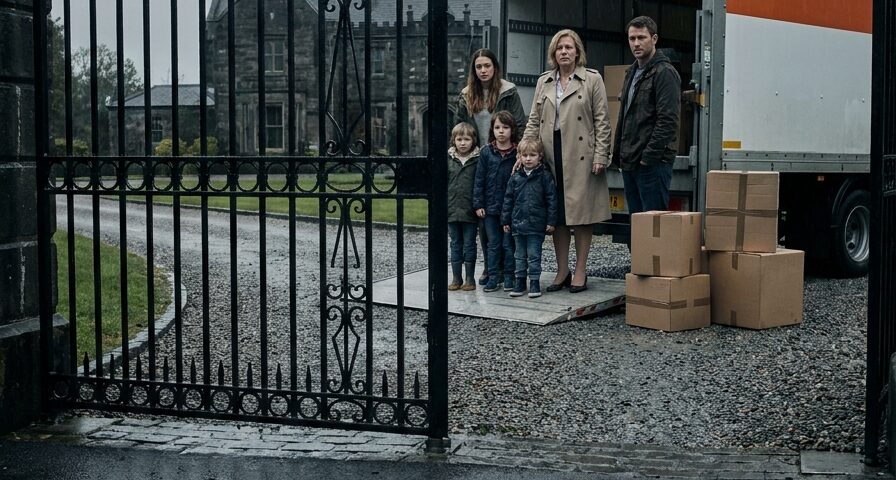
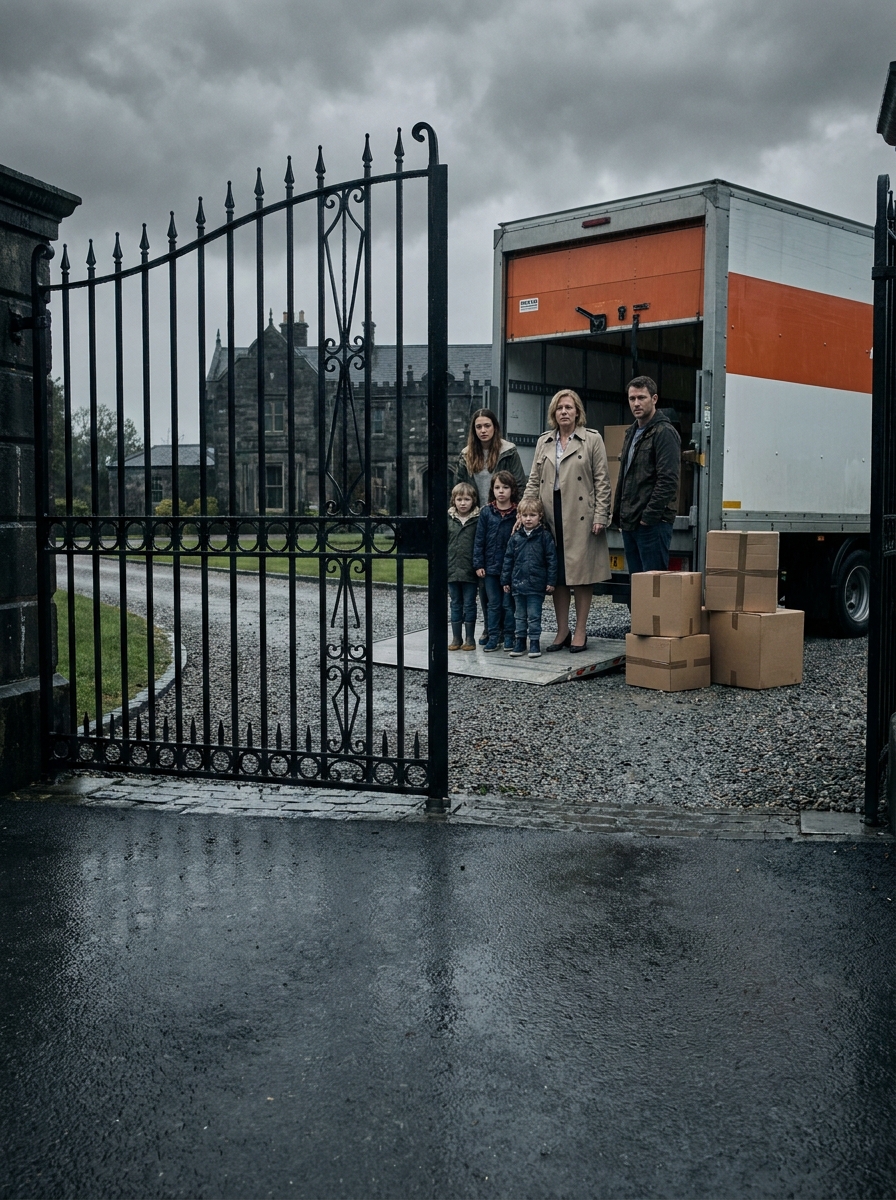
My name is Paige Whitaker. I was thirty-one years old when my mother appeared outside my gate with a rented moving truck, my twin sister, her husband, three children, and enough taped cardboard boxes to fill half my driveway.
The first thing Diane Whitaker said was not hello.
“Open the gate. We drove three hours, and the children are tired.”
She spoke through the intercom as though I had already agreed, as though my answer had been decided somewhere along the highway without my participation.
Behind her, my twin sister Mallerie stood beside her husband, Grant Keller. Their three children shifted impatiently near the truck, holding backpacks and tablets. One of them had already placed a small suitcase on the gravel beside the gate.
Mallerie pointed through the iron bars toward my house.
“The downstairs suite will be perfect for us,” she said. “The stairs in our current place are becoming difficult.”
Grant peered past her toward my detached workshop.
“Is the garage heated?”
My mother glanced toward the neighboring property.
“Paige, don’t embarrass me in front of the neighbors.”
I looked at the code panel beside the gate, then at the security cameras mounted above it.
Twelve years earlier, those same people had watched me leave home carrying two garbage bags and nowhere to sleep.
They had called it independence.
Now that I owned a brick house, a workshop, several company vans, and enough land to accommodate their moving truck, they called it family.
For the first time in my life, they were the ones standing outside the door.
And the gate remained locked.
My mother’s version of our family history was simple.
She had done the best she could after our father left when Mallerie and I were eight.
That was the sentence she used whenever anyone questioned how differently her two daughters were treated.
She never admitted that she loved Mallerie more.
She said Mallerie needed more attention.
She never admitted that I was expected to disappear whenever my presence became inconvenient.
She called me calm, capable, strong, and independent.
Mallerie was seven minutes older than me, but Diane treated those seven minutes as though a crown had been placed on her head in the delivery room.
Mallerie received the bed beside the bedroom window.
I slept nearest the door.
She received the new winter coat. I inherited the old one with the zipper that caught halfway up.
She attended dance classes because she was social and expressive.
I received a library card because I was supposedly happier alone.
On our birthdays, Mallerie selected the cake, restaurant, movie, and guest list. My mother told me I was fortunate because I did not have to plan anything.
Whenever relatives visited, Mallerie sat beside Diane and told stories in which I was always the strange twin—the serious one, the difficult one, the girl who made everything heavier than it needed to be.
I learned early that cruelty did not always arrive with shouting.
Sometimes it was disguised as humor.
Sometimes it came with a hand resting gently on your shoulder and a sentence like, “You understand, Paige. Your sister simply needs a little more from us.”
We grew up in Ridge Hollow, a small town in central Pennsylvania where everyone knew which porch needed repainting and whose son had been arrested before the boy’s parents even returned from work.
Diane worked in a medical billing office. She paid the rent on time, kept groceries in the refrigerator, and made certain the outside world had no obvious reason to interfere.
That was her particular talent.
She created a house that looked ordinary from the street and felt carefully ranked from within.
I was never starved.
No one struck me.
I had notebooks for school, a winter jacket, and a mother who signed field-trip forms.
But every day of my childhood taught me that life was easier when I required less.
The only person who named the imbalance was my grandmother, Elaine Morris.
Grandma Elaine was Diane’s mother. She wore her gray hair in a bun and laughed so warmly that strangers often turned toward her without knowing why.
She also had a way of looking at my mother that could end an argument without either woman raising her voice.
On Saturday mornings, she took me to estate sales.
“Old things tell the truth better than people do,” she once told me while examining a refinished table. “Look at the places where the cracks were repaired. That tells you where the pressure was.”
At the time, I thought she was teaching me about furniture.
Years later, I understood she had been teaching me about people.
Grandma noticed when Mallerie borrowed my birthday money and Diane told me not to be petty.
She noticed when I helped Mallerie study for an exam, only for Diane to praise my sister when she passed and dismiss my own grades as something that came easily.
She noticed when Mallerie cried her way out of chores and I was asked to finish them because I was the responsible twin.
Grandma Elaine never made dramatic promises about rescuing me.
She simply made space for me at her kitchen table.
She let me speak without correcting my feelings.
She allowed me to be angry.
Most importantly, she allowed me to be a child without making me earn the privilege.
During my senior year of high school, she became sick.
It happened faster than any of us were prepared to accept.
One month, she was arguing with a pharmacist over medication prices. The next, she was too exhausted to sit upright long enough to finish a cup of tea.
When she passed away, the balance inside our house changed immediately.
Mallerie stopped pretending she needed to be cautious around me.
Diane stopped pretending she intended to be fair.
At Grandma Elaine’s funeral, Mallerie cried into our mother’s blouse as though she had been the granddaughter who spent every Saturday beside her.
Diane rubbed Mallerie’s back and told everyone how sensitive her poor girl was.
I stood two feet away without crying because my grief had gone somewhere too deep for tears.
My mother looked at my dry face as if my silence were another personal failure.
That was when I first understood something that would save me years later.
Some families do not forget what they did to you.
They simply wait until they need something, rewrite the past, and expect you to agree with the new version.
After graduating from high school, I believed I had several months to prepare for independence.
I had been accepted into a community college program in architectural drafting. I did not yet have a grand career plan. I simply liked measuring rooms, reading blueprints, and understanding how structures fit together.
Grandma Elaine had left me nine hundred dollars in cash.
She placed it inside an envelope hidden in the lining of an old cookbook because she knew Diane would never open it.
I kept the money in the lining of a worn purse.
During the mornings, I worked at a grocery store. In the evenings, I cleaned classrooms at the middle school.
My plan was simple.
Save enough money to rent a room before the fall semester began.
Then Mallerie announced she was pregnant.
Diane cried happy tears for two days. She called every relative who still answered her phone and began walking through our rented duplex with a notebook as though she had become the host of a home-renovation program.
She decided the baby needed a peaceful environment.
She decided Mallerie needed constant support.
She decided Grant, Mallerie’s boyfriend, should move into the house because a young father needed to be involved.
Grant arrived with a black pickup truck, two laundry baskets filled with clothes, a television larger than any we had owned, and the confidence of a man who had never paid for the room he expected to occupy.
He was twenty-one, loud, charming whenever witnesses were present, and unable to maintain a job for more than several months.
Within forty-eight hours, his shoes blocked the hallway, his dirty dishes filled the sink, and his opinion appeared in every family conversation.
Then Diane announced that my bedroom was the only room large enough for a crib.
“Where am I supposed to sleep?” I asked.
My mother did not appear embarrassed.
She looked relieved to finally say the sentence she had been preparing.
“You’re nineteen, Paige. At some point, you need to stop making yourself my responsibility.”
I asked whether I could sleep on the couch until I found a room to rent.
Grant explained that his back sometimes locked if he slept incorrectly, so he needed access to the living room when the bedroom became uncomfortable.
I suggested the basement.
Mallerie said the air downstairs would be unhealthy for the baby’s belongings.
I reminded them that classes began in six weeks.
Diane sighed as though I had insulted her.
“Your sister is creating a family. You’re creating excuses.”
Mallerie stood behind our mother with one hand resting on her stomach.
A small smile appeared at the corner of her mouth.
“You always acted like you didn’t need us,” she said. “This should be easy for you.”
I packed my belongings while they watched television in the next room.
No one helped.
No one asked me to reconsider.
Before I left, Diane handed me a plastic grocery bag containing canned soup and crackers.
“Don’t tell people we threw you out,” she said. “Say you moved. It sounds more mature.”
For the first week, I slept on friends’ floors and lied about why I was there.
Pride is a strange thing when you are young.
It can keep you standing.
It can also prevent you from requesting the help that might save you.
I did not want pity.
I did not want teachers contacting Diane.
Most of all, I did not want Mallerie hearing that I had cried in someone’s bathroom at midnight because I was frightened and pretending not to be.
By the second week, the floors were no longer available.
Parents began asking questions. My friends had their own families, rules, obligations, and lives that could not become permanent shelters for mine.
That was how I ended up behind a closed roadside flea market outside Ridge Hollow with a discount tent, a flashlight, two bags of clothes, and less than two hundred dollars remaining from Grandma Elaine’s gift.
The flea market operated from Thursday through Sunday. During the other nights, the back field remained mostly empty.
I placed my tent behind a row of storage sheds painted dark red and prayed no one would notice.
I washed my hair and face in gas-station bathrooms before work.
My best shirt stayed folded inside a plastic bag so it would not smell like wet grass.
At night, I slept with my shoes beside my head because I had once read that a person should always be prepared to run.
Every sound became a question.
Raccoon or person?
Wind or footsteps?
Rain or something touching the thin fabric?
I learned how cold the ground could become after midnight, even in July.
I learned that hunger felt different when every dollar had to be saved for tomorrow.
I also learned that the sentence *family helps family* was most often spoken by people who had already decided which family members deserved help.
The most painful part was not sleeping in the tent.
It was knowing Diane was aware.
One rainy afternoon, I was collecting shopping carts in the grocery-store parking lot when I saw her car.
She looked directly at me through the windshield.
Mallerie sat in the passenger seat, laughing at something on her phone.
Diane did not park.
She did not lower the window.
She drove past slowly, as though I were an unpleasant memory she had decided not to recognize.
That night, I nearly called her.
I held my prepaid phone until the screen went dark.
Then I remembered Grandma Elaine telling me to study repaired cracks.
I promised myself that if I survived, I would build a life with secure walls, locking doors, and no room reserved for people who only remembered me when they needed something.
The job that eventually changed my life began with water damage inside a funeral home.
I was twenty-one by then, renting a single room above a laundromat and taking one college course at a time because that was all I could afford.
A pipe burst above the funeral home’s viewing room during a January freeze.
The cleaning company I worked for sent a crew to remove wet carpet, wipe the woodwork, and carry damaged ceiling tiles into a dumpster behind the building.
Most of the workers wanted to finish quickly and leave.
I kept studying the room.
Thin cracks branched through the plaster walls. Floorboards had buckled near the first row of chairs. The crown molding was damaged but did not appear beyond repair.
A man named Arthur Bell owned the restoration company hired to repair the property after our cleaning crew finished.
Arthur was in his late fifties. He wore flannel shirts beneath heavy work vests and had the calmest voice I had ever heard on a job site.
He noticed me studying the baseboards.
“Do you know what you’re looking at?” he asked.
“Not yet.”
He laughed.
“That’s a better answer than pretending.”
Arthur’s company specialized in restoring older homes and commercial buildings after floods, storms, fires, and years of neglect.
He did not automatically tear everything out.
He identified what could be saved, replaced what could not, documented every detail for insurance claims, and taught property owners the difference between damage and decay.
I began working for him on weekends.
Soon I was taking evening shifts.
When the school-cleaning contract ended, Arthur hired me full-time.
He taught me how to use moisture meters, repair plaster, sand floors, preserve window weights, follow lead-safe practices, prepare estimates, and photograph damage for claim files.
He also taught me how to explain expensive problems without making frightened homeowners feel that I was selling fear.
I loved the work.
Damaged buildings made sense in a way my childhood never had.
A ruined room did not need excuses.
It needed an honest assessment.
Rotten materials had to be removed before healthy sections could be restored.
Boundaries mattered.
So did documentation.
Arthur noticed that I was good with nervous clients.
I recognized the sound of people nearing their breaking point while still attempting to remain polite.
I knew how to stand in a destroyed kitchen and say, “We can manage the next step without pretending this situation is smaller than it is.”
For several years, I worked until my hands cracked during Pennsylvania winters.
At night, I took community college courses in construction management, bookkeeping, and small-business law.
I learned to read contracts because I already understood what happened when people trusted feelings instead of paper.
Every locked storage trailer needed an inventory.
Every project required a signature.
Every promise needed proof.
When I was twenty-six, Arthur offered to sell me one of his older vans and send me the small projects he no longer wanted.
I named my company Whitaker Restoration and Finish.
I wanted my last name to stand for something other than Diane’s house.
My first office was a desk in the corner of a rented garage.
My first employee was Luis Ramirez, a retired painter who could match stain colors by sight.
He reviewed my first estimates and shook his head.
“You charge too little because you still feel grateful anyone hired you.”
He was correct.
My second employee was Jenna Cole, a bookkeeper who wore bright pink glasses.
Within her first week, she found three overdue invoices buried in my email.
“Paige, those customers are not confused,” she said. “They are hoping you feel too uncomfortable to collect.”
She was correct too.
The company grew slowly.
Then, after a severe hailstorm struck the Harrisburg suburbs one spring, the phone did not stop ringing.
For months, we repaired porch columns, flooded floors, damaged windows, and cracked exterior trim.
A local insurance adjuster began recommending us because our documentation was precise.
Real estate agents called when older properties needed careful repairs before being listed.
Churches contacted us about storm windows.
Families hired us after a parent died and the old home needed to be made safe before anyone could consider selling it.
By thirty, I employed twelve people.
We operated four vans and maintained a warehouse filled with reclaimed flooring, doors, trim, and hardware.
We had also developed a reputation for telling clients the truth, even when honesty cost us the project.
The following year, I purchased a property outside Harrisburg.
It included a modest brick house, a detached workshop, a gravel lot for the vans, and an old carriage house I converted into storage for reclaimed materials.
The previous owner had installed a perimeter fence because he stored equipment on the property.
I upgraded the gate, lighting, cameras, and intercom.
I was not frightened of the world.
I simply understood the value of a boundary that did not depend upon another person’s willingness to respect it.
A professional security company patrolled the commercial yard at night. Their handlers occasionally brought trained dogs because the property contained expensive tools and irreplaceable architectural materials.
The dogs were controlled, leashed, and trained.
They were not there to harm anyone.
They existed to provide a clear warning before anyone made a foolish choice.
I moved into the house with two mattresses, a coffee maker, and Grandma Elaine’s old cookbook.
It was the same cookbook that had hidden the nine hundred dollars.
On my first evening, I walked from room to room turning lights on and off simply because I could.
No one accused me of wasting electricity.
No one told me that a room belonged to someone who needed it more.
No one stood in the doorway and made me feel like a guest in my own life.
I slept for eight uninterrupted hours.
That was when I first understood that peace can feel suspicious when you were raised inside chaos.
But I practiced.
I painted the kitchen green.
I planted rosemary beside the back steps.
I installed a heavy lock on the front door and programmed the gate code myself.
Every part of the property had been earned by the same hands Diane once considered useful only when they served someone else.
Two weeks after I moved in, my mother found the address.
I was reviewing invoices for a church-restoration project when movement appeared on the camera feed.
A silver SUV stopped outside the front gate.
Diane stepped out wearing sunglasses and carrying a purse too large for an ordinary visit.
She studied my house with an expression that tightened my stomach.
It was not pride.
It was calculation disguised as maternal concern.
Mallerie exited the passenger side.
She looked older than in the photographs I had occasionally seen online—softer around the face but harder around the mouth.
Grant parked a rented moving truck so poorly that one rear wheel rested in the grass beside my driveway.
Their three children climbed out with backpacks, tablets, and the weary confusion of children pulled into an adult decision they had not made.
Diane pressed the intercom button and smiled toward the camera.
“Paige, honey, open the gate. We need to talk.”
I answered through the speaker.
“You can talk from there.”
My mother’s smile froze briefly.
Mallerie moved closer.
“Seriously? You’re going to leave us standing outside?”
Grant stared through the bars at the workshop and vans.
“Nice place,” he said. “Business must be doing well.”
He made my success sound like something I had taken from him.
Diane explained that Mallerie’s lease was ending because the landlord intended to sell the duplex.
Mallerie interrupted to say that the rent had become unreasonable.
Grant muttered that landlords were parasites.
Then Diane folded her hands as though making an announcement at church.
They had found a solution that would benefit everyone.
Mallerie, Grant, and the children would stay in my downstairs guest suite temporarily.
No one offered a definition of temporarily.
Diane would remain several nights each week to help with childcare.
Grant intended to use part of my workshop to begin a furniture-resale business because, according to him, no single woman required so many tools.
Mallerie said the children deserved a yard.
Then Diane delivered the sentence she had clearly been saving.
“You know what it feels like not to have a comfortable place to sleep. You should be the last person to deny your family shelter.”
The words moved through me like a blade sharpened over twelve years.
“You remember that?” I asked.
Diane blinked.
“Of course I remember how difficult that period was for everyone.”
For everyone.
Not only for the nineteen-year-old sleeping behind flea-market sheds.
Not for the girl washing her hair in public bathrooms.
Not for the daughter who watched her mother drive past in the rain.
Mallerie leaned toward the intercom.
“Don’t start rewriting history, Paige. Mom worried herself sick. You refused to accept help.”
“What help?”
Grant laughed loudly enough for the microphone to capture it.
“This is why nobody contacts you. Everything becomes a trial.”
My mother’s expression changed.
The gentle mask disappeared.
The woman from my childhood looked directly into the camera.
“You’re single. You have no husband and no children. You have a house, a yard, and several buildings sitting partly empty while your sister’s family is struggling.”
She paused.
“I did not raise you to be selfish.”
That was her mistake.
She had raised me to be quiet, useful, and available.
She had not raised the woman standing inside that gate.
“The answer is no.”
Mallerie stared at the speaker as though it had spoken another language.
“No?”
“You are not moving into my home. You are not staying here. Grant will not use my workshop.”
I looked at the truck through the camera.
“You need to move it before I have it towed.”
Their youngest child began crying.
I felt sorry for the children.
But pity was not permission.
Mallerie lifted the little girl and glared toward the camera.
“Look at what you’re doing. You’re frightening them.”
“You brought them to a locked gate with a moving truck and no invitation. That is what frightened them.”
Grant stepped so close that his face filled the camera.
“Open the gate, Paige.”
I picked up my phone and called Rachel Monroe, my operations manager.
Rachel had dealt with contractors, law enforcement, insurance representatives, and angry property owners for twenty years. She did not panic, and she did not negotiate with nonsense.
“I need the front gate handled,” I told her. “Uninvited relatives with a moving truck. Bring the security team forward.”
Five minutes later, Rachel walked along the interior driveway with two uniformed handlers and two trained dogs walking calmly at heel.
The dogs did not bark or pull at their leashes.
They stood silently beside their handlers.
That silence made the message clearer.
I left the office and walked onto my front porch.
“Move the truck,” I said through the gate. “Leave the entrance and do not return without an appointment approved by me in writing.”
Mallerie looked at the dogs, then at me.
For the first time in my memory, she appeared uncertain whether tears would change the outcome.
Diane lowered her voice.
“Paige, this is cruel.”
“No, Mom. This is a boundary with witnesses.”
Grant called me dramatic, bitter, selfish, and several other things the cameras recorded clearly.
Rachel informed him that the truck was obstructing private commercial access and would be reported if he did not move it.
That finally persuaded him.
My mother returned to the SUV slowly, shaking her head as though I had failed a test she still believed she had the authority to administer.
As they drove away, Mallerie mouthed something through the window.
I could not hear her, but I recognized the shape of the words.
*You’ll regret this.*
I stood behind the locked gate and watched the truck disappear.
I felt no victory.
Only the cold understanding that people who arrived demanding entry would not accept a single refusal.
For three days, my phone became a museum of old manipulation.
Diane called first, leaving messages about forgiveness, family unity, and how badly I had behaved in front of the children.
When I blocked her number, she called from Mallerie’s phone.
After I blocked that one, Grant contacted me through a social-media account I had forgotten existed. He claimed I believed I was superior because I restored houses for wealthy clients.
Then the relatives began.
Cousins I had not spoken to in ten years sent paragraphs about compassion.
An aunt who had never invited me to Thanksgiving reminded me that children were innocent.
I prepared one response and copied it whenever necessary.
*They arrived without permission and attempted to move into my home. The answer is no. Do not contact me about this matter again.*
Some people stopped.
Diane did not.
On Friday morning, she came alone and pressed the intercom button repeatedly while I completed payroll.
Her eyes appeared red.
My mother could produce tears as easily as other people brewed coffee.
She said Mallerie was overwhelmed.
She said Grant had employment possibilities near Harrisburg.
She said she was becoming too old to carry everyone.
“Why are you still carrying the family you chose over me?” I asked.
That made her cry harder, though not more sincerely.
“I made mistakes,” she said. “But you survived. Doesn’t that mean something?”
For years, I had confused survival with forgiveness.
“It means something to me,” I replied. “It does not create a bedroom for Mallerie.”
Diane’s mouth tightened.
“Your grandmother would be ashamed of you.”
For one moment, the old wound opened.
Then I remembered Grandma Elaine’s kitchen table and the lessons hidden inside her conversations about repaired furniture.
“Grandma would have asked why you need my home after throwing me out of yours.”
Diane struck the intercom panel with her palm and walked away.
That afternoon, I drove to a project in Lancaster, where a storm had damaged the roof of a historic rowhouse.
I was standing in a bedroom with exposed wooden lath and wet insulation when Rachel called.
Her voice remained controlled, but each word was clipped.
“Paige, open the security application. Side delivery gate.”
I pulled up the camera feed.
Grant’s moving truck had been backed toward the secondary entrance.
Mallerie stood beside it holding a cardboard box.
Diane was there too, wearing the same blouse she had worn that morning.
Grant had cut through part of the protective chain covering and was using a pry bar against the secondary latch.
My breathing slowed.
Not because I was calm.
Because some part of me had expected this.
“They told the patrol handler you approved their move and forgot to update the access list,” Rachel said. “Grant says he has verbal permission.”
On the screen, Mallerie pointed toward the narrow opening near the damaged gate.
Her oldest child, no more than eleven, picked up a suitcase and took an uncertain step toward it.
My pity vanished.
Adults could feel entitled.
Adults could lie.
But using a child as evidence of permission was something else.
“Call the police,” I said. “Tell them there is an active trespass, forced-entry attempt, property damage, and children being directed into a commercial yard.”
“Already calling.”
Through the camera speaker, I heard Rachel’s voice.
“Step away from the gate. You do not have authorization to enter. This is a recorded area, and police are on the way.”
Grant shouted that she was only an employee and had no right to interfere in a family matter.
“This is not family business,” Rachel replied. “It is private property.”
Mallerie began crying, but the tears were directed toward the camera and the future audience she imagined judging me—not toward the child she had just instructed to approach a damaged entrance.
Diane repeated that I had given permission, that I was emotional, and that I often changed my mind.
I stood forty miles away inside a stranger’s damaged bedroom, watching my past attempt to break into my present.
The patrol dogs were brought forward on leashes and positioned inside the fence.
Their presence stopped Grant from forcing the gate farther.
It also made him louder.
He accused Rachel of mistreating him. He called me unstable. He insisted I had invited them and then created the confrontation because I resented my sister.
When the police arrived, Mallerie reached them first.
Her posture changed immediately. Her shoulders folded inward, her voice softened, and she held the youngest child close.
She told the officers they had only brought several belongings because I had promised them a place to stay.
Diane supported the story with wounded dignity.
Grant claimed the latch had already been damaged before his arrival.
Rachel did not argue.
That was one reason I trusted her.
She gave the officers access to the recording from the front gate three days earlier.
They heard me clearly refusing entry.
They viewed the blocked-access notice and watched footage of Grant working at the latch with a pry bar.
Rachel also showed them the sign posted beside the delivery entrance.
**AUTHORIZED EMPLOYEES AND SCHEDULED DELIVERIES ONLY. NO RESIDENTIAL ACCESS.**
Their story collapsed gradually.
Grant stopped speaking first.
Then Diane claimed she had misunderstood.
Mallerie accused Rachel of editing the footage in real time.
One officer stared at her before asking her to repeat the statement.
I remained on the phone.
When an officer asked whether I had invited them, I answered clearly.
“No. They have never had permission to enter my home, workshop, storage yard, or any other part of the property. I want them removed, and I want an incident report filed.”
Speaking the words felt like stepping out of the tent all over again.
But this time, I was not fleeing someone else’s house.
I was protecting my own.
Grant received citations for trespassing, property damage, and attempted unlawful entry. The officer explained that additional consequences might follow after the damage was assessed.
Mallerie screamed that I was ruining their lives.
Diane shouted my full name in the same tone she used when I was sixteen and had forgotten to clean a pan Mallerie burned.
I did not respond.
Rachel remained near the gate until they left.
When I returned after dark, the damaged latch hung beneath the floodlight, bent and ugly.
Compared with the disasters my company repaired each week, the physical damage was small.
Still, it made me angrier than a collapsed ceiling or flooded basement ever had.
Buildings failed because storms happened.
Pipes broke.
Time weakened materials.
People forced gates because they believed consequences existed only for strangers.
Rachel stood beside me while the dogs waited quietly with their handlers.
“Are you all right?” she asked.
“Yes.”
It was my oldest habit.
I corrected myself.
“No. But I will be.”
Rachel nodded as though that were the only honest answer.
That evening, we changed every temporary code.
We repositioned two cameras and installed a steel barrier behind the side gate.
Then I went inside, locked the front door, and sat on the kitchen floor until my hands stopped shaking.
The legal process moved more slowly than the confrontation.
Consequences rarely arrive as quickly as disrespect.
Grant continued calling the incident a misunderstanding until the repair estimate was completed.
The damaged latch, cut chain covering, bent mounting plate, and emergency security changes totaled twenty-eight hundred dollars.
He complained that the amount was inflated.
My attorney reminded him that damaging access to a commercially operated property created costs beyond the price of a replacement latch.
In the end, Grant accepted probation, community service, and restitution. A court order required him to remain away from my home, company, and employees.
Mallerie avoided the more serious consequences by claiming she had trusted Diane’s version of events.
The judge was unimpressed by the footage showing her directing a child toward the damaged opening.
She received a formal no-trespass order and mandatory parenting classes connected to the incident. She was also forbidden from contacting me through other relatives about housing, money, or family mediation.
Diane left the courthouse behaving as though the justice system had personally betrayed her.
For several days, I believed the matter might finally be over.
Then her own life began answering questions she had avoided.
Diane had allowed Mallerie, Grant, and the children to stay in her two-bedroom apartment while telling the landlord they were only visiting.
They had been there nearly a month.
Grant parked the rental truck behind the building several times. Neighbors complained about noise, boxes blocking the hallway, and additional garbage.
During a maintenance visit, the building manager discovered mattresses covering the living-room floor, boxes stacked near a heater, and more occupants than the lease allowed.
Diane received a violation notice.
She was given a deadline to remove the unauthorized residents or face eviction proceedings.
That was when she returned to my gate alone.
There was no moving truck this time.
No Mallerie.
No children.
No Grant admiring tools he believed a woman could not need.
Only Diane standing beneath the camera in a beige cardigan with her arms wrapped around herself.
She pressed the intercom once.
I nearly ignored her.
Part of me wanted to hear what form her desperation had taken.
“Paige,” she said. “I need somewhere to stay for a little while.”
I waited.
She filled the silence as she always had.
The building manager was unreasonable.
Mallerie’s family had nowhere stable to go.
Grant was under stress because of what I had done.
Relatives offered opinions but no bedrooms.
Then she said the sentence proving nothing inside her had changed.
“After everything, I am still your mother.”
I looked around my kitchen.
The green walls.
The rosemary visible through the back window.
Grandma Elaine’s cookbook resting on the shelf.
The floor I had refinished myself because I wanted the house to feel touched by my own hands.
Diane was not asking for shelter.
She was asking me to erase the meaning of every locked door I had built.
“No.”
Her eyes closed briefly.
“Only until things settle down.”
“Things already settled.”
“What does that mean?”
“They settled when you gave my room to Mallerie and told me to manage on my own.”
Diane stared at the camera.
“They settled when you drove past me in the rain. They settled when you came to my gate with a moving truck instead of an apology.”
Her jaw tightened.
“They settled when you damaged my property, lied to police, and tried to place the consequences of your decisions inside my home.”
The tired, helpless mother disappeared.
The woman from my childhood returned.
“You are punishing me for the past.”
“No. I am protecting my present.”
“How can you live with yourself?”
At twenty-one, that question might have destroyed me.
At thirty-one, it sounded like another debt someone else wanted me to pay.
“I live with myself very well,” I said. “That is why you cannot live with me.”
I ended the call.
Diane remained outside for nearly ten minutes.
Perhaps she expected me to change my mind.
Perhaps she wanted the camera to preserve an image of her looking abandoned.
Perhaps she had finally realized that the daughter she trained to endure had learned to refuse.
Rachel watched from the operations office but did not interfere.
She understood that I needed to close that door myself.
After Diane left, I completed the ordinary, unromantic work of becoming free.
Through my attorney, I filed formal trespass notices naming Diane Whitaker, Mallerie Whitaker Keller, and Grant Keller.
I changed my emergency contact from Diane to Jenna, my bookkeeper.
Jenna had shown more concern when I missed lunch than my mother had shown when I became homeless.
Every gate code, backup code, and vendor-access instruction was updated.
I added written directions stating that no member of my biological family was permitted beyond the entrance without my written approval. Employees were instructed to contact the police if anyone refused to leave.
I blocked phone numbers, email addresses, and social-media accounts.
I also blocked three relatives who had mistaken gossip for mediation.
Then I sat at Grandma Elaine’s old kitchen table.
I had purchased it from an aunt’s storage unit and restored every plank myself.
I opened the cookbook.
The envelope remained between the recipes for lemon bars and chicken pot pie.
It was empty now, flattened by the years.
For a long time, I believed the nine hundred dollars inside that envelope had saved me.
Perhaps it had, for a little while.
But the greater gift was the lesson hidden around it.
Someone had believed I deserved a chance even when my own mother treated me like an inconvenience.
Someone taught me to examine cracks—not to be ashamed of them, but to understand what pressure had been ignored and what a proper repair would require.
My family told people I had become cold.
They said I chose property over blood.
They said I used security dogs to frighten my own mother away from my gate.
They were free to say whatever helped them avoid the truth.
The truth was quieter and stronger.
I did not choose a house over family.
I chose safety over invasion.
I chose evidence over performance.
I chose the life I had built over people who respected only the doors they believed they could force open.
Revenge is not always shouting.
It is not begging people to admit what they did.
It is not necessarily making them suffer in precisely the way they made you suffer.
Sometimes revenge is standing behind a locked gate while the same voices that once threw you away ask to be welcomed inside.
Sometimes it is finally understanding that no is not cruelty.
No is a complete roof.
A complete wall.
A complete door.
And a complete answer.