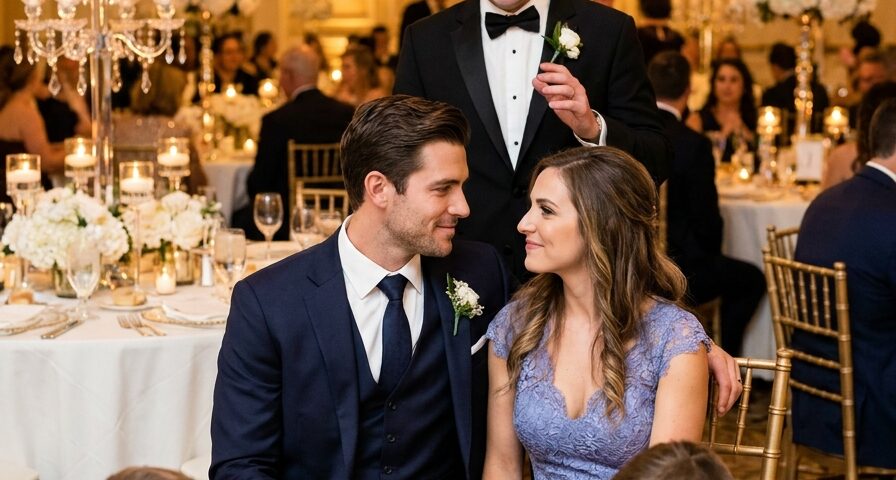
PART 2: My Brother Hid Me at the Children’s Table—Then the CEO He Wanted to Impress Sat Beside Me
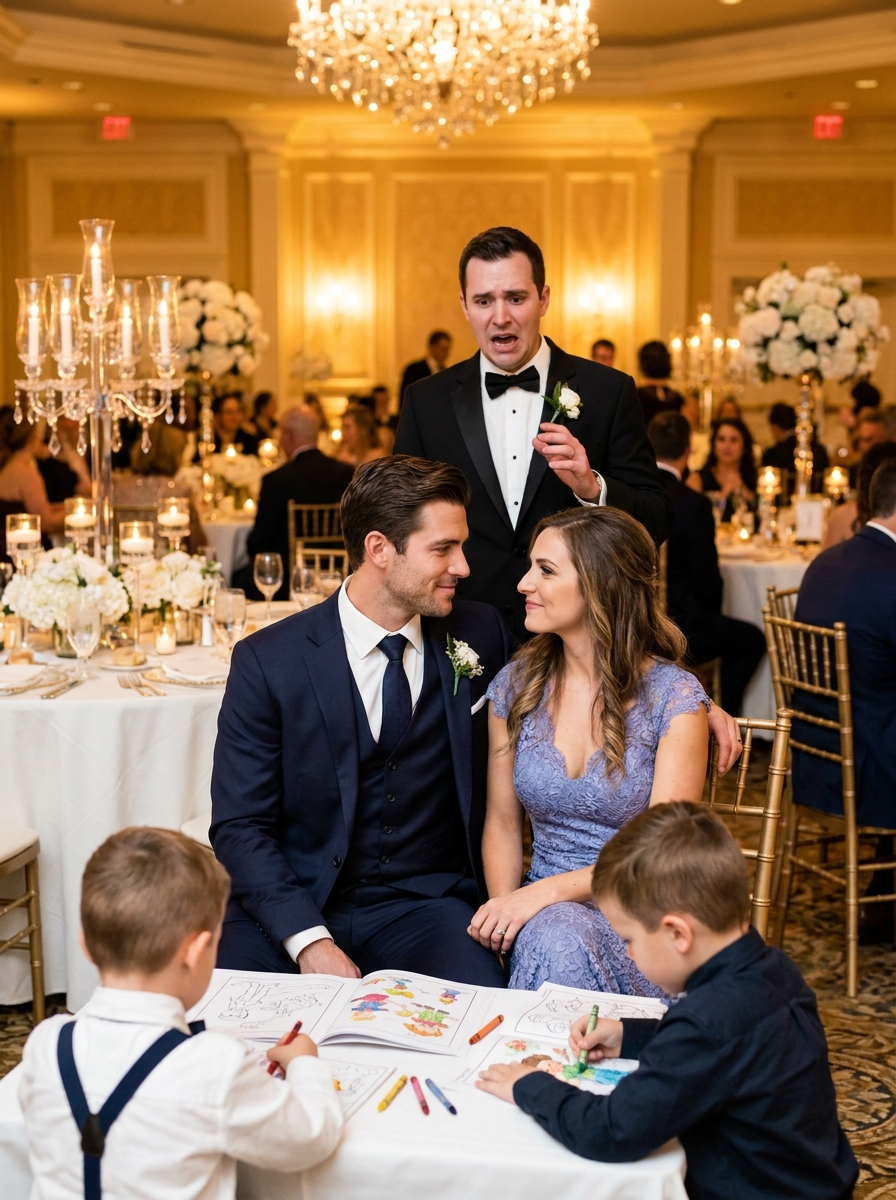
Then he turned to me and said, with the same calm warmth I had heard on dozens of late-night calls, “Jenna, I was hoping I’d find you before dinner. I wanted to thank you in person.”
The ballroom went so quiet I could hear a fork slip from someone’s plate.
Across the room, my brother Nicholas stood frozen beside the champagne tower, one hand still half-raised in greeting. His new bride, Allison, looked between him and me with confused curiosity. My mother, who had been busy introducing herself to the wealthier relatives on Allison’s side, turned around so fast her pearl earrings swung against her neck.
I felt every stare.
Every question.
Every silent calculation.
For one awful second, I was that little girl again, standing in the school hallway while Nicholas explained to his friends that I was “weird, but mostly harmless.” I was sixteen again, showing my parents the story I had won a regional prize for, only for Nicholas to walk in with a second-place debate trophy and become the evening’s celebration.
But then Milo pushed a purple crayon toward Emmett.
“You need wings,” he said. “Dragons always need wings.”
Emmett accepted the crayon. “Then wings it is.”
Something in me loosened.
I looked at Nicholas and saw panic rising behind his eyes. He mouthed my name, as if I had done something wrong by being found. I could almost hear his voice: Don’t make this awkward. Don’t embarrass me. Don’t say too much.
For once, I looked away first.
“Thank you for coming over,” I said to Emmett.
“I meant what I said.” He began sketching a lopsided dragon wing on the paper tablecloth. “That Pittsburgh keynote has already opened three conversations we’ve been trying to start for months.”
I smiled faintly. “I’m glad it landed well.”
“It did more than land.” His voice softened. “You found the emotional center. I’ve given hundreds of speeches. That was the first one where I felt like the room understood why the work mattered.”
A little girl across the table, Ella, looked up from her chicken nuggets.
“Are you famous?”
Emmett considered that. “Only in very boring rooms.”
She nodded, satisfied, and returned to dipping nuggets into ketchup.
A few people nearby laughed politely, but no one fully relaxed. They were still watching us, waiting for the explanation that would make the scene make sense.
Nicholas finally started toward us.
I knew that walk. He had used it when we were children and I accidentally said something too honest in front of company. He had used it in college when I told his girlfriend he had borrowed money from me and never paid it back. It was the walk of a man preparing to reframe reality before anyone else could understand it.
“Mr. Stewart,” he said brightly when he reached the table. “I’m so glad you made it. We were just about to seat you at Table One.”
Emmett looked up from his dragon.
“That’s kind, Nicholas, but I’m comfortable here.”
Nicholas laughed, too quickly. “Of course. Of course. Jenna can be very entertaining.”
The words were smooth. Light. Almost affectionate.
Almost.
Emmett’s hand paused over the crayon.
“She’s more than entertaining,” he said.
Nicholas’s smile stiffened. “Naturally. I just mean—”
“She’s the reason my company found its voice this year.”
The sentence settled over the table like a bell.
My mother’s hand flew to her necklace.
Nicholas blinked. “I’m sorry?”
Emmett set the crayon down and turned fully toward him. “Jenna has been consulting with Stewart Dynamics for three years. Quietly. Professionally. Brilliantly.”
Every word was measured, not cruel, not loud. That somehow made it more powerful.
I felt heat climb my neck.
“Emmett,” I said gently, “you don’t have to—”
“I know,” he replied. “But I want to.”
Nicholas looked at me, really looked at me, perhaps for the first time all day.
“You work with him?”
The question came out smaller than he intended.
“I do,” I said.
“As a writer,” Emmett added. “And as a strategic communications consultant.”
Nicholas swallowed. “But you said your blog—”
“You assumed my blog was all I did,” I said quietly.
That was the first time I saw Allison move. She came to Nicholas’s side, her ivory gown whispering softly against the floor.
“Nicholas,” she said, her voice low enough that only those near the table could hear, “you told me Jenna was between jobs.”
He opened his mouth, then closed it.
My stomach tightened, not from fear, but from something almost like sadness. This was supposed to be his wedding day. I had not come to expose him. I had come because, despite everything, he was still my brother.
“I didn’t want to make today about this,” I said.
Allison looked at me with a tenderness that caught me off guard.
“About what?”
Before I could answer, the bandleader announced that dinner service would begin shortly. The pause gave Nicholas the escape he needed.
“We’ll talk later,” he said quickly, smoothing his jacket. “Mr. Stewart, please, whenever you’re ready, I’d love to introduce you to my partners.”
Emmett smiled politely. “After dinner.”
Nicholas’s eyes flickered toward me.
Then he nodded and walked away.
For a few minutes, nothing happened except the gentle return of noise. Plates arrived. Children complained about vegetables. Great-Aunt Beatrice woke up, asked whether the ceremony had started, and then fell asleep again halfway through her salad.
Emmett ate his dinner at Table Nineteen without a trace of discomfort.
The children adored him.
Milo judged his dragon “pretty good for a grown-up.” Ella asked whether CEOs had bedtime. A little boy named Henry wanted to know if Emmett owned a rocket ship.
“Not yet,” Emmett said.
Henry frowned. “Then what’s the point?”
I laughed before I could stop myself.
It was the first real laugh I had given all day.
Emmett looked at me then, and there was something in his expression I didn’t know how to name. Not pity. Not surprise. Recognition, maybe.
“You know,” he said, lowering his voice, “I’ve sat beside prime ministers who were less direct than this table.”
“That’s because nobody here wants anything from you except crayons.”
“And possibly a rocket ship.”
“That too.”
His smile faded slightly. “Are you all right?”
The question was simple. That made it difficult.
I glanced toward the head table, where Nicholas leaned close to Allison, explaining something with both hands. My mother had turned her chair away from me, pretending not to watch. My father sat silent beside her, his expression unreadable.
“I’m fine,” I said.
Emmett gave me a look.
“All right,” I admitted. “I’m not fine. But I’m steady.”
“That’s different.”
“Sometimes it’s better.”
He nodded as if he understood that more than most people would.
Dinner passed slowly after that. Every so often, someone from the front of the ballroom looked back. A few guests came over with excuses: to compliment the children, to ask Emmett a harmless question, to say hello as if they had intended to speak with me all along.
I answered politely. I did not perform. I did not explain myself to people who had ignored me an hour earlier.
When the speeches began, the room softened into candlelight and expectation.
Allison’s father spoke first. He was warm, slightly nervous, and funny in the gentle way of men who love their daughters openly. He told a story about Allison at age eight trying to organize a neighborhood talent show and charging everyone one dollar to attend.
“She has always believed life should be both beautiful and efficient,” he said, raising his glass.
The guests laughed.
Then Nicholas’s best man gave a speech full of business-school jokes, golf trips, and polished anecdotes. Nicholas laughed loudly at all the right moments. He looked comfortable again. Restored.
Then my mother stood.
I hadn’t known she planned to speak.
She held a champagne flute in one hand and a small card in the other. Her smile was perfect from a distance, but I could see the strain at the corners of her mouth.
“Nicholas has always been ambitious,” she began. “Even as a boy, he knew exactly where he wanted to go.”
That was true.
“He pushed himself. He surrounded himself with excellence. And now, seeing him marry Allison, a woman of such grace and accomplishment, I know he has found a partner worthy of the future he has built.”
Applause rippled.
Then her gaze shifted, only briefly, toward me.
“In every family, children take different paths,” she continued. “Some shine early. Some find quieter ways to contribute.”
My fingers tightened around my napkin.
There it was.
The old comparison, polished for company.
Emmett noticed. He did not move, but I felt his attention sharpen beside me.
My mother lifted her glass higher.
“To Nicholas and Allison. May your life together be as bright and impressive as this beautiful evening.”
Everyone toasted.
I raised my glass too.
Not because the speech didn’t hurt.
Because I refused to let hurt make me small.
Then Allison stood.
A hush spread, softer than before. She did not hold notes. She simply touched Nicholas’s shoulder and smiled at the guests.
“Thank you all for being here,” she said. “I know weddings are supposed to be about two people, but tonight I’m struck by how much they reveal about families. About the stories people tell, and the stories they leave out.”
Nicholas glanced at her, uncertain.
Allison continued. “When I met Nicholas, I admired his confidence. He seemed so sure of himself, so certain of where he was going. I still admire his drive. But marriage is not only about ambition. It is also about truth.”
The ballroom became very still.
“I realized tonight that there are parts of his family I don’t know as well as I thought I did.” Her eyes found mine. “Jenna, I’m sorry we haven’t had the chance to talk more. I hope that changes.”
My throat tightened.
Nicholas leaned closer, whispering something. Allison listened, then gently moved the microphone away from him.
“I mean that,” she said.
It wasn’t dramatic. It wasn’t an accusation. It was simply honest.
And perhaps because honesty had been so rare in my family, it felt enormous.
After the speeches, the band began again. Guests moved toward the dance floor. The children at Table Nineteen became restless, sticky-fingered, and loud in the way only happy children can be. I helped Ella find her missing shoe under the table. Emmett rescued his jacket sleeve from a dab of frosting. Great-Aunt Beatrice woke and declared the salmon “too modern.”
For a brief stretch, I almost forgot the ache in my chest.
Then my father appeared beside me.
“Jenna,” he said.
I looked up.
He had aged more than I liked to admit. His hair, once dark and thick, had thinned at the temples. His suit was slightly too tight around the middle. He had spent most of my life avoiding emotional conversations by turning on the television or asking whether the car needed gas.
Tonight, he looked like a man who had run out of exits.
“Can we talk?”
I glanced at Emmett.
He stood immediately. “I should check in with a colleague.”
“You don’t have to leave,” I said.
“I know.” His smile was gentle. “But I think I should.”
He walked away toward the terrace doors, giving my father and me the kind of privacy that still allowed the room to see we were speaking.
My father sat carefully in the chair Emmett had vacated.
For a moment, neither of us said anything.
Milo offered him a crayon.
My father blinked. “Thank you.”
“It’s green,” Milo said.
“So it is.”
I waited.
Finally, my father placed the crayon beside his plate and looked at me.
“I didn’t know,” he said.
I almost laughed, but there was no humor in me.
“You didn’t ask.”
He winced. “That’s fair.”
A string of fairy lights glimmered along the far windows, reflecting against the dark Vermont countryside outside.
“I suppose we let Nicholas take up a lot of space,” he said.
“You suppose?”
He looked down. “Your mother and I thought he needed more pushing. More attention. You always seemed self-sufficient.”
“That’s what children become when no one comes to check.”
The sentence left me before I could soften it.
My father closed his eyes briefly.
“I’m sorry,” he said.
It was not a grand apology. It did not fix years of being overlooked. But it was the first time he had said those words to me without adding an explanation immediately afterward.
So I let myself hear them.
“Thank you,” I said.
He nodded, his eyes damp but steady. “When did you start working with Stewart?”
“Three years ago.”
“And you didn’t tell us?”
“I tried to tell Mom once that my writing was becoming more serious. She asked if it came with health insurance, then changed the subject to Nicholas’s promotion.”
He rubbed his forehead.
“That sounds like her.”
“It sounds like all of us.”
That hurt him. I could see it. But he did not argue.
From the dance floor, Nicholas watched us. His expression was impossible to read.
My father followed my gaze.
“He shouldn’t have seated you back here.”
“No.”
“He shouldn’t have spoken to you that way.”
“No.”
A long silence passed.
Then he said, “He’s scared.”
I turned to him. “Of what?”
“Being ordinary.”
The answer surprised me.
My father looked toward Nicholas, not with pride now, but with a weary sadness.
“When he was young, your mother praised him for every performance. Every trophy. Every room he impressed. Somewhere along the way, I think he decided love had to be earned that way.”
I swallowed.
“And me?”
“You earned it quietly,” he said. “So quietly we forgot earning was never supposed to be required.”
That sentence almost undid me.
I looked down at my hands until my vision steadied.
“I don’t hate him,” I said.
“I know.”
“But I’m tired of shrinking so he can feel tall.”
My father nodded.
“You shouldn’t have to.”
It was the most honest conversation we had ever had.
It ended not with a hug, but with something smaller and perhaps more believable: my father reaching across the table and squeezing my hand once.
Then Allison approached.
“Jenna,” she said softly, “could I borrow you for a minute?”
I stood.
She led me toward a quiet hallway outside the ballroom, away from the music and the curious guests. The air smelled faintly of lilies and rain. Through the windows, I could see the estate gardens glowing under lanterns.
Allison stopped near a small table holding framed family photos.
“I owe you an apology,” she said.
“You don’t.”
“I do.” She folded her hands in front of her gown. “When Nicholas described you, I believed him. Not because he said anything cruel exactly, but because he made you sound… unserious. Drifting. A little dependent.”
I looked away.
“That sounds familiar.”
“I should have questioned it.”
“You were planning a wedding. People believe what makes life easier.”
She gave a sad smile. “You’re generous.”
“I’m tired.”
“That too.”
For the first time that night, I really looked at her. Allison was beautiful in a composed way, but up close I could see the tension beneath it. The careful breathing. The way her fingers kept worrying the edge of her wedding band.
“Are you happy?” I asked.
The question startled us both.
She looked toward the ballroom, where Nicholas was laughing a little too loudly with two investors.
“I think I wanted to be,” she said.
That answer settled between us.
“I don’t mean I don’t love him,” she added quickly. “I do. Or I love parts of him. The charming parts. The determined parts. The part that can make you feel like the whole world is about to open.”
“I know that part,” I said.
Her eyes returned to mine. “But tonight I saw another part. And I realized I’ve seen it before. With waiters. With assistants. With people he thinks don’t matter.”
I said nothing.
“He told me you asked to sit at the children’s table because you didn’t know anyone.”
I let out a quiet breath.
“No. He put me there.”
Allison’s face tightened.
“I thought so.”
From inside the ballroom came applause as someone requested a dance. The sound felt far away.
“I’m not telling you this to hurt your wedding day,” I said.
“I know.”
“And I don’t want to stand here acting like Nicholas is only one thing. He’s my brother. He can be funny. He can be generous when he forgets to be impressive. When we were little, he once stayed up all night helping me build a cardboard castle for school because mine collapsed.”
Allison smiled faintly.
“That sounds like him too.”
“It is him. But so is the man who told me not to ruin the image.”
Her eyes glistened.
“I need to know both.”
“Yes,” I said. “You do.”
She reached for my hand.
“Will you have coffee with me after the honeymoon? Just us?”
The offer moved me more than I expected.
“I’d like that.”
We returned to the ballroom together, and for the first time all night, Allison walked beside me not as my brother’s bride, but as someone who had chosen to see me clearly.
Near the terrace doors, Emmett stood in conversation with a woman I recognized from a financial magazine. When he saw me, he excused himself and came over.
“Everything all right?”
“Strangely,” I said, “maybe.”
His eyes softened. “That’s promising.”
Before I could answer, Nicholas appeared.
He looked different now. Less polished. His bow tie sat slightly crooked, and a faint flush had risen along his neck.
“Jenna,” he said. “Can I speak with you?”
Allison touched his arm. “Nicholas.”
“I know,” he said quietly. “I just need five minutes.”
I studied him.
The old instinct was to protect him from discomfort, to make the conversation easier before it began. I had spent years doing that. Laughing off remarks. Explaining away dismissals. Pretending indifference so he never had to confront the damage.
Not tonight.
“Here is fine,” I said.
He glanced around.
People were pretending not to watch.
“Nicholas,” I added, “you chose a public room when you humiliated me. We can have a respectful conversation in one.”
His mouth tightened, then he nodded.
“I didn’t know about your work with Mr. Stewart.”
“That’s becoming a popular sentence tonight.”
He exhaled.
“I was wrong.”
The words sounded unfamiliar coming from him.
I waited.
He looked at Emmett, then back at me. “I made assumptions. About your career. About your life.”
“And about my worth.”
His face changed at that.
“Yes,” he said after a moment. “That too.”
A part of me had wanted him to deny it, because anger is easier when the other person refuses to understand. But he didn’t deny it. That made the moment more complicated.
“I need to apologize,” he said.
“You need to understand before you apologize.”
He swallowed. “Then tell me.”
So I did.
Not loudly. Not cruelly.
I told him what it felt like to be introduced as “my sister, she writes online” while he was introduced by title and salary. I told him what it felt like to save for two months for a wedding gift, only to be seated beside toddlers because I didn’t fit his image. I told him that his embarrassment of me had become so routine that I had started arriving at family gatherings already braced for the next small cut.
Nicholas listened.
At first, he looked defensive. Then uncomfortable. Then, finally, ashamed.
“I thought…” He stopped. “I thought you didn’t care what people thought.”
“I learned not to show it.”
His eyes flickered.
“I was jealous of you,” he said.
That was the last thing I expected.
“Jealous?”
“You never seemed to need their approval.” He looked toward our parents. “I needed it constantly. Every grade, every job, every promotion. I didn’t know who I was without someone being impressed.”
“That doesn’t excuse what you did.”
“No,” he said. “It doesn’t.”
The band shifted into a slower song. Couples moved together under the chandeliers.
Nicholas took a shaky breath.
“I’m sorry, Jenna. Not because Mr. Stewart knows you. Not because it made me look bad. I’m sorry because I treated you like a problem to hide when you came here to celebrate me.”
The apology was imperfect. It did not erase the day.
But it was real enough to hurt.
“I accept that you’re sorry,” I said carefully. “I don’t know yet what that changes.”
He nodded, and to his credit, he did not ask for more.
Then Emmett, who had remained quietly beside me, spoke.
“Nicholas, since we’re all being honest, I should tell you something. I was never attending tonight to discuss an investment in your firm.”
Nicholas looked startled. “You weren’t?”
“No. I came because Jenna mentioned months ago that her brother was getting married in Vermont. She didn’t ask me to come. In fact, she never would have. But I had business in Boston and accepted the invitation when your planner sent it.”
My brow furrowed. “Your office told me you were in meetings all weekend.”
“I was,” Emmett said. “Mostly.”
Nicholas looked between us. “Then why would my planner invite you?”
The question produced an odd silence.
Allison stepped closer. “Nicholas, I didn’t add Mr. Stewart to the guest list.”
“I didn’t either,” Nicholas said.
Emmett’s expression changed slightly.
“Your planner said the invitation came from the family office.”
“My family doesn’t have a family office,” Nicholas replied.
I felt a small prickle of unease.
Then my phone vibrated.
I looked down.
An email notification had appeared from an address I hadn’t seen in nearly nine years.
My former mentor.
Lydia Crane.
The subject line read:
You may want to step outside before midnight.
My hands went cold.
Lydia had been the first person to tell me my writing mattered. She had run the small literary fellowship I attended after college, the one Nicholas called “summer camp for adults.” Then, without warning, she disappeared from the publishing world. No explanation. No goodbye. Only a rumor that she had taken a private position with a powerful family.
I opened the email.
There was no greeting.
Only three lines.
Jenna,
Emmett Stewart is not the only person in that ballroom because of your work.
Your brother’s wedding was never the real reason I arranged the invitation.
I read the words twice.
The room blurred around me.
Attached to the email was a document titled:
THE MERCER LETTERS – AUTHORSHIP REVIEW.
Mercer.
That name meant nothing to me at first.
Then I heard Emmett inhale softly beside me.
I turned to him.
His face had gone still.
“You know what this is,” I said.
He looked at me, and for the first time since I had known him, he seemed unsure of what he was allowed to say.
Before he could answer, the ballroom lights dimmed for the cake cutting.
Allison turned toward the head table.
Nicholas said something, but I couldn’t hear him over the sudden rush of blood in my ears.
My phone vibrated again.
Another message from Lydia appeared.
This one was shorter.
Ask your mother why she kept your first manuscript.
I looked across the ballroom.
My mother was already staring at me.
And in her expression, beneath the practiced smile and carefully arranged pearls, I saw something I had never seen before.
Fear.