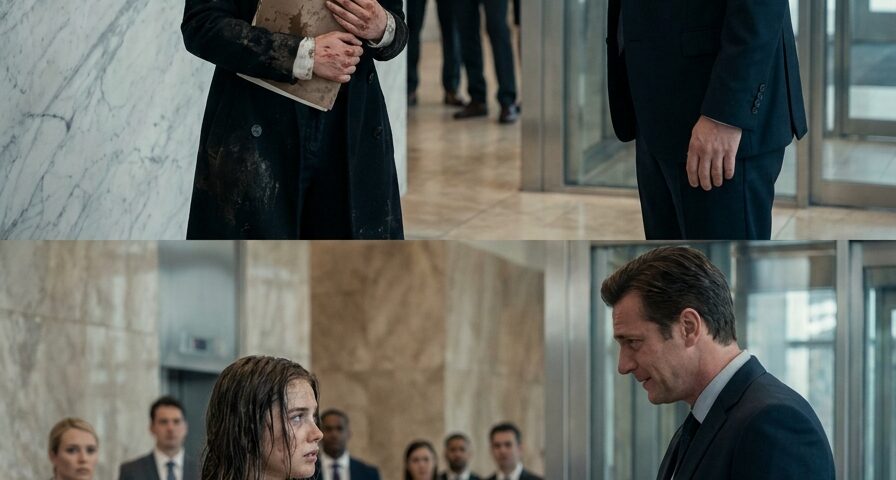
PART 2: I ARRIVED LATE, MUDDY, AND MOCKED FOR MY DREAM JOB—THEN THE CEO SAW WHAT I WAS CARRYING
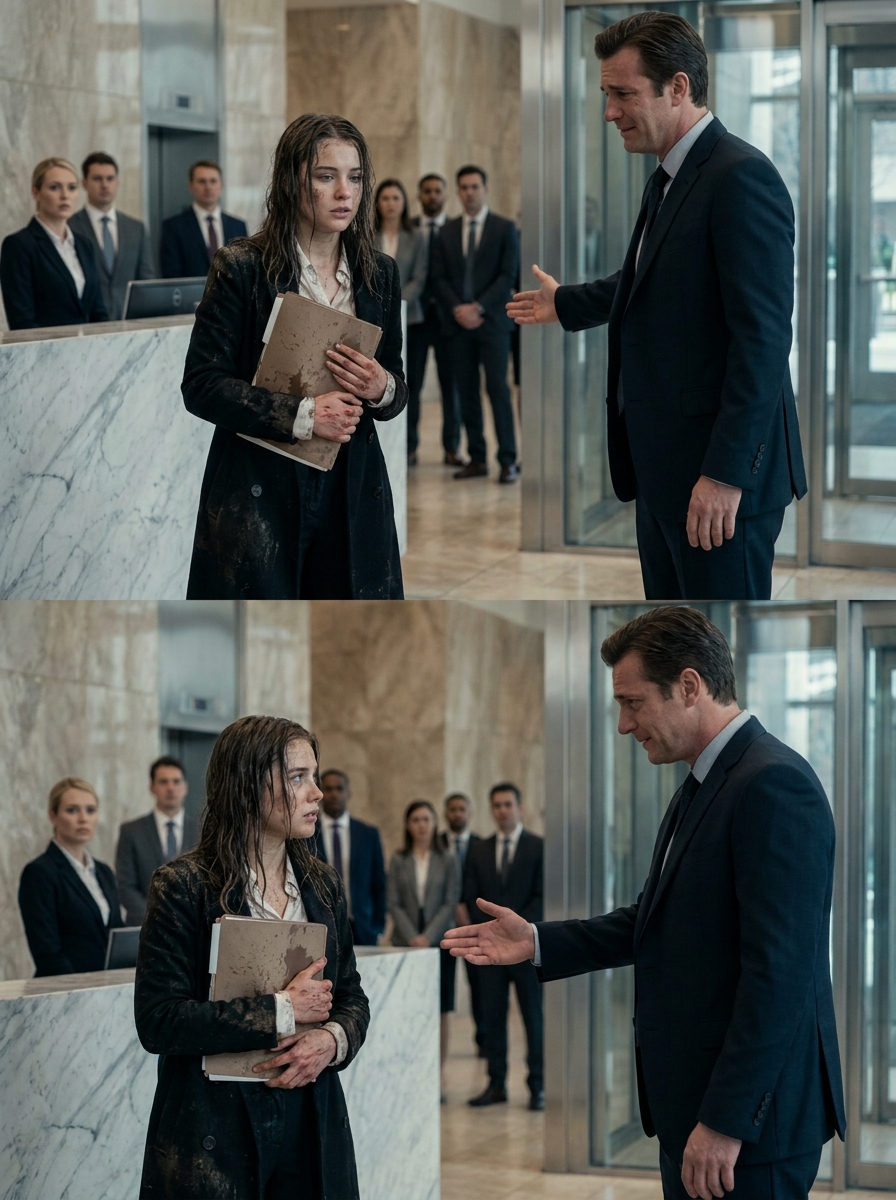
Grayson Pierce noticed.
Of course he did.
He pressed a button near the panel. “We’ll stop at the executive floor first. You need towels, dry clothes, and someone to look at your hands.”
“I’m fine,” I said automatically.
His eyes moved to the blood drying across my knuckles.
“No, you’re not.”
It wasn’t harsh. That was what undid me.
I had expected suspicion. Condescension. Maybe a polished thank-you before being quietly escorted out. What I didn’t expect was simple concern, delivered without performance.
I looked down at the folder pressed against my chest. Water had soaked through the cheap blue cover. The edges of my documents curled outward, ink bleeding in places where I had held it too tightly in the rain.
“My proposal,” I murmured.
“We can print another copy.”
“Not all of it.”
Grayson’s gaze sharpened slightly.
I regretted speaking at once.
The elevator slowed. When the doors opened, we stepped into a quiet hallway lined with glass offices and soft gray carpeting. A woman in her fifties looked up from a desk outside a corner suite. She had silver-streaked hair, intelligent eyes, and the composed expression of someone who had seen enough corporate emergencies to rank them by smell.
“Mr. Pierce,” she said, rising. “Your nine-thirty with Legal—”
“Move it ten minutes. And ask Facilities for a first-aid kit. Also, find something dry for Ms. Bellamy. Sweater, blazer, anything.”
The woman looked at me properly then. Not the way the lobby had looked at me. Not with contempt, but assessment.
“Of course.” She turned toward me. “I’m Elise Hart, Mr. Pierce’s executive assistant.”
“Nora Bellamy,” I said, and immediately felt ridiculous. He had already said my name downstairs.
Elise’s expression softened. “Come with me.”
Grayson did not leave. He walked beside us into a spacious conference room where the city stretched beyond floor-to-ceiling windows, all steel towers and gray morning light. Elise returned quickly with towels, bottled water, and a small medical kit. A few minutes later, she handed me a folded navy cardigan and a pair of soft black flats that looked new.
“Emergency wardrobe,” she said. “You’d be surprised how often coffee, rain, and panic collide in this building.”
Despite everything, I nearly smiled.
In the restroom adjoining the conference room, I cleaned mud from my face and arms as best I could. My blouse was beyond saving, but the cardigan hid the worst of it. The flats were half a size too large, but after walking in a broken heel, they felt merciful.
When I returned, Grayson was standing near the window, speaking quietly into his phone.
“No,” he said. “I said I want the raw lobby footage preserved. From eight-thirty onward. No edits, no internal review before it reaches my office.”
He paused.
“I’m aware of who oversees lobby protocol.”
Another pause.
“Then let Ms. Crane know I asked personally.”
He ended the call and turned back to me.
Something about his expression told me that what had happened downstairs was not merely embarrassing. It had confirmed something he had already suspected.
Elise gently cleaned the scrapes on my palms while I tried not to wince.
“Did the child have family nearby?” she asked.
“His older sister,” I said. “Maybe twelve. She was trying to get help, but the rain was so loud and traffic kept passing. Nobody stopped.”
Grayson’s face tightened, though he said nothing.
“They took him to St. Mary’s,” I continued. “The paramedic said he was breathing. He was scared, but awake.”
“Do you know his name?”
“Leo.” My throat warmed around it. “He kept apologizing for getting my folder wet.”
Elise made a soft sound. “Poor baby.”
I looked at the table, suddenly afraid emotion would catch up with me if I let it.
Grayson pulled out a chair across from me. “Ms. Bellamy, before we discuss the job, I need to ask something.”
I nodded.
“Why didn’t you lead with that downstairs?”
I blinked.
“The child,” he clarified. “You could have told them immediately.”
I thought of the lobby. Of all those polished shoes and amused eyes. Of the receptionist’s careful disgust.
“I didn’t think they would believe me.”
He said nothing.
“And,” I added after a moment, “I didn’t save him so people would clap for me.”
Something in his face changed.
Not dramatically. Just a slight stillness, as if an answer had settled exactly where he expected it.
Elise finished wrapping a bandage around my palm. “There. Not perfect, but better.”
“Thank you,” I said.
She gathered the used wipes and stood. “I’ll be just outside.”
The door closed behind her.
Grayson leaned back, but not casually. There was too much attention in him for casualness.
“Now,” he said. “Tell me why Cassandra Crane flagged you as a cultural risk before you even walked into this building.”
I almost laughed.
It would have been easier to begin with my résumé. I knew how to talk about process audits, compliance reviews, vendor systems, and operational risk. Those were safe words. Clean words. Words that made people believe difficult truths could fit inside spreadsheets.
But Grayson had not asked about my qualifications.
He had asked the dangerous question.
I drew a slow breath. “Because three weeks ago, I sent Human Resources an anonymous complaint.”
“About what?”
“Hiring irregularities. Vendor favoritism. Internal retaliation.”
His eyes did not leave mine. “At Pierce Meridian?”
“Yes.”
“Why anonymous?”
“Because the last person who put his name on a complaint disappeared from the company records.”
For the first time, Grayson looked visibly unsettled.
“What person?”
I reached for the soaked folder, then hesitated. Some of the pages stuck together at the corners.
“His name was Aaron Bellamy.”
Grayson went very still.
“My father,” I said quietly.
Outside the glass wall, Elise moved past with a phone against her ear. In the distance, office life continued: muted footsteps, ringing phones, printers humming, people hurrying toward meetings that assumed the world was stable.
Inside the room, it no longer was.
Grayson’s voice lowered. “Your father worked here?”
“For nine years. Facilities procurement. He handled maintenance contracts for regional offices before Pierce Meridian became what it is now.”
“I know the name,” he said slowly. “Bellamy. I was overseas during part of that period, but I remember a procurement review. There was a resignation.”
I gave a small nod. “That’s what the record says.”
“What do you say?”
I opened the folder carefully and pulled out the driest page: a copy of my father’s resignation letter.
“This isn’t his signature.”
Grayson took the page, eyes scanning quickly.
“My father had early arthritis in his right hand,” I said. “After forty, his signature changed. The B leaned forward. Always. This one doesn’t.”
“That alone wouldn’t prove—”
“I know.” I pulled out another sheet. “So I found payroll records. His final check was deposited into an account that wasn’t his. Two weeks later, our landlord received a letter stating my family had relocated out of state.”
“Had you?”
“No.” My voice tightened. “We were still living in Queens. My father had already been dead for five days.”
Grayson’s face lost color.
I had never said it like that before. Not to someone who might be able to change anything. For years, my father’s death had been a closed room in my life. I could stand outside it, touch the door, even speak around it. But opening it always released the same cold air.
“He died of a heart attack,” I said. “That’s what the hospital record says. He was fifty-one.”
“I’m sorry.”
The words were simple. I did not know what to do with them, so I looked down at my hands.
“Before he died, he left my mother a flash drive taped behind the water heater in our apartment. She found it six months later, after the eviction notice came.”
Grayson’s jaw tightened. “Eviction?”
“The company said his resignation voided a relocation benefit he was owed. We couldn’t fight it. My mother was working nights at a pharmacy and days at a bakery. I was sixteen.”
He looked at the folder. “What was on the drive?”
“Vendor contracts. Internal emails. Payment approvals. Notes about a company called Northstar Civic Solutions.”
Recognition flickered in his face.
“You know it,” I said.
“I know the name. Northstar handled early municipal expansion work. Permits, local site coordination, compliance liaison services. They were used before my tenure as CEO.”
“They were also paid for work they never performed.”
He looked down at the documents again.
“And your father knew.”
“Yes.”
My father had been a quiet man. Patient. Meticulous. The sort of person who fixed cabinet hinges before they broke and saved receipts in envelopes labeled by month. He believed in rules not because he was naive, but because he thought rules were the only shield ordinary people had against powerful ones.
The night before he died, I found him at our kitchen table surrounded by papers.
“Nora,” he had said, too quickly folding them away, “never sign something you haven’t read.”
I was sixteen and annoyed because the kettle had whistled for too long.
“I know, Dad.”
He smiled sadly.
“No,” he said. “One day, you’ll know.”
I had spent seven years learning.
Grayson rose and walked to the conference room door. “Elise.”
She appeared almost immediately.
“Cancel the Legal meeting. Bring in Priya Desai from Internal Audit. Quietly. And no one from HR.”
Elise’s eyes moved from him to me, then to the damp folder.
“Understood.”
When the door closed again, I said, “If this is too much, I can leave copies and—”
“No.” Grayson turned back. “You’re not leaving.”
The firmness in his voice should have comforted me. Instead, it frightened me.
People with power often sounded certain right before they decided how much truth they could afford.
He seemed to read the doubt in my face.
“I don’t mean that as an order,” he said. “I mean you came here with something important, and I’m going to hear it.”
I nodded, because words felt too difficult for a moment.
Priya Desai arrived seven minutes later, carrying a tablet and wearing a charcoal suit with no jewelry except a thin gold bracelet. She had sharp eyes, but not unkind ones. Grayson introduced us briefly and told her only enough to make her sit down immediately.
“Nora,” Priya said, “I’m going to ask precise questions. Not because I doubt you, but because precision protects everyone.”
I liked her instantly.
For the next hour, the interview I had prepared for became something else entirely.
I talked through my experience first, because Priya insisted on structure. My degree in accounting. My two years at a nonprofit compliance office. The fellowship I had lost after reporting grant irregularities. The temporary contracts I stitched together afterward while caring for my mother through kidney disease. The reason I wanted a role in Human Resources analytics, despite my audit background.
“Because HR data shows the earliest signs of rot,” I said.
Priya looked up. “Rot?”
I glanced at Grayson. “Retaliation hides in reassignment patterns. Discrimination hides in promotion delays. Fraud hides in consulting approvals and referral networks. People call HR soft because they don’t understand how much power is buried there.”
Grayson’s expression was unreadable.
Priya’s was not. She looked impressed despite herself.
Then we moved to the folder.
Northstar Civic Solutions had been dissolved four years earlier. Before that, it had received over twelve million dollars in payments from Pierce Meridian and related entities. On paper, the contracts looked routine. In practice, many were vague, duplicative, or approved in strange clusters at quarter-end.
The signatures were worse.
“My father flagged the first irregularity after noticing the same invoice format used by three separate vendors,” I explained. “Different names. Same template. Same billing language. Same mistake in the footer.”
Priya leaned closer. “What mistake?”
“Pierce was spelled ‘Peirce.’”
For the first time that morning, Grayson gave a short, humorless exhale. “That’s what exposed it?”
“My father used to say fraud is arrogant, but paperwork is lazy.”
Priya almost smiled.
I showed them copies of emails from my father’s old flash drive. Most were technical, dry, easily dismissed by someone not looking closely. But one thread stood out. My father had asked why Northstar’s invoices were being routed through an HR discretionary fund tied to executive recruitment. A senior manager had replied that Facilities had no authority to question leadership allocations.
Three days later, my father’s system access was revoked.
Five days later, the resignation appeared.
Nine days later, he died.
Grayson stared at the timeline.
Priya’s fingers moved across her tablet. “Who was the senior manager?”
I pulled another page free.
“Cassandra Crane.”
The name hit the table like a dropped glass.
Grayson closed his eyes briefly.
When he opened them, something had changed in him. Not anger exactly. Something older and more personal.
“You understand the seriousness of what you’re alleging,” he said.
“Yes.”
“Cassandra Crane is now Senior Vice President of People Operations. She oversees global hiring, employee relations, executive culture, and internal reporting.”
“I know.”
“She also sits on the Ethics Governance Committee.”
“I know that too.”
“And she flagged you as a cultural risk.”
I looked at the bandage around my hand. “That happened forty-six minutes after I submitted my anonymous complaint from a separate email address. I never used my name in the complaint. But the supporting file contained metadata from an old document my father created. I removed what I thought I needed to remove, but I must have missed something.”
Priya’s face tightened. “So Crane connected you to Aaron Bellamy.”
“Yes.”
Grayson walked to the window and looked out over the city.
I waited.
That had been the hardest part of the last seven years: waiting while powerful people decided whether the truth was inconvenient enough to ignore.
Finally he said, “Why apply for a job here?”
The question was quiet.
I had expected it.
Still, answering felt like stepping into deep water.
“Because sending documents from the outside didn’t work. Because every hotline led back to the same people. Because my father died with everyone thinking he quit under suspicion. Because my mother died last winter still believing someone would someday say his name without shame.”
My voice broke.
I hated that it did.
I pressed my lips together, but it was too late. The conference room blurred.
Grayson turned from the window.
I looked down quickly. “I didn’t come here for revenge.”
“No?”
“No.” I wiped my cheek with the heel of my palm. “I came because companies are made of people. If people like Cassandra Crane can destroy a man quietly, erase him neatly, and build careers on the silence afterward, then everyone below them learns the same lesson: keep your head down, or become disposable.”
Priya was silent for a long moment.
Then she said, “That was a better answer than most executives give in ethics training.”
A small, startled laugh escaped me.
Grayson returned to the table. “Do you still have the flash drive?”
“No.”
Both of them looked at me.
“It was stolen from my apartment four months ago.”
Priya straightened. “Stolen?”
“My place was broken into. Nothing valuable taken. Laptop left behind. Rent cash untouched. Only the lockbox from my closet was missing.”
“Police report?” Grayson asked.
“Yes.”
“Did you have backups?”
“Yes.”
His shoulders eased slightly.
“Not all in one place,” I added. “Some with my landlord. Some in cloud storage. Some with a journalist who stopped answering my emails last month.”
“A journalist?” Priya repeated.
“Marisol Keene. Business accountability reporter. She was interested until she wasn’t.”
Grayson and Priya exchanged a look.
“What?” I asked.
Grayson reached for the conference room phone. “Elise, find out where Marisol Keene is currently employed and whether she’s contacted our communications team in the past ninety days.”
Priya turned back to me. “Nora, did Marisol say why she stopped responding?”
“No. We had a call scheduled. She missed it. Then her email bounced. Her social profiles disappeared a week later.”
“That’s unusual.”
“I thought so.”
I had thought many things. Most of them at three in the morning, lying awake in my apartment while the radiator knocked and rain scratched the window. I thought I was being paranoid. Then I thought I wasn’t paranoid enough. Then I thought perhaps truth was simply too heavy for one person to carry.
Now, seated across from the CEO of the company I had feared for years, I felt the burden shifting—but not disappearing.
Elise returned with printed pages.
“Marisol Keene left The Ledger six weeks ago,” she said. “No current employer listed. But Communications received two requests from her before she left. One regarding Northstar Civic Solutions. Another regarding the death of Aaron Bellamy.”
My breath caught.
Grayson took the pages.
Elise continued, “Both requests were routed to Legal. The internal response is marked confidential.”
“Who handled it?” he asked.
Elise hesitated.
That tiny pause told me before she did.
“Cassandra Crane was copied,” Elise said. “So was Martin Vale.”
Grayson’s face hardened.
Priya frowned. “Why would the Chief Financial Officer be involved in a press inquiry about a former Facilities employee?”
No one answered.
But the room understood.
My father’s story was not buried in HR alone.
It ran through money.
Grayson looked at Elise. “I want Vale in my office at noon. No agenda. No warning.”
“Understood.”
“And Cassandra Crane?”
Elise’s mouth tightened almost imperceptibly. “She’s asking why Ms. Bellamy is still in the building.”
“Tell her Ms. Bellamy is with me.”
“I did.”
“And?”
“She said this may create a reputational issue.”
Grayson’s smile was small and cold. “She’s right.”
After Elise left, silence returned.
I stared at the documents, at the fragile paper trail my father had left behind, and suddenly thought of Leo, the boy in the ditch. His backpack strap caught on rebar, water rising, his sister screaming while cars kept driving past.
Sometimes danger looked like rushing water.
Sometimes it wore a corporate badge and smiled through glass.
Grayson sat across from me again. “Nora, I want to offer you a formal consulting engagement effective today. Independent of HR. You’ll work with Priya and my office to review historical vendor and personnel records related to Northstar, your father’s departure, and any linked entities.”
I blinked. “I came for an interview.”
“You’re getting one.”
“This feels different.”
“It is.” He folded his hands. “You can say no.”
I looked at Priya.
She nodded. “You should have counsel review anything before signing.”
That made me trust her more.
“I can’t afford counsel,” I said.
Grayson answered immediately. “Then we’ll provide independent counsel paid by the company but selected by you from an approved outside list.”
“No,” I said before I could stop myself.
He waited.
I forced myself to explain. “My father trusted company-approved processes.”
Grayson accepted that without argument. “Fair. Then I’ll have Elise compile options, and you choose whether any work. Or you bring your own when you’re ready. Nothing signed today.”
The offer was reasonable.
That frightened me too.
Because reasonable things make hope possible.
And hope, in my experience, had sharp edges.
Before I could answer, the conference room phone rang.
Grayson pressed the speaker.
Elise’s voice came through, controlled but tense. “Mr. Pierce, Cassandra Crane is on the executive floor. She says she has an obligation to address an unauthorized candidate escalation.”
Priya muttered something under her breath.
Grayson stood. “Let her in.”
My stomach tightened. “Maybe I should—”
“No,” he said.
The door opened fifteen seconds later.
Cassandra Crane entered as if the room belonged to her.
She was elegant in a cream suit, with auburn hair cut neatly above her shoulders and a face arranged into warm concern. I recognized her from company videos: the executive who spoke about belonging, workplace empathy, and values-based leadership while standing before banners that said People First.
She looked at me, then at my bandaged hands and borrowed cardigan.
“Nora,” she said gently. “I’m glad you’re safe after whatever happened this morning.”
Whatever happened.
Already shrinking it. Softening it. Turning it vague.
“Thank you,” I said.
Her smile did not reach her eyes.
She turned to Grayson. “I’m concerned about process. This candidate was flagged after irregularities appeared in her application file.”
Priya lifted her brows. “What irregularities?”
Cassandra looked at her as though only just noticing she was there. “Priya. I wasn’t aware Audit was involved.”
“It became relevant.”
“I see.” Cassandra’s gaze sharpened almost invisibly. “The application contained inconsistencies around employment history, including short-term roles and unexplained gaps. Given the sensitivity of executive floor access, I advised against proceeding.”
I felt heat rise in my face.
Not shame.
Anger.
Those gaps had names: my mother’s dialysis, eviction court, night shifts, grief.
Grayson spoke before I could.
“Did you know Nora Bellamy was Aaron Bellamy’s daughter when you flagged her?”
Cassandra’s expression did not change.
That was how I knew she had expected the question.
“I became aware of a potential relation during preliminary screening.”
“A potential relation.”
“Yes.”
“Why didn’t you disclose that to me?”
“It wasn’t relevant to a standard HR interview.”
Priya leaned forward. “It became relevant when an anonymous complaint naming you was followed by adverse candidate treatment.”
Cassandra’s eyes moved to her. “That is a serious implication.”
“It is.”
Cassandra’s warmth cooled by a few degrees. “May I ask what Ms. Bellamy has alleged?”
“No,” Grayson said.
She blinked once.
It was tiny. But it was the first crack.
“This is my department,” she said.
“Not today.”
The room seemed to tighten around the words.
Cassandra looked at me again, and for the first time, I saw not the smiling executive from training videos, but the person my father might have faced across an email thread years earlier. Intelligent. Controlled. Experienced in making danger sound procedural.
“Nora,” she said, “I understand losing a parent can leave unanswered questions. But grief can create patterns where none exist.”
My hands clenched under the table.
Grayson’s voice became quiet. “Careful.”
Cassandra turned back to him. “I’m trying to protect the company.”
“So am I.”
“No,” she said softly. “You’re reacting emotionally to a compelling story.”
That struck him in a place I did not understand.
For half a second, something moved behind his face. Pain, perhaps. Or memory.
Then it vanished.
“Leave the room,” he said.
Cassandra stood motionless.
“Grayson—”
“Now.”
She collected herself quickly, but not completely. Her smile returned, thinner this time.
“Of course. I’ll prepare a memo documenting my concerns.”
“I’m sure you will.”
At the door, she paused.
Her eyes met mine.
“Nora, I hope you find the closure you’re looking for.”
The words sounded kind.
They felt like a warning.
When she left, my breath came out all at once.
Priya looked at Grayson. “She’s rattled.”
“She’s dangerous when rattled.”
“You knew already,” I said.
Both turned toward me.
“Not about my father maybe,” I said. “But something. You weren’t surprised enough.”
Grayson looked toward the closed door.
“No,” he admitted. “I wasn’t.”
He sat down slowly, and for the first time since he stepped out of the elevator, he looked tired.
“My father founded Pierce Meridian,” he said. “When I took over, everyone told me the company had outgrown its early chaos. That the old guard had stabilized things. Cassandra was part of that group. So was Martin Vale.”
“The CFO,” I said.
He nodded.
“Over the past year, I’ve noticed patterns. Employees leaving after complaints. Vendor reviews stalling. Good people getting labeled as poor culture fits after raising uncomfortable issues.” His jaw tightened. “Every time I got close, there was always a reasonable explanation.”
“Reasonable explanations are where secrets go to sleep,” I said.
He looked at me.
“My father used to say that,” I added.
Grayson’s expression softened slightly. “He sounds like a wise man.”
“He was.”
For a moment, the room held the shape of him: Aaron Bellamy with his worn work jacket, his careful envelopes, his steady voice telling me to read before signing. I wondered what he would think of me sitting here. Muddy. Late. Terrified. Still trying.
Elise knocked once, then entered without waiting.
“Mr. Pierce,” she said, “Security found something.”
Grayson stood. “What?”
“The lobby footage. At 8:42, before Ms. Bellamy arrived, Cassandra Crane spoke with reception and security. Audio is limited, but after that conversation, Ms. Bellamy’s visitor badge was canceled.”
I stared at her.
“She canceled my badge before I was late?”
Elise nodded. “Yes.”
My chest tightened.
I had run seven blocks in the rain. I had climbed into a drainage ditch. I had walked into that lobby apologizing for being late, believing time itself had betrayed me.
But even if I had arrived perfectly dressed and early, they had already decided I would not enter.
Priya’s face hardened. “Preserve the footage.”
“Already done,” Elise said.
Grayson looked at me. “Nora—”
His phone rang before he could finish.
He checked the screen and frowned.
“Unknown number.”
Something in me went cold.
“Answer it,” I said.
He did, placing it on speaker.
For three seconds, there was only static.
Then a woman’s voice spoke.
“Is Nora Bellamy with you?”
Grayson’s eyes met mine.
“Who is this?” he asked.
The woman exhaled shakily. “Marisol Keene.”
I gripped the edge of the table.
Priya leaned forward. “Ms. Keene, this is Priya Desai with Pierce Meridian Internal Audit. Where are you?”
“Somewhere safe for now. Listen carefully. I don’t have long.”
Grayson said, “Why are you calling me?”
“Because I sent Nora three messages this morning and they bounced. Then I saw a live social post about a muddy woman being mocked in your lobby, and I knew she had made it there.”
I closed my eyes briefly.
Of course someone had posted it.
The humiliation was already public.
Marisol continued, “Nora, your father wasn’t the only one.”
My breath stopped.
“What do you mean?”
“There were others. Not deaths, necessarily. Careers destroyed. Settlements buried. A woman named Diane Mercer in payroll. A compliance analyst named Joel Kim. A receptionist named Talia Rios who saw documents she shouldn’t have.”
Priya typed quickly.
Marisol’s voice lowered. “They were all connected to Northstar. But Northstar is just the surface.”
“What’s beneath it?” Grayson asked.
A pause.
“Meridian House.”
Grayson frowned. “That’s the old employee assistance foundation.”
“Not old,” Marisol said. “Active. Hidden under successor entities. Money moves through wellness grants, relocation funds, hardship payments, and executive recruitment budgets. It looks charitable from the outside. Inside, it’s a slush network.”
Priya whispered, “That explains the HR fund.”
Grayson’s face had gone very still.
Marisol continued, faster now. “I found evidence that Aaron Bellamy tried to alert someone above Crane before he died. He requested a meeting with the founder.”
“My father?” Grayson asked.
“Yes.”
“That meeting never happened.”
“It did.”
Grayson went pale.
I looked from him to the phone.
Marisol’s voice softened. “Grayson, your father met Aaron Bellamy the night before he died.”
The room fell utterly silent.
Grayson’s hand tightened around the phone.
“No,” he said quietly. “My father would have told me.”
“Maybe he planned to,” Marisol said. “But two days after Aaron died, your father signed emergency governance authority to Cassandra Crane and Martin Vale. Three months later, he had his stroke.”
Grayson stepped back as if struck.
I knew that look.
It was the expression of someone realizing a memory had been placed on a shelf years ago facing the wrong direction.
“Elise,” he said, barely above a whisper.
She had gone pale too.
“I remember,” she said. “Your father was agitated that week. He asked me to find an old procurement employee, but then Mr. Vale told me the matter was resolved.”
Marisol said, “It wasn’t resolved. It was contained.”
A low buzzing filled my ears.
My father had not died unheard.
He had reached the top.
And then he had disappeared anyway.
“Why are you telling us now?” Priya asked.
“Because they found out I copied the Meridian House ledger,” Marisol said. “And because there’s a name in it none of you are going to believe.”
“What name?” Grayson asked.
Before she could answer, a loud sound cracked through the line.
Not a gunshot. Not something dramatic.
A door slamming.
Marisol whispered, “I have to go.”
“Wait,” I said. “Please. Where are you?”
“I sent Nora a package. Physical mail. It should arrive today.”
“My apartment was broken into.”
“Not there,” Marisol said. “To the address Aaron Bellamy listed as his emergency contact.”
My heart lurched.
“My mother?”
“No. Someone named Ruth Bellamy.”
My grandmother.
She had died when I was twelve.
Her old house in Pennsylvania had been sold years ago.
“That address doesn’t exist anymore,” I said.
“It does in one place,” Marisol replied. “Pierce Meridian’s archived employee records.”
Then the line went dead.
For a long moment, no one moved.
The city beyond the windows looked unchanged. Morning had lifted into a dull silver afternoon. Somewhere below, the lobby still gleamed. People still arrived for meetings. Badges still scanned. Elevators still opened.
And yet something vast had shifted.
Grayson turned to Elise. “Find that emergency contact address.”
She was already moving.
Priya looked at me. “Do you know it?”
“Ruth Bellamy lived in Millbrook, Pennsylvania. But the house was demolished. There’s a pharmacy there now.”
Elise stopped typing. “Not according to the archived record.”
She turned her screen slightly.
There, beneath my father’s employee profile, was an emergency contact field.
Ruth Bellamy.
Address: 14 Wren Lane, Millbrook, PA.
But below it, in smaller text, was a secondary delivery instruction I had never seen before.
If undeliverable, forward to: E. Hart, personal archive.
Elise Hart went completely still.
Grayson turned toward her slowly.
“Elise,” he said.
Her face had drained of color.
“I don’t understand,” she whispered.
But she did.
Or some part of her did.
Because her hand had gone to the thin gold chain at her neck, where a small key rested beneath her blouse.
The same kind of key my father had taped inside the envelope hidden behind our water heater.
Priya noticed too.
“Elise,” she said gently, “what is E. Hart’s personal archive?”
Elise looked at me, then at Grayson.
“I thought it was just old correspondence,” she said. “Your father’s private files. After his stroke, he asked me to keep certain boxes away from Legal. He said if anyone ever came asking about Aaron Bellamy, I should give them Box Seven.”
My pulse thundered.
Grayson’s voice was almost unrecognizable. “You never told me.”
“I was told not to.” Tears filled Elise’s eyes, but she did not let them fall. “By your father.”
The room seemed to tilt.
My father had left a trail.
Grayson’s father had preserved it.
And Elise Hart had been guarding it for years without knowing what it meant.
“Where is Box Seven?” I asked.
Elise touched the key again.
“In the basement archive.”
Grayson reached for his jacket. “Then we go now.”
The basement archive of Pierce Meridian did not look like a secret vault.
It looked like an overorganized storage floor, all climate-controlled rooms, labeled shelves, and coded drawers. Elise led us past rows of acquisition records, old branding materials, litigation boxes, and bound board minutes. Every step echoed against polished concrete.
My borrowed flats made almost no sound.
At the far end, Elise unlocked a narrow room marked EXECUTIVE HISTORICAL.
Inside were metal shelves and gray archive boxes.
She went directly to the back.
Box Seven sat on the third shelf.
Plain.
Dusty.
Waiting.
Grayson lifted it down and placed it on a table.
No one spoke as Elise cut the seal.
Inside were files, cassette tapes, old USB drives, and a handwritten note on Pierce Meridian letterhead.
Grayson picked it up.
His father’s handwriting covered the page.
If this box is opened, then Aaron Bellamy’s daughter found the courage I failed to reward in him.
Grayson sat down hard.
I pressed one hand to my mouth.
Priya whispered, “Read it.”
Grayson did.
His voice was rough.
Aaron Bellamy came to me with evidence of a concealed payment network involving Northstar Civic Solutions, Meridian House, and senior leadership. He believed funds intended for employee relocation and hardship relief were being redirected through shell vendors.
He was afraid but determined.
I asked for forty-eight hours to verify his claims.
He was dead before I could bring him back safely.
I have never forgiven myself.
The official explanation was simple. Too simple. After Aaron’s death, I was advised that pursuing the matter would expose the company to reputational catastrophe and endanger thousands of jobs. I accepted compromise where I should have chosen truth.
That failure spread.
Cassandra Crane and Martin Vale used my hesitation to entrench themselves. I signed authority I should not have signed. By the time I understood the scale, my health was failing and my access was limited.
If Grayson reads this: son, distrust any empire that asks you to preserve it at the expense of a single honest person.
And if Nora Bellamy reads this: your father was not disloyal. He was brave. I am sorry I let the company survive him without clearing his name.
My vision blurred.
For seven years, I had wanted someone powerful to say my father had not done what they claimed.
Now the words were there.
Too late for him.
Not too late for truth.
Beneath the note was a ledger.
Priya opened it first.
Her face changed as she scanned the columns.
“Names,” she said. “Payments. Approvals. Internal codes.”
Grayson leaned over.
Then he froze.
“What?” I asked.
He pointed to one line.
Meridian House Beneficiary Override — Approved: M. Vale / C. Crane
Secondary Authorization: G.P.
My eyes moved to Grayson.
He shook his head slowly. “I didn’t authorize this.”
Priya’s voice was grim. “Initials can be forged.”
“No,” Grayson said.
He turned another page.
Then another.
His initials appeared again and again.
Different dates.
Different transfers.
Some from years before he became CEO.
Some from when he was overseas.
Some from the month after his father’s stroke.
A pattern built in front of us like a trap.
“They used my identity,” he said.
Elise covered her mouth.
Priya’s eyes narrowed. “Not just to move money. To make sure that if this surfaced, it implicated you.”
Grayson stared at the ledger.
For the first time, the billionaire CEO looked less like the man whose name was on the tower and more like a son standing in the ruins of his father’s unfinished confession.
Then my phone buzzed.
I looked down.
Unknown number.
A message appeared.
You should have left when Crane told you to.
Attached was a photograph.
Not of me.
Not of my apartment.
Of Leo, the little boy from the drainage ditch, sitting in a hospital bed with his sister beside him.
My blood went cold.
A second message arrived immediately.
Ask Grayson why the boy’s last name is Vale.
Priya sucked in a breath.
Grayson took the phone from my trembling hand and stared at the image.
“Vale,” he whispered.
Martin Vale.
The CFO.
Elise’s face went white. “Mr. Pierce…”
But before she could finish, the archive room door opened.
A security guard stood there, uncomfortable and pale.
“Mr. Pierce,” he said, “Martin Vale is upstairs for your noon meeting.”
He swallowed.
“And he brought the boy’s mother with him.”