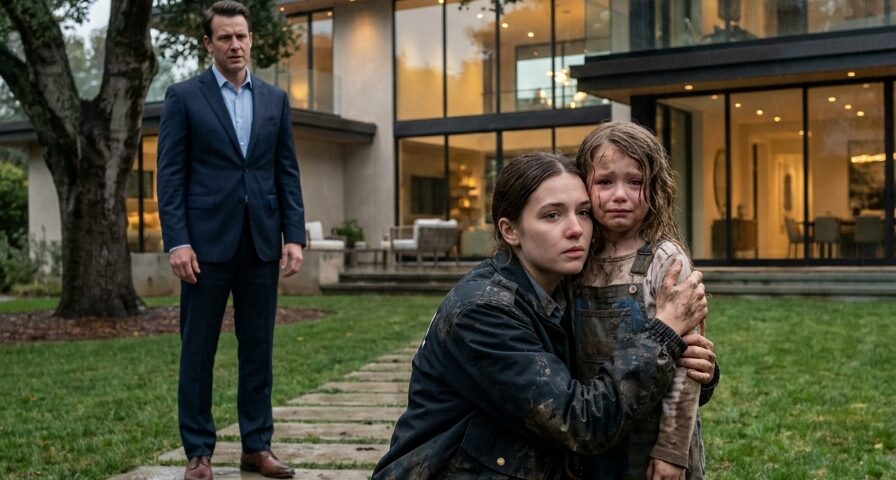
PART 2: I FIRED THE NANNY FOR LETTING MY CHILDREN PLAY IN THE MUD—THEN MY DAUGHTER REVEALED WHY THEY NEEDED HER
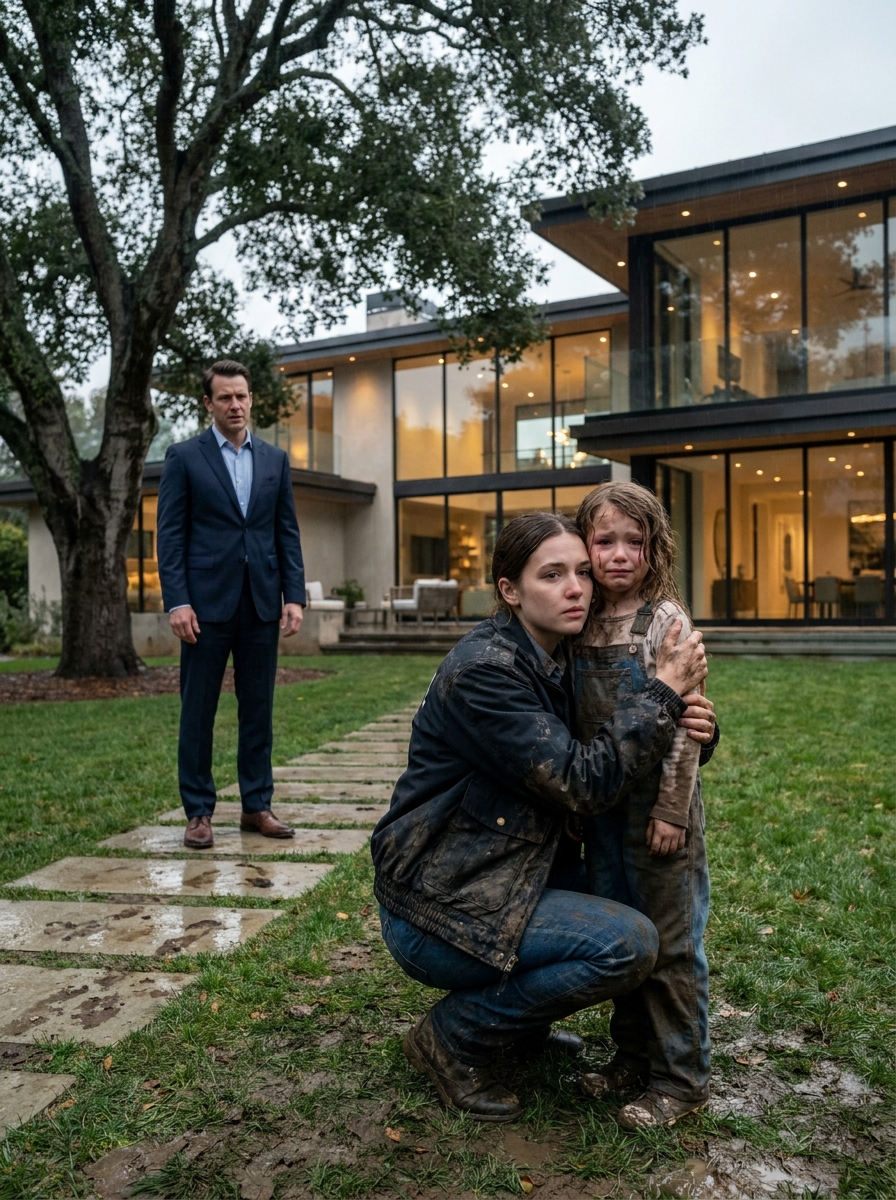
“Because she’s the only one who knows when Owen stops breathing at night.”
The words landed so quietly that for a moment, I did not understand them.
The garden stood frozen around us. Ethan, my four-year-old, clutched a red plastic bucket against his chest. Owen stood beside him, mud dripping from the ends of his sleeves, his dark curls plastered to his forehead. Emily’s face had gone pale beneath the streaks of dirt. Even the fountain behind the patio seemed suddenly too loud.
“What did you say?” I asked.
Lily shrank a little, but she did not look away.
“Owen,” she whispered. “Sometimes he can’t breathe right when he sleeps. Emily helps him.”
The anger that had filled me only seconds before did not disappear. It changed shape. It became cold confusion, then something far sharper.
I turned to Emily.
“Explain.”
She glanced at Owen first. That small motion told me more than her answer did. Her instinct was not to defend herself. It was to protect him.
“Mr. Reed,” she said carefully, “this isn’t a conversation we should have in front of the children.”
“No.” My voice came out clipped. “We’re having it now.”
Lily flinched.
I saw it.
I hated that I saw it.
Emily’s expression shifted, not with fear, but with disappointment so quiet it unsettled me more than defiance would have.
“Lily,” she said softly, kneeling again despite the mud, “take your brothers to the patio, please. Sit on the towels. I’ll be right there.”
“But you’re leaving,” Ethan said, his small face crumpling.
Emily opened her mouth, then closed it. She looked toward me.
For the first time, I understood that my children were waiting to see which version of their father would answer.
The one who cared more about imported grass than their tears.
Or someone else.
I inhaled slowly. The smell of wet earth filled my lungs.
“Go to the patio,” I said, forcing my voice lower. “Emily and I need to talk. She won’t leave until we’ve talked.”
The children moved reluctantly. Lily took Owen’s hand. Ethan dragged his bucket behind him. Their muddy footprints crossed the stone path I had spent a ridiculous amount of money having sealed three weeks earlier.
I watched them go.
Then I turned back to Emily.
“What is wrong with my son?”
Her shoulders lifted and fell once. “I don’t know exactly. I’m not a doctor.”
“But you know he stops breathing.”
“I know he has episodes.” She clasped her hands in front of her, fingers stained with mud. “Usually at night. Sometimes after crying. Sometimes when he’s had a cold. He gets quiet first. Too quiet. Then his breathing becomes shallow. A few times, he’s seemed to pause for several seconds.”
“And you didn’t tell me?”
“I tried.”
The answer was immediate.
I stared at her.
“When?”
“Three times by email. Twice in person. Once through Mrs. Vale.”
Mrs. Vale was my house manager, a brisk woman in her sixties who had worked for my father before she worked for me. She ran the estate with the precision of a military operation and the emotional warmth of polished marble.
“I never received those emails.”
Emily’s gaze did not waver. “I sent them to the address I was given.”
“I have one email address for household matters.”
“No,” she said gently. “Mrs. Vale told me urgent child-related issues were to go through her first, so your workday wouldn’t be interrupted unless necessary.”
Something unpleasant moved through my chest.
My workday.
The sacred, untouchable center around which everyone in the house had apparently learned to orbit.
“You should have called me.”
“I did.”
The answer struck harder than the last.
Emily reached into the pocket of her soaked cardigan and pulled out her phone. The screen was cracked at the corner. She tapped it twice, then turned it toward me.
My name sat beside a list of outgoing calls.
Six of them.
Some lasted one second. Some went to voicemail.
I remembered none.
“That number goes to my assistant when I’m in meetings,” I said.
“I know that now.”
The children were on the patio, sitting miserably on old towels while mud dried on their legs. Lily watched us with the solemn intensity of a child who had learned to read adult weather too early.
I looked back at Emily. “Why didn’t you take him to a doctor yourself?”
Her jaw tightened.
“I did.”
All the sound seemed to drain from the yard.
“What?”
“Three weeks ago. Urgent care in Carmel. He had an episode after his nap. Lily came to get me. Owen was pale and frightened, and I couldn’t reach you or Mrs. Vale. So I drove him in.”
“You took my son to urgent care without permission?”
“I took your son to urgent care because he was struggling to breathe.”
The words were calm. They contained no insult, no accusation, no raised voice. That made them impossible to dismiss.
I felt the first thin crack in the version of reality I had been standing inside.
“And no one told me?”
“They said they would send the notes to his primary physician.”
“I don’t know anything about this.”
Emily’s eyes softened, and somehow that was worse.
“I know.”
“What did they say?”
“They recommended a pediatric sleep evaluation and a follow-up with an ENT. They said it might be enlarged adenoids or sleep apnea. Maybe something minor, maybe not. They said it needed attention.”
A breeze moved over the lawn, carrying the smell of rain and torn grass. The mud obstacle course looked less like destruction now and more like evidence of a life happening in a place I had mistaken for a showroom.
“Why were they playing in mud?” I asked, because I needed one question that did not make me feel as if the ground were giving way.
Emily looked toward the children. “Because they were scared.”
“Of what?”
“Of today.”
I frowned. “Today?”
She hesitated.
Then Lily’s small voice came from the patio.
“Mom’s birthday.”
The air left me.
I turned toward my daughter.
Lily sat very still, her bare muddy toes curled against the towel. Ethan leaned into her side. Owen stared at the ground.
My wife, Claire, had been gone eighteen months.
Her birthday had been circled on calendars for years in her loose, looping handwriting. She loved birthdays, not because she wanted attention, but because she believed people needed reasons to light candles and gather around tables. After she died, I had removed her calendar from the kitchen wall because seeing her handwriting beside dentist appointments and school events had felt unbearable.
Apparently, I had removed more than paper.
I looked at Emily.
“They remembered?”
“Lily did,” she said. “The boys don’t fully understand dates, but they understand when Lily is sad.”
I swallowed.
“What does that have to do with mud?”
Emily’s expression became tender. “Claire used to let them make mud pies on her birthday.”
I almost said no.
Not because I knew it was untrue, but because it did not match the version of Claire I had allowed myself to remember. Claire in silk dresses at charity dinners. Claire arranging flowers in the foyer. Claire beside me in photographs, elegant and composed.
But another memory rose behind it.
Claire barefoot in the herb garden, laughing as Lily, then only four, decorated a mud cake with rosemary sprigs and pebbles. Me standing by the patio doors in a suit, telling them to be careful of the stonework. Claire turning toward me with that look she used when she was deciding whether to tease me or forgive me.
“Come outside, Graham,” she had called. “You can wash a suit. You can’t reschedule a childhood.”
I had smiled, but I had not gone outside.
There had been a call from Singapore.
There was always a call.
I pressed my fingers to the bridge of my nose.
Emily continued quietly. “This morning, Lily asked if they could make mud pies for their mother. Mrs. Vale said no. She said it was inappropriate and messy. Lily didn’t argue, but after breakfast she stopped speaking. Owen started crying because Lily was crying. Then he had one of his breathing spells.”
My eyes went to Owen.
He looked so small on the towel.
“What happened?”
“It passed quickly,” Emily said. “But he was frightened. They all were. So I brought them outside after the rain and made a game of it. Something physical. Something joyful. Something that felt like their mother instead of another day of pretending not to miss her.”
I had built a house where grief had to behave itself.
The realization came without drama, and because of that it went deeper.
I had thought silence meant resilience. I had thought clean rooms and structured schedules and private tutors would give my children stability. I had thought if I kept everything polished, ordered, and controlled, then the rupture Claire left behind would not swallow us.
But my children were not stable.
They were quiet.
There is a difference.
I looked toward the patio again. Lily was stroking Owen’s hair the way Claire used to stroke hers. Ethan had begun crying silently, tears cutting clean lines through the mud on his cheeks.
The sight undid me.
I stepped past Emily and walked toward them.
All three children stiffened.
That nearly stopped me.
My own children bracing because I approached.
I crouched in front of Lily, my expensive shoes sinking slightly into the wet edge of the lawn.
“Lily,” I said.
She looked down.
I had heard men negotiate billion-dollar failures with less fear than I saw on my daughter’s face.
“I’m sorry,” I said.
Her eyes lifted slowly.
I had not said those words often enough in this house. Not to the children. Not to Claire. Perhaps not to anyone.
“I didn’t remember what today was,” I admitted. “I should have.”
Lily’s lower lip trembled. “I didn’t want you to be sad.”
Something in me broke cleanly.
“Oh, sweetheart.” My voice was rough. “You don’t have to protect me from missing your mother.”
“But nobody talks about her.”
The words were not loud. They did not need to be.
Ethan sniffed. “Mrs. Vale says it makes the house gloomy.”
Owen whispered, “I like gloomy if it has Mom.”
I bowed my head.
For eighteen months, I had told myself grief was a private room. I had closed the door to spare my children the sight of my pain, never realizing I had locked them on the other side with theirs.
I looked back at Emily. She stood near the lawn, still and quiet, holding every truth she had tried to hand me before I was willing to receive it.
“You’re not fired,” I said.
Emily did not react with relief. She only looked at the children first, as though my words mattered mainly because of what they meant for them.
Then she said, “We still need to discuss Owen’s medical care.”
“Yes,” I said immediately. “We do.”
“And boundaries.”
That surprised me.
“Boundaries?”
Her chin lifted slightly. “I love your children, Mr. Reed. But I cannot continue being the only adult in this house allowed to notice when they are hurting.”
The sentence struck with uncomfortable accuracy.
Lily looked at her with fierce devotion.
I had hired Emily Monroe eleven months ago after three previous nannies resigned within six weeks. Mrs. Vale had called Emily unconventional. Too soft. Too informal. Too inclined to let children have opinions. I had nearly dismissed her after the first month because she allowed Lily to choose her own reading order instead of following the enrichment schedule I had approved.
Claire would have liked her.
That thought arrived quietly.
Claire would have liked her very much.
“I understand,” I said.
Emily’s eyes searched my face, not trusting the promise yet.
Fair.
I stood and turned to the children. “All right. First, everyone needs a bath.”
Ethan’s face crumpled again. “But Emily has to leave.”
“No,” I said. “Emily is staying.”
Lily’s eyes filled. “Really?”
“Really.”
The twins launched themselves at Emily before I could move. She knelt and held them, mud and all, closing her eyes as if she had been bracing herself for loss and could finally breathe again.
Lily did not run. She came to me instead.
Slowly.
I opened my arms, uncertain whether she wanted them.
She stepped into them and pressed her muddy face against my shirt.
I held my daughter for the first time in what felt like years.
Not a quick kiss on the head before leaving for a meeting. Not a formal hug for a photograph. A real hold. Her shoulders shook once, then again, and I realized she was crying with relief.
“I miss her,” she whispered.
“I do too.”
“Do you?”
The question was so honest it hurt.
“Yes,” I said. “Every day. I just didn’t know how to say it.”
Lily pulled back slightly. “You can practice.”
A laugh came out of me, cracked and wet with grief.
“I suppose I can.”
The house looked different when we went inside.
Nothing had changed, not really. The marble floors still gleamed. The entryway chandelier still scattered light across walls painted in expensive neutrals. The staircase still curved with architectural perfection toward the upper floors.
But now I saw what I had not wanted to see before.
No children’s drawings on the refrigerator.
No toys in the foyer.
No fingerprints on the glass.
No evidence that three young lives were unfolding here except in rooms assigned to them.
I had confused absence with order.
Mrs. Vale appeared at the end of the hall, her posture rigid as her eyes swept over the muddy children.
“Mr. Reed,” she said, appalled. “I was about to call housekeeping. The rear lawn is—”
“Later,” I said.
Her mouth tightened. “Sir, the children are tracking mud across imported stone.”
“They live here.”
The words surprised both of us.
Mrs. Vale blinked.
I glanced down at the muddy footprints already marking the marble.
“They live here,” I repeated, more quietly. “The stone will survive.”
Emily looked at me from the corner of her eye.
Not smiling.
Not yet.
But something in her shoulders eased.
The next hour moved with the strange tenderness that follows an emotional storm. Emily bathed the twins while I sat on the bathroom floor in rolled-up sleeves, holding towels and feeling useless but present. Lily perched on the edge of the tub and supervised, correcting my every attempt to guess which pajamas belonged to which boy.
“No, Dad. Owen likes the green ones because they have rockets. Ethan likes blue because he says dinosaurs are calmer in blue.”
“I didn’t know dinosaurs had color preferences.”
“They do if you listen.”
Emily hid a smile.
I deserved that.
After the twins were clean and warm, I helped Lily wash mud from her hair. She talked more than she had in months. Not about school achievements or piano practice or the things adults praised her for, but about Claire.
“Mom used to sing when she brushed my hair,” she said.
“What did she sing?”
Lily looked at me in the mirror. “You don’t remember?”
I did.
Or I remembered the shape of it. Claire humming in the bathroom. Steam on the mirror. Lily giggling when Claire changed the words to include the names of stuffed animals. I had heard it from the hallway countless times without stopping.
“Teach me,” I said.
So she did.
My voice was terrible. Lily told me so with Claire’s exact blunt kindness, and for one brief moment, my wife felt almost present in the room, as though love could remain in rituals if someone was brave enough to repeat them.
At eight-thirty, the children were tucked into the family room beneath blankets, eating toast because dinner had been forgotten and no one cared. Emily sat beside Owen, watching his breathing with practiced subtlety. I noticed every time her eyes moved to his chest.
How many nights had she done that?
How many nights had I slept behind the closed door of the primary suite or worked in my study while this young woman sat awake with my son?
When the twins finally drifted off and Lily curled beside them, Emily and I moved to the kitchen.
The kitchen had always been Claire’s favorite room. After she died, I had avoided it except for coffee. Mrs. Vale kept it spotless, which suddenly seemed like another kind of mourning.
Emily washed her hands at the sink. Mud swirled down the drain.
“I owe you an apology,” I said.
She dried her hands slowly. “Yes.”
The answer was so direct that I almost smiled.
Then I realized she was right to say it.
“I’m sorry,” I said. “For firing you. For not listening. For making it difficult for anyone in this house to reach me about my own children.”
Emily leaned against the counter, exhaustion showing now that the children were asleep.
“I appreciate that.”
“But it isn’t enough.”
“No,” she said. “It isn’t.”
I nodded.
That should have irritated me. A year ago, it would have. A month ago, maybe even this morning, I might have reminded her that she was an employee. But tonight the word employee felt too small for the person who knew my son’s breathing patterns and my daughter’s grief calendar better than I did.
“What do you need?” I asked.
“For Owen, a medical appointment this week. Not next month. Not when your schedule opens. This week.”
“Yes.”
“For Lily, grief counseling. She’s carrying too much.”
My throat tightened. “Yes.”
“For the twins too, eventually. But Lily first.”
“Agreed.”
“And Mrs. Vale cannot be the gatekeeper for information about your children.”
I looked toward the hall. “I’ll handle that.”
Emily studied me. “Will you?”
The question was not disrespectful. It was careful.
“I will,” I said. “Tonight.”
She seemed to believe me halfway.
Halfway was more than I deserved.
I poured two glasses of water because it was the only useful thing I could think to do. Emily accepted hers.
“You said you tried to tell me through Mrs. Vale,” I said.
“I did.”
“What happened?”
“At first she said I was being dramatic. Then she said children have phases. After urgent care, she told me I had exceeded my authority and that bothering you during the merger negotiations would be irresponsible.”
I closed my eyes briefly.
The biggest investment deal of my career.
I had nearly celebrated it while my son needed a doctor and my daughter mourned alone.
“Why didn’t you resign?” I asked.
Emily looked toward the family room.
“Because of them.”
Simple.
Impossible to argue with.
“And because Claire asked me not to give up on you.”
My hand tightened around the glass.
“What?”
Emily’s eyes widened slightly, as if she had not meant to say it.
The kitchen became very still.
“You knew my wife?”
For the first time all evening, Emily looked truly uncertain.
“Yes.”
I set the glass down carefully. “How?”
She drew a breath. “We met at the community literacy center in Salinas. I volunteered there while finishing my degree. Claire came twice a month to read with children. She didn’t tell anyone who she was at first. She just showed up in jeans with a canvas bag full of books.”
That sounded like Claire.
Private generosity. Quiet rebellion against the polished world my father had built and I had inherited.
“She never mentioned you,” I said.
“She said you were busy.”
The word landed with a familiar weight.
Busy.
The cleanest excuse for absence.
Emily continued. “When she got sick, she asked if I would consider applying here someday if the family needed help. I thought she meant occasional tutoring for Lily. I didn’t realize…” She stopped.
I looked away.
Claire’s illness had moved quickly. Too quickly for comprehension. Diagnosis in spring. Treatments in summer. Hope in September. Funeral in November. The house had filled with flowers, casseroles, murmured condolences, then silence.
“What else did she say?” I asked.
Emily’s face softened with memory. “She said the children were loved, but the house sometimes forgot how to show it.”
That was Claire. Gentle enough not to wound, precise enough not to miss.
“She said you loved them,” Emily added.
I almost laughed, but the sound would have broken.
“She said that?”
“Yes.”
“I’m not sure I proved it very well.”
“She knew you didn’t always know how.”
There was no judgment in Emily’s voice, which made the words harder to bear. I had grown up in a family where love looked like expectation. My father praised discipline, achievement, restraint. My mother, gone long before Claire, had floated through rooms like perfume, beautiful and distant. When I was ten and scraped my knee badly enough to need stitches, my father told me, “Pain is information. Use it, don’t display it.”
I had used pain.
I had built towers out of it.
Then I had asked my children to live inside them.
“Did Claire know she was dying when she spoke to you?” I asked.
Emily nodded.
The room blurred at the edges.
“She made plans,” Emily said softly. “Not in a controlling way. More like… she was leaving lanterns. Names of counselors. Books she loved. Little traditions she hoped the children would remember.”
“Where are those plans?”
Emily looked down at her water.
“I gave them to Mrs. Vale when I was hired. She said she would put them with the household files.”
A slow, quiet unease moved through me.
“Show me.”
We went to Mrs. Vale’s office, a small room near the service entrance that contained filing cabinets, schedules, household ledgers, and the kind of order that suddenly felt less reassuring than it once had.
Mrs. Vale was not there.
Emily stood by the doorway as I opened drawers. Medical. School. Travel. Staff. Seasonal Maintenance. Everything labeled. Everything immaculate.
No folder with Claire’s name.
No lanterns.
I opened the locked cabinet with the master key from my pocket. Inside were contracts, insurance documents, property records, and staff evaluations.
Emily’s file was there.
I pulled it out.
On top was her original application. Then references. Then notes in Mrs. Vale’s precise handwriting.
Too emotionally familiar with children.
Encourages disorderly play.
Undermines household standards.
I flipped to the next page.
Recommendation: replace when feasible.
Emily read it over my shoulder, then looked away.
“I’m sorry,” I said.
She lifted one shoulder, but I could see the hurt. “She never liked me.”
“She didn’t like anything she couldn’t categorize.”
At the back of the file was a sealed envelope.
My name was written across it.
Graham.
Not Mr. Reed.
Not Graham Reed.
Just Graham, in Claire’s handwriting.
The sight of it emptied my lungs.
Emily covered her mouth.
“I didn’t know that was there,” she whispered.
I believed her.
My fingers hovered over the envelope, suddenly afraid of paper.
For eighteen months, I had wanted one more conversation with my wife. One more chance to ask what I was supposed to do with the children, with the house, with the enormous vacancy beside me in bed. Now her handwriting lay in my hand, and I was terrified to hear what she had left unsaid.
I opened it carefully.
Inside was a letter and a small photograph.
The photograph showed the backyard after rain. Lily was younger, kneeling beside a mud pie covered in petals. Ethan and Owen were babies in high chairs on the patio, their faces smeared with something orange. Claire sat barefoot on the grass, holding up a ridiculous mud-covered spoon like a trophy.
On the back, she had written:
Let them be messy. They will have enough time to be careful later.
I pressed my thumb against the words.
Then I unfolded the letter.
My dearest Graham,
If you are reading this, it means I was right about two things: first, that I would not get as much time as I wanted; and second, that you would try to survive losing me by becoming even more controlled than before.
Please don’t be angry. I know you. I love you. I know the discipline that built your life also helped you endure what would have broken someone else. But our children do not need a monument to endurance. They need a father.
Lily will try to become useful when she is sad. Watch for that. She will organize her pain into perfect behavior if no one stops her.
Ethan will make jokes when he is afraid.
Owen will go quiet.
When Owen goes quiet, pay attention.
I stopped reading.
Owen will go quiet.
Emily stood very still beside me.
I forced myself to continue.
There are medical notes in the blue folder from Dr. Sayegh. Nothing certain yet, but he wanted Owen observed if the nighttime breathing continued. I was going to follow up after the benefit gala. Then the scans came back, and everything became hospitals.
I need you to promise me something, even if I have no right to ask for promises from wherever I am now.
Choose them over the next call.
Not every time. I know life is complicated. But often enough that they know the difference.
Emily Monroe is someone I trust. She sees children clearly. If she ever comes into our lives, listen to her before you listen to the rules of the house.
And Graham, be careful with Mrs. Vale.
My eyes froze on the sentence.
Emily leaned closer, her breath catching.
I read it again.
Be careful with Mrs. Vale.
She loved your father deeply, and she carries his ideas about family as if they are scripture. She believes order is protection. She means well in the way people mean well when they are afraid of change.
But love that cannot bend becomes something else.
Do not let this house raise our children in your father’s image.
Raise them in yours—the version of you I saw when you forgot to be impressive.
That is the man they need.
All my love,
Claire
For a long time, I could not speak.
Emily’s eyes were wet.
“She knew,” I said.
“Yes.”
“She knew about Owen. About Lily. About the house.”
“She saw everything,” Emily whispered.
Of course she had.
Claire had always seen beneath surfaces. It was one of the reasons I loved her, and one of the reasons I had sometimes avoided looking too closely at myself around her.
I folded the letter with care.
“Where is the blue folder?” Emily asked.
I searched the locked cabinet again.
Nothing.
We checked every drawer in Mrs. Vale’s office. Household medical files. Archived pediatric records. Old appointment cards. Nothing from Dr. Sayegh. No blue folder. No notes about Owen’s breathing.
The unease hardened into concern.
“Maybe she moved it,” Emily said, though her voice held little conviction.
I looked toward the hallway.
“Mrs. Vale.”
We found her in the front sitting room, speaking quietly on her phone. She ended the call the moment she saw me.
“Sir,” she said. “Is everything all right?”
“No,” I answered. “Where is Claire’s blue medical folder for Owen?”
Her face did not change enough for most people to notice.
But I noticed.
“I’m not familiar with that.”
“Claire left a letter. She said there were notes from Dr. Sayegh.”
Mrs. Vale’s hands folded at her waist. “Mrs. Reed was very ill near the end. There may have been confusion.”
Emily stiffened beside me.
I heard the old version of myself in Mrs. Vale’s answer. Smooth. Controlled. Dismissive beneath its manners.
“Do not do that,” I said.
Her eyebrows lifted. “Sir?”
“Do not use my wife’s illness to erase what she wrote.”
For the first time in all the years I had known her, Mrs. Vale looked offended.
“I served this family for thirty-two years.”
“I know.”
“I protected this household when your father was alive, and I protected it after Mrs. Reed passed.”
“Protected it from what?”
Her gaze flicked briefly toward Emily.
There it was.
Not hatred. Something more complicated. Fear, loyalty, class prejudice, grief calcified into rules.
“From instability,” she said.
I looked around the sitting room. Pale upholstery. Silver-framed photographs. No toys, no books, no trace of mud.
“Is that what you call my children’s feelings?”
Her mouth tightened. “Children require structure.”
“They also require care.”
“I have never neglected them.”
“I didn’t say you did.”
But Lily’s voice came from behind us.
“You threw away Mom’s birthday calendar.”
We all turned.
Lily stood in the doorway in clean pajamas, hair damp from her bath. She held the banister with one hand as if she had come downstairs slowly and without permission.
Mrs. Vale’s expression softened, but not enough. “Miss Lily, you should be in bed.”
“You threw it away,” Lily repeated. “I saw it in the pantry trash. The one with Mom’s flowers on it.”
I remembered that calendar. Claire had painted little flowers around special dates.
Mrs. Vale looked at me. “It was upsetting her.”
“It was mine,” Lily said.
The room went quiet.
Emily moved instinctively toward Lily, then stopped, letting me respond first.
That small restraint felt like an invitation to become the father Claire had asked me to be.
I crossed the room and crouched in front of my daughter.
“I’m sorry,” I said. “I should have asked before anything of your mother’s was moved.”
Lily nodded, but her eyes stayed on Mrs. Vale.
“She said Mom wouldn’t want us crying.”
Mrs. Vale inhaled. “I said your mother would want you to be strong.”
“She let me cry,” Lily whispered.
The sentence settled over the room like dust after a collapse.
Mrs. Vale looked away first.
I stood.
“Where is the folder?” I asked again.
“I don’t know.”
This time, I heard not certainty, but evasion.
“Mrs. Vale.”
She straightened. “I removed some materials I felt were unhelpful. Mrs. Reed kept many sentimental things near the end. Some were not suitable for maintaining a healthy environment for the children.”
Emily’s voice remained soft, but it carried. “Medical notes are not sentimental.”
Mrs. Vale’s eyes sharpened. “You forget your place, Miss Monroe.”
“No,” I said.
Both women looked at me.
I thought of my father’s voice. Discipline comes before happiness.
I had obeyed him for so long he no longer needed to be alive to command the room.
“That sentence,” I said to Mrs. Vale, “will not be used in this house again.”
Her face paled.
“For tonight, you may retire to your quarters. Tomorrow we’ll discuss your position here.”
“Mr. Reed—”
“Tomorrow.”
She looked at me as if seeing, perhaps for the first time, that I was no longer a boy standing in my father’s shadow.
Then she left the room.
Lily slipped her hand into mine.
“She scares Owen,” she whispered after Mrs. Vale disappeared.
I closed my eyes briefly.
“Thank you for telling me.”
“Are you mad?”
“At you? No.”
“At her?”
I considered the question. Anger was easy. It was also incomplete.
“I’m concerned,” I said. “And I’m sad I didn’t see it sooner.”
Lily leaned into my side.
That night, I did not return to my study.
I sat in the hallway between the children’s rooms with my laptop balanced on my knees, searching pediatric sleep apnea, enlarged adenoids, childhood grief, and every term Emily remembered from urgent care. At midnight, I emailed Owen’s pediatrician and copied Emily with her permission. At one in the morning, I found Dr. Sayegh’s clinic listed in Claire’s old contacts and left a message marked urgent.
At two, Owen coughed.
It was small. Barely anything.
Emily’s door opened at once.
So did mine.
We met in the hallway, both wide awake.
For the first time, I saw the nights she had been living. The listening. The readiness. The quiet fear.
Together we stepped into the twins’ room.
Owen was asleep, curled on his side. His breathing was soft but uneven. Ethan slept sprawled beside him, one foot outside the blanket.
Emily stood near the bed, counting silently.
I counted with her.
After a few seconds, Owen inhaled more deeply and settled.
Emily exhaled.
I did too.
“He should be seen tomorrow,” I whispered.
“Yes.”
“Thank you,” I said.
She looked at me in the dim night-light glow. “For what?”
“For not leaving when I made it easy to.”
She glanced at Owen. “It was never easy.”
In the morning, sunlight came through the house differently.
Or perhaps I was the one seeing differently.
There were still muddy footprints on the entry floor. Housekeeping had not yet arrived, and for once, I did not rush to erase them. The children came downstairs cautiously, as if unsure whether yesterday’s father would return.
I made pancakes.
Badly.
Emily tried not to interfere until smoke rose from the first batch. Lily took over measuring. Ethan declared the burned ones “dragon pancakes.” Owen laughed so hard he snorted, then immediately looked embarrassed.
I looked at Emily.
She was watching Owen’s color, his breathing, his smile.
Not hovering. Caring.
After breakfast, the pediatrician returned my call personally. Owen had an appointment that afternoon and a referral to a specialist. Dr. Sayegh’s office also confirmed something that made my stomach twist: Claire had scheduled an appointment for Owen nineteen months earlier.
Two weeks before she died.
It had been canceled.
Not by Claire.
By “household staff.”
I wrote the detail down with a hand that remained steady only because the children were in the room.
At ten, I asked Mrs. Vale to meet me in the library.
She entered dressed as impeccably as always, but there were shadows beneath her eyes.
Emily was not present. I had offered to include her. She declined.
“This is family business,” she said. “But don’t let that become an excuse again.”
She was right.
Mrs. Vale stood near my father’s portrait, a placement so perfect it almost seemed rehearsed.
“I called Dr. Sayegh’s office,” I said.
Her face closed.
“You canceled Owen’s appointment.”
“Mrs. Reed was dying,” she replied. “The household was in crisis. You were barely sleeping. The children were confused. I made decisions to reduce unnecessary strain.”
“A doctor’s appointment was not unnecessary.”
“At the time, Owen had no diagnosis.”
“Because you canceled the appointment.”
Her lips pressed together.
I looked at the woman who had packed my school trunks, managed my father’s dinner parties, organized Claire’s funeral reception, and quietly shaped the house my children lived in. She had been loyal. She had also been wrong in ways that mattered.
“Why didn’t you tell me Emily took Owen to urgent care?”
“Because Miss Monroe overstepped.”
“She protected him.”
“She disrupted the chain of authority.”
The phrase sounded exactly like my father.
There it was again: the old house speaking through a living person.
I sat back.
“Mrs. Vale, do you care about my children?”
Her expression changed. The offense faded, replaced by something wounded.
“Of course I do.”
“I believe you. But you have mistaken control for care.”
She looked down.
For the first time, her age showed.
“Your father trusted me to maintain standards,” she said quietly.
“My father is gone.”
“Yes.” Her voice tightened. “And so is Mrs. Reed. And when people leave, Mr. Reed, houses fall apart unless someone holds the line.”
The honesty in that sentence softened my anger without erasing it.
“You were grieving too,” I said.
Her eyes flickered.
“I don’t presume to compare my grief to yours.”
“Grief isn’t a competition.”
She looked away toward the window.
“I loved this family,” she said. “I gave my life to it.”
“I know.”
“And then Mrs. Reed came and changed everything. She brought noise and color and garden dirt and kitchen suppers. Your father would have hated it.”
“I loved it,” I said softly.
Mrs. Vale looked at me.
I had not known it was true until I said it.
“I loved it,” I repeated. “I just didn’t know how to protect it after she was gone.”
Her mouth trembled once, almost imperceptibly.
“I thought I was helping you.”
“You hid medical information about my son. You dismissed my daughter’s grief. You tried to push out the one person Claire specifically trusted.”
Mrs. Vale closed her eyes.
“I am sorry for Owen,” she said. “Truly. I never believed he was in danger.”
“But you decided that without asking a doctor.”
“Yes.”
The admission sat between us.
I made the decision then, not with satisfaction, but with sadness.
“You can no longer manage this household.”
She opened her eyes.
“I see.”
“I’ll arrange a generous severance and references if you want them. You may stay in the guest cottage for sixty days while you make arrangements.”
For a moment, she looked as if she might argue.
Then she straightened.
“Your father would say you were being sentimental.”
“My wife would say I’m late.”
A faint, unexpected smile touched Mrs. Vale’s mouth, then vanished.
“She was a remarkable woman,” she said.
“Yes.”
As she left, I felt no triumph.
Only the ache of changing a house built by people who thought love had to stand at attention.
That afternoon, I took Owen to the pediatrician.
Not a driver.
Not Emily alone.
Me.
Emily came too because Owen asked for her. He held her hand in the waiting room and leaned against my knee without seeming to realize he was doing it. I sat very still, afraid that any movement might break the fragile trust of that small weight.
The doctor listened. Asked questions. Reviewed urgent care notes. Examined Owen gently. He recommended further evaluation but reassured us that we had caught the concern and could take appropriate steps.
Caught it.
The phrase stayed with me.
Emily had caught it.
Lily had caught it.
Claire had caught it from beyond the reach of her own life.
I was the one catching up.
When we returned home, the backyard had dried under the sun. The obstacle course remained in ruins. Buckets tipped on their sides. Traffic cones leaned like exhausted soldiers. The once-perfect lawn was scarred with footprints.
The children ran toward it after dinner.
Then stopped.
All three looked back at me.
Waiting.
I understood then that permission is not always spoken. Sometimes it is a gate children stand before, watching your face for signs of weather.
I loosened my tie.
“Show me how it works.”
Ethan’s mouth fell open. “You?”
“Yes.”
“In mud?”
“I believe that is the general idea.”
Lily’s smile came slowly, cautiously, as if she did not fully trust it yet.
Emily stood on the patio, arms folded, watching.
I stepped onto the lawn.
The mud was cold through my shoes. Ethan shrieked with laughter as if I had performed a miracle. Owen giggled. Lily clapped both hands over her mouth.
“Dad,” she said, delighted and horrified, “your pants.”
“They’ve had a meaningful life.”
Noah was not part of our family; there was no Noah here, only Ethan and Owen, but Ethan declared himself the official referee and announced that I had to hop between flowerpots while carrying a bucket of “dragon water.” I did it badly. I slipped once, not enough to fall, but enough to make all three children scream with laughter.
Emily laughed too.
The sound surprised me.
I looked toward her, and she looked away quickly, smiling despite herself.
For twenty minutes, I was not Graham Reed, founder of Reed Capital, the man business publications called precise and formidable.
I was Dad.
Muddy, clumsy, late.
But present.
Afterward, as the children created one final mud cake for Claire and decorated it with petals from the surviving flower beds, Lily placed a candle in the center. Not a real candle. A twig.
“Mom would say it counts,” she said.
“Yes,” I replied. “She would.”
We stood around the mud cake in the fading light.
No one knew quite what to say.
Then Emily began softly, “Happy birthday…”
Lily joined first. Then the twins. Then me, my voice rough and uneven.
We sang to a woman who was not there and yet somehow was everywhere—in the mud, in the petals, in Lily’s dimples, in Owen’s quiet, in Ethan’s laughter, in the letter folded safely in my pocket.
When the song ended, Lily leaned against me.
“This was a good gloomy,” Owen said.
Emily wiped her eyes quickly.
“Yes,” I said. “It was.”
That night, after the children were asleep, I returned to Claire’s letter.
Something had been bothering me since I first read it. Not the words themselves, but the way the envelope had been hidden in Emily’s file rather than Claire’s things. Why there? Why place my wife’s private letter inside the personnel file of a nanny Mrs. Vale clearly wanted dismissed?
I sat at the kitchen table, the house quiet around me, and examined the envelope again.
There was a slight thickness along the bottom seam.
Carefully, I slid a letter opener beneath the glued edge.
A smaller folded note slipped out.
My name was not on this one.
Emily’s was.
I went still.
I should have taken it to her unopened.
I know that now.
But grief and fear make poor guardians of patience. I saw Claire’s handwriting, and my hands moved before my conscience caught up.
Emily,
If Graham is reading this someday, forgive me for placing you in the middle of our unfinished life. I wish I had another choice.
There is something he does not know.
I stopped breathing.
The kitchen clock ticked steadily on the wall.
I read on.
The doctors believe my illness was chance, and perhaps they are right. But before I became sick, I began noticing discrepancies in the charitable foundation accounts tied to Reed Capital. Nothing obvious. Nothing Graham would have ignored if he had seen it. But the kind of quiet rerouting his father used to excuse as “family housekeeping.”
Mrs. Vale knows more than she admits. I don’t know whether she participated or only protected what she believed should stay buried.
If I am gone, and if the children begin to disappear inside the rules of this house, help Graham look closer.
Not at the children.
At the family.
My hands went cold.
At the bottom of the note was one final line.
The truth is in the west greenhouse, beneath the lemon tree Graham planted the year Lily was born.
I rose so abruptly the chair scraped against the floor.
The west greenhouse had been locked for over a year.
Mrs. Vale said the irrigation system had failed and the structure was unsafe. I had accepted that explanation the way I had accepted too many explanations: gratefully, because it kept me from having to look.
I took a flashlight from the pantry and walked outside.
The night air was cool and smelled faintly of damp soil. Across the lawn, the muddy footprints had hardened into dark impressions under the moonlight. I passed the obstacle course slowly, then continued down the stone path Claire had designed herself, past lavender beds and rosemary hedges, toward the old glass greenhouse at the edge of the property.
The padlock was newer than I remembered.
I used the master key.
For a moment, it did not turn.
Then the lock gave.
The door opened with a reluctant groan.
Inside, the air was stale and green. Dead vines clung to trellises. Empty pots lined the walls. Moonlight silvered the glass panes and turned every shadow into a question.
The lemon tree stood in the back corner.
Claire had insisted on planting it herself when Lily was born. She said every child should grow up with something that smelled like sunlight.
The soil beneath it had been recently disturbed.
My pulse slowed into something heavy and deliberate.
I knelt.
The first few inches came away easily. Too easily. Someone had dug here before me, and not long ago.
My fingers struck metal.
I cleared away the soil and lifted out a small weatherproof box.
It was unlocked.
Inside was a blue medical folder.
Owen’s name was written on the tab.
Beneath it sat a flash drive, a stack of copied financial statements from the Reed Family Foundation, and a photograph I had never seen before.
Claire stood in this very greenhouse, thinner than I remembered, one hand resting on the lemon tree. Beside her was Emily Monroe.
And between them, seated on a small stool with a watering can in her lap, was a little girl.
A girl who looked about three years old.
A girl with Claire’s eyes.
On the back of the photograph, Claire had written five words.
Graham must know about Ava.
I stared at the name until the letters blurred.
Ava.
The greenhouse seemed to tilt around me.
I had three children.
At least, that was what I had believed when the sun rose that morning.
But somewhere inside the quiet machinery of my perfect house, my wife had hidden a name, a photograph, and a truth someone had worked very hard to keep from me.
Behind me, the greenhouse door creaked.
I turned, flashlight shaking in my hand.
Emily stood in the doorway, pale beneath the moonlight.
She looked at the photograph in my hand.
Then she whispered, “Graham… I can explain.”