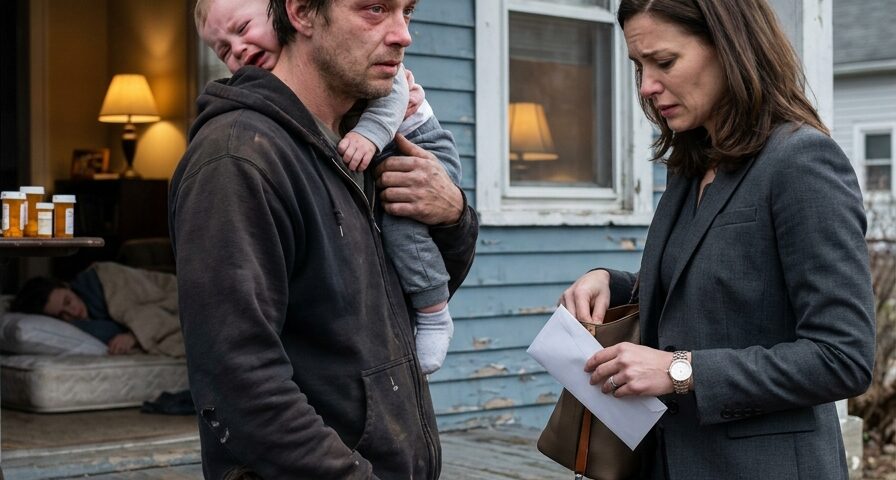
PART 2: The Door That Changed the CEO’s Heart
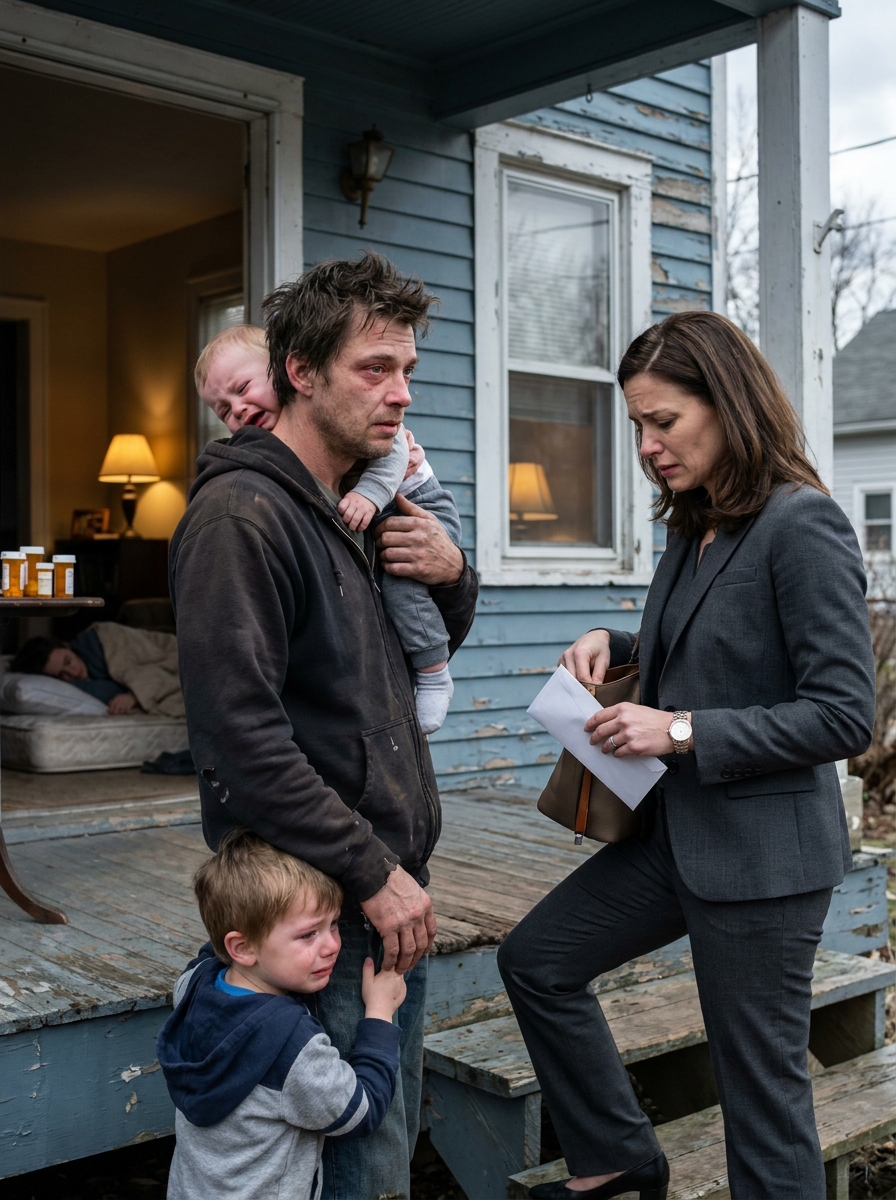
He shifted the baby against his shoulder and said quietly, “Ms. Bennett, please.”
The word please stopped me.
Not because it was dramatic, but because it was tired.
It was the kind of please spoken by someone who had already begged hospitals, landlords, utility companies, and fate itself, and had learned that most doors still stayed closed.
“I’m not firing you,” I said.
He blinked.
The baby hiccuped against his shoulder.
The little boy at his leg peered up at me with solemn brown eyes.
“I’m calling my doctor,” I continued.
Daniel looked confused. “Your doctor?”
“My company physician coordinates with several specialists. I don’t know whether he can help, but he’ll know who can.”
Daniel’s mouth opened, but no words came out.
Behind him, the woman on the mattress stirred.
“Daniel?” she whispered.
He turned immediately, his whole body reacting to her voice.
“I’m here, Ana.”
Ana.
Her name fit her somehow. Soft, brief, delicate in the air.
I stepped inside without asking, then stopped myself. The instinct embarrassed me. I was used to entering spaces as if permission came attached to my title. This was Daniel’s home, however small and worn and desperate it looked.
“May I come in?” I asked.
Daniel seemed startled by the question.
Then he stepped aside.
The house smelled faintly of baby formula, antiseptic, and damp wood. A pot sat on the stove with something thin and pale inside it. The living room had been arranged around illness the way some homes were arranged around televisions. Pillows within reach. Bottles labeled by time and dose. A plastic basin. Folded towels. A notebook filled with numbers and names and crossed-out appointment times.
I had walked into construction sites worth hundreds of millions of dollars and spotted structural flaws before anyone else.
But I had never stood inside a room built entirely around survival.
Ana tried to sit up when she saw me.
Daniel hurried to her side. “Don’t. It’s okay.”
Her eyes moved from him to me. They were dark and bright with feverish embarrassment.
“I’m sorry,” she said. “The house is a mess.”
The apology struck me so sharply that I almost looked away.
She was sick enough to sleep on a mattress in her living room, and still she apologized to me.
“It isn’t,” I said, though both of us knew that was not true in the ordinary sense. “I’m Laura Bennett.”
“I know.” A faint, exhausted smile touched her mouth. “Daniel keeps your company badge in a drawer like it’s a medal.”
Daniel looked down. “Ana.”
“What? You do.”
I saw him blush beneath the fatigue, and for the first time since I had knocked on the door, I glimpsed the man he must have been before crisis hollowed him out. Quiet, yes. But not defeated. Tender. Embarrassable. Proud in ways he tried to hide.
The little boy still stood near the door.
“What’s your name?” I asked him.
He pressed himself against Daniel’s leg and whispered, “Mateo.”
“How old are you, Mateo?”
He held up four fingers.
The baby began to fuss again, and Daniel bounced her gently.
“And this is?”
“Lily,” he said. “She’s seven months.”
Seven months.
I looked at the termination envelope still clutched in my other hand.
I had walked up those steps ready to take away the income that bought Lily’s formula, Mateo’s shoes, Ana’s medicine.
My face warmed with shame.
I turned the envelope over and slid it into my bag.
Daniel noticed.
His eyes filled with something too fragile to name.
I called Dr. Samuel Greer, who had been our corporate medical consultant for nine years. He answered on the third ring, probably because people in my position were used to being answered quickly.
“Laura,” he said. “Is everything all right?”
“No,” I said.
The room went very still.
I gave him Ana’s name, her condition as best Daniel could explain it, the hospital involved, the notes written on the kitchen table, the medications. As I spoke, Dr. Greer’s professional calm sharpened into concern.
“Who is managing her care?” he asked.
Daniel gave me a doctor’s name.
Dr. Greer paused.
I did not like the pause.
“Email me photographs of her documents,” he said. “All of them. Lab reports, discharge papers, bills, medication list. I’ll review immediately.”
“Today,” I said.
“Yes, Laura. Today.”
When I ended the call, Daniel looked as if he had been holding his breath for several minutes.
“I can’t pay for a private doctor,” he said.
“I didn’t ask you to.”
His jaw tightened. “I don’t take charity.”
There was no anger in the words, only dignity worn thin.
“Good,” I said. “Because I’m not offering charity.”
He looked up.
“I came here because I failed as your employer,” I said. “You told my office there were family emergencies, and instead of asking what support you needed, I assumed the worst. That is my responsibility.”
Daniel’s eyes dropped to the floor.
“It’s not your fault my wife is sick.”
“No,” I said. “But it is my fault that you believed missing work to keep her alive was something you had to hide.”
Ana closed her eyes.
A tear slipped quietly down her temple into her hair.
Daniel saw it and looked away, fighting his own.
I had always been uncomfortable with crying. In boardrooms, tears meant someone had lost control. At funerals, they meant something final had happened that no solution could touch. I had trained myself to respond to emotion with logistics because logistics made me useful.
So I did what I knew how to do.
I called my assistant, Maren.
“Cancel my afternoon,” I said.
There was a pause. “All of it?”
“Yes.”
“You have the zoning call at three.”
“Move it.”
“The investors from Toronto are already—”
“Maren.”
She stopped.
“My afternoon is gone.”
Another pause. Softer this time. “Understood.”
“Also, I need a grocery delivery to this address. Fresh food, diapers, formula, cleaning supplies. Nothing extravagant. Practical.”
“Of course.”
“And contact HR. Daniel Carter is on emergency paid family leave effective immediately. No disciplinary action. No attendance flags. I want it documented before anyone else touches his file.”
Daniel’s head snapped up.
“Ms. Bennett—”
I held up a hand gently. “Let me finish.”
Maren said, “I’ll handle it.”
“One more thing,” I said. “Find out whether our employee assistance program has a medical advocate attached. If not, hire one.”
“We don’t currently have—”
“Then we will by tomorrow.”
When I hung up, silence filled the house.
Daniel stared at me as if I had spoken in another language.
“You can’t just do that,” he said.
“I own the company.”
“I mean…” He struggled. “For me.”
“For employees,” I corrected. “Starting with you.”
Ana opened her eyes.
“Daniel works hard,” she said, her voice weak but fierce. “He never complains.”
“I know,” I said.
But the truth was, I had not known.
I knew his employee number. I knew the division he reported to. I knew his attendance irregularities, the ones that had irritated me on a spreadsheet between a financing call and a legal review. I knew the version of Daniel Carter that fit neatly into a personnel file.
I did not know he packed lunches before dawn while holding a baby.
I did not know he changed dialysis dressings with hands that shook from lack of sleep.
I did not know he read hospital bills at midnight and still arrived at work in a clean uniform, quietly fixing leaks and faulty wiring in buildings whose residents never learned his name.
“I’m learning,” I said.
Mateo tugged on Daniel’s shirt.
“Daddy,” he whispered, “is Mommy going back to the hostipal?”
Daniel crouched carefully, still holding Lily. “Maybe, buddy. We’re going to get Mommy some help.”
Mateo looked at me. “Are you a doctor?”
“No,” I said.
“Are you rich?”
Daniel closed his eyes. “Mateo.”
The question was so direct, so innocent, that I nearly smiled.
“Yes,” I said. “I am.”
Mateo considered this seriously. “Can you buy Mommy a new kidney?”
The room went quiet.
Daniel’s face twisted.
Ana turned toward the wall.
I felt the full weight of my wealth then, not as power, but as limitation. I could buy buildings, lawyers, consultants, influence, speed. I could buy comfort around pain.
But not a kidney.
Not life.
Not fairness.
“No,” I said softly. “I can’t buy that.”
Mateo’s mouth trembled.
“But I can help your dad find people who know what to do next,” I added. “And I can make sure he has time to take care of you.”
That seemed to satisfy him only a little.
Children, I thought, were honest about the inadequacy of adult promises.
Dr. Greer called back thirty-two minutes later.
I had been scanning Ana’s documents on Daniel’s kitchen table while he warmed milk for Lily and Ana dozed uneasily. The more papers I photographed, the worse the story became. Delayed referrals. Conflicting instructions. A transplant evaluation marked pending for months. A billing dispute that appeared to have slowed everything.
Dr. Greer’s voice was controlled when I answered.
“Laura, this needs attention immediately.”
I stepped toward the front window. “Tell me.”
“She should not have been discharged without a clearer plan. I’m not saying the hospital acted maliciously, but there are gaps here. Serious ones.”
“What kind of gaps?”
“Her transplant evaluation was never completed.”
I looked at Daniel. He was standing at the sink, rinsing a bottle with one hand while gently rocking Lily in the crook of his other arm.
“They told Daniel they couldn’t continue treatment without more payment upfront,” I said.
“That may be billing pressure, not clinical policy,” Dr. Greer replied. “And if so, someone needs to challenge it. I know a nephrologist at Northwestern who can review her case. She’s excellent. I’ve already sent a message.”
“When can Ana be seen?”
“If Daniel agrees, tonight through the emergency department, or tomorrow morning through direct admission if we can arrange it.”
I repeated the information aloud.
Daniel came toward me slowly.
“Tonight?” he asked.
Dr. Greer heard him and said, “Mr. Carter should know this is not a guarantee. But his wife needs proper evaluation, not piecemeal crisis care.”
I put the phone on speaker.
Daniel listened carefully, asking precise questions despite his exhaustion. What should he bring? Would Ana be safe? Could the children come? What would happen if they admitted her?
Not once did he ask whether it would cost money.
I realized he already knew it would.
He had lived for months inside that fear.
When the call ended, Daniel sat heavily in one of the kitchen chairs.
“I don’t know how to do this,” he said.
“You have been doing it,” I replied.
“No.” He rubbed both hands over his face. “I’ve been patching holes. That’s different.”
The phrase stayed with me.
Patching holes.
Wasn’t that what half of adulthood became when no one was looking? Patching holes in homes, bodies, marriages, bank accounts, confidence. Some people patched with money. Others with silence. Daniel had been patching with his own exhausted body until there was almost nothing left of him.
“Do you have family who can help with the children?” I asked.
His expression closed.
“No.”
Ana opened her eyes.
“Daniel,” she said gently.
He shook his head.
I looked between them.
There was a story there.
Not one for me to demand.
Still, Ana reached for his hand.
“You can tell her,” she whispered. “She’s already standing in our living room.”
Daniel let out a tired breath.
“My mother lives fifteen minutes away,” he said. “She hasn’t seen the kids in almost a year.”
“Why?”
His gaze moved to Lily, sleeping now in the crook of his arm.
“Because when Ana got sick, my mother said I had chosen a burden over my future.”
Ana closed her eyes.
“She didn’t always dislike me,” she said. “Just once I needed things.”
Daniel’s voice was flat. “She told me to put Mateo with her and let Ana’s sister take Lily so I could keep working. Like my family was a schedule problem.”
I thought of my own mother then, an image I rarely allowed myself to hold for long.
Margaret Bennett had believed softness was a liability. When I was nine and cried after losing a spelling bee, she told me tears were invitations for people to underestimate me. When I was seventeen and my father left, she sold our family house, moved us into a smaller apartment, and never said his name again.
By thirty, I had become fluent in her language.
By thirty-nine, I had nearly forgotten there were others.
“Sometimes people mistake hardness for strength,” I said.
Daniel looked at me.
I had not meant to say it aloud.
Maybe I had said it to myself.
The groceries arrived before sunset.
Maren had interpreted practical generously but not offensively. Fresh fruit. Soup. Bread. Diapers. Formula. Paper towels. Laundry detergent. A small stuffed elephant tucked into one bag, which I suspected was her doing rather than mine.
Mateo claimed it immediately.
Daniel tried to protest again.
Ana stopped him with a look.
“Daniel,” she said, “let the children eat the rich lady’s bananas.”
I laughed before I could stop myself.
So did Daniel.
The sound surprised all of us.
It was brief, fragile, but real.
A hospital transport was arranged for Ana through Dr. Greer’s recommendation. Daniel packed a bag for her with the practiced movements of someone who had done it too many times: sweater, socks, documents, charger, hairbrush, medication list. He moved efficiently, but his eyes kept returning to the children.
“I can call a service,” I said. “A vetted childcare nurse, someone experienced.”
Daniel hesitated.
“It’s only temporary,” I added. “You choose. You stay. You say no at any time.”
He looked at Ana.
She nodded faintly.
“We need help,” she said.
The words seemed to cost them both.
Help should not have been humiliating.
But I understood why it was.
People like Daniel and Ana had probably learned that help often arrived wrapped in judgment. Forms asking them to prove need. Voices asking why they had not planned better. Smiles that made gratitude feel mandatory.
“I’ll make sure the person understands this is your home,” I said. “Your rules.”
Daniel nodded once.
“Thank you.”
It was the first time he said it without shame.
At the hospital, the nephrology team moved faster than Daniel expected and slower than I wanted. There were still forms, questions, delays, bloodwork, reassessments. But this time, people explained. This time, Daniel did not stand alone at a counter while someone spoke to him through glass.
I stayed because leaving felt wrong.
No one asked me to.
Ana noticed.
Near midnight, while Daniel took Mateo and Lily to the family lounge with the childcare nurse, Ana opened her eyes and found me sitting near the window.
“You don’t have to stay,” she said.
“I know.”
“CEOs don’t usually sit in hospital rooms with maintenance workers’ wives.”
“No,” I said. “They usually send flowers.”
Her mouth curved faintly. “I’d rather have answers.”
“Me too.”
She studied me for a moment.
“You looked angry when you first came to our door.”
“I was.”
“At Daniel?”
“Yes.”
“And now?”
I looked toward the hallway, where Daniel’s low voice drifted as he tried to convince Mateo that vending machine crackers did not count as dinner.
“Now I’m angry at how easy it was for me not to know,” I said.
Ana nodded slowly.
“That’s an honest answer.”
“I’m trying to practice.”
She smiled, but it faded quickly.
“Daniel was proud of your company,” she said. “He said Bennett Developments fixed old buildings instead of tearing everything down.”
I looked at her.
“That was the idea.”
“He liked that. Said it made the city feel remembered.”
I had not heard the company described that way in years.
Investors talked about adaptive reuse, tax incentives, returns, unit yields. City officials talked about revitalization. Marketing called it heritage luxury.
Daniel had called it remembered.
“I didn’t know he felt that way,” I said.
“Daniel notices things.” Her voice softened. “He just doesn’t always think people want to hear them.”
The comment stayed with me long after she fell asleep.
At two in the morning, Dr. Greer arrived wearing a wrinkled coat over his clothes, his gray hair uncombed. He looked irritated in the way good doctors sometimes look when systems have made a patient’s life harder than the illness already has.
He reviewed Ana’s chart with the attending nephrologist, Dr. Priya Shah, then pulled Daniel and me aside.
“She needs stabilization,” Dr. Shah said. “We’ll complete the transplant evaluation properly. There may be options, including paired donation programs, but we need updated testing first.”
Daniel absorbed every word.
“Is she dying?” he asked.
Dr. Shah did not soften the truth so much that it lost shape.
“She is seriously ill,” she said. “But she is not beyond help.”
Daniel closed his eyes.
His shoulders shook once.
He did not cry.
Maybe he did not have enough room inside him yet.
Dr. Greer looked at me. “Can I speak with you privately?”
We stepped into a quiet corridor near a vending machine humming under fluorescent lights.
“What?” I asked.
He folded his arms. “I reviewed more of the billing trail.”
“And?”
“There’s something odd. The coverage denials and payment demands don’t line up cleanly with the hospital’s normal process.”
I frowned. “Meaning?”
“Meaning I want to know who told Daniel treatment couldn’t continue unless he paid more upfront. That is not how this should have been handled.”
“Could it be a mistake?”
“Possibly.”
“You don’t sound convinced.”
“I’m not.”
The elevator doors opened at the end of the hall. A nurse stepped out carrying a stack of charts.
Dr. Greer lowered his voice. “Do you have any connection to the hospital’s development board?”
“Yes. We donated to their expansion fund two years ago.”
“Then you may want to ask careful questions.”
“Careful questions are rarely my style.”
“I know. Develop one.”
He walked away before I could answer.
By morning, Maren had already sent me a summary of Daniel’s employment history.
It was short and quietly damning.
Not of him.
Of us.
Three years at Bennett Developments. Consistently strong performance reviews. Multiple supervisor notes praising reliability, skill, and calm handling of difficult tenant calls. No disciplinary actions until the last month. No record of anyone asking whether he needed leave assistance. No HR outreach after the first missed shift. The system had marked him as a risk before any human being had treated him as a person.
I sat in the hospital cafeteria with burnt coffee cooling in front of me and read the file twice.
Then I called our head of human resources.
“Review every attendance termination from the last two years,” I said.
Karen sounded startled. “Every one?”
“Yes.”
“That could be hundreds of files.”
“Then start with medical leave indicators, caregiving references, and employees who did not have manager follow-up notes.”
A pause.
“Laura, is something wrong?”
“Yes,” I said. “Something is wrong with us.”
By noon, Daniel had been awake nearly thirty hours.
He refused to leave Ana.
I finally brought him coffee and sat across from him in the family lounge while Mateo colored beside the childcare nurse and Lily slept in a stroller.
“You need rest,” I said.
“I know.”
“You’re not resting.”
“I know that too.”
“You’re very difficult.”
That earned the smallest smile.
“My wife says the same thing.”
For a while, we watched Mateo color a purple elephant with green ears.
Then Daniel said, “I thought about quitting last week.”
I looked at him.
“I sat in my car outside one of your buildings and thought, I can’t do this anymore.” He rubbed a hand over his jaw. “Then I went in because rent was due.”
“I’m sorry.”
He nodded, not letting me off the hook, not punishing me either.
“I used to like the work,” he said. “Fixing things. Seeing what was wrong and making it right.” His eyes moved toward the window. “Lately, everything feels broken faster than I can reach it.”
I thought again of patching holes.
“Daniel,” I said, “when Ana stabilizes, I’d like you to consider a different role.”
He stiffened. “I’m not looking for special treatment.”
“It wouldn’t be.”
“It would.”
“Maybe,” I admitted. “At first.”
That surprised him.
“I need people inside the company who understand what our policies look like from the other side,” I said. “Not executives guessing in conference rooms. People who know what it means when a supervisor ignores a leave request or when a benefits packet reads like it was written to discourage use.”
“I’m a maintenance worker.”
“You’re a person who sees problems clearly.”
He looked down at his hands.
“Think about it,” I said. “No answer now.”
He nodded slowly.
Later that afternoon, I returned to my office for the first time since visiting Daniel’s house.
The building looked different.
Same marble lobby. Same green wall behind reception. Same silent elevators carrying people upward into climate-controlled confidence. But I could no longer unsee the distance between that lobby and the faded blue door on number 847.
Maren followed me into my office with a tablet and the careful expression she used when she had been waiting to tell me something unpleasant.
“The Toronto investors are annoyed,” she said.
“They’ll survive.”
“The zoning call moved to Thursday.”
“Good.”
“Karen from HR sent preliminary numbers. You were right to ask.”
I looked up.
“How bad?”
“Bad enough that she wants legal included before putting anything in writing.”
I leaned back slowly.
Maren hesitated.
“There’s also something else.”
I knew that tone.
“What?”
She placed a printed document on my desk.
“It concerns Lakeshore Medical Center. Daniel’s wife’s hospital.”
I picked up the page.
At first, I saw only names and columns. Board affiliations. Donor relations. Development partnerships. Then my gaze stopped on a familiar entry.
Whitcomb Urban Holdings.
My former husband’s company.
I felt the old coldness move through me.
“Why is Paul Whitcomb on this list?” I asked.
“His firm has been advising the hospital expansion project for eighteen months.”
My jaw tightened.
Paul.
The man who had once told me compassion was inefficient.
We had divorced six years earlier after I discovered he had been quietly using my company’s early contacts to build his own competing portfolio. Publicly, we were civil. Privately, I avoided his name whenever possible. He had a gift for appearing wherever money and influence gathered, smiling as though ethics were a decorative accessory.
“Keep going,” I said.
Maren tapped the page. “There’s a subcontractor tied to patient billing software implementation. Small company. Recently formed. I wouldn’t have noticed except Dr. Greer asked who handled payment communications.”
I read the company name.
Northline Administrative Solutions.
“Who owns it?”
“That’s the interesting part,” Maren said. “On paper, an LLC. Behind that, another LLC. But legal found a registered agent shared with Whitcomb Urban Holdings.”
The office went quiet.
“Are you telling me my ex-husband may be connected to the payment system that delayed Ana Carter’s care?”
“I’m saying there is enough overlap to ask questions.”
Careful questions, Dr. Greer had said.
My hands tightened around the paper.
“Ask them,” I said.
Maren did not move.
“Laura.”
I looked at her.
“You’re angry.”
“Yes.”
“You make mistakes when you’re angry.”
The words would have offended me from almost anyone else.
Maren had earned the right.
She had been with me eleven years. She knew every version of my silence.
“I won’t make this personal,” I said.
“It already is.”
I looked toward the city through the glass wall of my office. Towers rose beyond the window, steel and light and ambition. I had built a life high above the streets where Daniel carried groceries through the rain. I had told myself height meant vision.
Maybe sometimes it only meant distance.
“Then I’ll make it useful,” I said.
That evening, I visited Ana again.
Her color looked marginally better. Daniel was asleep in a chair beside her bed, his head tilted at an impossible angle, one hand still resting near hers. Mateo slept curled on a small sofa under a donated blanket. Lily was with the childcare nurse in the family room.
Ana saw me enter and lifted a finger to her lips, smiling faintly at Daniel.
“He finally surrendered,” she whispered.
“I won’t wake him.”
I placed a small bag on the table.
“Soup,” I said. “From a place near my office. And before you ask, yes, it is overpriced.”
Ana smiled.
“Thank you.”
For a while, we sat quietly.
Then she said, “Daniel told me you offered him a different job.”
“Only a possibility.”
“He’ll worry people will think he didn’t earn it.”
“I know.”
“He needs to earn things. It’s how he keeps standing.”
“I’m beginning to understand that.”
Ana studied me. “And how do you keep standing?”
No one asked me questions like that.
Or maybe they had, and I had trained them not to.
I thought about giving a polished answer. Discipline. Purpose. Responsibility. The reliable vocabulary of successful people who do not want to discuss emptiness.
Instead, I told the truth.
“I stay busy enough not to notice whether I’m standing or running.”
Ana’s gaze softened.
“That sounds lonely.”
I looked at Daniel asleep in the chair, at Mateo on the sofa, at the half-open blinds showing a slice of darkening sky.
“Yes,” I said. “It is.”
The admission felt strange. Not humiliating. Just unfamiliar.
Ana reached for the soup bag, then winced.
I stood quickly to help, but she smiled.
“See?” she said. “You are learning to be useful without taking over.”
I laughed softly.
She ate three spoonfuls.
It felt like a triumph no boardroom victory had ever matched.
Over the next week, Daniel’s life did not become easy.
That would have been a lie.
Ana remained hospitalized while doctors worked through the tests that should have been completed months earlier. The children moved temporarily into a modest furnished apartment my company owned for relocating employees, though Daniel insisted on signing a short-term occupancy agreement and paying a reduced rent once he returned to work.
I did not argue.
Dignity, I was learning, sometimes looked like paperwork.
At Bennett Developments, the internal review widened.
Karen from HR found a pattern: employees in lower-wage roles were technically eligible for assistance programs but often never accessed them. Supervisors had not been trained to recognize caregiving crises. Attendance software flagged absences faster than managers asked questions. We had built a company that restored neglected buildings while neglecting people inside our own walls.
The irony was not subtle.
I held a meeting with senior leadership on Friday morning.
No dramatic speeches. No accusations.
Just files.
Names.
Policies.
Consequences.
Some executives looked uncomfortable. A few looked defensive. One suggested we could “phase in” changes over eighteen months to manage costs.
I looked at him until he stopped talking.
“We will not congratulate ourselves for community investment while allowing employees to disappear into emergencies we made harder,” I said. “Rewrite the leave protocols. Simplify the assistance program. Train supervisors. Create an emergency bridge fund. And review every case where we may have failed someone.”
A silence followed.
Then Maren, seated at the far end of the room, began taking notes.
The room followed.
That afternoon, Dr. Greer called.
“Ana’s evaluation is moving,” he said. “Dr. Shah found an error in the referral chain. Not medical judgment. Administrative delay.”
“Northline?”
“Possibly. I can’t prove that yet.”
“I may be able to.”
He sighed. “Laura.”
“I know. Careful questions.”
“I’m serious.”
“So am I.”
There was a pause.
Then he said, “There’s another issue. Ana mentioned a sister.”
I glanced at the file on my desk. “Daniel said there was family difficulty.”
“Her sister may have offered to be tested as a donor months ago. Ana says the paperwork was submitted, then no one followed up.”
I sat very still.
“What’s the sister’s name?”
“Marisol Vega.”
I wrote it down.
“Does Daniel know?”
“I think Ana was afraid to tell him. She didn’t want him hoping again.”
Hope, I thought, could be cruel when systems misplaced it.
“I’ll ask only with Ana’s permission,” I said.
“Good.”
“And Dr. Greer?”
“Yes?”
“Thank you.”
He sounded amused. “Twice in one week. You’re evolving.”
“Don’t tell anyone.”
“I’ll put it in your chart.”
When I visited Ana that evening, I did not mention Marisol immediately.
She was sitting up more comfortably, brushing her own hair while Lily napped beside her in a hospital bassinet. Daniel had taken Mateo downstairs for fresh air.
“You look better,” I said.
“I look less like a haunted napkin.”
I smiled. “That too.”
She set the brush down.
“You want to ask me something.”
“You’re observant.”
“When people are sick, everyone thinks we stop noticing things. We don’t.”
I sat beside her bed.
“Dr. Greer mentioned your sister.”
Ana looked toward the window.
“Marisol.”
“He said she may have offered to be tested.”
“She did.”
“What happened?”
Ana’s fingers twisted in the blanket.
“She filled out forms. Took calls. Then nothing. Weeks passed. When I asked the hospital, they said donor coordination had not received complete paperwork. Marisol thought maybe she’d done something wrong.” Ana’s voice lowered. “She gets overwhelmed by forms. English is her second language. She blamed herself and stopped calling.”
“Do you want us to find out what happened?”
Ana closed her eyes.
“I want to hope,” she whispered. “But I’m tired of hope becoming another bill.”
I reached out slowly and placed my hand near hers, not touching until she shifted her fingers toward mine.
“We’ll find out,” I said. “Only that. No promises beyond the next truth.”
She nodded.
“That I can bear.”
The next truth arrived two days later.
Maren found that Marisol’s donor inquiry had indeed been entered into the hospital system, then marked incomplete after an automated communication was sent to the wrong email address. A second notice had been routed through Northline’s patient coordination software and never followed up.
Error or negligence, I did not yet know.
But Marisol had not failed.
The system had failed her.
When Daniel learned this, he stepped out of Ana’s room and stood in the hallway with both hands pressed to the wall.
I gave him space.
After several minutes, he said without turning, “I was angry at Marisol.”
“You didn’t know.”
“I thought she disappeared when Ana needed her.”
“You didn’t know,” I repeated.
He turned then, eyes red.
“How many things do people lose because no one calls twice?”
I had no answer that would not sound like a confession.
Marisol arrived the next morning from Cicero in a borrowed car, wearing a green coat missing one button and carrying a grocery bag full of homemade food Ana was not yet allowed to eat. She cried before she reached the bed. Ana cried too. Daniel stood awkwardly by the window until Marisol turned and hugged him so fiercely he nearly lost his balance.
“I thought you hated me,” she said.
“I thought you left,” he replied.
“I called.”
“I know that now.”
“I filled everything out.”
“I know.”
The apology between them was messy and unfinished, but it existed.
That was sometimes enough for one day.
Testing would take time. Compatibility was not guaranteed. Nothing was simple.
But the door had reopened.
Meanwhile, the Northline question deepened.
Legal confirmed that Paul Whitcomb’s network had a financial interest in the company handling portions of patient billing and coordination. The arrangement was not necessarily illegal. That was how people like Paul operated: close enough to profit, distant enough to deny intent.
I asked for a meeting.
Paul accepted within eleven minutes.
He arrived at my office wearing a charcoal suit and the relaxed smile of a man who had never doubted his welcome anywhere. At forty-six, he was still handsome in a polished, impersonal way. Looking at him, I wondered how I had once mistaken composure for character.
“Laura,” he said, kissing the air near my cheek before I could step back. “It’s been too long.”
“Not really.”
He laughed. “Still direct.”
“Still evasive?”
His smile thinned.
We sat at the conference table, not my desk. Neutral ground.
Maren joined us with legal counsel. Paul noticed and adjusted his posture slightly.
“So,” he said, “this is not a social invitation.”
“No.”
“A pity.”
I placed the Northline documents in front of him.
“Explain your connection.”
He glanced down, then back at me. “Administrative healthcare support. Boring, necessary, profitable.”
“Did your systems delay transplant donor communications for a patient named Ana Carter?”
“I wouldn’t know individual cases.”
“But you can find out.”
“Perhaps.”
“Do.”
His expression cooled. “Careful, Laura. Hospitals are complex. People miss emails. Forms get lost. Not every sad story is a conspiracy.”
“I never said conspiracy.”
“You implied significance.”
“I asked accountability.”
He leaned back.
There he was. The man who had once told me employees were numbers wearing coats. The man who smiled whenever someone used the word compassion because he considered it a decorative weakness.
“You always did collect causes when you felt guilty,” he said.
Maren’s pen stopped moving.
I felt the old anger rise, but beneath it was something clearer.
“You’re right about one thing,” I said. “Guilt brought me to the first door. Responsibility kept me there.”
Paul studied me, perhaps hearing the difference.
“I’ll have Northline review the case,” he said at last.
“Independently audited.”
“That’s excessive.”
“It’s necessary.”
His eyes narrowed. “This is about more than one employee’s wife.”
“Yes,” I said. “It is.”
When he left, Maren exhaled slowly.
“I hate him,” she said.
I looked at her, surprised.
She adjusted her glasses. “Professionally.”
For the first time that week, I laughed from somewhere deep enough to hurt.
Ten days after I first knocked on Daniel’s door, Ana was stable enough to sit in a chair by the hospital window. Marisol’s preliminary donor testing had begun. Mateo visited with the stuffed elephant tucked under his arm. Lily had developed an attachment to Dr. Shah’s stethoscope and tried to grab it whenever possible.
Daniel looked tired still, but no longer hollowed out.
One evening, as I was leaving, he walked me to the elevator.
“I don’t know how to repay you,” he said.
“You don’t.”
“That doesn’t sit right with me.”
“I know.”
He looked toward Ana’s room. “She said I should accept that some debts become changes, not payments.”
“Ana is wise.”
“She is.”
The elevator doors opened, but I did not step in immediately.
“Daniel, I need to tell you something.”
He waited.
“The review into the hospital’s administrative process may involve my former husband’s company.”
His expression sharpened. “Former husband?”
“Yes.”
“Did you know when you came to my house?”
“No.”
He searched my face.
I let him.
“I’m telling you because this could become complicated,” I said. “And because you deserve to know where my interests may appear tangled.”
Daniel was quiet for a moment.
Then he said, “When you came to my door, I thought you were there to end my life.”
The words hit me hard.
“Daniel—”
“I don’t mean literally. I mean…” He looked down. “Everything was hanging by one thread, and you were holding scissors.”
“I know.”
“But you didn’t cut it.” He met my eyes. “So if this gets complicated, tell me the truth. That’s all.”
“I will.”
The elevator chimed softly, waiting.
“Ms. Bennett,” he added.
“Laura,” I said.
A small smile crossed his face.
“Laura. Thank you for knocking before deciding who I was.”
I thought of the first knock, hard and impatient, full of judgment.
“I almost didn’t,” I said.
He nodded. “Most people don’t.”
That night, I returned home to my penthouse and found it exactly as I had left it.
Spotless. Silent. Expensive.
For years, I had mistaken the quiet for peace. Now it felt like a room holding its breath.
I stood in the kitchen, looking at a refrigerator filled by someone else, at flowers replaced weekly by a service, at windows overlooking a city I had claimed to know while missing entire lives beneath me.
Then I opened an old drawer and found a photograph of my mother.
Margaret Bennett stood in front of our first apartment after my father left, one hand on her hip, hair pinned back, eyes fierce with exhaustion. I had spent years believing she taught me never to need anyone.
But maybe I had remembered only the part that suited my ambition.
Maybe what she had really taught me was how hard life becomes when no one comes to the door.
The next morning, Maren entered my office before eight.
She looked pale.
“What happened?” I asked.
She closed the door behind her.
“Northline sent over preliminary records.”
“And?”
“Ana Carter’s file wasn’t just delayed.”
My stomach tightened.
Maren placed a folder on my desk.
“There was a manual override. Someone flagged Marisol Vega’s donor inquiry as withdrawn.”
“Who?”
“That’s the problem.” Maren’s voice lowered. “The override was made using executive credentials from Lakeshore’s development board portal.”
I opened the folder.
The page blurred for one second before the name came into focus.
Paul Whitcomb.
But beneath his login signature was an attached note, short and informal, written to someone identified only by initials.
Hold this one until after the Bennett redevelopment vote. L.B. can’t be seen attached to another employee charity case right now.
My blood went cold.
“L.B.?” I whispered.
Maren did not answer.
She did not have to.
Those were my initials.
Laura Bennett.
I read the note again, slower this time.
It was written as if I had known.
As if I had approved.
As if Ana Carter’s care had been delayed to protect my reputation before a hospital redevelopment vote I barely remembered attending.
“That’s not from me,” I said.
“I know.”
But her face told me there was more.
“Maren.”
She placed a second document beside the first.
It was an email authorization.
My name appeared at the bottom.
My company signature.
My formatting.
My initials.
For a moment, the office seemed to tilt beneath me.
Then I saw the date.
Six months earlier.
The same week I had been in London closing the Kingsley acquisition.
Maren spoke softly.
“Laura, someone used your identity.”
I stared at the forged authorization, at my name sitting beneath a decision that had helped bury Ana’s chance for treatment, and felt the story I had stepped into widen into something far darker than one family, one employee, one hospital mistake.
My phone buzzed.
A message from an unknown number filled the screen.
Stop asking about Northline, or Daniel Carter will learn why you really came to Chicago.
I read it twice.
Then a second message arrived.
Ask your mother what she signed before she died.