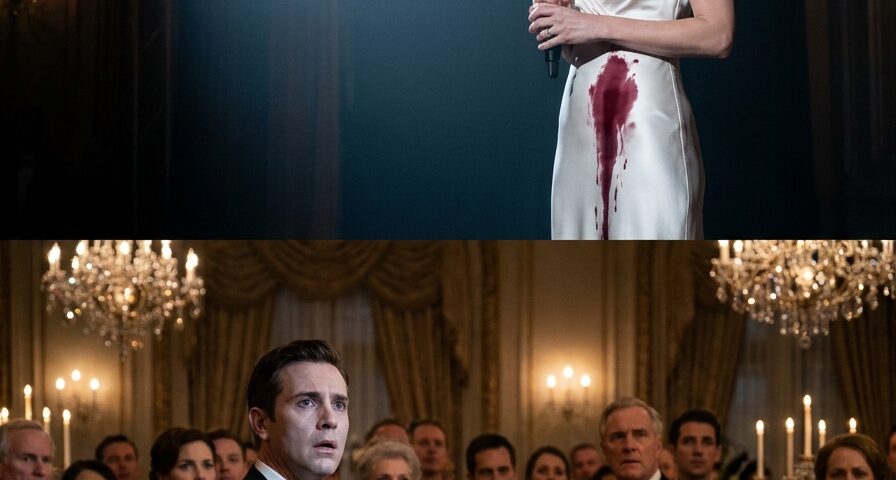
PART 2: The Woman He Called the Nanny Owned His Future
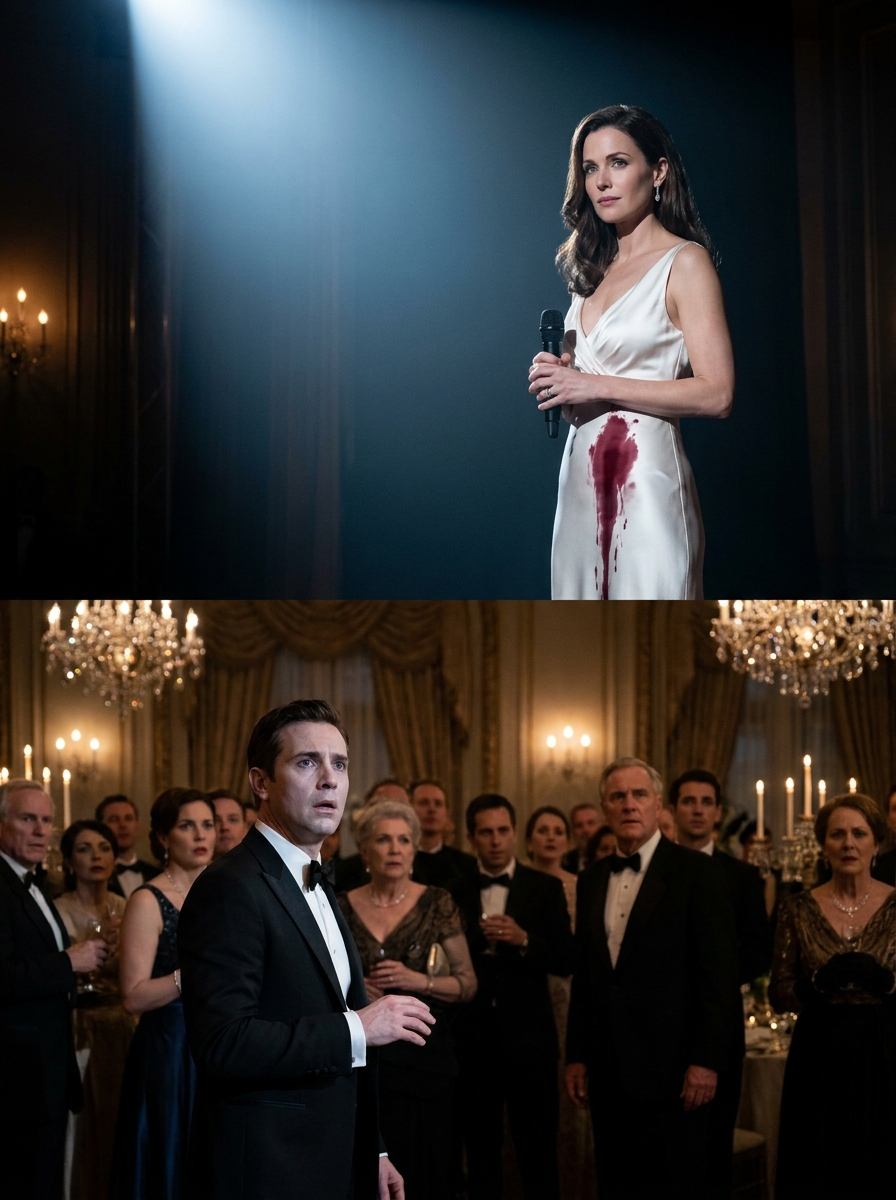
His eyes moved from me to Arthur Henderson, then to the host, then back to me again, searching for the missing piece that would make the world sensible.
Arthur did not move.
He stood beside the front table with his champagne untouched in his hand, watching me with the steady calm of a man who had been waiting for this moment far longer than David realized.
I lowered the microphone slightly and let the silence do its work.
When David finally stepped forward, his voice carried through the stillness.
“Maya,” he said with a strained laugh, “that’s enough.”
A few heads turned toward him.
He raised both hands in the air, trying to recover the room the way he recovered every awkward dinner, every cruel remark, every public insult he believed charm could erase.
“She’s upset,” he told the crowd. “My wife has a flair for drama.”
My wife.
The words arrived too late to save him.
A murmur passed through the guests. Not loud. Not dramatic. Just enough to reveal that people were beginning to understand.
Arthur placed his glass on the table.
“David,” he said, his voice quiet but unmistakably firm, “I would be careful.”
David froze.
For the first time that night, he looked at Arthur not as someone to impress, but as someone who might know something he did not.
I looked down at my ruined white silk dress. The red wine had spread across the fabric like a wound, but I no longer felt embarrassed. There had been a time when a stain like that would have made me disappear into a bathroom and cry quietly behind a locked door. There had been a time when Sarah’s smirk would have followed me home and kept me awake all night.
Not anymore.
I lifted the microphone again.
“Before anyone misunderstands,” I said, “tonight is not about a dress. It is not even about what David chose to call me in front of this room.”
David swallowed.
Sarah stood near the side of the ballroom, the empty wineglass still in her hand. Her confidence had faded into something brittle and uncertain.
“This evening was meant to celebrate Apex Innovations,” I continued. “A company that nearly disappeared three years ago because of poor leadership, careless spending, and a culture that rewarded appearances over integrity.”
A few executives shifted in their seats.
I saw several board members exchange glances.
That was the thing about truth. It did not need to shout. It only needed to arrive at the right time.
“When I invested in Apex,” I said, “I did so because I believed the people working inside this company deserved better than another headline about failure. Engineers who gave their weekends. Analysts who stayed after midnight. Designers who believed their work could matter. I believed they deserved stability, respect, and leadership worthy of their effort.”
David’s lips parted.
He was beginning to understand.
Not fully.
But enough.
I turned toward him.
“And because I remained anonymous, I learned far more than any quarterly report could have told me.”
His face tightened.
I did not list every insult. I did not repeat every dinner conversation where he called me simple, sheltered, uneducated, lucky. I did not tell the room how he introduced me as “not business-minded” while asking me to iron the shirt he wore to board presentations. I did not describe the years I sat at the table with our children while he spoke over me, corrected my pronunciation of words I already knew, or laughed whenever I asked about his work.
I could have.
But that would have made the night about revenge.
And I had not come for revenge.
I had come for an ending.
“Effective immediately,” I said, “David Carter is suspended pending formal review by the board and compliance committee. Sarah Carter’s consulting agreement with Apex is terminated according to the morality and conduct clause she signed six months ago.”
A visible ripple moved across the ballroom.
Sarah’s mouth opened. “Consulting agreement?”
Arthur finally stepped forward.
“Yes, Sarah,” he said. “The branding contract you insisted David recommend to the marketing department.”
Sarah looked at David.
David looked at the floor.
There it was—the small private panic of people who had spent too long believing family favors were invisible.
I handed the microphone back to the host before anyone could turn the moment into a spectacle. The host accepted it with both hands, looking as though he would have rather been anywhere else.
Then I stepped down from the stage.
No applause followed.
I was grateful.
Applause would have made it ugly.
Instead, people made way as I crossed the ballroom. Some avoided my eyes. Others watched me with something like sympathy. A woman from finance, whose name I remembered was Elena, gave me the smallest nod. It was not admiration. It was acknowledgment.
That meant more.
Arthur met me near the edge of the dance floor.
“Maya,” he said softly, “we can move the board into the private conference room.”
I nodded. “Give David ten minutes.”
Arthur glanced toward him. “Are you sure?”
“No,” I said honestly. “But I owe myself one conversation before this becomes paperwork.”
Arthur’s expression softened.
He knew more than most people. Not everything, but enough. He knew that I had chosen anonymity not because I was afraid of leadership, but because I understood people reveal themselves more clearly when they think no one powerful is watching. He knew David’s treatment of me had become harder to ignore. He also knew that I had delayed this night longer than I should have.
David was still standing near the front of the ballroom when I approached him.
His sister had disappeared. His colleagues had scattered into small careful groups, all pretending not to listen.
“Maya,” he said, and this time my name sounded different in his mouth. Smaller. Cautious.
I stopped in front of him.
For years, I had imagined this moment. In some versions, I yelled. In others, I cried. In the loneliest versions, he finally understood, apologized, and became the man I had once believed I married.
But real life was quieter than imagination.
“You own Apex,” he said.
“I do.”
“How?”
The question almost made me laugh.
Not because it was funny.
Because even now, standing in a ballroom where everyone had heard the truth, David’s first instinct was disbelief. Not remorse. Not shame. Not even curiosity about what it had cost me to keep such a secret.
Only how.
“My grandmother,” I said. “The inheritance you once told me was probably ‘not much.’ I invested it.”
His eyes flickered. He remembered.
Of course he remembered.
He had dismissed that inheritance at dinner six years earlier while telling his father I came from “a sweet family, but not a serious one.” My grandmother had run a neighborhood pharmacy for forty-two years. She had known every customer by name, raised three children alone, and quietly bought property in a part of the city no one valued until developers did. She had left me more than money. She had left me the lesson that being underestimated was sometimes useful.
David rubbed a hand across his mouth.
“Maya, listen. I made a mistake tonight.”
“A mistake is forgetting someone’s name,” I said. “You called your wife the nanny.”
He looked toward the guests, then lowered his voice. “I panicked.”
“Because Arthur called me your wife?”
He had no answer.
I studied him carefully. The expensive tuxedo. The watch he bought after his last bonus. The polished shoes. The perfect image he had worn so proudly into the room.
For so many years, David had treated dignity like something issued by job title.
He had never understood mine did not come from him.
“You weren’t embarrassed because I was there,” I said. “You were embarrassed that people might know you were married to me.”
His jaw tightened. “That isn’t fair.”
“It is exact.”
He looked wounded then, but the expression did not move me the way it once would have. I had spent years carrying his discomfort, softening my words so he would not feel accused, laughing at jokes that reduced me, shrinking myself in rooms where I had every right to stand tall.
That habit ended under the chandeliers.
“What happens now?” he asked.
“The board will review your conduct, your department’s spending, and the contracts you influenced,” I said. “You’ll have representation. You’ll be allowed to respond.”
His eyes sharpened. “So that’s it? You’re destroying my career?”
“No,” I said. “I’m no longer protecting it.”
The difference mattered to me, even if it did not matter to him.
He leaned closer, desperate now. “And our children? Have you thought about them?”
There it was.
Not love. Not apology.
Leverage.
I felt something inside me close gently, like a door I had finally learned to shut without slamming.
“I think about them every day,” I said. “That’s why I’m done letting them grow up believing disrespect is normal.”
His face changed.
For a moment, he looked less like an executive and more like the man who used to sit with me on the floor of our first apartment, eating takeout from cardboard containers because we could not afford a dining table yet. Back then, before promotions and galas and the hunger to be admired, David had listened when I spoke. He had held my hand in grocery store aisles. He had cried when our first child was born.
I had spent years trying to find that man again.
But memory is not evidence.
“I didn’t know,” he said quietly.
I looked at him. “You didn’t ask.”
His eyes lowered.
That was when Arthur appeared beside us.
“The board is ready,” he said.
David straightened automatically, but the old confidence did not return.
I turned away first.
The private conference room had been prepared behind the ballroom, through a discreet hallway lined with framed photographs of past Apex launches. I had approved most of those projects from behind a screen, my name hidden in legal documents, my decisions filtered through Arthur and the board chair.
Inside, seven board members sat around a long table. Some looked unsettled. Others looked relieved. No one looked surprised enough.
That told me plenty.
Arthur closed the door after David entered.
I remained standing at the head of the table.
“Before we begin,” I said, “I want to make one thing clear. This is not a marital dispute. This is a governance matter.”
Board Chair Evelyn Park nodded. She was in her sixties, with silver hair pulled into a neat knot and a gaze sharp enough to cut through excuses.
“We understand,” she said. “The compliance report has been circulated.”
David’s head snapped toward her. “Compliance report?”
Evelyn slid a folder across the table.
He stared at it as if it had appeared from nowhere.
Arthur spoke next. “For the last eight months, an internal review has been examining several irregularities involving vendor recommendations, expense approvals, and hiring influence inside your division.”
David sat very still.
I watched his hands.
They were gripping the folder too tightly.
“This review began before tonight,” Arthur continued. “The incident in the ballroom only accelerated decisions already under consideration.”
David looked at me. “You investigated me?”
“No,” I said. “The company investigated your department.”
“That’s the same thing.”
“It isn’t.”
Evelyn opened her own copy of the folder. “Mr. Carter, you recommended Verity Brand Group for a consulting contract without disclosing your sister’s involvement.”
David glanced at the table. “Sarah’s role was minor.”
“She received thirty percent of the contract fee,” Evelyn said.
His silence answered for him.
Another board member, a retired attorney named Malcolm Ruiz, leaned forward. “You also approved travel expenses that appear unrelated to company business.”
David’s mouth tightened. “That’s common in senior development roles.”
“Not when the receipts place you in Miami during a conference you reported attending in San Francisco,” Malcolm replied.
I looked away.
Not because I was surprised.
Because the sadness came back in a sharp, unexpected wave.
Miami.
He had told me he was in San Francisco the week our daughter had a fever that would not break. I remembered standing in the hallway at two in the morning, holding a thermometer in one hand and my phone in the other, listening to him say he wished he could help. He had sounded tired. Concerned.
He had sounded truthful.
That memory hurt more than the gala.
David started to explain. Then stopped. Then began again.
“There are context issues here,” he said. “Apex was struggling. We were all doing what we had to do.”
Evelyn closed the folder. “The company was struggling because too many people used that excuse.”
The room quieted.
David looked smaller in the leather chair than he ever had at home.
I almost pitied him.
Almost.
But pity, I had learned, could become another kind of cage.
The meeting lasted forty-three minutes. No voices were raised. No one threatened him. The board placed him on administrative leave pending completion of the review. He would retain access to counsel but lose access to internal systems. Sarah’s contract would end immediately, and legal would determine whether funds needed to be recovered.
Everything was procedural.
Everything was calm.
That made it worse for David.
He had expected a fight.
A fight would have allowed him to become the victim.
Process gave him no such comfort.
When the meeting ended, he remained seated while everyone else gathered their papers.
I was nearly at the door when he spoke.
“Maya.”
I turned.
His voice was low. “Were you ever going to tell me?”
I thought about that.
For a long time, I had believed I would. I had imagined choosing the right evening, pouring wine, sitting across from him at the kitchen island and saying, There’s something you should know. I had imagined his surprise turning into pride. I had imagined him laughing, pulling me into his arms, apologizing for underestimating me without needing to be asked.
But each year, he gave me fewer reasons to trust him with the truth.
“At first,” I said, “yes.”
His face tightened. “And then?”
“Then I needed to know who you were when you thought I had nothing to offer.”
He looked down.
I left before he could answer.
In the hallway, I found Arthur waiting.
“You handled that with more restraint than most people would have,” he said.
“I don’t feel restrained.”
“You were.”
I leaned against the wall for a moment and closed my eyes. The adrenaline that had carried me through the ballroom began to fade, leaving behind exhaustion. My dress was still damp. My skin smelled faintly of wine. My hands trembled now that there was no one left to impress.
Arthur noticed, but he did not comment.
“Do you need a car?” he asked.
“I need a sweater first.”
A gentle smile crossed his face. “My wife keeps emergency shawls in every event bag. She calls them survival equipment.”
Ten minutes later, wrapped in a soft black shawl that covered the ruined dress, I stepped back into the ballroom. The gala had resumed in fragments. The orchestra played softly again, but no one danced. Conversations rose and fell in careful waves.
I found Sarah near the coat check, crying angrily into her phone.
The sight did not satisfy me.
That surprised me.
I had expected to feel vindicated, but watching her wipe mascara from beneath her eyes, I felt only tired. Sarah had been cruel to me for years, yes. She had mocked my clothes, my background, my cooking, my quietness. But I understood something now that I had missed before.
Cruelty had been the family language.
David spoke it more elegantly.
Sarah spoke it louder.
Their father had taught it with silence.
Their mother had polished it into manners.
Sarah ended her call when she saw me.
For a second, we stood facing each other.
The old Sarah might have lifted her chin and said something sharp.
This Sarah only looked at the wine stain beneath the shawl.
“I shouldn’t have done that,” she said.
“No,” I replied. “You shouldn’t have.”
Her lips pressed together. “I didn’t know who you were.”
The words might have been an apology if they had been different.
I studied her. “That’s the problem, Sarah.”
She frowned.
“You thought it was acceptable when you believed I had no power.”
Color rose in her cheeks.
I left her there with that truth.
Outside, winter air met me like a blessing. The city glittered beyond the hotel entrance, headlights sliding across wet pavement, steam rising from street vents, people moving through the night unaware that my life had just split into before and after.
My driver opened the car door, but I hesitated.
Through the glass entrance, I saw David standing alone near the lobby. His bow tie hung loose now. His phone was in his hand. He was not calling me.
Of course he wasn’t.
I got into the car.
The ride home took thirty minutes.
I spent most of it staring at my reflection in the dark window. In the glass, I looked composed, almost unfamiliar. The woman reflected back at me had walked onto a stage and told the truth. She had not apologized for her intelligence. She had not softened facts to protect someone who never protected her.
Still, beneath all that strength, there was grief.
No one tells you that choosing yourself can still feel like mourning.
At home, the house was quiet except for the low hum of the refrigerator and the soft night-light glowing in the hallway outside the children’s rooms.
I changed into a sweater and washed the wine from my skin. The dress lay in the hamper, stained beyond repair. I looked at it for a long time before closing the lid.
Then I went to check on the children.
Lily, our eight-year-old, slept curled around a stuffed rabbit. Her dark hair spilled across the pillow, one hand tucked beneath her cheek. Caleb, six, had kicked his blanket onto the floor and was sleeping sideways, one sock half off his foot.
I covered him gently.
In the doorway between their rooms, I let myself breathe.
They were the reason I had stayed as long as I did.
They were also the reason I could not stay any longer.
Downstairs, my phone buzzed.
I expected David.
Instead, the screen showed a name I had not seen in years.
Nora Whitcomb.
My grandmother’s attorney.
A strange unease moved through me.
Nora never called late.
I answered quietly. “Hello?”
“Maya,” she said, her voice careful. “I’m sorry for the hour. I heard about the Apex gala.”
I closed my eyes. News traveled fast when money was involved.
“It’s been a long night.”
“I imagine so.” She paused. “There is something we need to discuss. It concerns your grandmother’s estate.”
“My grandmother passed away seven years ago.”
“I know.”
The silence that followed made me sit down at the kitchen table.
“Nora,” I said slowly, “what is this about?”
She exhaled. “Your grandmother left a sealed letter with instructions that it be opened only if two conditions were met. First, you assumed full public control of one of the companies purchased through the trust. Second, your marriage entered legal separation or became materially unstable.”
My hand tightened around the phone.
“What?”
“I realize how that sounds,” Nora said gently. “But she was very specific.”
My grandmother had known David only briefly before she died. At the funeral, he had worn a dark suit and said all the right things. He had called her a practical woman, as if practicality explained the fierce tenderness with which she had loved me.
“What does the letter say?” I asked.
“I haven’t opened it. I’m not permitted to. You need to come to my office.”
“When?”
“As soon as possible.”
I looked toward the hallway, where my children slept in the peaceful ignorance of the very young.
“Is it bad?”
Nora hesitated.
That hesitation frightened me more than a direct answer would have.
“I don’t know,” she said. “But there is something else. Your grandmother placed a restriction on a portion of the trust. I always assumed it related to business holdings, but tonight I reviewed the documents again.”
“And?”
“The restriction names David.”
My breath caught.
Nora continued, softer now. “Maya, your grandmother knew something about him. Something she never told you.”
The house seemed to grow colder around me.
I stood slowly, staring at the dark window above the sink. My reflection stared back, wrapped in an old sweater, eyes wide and tired and suddenly uncertain.
On the counter, my phone buzzed with another incoming call.
David.
I let it ring.
“Nora,” I whispered, “what did she know?”
There was a rustle of paper on the other end of the line.
Then Nora said the words that made the entire night tilt beneath my feet.
“The sealed file is labeled: Why David Carter married my granddaughter.”